High-intensity interval training versus moderate-intensity
steady-state training in UK cardiac rehabilitation
programmes (HIIT or MISS UK): study protocol for a
multicentre randomised controlled trial and economic
evaluation
MCGREGOR, Gordon, NICHOLS, Simon
<http://orcid.org/0000-0003-0377-6982>, HAMBORG, Thomas, BRYNING, Lucy, TUDOR-EDWARDS,
Rhiannon, MARKLAND, David, MERCER, Jenny, BIRKETT, Stefan, ENNIS,
Stuart, POWELL, Richard, BEGG, Brian, HAYKOWSKY, Mark J, BANERJEE,
Prithwish, INGLE, Lee, SHAVE, Rob and BACKX, Karianne
Available from Sheffield Hallam University Research Archive (SHURA) at:
http://shura.shu.ac.uk/16941/
This document is the author deposited version. You are advised to consult the
publisher's version if you wish to cite from it.
Published version
MCGREGOR, Gordon, NICHOLS, Simon, HAMBORG, Thomas, BRYNING, Lucy,
TUDOR-EDWARDS, Rhiannon, MARKLAND, David, MERCER, Jenny, BIRKETT,
Stefan, ENNIS, Stuart, POWELL, Richard, BEGG, Brian, HAYKOWSKY, Mark J,
BANERJEE, Prithwish, INGLE, Lee, SHAVE, Rob and BACKX, Karianne (2016).
High-intensity interval training versus moderate-intensity steady-state training in UK
cardiac rehabilitation programmes (HIIT or MISS UK): study protocol for a
multicentre randomised controlled trial and economic evaluation. BMJ Open, 6 (11),
e012843.
Copyright and re-use policy
See
http://shura.shu.ac.uk/information.html
High-intensity interval training versus
moderate-intensity steady-state training
in UK cardiac rehabilitation
programmes (HIIT or MISS UK): study
protocol for a multicentre randomised
controlled trial and economic evaluation
Gordon McGregor,1,2Simon Nichols,3Thomas Hamborg,4Lucy Bryning,5 Rhiannon Tudor-Edwards,5David Markland,6Jenny Mercer,2Stefan Birkett,3 Stuart Ennis,1,2 Richard Powell,1Brian Begg,2,7Mark J Haykowsky,8
Prithwish Banerjee,1,9Lee Ingle,3Rob Shave,2Karianne Backx2
To cite:McGregor G, Nichols S, Hamborg T,et al. High-intensity interval training versus moderate-intensity steady-state training in UK cardiac rehabilitation programmes (HIIT or MISS UK): study protocol for a multicentre randomised controlled trial and economic evaluation.BMJ Open
2016;6:e012843.
doi:10.1136/bmjopen-2016-012843
▸ Prepublication history for
this paper is available online. To view these files please visit the journal online (http://dx.doi.org/10.1136/ bmjopen-2016-012843). Received 26 May 2016 Revised 12 September 2016 Accepted 5 October 2016
For numbered affiliations see end of article.
Correspondence to
Dr Gordon McGregor; [email protected]. uk
ABSTRACT
Introduction:Current international guidelines for cardiac rehabilitation (CR) advocate moderate-intensity exercise training (MISS, moderate-intensity steady state). This recommendation predates significant advances in medical therapy for coronary heart disease (CHD) and may not be the most appropriate strategy for the‘modern’patient with CHD. High-intensity interval training (HIIT) appears to be a safe and effective alternative, resulting in greater improvements in peak oxygen uptake (VO2 peak). To date, HIIT trials
have predominantly been proof-of-concept studies in the laboratory setting and conducted outside the UK. The purpose of this multicentre randomised controlled trial is to compare the effects of HIIT and MISS training in patients with CHD attending UK CR programmes.
Methods and analysis:This pragmatic study will randomly allocate 510 patients with CHD to 8 weeks of twice weekly HIIT or MISS training at 3 centres in the UK. HIIT will consist of 10 high-intensity (85–90% peak power output (PPO)) and 10 low-intensity (20–25% PPO) intervals, each lasting 1 min. MISS training will follow usual care recommendations, adhering to currently accepted UK guidelines
(ie, >20 min continuous exercise at 40–70% heart rate reserve). Outcome measures will be assessed at baseline, 8 weeks and 12 months. The primary outcome for the trial will be change in VO2 peakas
determined by maximal cardiopulmonary exercise testing. Secondary measures will assess physiological, psychosocial and economic outcomes.
Ethics and dissemination:The study protocol V.1.0, dated 1 February 2016, was approved by the NHS Health Research Authority, East Midlands— Leicester South Research Ethics Committee (16/EM/ 0079). Recruitment will start in August 2016 and will be completed in June 2018. Results will be published in peer-reviewed journals, presented at national and
international scientific meetings and are expected to inform future national guidelines for exercise training in UK CR.
Trial registration number:NCT02784873; pre-results.
INTRODUCTION
Coronary heart disease (CHD) accounts for one-third of all deaths globally, totalling 7.4 million in 2013.1 In the UK alone, ∼175 000 myocardial infarctions (MI) are recorded annually.2While this is a significant number,
advances in preventative therapy and medical treatment have contributed to an overall reduction in CHD mortality in the UK.3 An estimated 2.3 million people are now living with the disease,2 and with a
Strengths and limitations of this study
▪ To ensure the findings are applicable to the‘real
world’, this study will adopt a pragmatic, multi-centre approach to assessing the efficacy of high-intensity interval training (HIIT) in UK cardiac rehabilitation (CR) programmes.
▪ This study will conduct an holistic,
multidiscip-linary investigation into the physiological, psy-chosocial and economic value of HIIT in patients with CHD.
▪ As a limitation, participants will only attend
supervised exercise twice weekly for 8 weeks. This is suboptimal in relation to published data recommending three times per week for 12 weeks.
growing population of CHD survivors, the need for com-prehensive and cost-effective chronic disease manage-ment is ever more apparent.
Integral to the long-term management of CHD is the provision of cardiovascular rehabilitation (CR) pro-grammes.4 5 Exercise training is considered a key com-ponent alongside risk factor management and facilitation of long-term behavioural change.4 Compelling evidence exists for CR programmes, with meta-analyses historically highlighting a favourable effect on functional capacity, health-related quality of life (HR-QoL), hospital admissions and mortality.6–8 The most recent data, however, do not confirm a survival
benefit from participation in CR.9This may relate to the
ability of contemporary medical care, interventional car-diology and secondary prevention pharmacotherapy, to achieve much of what was previously attributed to CR. However, CR does improve HR-QoL and, as such, strat-egies to maximise long-term physical functioning (ie, optimised, personalised exercise training programmes) should be pursued in patients with CHD. Tangible
bene-fits are realistic for the individual and an overburdened
healthcare system, and CR programmes have a vital role to play in this regard.
In addition to improved medical care, the prescribed intensity of the exercise training interventions included in the recent meta-analysis by Andersonet al9 may help explain the lack of improvement in mortality rates with CR. Exercise intensity ranged from 50% to 95% of peak oxygen uptake (VO2 peak), with the vast majority of
pro-tocols at the lower end of this range, that is, equivalent to moderate-intensity exercise (∼46–64% VO2 peak).10
This is in line with current international exercise guide-lines for CHD which advocate moderate-intensity train-ing (<80% VO2 peak) prescribed as either interval or
steady state (MISS, moderate-intensity steady state).10 It is well known that greater improvements in VO2 peakcan
be expected with exercise training of a higher intensity and that a higher VO2 peakis associated with an
improve-ment in mortality risk.11 12Given that current guidelines predate significant advances in interventional cardiology
and medical therapy, moderate-intensity exercise may be considered conservative and suboptimal for the ‘modern’ patient with CHD.13 Greater benefit may be
attained by participating in high-intensity interval train-ing (HIIT) involvtrain-ing repeated bursts of harder exercise interspersed with periods of recovery.14 15High intensity, in this context, describes exercise performed above moderate intensity (ie, >64% VO2 peak) as opposed to
the maximal or supramaximal exercise specified in
some protocols in healthy individuals.16
Meta-analyses have indicated the superiority (∼1.7 mL/kg/min) of HIIT over MISS for improvements in VO2 peakin patients with CHD.14 15 17These analyses,
however, are limited by small sample sizes and the sig-nificant heterogeneity of study populations and HIIT
protocols. HIIT protocols can be modified in numerous
ways (eg, modality, intensity, interval duration) to suit
the population or intended outcome,18 but there is no consensus as to the optimal configuration for the CHD
population.17 In a landmark European study, high-intensity intervals lasting 4 min were deemed unfeasible in patients with CHD and offered no additional benefit
over continuous training.19 As an alternative, low-volume HIIT uses 1 min intervals to provide intermittent meta-bolic stimulus with non-sustained cardiovascular stress. This appears to be safe and well tolerated in addition to being effective at improving VO2 peak in patients with
CHD.20 21 The benefit of this ‘low-volume HIIT’
approach in ‘real world’ CR programmes in the UK, however, cannot be confirmed. Previous studies have
gen-erally been proof-of-concept studies conducted under ‘laboratory’ conditions. Carefully selected populations, tightly controlled exercise protocols and researcher-led interventions may limit the ecological validity of such studies. Likewise, substantial international variation in the provision and implementation of exercise-based CR may reduce the extent to which non-UK data can be applied to CR programmes in the UK.
The high-intensity interval training versus moderate-intensity steady-state training in UK Cardiac Rehabilitation trial (HIIT or MISS UK) is a pragmatic multicentre randomised controlled trial and economic evaluation comparing two CR exercise interventions. The primary objectives of the trial are:
1. To assess the effect of HIIT on VO2 peak and
cardio-vascular health.
2. To assess the acceptability of HIIT and the psycho-logical and motivational factors associated with com-pliance and adherence.
3. To assess the effect of HIIT on lifestyle physical activ-ity and a HR-QoL.
4. To conduct an economic evaluation of HIIT com-pared with MISS in CR programmes in the UK. 5. To assess the safety of HIIT.
In patients attending CR programmes in the UK, we hypothesise that HIIT will improve VO2 peak to a greater
extent than MISS training. In this population, data relat-ing to the effects of HIIT ( particularly low-volume HIIT) on clinical, physiological, psychosocial and eco-nomic outcomes are limited but appear to indicate at least an equivalent effect.22–24 As such, we also hypothe-sise that HIIT will (1) be more acceptable than MISS and demonstrate greater patient compliance and adher-ence; (2) improve cardiovascular health to a greater extent than MISS; (3) improve HR-QoL to a greater extent than MISS; (4) lead to more positive motivation and attitudes to exercise than MISS; (5) increase short-term and medium-short-term participation in lifestyle physical activity to a greater extent than MISS; (6) be a cost-effective alternative to MISS and (7) be as safe as MISS.
METHODS AND ANALYSIS
and economic evaluation. In line with the median UK CR programme duration of 8.5 weeks,25participants will be randomly allocated to 8 weeks of HIIT or MISS train-ing (usual care). Outcomes will be measured at baseline, 8 weeks and 12 months by assessors blinded to group allocation. Study interventions will be delivered by clin-ical (not research) staff. The study is pragmatic in nature in that it will be conducted in existing CR pro-grammes. It is, therefore, accepted that some variation in the delivery of usual care will be evident between study sites. This will ensure generalisability of the fi
nd-ings to UK CR programmes. The trial protocol adheres to the Standard Protocol Items: Recommendations for Clinical Trials (SPIRIT) guidelines.26
Setting
The HIIT or MISS study will be conducted at three com-munity CR centres; (1) Atrium Health, Centre for Exercise & Health, Coventry, (2) Department of Sport, Health & Exercise Science, University of Hull and Hull Royal Infirmary, Kingston-upon-Hull and (3) Ystrad Fawr
Hospital, Ystrad Mynach, South Wales. Programmes are commissioned by University Hospitals Coventry & Warwickshire NHS Trust, City Healthcare Partnership CIC (Hull) and Aneurin Bevan University Health Board (South Wales), respectively. Starting August 2016, 510 CR patients will be recruited over a 2-year period.
Participants
The study will recruit patients with established coronary artery disease (CAD) referred for CR exercise training. Patients with MI, coronary artery bypass graft (CABG) surgery, angiographically documented CAD and elective percutaneous coronary intervention (PCI) will be eligible.
General inclusion criteria
1. Successfully revascularised following PCI or CABG. 2. Angiographically documented non-obstructive CAD. 3. Left ventricular ejection fraction >40%.
4. Clinically stable (symptoms and medication) for >2 weeks.
5. 18–75-year of age.
General exclusion criteria 1. Symptoms of ischaemia.
2. Significant left main stem stenosis.
3. NYHA class III–IV symptoms.
4. Compromising ventricular arrhythmia. 5. Significant valvular heart disease.
6. Inability to comply with guidelines for participation in exercise testing and training.27–29
7. Significant limiting comorbidities that would prevent
full participation.
Additional exclusion criteria
Further to the analysis of cardiopulmonary exercise test (CPET) and resting echocardiography by the research
team at baseline, and prior to randomisation, patients will be prevented from continuing their involvement in the study if there is indication of:
1. Exercise-induced ischaemia or significant
haemo-dynamic compromise.
2. Left ventricular ejection fraction <40%.
3. Clinical instability in accordance with CR guidelines.27 29 4. Inability to comply with guidelines for participation
in exercise testing and training.28 29
Study procedures
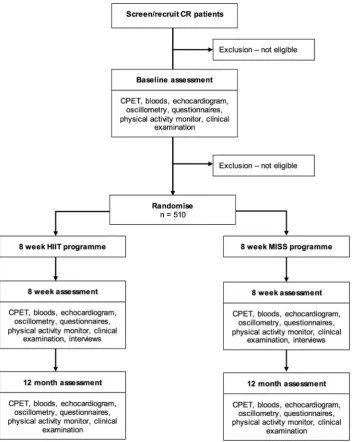
An outline of the participant pathway for the study is presented in figure 1. Eligibility will be assessed by the
research team at each site under the supervision of the local principal investigator (PI). Potential participants will be approached at their first outpatient CR
appoint-ment by a member of the study team: verbal and written information will be provided. A subsequent phone call (at least 48 hours later) will confirm those who wish to
participate. Informed consent will be attained at the baseline assessment visit, which will coincide with an out-patient CR appointment. Baseline procedures will include CPET, echocardiogram, venipuncture, arterial oscillometry and clinical examination. Instruments to assess HR-QoL, health and social care use and the psy-chological and motivational factors associated with com-pliance and adherence will be administered, and a lifestyle physical activity monitor will be fitted (removed
1 week later). Further to the analysis of CPET and echo-cardiography at baseline, the local research team will rescreen potential participants for eligibility. Those who are ineligible will take no further part in the study but will continue with usual care CR. Eligible participants will subsequently be randomised to 8 weeks of twice weekly HIIT or MISS training. All measures completed at baseline will be repeated at 8 weeks and 12 months.
Interventions
variation in the structure and delivery of the MISS inter-vention at each of the study sites. This is in keeping with the pragmatic nature of the trial. Each centre will, however, adhere to current UK standards.29
The following exercise training criteria must be satisfied
for participants to be regarded as having sufficiently
adhered to the treatment protocol:
▸ A minimum of 80% of sessions completed (13 of 16). ▸ HIIT—10×1 min protocol achieved by week 4.
▸ MISS—20 min continuous CV exercise achieved by week 4.
The number of participants who do not meet the above criteria will be recorded.
Randomisation and blinding
Trial participants will be randomised to HIIT or MISS on a 1:1 basis. The random allocation sequence will be generated by the trial statistician using a random number generator and implemented by a central
telephone registration and randomisation service at Warwick Clinical Trials Unit. Randomisation will be stratified by site using random permuted blocks
random-isation within each site to ensure approximately equal numbers of patients are allocated to HIIT and MISS. To ensure allocation concealment, researchers will request randomisation on completion of all baseline assess-ments. Outcome assessors will be blinded to group allo-cation, as will the trial statistician. Clinical staff delivering the interventions cannot be blinded, however, they will not be involved in data analysis or reporting.
Study outcome measures
The primary outcome measure is the change in peak oxygen uptake (VO2 peak) at 8 weeks. A number of
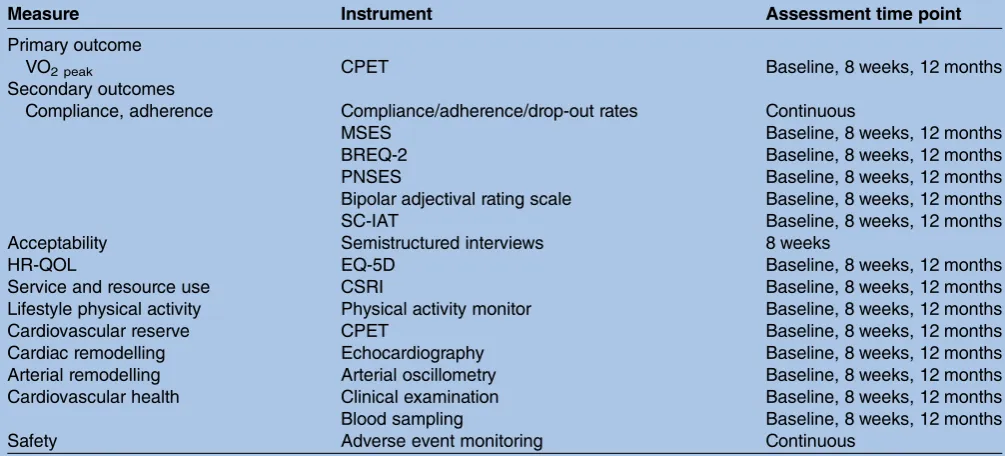
[image:6.595.201.554.46.489.2]physical activity; (5) cardiovascular reserve; (6) cardiac remodelling; (7) arterial remodelling; (8) cardiovascular health and (9) safety. Table 3 provides the complete schedule for outcome assessment.
Cardiopulmonary exercise testing will be performed to measure VO2 peak and other parameters
representa-tive of cardiovascular reserve. Tests will be conducted using a standard bicycle ramp protocol in accordance with American Thoracic Society guideline.30 Participants will be encouraged to maintain a cadence of 70 rpm until symptom-limited volitional fatigue prevents con-tinuation. Criteria for the assessment of a good partici-pant effort will include peak respiratory exchange ratio (RER) >1.10, peak HR≥85% predicted and RPE≥18.31
Compliance and adherence will be determined by recording the number of training sessions attended and successfully completed in accordance with the exercise protocol. Drop-out from the programme will also be documented for both study groups in addition to reason for drop-out, where provided voluntarily by participants. To assess the psychological and motivational factors asso-ciated with compliance and adherence to the exercise
training interventions, the predictive effects of self-efficacy, motivation, need satisfaction and implicit and
explicit attitudes and, reciprocally, the effects of training on self-efficacy, motivation, need satisfaction and implicit
and explicit attitudes, will be quantitatively measured using validated tools: (1) the Multidimensional Self-Efficacy for Exercise Scale (MSES);32 (2) the
Behavioural Regulation in Exercise Questionnaire-2 (BREQ-2);33 (3) the Psychological Need Satisfaction in Exercise Scale (PNSES);32 (4) Courneya and Bobick’s 7-point Bipolar Adjectival Rating Scale34 and (5) a Single-Category Implicit Association Test (SC-IAT).35 Semistructured interviews will qualitatively evaluate acceptability in a subgroup of 40 patients, representative of completers and drop-outs in both intervention groups. Verbatim transcripts will be thematically analysed.36
Health-related quality of life will be assessed with the
five-item EuroQoL (EQ-5D-5L),37 as recommended by
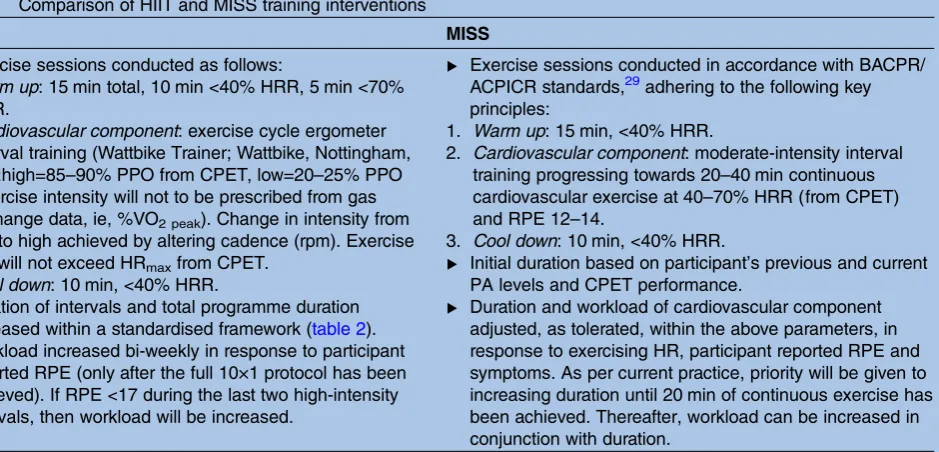
[image:7.595.79.549.56.282.2]the National Institute for Health and Care Excellence in the UK for economic evaluation in clinical trials.38 General population preference-based tariffs for the UK Table 1 Comparison of HIIT and MISS training interventions
HIIT MISS
▸ Exercise sessions conducted as follows:
1. Warm up: 15 min total, 10 min <40% HRR, 5 min <70% HRR.
2. Cardiovascular component: exercise cycle ergometer interval training (Wattbike Trainer; Wattbike, Nottingham, UK):high=85–90% PPO from CPET, low=20–25% PPO (exercise intensity will not to be prescribed from gas exchange data, ie, %VO2 peak). Change in intensity from low to high achieved by altering cadence (rpm). Exercise HR will not exceed HRmaxfrom CPET.
3. Cool down: 10 min, <40% HRR.
▸ Duration of intervals and total programme duration
increased within a standardised framework (table 2).
▸ Workload increased bi-weekly in response to participant
reported RPE (only after the full 10×1 protocol has been achieved). If RPE <17 during the last two high-intensity intervals, then workload will be increased.
▸ Exercise sessions conducted in accordance with BACPR/
ACPICR standards,29adhering to the following key
principles:
1. Warm up: 15 min, <40% HRR.
2. Cardiovascular component: moderate-intensity interval training progressing towards 20–40 min continuous cardiovascular exercise at 40–70% HRR (from CPET) and RPE 12–14.
3. Cool down: 10 min, <40% HRR.
▸ Initial duration based on participant’s previous and current
PA levels and CPET performance.
▸ Duration and workload of cardiovascular component
adjusted, as tolerated, within the above parameters, in response to exercising HR, participant reported RPE and symptoms. As per current practice, priority will be given to increasing duration until 20 min of continuous exercise has been achieved. Thereafter, workload can be increased in conjunction with duration.
CPET, cardiopulmonary exercise test; HIIT, high-intensity interval training; HR, heart rate; HRR, heart rate reserve; MISS, moderate-intensity steady state; PA, physical activity; PPO, peak power output; RPE, rating of perceived exertion; VO2 peak,peak oxygen uptake.
Table 2 Breakdown of HIIT training programme by week
Week
High-intensity intervals (number×time in min)
Low-intensity intervals (number×time in min)
Total high-intensity exercise (min)
Total low-intensity exercise (min)
Total
exercise time (min)
1 5×0.5 5×1 2.5 5 7.5
2 5×1 5×1 5 5 10
3 7×1 7×1 7 7 14
4–8 10×1 10×1 10 10 20
HIIT, high-intensity interval training.
allow for the comparison of EQ-5D index scores with population norms and other health conditions.39 An adapted client service receipt inventory (CSRI), based on examples in the DIRUM database,40 will be adminis-tered at each time point to capture participant health and social care service use since the last time point ( plus a retrospective 2-month period at baseline).
Lifestyle physical activity will be recorded over a 7-day period with an ActiGraph GT9X Link (Actigraph, Pensacola, Florida, USA) worn on the wrist. Comprehensive evaluation of participants’ daily physical activity patterns will be derived from the unit’s 3-axis accelerometer, magnetometer and gyroscope. The Actigraph GT9X Link is considered the gold standard in non-invasive research grade physical activity monitoring and has been extensively validated.
To quantify cardiac remodelling, echocardiographic images will be obtained and analysed as recommended in current guidelines.41 42 To assess cardiac structure and function (systolic and diastolic), standard techni-ques will be used including 2D, M-mode, pulse wave Doppler and tissue Doppler echocardiography. To inves-tigate arterial remodelling, pulse wave velocity will be determined through the non-invasive method of bra-chial oscillometry (Mobil-O-Graph PWA Monitor, IEM GmbH, Stolberg, Germany). A blood pressure cuff will be placed on the participant’s upper left arm and will inflate and deflate automatically. Mobil-O-Graph PWA
has been validated against internationally recognised invasive and non-invasive gold standards.43
Standard clinical examination will include medical history, stature, body mass and cardiovascular risk factor assessment, that is, resting blood pressure, diabetes,
family history of premature CHD and smoking status. Blood sampling will be performed to allow the measure-ment of biomarkers of cardiovascular and metabolic health. Routine testing will include full blood cell count, liver function, urea and electrolytes, glycaemic control and a full lipid profile. Serum and plasma will be stored
for the analysis of current and emerging biochemical markers of cardiovascular and metabolic health relating to inflammation, cardiac remodelling, pro-thrombosis,
endocrine function and lipids.44 45
To verify the safety of HIIT and MISS training per-formed in CR, adverse and serious adverse events will be carefully monitored, recorded and reported. In line with the principles of Good Clinical Practice, the nature and severity of the event, in addition to its potential associ-ation with the exercise training intervention, will be ascertained by the local PI and ratified by the trial
clinician.46
Sample size
Given the pragmatic nature of the trial, a 1.5 mL/kg/min larger improvement of VO2 peak in the HIIT group
compared to the MISS group is considered a clinically relevant difference. Keteyian and colleagues reported a reduction of ∼15% in all-cause mortality for each 1 mL/kg/min increase in VO2 peakin a large CR cohort
with revascularised coronary disease.47 In the present study, a sample size of 191 patients in each group will be sufficient to detect this difference assuming a SD of
4.5 mL/kg/min, a power of 90% and a significance level
of 5%. The assumed SD is based on observations from Conraadset al.19This trial is similar to HIIT or MISS and reported a loss to follow-up from baseline to post-Table 3 Outcome measures and assessment schedule
Measure Instrument Assessment time point
Primary outcome
VO2 peak CPET Baseline, 8 weeks, 12 months
Secondary outcomes
Compliance, adherence Compliance/adherence/drop-out rates Continuous
MSES Baseline, 8 weeks, 12 months
BREQ-2 Baseline, 8 weeks, 12 months
PNSES Baseline, 8 weeks, 12 months
Bipolar adjectival rating scale Baseline, 8 weeks, 12 months
SC-IAT Baseline, 8 weeks, 12 months
Acceptability Semistructured interviews 8 weeks
HR-QOL EQ-5D Baseline, 8 weeks, 12 months
Service and resource use CSRI Baseline, 8 weeks, 12 months
Lifestyle physical activity Physical activity monitor Baseline, 8 weeks, 12 months
Cardiovascular reserve CPET Baseline, 8 weeks, 12 months
Cardiac remodelling Echocardiography Baseline, 8 weeks, 12 months
Arterial remodelling Arterial oscillometry Baseline, 8 weeks, 12 months
Cardiovascular health Clinical examination Baseline, 8 weeks, 12 months
Blood sampling Baseline, 8 weeks, 12 months
Safety Adverse event monitoring Continuous
BREQ-2, Behavioural Regulation in Exercise Questionnaire-2; CPET, cardiopulmonary exercise test; CSRI, client service receipt inventory; EQ-5D, 5 item EuroQol; HR-QoL, health-related quality of life; MSES, Multidimensional Self-Efficacy for Exercise Scale; PNSES,
[image:8.595.45.548.66.294.2]intervention of 13%. A conservative drop-out of ∼25% yields a required sample size of 510 patients (255 per group) to be randomised. Should the drop-out rate at 12 months be 50%, then the study would retain power of 76% to detect a difference of 1.5 mL/kg/min in the primary outcome at this time point using the aforemen-tioned assumptions.
Data collection and management
Study data will be collected on a case report form by the research team at baseline, 8 weeks and 12 months. Each participant will be allocated a unique study ID number; a list of participants will be stored electronically by UHCW NHS Trust. Data will be anonymously entered into REDCap (Research Electronic Data Capture),48 a secure, web-based application designed to support data capture for research studies. This will be hosted by Cardiff Metropolitan University.
Statistical analysis
The primary end point for the statistical analysis is the mean change in VO2 peak (mL/kg/min) from baseline
to 8 weeks of follow-up. The primary end point will be compared between intervention arms using a general linear model with the treatment group and baseline VO2 peak fitted as covariates, and 8-week VO2 peak as the
dependant variable. The linear model will be adjusted for the continuous covariate age, and the categorical covariates sex and study site. Further adjustment vari-ables may be investigated as part of the exploratory ana-lysis. The robustness of the primary outcome analysis will be investigated using three standard multiple imputation methods (monotone regression, fully conditional specifi
-cation regression and Markov chain Monte Carlo (MCMC)).
The secondary outcome measures will be analysed using the same covariates as the primary outcome ana-lysis. Likewise, the differences between groups in terms of continuous secondary outcome measures will be assessed with the same statistical model as the primary outcome analysis. Differences between treatment arms for binary, unordered categorical and ordinal secondary outcome variables will be analysed using logistic regres-sion, multinomial logistic regression and proportional odds models, respectively.
The primary and secondary outcome analyses will be conducted at the conventional (two-sided) 5% level. To reduce the risk of false-positive claims, all secondary ana-lyses will be considered to be exploratory if a non-significant result is obtained from the primary analysis
and, whenever reported, the failure to achieve a signifi
-cant result in the primary analysis will be declared. It is not proposed to formally adjust for multiple testing among the secondary end points as these are likely to be correlated so that standard adjustment techniques such as the Bonferroni method would be conservative. All analyses will be performed on an intention-to-treat basis. Aper protocol analysis will be conducted as an exploratory
analysis, as will subgroup analyses (for subgroups prespe-cified in the protocol) and repeated measures mixed
models.
All data will be summarised and reported in accord-ance with the Consolidated Standards of Reporting Trials (CONSORT) guideline.49 No formal interim ana-lyses are anticipated.
Economic evaluation
In line with the National Institute for Health and Clinical Excellence (NICE) guidance on the economic evaluation of public health interventions,50 from a soci-etal perspective, a cost-consequence analysis of HIIT (embedded within CR) compared with MISS training (representing usual care) will be undertaken. Within the cost-consequence analysis, there will be an embedded cost-utility analysis, using Quality Adjusted Life Years (QALYs) gained with HR-QoL weights drawn from EQ-5D-5L. This approach has been chosen because QALYs allow comparison with the value for money of other medical and public health interventions but do not capture the full range of relevant outcomes in public health prevention.50 We will use STATA V.14 to bootstrap (5000 replications) the differences in cost and outcomes, to produce a 95% CI, cost-effectiveness planes and cost-effectiveness acceptability curves, to present to healthcare policymakers and local commis-sioners the probability that the intervention is cost-effective at different payer thresholds.
The health economics component of the study will be written up in accordance with the Consolidated Health Economic Evaluation Reporting Standards (CHEERS) statement for the reporting of published economic evaluations.51
Patient and public involvement
Patient and public involvement has been integral to protocol development. A formal consultation event was attended by a representative sample of current CR parti-cipants in August 2015. Partiparti-cipants were introduced to various different approaches to exercise training and asked to comment on their suitability. A range of opi-nions and views were recorded with the overriding senti-ment being that participants would be prepared to engage in HIIT with minimal concern. Close supervision by experienced CR exercise professionals was considered essential. The only significant negative comment related
to the fact that HIIT would be performed solely on an exercise bike as opposed to a range of cardiovascular exercise equipment. However, participants confirmed
that they would be prepared to tolerate this in the short term. Two CR participants will sit on the trial steering group for the duration of the trial.
Dissemination and impact
and non-academic outlets such as national governing body publications. On completion, the study results will be published in peer-reviewed journals and presented at scientific meetings. The results will also be disseminated
in newsletter form throughout the UK via national gov-erning bodies and at local research and patient confer-ence events. It is anticipated that the results of the study will inform future national guidelines for exercise train-ing in UK CR.
Author affiliations
1Department of Cardiac Rehabilitation, Centre for Exercise & Health, University
Hospital, Coventry, UK
2Cardiff Centre for Exercise & Health, Cardiff Metropolitan University, Cardiff,
UK
3Department of Sport, Health & Exercise Science, University of Hull, Hull, UK 4Statistics and Epidemiology, Division of Health Sciences, Warwick Medical
School, University of Warwick, Warwick, UK
5Centre for Health Economics and Medicines Evaluation, Bangor University,
Bangor, Gwynedd, UK
6School of Sport, Health & Exercise Sciences, Bangor University, Bangor,
Gwynedd, UK
7Aneurin Bevan University Health Board, Gwent, Wales, UK
8College of Nursing and Health Innovation, University of Texas at Arlington,
Arlington, Texas, USA
9School of Health & Life Sciences, Coventry University, Coventry, UK
Twitter Follow Gordon McGregor at @HIITorMISSUK
Contributors GM is the chief investigator for the trial, leading on protocol writing, ethics application and manuscript preparation. GM, KB, RS, SN, LI, SE, RP, SB, MJH, BB, TH and PB all contributed fully to study design. TH (statistics), RT-E, LB (health economics), DM (quantitative psychology) and JM (qualitative psychology) provided expertise in their respective discipline and authored the relevant section of the protocol and manuscript. KB, RS and SN edited the manuscript. All authors read and approved the final version of the manuscript.
Competing interests None declared.
Ethics approval The study protocol V.1.0, dated 1 February 2016, was approved by the NHS Health Research Authority, East Midlands—Leicester South Research Ethics Committee on 4 March 2016 (16/EM/0079).
Provenance and peer review Not commissioned; externally peer reviewed.
Open Access This is an Open Access article distributed in accordance with the Creative Commons Attribution Non Commercial (CC BY-NC 4.0) license, which permits others to distribute, remix, adapt, build upon this work non-commercially, and license their derivative works on different terms, provided the original work is properly cited and the use is non-commercial. See: http:// creativecommons.org/licenses/by-nc/4.0/
REFERENCES
1. WHO.The top 10 causes of death. Fact sheet No. 310. World Health Organization, 2014. http://www.who.int/mediacentre/ factsheets/fs310/en/ (updated May 2014).
2. BHF. Coronary Heart Disease Statistics. A compendium of health statistics. 2012 edition, 2012.
3. Allender S, Scarborough P, O’Flaherty M,et al. Patterns of coronary heart disease mortality over the 20th century in England and Wales: possible plateaus in the rate of decline.BMC Public Health
2008;8:148.
4. Buckley JP, Furze G, Doherty P,et al. BACPR scientific statement: British standards and core components for cardiovascular disease prevention and rehabilitation.Heart2013;99:1069–71.
5. NICE.Secondary prevention after a myocardial infarction. NICE quality standard (QS99), 2015. https://www.nice.org.uk/guidance/ qs99
6. Valkeinen H, Aaltonen S, Kujala UM. Effects of exercise training on oxygen uptake in coronary heart disease: a systematic review and meta-analysis.Scand J Med Sci Sports2010;20:545–55. 7. Lawler PR, Filion KB, Eisenberg MJ. Efficacy of exercise-based
cardiac rehabilitation post-myocardial infarction: a systematic review and meta-analysis of randomized controlled trials.Am Heart J
2011;162:571–84.e2.
8. Heran BS, Chen JM, Ebrahim S,et al. Exercise-based cardiac rehabilitation for coronary heart disease.Cochrane Database Syst Rev2011;(7):CD001800.
9. Anderson L, Oldridge N, Thompson DR,et al. Exercise-based cardiac rehabilitation for coronary heart disease: Cochrane systematic review and meta-analysis.J Am Coll Cardiol2016;67:1–12.
10. ACSM.Guidelines for exercise testing and prescription. 9th edn. Lippincott Williams & Wilkins, 2014.
11. Kodama S, Saito K, Tanaka S,et al. Cardiorespiratory fitness as a quantitative predictor of all-cause mortality and cardiovascular events in healthy men and women: a meta-analysis.JAMA
2009;301:2024–35.
12. Garber CE, Blissmer B, Deschenes MR,et al. American College of Sports Medicine position stand. Quantity and quality of exercise for developing and maintaining cardiorespiratory, musculoskeletal, and neuromotor fitness in apparently healthy adults: guidance for prescribing exercise.Med Sci Sports Exerc2011;43:1334–59. 13. West RR, Jones DA, Henderson AH. Rehabilitation After Myocardial
Infarction Trial (RAMIT): multi-centre randomised controlled trial of comprehensive cardiac rehabilitation in patients following acute myocardial infarction.Heart2012;98:637–44.
14. Liou K, Ho S, Fildes J,et al. High intensity interval versus moderate intensity continuous training in patients with coronary artery disease: a meta-analysis of physiological and clinical parameters.Heart Lung Circ2016;25:166–74.
15. Elliott AD, Rajopadhyaya K, Bentley DJ,et al. Interval training versus continuous exercise in patients with coronary artery disease: a meta-analysis.Heart Lung Circ2015;24:149–57.
16. Gillen JB, Martin BJ, MacInnis MJ,et al. Twelve weeks of sprint interval training improves indices of cardiometabolic health similar to traditional endurance training despite a five-fold lower exercise volume and time commitment.PLoS One2016;11:e0154075. 17. Pattyn N, Coeckelberghs E, Buys R,et al. Aerobic interval training
vs. moderate continuous training in coronary artery disease patients: a systematic review and meta-analysis.Sports Med
2014;44:687–700.
18. Gibala MJ, Little JP, Macdonald MJ,et al. Physiological adaptations to low-volume, high-intensity interval training in health and disease.
J Physiol2012;590(Pt 5):1077–84.
19. Conraads VM, Pattyn N, De Maeyer C,et al. Aerobic interval training and continuous training equally improve aerobic exercise capacity in patients with coronary artery disease: the SAINTEX-CAD study.Int J Cardiol2015;179:203–10.
20. Currie KD, Dubberley JB, McKelvie RS,et al. Low-volume, high-intensity interval training in patients with CAD.Med Sci Sports Exerc2013;45:1436–42.
21. Currie KD, Bailey KJ, Jung ME,et al. Effects of resistance training combined with moderate-intensity endurance or low-volume high-intensity interval exercise on cardiovascular risk factors in patients with coronary artery disease.J Sci Med Sport
2015;18:637–42.
22. Aamot IL, Karlsen T, Dalen H,et al. Long-term exercise adherence after high-intensity interval training in cardiac rehabilitation: a randomized study.Physiother Res Int2016;21:54–64.
23. Pattyn N, Vanhees L, Cornelissen VA,et al. The long-term effects of a randomized trial comparing aerobic interval versus continuous training in coronary artery disease patients: 1-year data from the SAINTEX-CAD study.Eur J Prev Cardiol2016;23:
1154–64.
24. Ribeiro PA, Boidin M, Juneau M,et al. High-intensity interval training in patients with coronary heart disease: prescription models and perspectives.Ann Phys Rehabil Med2016. doi:10.1016/ j.rehab.2016.04.004
25. The National Audit of Cardiac Rehabilitation Annual Statistical Report. 2015. http://www.cardiacrehabilitation.org.uk/docs/BHF_ NACR_Report_2015.pdf
26. Chan AW, Tetzlaff JM, Altman DG,et al. SPIRIT 2013 statement: defining standard protocol items for clinical trials.Ann Intern Med
2013;158:200–7.
27. AACVPR.Guidelines for cardiac rehabilitation and secondary prevention programs. 4th edn. Champaign (IL): Human Kinetics, 2003.
29. ACPICR. Standards for physical activity and exercise in the cardiac population. 2015. http://acpicr.com/sites/default/files/ACPICR% 20Standards%202015_0.pdf
30. Ross RM. ATS/ACCP statement on cardiopulmonary exercise testing.Am J Respir Crit Care Med2003;167:1451; author reply 51. 31. Balady GJ, Arena R, Sietsema K,et al. Clinician’s guide to
cardiopulmonary exercise testing in adults: a scientific statement from the American Heart Association.Circulation2010;122:191–225. 32. Rodgers WM, Wilson PM, Hall CR,et al. Evidence for a
multidimensional self-efficacy for exercise scale.Res Q Exerc Sport
2008;79:222–34.
33. Markland D, Tobin V. A modification of the Behavioral Regulation in Exercise Questionnaire to include an assessment of amotivation.
J Sport Exerc Psychol2004;26:191–6.
34. Courneya KS, Bobick TM. Integrating the theory of planned behaviour with processes and stages of change in the exercise domain.Psychol Sport Exerc2000;1:41–56.
35. Karpinski A, Steinman RB. The single category implicit association test as a measure of implicit social cognition.J Pers Soc Psychol
2006;91:16–32.
36. Clarke BA.Successful qualitative research. London: Sage, 2013. 37. The EuroQol Group.EQ-5D user guide. Rotterdam, The
Netherlands: The EuroQol Group, 1996.
38. NICE. Guide to the methods of technology appraisal. 2013. http:// www.nice.org.uk/article/pmg9/resources/non-guidance-guide-to-the-methods-of-technology-appraisal-2013-pdf
39. Kind P, Hardman G, Macran S.UK Population Norms for EQ-5D. Discussion Paper 172. UK: Centre for Health Economics Discussion Paper Series, University of York, 1999.
40. Ridyard CH, Hughes DA. Methods for the collection of resource use data within clinical trials: a systematic review of studies funded by the UK Health Technology Assessment program.Value Health
2010;13:867–72.
41. Nagueh SF, Smiseth OA, Appleton CP,et al. Recommendations for the evaluation of left ventricular diastolic function by
echocardiography: an update from the American Society of Echocardiography and the European Association of Cardiovascular Imaging.J Am Soc Echocardiogr2016;29:277–314.
42. Lang RM, Badano LP, Mor-Avi V,et al. Recommendations for cardiac chamber quantification by echocardiography in adults: an update from the American Society of Echocardiography and the European Association of Cardiovascular Imaging.J Am Soc Echocardiogr2015;28:
1–39.e14.
43. Luzardo L, Lujambio I, Sottolano M,et al. 24-h ambulatory recording of aortic pulse wave velocity and central systolic augmentation: a feasibility study.Hypertens Res2012;35:980–7.
44. Vasan RS. Biomarkers of cardiovascular disease: molecular basis and practical considerations.Circulation2006;113:2335–62. 45. Montgomery JE, Brown JR. Metabolic biomarkers for predicting
cardiovascular disease.Vasc Health Risk Manag2013; 9:37–45.
46. ICH Harmonised Tripartite guideline—guideline for good clinical practice E6 (R1). 1996. http://www.ich.org/products/guidelines/ efficacy/efficacy-single/article/good-clinical-practice.html
47. Keteyian SJ, Brawner CA, Savage PD,et al. Peak aerobic capacity predicts prognosis in patients with coronary heart disease.
Am Heart J2008;156:292–300.
48. Harris PA, Taylor R, Thielke R,et al. Research electronic data capture (REDCap)—a metadata-driven methodology and workflow process for providing translational research informatics support.
J Biomed Inform2009;42:377–81.
49. Moher D, Hopewell S, Schulz KF,et al. CONSORT 2010
explanation and elaboration: updated guidelines for reporting parallel group randomised trials.BMJ2010;340:c869.
50. NICE.Methods for the development of NICE public health guidance. 3rd ed. NICE article [pmg4], 2012. https://www.nice.org.uk/article/ pmg4/chapter/1%20introduction
51. Husereau D, Drummond M, Petrou S,et al. Consolidated Health Economic Evaluation Reporting Standards (CHEERS) statement.
BMJ2013;346:f1049.
evaluation
randomised controlled trial and economic
or MISS UK): study protocol for a multicentre
UK cardiac rehabilitation programmes (HIIT
moderate-intensity steady-state training in
High-intensity interval training versus
Banerjee, Lee Ingle, Rob Shave and Karianne Backx
Stuart Ennis, Richard Powell, Brian Begg, Mark J Haykowsky, Prithwish Rhiannon Tudor-Edwards, David Markland, Jenny Mercer, Stefan Birkett, Gordon McGregor, Simon Nichols, Thomas Hamborg, Lucy Bryning,
doi: 10.1136/bmjopen-2016-012843
2016 6: BMJ Open
http://bmjopen.bmj.com/content/6/11/e012843 Updated information and services can be found at:
These include:
References
#BIBL
http://bmjopen.bmj.com/content/6/11/e012843
This article cites 35 articles, 7 of which you can access for free at:
Open Access
http://creativecommons.org/licenses/by-nc/4.0/
non-commercial. See:
provided the original work is properly cited and the use is
non-commercially, and license their derivative works on different terms, permits others to distribute, remix, adapt, build upon this work
Commons Attribution Non Commercial (CC BY-NC 4.0) license, which This is an Open Access article distributed in accordance with the Creative
service
Email alerting
box at the top right corner of the online article.
Receive free email alerts when new articles cite this article. Sign up in the
Collections
Topic
Articles on similar topics can be found in the following collections(222)
Sports and exercise medicine
(312)
Rehabilitation medicine
(714)
Qualitative research
(365)
Health economics
(808)
Cardiovascular medicine
Notes
http://group.bmj.com/group/rights-licensing/permissions To request permissions go to:
http://journals.bmj.com/cgi/reprintform To order reprints go to: