AUSTEN, Liz <http://orcid.org/0000-0002-2837-8297> and MALONE, Cathy
<http://orcid.org/0000-0002-7318-511X>
Available from Sheffield Hallam University Research Archive (SHURA) at:
http://shura.shu.ac.uk/21124/
This document is the author deposited version. You are advised to consult the
publisher's version if you wish to cite from it.
Published version
AUSTEN, Liz and MALONE, Cathy (2018). What students’ want in written feedback:
praise, clarity and precise individual commentary. Practitioner Research in Higher
Education, 11 (1), 47-58.
Copyright and re-use policy
See
http://shura.shu.ac.uk/information.html
Citation
Auste , L. a d Malo e, C. What stude ts a t i itte feedback: praise, clarity and precise individual commentary , Practitioner Research in Higher Education Journal, 11(1), pp. 47-58.
47
What students’ want in written feed a k: praise, clarity and precise individual commentary
Practitioner Research in Higher Education Special Assessment Issue Copyright © 2018 University of Cumbria Vol 11(1) pages 47-58 Liz Austen & Cathy Malone
Sheffield Hallam University, Sheffield, UK
Abstract
This research paper explores a sample of written summative feedback which was provided to undergraduate social science based students in 2014-2015. A series of focus groups were facilitated where students evaluated 95 pieces of individual written feedback and discussed their findings. Texts were scored, ranked and used to create mini corpora of high and low ranking feedback. A contrastive analysis examined frequency counts, keyword analyses as well as concordances, collocations and semantic analyses. This analysis was supported by student annotations of their evaluations and thematic coding of the verbal discussions which took place.
This research has been able to outline the characteristics of feedback which students in this sample judged to be effective - specific praise, clarity and completeness, forward orientation, interpersonal positioning and clear and error free text. The contrastive analysis brought the metadiscoursal features strongly into focus, with distinct linguistic patterns emerging in the use of modals, personal pronouns and the mitigation of criticism. Findings confirmed the highly interpersonal nature of academic feedback and students demonstrated particular sensitivity to the tenor of the feedback and the way criticism was incorporated. There were also distinct preferences concerning the length and presentation of text, the quality of praise, and whether it contained a forward orientation.
Keywords
Feedback; feedback literacy; corpus analysis.
Introduction
I thi k it s just use of language really (focus group).
The aim of this paper is to present the findings of a mixed methods research project which analysed student evaluations of the way feedback comments are written. This paper provides the context and findings necessary to address the research question: what are the features of written feedback that students value? This research was initially conducted at a local level in one Department of a UK Higher Education institution with a lower than average National Student Survey score for 'Assessment and Feedback'. An initial analysis of the qualitative features of a sample of written feedback taken from this Department has been published (Austen, 2016) and developed alongside bespoke CPD work with the aforementioned staff group (Malone & Austen, 2017). Due to the richness of the data, a second phase of data collection and analysis was commissioned to explore student perspectives.
48 in this paper sought to explore feedback that students valued, as an implicitly more constructive appraisal. The analysis of these value judgements have been thematically grouped into five key findings: specific praise, clarity and completeness, forward orientation, interpersonal positioning and clear and error free writing, which should be considered holistically in order to enhance feedback practice and feedback literacy.
Research Context
This paper will present an approach that builds on previous studies which used alternative methodologies or targeted samples (Hyland & Hyland, 2001; Hyatt, 2005), and focuses on summative written feedback provided at the end of a module. The emphasis of this paper, furthering the work of others on written feedback (Chanock, 2000; Higgins et al., 2002; Carless, 2006; Orsmond & Merry, 2011;Long, 2014; Dunworth & Sanchez, 2016), is a frequency driven linguistic analysis of free text feedback comments written to undergraduate students. This research does not intend to debate the future of written feedback in Higher Education; it is acknowledged that there is a significant evidence base for using alternative formats, such as audio feedback, or even online, in text annotations (Merry & Orsmond, 2008; Lunt & Curran, 2010; Ball, 2010; Hennessy & Forrester, 2014) which are less formal and champion dialogic or quasi-dialogic functionality. However, the researchers are committed to improving current practices within their host institution, and presently, summative written feedback is still the dominant feedback model.
The efo e, this esea h o ti ues f o the assu ptio : that good feed a k p a ti e is oadl defi ed … as a thi g that ight st e gthe the stude ts apa it to self-regulate their own
pe fo a e Ni ol & MacFarlane-Dick 2006:205). The sample of feedback obtained for this research was provided at a summative point at the end of semester 1; this mid-year point provides a bridge between semester 1 and semester 2 modules, and performs a formative function for the remaining assessments. To this end, Nicol & MacFarlane-Di k s p i iples fo fo ati e assess e t and feedback to support self-regulation have been used to design the primary research instrument for this project.
The aim of the research was to explore feedback that students valued with the primary objective to enhance the feedback literacy of the sampled staff group. Most of the recent commentary on feedback literacy has focused on the deficits of the student and variance in understanding of the role and purpose of assessment and feedback practice. Sutton (2012) suggests that the development of student feedback literacy should address both practical and emotional dimensions, namely how to act upon feedback and an understanding of the social context in which that feedback is situated. This research was premised on the assumption that academic staff also need to develop this knowledge in order to provide effective feedback, described by Xu & Carless (2017) as 'teacher feedback literacy'.
Methodology
A sample of 95 pieces of written feedback was obtained for this research. This feedback was written for a random sample of modules across four undergraduate social sciences courses. The modules spanned all three years of the courses and included a range of assessment types including essays, reports and presentations (but not exams). Most of the feedback was provided electronically. Austen (2017) qualitatively analysed the contents of this sample of feedback with a student researcher (to secure the authenticity of the findings) and found that the writing exposed a
49 A review of recent publications shows that the student perspective of effective feedback is still being explored using traditional questionnaire and focus group techniques (see Tucker & Tucker, 2017; Small & Atree, 2015). There have been some interesting developments, including Pitt and Norton's (2016) use of one to one interviews where the student selects and bring one example of good and bad feedback and Winstone et al. (2015) use of laboratory conditions to allow student to actively budget (prioritise) learning (including feedback) 'luxuries'.
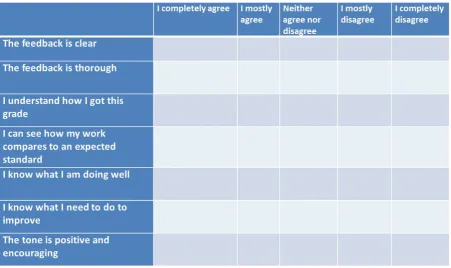
In order to explore the student perspective, this research facilitated five activity based student focus groups during 2016 (Gibbs, 1997). Twenty eight students, who were accessed by convenience from the current cohort of students on the sampled courses, participated in these focus groups. The student participants were asked to read anonymised feedback and evaluate it, using criteria which developed from the literature (Nicol & MacFarlane-Dick, 2006). The students were commenting on feedback written by staff they knew, in a discipline they knew, but the feedback was not their own. This allowed students to remove themselves from the feedback process, and respond less passionately than if they were using feedback they had personally received (Pitt & Norton, 2017). The students were encouraged to annotate their evaluations, and then reflect on the feedback they had read as a group discussion. These discussions were recorded and transcribed.
[image:4.595.73.525.426.694.2]In line with BERA principles for educational research, consent to participate and to use the data in publications was obtained from each student who participated in the focus groups. The names of staff members (feedback writers) and students (feedback recipients), modules and courses were anonymised prior to the focus groups activity, in addition to the personal details of the focus groups participants.
Table 1. Focus group evaluation criteria.
50 from the low scoring feedback (Corpus B). A corpus analysis was then conducted to compare the linguistic features of each.
Analysis
Scoring and ranking texts enabled us to create mini -corpora (bodies of text) and subject these to frequency driven analysis using Antconc and WMatrix software (Antony 2014, Rayson 2009). The contrastive analysis of the high scoring and low scoring feedback included frequency counts, keyword analyses as well as concordances, collocations and semantic analyses. These were then used to identify patterns in each corpus and these were compared to isolate the distinctive linguistic features of text in feedback that was valued by students. As can be seen in the detailed analyses below, frequently the two corpora include the same functional operation, (both bodies of text have the same broad purpose such as offering praise or criticism), however, the difference between them is how this is done, and the quality and precision of the language used to enact the same linguistic function.
The student annotations, either written alongside the evaluation criteria, or on post-it notes, were documented alongside each feedback record. A thematic analysis of the student annotations, in addition to the thematic coding of verbal discussions added an extra layer of analysis to support the findings from the corpus techniques.
Findings
The findings have been collated into 5 key categories, each representing a notable rather than significant identified difference between Corpus A and Corpus B, supported by qualitative data.
1. Specific Praise
Students appear sensitive to how praise is positioned and the overall tone of the feedback:
If I had got that a k I ould ha e go e 'The tuto hates e. I do t a t to go a k ... I ould
e like ell, I s e ed'
(focus group).
This quote was from one of the students who reflected on how they would feel if they had received one of the sampled pieces of feedback - there would be a risk to retention and overall progression, and some might argue, overall wellbeing.
On a few occasions the students discussed feedback as motivating and the importance of receiving praise. Clear comments about what has been done well was needed to highlight which aspect of the work could be repeated in forthcoming assessments. In contrast, the students also talked about feedback as de-motivating. Praise was seen as necessary, even on work that was of a low standard:
ou eed to poi t out hat as good , athe tha just goi g this is wrong, you need to do
this
(focus group).
I thi k it s i e, o iousl , if ou ha e o sta tl egati e o e ts it s goi g to put ou
down a bit he eas if ou ha e a e o e o t o he e the sa hat ou e do e ell it kind of makes you feel a bit better about the negative ones
51 This affective dimension evident in the research findings framed how we began to interpret our analysis. The corpus analysis reinforced the affective response to feedback (remembering that this is evident even when the feedback was not theirs). 'Good' was one of the most frequent words used in the whole sample and appears with similar frequency in both corpora - suggesting that staff understand the need/ importance of attributing praise. But, the way 'good' is used is distinct.
Table 2. The use of the o d good.
Corpus A Corpus B
good introduction good point(s)
good summaries overall good (critical) thinking
good arguments here good answer
good links to ... good work
a good clarification of key terms good conclusion
good breadth of theory good, but ...
good academic critique
you started to do this near the end, which was good...
your recommendations were unusually clear, which is good, but need more discussion
Corpus A (the feedback hi h stude ts s o ed highl used good u h o e p e isel 'a good clarification of key terms'). This aspect of student preference was also noted in the focus groups:
so the ould e like pa t A of ou assig e t as good ut this is ot good , o pa t B is good , like eall spe ifi a d oke do , I thi k that is eall helpful
(focus group).
Corpus B's use of 'good ' was much more vague, and more generic ('good work, good points'). These statements were also used with higher frequency indicating a reliance on generic bank statements in some of the feedback. The qualitative data suggested that bank statements were interpreted as
i di ato s that the a ke 'did t a e', had ot spe t the e essa ti e, o p o ided the e essa
effort, when marking the work.
Yeah I have actually had that before, somebody checked our feedback and it was exactly the same, they had just copied and pasted it
(focus group).
In addition, in Corpus B, 'good' was immediately modified: "good, but...." followed by either a comma, 'and' 'but' or a hyphen and new clause which expands on what was lacking. This means even when the writer identified something positive it was immediately critiqued.
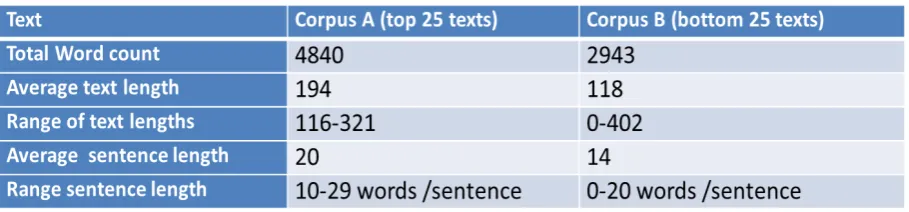
52 Table 3. Feedback length and composition.
Our findings suggest that there is a substantial difference in the size of these corpora (total word count) which could suggest that students simply prefer longer feedback. There is also a moderate positive correlation (0.51) between length of feedback text and overall student evaluation. However, Corpus B had both the longest and shortest texts. The difference on examination is the type of feedback.
The lengthiest feedback included large sections of textual commentary which was dispreferred - seen in Corpus B. Students appeared to prefer feedback that summed up their overall performance:
Too long! Text length 399
(annotation).
Clarity was also discussed in relation to the construction of free text written feedback. One student commented that feedback was often 'too chatty' and as such it was difficult to assess which aspects of the work needed improvement. Another student referred to her feedback as having 'too much fluff', in which length begins to interplay with the affective dimension.
I k o o iousl the e got to gi e ou so e positi e o e ts o hate e , ut if the ' e
struggling to find it they should just be like open with it instead of trying to fluff it up
(focus group).
Some comments also revealed how students interpret short texts as indicating a cursory, formulaic, or hasty response, attributing emotion to text length. The evidence also suggests that students have quite firm expectations about the function, purpose and length of feedback. The student annotations and comments made during the focus group discussion indicated that short feedback, or feedback which contained no free text comments, was frequently viewed as rushed:
Too short, no real feedback given. Wouldn't be useful to me Text length 66
(annotation).
While text counts provide a fairly direct measure of length, 'completeness' might be a more sophisticated measure that addresses student expectations. This may be because if feedback averages sentences of 10 rather than 20 words per sentence then what the feedback offers is quite distinct.
3. Forward Orientation
53
[image:8.595.69.527.137.306.2][I eed to k o ] ho to i p o e like i futu e, steps to get ette g ades ... .A d o iousl hat I' e do e ell ... so that a e epeated (focus group)
Table 4. Key Distinctive Concepts for Corpus A & B based on USAS semantic tagging.
An analysis of the distinctive concepts in each corpus suggests that Corpus A is forward oriented, referring to improvement and progress. In contrast, Corpus B looks back to what the student has failed to demonstrate. It shows how staff, in an attempt at clarity, delineate exactly what was expected and needed in an assignment, but not demonstrated. The backward orientation of this presents as a negative focus on failure. Students evaluate highly feedback with a forward orientation. This is a distinct sensitivity to forward orientation in feedback which softens the criticism, simply by reframing it:
There is NO advice on what the student could do better in the future
(annotation).
4. Interpersonal positioning
Table 5.F e ue of ou a d ou i oth o po a.
Student readers also appear sensitive to the tenor of communication struck in feedback as it is a high stakes text with a narrow topic focus. The research found that, compared to British National Corpus (6 million words), the extremely high keyness scores of 'you' and 'your' in both corpora reflect the narrow topic focus of feedback. This data also demonstrates a marked use of personal pronouns throughout the sample of written feedback. However, although the fo us o the stude t ou as being defined by personal pronoun use, the students reflected on the dissonance between the feedback comments and the submitted work during the focus groups. There were repeated calls for
feed a k to e spe ifi , i hich comments directly address the personal development of their own work. This as o t asted ith ge e i o e ta , appli a le to the whole cohort, which hinders the student readers from seeing themselves and their work in the text:
I want the detail, eah, that s pe so alised to e a d ot ge e i to e e o e
54 'I' occurred substantially more in Corpus A (high value) than in B (in raw frequency counts, but not as a keyword) and was often used to soften the impact of a critical comment. The introduction of the self into the text breaks the exclusivity of the focus on the student and make the feedback more balanced (closes the interpersonal distance). This is an important finding when considering that this use of pronouns is one way a more dialogic (or quasi-dialogic) and inclusive tone can established. In addition, according to Biber's (1988) classification, first and second person pronouns indicate a high loading for interactiveness, thus Corpus A emerges as much more interactive than Corpus B. The tone of Corpus B is in contrast much more direct and emphatic (modal use and bare verbs)
We conclude that it is difficult to read feedback as neutral or objective commentary. Further, the power relations implicit in this use of language mean it becomes impossible for students not to take
this pe so all . It is i te esti g to ote that, ith the p e ale e of the stude ts as pa t e s ethos
(Healey et al 2014), 'We' did not occur in either corpus. It would be useful to identify feedback from within the sector that positions feedback commentary in this way to assess whether students value this approach.
5. Clear and Error-Free
By undertaking the keyword analysis, almost as a by-product, this approach identifies acronyms, abbreviations and error. There were no instances of error in keyword list of Corpus A (the feedback that students valued highly). In Corpus B errors occurred at a ratio of 15/100 words. In more than one focus group the students suggested that they understood the workload and time pressures on academic staff, however this was not adequate mitigation for poor quality feedback. In addition to the use of bank statements, e o s e e i te p eted as i di ato s that the a ke 'did t a e' a d had not spent the necessary time, or provided the necessary effort, when marking their work. The con ept of fai ess is ele a t:
Also I get that the marker has like a million different essays to mark, so obviously they are not going to be spending 10-15 minutes on each one, but on one of mine it was so obvious that they had rushed because it was just full of spelling mistakes. Like, half of it did t e e ake sense
(focus group).
And the mistakes in the writing, the spelling mistakes, it makes you think like they have just
ski ed th ough it a d just itte it up e ui kl so it s like the ' e ot gi i g ou a fai
grade
(focus group).
The focus group data also suggests that students preferred feedback which was clear. This included the discussion of error alongside the presentation and layout of the feedback.
it needs to be ... presented well, as we have to present to them, because if they are going to
o plai a out little thi gs like dou le spa es the ou ha e to spell … o e tl
(focus group).
I had feed a k o e a d the just ote …. uestio a ks…
(focus group).
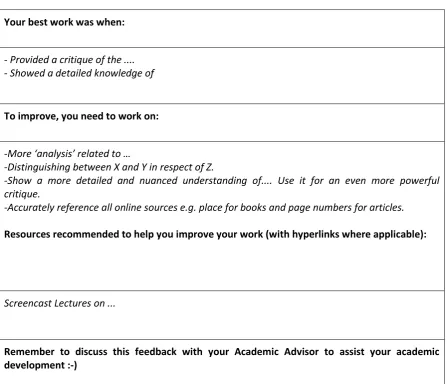
55 Table 6. Highly valued feedback template.
Your best work was when:
- Provided a critique of the .... - Showed a detailed knowledge of
To improve, you need to work on:
-More analysis related to …
-Distinguishing between X and Y in respect of Z.
-Show a more detailed and nuanced understanding of.... Use it for an even more powerful critique.
-Accurately reference all online sources e.g. place for books and page numbers for articles.
Resources recommended to help you improve your work (with hyperlinks where applicable):
Screencast Lectures on ...
Remember to discuss this feedback with your Academic Advisor to assist your academic development :-)
With reference to the key findings of this research, this format positioned praise at the forefront of the feedback, was relatively short including approximately 150 words, and had clear forward orientation in both the detail of improvements and the inclusion of hyperlinks to suggested resources. This format did not eliminate written error, but did present the work in short bullet points rather than formal grammatical structures which could provide more obvious opportunities for error. Fi all , as e pe ted, ou a d ou fo used the atte tio of the feed a k o the student. Lower value was occasionally placed on this style of feedback by the student sample, in one example because not all the feedback commentary linked to the overall grade:
I do t u de sta d the toolkit li ks as it does t e plai hat these o t i ute g ade ise!
(annotation, focus group). This template appears to capture some of the key functions of feedback identified in the literature (Nicol & MacFarlane Dick, 2006) and works to standardise this across a group of staff writers. It is also distinctive in that it effectively prompts the staff writer to sum up the feedback and presents the main 'take-home' messages succinctly on one page.
56 In conclusion, this research found distinct differences in the language used across the two corpora, and each distinction has been supported by qualitative data from the student sample. The characteristics of highly valued feedback are summarised as:
Specific praise
Clarity and completeness
Forward orientation
Interpersonal positioning
Clear and error free text
Findings confirm the highly interpersonal nature of academic feedback and students demonstrated particular sensitivity to the tenor of the feedback and the way criticism was incorporated. There were also distinct preferences concerning the length and presentation of text, the quality of praise, the specificity of the feedback and whether it contained a forward orientation. We infer that the notion of 'discursive orientation' is the key distinctive feature between Corpus A and B and how the agency of the student is reflected in the writing.
As we found in Phase 1 of the research when analysing the complete sample (Austen 2016), the affective dimension to written text and the affective response by the reader is a key consideration in student feedback. This research highlights the affective response of student readers to a text which writers may perceive as objective, structured and criteria based. This acknowledgement of emotion mirrors the findings of Pitt and Norton (2017), and evidence contained within the reviews of Varlander (2008); Molloy et al. (2013) and Evans (2013). The findings suggest that student sensitivity to the tenor and content of the feedback, rather than the process or speed by which is it disseminated, can play an important role in student satisfaction. Finally, the notion of 'completeness' can be used to bring together the component parts of our findings, rather than focusing on one element with the expectation that this will improve student evaluations of our feedback.
These findings also resonate with the Assessment for Social Justice literature (McArthur, 2016) in that assessments (and feedback practices) should incorporate concepts such as fairness, care, respect, esteem and worth. These principles -manifested within specific praise, clarity and completeness, forward orientation, interpersonal positioning and clear and error free text - can clearly be evidenced in the feedback that students value. These concepts have been found in other research into feedback literacy including the Sutton and Gill (2010) and Xu and Carless (2017) and align with Boud and Molloy's discussion of 'trust' (2013). This paper encourages those providing feedback to students to take action to address these aspects, rather than procedural dimensions of feedback delivery.
The researchers have been providing CPD within the host institution to develop feedback practices and teacher feedback literacy, with a particular interest in using Appreciative Inquiry approaches, developing feedback peer review and supporting staff both personally and in teams to develop practice (Malone & Austen 2017). Recent evaluations of these sessions suggest that academic staff have a greater understanding of how feedback might impact students and have begun to self-monitor their use of language in order to write feedback that demonstrates care, respect and esteem that staff want to signal in the professional collegial relationships with students.
57 References
Anthony, L. (2014) AntConc (Version 3.4.3) [Computer Software]. Tokyo, Japan: Waseda University. Available at: http://www.laurenceanthony.net/ (Accessed: September 2017).
Austen, L. (2016) Balancing academic gatekeeping and interpersonal positioning: a qualitative analysis of written feedback to undergraduate students,Practitioner Research in Higher Education, 10(2), pp. 67-81.
Ball, E. C. (2010) Annotation an effective device for student feedback: A critical review of the literature , Nurse Education in Practice, 10, pp. 138–143.
British National Corpus Written (BNC1994) The British National Corpus, version 3 (BNC XML Edition). 2007. Distributed by Bodleian Libraries, University of Oxford, on behalf of the BNC
Consortium. Available at: http://www.natcorp.ox.ac.uk/ (Accessed: 27 April 2018).
Boud, D. & Molloy, E. (2013) Rethinking models of feedback for learning: the challenge of design , Assessment & Evaluation in Higher Education, 38(6), pp. 698-712.
Carless, D., (2006) Differing perceptions in the feedback process , Studies in Higher Education, 31(2), pp. 219-233.
Chanock, K., (2000) "Comments on essays, do students understand what tutors write?" Teaching in Higher Education, 5(1), pp. 95-105.
Dunworth, K. and H. S. Sanchez (2016) Perceptions of quality in staff-student written feedback in higher education: a case study,Teaching in Higher Education, 21(5), pp. 576-589.
English, F. (2011) Student writing and genre: Reconfiguring academic knowledge. London: A & C Black.
Gibbs, A. (1997) Focus groups,Social research update, 19(8), pp.1-8. Available at http://sru.soc.surrey.ac.uk/SRU19.html (Accessed: September 2017).
Healey, M., Flint, A. and Harrington, K. (2014) Engagement through partnership: students as partners in learning and teaching in higher education. York: Higher Education Academy. Available at: https://www.heacademy.ac.uk/system/files/resources/engagement_through_partnership.pdf (Accessed: September 2017).
Hennessy, C. and Forrester, G. (2014) Developing a framework for effective audio feedback: a case study,Assessment & Evaluation in Higher Education, 39(7), pp. 777-789.
Higgins, R., P. Hartley, and Skelton, A. (2002) The conscientious consumer: Reconsidering the role of assessment feedback in student learning,Studies in higher education, 27(1), pp. 53-64. Hyatt, D.F. (2005) Yes, a very good point! , a critical genre analysis of a corpus of feedback
commentaries on Master of Education assignments,Teaching in Higher Education, 10(3), pp. 339-353.
Hyland, F. and Hyland, K. (2001) Sugaring the pill: Praise and criticism in written feedback,Journal of second language writing, 10(3), pp. 185-212.
Long, P. (2014) Staff and stude ts o eptio s of good itte feed a k, I pli atio s fo P a ti e , Practitioner Research in Higher Education, 8(1), pp. 54-63.
Lunt, T. and Curran, J. (2010) Are you listening please? The advantages of electronic audio
feedback compared to written feedback,Assessment & Evaluation in Higher Education, 35(7), pp.759-769.
Malone, C. and Austen, L. (2017). Exploring feedback practices that students value, in Elkington, S. and Evans, C. (eds.). Transforming Assessment In Higher Education: A Case Study Series. York, Higher Education Academy. pp. 90-93.
McArthur, J. (2016) Assessment for social justice: the role of assessment in achieving social justice , Assessment and Evaluation in Higher Education, 41(7), pp. 967-981.
58 Molloy, E., Borrell-Carrió, F. and Epstein, R. (2013) The impact of emotions in feedback, in Boud , D. and Molloy, E. (eds.). Feedback in higher and professional education: Understanding it and doing it well. London: Routledge. pp. 50–71.
Mulliner, E. & Tucker. M. (2017) Feedback on feedback practice: perceptions of students and academics,Assessment & Evaluation in Higher Education, 42(2), pp. 266-288.
Nicol, D. J., and Ma fa la e‐Di k, D. Fo ati e assess e t a d self‐ egulated lea i g: A model and seven principles of good feedback practice, Studies in higher education, 31(2), pp. 199-218.
Orsmond, P. and S. Merry, (2011) Feedback alignment: effective and ineffective links between
tuto s a d stude ts u de sta di g of ou se o k feed a k, Assessment & Evaluation in Higher Education, 36(2), pp. 125-136.
Pitt, E. & Norton, L. (2017) No that s the feed a k I a t! “tude ts ea tio s to feed a k o graded work and what they do with it,Assessment & Evaluation in Higher Education, 42(4), pp. 499-516.
Rayson, P. (2009) Wmatrix: a web-based corpus processing environment. Lancaster: Computing Department, Lancaster University. Available at: http://ucrel.lancs.ac.uk/wmatrix/ (Accessed: 10 April 2018).
Small, F. and Attree, K. (2016) Undergraduate student responses to feedback: expectations and experiences , Studies in Higher Education, 41(11), pp. 2078-2094.
Sutton, P. (2012) Conceptualizing feedback literacy, knowing, being, and acting,Innovations in Education and Teaching International, 49(1), pp. 31-40.
Sutton, P., & Gill, W. (2010) Engaging feedback: meaning, identity and power,Practitioner Research in Higher Education, 4(1), pp. 3-13.
Winstone, N.E., Nash, R.A., Rowntree, J. and Menezes, R. (2016) What do students want most from written feedback information? Distinguishing necessities from luxuries using a budgeting methodology,Assessment & Evaluation in Higher Education, 41(8), pp. 1237-1253. Xu, Y. & Carless, D. Only true friends could be cruelly honest : cognitive scaffolding and