the substrate exhibited linear detector response. RNA detection by UV absorbance was found to be a limit-ing factor in the Michaelis}Menten analysis.
Characterization of pre-tRNA maturation by RNase using capillary gel electrophoresis A CGE-based technique has been developed in order to characterize the reaction kinetics and mechanism for maturation of a set of pre-tRNAfMetmutants. At all steps of the study of RNase P, including the preparation of the pre-tRNA (quality), the kinetic analysis and the con-trol and yield of the puriRcation steps, CGE was found appropriate and reliable.
Analysis of a ribonuclease H digestion of N3}P5 phos-phoramidate}RNA duplexes by capillary gel elec-trophoresis The activity of a ribonuclease H (RNase H)-mediated RNA hydrolysis of duplexes formed by oligodeoxyribonucleotides or their analogue, N3}P5 phosphoramidates and complementary RNA strands, have been investigated. The enzymatic assay conditions were carefully optimized enabling sampling directly from the reaction mixture. CGE electropherograms revealed that RNA}N3}P5 phosphoramidates du-plexes remained intact and therefore did not appear to be a substrate for RNase H.
Conclusion
Today, CE of nucleic acids has become an important analytical technique for biochemists and molecular
biologists and the scientiRc studies described here clearly illustrate the applicability of CE in the analysis of RNA. Through efRcient separations of RNA molecules ranging from a few bases to several kilobases, the speciRc and sensitive detection of RNA sequences and the study of RNA reaction kinet-ics, scientists have taken advantage of the prominent characteristics of CE. Compared to the analysis of DNA, additional challenges exist in the analysis of RNA, challenges mainly related to RNA stability and conformation. However, efforts should be made to overcome problems related to inefRcient separ-ation, identiRcation and detection of RNA in CE. Extended insight into these phenomena will realize the inherent potential of CE for a diversity of RNA analyses.
Further Reading
Cellai L, Onori AM, Desiderio C and Fanali S (1998)
Electrophoresis19: 3160}3165.
Dedonisio L, Raible AM and Gryaznov SM (1998) Elec-trophoresis19: 1265}1269.
Katsivela E and HoKSe MG (1995)Journal of Chromatogra-phy A717: 91}103.
Kolesar JM, Allen PG and Doran CM (1997)Journal of Chromatography B697: 189}194.
Saevels J, Schepdael AV and Hoogmartens J (1999)Journal of Analytical Biochemistry266: 93}101.
Skeidsvoll J and Ueland PM (1996) Electrophoresis 17: 1512}1517.
RNA
See III / DEOXYRIBONUCLEIC ACID PROFILING: Capillary Electrophoresis
SELECTIVITY OF IMPRINTED POLYMERS:
AFFINITY SEPARATION
O.RamstroKm, ISIS}Universite& Louis Pasteur, Strasbourg, France
Copyright^ 2000 Academic Press
Ever since the discovery of antibodies and receptors, and their remarkable selectivities for almost any given chemical structure, scientists have been intrigued by the quest of mimicking their properties in synthetic or
Figure 1 Reduction of nonspecific binding by chemical blocking. Molecular imprinting technology (MIT) is an emerging concept that meets the objective of creating substrate selective materials in a fairly simple, yet efRcient, manner. This technique is based on the formation of binding sites, or ‘imprints’, in a macromolecular matrix, or other suitable molecular support, by a molecular casting procedure. The ligand of interest is thus acting as an active guide, positioning the formation of the binding site, and the outcome is a two- or three-dimensional network embracing the template. Using dynamic interactions between the ligand (or its substitute) and selected building blocks, materials carrying a memory of the ligand structure can be formed. Once the formation of the network is established, the ligand can be re-moved, thus exposing the binding sites, which are subsequently accessible for repeated binding. A more general description of the molecular imprinting con-cept is presented elsewhere in this Encyclopedia.
The ligand afRnities that can be obtained by this concept are quite remarkable and are often very sim-ilar to what can be achieved by the natural systems they are mimicking. Binding constants in the nanomolar range have been reported. Likewise, the selectivities they display are conspicuous, such that very small differences in ligand structure can be dis-tinguished. Thus, the dynamic arrangement of inter-acting groups in the binding site, moulded in place by the imprinting process, can result in very speciRc interactions between the imprinted material and the targeted ligand. In this section, the selectivity of mo-lecular imprinted polymers and other matrices will be discussed, focusing on their use in afRnity separation.
Molecularly Imprinted Materials
Of all areas where molecularly imprinted materials have found applications, such as diagnostic assays,
drug delivery, sensor technology, and catalytic proto-cols, by far the most explored Reld is their use in separation science. Such materials have been de-veloped for use in liquid chromatography (molecular imprinting chromatography, MIC), solid-phase ex-traction (SPE), capillary electrophoresis, membrane technology and library screening protocols. Especially, chiral discrimination has been heavily investigated, and a large number of impressive chiral separations have been performed. More detailed overviews with respect to chiral separation, as well as to SPE, by these materials can be found elsewhere in this Encyclopedia.
Af\nity Separation
As is the case with all types of afRnity-based separ-ation techniques, imprint-based protocols can be con-sidered as a mixed-type separation process. The recognition between the analytes and the matrix relies on both afRnity-type interactions, exerted by the en-semble of interactions between the analyte and the matrix in the recognition site, and less selective pro-cesses, such as general ion exchange, metal coordina-tion and hydrophobic interaccoordina-tions. Although this mixed-type separation can sometimes be advantage-ous in as much as it offers a means for the analytical chemist to control the retention, most often it is a drawback, and attempts have been made to mask unwanted recognition contributions. For example, the nonselective ion exchange contribution of charged moieties in the matrix can be chemically blocked, resulting in a material where only the charged groups in the sites are active (Figure 1).
Figure 2 The higher the bond energy used for point interac-tions, the higher the compliance of the positioning of the groups in the site, but the lower the applicability of the concept. For this reason, most protocols are based on noncovalent systems. will inevitably change upon imprinting, a change in
retention will also be found for compounds not selec-tively recognized by the material. For example, if a material is prepared using methacrylic acid as func-tional monomer, the resulting imprinted material may show more pronounced retention than its nonimprinted counterpart. This phenomenon can in part be attributed to the formation of carboxylate dimers in the blank material, thus displaying fewer carboxylate groups free to interact with the analytes. On the other hand, in the imprinted material the carboxylate groups take part in the recognition pro-cess and are more exposed to the analytes. Thus, in order to estimate the selectivity of imprinted mate-rials, an estimate of the behaviour of both imprinted and nonimprinted matrices needs to be made. For a full investigation, the behaviour of two or more imprinted matrices is also a very useful comparison. The nonimprinted matrix will address nonselective contributions for a chosen eluent. A set of imprinted matrices will provide information on both the selectiv-ity accomplished and the physical change introduced by the imprinting process. Of course, when chiral separations are targeted, the chiral discrimination in itself is proof of the accomplished selectivity, since a nonimprinted matrix will normally never show enan-tioselectivity (unless chiral building blocks are used).
Selectivity
As mentioned above, the selectivities that can be accomplished with molecularly imprinted materials are often on a par with natural binders such as anti-bodies and biological receptors. In most cases, how-ever, this can only be achieved by careful consideration of the system chosen, with respect to the ligand and the building block functionalities. Al-though much of the beauty and attraction of the entire concept lies in its seemingly compliant facility, design is none the less imperative for the outcome of an efRcient imprinting process. It is only after judi-cious control of all system parameters that highly selective materials can be produced. Rational design is thus involved in using interactions as speciRc as pos-sible from the very start. Most of the bond types used are chosen in order to acquire a desired selectivity directly from the resulting interaction with its corre-sponding counterpart, and this selectivity can sub-sequently be further accentuated by the imprinting process.
Molecular Imprinting Protocols
The characteristics of the imprinting process depend very much on the strength of the bonds used between the ligand and the functional building blocks, ranging
from strong, albeit reversible, covalent bonds to weak, noncovalent interactions. What can be gained from an increased strength between the ligand and the functional building blocks during the imprinting process is often a drawback during the utilization of the resulting materials, and vice versa if noncovalent bond types are used. If too strong bonds are used, such as carboxylic amides and esters, the ease with which the extraction/rebinding process can procure is strongly limited, requiring exceedingly harsh condi-tions. Thus, weaker bond types have to be employed (Figure 2). Amongst reversible covalent bond types that have been used are boronic esters, imines and disulRdes, all easily reversible under reasonably mild conditions. However, only boronic acid esters have been successfully used in chromatographic systems, due to their faster exchange kinetics, which is a reS ec-tion of their very low bond strength in aqueous envi-ronments (G&12 kJ mol\1 for the interaction between phenylboronic acid and glucose).
The special characteristics of metal coordination make these very useful for molecular imprinting. The binding strengths lie between covalent and noncovalent, and can be easily varied by exchange of the metal ion used. The bond energy for a commonly used building block, iminodiacetate (IDA) complexed with Cu2# and imidazole, amounts
to&20 kJ mol\1 at room temperature in aqueous solution.
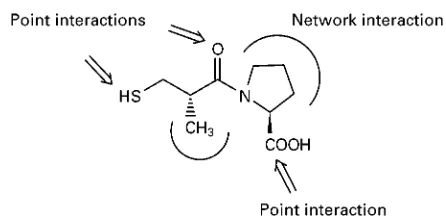
Figure 3 Schematic representation of interactions between a chosen ligand (here captopril) and a molecularly imprinted material. In addition to possible point interactions, whether covalent (disulfide, acetal, ester) or noncovalent (hydrogen bonds, coulombic electrostatic), the backbone of the imprinted network may also contribute to overall selectivity.
been the preferred choice in many imprinting protocols.
Attempts to overcome the drawbacks from the re-spective protocols, but still be able to beneRt from their advantages, can be made by combining the two extremes. Thus, protocols based on covalent binding during the Rxation process, but switching to non-covalent interactions afterwards, have been designed, for example, successful protocols based on cleavage of esters, carbonates and amides.
Origin of Selectivity
The complex, normally macromolecular nature of molecularly imprinted materials has precluded a full understanding of the recognition mechanism between the analyte and the matrix. Physical methods, such as solid-state nuclear magnetic resonance, Fourier trans-form infrared, atomic force microscopy (AFM) and electron spin resonance (ESR), have revealed some of the characteristics of the materials, but a more de-tailed account of the site architecture remains to be resolved. In contrast, the complexes between the functional building blocks and the print species, for-med in solution prior to any imprinting process, can be studied more easily. Obviously, the use of covalent interactions, and often metal coordination interac-tions, results in structures that can be well character-ized by common physical organic methods. In noncovalent systems the situation is more complex, but the use of solution-phase methods has allowed a picture of the interactions to be drawn. Although imprinting of these complexes/adducts may change their structures considerably, the information that can be retrieved from such studies is nevertheless valuable.
The recognition of events taking place in encoun-ters between ligands and receptors is highly depen-dent on the additive effect of a number of binding forces. An optimal combination of the poten-tial binding forces may lead to strong binding. Thus, in order to achieve proRcient complexation between the host molecule and the guest species, several fac-tors such as shape complementarity, functional complementarity and contributions from the sur-rounding pool of solvent have to be considered.
In all imprinting protocols, be they based upon covalent or noncovalent interactions, the most impor-tant factor governing the substrate selectivity is the quality and number of point interactions used to form bonds in solution prior toRxation, gelation or polym-erization. In self-assembly systems using noncovalent interactions, the main factors responsible for selective rebinding of ligands to the imprinted sites have been shown to be strong noncovalent bonds such as charge}charge interactions and hydrogen bonding.
Other types of interactions, such as}stacking and dipole interactions, may take part as well, but normally to a lesser extent. The three-dimensional arrangement of these interaction points, a reSection of the solution-phase situation set in place by the polymerization step, leads to an inherent speciRcity of the formed sites. Likewise, in metal coordination sys-tems, the major points of interaction occur between the immobilized metal ions and the coordination sites of the analyte, and the reversible covalent interactions between the functional moieties of the matrix and their counterparts of the analyte make up the major interaction in covalent systems.
In addition to these point interactions, the architec-ture of the surrounding matrix determines the steric limits of the site, thus providing a more or less efR -cient van der Waals surface to the analyte. Although the arrangement of the functional moieties in the matrix accounts for most of the selectivity, the shape of the site also plays an important role. The conR g-uration of the surrounding matrix backbone, as cast in place around the print molecule, contributes to the overall ligand speciRcity (Figure 3). This effect is sometimes less pronounced and substantial freedom in ligand structure can be observed, but often the effect is considerable and minute differences in size can be distinguished. In several cases, the position of a single methyl group is crucial for recognition. In this perspective, the shape effect of the site is particularly pronounced for parts of an imprinted molecule in close proximity to the point interactions. For struc-tural features of the analyte more distal from such bonds, the shape is less important.
Forms of Selectivity
The topic of chemical selectivity can be categorized into three main groups:
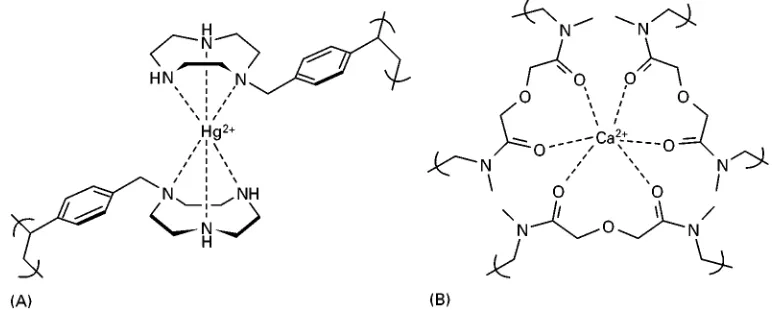
Figure 4 Metal ions can be very selectively recognized by imprinted matrices. For example, Hg(II) can be distinguished from Cd(II), Pb(II) and Cu(II) by the imprinted structure (A). Similarly, material (B) could selectively separate Ca(II) and Mg(II).
2. regioselectivity, referring to orientational control of the interaction
3. stereoselectivity, specifying the control of stereo-chemistry in the recognition site
Sometimes the last group is further subdivided with reference to the control of relative stereochemistry (diastereoselectivity) and absolute stereochemistry (enantioselectivity). A further physical type of selec-tivity is the discrimination of molecular size}an issue that may be of substantial importance when dealing with macromolecules and solid matrices.
Chemoselectivity In imprinting protocols based upon reversible covalent bonds, such as boronate esters, disulRdes and imines, the chemoselectivity is principally a consequence of the properties of the covalent bond type chosen. Thus, for boronate esters,
vic-diols are preferred as they give more stable esters than, e.g., mono-alcohols orgem-diols, and disulRdes are formed exclusively from thiols. Other bond types of a slightly more general character, e.g. acetals, selective for carbonyl groups/alcohols, and imines, selective for carbonyl/amino moieties, are however potentially useful in recognizing a wider variety of ligands.
In metal coordination systems, the coordination properties of the ligand-metal ion pair govern most of the chemoselectivity that can be expected. This pro-grammed selectivity can easily be changed, simply by changing the metal ion. If such a molecularly im-printed material is charged with different metal ions, the coordination properties can be Rne-tuned. Such a bait-and-switch strategy has been used for changing the binding strength from high afRnity during the imprinting process to low afRnity in the rebind-ing/separation process. For example, Cu(II) can been changed for Zn(II), since the latter displays a weaker
afRnity for imidazole groups. When the ion itself is the target species (ligand), coordinating building blocks are normally chosen to occupy less than or equal to half of the coordinating bonds of the ion, allowing for adaptation during the imprinting process (Figure 4). The ionic recognition that can be achieved with such systems is often remarkable, and systems that are able selectively to distinguish small differ-ences in ionic size and coordination pattern have been designed.
In noncovalent systems, the chemoselectivity is much less obvious in the design of the interactions. If a print molecule contains charges or hydrogen-bond-ing moieties, and functional monomers are chosen accordingly, the inherent chemoselectivity in the complexes formed is less strong, and other ligands can compete for the interactions as well. In addition, the functional building blocks, as well as the ligands, may self-interact to some extent. Nevertheless, a dra-matic chemoselectivity can be accomplished when the strength of the noncovalent interaction is altered, for example, by introducing substituents which change the electronic density of a compound, or substituting a hydrogen taking part in a hydrogen bond. For example, caffeine (1b) binds very poorly to a molecu-larly imprinted material prepared against theophyl-line (1a), only differing in the exchange of a hydrogen for a methyl group, and the exchange of a hydroxyl group for a keto group in cortisol/cortisone (2a/2b) results in a remarkable loss in binding (Figure 5).
mono-Figure 5 Examples of high chemoselectivity in noncovalent systems. Caffeine (1b) and theophylline (1a) differ only in one methyl group. Nevertheless, caffeine does not bind to matrices prepared against theophylline. Similarly, cortisone (2b) binds poorly to an anticortisol (2a) polymer.
Figure 6 Multiple hydrogen bonding between cyclobarbital (3)
andbis-amidopyridines (4).
mers, a high chemoselectivity can be designed for a chosen structure prior to the imprinting process. On the other hand, if a carefully designed multipoint system does not allow for dynamic adjustment, not much is gained from the imprinting process. In this example, the general structure (3) is well recognized, irrespective ofRandR.
In all these cases, however, the chemoselectivity that is more or less rationally designed upon exam-ination of the target print species can be radically enhanced by the imprinting process. This is particularly the case when dealing with less speciRc noncovalent interactions. The positioning of the functional groups in the three-dimensional network of the matrix, together with the formation of the site or imprint, often results in a tremendous increase in speciRcity.
Regioselectivity Regioselectivity can often be nicely demonstrated by molecularly imprinted materials us-ing all types of imprintus-ing protocols. In this case, the imprinting processper se, rather than the bond type, endows high regioselectivity. It is mainly due to proper three-dimensional (or two-dimensional) posi-tioning of the functional building blocks in theRnally produced matrix that high selectivity can be accomp-lished. Sometimes, however, the selectivity is also
a consequence of the architecture of the surrounding backbone of the imprinted matrix in addition to organized point interactions. Obviously, this works concertedly, such that the build-up of the matrix backbone may force the originally noninteracting parts of the functional building blocks to accommo-date a position, resulting in steric hindrance of differ-ent analytes.
A number of systems have been designed where
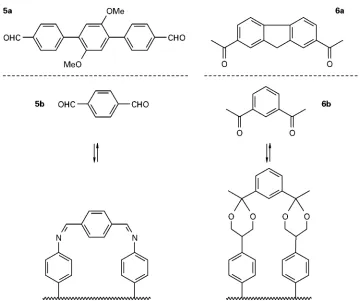
bis-functional compounds displaying a difference in distance between the point interactions can be efR -ciently distinguished by the produced matrix. For example, a range of either bis-aldehydes (5a/5b) or diketones (6a/6b) could be selectively discriminated by matrices produced using imine- and acetal-forma-tions, respectively (Figure 7).
Another example is the imprinting ofbis-imidazole structures using Cu(II) coordination. A selectivity between the structures could be recorded, largely dependent upon the positioning of the Cu ions in the material. In these examples, the distance between the point interactions can be considered as being of major importance for recognition.
Similar studies have been pursued using non-covalent interactions, e.g. the interactions ofbis -py-ridyl and bis-aniline compounds with carboxylic acids, which show high distance selectivities also.
[image:6.568.71.258.552.684.2]Figure 7 Distance selectivity in reversible covalent systems.Bis-aldehydes5a/5b, andbis-ketones6a/6bcould be distinguished by matrices prepared against one of the structures using imine and ketal formation, respectively.
Stereoselectivity The physical properties of enantio-mers, i.e. identical properties in a symmetrical envi-ronment, render them ideal substrates for the study of imprinting speciRcity. This is one of the reasons why this aspect has been the most extensively studied in MIT in general, and in MIC in particular. Indeed, this quality offers the clearest evidence for the outcome of a successful imprinting process. Obviously, if chiral discrimination can be introduced in a matrix through an imprinting process, based upon exclusively achiral building blocks, an indisputable demonstration of the concept is obtained.
A large number of investigations concerning chiral separations by molecularly imprinted materials have been performed, and hardly any type of compound has been neglected from examination. Thus, com-pounds such as amino acids, carbohydrates, nucleic acids and pharmaceuticals have all been applied in various imprinting protocols. The stereoselectivity that can be achieved is also quite extraordinary, and differences in binding of single hydroxyl groups (R -and S-timolol), and even single methyl groups can sometimes be observed (R- and S-naproxen). The interested reader canRnd a more detailed overview of chiral separations using molecularly imprinted ma-terials elsewhere in this Encyclopedia (Kempe M,
Chiral Separation: Molecular Imprints as Stationary Phases).
Conclusions and Future Prospects
MIT is a technique that has substantially improved over the last few years. Many of the drawbacks ini-tially encountered have gradually been overcome, and intense research is ongoing to resolve some of the remaining challenges. As has been pointed out, the technique is already competent at recognizing very small structural differences, and the ultimate venture that prevails in this respect is the separation of iso-topes. Another task that needs further attention, al-though some steps have already been taken in this direction, is the selective recognition/separation of biological macromolecules, and even whole cells.
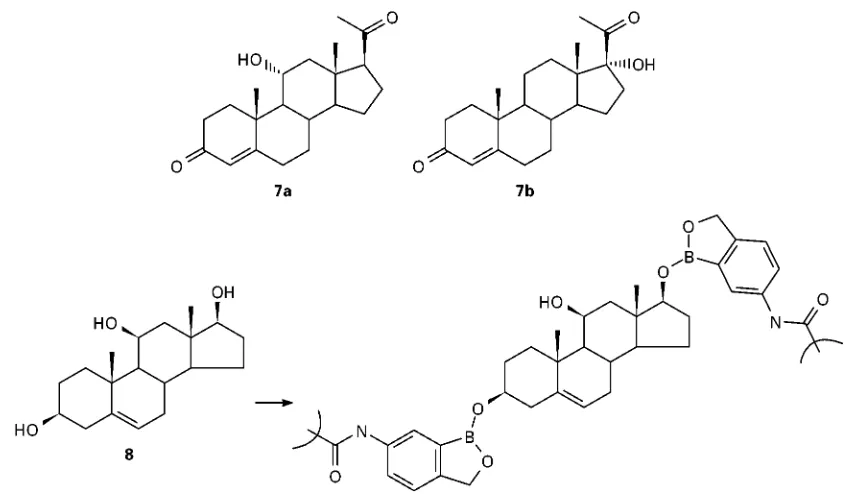
Figure 8 Examples of the high regioselectivity that can be achieved by matrices produced against steroids.-11-OH-progesterone (7a) and-17-OH-progesterone (7b) were efficiently separated by a molecularly imprinted chromatographic stationary phase. The androstene-triol (8) could be selectively acetylated in the 11-position upon protection/binding to the matrix.
can also be preferable. This is the case when perform-ing separations of groups of molecules rather than a single species, such as the recognition of the -lactam group as a whole, rather than individual peni-cillins. Using materials that are apt at recognizing a ‘molecular chord’, rather than single ‘molecular notes’, can sometimes be beneRcial.
See also: I/Affinity Separation. II/Affinity Separation: Immunoaffinity Chromatography; Imprint Polymers. III/Chiral Separations: Molecular Imprints as Stationary Phases. Immunoaffinity Extraction. Molecular Imprints for Solid-Phase Extraction. Selectivity of Imprinted Polymers: Affinity Separation.
Further Reading
Andersson LI (1998) Molecular imprinting as an aid to drug bioanalysis. In: Reid E, Hill H and Wilson I (eds)
Drug Development Assay Approaches,Including Mo-lecular Imprinting and Biomarkers, pp. 2}12. Royal Society of Chemistry.
Bartsch RA and Maeda M (eds) (1998) Molecular and ionic recognition with imprinted polymers. ACS Symposium Series 703.
Mosbach K (1994) Molecular imprinting.Trends in Bio-chemical Science19: 9}14.
RamstroKm O and Ansell RJ (1998) Molecular imprinting technology: challenges and prospects for the future.
Chirality10: 195}209.
Remcho VT and Tan ZJ (1999) MIPs as chromatographic stationary phases for molecular recognition.Analytical Chemistry71: A248}A255.
Sellergren B (1997) Noncovalent molecular imprinting: antibody-like molecular recognition in polymeric net-work materials. Trends in Analytical Chemistry 16: 310}320.
Shea KJ (1994) Molecular imprinting of synthetic network polymers: the de novo synthesis of macromolecular binding and catalytic sites.Trends in Polymer Science2: 166}173.
Vidyasankar S and Arnold FH (1995) Molecular im-printing: selective materials for separations, sensors and catalysis. Current Opinion in Biotechnology 6: 218}224.
Whitcombe MJ, Alexander C and Vulfson EN (1997) Smart polymers for the food industry.Trends in Food Science and Technology8: 140}145.
Wulff G (1995) Molecular imprinting in cross-linked ma-terials with the aid of molecular templates } a way towards artiRcial antibodies. Angew. Chem. Int. Ed.
Engl. 34: 1812.