Unifying Agent Systems
Mark d’Inverno Michael Luck
Cavendish School of Computer Science Dept of Electronics and Computer Science
University of Westminster University of Southampton
London, W1M 8JS, UK Southampton, SO17 1BJ, UK
[email protected] [email protected]
Abstract
Whilst there has been an explosion of interest in multi-agent systems, there are still many problems that may have a potentially deleterious impact on the progress of the area. These prob-lems have arisen primarily through the lack of a common structure and language for understanding multi-agent systems, and with which to organise and pursue research in this area. In response to this, previous work has been concerned with developing a computational formal framework for agency and autonomy which, we argue, provides an environment in which to develop, evaluate, and compare systems and theories of multi-agent systems. In this paper we go some way towards justifying these claims by reviewing the framework and showing what we can achieve within it by developing models of agent dimensions, categorising key inter-agent relationships and by ap-plying it to evaluate existing multi-agent systems in a coherent computational model. We outline the benefits of specifying each of the systems within the framework and consider how it allows us to unify different systems and approaches in general.
1
Introduction
In recent years, there has been an explosion of interest in agents and multi-agent systems. This has not only been in artificial intelligence but in other areas of computer science such as information retrieval and software engineering. Indeed, there is now a plethora of different labels for agents including
autonomous agents [32], software agents [22], intelligent agents [59], interface agents [37], virtual agents [1], information agents [35], mobile agents [57], and so on. The diverse range of
applica-tions for which agents are being touted include operating systems interfaces [21], processing satellite imaging data [54], electricity distribution management [31], air-traffic control [34] business process management [29], electronic commerce [26] and computer games [25], to name a few. Moreover, significant commercial and industrial research and development efforts have been underway for some time [9, 11, 44, 45], and are set to grow further.
definitions of fundamental terms frequently used when discussing multi-agent systems, and second we need to provide an environment in which different systems and theories can be developed, evaluated and compared.
1.1 Formal Frameworks
We have previously considered the requirements for the structures or frameworks that are necessary to provide a rigorous approach to any discipline [19], and in particular to agents and multi-agent systems [40]. Such frameworks should precisely and unambiguously provide meanings for common concepts and terms but in an accessible manner since only then will a common conceptual framework have a chance of emerging. (If there is a generally held understanding of the salient features and issues involved in the relevant class of models then we can assert the existence of a common conceptual framework). Another important aspect, and key to the work presented in this paper is that it enables models and systems to be explicitly presented, compared and evaluated. Not only must it provide a description of the common abstractions found within that class of models, but also it must provide a means of further refinement to specify particular models and systems.
Multi-agent systems are inherently complicated, and, consequently, reasoning about the behaviour of such systems becomes difficult. The ability to formalise multi-agent systems, to do so in such a way that allows automated reasoning about agents’ behaviour and, additionally, to do so in a way that is also accessible, is therefore critically important.
In what follows, we seek to show that the formal framework we have developed satisfies these requirements and provides just such a base as is necessary for a rigorous and disciplined approach to multi-agent systems research. Our aim here is not to provide a detailed presentation of our framework, which has been presented extensively elsewhere, but instead to show how it may be applied to different systems, and how they may be accommodated within a single overarching framework. Similarly, we are not concerned in this paper with the detailed specification of agent behaviour, though we have addressed this previously in [16, 18], nor with reasoning about agent behaviour, though again related work has addressed this, for example in the context of Agentis [15, 56].
1.2 Overview
In this paper, we review and build on previous work that has developed a formal agent framework and extend it to construct several agent models. These models range from generic abstract models to very specific system models that have been described and implemented elsewhere. In the next section we review the framework we have developed and in Section 4 and show how it can be extended to describe certain types of agents, describing autonomous agents, planning agents, memory agents and social agents. Next, the paper presents three case studies in applying the framework. These case studies have been chosen as exemplars specifically because they lie at opposite ends of the multi-agent system spectrum; one is a relatively new mostly theoretical model, while the other two are well-known, fully developed and implemented systems. Finally, the paper assesses the significance of this research, and considers further work.
2
Formal Specification
there have been several notable efforts to address this (e.g. [46, 58]), it is still the case that most new formal models do not even outline their role in system design and implementation.
There is a large number of formal techniques and languages available to specify properties of software systems [14] including state-based languages such as VDM [33], Z [53] and B [36], process-based languages such as CCS [41] and CSP [28], temporal logics [20], modal logics [10], and State-charts [55]. However, in bringing together the need for formal models on one hand and computational models that relate to software development on the other, we adopt the Z specification language. Z is the most widely used of formal methods from software engineering, and offers arguably the best chance of the agent models developed achieving a significant degree of adoption in the broader com-munity.
The Z language is used both in industry and academia, as a strong and elegant means of formal specification, and is supported by a large array of books (e.g. [2, 27]), articles (e.g. [3, 4]) and development tools. Its use in industry is both a reflection of its accessibility (the language is based on simple notions from first order logic and set theory) and its expressiveness, allowing a consistent, unified and structured account of a computer systems and its associated operations. Furthermore, Z is gaining increasing acceptance as a tool within the artificial intelligence community (e.g. [24, 39, 42]) and is consequently appropriate in terms of standards and dissemination capabilities.
2.1 Z Language Syntax
The key syntactic element of Z is the schema, which allows specifications to be structured into man-ageable modular components. The schema below has a very similar semantics to the Cartesian product of natural numbers but without any notion of order. In addition, and as can be seen in the example, the schema enables any declared variables to be constrained. In this case the schema declares two variables that are both natural numbers, and constrains them so that the variable
is less than or equal to the variable .
Modularity is facilitated in Z by allowing schemas to be included within other schemas. We can select a state variable,!
, of a schema, "#$
, by writing "#$ &%
!
. For example, it should be clear that
' %
refers to the variable (
in the schema
.
Now, operations in a state-based specification language are defined in terms of changes to the
state. Specifically, an operation relates variables of the state after the operation (denoted by dashed
variables) to the value of the variables before the operation (denoted by undashed variables). Opera-tions may also have inputs (denoted by variables with question marks), outputs (exclamation marks) and a precondition. In the )
*,+&-/.01
schema below, there is an operation with an input variable, 243
; if 243
lies between the variables (
and , then the value of
is replaced with the value of
243
. The original value of (
is the output as .05
. The6
symbol, is an abbreviation for '87 '19
and, as such, includes in this schema all the variables and predicates of the state of '
)
:243;
6
' .<5
=243 :243>? @9BAC243
9 AD .<5EAF(
A key type in the specification contained in this paper is the relation type, expressing a mapping between two sets: a source set and a target set. The type of a relation with sourceG and target H is a simply a set of ordered pairs, IKJMLN&O. More formally, we have the following definition for the relation type.
GQP H A;ASR
ITGVU=H8O
By way of example, consider the following relation between natural numbers.
J
$4W.X.
Y
P
J
$4W.X.
ZAC[
IT\,L^]#OLIT_,L`aOLITb,L\,O^c
The domain of a relation (dom) is the set of related source elements, while the range (ran) is the set of target elements. In the example above we have the following.
dom
J
$4W.0^.
ZAD[ \,L_,Lbac ran
J
$4W.0^.
ZAD[ `,L\,L^]#c
In the following example we show how a set of elements can be defined using set comprehension.
[
J
dfe
Jhgji>kl`4mnJMc AD[po
L`,L^]ELb,Lq,Lr
o
Lr`,c
The “bullet” can also be used in predicates such as the one below, which states that the square of any natural number less than 10 is less than 100.
s tdfea g r
o
k
m
gur oo
2.2 Z Extensions
In the schema given below,
$
Wv
takes a function and a sequence and applies the function to each element of the sequence and$ W&
takes a function and a set and applies the function to each element of the set.
w
GxLBHzy $ Wv{
ITG |
}
H{O~|
}
seqG |
}
seq H
$
Wn ITG |
}
H8Oj|
}
R
G |
}
R
H
s v;
seqGnJ ;R
Gx
G |
}
HCk
$
W&v
vzAD[dZCe,Z
r
%%1 v
k{I
L*(
I
v O^O^c
7
$ W&
J
zAC[
J
G
e
J
J
k(
We have found it useful in this specification to be able to assert that an element is optional. For example, in the specification given in this paper, whether a social agent has a model of itself or not is optional. The following definitions provide for a new type, #1^E , for any existing type, .
#Ed
w
Gy A;Au[
J
>R
G
e
J r1c
Most other syntactic constructs in this paper are fairly standard but more complete treatments of Z can be found elsewhere [53].
3
The Agent Framework
There are four types upon which all our notions in theSMART (Structured and Modular Agents and
Relationship Types) agent framework are based. The definitions within this paper will be built up using only these types; they are declared below.
w * *
K
L
p L)
. L
d
!
y
An entity is something that comprises a set of attributes, a set of actions, a set of goals and a set of motivations. The schema below has a declarative part containing four variables. First, *
K( is the set of features of the entity. These features are the only characteristics of the entity that are manifest. They need not be perceived by any particular entity, but must be potentially perceivable in an omniscient sense. Second, W d . (
is the set of actions of the entity, and is sometimes referred to as the competence of the entity. Next,+a .
and${d
!
E
are the sets of goals and motivations of the entity respectively. Goals are simply states of affairs to be achieved in the environment, in the traditional artificial intelligence sense, while motivations are higher-level non-derivative components characterising the nature of the agent, but are related to goals. Motivations are, however, qualitatively different from goals in that they are not describable states of affairs in the environment. For example, the motivation greed does not specify a state of affairs to be achieved, nor is it describable in terms of the environment, but it may (if other motivations permit) give rise to the generation of a goal to rob a bank. The distinction between the motivation of greed and the goal of robbing a bank is clear, with the former providing a reason to do the latter, and the latter specifying what must be done. Finally, the predicate part states that the entity must have a non-empty set of attributes.
&
N
* *
K(;dR * *
K W d. >R
+a
.>R
)
.
$
!
B>R
d
!
* *
K(AC[
c
An object is any entity that has capabilities (as well as attributes). The schema defining an object is that of an entity with the further proviso that the object has a non-empty set of capabilities.
T &
N
W d. AD[
In our framework an agent is an object that is serving some purpose. That is, an agent is an instantiation of an object together with an associated goal or set of goals. The schema for an agent is simply that of an object but with the further restriction that the set of goals of an agent is not empty.
+a& T
+a .AD[
c
We define an
!
B$&
to be a set of attributes.
!
^B$&A>AjR
*
K
Next we define an interaction. An interaction is simply what happens when actions are performed in an environment. The effects of an interaction on the environment are determined by applying the &K p
function in the axiom definition below to the current environment and the actions taken. This axiom definition is a global variable and is consequently always in scope. We require only one function to describe all interactions, since an action will result in the same change to an environment whether taken by an object or any kind of agent.
* z p
K
Z
!
&$&
}
R p
|
}
!
^B$
3.1 Agent Perception and Agent Action
Perception can now be introduced. An agent in an environment may have a set of percepts available, which are the possible attributes that an agent could perceive, subject to its capabilities and current state. We refer to these as the possible percepts of an agent. However, due to limited resources, an agent will not normally be able to perceive all those attributes possible, and will base its actions on a subset, which we call the actual percepts of an agent. Indeed, some agents will not be able to perceive at all. In this case, the set of possible percepts will be empty and consequently the set of actual percepts will also be empty.
To distinguish between representations of mental models and representations of the actual envi-ronment, a type, ¡
2
, is defined to be the perception of an environment by an agent. This has an equivalent type to that of
!
B$&
, but now physical and mental components of the same type can be distinguished.
¡
2jA;AjR/¢ * *
K
It is also important to note that it is only meaningful to consider perceptual abilities in the context of goals. Thus when considering objects without goals, perceptual abilities are not relevant. Objects respond directly to their environments and make no use of percepts even if they are available. We say that perceptual capabilities are inert in the context of objects.
In the schema for agent perception,
+,& ^ @W:£
, we add further detail to the definition of agents, and so include the schema
+a&
. An agent has a set of perceiving actions,WB^
!
a+ E , which are a subset of the capabilities of an agent. The function, WE (
!
the function,
! , describes those attributes that are actually perceived by an agent and will always be applied to its goals.
+a& (@W£ +a&
WB^
!
a+ E>dR
p WE ( ! ¤ ! ^B$& } R p | } ! ^B$& 2
.£.WE (
! ¤R ) . } ! &$& } ¡ 2 WB^ !
a+ E¤¥D W . s ! ! ^B$& ;R k > domI WE^ ! ¤ !BO§¦ zA¨WE ( !
a+ pE dom 2 .£.WB^ ! >AD[+ .© c
Directly corresponding to the goal or goals of an agent, is an action-selection function, dependent on the goals, current environment and the actual perceptions. This is specified in
+,&
below, with the first predicate ensuring that the function returns a set of actions within the agent’s competence. Note also that if there are no perceptions, then the action-selection function is dependent only on the environment. +a& +a& +a E>R ) . } ¡ 2 } ! ^B$& } R s +;R ) . 4! ¡ 2 ! ! ^B$ k I
+,& pE+
!
!BO
¥D W . dom +a& E;Au[+ .©
c
3.2 Agent State
The state of an agent describes an agent currently situated in some environment and is defined as follows. This includes two variables,WE1KWE^ ªW£
, describing those percepts possible in the current environment, and
.WE^ ªW£
, a subset of these which are the current (actual) percepts of the agent. These are calculated using the
WE (
!
and
2 .£.WE (
!
functions.
+a&«& K ! ^B$&n ! ^B$& +a& (@W£ +a& WE1KWE^ ªW£8 ¡ 2
.WE^ ªW£¤
¡
2 2 .£.<dR
.WE^ ªW£8¥FWE1KWE^ ªW£ WB^
!
a+ EAC[ cj¦ W#1TWE (@W£>AD[ c WE1KWE^ ªW£;A¬ WB^ ! 8 ! &$&WE^ ! a+ E
.WE^ ªW£lAC2
.£.WE (
!
4+
.©W#1TWE (@W£ 2 .£.<dA +,& E'+ .
.WE (@W£8
!
Lastly we specify how an agent interacts with its environment. As a result of an interaction, the environment and the
+a&«&
K
change.
+a&
!® &K
p
6
+,&«& K
!
^B$&ª9&A¬* z p&K Z
!
B$&2 .£.0d WE1KWE^ ªW£9:A¯ WE (
!
8
!
^B$@9dWE^
!
,+ pB
.WE^ ªW£9:AC2 .°.WE (
!
'+a .W#1KWE^ ªW£9
2
.£.<dd9&A
+a&
p
B'+a
.
.WE^ ªW£9±
!
^B$@9
3.3 Tropistic Agents
SMART specifies a set of generic architectures. The types, functions and schemas it contains can be
applied to other systems and concepts. In order to illustrate its use in this way, and to show how the model of interaction is sufficiently general to capture most types of agents, tropistic agents [23] are reformulated as an example of an agent. It is one of a set of core agent architectures used by Genesereth and Nilsson to demonstrate some key issues of intelligent agent design. The activity of tropistic agents, as with reflexive agents, is determined entirely by the state of the environment in which they are situated. First, the original description of tropistic agents is summarised and then reformulated using elements ofSMART.
According to Genesereth and Nilsson, the set of environmental states is denoted by
«
. Since agent perceptions are limited in general, it cannot be assumed that an arbitrary state is distinguishable from every other state. Perceptions thus partition
«
in such a way that environments from different partitions can be distinguished whilst environments from the same partition cannot. The partitions are defined by the sensory function,
, which maps environments contained in «
to environments contained in , the set of all observed environments. The effectory function,
, which determines how environments change when an agent performs an action, taken from the set of the agent actions,
, maps the agent’s action and the current environment to a new environment. Finally, action-selection for a tropistic agent,
, is determined by perceptions and maps elements of to elements of
. Tropistic agents are thus defined by the following tuple.
I
«
LaL
L
8E«
}
L d
U
«
}
«
L
Z
}
O
3.3.1 Reformulating Perception
TheSMARTframework can be applied to reformulate tropistic agents by first defining types: equating
the set
«
to theSMART type,
!
B$&
; the set (as it refers to agent perceptions), to the type
¡
2
; and the set,
, to the type
p
. The following type definitions can then be written.
«xA;A
!
B$&7
A;A
¡
2j7 A;A p
According toSMART, tropistic agents are not autonomous. Thus the agent-level of
conceptualisa-tion is the most suitable level, and these are the models chosen. The funcconceptualisa-tions defining architecture at this level are WE (
!
, 2 .£.WE^
!
and +a& pB
, defining the possible percepts, actual percepts and performed actions, respectively. The effect of actions on environments is independent of the level chosen in the agent hierarchy and defined by
z
&K
! ! } | } ¡ 2
.£.WE (
! 8R ) . } ¡ 2 } ¡ 2 +a E8R
) . } ¡ 2 } ! &$& } R * z pK
! &$& } R } ! B$&
These functions include explicit reference to agent goals, which are not represented in the model of tropistic agents since they are implicitly fixed in the hard-coded functions. In what follows, the value of these goals is taken to be
+
and accordingly set all goal parameters ofSMART functions to this value.
The goals of a tropistic agent do not constrain the selection of its perceptions from those that are available, and
2 .°.WE (
!
is defined as the identity function on observed environments. In
SMART, the perceiving actions are used at every perceiving step so that the second argument of WE^
!
is always applied to the perceiving actions (WB^
!
a+ E
) of the agents as spec-ified in the
+,& ^ @W:
schema. Accordingly, tropistic perception is reformulated in the second predicate below. There is an implicit assumption that tropistic agents are capable perceivers; percep-tions are always a subset of the actual environment. This assumption is formalised in the last of the three predicates below that together define tropistic perception.
2 .£.WE (
! +zAD[ ! ¡ 2 kI!&L!&O^c s ;E« k
>AC2 .°.WE (
! 4+ I WE ( ! 8WE ( !
a+ E
O
s L!
E«
k
2 .£.WE (
! 4+ I WB^ ! WB^ !
a+ E
O
¥D
The set of partitions in
«
can be calculated using set comprehension.
W ( E>A;Au[, L! ! B$&e ! AD> k 4²³[ !Bcc
3.3.2 Reformulating Action
The difference between theSMART framework and tropistic agent effectory functions is simply that the former allows for a set of actions to be performed rather than a single action.
s ;
! ^B$& k d I L O
A¬* z p&K Z[
c
The action selected by a tropistic agent is dependent solely on its perceptions. InSMART, the
ac-tions performed are additionally dependent on goals and the environment. The environment can affect the performance of selected actions if, for example, an agent has incorrect or incomplete perceptions of it. By contrast it is assumed that a tropistic agent correctly perceives its static environment and performs actions that are equivalent to those selected. These assumptions mean that the environment does not affect the performance of actions once they have been selected. In order to specify this in
SMART, the
!
B$&
parameter of +,& E
is fixed to the empty set, and
is defined using +,& p E as follows. s ! Sk !
A +,& pE+
!
[
c
Reformulating tropistic agents usingSMART highlights several issues of note. First,SMART
that agent goals change over time and that the selection of actions and perceptions must be adapted accordingly. Clearly, it is inefficient to have to re-write the functions defining action and perception selection every time new goals are adopted. Third, features ofSMART are more generally applicable
than those described for tropistic agents, and it can therefore be used to explicitly formalise any as-sumptions (implicit or otherwise) regarding the tropistic agent, its environment, and the interaction between them.
In this section we have constructed a formal specification that provides us with a hierarchy where all agents are objects, and all objects are entities, with the distinction between each category made precise. However, the agents that have been defined are not in themselves especially useful or in-teresting. Consequently, we must consider how we can refine this framework to develop definitions for other, more interesting and more varied kinds of agents. The next section describes and specifies four types of agents, each describing some subset of the agent class. These are autonomous agents, memory agents, planning agents and social agents. Each definition will arise through a refinement of the ideas and schemas presented above.
4
Classes of Agents
4.1 Autonomous Agents
Our definition of agents entails the notion that an entity is serving some purpose or, equivalently, that the entity can be ascribed some goal. However, we have not as yet considered how goals arise in the first place. In our view, goals are derivative components that are constructed in response to the needs either of the agent itself, or of some other agent. Goals can be adopted and transferred, but if goals are derivative as we claim, then there must be some entities in the world can generate or derive these goals. We define the non-derivative components from which goals are derived as motivations; goals are generated solely in response to motivations. It is this quality that defines autonomy; an agent that has a non-empty set of motivations (from which goals may be created) is an autonomous agent.
An autonomous agent is an agent together with an associated set of motivations.
T$
+a&
+a&
$
!
BAD[
c
An autonomous agent is defined as an agent with motivations and some potential means of evalu-ating behaviour in terms of the environment and these motivations. In other words, the behaviour of the agent is determined by both external and internal factors. This is qualitatively different from an agent with goals because motivations are non-derivative and governed by internal inaccessible rules, while goals are derivative and relate directly to motivations.
Autonomous agents also perceive, but motivations, as well as goals, filter relevant aspects of the environment. In the schema below, the function
T2 .£.WE^
!
is then a more complex version of an agent’s
2 .£.WB^
!
, but they are related — if we choose to interpret the behaviour of the agent solely in terms of its agenthood (and therefore its goals) then the
2
.£.W^
!
representation is appropriate, and if we wish to interpret its behaviour in terms of its autonomy (and therefore its motivations as well as its goals) then the function
T2 .°.WE (
!
will be appropriate.
Nevertheless, that which an autonomous agent is capable of perceiving at any time is independent of its goals and motivations and we just import the definition of WE^
!
from
T$ +a&
+a& (@W£
T2 .£.WB^
! R ! } R ) . } ! B$& } ¡ 2 dom
T2 .£.WE^
!
>Au[d$
!
E
c
The next schema defines the action-selection function and includes the previous schema defini-tions for
+a&
and T${ +,&
. The action-selection function for an autonomous agent is produced at every instance by the motivations of the agent, and is always and only ever applied to the motivations of the autonomous agent.
T$ +a& p T$ +a& +a&
T E8R
! } R ) . } ¡ 2 } ! ^B$& } R dom T E;AD[d$ ! E c
We also define the state of an autonomous agent in an environment by including the
+,&«& K , T${
+,& ^ ªW£ and T$ +a& p schemas. T$
+a&«& K
T$
+a& (@W£
T$
+a& p
+a&«& K
.WE^ ªW£lA
T2 .£.WB^
!
>$
!
E+a .WE1KWE^ ªW£ 2 .£.<dA
T El$
!
E4+ .© p
.WE (@W£{
!
^B$
Now we can specify the operation of an autonomous agent performing its next set of actions in its current environment. Notice that while no explicit mention is made of any change in motivations, they may change in response to changes in the environment.
T$ +a& !®
&K p
6 T$
+a&«& K
! ^B$&ª9&A¬* z p &K Z ! B$&2 .£.0d
WE1KWE^ ªW£ 9 A¯ WE (
!
8
!
^B$ 9 WE^
!
,+ pB
.WE^ ªW£9:A
T2 .£.WE (
!
p9${d
!
E9¤+ .©9W#1KWE^ ªW£9 2 .£.<d 9 A
T pB;${d
!
E 9 +a . 9M p
.WE (@W£ 9
!
B$& 9
The essential feature in distinguishing autonomous agents from non-autonomous agents is the ability to generate their own goals according to their internal non-derivative motivations. Once goals are generated, they can subsequently be adopted by, and in order to create, other agents. We can extend the framework to show how an autonomous agent can generate goals.
each autonomous agent having its own such repository. An agent tries to find a way to mitigate mo-tivations, either by selecting an action to achieve an existing goal, by reactively performing an action in direct response to motivations, or by retrieving a goal from a repository of known goals. The first two of these alternatives were addressed by the
T E
function in the
T$
+,&
schema seen earlier, while the last is considered briefly below.
In order to retrieve goals to mitigate motivations, an autonomous agent must have some way of assessing the effects of competing or alternative goals. Clearly, the goals that make the greatest positive contribution to the motivations of the agent should be selected. To do this, an autonomous agent must monitor its motivations for goal generation, and retrieve appropriate sets of goals from a repository of available known goals. We can define a function that takes a particular configuration of motivations and a set of existing goals and returns a numeric value representing the motivational effect of satisfying those goals. Then all that is necessary for goal generation is to find the set of goals in the goalbase that has a greater motivational effect than any other set of goals, and to update the current goals of the agent are updated to include the new goals.
4.2 Memory Agents
The agents considered above are very simple and rely solely on the environment, goals and motivations (if available) to determine action. We have not yet specified the way in which some agents may be able to take into account prior experience (except through any changes that arise in goals and motivations). Agents who cannot take past experience into account will be extremely limited as a result. By adding further detail to our existing definitions we now provide a description of agents with the ability to access an internal store of attributes or memory that can record, for example, prior experience and other relevant information. We call an agent with such an internal store a memory agent.
A memory agent does not necessarily record just those attributes that are currently available in the external environment, but may also store some other attributes regarding more general learned or acquired information.
$
N
+,&
+a& $${
N
R
*
K
$${
N
AD[
c
Thus a memory agent differs from the previous agents by having available, in addition to the external environment, an internal store of attributes, both of which contribute to forming the agent’s current view of the world. Clearly, a memory agent will require certain perceiving actions in order to access the memory. In this respect it may often be useful to divide the perceiving actions of an agent into internal and external parts and, analogously, the environment may also be split into internal and external components, the internal environment being the memory.
Note that we refer to the internal set of attributes as an environment, rather than a ! 2
N $ N +,&
+a& (@W£ &K .WE (
!
a+ E¤dR
p J K
.WE (
!
a+
E¤dR p
$${ WE (
! 8 I ! ^B$& U ! ^B$ O } R | } ! &$&
&K .WE (
!
a+ Eµ´Y
J
K .WB^
!
a+ E>A¨WE (
!
a+ pE &K .WE (
!
a+ Eµ¶Y
J
K .WB^
!
a+ E>AD[
c s !rL !,` ! ^B$ ;R k > domI
$$ WE^
! I !rL !,`aO^O¦ zA¨WB^ !
a+ E
A memory agent’s possible percepts are derived from applying its perceiving actions to both its external environment and its internal memory. Depending on its goals, the agent will select a subset of these available attributes, as defined previously by
2
.£.W (
! in the +a ^ ªW£ schema. The action that such an agent selects at any time is also determined in the same way as defined previously in the
+a&
p
schema, since the memory is carried through possible percepts and actual percepts to the action-selection function,
+a& p B . $ N +,&
+a&
$
N
+,&«& K
$
N
+,& ^ @W:£ +a&«&
K
WE1KWE^ ªW£;Af$$ WB^
! I ! B$& L $$ NBO WB^ !
a+ E
As a result of these refinements, we must also consider the consequences of an action on the environment and memory. The performance of some set of actions may, in addition to causing a change to the external environment, also cause a change to the memory of the agent. In this respect, we define two functions for these interactions below, where the external environment function is exactly as defined earlier, but the memory is updated as a function of both the internal environment, external environment and the current goals of the agent. Goals are relevant here because they may constrain what is recorded in memory, and what is not.
J
K .0* z p &K
! &$& } R p | } ! ^B$ &K .0* z p &K
! &$& } ! ^B$& } R | } R ) . } ! ^B$&
We can now refine another schema to take into account these changes. The following schema, which specifies how a memory agent interacts with its environment, is a new version of the
+a !®
&K
N
!®
6 $
N
+,&
+a& !®
&K p
J
K .0
!
B$&µ
!
^B$&
J
K
.0
!
B$&ª9M
!
B$&
J
K
.0
!
B$&9 A¬
J
K(
.X
&K
p
J
K(
.X
!
&$&2
.£.0d $${
N
9A &K .0* z pK Z$$
N
J
K( .X
!
^B$2 .£.<d>+ .
These memory agents are similar in spirit to the knowledge-level agents of Genesereth and Nils-son [23], in which an agent’s mental actions are viewed as inferences on its database, so that prior experience and knowledge can be taken into account when considering what action to take.
4.3 Planning Agents
Planning is the process of finding a sequence of actions to achieve a specified goal. Our definition of agents requires the presence of goals, and although we have briefly discussed how goals may be generated, we have not considered how agents plan to achieve them. This section increases the complexity of the agent specification so that it captures the essence of a planning agent.
4.3.1 Modelling Plans
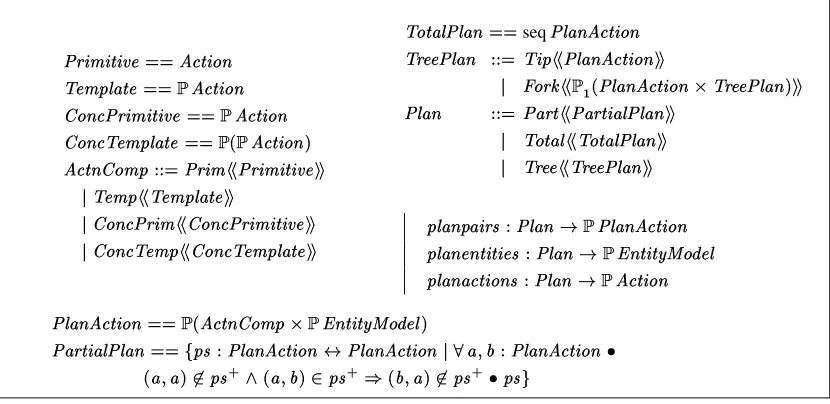
This involves defining first the components of a plan, and then the structure of a plan, as shown in Figure 1. The components, which we call plan-actions, each consist of a composite-action and a set of related entities as described below. The structure of plans defines the relationship of the component plan-actions to one another. For example, plans may be total and define a sequence of plan-actions,
partial and place a partial order on the performance of plan-actions, or trees and, for example, allow
choice between alternative plan-actions at every stage in the plan’s execution.
We identify four types of action that may be contained in plans, called primitive, template,
concurrent-primitive and concurrent-template. There may be other categories and variations on those we have
chosen, but not only do they provide a starting point for specifying systems, they also illustrate how different representations can be formalised and incorporated within the same model. A primitive action is simply a base action as defined in the agent framework, and an action template provides a high-level description of what is required by an action, defined as the set of all primitive actions that may result through an instantiation of that action-template. An example where the distinction is manifest is in dMARS (see Section 7.2), where template actions would represent action formulae containing free variables. Once all the free variables are bound to values, the action is then a primitive action and can be performed. We also define a concurrent-primitive action as a set of primitive actions to be performed concurrently and a concurrent action-template as a set of template actions that are performed concurrently. A new type,
±-·$4W
, is then defined as a compound-action to include all four of these types.
¸:¹@º<»º0¼<º<½¾±¿·¿ÁÀÂ^¼<º0Ã(Ä Å¾ª»ÇÆdÈÊɼX¾§¿·¿ÌËÀÂ^¼<º0Ã(Ä Í Ã(Ä1ÂK¸M¹Kº<»º<¼<º<½¾§¿·¿ËÀMÂ^¼<º0Ã(Ä Í Ã(Ä1žª»±ÆdÈÊÉ(¼X¾·¿·¿Ë&Î<ËÀÂ^¼<º<Ã(ÄaÏ ÀÂ^¼<Ä
Í
Ã(»±Æ>Ðпt¸:¹Kº<»lÑÑÒ¸M¹Kº<»º<¼<º<½¾ÓÓ
Ô
žª»ÇÆBÑÑÅ1¾ª»±ÆdÈÊɼX¾ÓÓ
Ô Í Ã(Ä1ÂK¸M¹Kº<»lÑÑ Í Ã(ÄÂK¸:¹Kº<»º0¼<ºÕ½¾ÓÓ Ô Í
Ã(Ä1žª»±ÆBÑÑ
Í
Ã(Ä1žª»±ÆdÈÊÉ(¼X¾ÓÓ
seq
Ź¾K¾T¸MÈÊÉ(ÄÖЩпfÅ,ºÆEÑÑÒ¸MÈÊÉ(ÄpÀMÂ^¼<º0Ã(ÄÓÓ ÔØ×
ùTÙÑÑ<Ë&Ú^ÎÒ¸MÈÊÉ(ÄpÀMÂ^¼<º0Ã(Ä>ÛŹ¾T¾T¸ÈÊÉ(ÄÏÓÓ ¸MÈÊÉ(Ä Ð©Ð¿Ü¸MÉ(¹@¼@ÑÑҸɹª¼<º0É(ȸÈÊÉ(ÄdÓÓ
Ô
Å1Ã(¼0ÉÈ£ÑÑÅ1ü0ÉȸMÈÊÉ(ÄÓÓ
Ô
Ź¾T¾ÑÑŹ¾K¾T¸MÈÊÉ(ÄÓÓ
ÆdÈÊÉÄÆpÉ(º<¹KݧиÈÊÉ(Ä4Þ Ë¸MÈÊÉ(ÄpÀMÂ^¼<º0Ã(Ä ÆdÈÊÉľªÄ¼<º<¼<ºX¾ªÝ·Ð¸MÈÊÉ(Ä4ÞuË·ßMÄ1¼<º0¼<à^á>Ã^â¾È ÆdÈÊÉÄÉÂ^¼<º0ÃÄ1ݷиÈÊÉ(ÄzÞ ËÀÂ^¼<º<Ã(Ä
¸ÈÊÉÄpÀÂ^¼<º<Ã(Ä4¿·¿ÌËΰÀMÂ^¼<Ä Í Ã(»ÇÆ8Û'Ëß:ļ<º<¼<àá>Ã^â¾ÈXÏ ¸É¹ª¼<º0É(ȸÈÊÉ(Ä4¿·¿ÁãªÆݧиMÈÊÉ(ÄÀÂ^¼<º0Ã(Ääu¸ÈÊÉ(ÄÀÂ^¼<º0ÃÄ
Ô^å
Éæç·Ð¸MÈÊÉ(ÄpÀMÂ^¼<º0Ã(Äzè Î*ÉæÉÏ/é
ê
ÆÝë¤ìÎ*ÉæçÏ
ê
[image:15.612.86.501.61.263.2]ÆÝë8í¬ÎTç(æ^Éϱéê ÆÝë¤èÇÆÝî
Figure 1: Plan components and structure
We specify three commonly-found categories of plan according to their structure as discussed earlier, though other types may be specified similarly.
k Partial Plans.
A partial plan imposes a partial order on the execution of actions, subject to two constraints. First, an action cannot be performed before itself and, second, if plan-action
is before , cannot be before
. Formally, a partial plan is a relationship between plan-actions such that the pair I
L
O is not in the transitive closure and, further, if the pair I
L
O is in the transitive closure of the relation then the pairI
L
O is not.
k Total Plans. A plan consisting of a total order of plan-actions is a total plan. Formally, this is represented as a sequence of plan-actions.
k Tree Plans A plan that allows a choice between actions at every stage is a tree. In general, a tree is either a leaf node containing a plan-action, or a fork containing a node, and a (non-empty) set of branches each leading to a tree.
These are formalised in Figure 1.
Using these components we can define a planning agent. Any planning agent must have a set of goals currently being pursued,
+a
.
, and a set of plans associated with these goals, W.
E . The plans associated with each of the goals is given by the function,
!
@W. ,+ .
. There will also be a repository of all goals,
+ .
, a repository of all plans,
W.
, and a function associating plans in the
W.
with the goals in the +a
.
, W.
a+a
.
+a&
!
@W. ,+ .·
)
.
}
R . W. B>R .
W. ,+ .·
)
.
}
R . +a
.
8R
)
.
W. ¤R .
dom
!
ªW.
a+
./A?+
.©
ï
Iran
!
@W. ,+ .
O
A¨W. E
ï
Iran
W. ,+ .
O
A¨W. dom
W. a+ .¥~+ . +a
.¤¥¨+a
.
The way in which a planning agent chooses how to act is now also a function of its current plans. This is shown in the
. B a+
+a&
schema below.
. B a+
+a&
p . B a+
+a& +a&
W. & ,+ +,& pE¤R
)
.
}
R .
}
¡
2
}
!
&$&
}
R
s
+;R
)
.
W;R
.
'!
¡
2
!
!
&$&
kI
W. B a+ +a& pB4+W
!
!BO
¥u W d. dom
W.
B
a+
+,&
E>AD[+
.©
c
s W>R .
k
W&> domI
W. B a+ +a E4+a . O¦
W&zAjW. E
Here, we have only extended our description of an agent to include the ability to plan. Further work is necessary to investigate and specify how the plans of an agent also affect its reasoning. For example, we must address the questions of when an agent should abandon plans, generate new plans, abandon goals because of a lack of appropriate plans, and so on. However, this is beyond the scope of the current work and will not be addressed further in this paper. Nevertheless, we have provided a framework within which such issues and related theories and systems can be formally presented as we shall show in the next section when we show how plans are modelled for various existing systems.
4.4 Sociological Agents
4.4.1 Agent Models
We have already stated that an agent will have certain percepts available to it. If an agent can make sense of these attributes and group certain sets of them together into entity-describing models, then we have the beginnings of a sociological agent, which we take to be an agent that is aware of other agents, and their role and function. Specifically the agent framework provides the structure that allows an agent to construct meaningful and useful models of these roles and functions in a very simple but effective way. Such models are described below.
Once again, we refine the schemas given earlier to construct our model of a sociological agent. The schema below describes an agent that has grouped attributes into distinct entities.
+a&
p. & ( +a&«&
K & dR &
N
& {AC[
c
ï;[,>& (
k
%Ò * *
K(
c
¥
.WE^ ªW£
Though the agent does not necessarily have memory, this still constitutes a model of the world that it possesses, since it imposes a structure by grouping attributes. This kind of modelling is used by mechanisms such as a robot arm on a production line. The arm is only concerned with the perceptual stimuli needed for it to perform the appropriate action on an entity. In many cases, it will not need to know about the capabilities of the entity.
Now an agent may, in addition, associate capabilities with some entity, and its model of the world will therefore be a collection entities and objects. (This will typically involve the use of memory, but we will not consider memory further here, so that we may clearly differentiate the qualities that arise for distinct reasons.)
+a&
p. *
p£
+a&
p. & ( * £;R *
* £AC[
c
* £>¥C&
Similarly, a more sophisticated agent may be able to model the world as a set of entities, objects and agents.
+a&
p.
+,&£
+a&
p. * p£
+a£;R +,&
+a£AD[
c
+a£>¥u * p£
At this level of modelling, an agent is aware of the concept of agenthood. That is, it is aware that some of the entities in the world are serving a purpose. However, we cannot yet claim this to be a sociological agent, since it must be aware not only that a goal is being satisfied, but also
2§"
N the goal exists. In other words, it must know that the goal has been generated by some agent. A sociological agent must thus understand the concept of autonomous agents, which are the only agents capable of generating goals. We therefore define a sociological agent to be any agent that has the ability to model an entity as an autonomous agent.
+a&
p. +,&£
T$
+,&£8R
T${
+,&
T$
+,&£AD[
c
T$
+,&£¥ +,&£
According to this view, an agent can be sociological even it has no social capabilities (such as rhetorical devices) other than that it recognises autonomy.
If we expand the previous schema, then a sociological agent considers the world to consist of entities, objects, agents and autonomous agents, where all autonomous agents are agents, all agents are objects and all objects are entities. In addition, if it can recognise agents that are autonomous and objects that are agents then it will certainly be able to recognise agents that are not autonomous and objects that are not agents. These are known as Server Agents and Neutral Objects respectively, and are defined as follows.
«:
!
+a +a&
$
!
BAD[
c
ð
. * T
+a .AD[
c
7Ø$
!
E;AD[
c
A sociological agent may also have a model of itself. This is given in the following schema. Note that a sociological agent is not necessarily an autonomous agent, nor is an autonomous agent a sociological agent. (For a definition of #E1 the reader is asked to consult the Appendix A.)
« .0+ .
+a
. « .0+ .
+a :
.< T £>dR ð
. * p
!
+,&£;dR«
!
+a& .
#E1 w
+,&
y
+a£zA
T$
+a&£µ´t
!
+,&£ * £zAf
.< * £µ´ +a&£
Naturally, if an agent want to take advantage of its ability to model these agents, it will need to use certain persuasive devices as described in [6], but which will not be considered here.
behaviour. However, if the robot has the ability to model the relationship between the radio and the agents for which that radio is serving a purpose, which may in turn be serving a purpose for other agents, it may be able to identify the autonomous agent at the top of the regressive agent chain. In this case, the robot may attempt to persuade this agent to release the radio from its original purpose, so that it may use it instead.
In other words, we still need an understanding of the relationships between the various entities in the world according to the purposes they serve. We need to be able to identify the originators of these purposes or goals, the autonomous agents that generated them. This requires an ability to model an agent directly engaging a server agent, and an autonomous agent cooperating with another autonomous agent. We now specify the social structures we call engagements and cooperations that exist in a multi-agent world.
4.4.2 Engagement and Cooperation
A direct engagement takes place whenever a neutral-object or a server-agent adopts some goals. In a direct engagement, an agent with some goals, which we call the client, uses another agent, which we call the server, to assist them in the achievement of those goals. Note that according to our previous definition, a server-agent is non-autonomous. It either exists already as a result of some other engagement, or is instantiated from a neutral-object for the current engagement. There is no restriction placed on a client-agent.
We define a direct engagement in the following schema, which consists of a client agent, .& , a server agent,
!
, and the goal that
!
is satisfying for .
&
. Necessarily, an agent cannot engage itself, and both agents must have the goal of the engagement.
ñ> ^
a+
+,$ .
+a&
!
¤E«
!
+,& +a
./
)
.
.
4AD
!
+a .§
I
.& %+ .©'¶t
!
%+ .©
O
An engagement chain represents a sequence of direct engagements. For example, suppose a robot uses a computer terminal to run a program to access a database in order to locate a library book, then there is a direct engagement between the robot and the terminal, of the terminal and the program, and of the program and the database, all with the goal of locating the book. An engagement chain thus represents the goal and all the robots involved in the sequence of direct engagements. In the above example, the agents involved would be as follows:
ò La
($ .
L
^+d $
L
ñ8
Specifically, an engagement chain comprises some goal + .
, the autonomous client-agent that generated the goal,
T +a
, and a sequence of server-agents, "
, where each one in the se-quence is directly engaging the next. For any engagement chain, there must be at least one server-agent, all the agents in involved must share+ .
+a
./
)
.
T +a&n
T${
+,& " t
seq
¢
+,&
+a .§
T +,& %+a . +a
.§ tï>[; +aµe,> ran
"
k
%
+
.©
c
Iran "
O
A "
The term cooperation is reserved for use only when the parties involved are autonomous and po-tentially capable of resisting. If they are not autonomous (and not capable of resisting), then one simply engages the other. A cooperation describes a goal, the autonomous agent that originally gen-erated that goal, and those autonomous agents who have adopted that goal from the generating agent. Thus in this view, cooperation cannot occur unwittingly between autonomous agents.
-·pWE
+a ./
)
. +, a+ +a&n
T${
+,& WE
a+
+a&£R
T$
+,&
WB
,+
+,&£{ó
r
s WB ,+ +,&£
k
+ .· d&%+ . +a .§ Á+a a+ +a %+a .
A sociological agent thus views the world as a collection of engagements, engagement chains and cooperations between the entities in the world.
ð 2·« .0+ .
+a
. « .0+ .
+a
.
aa+ +a$&R ñ> p a+ +a$& a+ "
tdR
a+
+a$&-±"
WE B8Rt-·pWE
These schemas provide useful structure that can be exploited by intelligent agents for more ef-fective operation. This is only possible if each agent maintains a model of their view of the world. Specifically, each agent must maintain information about the different entities in the environment, so that both existing and potential relationships between those entities may be understood and conse-quently manipulated as appropriate.
5
Application of the Framework
The structures described above will be present to a greater or lesser extent in all multi-agent systems. Naturally, these models and the models that an agent has of other entities can become even more sophisticated. For example, an agent may model other agents as planning agents as we shall see later in this section. In this way, agents can coordinate their activities and enlist the help of others in order that plans can be achieved successfully and efficiently.
distributed Multi-Agent Reasoning System), which has been applied in perhaps the most significant multi-agent applications to date. The second is the well-known contract net protocol [51, 52, 12], which again is situated in the domain of practical implemented systems. The third application is the social dependence network[49, 50], which is a structure that forms the basis of a computational model of Social Power Theory[7, 8]. These networks allow agents to reason about and understand the collective group of agents that make up the multi-agent world in which they operate. Below, we consider each of these in turn, and show how they can be formalised in the context of previous models. In order to achieve this, we reuse, refine and elaborate the schemas presented so far, in order to specify these multi-agent systems at a detailed level of description.
5.1 Application 1: The distributed Multi-Agent Reasoning System (dMARS)
While many different and contrasting single-agent architectures have been proposed, perhaps the most successful are those based on the belief-desire-intention (BDI) framework. In particular, the Proce-dural Reasoning System (PRS), has progressed from an experimental LISP version to a full C++ implementation known as the distributed Multi-Agent Reasoning System (dMARS). PRS, which has its conceptual roots in the belief-desire-intention (BDI) model of practical reasoning, has been the subject of a dual approach by which a significant commercial system has been produced while the theoretical foundations of the BDI model continue to be closely investigated.
As part of our work, we have sought to formalise these BDI systems through the direct repre-sentation of the implementations on the one hand, and through refinement of the detailed models constructed through the abstract agent framework on the other. This work has included the formal specification [16] of the AgentSpeak(L) language developed by Rao [46], which is a programming language based on an abstraction of the PRS architecture; irrelevant implementation detail is removed, and PRS is stripped to its bare essentials. Our specification reformalises Rao’s original description so that it is couched in terms of state and operations on state that can be easily refined into an imple-mented system. In addition, being based on a simplified version of dMARS, the specification provides a starting point for actual specifications of these more sophisticated systems. Subsequent work con-tinued this theme by moving to produce an abstract formal specification of dMARS itself, through which an operational semantics for dMARS was provided, offering a benchmark against which future BDI systems and PRS-like implementations can be compared.
Due to space constraints, we cannot hope to get anywhere near a specification of either of these systems, but instead we aim to show how we can further refine the models of plans described above to get to a point at which we can specify the details of such implementations. The value of this is in the ease of comparison and analysis with the more abstract notions described earlier.
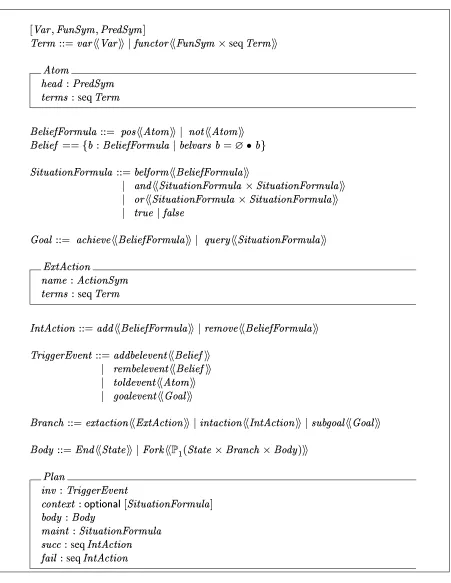
We begin our specification, shown in Figure 2 by defining the allowable beliefs of an agent in dMARS, which are like PROLOG facts. To start, we define a term, which is either a variable or a
function symbol applied to a (possibly empty) sequence of terms, and an atom, a predicate symbol applied to a (possibly empty) sequence of terms. In turn, a belief formula is either an atom or the negation of an atom, and the set of beliefs of an agent is the set of all ground belief formulae (i.e. those containing no variables). (We assume an auxiliary function
.
!
which, given a belief formula, returns the set of variables it contains.) Similarly, a situation formula is an expression whose truth can be evaluated with respect to a set of beliefs. A goal is then a belief formula prefixed with an achieve operator or a situation formula prefixed with a query operator. Thus an agent can have a goal either of achieving a state of affairs or of determining whether the state of affairs holds.
¡
LôM N L
N y ($õ0A ! EöÊö ¡ d÷Ê÷e ( TEöÊö ô: B« N $
U seq ($Ì÷Ê÷ T$ "# ^« N $ K($8; seq ($ ø . ô ($ .
0AùW#1öÊö T$÷Ê÷4e;öÊö T$÷Ê÷ ø .
A>Au[ ø . ô
($
. e .
! A=ú k c « ô $
. 0A .
($töÊö ø . ^ô
$
. ÷Ê÷
e MöÊöª« ô $ . U « ô $ . ÷Ê÷ eDEöÊöª« ô ($ . U « ô ($
. ÷Ê÷ eu {e . ) ./0A " ! ,öÊö ø . ô ($ . ÷Ê÷4e¤v N öÊöª« ô $ . ÷Ê÷ J p $¤ B« N $ K($8; seq ($ ® & 0A MöÊö ø . ô $ . ÷Ê÷lea$ ! ,öÊö ø . ô ($ . ÷Ê÷ +p+, !
&0A .0
!
öÊöø .
÷Ê÷ eu$ .0
!
&öÊöø .
÷Ê÷ eDT.0
!
öÊö T$Ì÷Ê÷ eS+a .X
!
&öÊö
)
.*÷Ê÷
ø "0Aû
J
§öÊö
J
÷Ê÷4e & p ·öÊö
®
&
÷Ê÷4ea
+ .ªöÊö
[image:22.612.82.533.75.658.2]) .÷Ê÷ ø N 0A MöÊöª«& K÷Ê÷4e ô ü:öÊö°R¢ I «& K U ø " U ø p NBO ÷Ê÷ . ! +p+, ! & &K J n #1^E w « ô $ . y p N ø p N $ &nE« ô ($ . l seq® p ./ seq® p
action is the agent itself). External actions are specified as if they are procedure calls, and comprise an external action symbol (analogous to the procedure name) taken from the set
w p
&«
N
$
y, and a sequence of terms (analogous to the parameters of the procedure). Internal actions may be one of two types: add or remove a belief from the data base.
Plans are adopted by agents and, once adopted, constrain an agent’s behaviour and act as
inten-tions. They consists of six components: an invocation condition (or triggering event); an optional context (a situation formula) that defines the pre-conditions of the plan, i.e., what must be believed by
the agent for a plan to be executable; the plan body, which is a tree representing a kind of flow-graph of actions to perform; a maintenance condition that must be true for the plan to continue executing; a set of internal actions that are performed if the plan succeeds; and finally, a set of internal actions that are performed if the plan fails. The tree representing the body has states as nodes, and arcs (branches) representing either a goal, an internal action or an external action as defined below. Executing a plan successfully involves traversing the tree from the root to any leaf node.
A trigger event causes a plan to be adopted, and four types of events are allowable as triggers: the acquisition of a new belief; the removal of a belief; the receipt of a message; or the acquisition of a new goal. This last type of trigger event allows goal-driven as well as event-driven processing. As noted above, plan bodies are trees in which arcs are labelled with either goals or actions and states are place holders. Since states are not important in themselves, we define them using the given set
w
«& K
y. An arc (branch) within a plan body may be labelled with either an internal or external action, or a subgoal. Finally, a dMARS plan body is either an end tip containing a state, or a fork containing a state and a non-empty set of branches each leading to another tree.
All these components can then be brought together into the definition of a plan. The basic ex-ecution mechanism for dMARS agents involves an agent matching the trigger and context of each plan against the chosen event in the event queue and the current set of beliefs, respectively, and then generating a set of candidate, matching plans, selecting one, and making a plan instance for it.
Space constraints prohibit going into further details of the various aspects of this work, but we hope that it has been possible to show how increasing levels of analysis and detail enable transition between abstract conceptual infrastructure and implemented system.
5.2 Application 2: The Contract Net Protocol
The Contract Net as described by Smith [12, 51, 52] is a collection of nodes that cooperate in achieving goals which, together, satisfy some high-level goal or task. Each node may be either a manager who monitors task execution and processes the results, or a contractor who performs the actual execution of the task.
5.2.1 The Contract Net Structure
First, we specify the different kinds of entity from which a contract net is constructed, and which participate in it. A node in a contract net is just an object.
- ð T
Then, reusing our definition of agents, we define a
-·& p
+,&
-ð
+a&
Davis and Smith[12] also describe a single processor node in a distributed sensing example called a monitor node, which starts the initialisation as the first step in net operation. If this is just a node that passes on information to another, then it is no different to the manager specified above. If it generated the goal or task to perform by itself, then it is an autonomous agent.
T
T$
+a& -·&
+a
The contract net consists of
, which are objects. Of these, some are & p +a&£
, which are agents, and a subset of these are
$
T
, which are autonomous agents.
.°.ð p( (¤Rt
* p & +a£¤Rt T $ T>R
T$
+a&
$ T¤¥u & +a£¥ (
However, this is precisely the same as the schema, « .0+ .
+a
, which described a soci-ological agent’s view of the world. We can therefore define
.°.ð p(
in terms of this schema by renaming or substituting the various state variables within it as follows.
.°.ð p( «
.0+
. +a w(ý# T
£
L
&*
+a£1ý
+a&£
L
$
T(ý
T$
+,&£
y
A manager engages contractors to perform certain tasks, where a task is just the same as a goal, since it specifies a state of affairs to be achieved.
üA;A
)
.
In a contract net, a &
comprises a task, and a pair of nodes, a manager and a contractor. Yet again we can define a contract by reusing previous schemas. A contract is a specific type of direct
engagement in which the client of the engagement is the manager of the contract, the server is the
contractor, and the goal of the engagement is the task of the contract. Consequently, we define a contract as follows.
-·& ñ>
^
a+
+,$ w$
+aý# .
&
L
&
Tdý
!
L
üBý+
.
y
Now we can define the set of all contracts currently in operation in the contract net. The schema below includes
.£.
ð
a(
, and defines &
£