Towards a Methodology for Coordination Mechanism
Selection in Open Systems
Simon Miles , Mike Joy
, and Michael Luck
Department of Electronics and Computer Science
University of Southampton, Southampton SO17 1BJ, United Kingdom, [email protected]/[email protected]
Department of Computer Science, University of Warwick, Coventry CV4 7AL, United Kingdom,[email protected]
Abstract. Agent-oriented software engineering (AOSE) is a promising approach to developing applications for dynamic open systems. If well developed, these applications can be opportunistic, taking advantage of services implemented by other developers at appropriate times. However, methodologies are needed to aid the development of systems that are both flexible enough to be opportunistic and tightly defined by the application requirements. In this paper, we investigate how developers can choose the coordination mechanisms of agents so that the agents will best fulfil application requirements in an open system.
1
Introduction
Connecting together software environments (subsystems) to form dynamic open sys-tems offers applications the potential to make use of the most up-to-date functionality in any of those environments at any time. That functionality can then be extended by adding more environments and adding new services to the existing environments. Now, underpinning much of the raison d’etre for multi-agent systems is that they are a highly appropriate technology for applications that run in dynamic open systems. By reacting to changes in the system state and making appropriate decisions, agents can, if well designed, be opportunistic. Opportunistic agents attempt to take advantage of the best functionality available, regardless of whether those services have been implemented by the developer of the agents or provided by another. In order to ensure that an appli-cation can be judged to be opportunistic, the design should be tightly defined by the application requirements, i.e. the design should have justification.
control of the application’s designers or other accessible agents or processes within the open system.
We have developed a methodology in which we model cooperation to achieve an ap-plication’s goals as the result of interactions between agents, without specifying which particular agents the interactions take place between. By raising interactions to the sta-tus of first-class design objects, we allow many agents, including those not existing at design time, to take on the role of participants in the interactions. The aim is that the most suitable agents within the open system can achieve the goals to the highest quality at any point in time.
With applications that have a set of differing goals, the agents that coordinate over those goals may appropriately use different coordination mechanisms. Choosing a sin-gle coordination model, such as a marketplace or a hierarchy, would not necessarily best fit the requirements. We therefore propose analysing each goal to determine the most suitable coordination mechanisms for use by agents cooperating to achieve the goal. We can then design agents that ensure application goals are achieved within the open system, based on the analysis results. Designing the multi-agent system for agent inter-actions where the participating agents are not known in advance places further demands on the analysis process.
In this paper, we demonstrate that our assurance analysis design process meets these demands, with a small example. In order, we present the following.
– A case study is provided to illustrate the methods described in this paper (Section
2).
– The case study requirements are analysed to derive the application goals and
pref-erences as to how to best achieve the goals (Section 3.1).
– We discuss how a designer can choose from known agent coordination mechanisms
to make sure the application is opportunistic and its design is justified (Section 3.2).
– Details of this approach are explained and illustrated by analysing the goals of the
case study application (Section 3.3).
– After goals are matched to the coordination mechanisms which would best allow
them to be achieved, we discuss how the designer can use this information to design the application agents. These agents will use the resources of the open system to achieve the application goals (Section 3.4).
– To show that the design is justified as we have claimed, we show how the design
decisions made in the case study can be traced back to the requirements (Section 4).
Agent Interaction Analysis Our methodology, as a whole, is called agent interaction
analysis. Using the methodology, a designer will perform broadly the following steps to create a multi-agent application functioning in an open system.
– Analyse the application requirements to discover the goals of the application and
– The ideal target application design is then viewed in terms of agent interactions. The
application can be seen as the achievement of the application goals within the open system due to cooperation between agents, each goal achieved being represented by an agent interaction. The agents taking part in the application are not specified as they cannot all be known about at design time ([8] also discusses designing systems that allow interactions between dynamically created agents).
– To achieve this target design, the designer adds agents to the open system to ensure
the application goals are met.
– The designs of individual agents are tailored to match the preferences of the
ap-plication, so as to best achieve the goals. The designer chooses between different models for each agent mechanism, where the models are described by third-party design patterns. The approach aims to preserve flexibility in the system as far as possible to allow full use of other agents in the open system that may more closely match preferences in their activity than the ones that the designer has added.
In this paper, we concentrate only on choosing the coordination mechanisms for the agents added to the system, which is a later stage of our methodology. As stated above, the coordination mechanisms most suitable for achieving a goal are those that tailor the interacting agents to best match the goal’s preferences. See [10] for more on our methodology, and [13] for an overview of agent-oriented software engineering.
2
Case Study
To illustrate the design of multi-agent applications, we provide a case study that will be used throughout this paper. We assume that the case for using an agent-based approach for this application has already been made. In this section, we present the requirements document for an example application.
We require a collaborative weather mapping application. Using the application, a global weather map giving the current state is accessed and edited by various collabo-rating organisations. Contributors can add data they have gathered locally to the map in authorised locations. For example, one organisation may be authorised to add data concerned with a small local area, while another can add data for any location within a country. Authorisation is enforced to prevent accidental changes. Contributors and other organisations can access the weather data and be provided with predictions of weather at specified locations in the future. As with the contribution of data, different organisations have differing access rights to predictions on different locations.
over opportunism in general. Authorisation for editing data and viewing predictions is governed by stored access rights, which some users are authorised to edit.
Of course, requirements are unlikely to be provided completely in a single docu-ment, and further requirements capture may require further processes. Appropriate re-quirements capture and analysis is beyond the scope of this paper, and so we summarise key points that have been identified by the designer in our case study.
– Users need to perform three operations using the application as a whole: contribute
some weather data, view predictions based on this data and set access rights for other users.
– When contributing data to the map, a user wishes the data to be added as quickly
as possible, access rights to be observed and the data to be reliably integrated into the map, especially as new data may be generated frequently.
– When viewing a prediction based on existing data, a user particularly wishes for
the quality of the prediction (the probability of its accuracy) to be high, as well as wishing it to be quickly presented to them. Again, the access rights should be observed, but also the user of the application wishes to ensure that it has enough flexibility to use higher quality prediction services when they become available.
– In setting access rights, the user primarily wishes the operation to be performed
quickly and in observation of access rights.
3
Designing Coordination for an Open Application
In this section we examine how agents can be designed to fit application requirements. In particular, we examine which coordination mechanisms would best match the pref-erences of application goals, to allow an agent added to the system, or, indeed, already existing in the open system, to best fulfil the application goals opportunistically. The justification for each design decision is made explicit in sections marked ‘Justification of Design Decision’.
3.1 Requirements to Design
Requirements engineering is the process of understanding and refining the requirements of an application. This may be aided by taking prospective users through usage scenar-ios [7], for example. Agent-oriented approaches to development should not force any change in an applications requirements. Therefore, the techniques used in requirements engineering for agent-based systems will be the same as those elsewhere [3, 12] (see Tropos [1] for an agent-oriented software engineering methodology based on require-ments engineering).
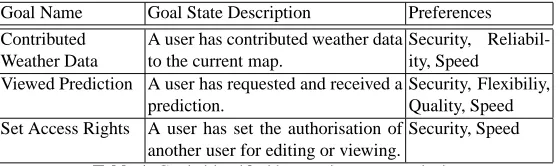
A common requirements engineering technique is to describe the requirements in terms of functional goals it is intended to achieve and priorities and restrictions which, jointly, we call preferences. For brevity we exclude the requirements analysis of our case study and simply present the results in Tables 1 and 2 for goals and preferences respectively.
Goal Name Goal State Description Preferences Contributed
Weather Data
A user has contributed weather data to the current map.
Security, Reliabil-ity, Speed
Viewed Prediction A user has requested and received a prediction.
Security, Flexibiliy, Quality, Speed Set Access Rights A user has set the authorisation of
another user for editing or viewing.
[image:5.612.170.450.65.148.2]Security, Speed
Table 1. Goals identified by requirements analysis
achieved. The associated preferences state those priorities and restrictions that should be observed while attempting to achieve the goal. A goal is, in fact, a class of goal instances; there will be many times in which a user will contribute weather data, for example, and each of those may be the contribution of data at a different map location. Each contribution is an instance of the Contributed Weather Data goal. In Table 2, each preference identified is given a name and a description.
Preference Name Preference Description
Security Security of information prioritised. Reliability Reliability of achievement prioritised.
Flexibility Flexibility for opportunistic behaviour prioritised. Quality Quality of results prioritised.
Speed Speed of achievement prioritised.
Table 2. Preferences identified by requirements analysis
Justification of Design Decision The goals and preferences are decided upon by being
directly identified from the requirements.
For a complex application, goals can be divided into subgoals. A subgoal will inherit the applicable preferences from its parent goal. This is not discussed further here but see [10] for more.
3.2 Coordination Mechanisms
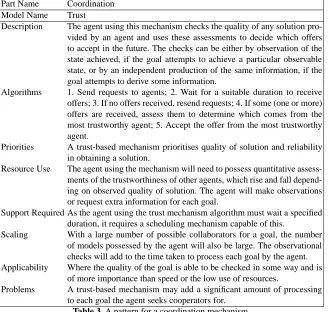
Trust An agent using this mechanism, based broadly on the one suggested by Marsh
[9], keeps a record of the success of cooperating agents in achieving goals. Future choices of cooperating agents are decided by whichever agents have been most suc-cessful in the past. This allows the agent to choose between agents based on their trustworthiness [5]. For Contributed Weather Data and Set Access Rights goals, the successfulness of an attempt could be the speed at which the goal is achieved. For Viewed Prediction, the success is judged by the prediction’s accuracy, which could be checked when the actual data for the predicted time and location is contributed. The mechanism may take longer to use than others as the agent will have to dis-cover which potential cooperating agents are available before choosing one. There is a wide range of research on modelling trust [5], and we do not claim that this mechanism as described is better or worse than others.
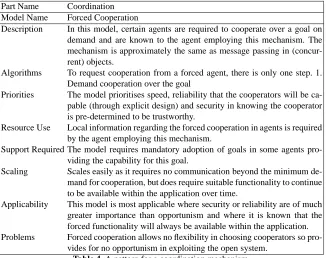
Forced Cooperation An alternative method for an agent to find suitable cooperating
agents is for the designer to implement agents with references to pre-selected agents that are known to be tailored to achieve a goal and are forced to accept requests for cooperation over that goal. This mechanism, similar to standard method invocation in object-oriented systems, prioritises speed and reliability over opportunism.
Different goals have different measures of success, as given by the preferences such as those given in the preceding section. In order for a coordination mechanism to be suitable for matching a preference, a mechanism must have two properties. First, it must be useful in choosing agents or other services in the open system whose activity best matches the preference. Second, it must match the preference itself. For example, in our case study, contributing weather data should occur as quickly as possible. A mechanism coordinating this goal should choose agents offering to edit the appropriate part of the weather map and should not slow the process down unduly by the act of coordination.
In agent interaction analysis, the designer performs the following steps to decide on which coordination mechanisms is most appropriate for each application goal.
1. The designer is supplied with a set of coordination mechanism definitions in a stan-dard pattern language. This follows the approach of design patterns [6], in which abstract parts of a design are made available to designers to encourage re-use of well-founded designs. There are many agent coordination mechanisms suggested in the literature but we use only the above two as examples in this paper (for brevity). 2. For each application goal, the designer chooses a coordination mechanism most suitable for matching the goal’s preferences. In order to aid comparison, the de-signer performs more detailed analysis of the mechanisms. This analysis is called assurance analysis and is described in the next section.
3. From the choices of coordination mechanisms for each goal, the designer decides on the coordination mechanisms for the agents that will be added to the open sys-tem. When these agents are added the appication will be instantiated. This step is called collation and is discussed in Section 3.4.
shown in Tables 3 and 4. The tables describe eight aspects of each mechanism that may be revelant to application preferences.
Part Name Coordination Model Name Trust
Description The agent using this mechanism checks the quality of any solution pro-vided by an agent and uses these assessments to decide which offers to accept in the future. The checks can be either by observation of the state achieved, if the goal attempts to achieve a particular observable state, or by an independent production of the same information, if the goal attempts to derive some information.
Algorithms 1. Send requests to agents; 2. Wait for a suitable duration to receive offers; 3. If no offers received, resend requests; 4. If some (one or more) offers are received, assess them to determine which comes from the most trustworthy agent; 5. Accept the offer from the most trustworthy agent.
Priorities A trust-based mechanism prioritises quality of solution and reliability in obtaining a solution.
Resource Use The agent using the mechanism will need to possess quantitative assess-ments of the trustworthiness of other agents, which rise and fall depend-ing on observed quality of solution. The agent will make observations or request extra information for each goal.
Support Required As the agent using the trust mechanism algorithm must wait a specified duration, it requires a scheduling mechanism capable of this.
Scaling With a large number of possible collaborators for a goal, the number of models possessed by the agent will also be large. The observational checks will add to the time taken to process each goal by the agent. Applicability Where the quality of the goal is able to be checked in some way and is
of more importance than speed or the low use of resources.
[image:7.612.146.477.115.427.2]Problems A trust-based mechanism may add a significant amount of processing to each goal the agent seeks cooperators for.
Table 3. A pattern for a coordination mechanism.
3.3 Assurance Analysis
The choice between mechanisms, even when design patterns are provided, may be difficult be-cause different stages of the mechanisms’ use can have very different effects on an application’s performance. For example, with a trust mechanism such as the one suggested above, the process of building up a large table of trustwothiness information on agents in the open system may be costly in terms of time and storage space. It would, however, be very useful in making coordi-nation decisions on which agents to best cooperate with. In order to supplement the information given in the supplied patterns, an application designer can further analyse how well mechanisms meet the application requirements by breaking their operation into smaller parts.
Assurance analysis is a procedure in which to analyse how well a coordination
Part Name Coordination Model Name Forced Cooperation
Description In this model, certain agents are required to cooperate over a goal on demand and are known to the agent employing this mechanism. The mechanism is approximately the same as message passing in (concur-rent) objects.
Algorithms To request cooperation from a forced agent, there is only one step. 1. Demand cooperation over the goal
Priorities The model prioritises speed, reliability that the cooperators will be ca-pable (through explicit design) and security in knowing the cooperator is pre-determined to be trustworthy.
Resource Use Local information regarding the forced cooperation in agents is required by the agent employing this mechanism.
Support Required The model requires mandatory adoption of goals in some agents pro-viding the capability for this goal.
Scaling Scales easily as it requires no communication beyond the minimum de-mand for cooperation, but does require suitable functionality to continue to be available within the application over time.
Applicability This model is most applicable where security or reliability are of much greater importance than opportunism and where it is known that the forced functionality will always be available within the application. Problems Forced cooperation allows no flexibility in choosing cooperators so
[image:8.612.146.472.65.323.2]pro-vides for no opportunism in exploiting the open system. Table 4. A pattern for a coordination mechanism.
mechanisms for the application. It takes the viewpoint of a single agent attempting coordination with unknown others, so as to ensure flexibility in making full use of the open system. In this paper, we use simple tables to provide the results of the analysis for brevity.
In Tables 6, 7 and 8, we analyse and compare how well each of the two coordination mecha-nisms matches the preferences of each goal of our case study. The analysis attempts to be detailed to guide the designer in considering all aspects of the decision. Each cell in the tables is com-pleted by the designer, and indicates whether a coordination mechanism is suitable for the goal being analysed, in some respect. Clearly two different designers may give different analyses, and so different entries into the tables, but the analysis still gives a justification for design decisions. Any more objective measure would be difficult as the priorities (preferences) of applications will vary widely.
Each of the tables is divided into four stages of execution. The top stage analyses the obtain-ing of information required to coordinate. The next stage down examines the updatobtain-ing of stored information on potential cooperating agents. The third stage concerns the analysis made by the agent from the cooperating agent information. The lowest stage examines acting on the analyses made.
For example, in Table 6, the Trust mechanism has a ‘no’ entry in the second stage for the preference to prioritise speed. This is because, at the stage of building up information on potential cooperating agents, the Trust mechanism could be slow and prioritises quality of solution over speed. It can be seen that the analysis of a mechanism with regard to a preference is independent of any goal, so the same analysis of the Speed preference is made in Tables 6 and 8, for instance. In Table 7, the Forced Cooperation mechanism is stated not to allow the prioritisation of flexibility or quality of solution from the point at which it gathers information for cooperation (the first stage). This is because it does not attempt to discover any more suitable agents in the system but instead relies on pre-selected agents.
The analyses made suggest that the Forced Cooperation mechanism is most useful for the Contributed Weather Data and Set Access Rights goals and Trust is best for coordinating over Viewed Prediction.
Justification of Design Decision The analysis of how well each coordination mechanism matches the preferences of each goal justifies the choice of mechanisms.
3.4 Collation
Once designers have decided which of the coordination and other mechanisms available best match the application preferences, they can use this information to decide on the design of agents. The agents, when added to the open system, should instantiate the application goals while match-ing the preferences.
In our example, we have decided that a Forced Cooperation coordination mechanism would be best for coordinating Contributed Weather Data and Set Access goals and Trust would be most suitable for coordinating Viewed Prediction goal. As there are no other mechanisms specified in this brief example, the most obvious agents to introduce are to have one tailored to adopting and coordinating over the Contributed Weather Data and Set Access goals and one for the Viewed Prediction goal.
We give the final agent design in Table 5, which includes both the coordination mechanisms and the goals that each of the agents will make offers to achieve if requested (the goals they will
adopt). The first agent can only adopt the Contributed Weather Data and Set Access Rights goals
because it requires pre-selected cooperating agents and will only have them for those goals. We allow the second agent to adopt any of the goals, as there is no reason to restrict it and therefore, for maximum opportunism of the application, we do not restrict it (though it will be restricted in implementation). The full criteria for deciding on the complete set of agents being added to an open system depends on the application-wide preferences given in the requirements. Techniques for assessing whether applications meet application-wide preferences is discussed in [2].
The above application of assurance analysis is fairly simple as our case study is also simple and contrived for the purpose of this paper. For this reason we cannot illustrate the full potential of the analysis here. For example, both of the Forced Cooperation and Trust mechanisms concentrate on choosing between suitable agents which leads to preferences being disallowed at the early stages (higher tables in the analysis) or not at all.
Agent Coordination Will Adopt
1 Forced Cooperation Contributed Weather Data, Set Access Rights
2 Trust All goals
[image:9.612.176.439.557.600.2]Information Acquisition
Preference Trust Forced Cooperation Security yes yes
Reliability yes yes
Speed yes yes
Updating Models
Preference Trust Forced Cooperation Security yes yes
Reliability yes yes
Speed no yes
Information Analysis
Preference Trust Forced Cooperation Security yes yes
Reliability yes yes
Speed no yes
Acting on Analysis
Preference Trust Forced Cooperation Security yes yes
Reliability yes yes
Speed no yes
Table 6. Assurance Analysis of Contributed Weather Data goal
Information Acquisition
Preference Trust Forced Cooperation Security yes yes
Flexibility yes no Quality yes no
Speed no yes
Updating Models
Preference Trust Forced Cooperation Security yes yes
Flexibility yes no Quality yes no
Speed no yes
Information Analysis
Preference Trust Forced Cooperation Security yes yes
Flexibility yes no Quality yes no
Speed no yes
Acting on Analysis
Preference Trust Forced Cooperation Security yes yes
Flexibility yes no Quality yes no
[image:10.612.132.480.63.354.2]Speed no yes
Table 7. Assurance Analysis of Viewed Predic-tion goal
Information Acquisition
Preference Trust Forced Cooperation Security yes yes
Speed no yes
Updating Models
Preference Trust Forced Cooperation Security yes yes
Speed no yes
Information Analysis
Preference Trust Forced Cooperation Security yes yes
Speed no yes
Acting on Analysis
Preference Trust Forced Cooperation Security yes yes
[image:10.612.312.477.390.582.2]Speed no yes
Justification of Design Decision The design of agents produced by collation is wholly
based on the mechanisms determined to be best for each goal.
4
Judging the Design
When creating a multi-agent application, the design is justified by the requirements if the functionality is divided between agents in a way justified by the requirements. The dynamic nature of open systems means that any test performed on an implemented (opportunistic) open system application is unrepeatable and, therefore, of limited value [14]. Also, the application may make use of any functionality in the open system but, clearly, the only part of the application that can be tailored to the requirements is that which is known about at design time and whose form is under the control of the de-signer.
4.1 Tracing Backwards
The first agent in Table 5 has the functionality identified as most suitable for originators of two goals: Contributed Weather Data and Set Access Rights. The designer has chosen to merge the agents designed to coordinate over these goals, so that the organisation contains one agent (in the application set) tailored to providing this functionality rather than two. By simply identifying agents in the original requirements, the designer could, for example, have chosen to implement two agents that separately dealt with the two goals. To see why the decision to choose this particular organisation is justified, we can reason (trace) backwards from the collation stage, at which the final organisation is chosen.
1. At the start of the collation stage, the designer has decided that an agent tailored to coordinating over the Contributed Weather Data goal would have an architecture which used forced cooperation to coordinate. The designer has also decided that an agent tailored to coordinating over the Set Access Rights goal would have the same architecture. These are decisions on the most suitable architectures for agents initiating cooperation over the goals. The decisions on the choice of most suitable architecture for each agent is the results of analysis, such as the assurance analysis described earlier, into how the agents can be tailored to match the requirements, and should, therefore, inform the choice of organisation.
agents are similar enough, as long as the architectures are themselves justified by the requirements.
3. To see that the architectures of the agents are justified we examine the assurance analysis. The assurance analysis for the Contributed Weather Data goal gives rea-sons why the most suitable coordination mechanisms for the goal is Forced Coop-eration, based on comparing preferences of that goal with the operations of each mechanism. The Set Access Rights analysis comes to the same conclusion for that goal. The choice of architectures for the agents was decided on the basis of the goal and application preferences.
4. The Contributed Weather Data and Set Access Rights goals and their preferences were extracted from the requirements in the requirements analysis stage by exam-ining the scenarios, entities and goals mentioned in the requirements.
4.2 Opportunism
The other aspect of justification for designs is that it is restricted as little as possible in its opportunism. The two agents in Table 5 differ greatly in their interoperability. The first agent is heavily restricted in its operations while the second is highly interoperable. We claim that the opportunism of each is restricted only as far as the requirements de-mand and the design decisions are, therefore, justified. We examine the design decisions restricting or allowing opportunism for each agent below.
1. The first agent is heavily restricted in its activity.
(a) The preference to validate authorisation to edit the weather map and access rights and the emphasis on reliability in contributing to the map require that the agent uses only trusted agents in making alterations. This can either be achieved by checking the agent’s actions to determine their reliability or by always using standard cooperating agents chosen by the designer. Speed is more important than interoperability so the designer chose the latter option (the Forced Cooperation coordination mechanism).
(b) Using Forced Cooperation requires that references to cooperating agents be known in advance. Thus, only the goals for which references are provided can be attempted by the agent, which are Contributed Weather Data and Set Access Rights in this case. The agent will only offer to adopt these two goals. (c) These restrictions are derived from the requirements (goals and preferences).
2. The second agent has very little restriction on its behaviour.
(a) The preferences on getting accurate predictions in prediction viewing opera-tions lead the designer to use interoperation to find the most suitable cooper-ating agents at each instance. To decide between coopercooper-ating agents, the agent uses a trust-based mechanism giving information on the previous likely accu-racy of results.
(b) There is no reason to prevent the agent from being given the ability to coordi-nate over other goals, and so it is given the ability to do so.
5
Conclusions
In this paper, we have shown how a designer can choose coordination mechanisms for agents implementing an application in an open system. We have shown that these decisions can be analysed to determine that the design does meet the requirements, and allows for flexible use of the functionality available in the open system at any one time. Our methodology was developed to allow designers to produce opportunistic open systems applications whose design is fully justified by the application requirements. We do not believe this is currently achieved by other agent-oriented software engineering methodologies.
Future work will examine how the infrastructure supporting agents can also be de-signed to cohere with the guiding concepts identified above. One minor problem to be addressed with the methodology, however, as with any that attempts to analyse all points at which an application could take advantage of available functionality, is keep-ing the volume of the specification to a manageable level. More detailed results of the case study, and further details of the methodology, are available from the first author.
Acknowledgements This work was carried out while supported by the myGrid project
(EPSRC reference GR/R67743/01) at University of Southampton.
References
1. J. Castro, M. Kolp, and J. Mylopoulos. A requirements-driven development methodology. In Proceedings of the 13th International Conference on Advanced Information Systems
En-gineering (CAiSE-01), Interlaken, Switzerland, 2001.
2. P. Davidsson and S. Johansson. Evaluating multi-agent system architectures: A case study concerning dynamic resource allocation. In this volume, Madrid, Spain, 2002.
3. A. M. Davis. Software Requirements: Objects, States and Functions. Prentice Hall, 1993. 4. V. Dignum, H. Weigand, and L. Xu. Agent Societies: Toward Frameworks-Based Design. In
M. Wooldridge, P. Ciancarini, and G. Weiss, editors, Proceedings of the Second International
Workshop on Agent-Oriented Software Engineering (AOSE-2001), pages 25–32, Montreal,
Canada, 2001.
5. R. Falcone and B. S. Firozabadi. The challenge of trust: The Autonomous Agents ’98 Work-shop on Deception, Fraud and Trust in Agent Societies. Knowledge Engineering Review, 14(1):81–89, 1999.
6. E. Gamma, R. Helm, R. Johnson, and J. Vlissides. Design patterns: Abstraction and reuse of object oriented design. In Proceedings of ECOOP’93, Kaiserslautern, Germany, 1993. 7. P. Haumer, K. Pohl, and K. Weidenhaupt. Requirements elicitation and validation with real
world scenes. IEEE Transactions on Software Engineering, 24(12), December 1998. 8. M. N. Huhns. Interaction-oriented programming. In P. Ciancarini and M. J. Wooldridge,
editors, Proceedings of Agent-Oriented Software Engineering 2000 (AOSE 2000), 2000. 9. S. P. Marsh. Formalising Trust as a Computational Concept. PhD thesis, Department of
Computing Science and Mathematics, University of Stirling, 1994.
10. S. Miles, M. Joy, and M. Luck. Designing agent-oriented systems by analysing agent in-teractions. In P. Ciancarini and M. J. Wooldridge, editors, Proceedings of Agent-Oriented
11. A. Omicini. SODA: Societies and infastructures in the analysis and design of agent-based systems. In P. Ciancarini and M. J. Wooldridge, editors, Proceedings of Agent-Oriented
Software Engineering 2000 (AOSE 2000), 2000.
12. A. van Lamsweerde. Requirements engineering in the year 00: A research perspective. In
Proceeding of the Twenty-Second International Conference on Software Engineering (ICSE-00), 2000.
13. M. Wooldridge and P. Ciancarini. Agent-oriented software engineering: The state of the art. In P. Ciancarini and M. J. Wooldridge, editors, Proceedings of Agent-Oriented Software
Engineering 2000 (AOSE 2000), 2000.