IEEE Proof
Average Error Rates and Achievable Capacity in
Large Office Indoor Wireless Environments
Indrakshi Dey, Member, IEEE, Geoffrey G. Messier, Member, IEEE, and Sebastian Magierowski, Member, IEEE
Abstract— Performance of common digital modulation
tech-1
niques is analyzed over indoor wireless environments modeled 2
through the recently proposed joint fading and two-path shadow-3
ing (JFTS) channel model. Mathematically tractable expressions 4
for the instantaneous signal-to-noise ratio statistics, average bit 5
error rates, and achievable channel cutoff rates are derived. 6
Analytical results are used to: 1) investigate the impact of differ-7
ent JFTS model parameters and different modulation techniques 8
on bit error rates and cutoff rates and 2) demonstrate how the 9
JFTS channel model affects system performance in comparison 10
with conventional empirical channel models. Finally simulation 11
results are used to corroborate this analysis and evaluate the 12
usefulness of such an analysis. 13
Index Terms— JFTS, ABER, M-QAM, M-PSK.
14
I. INTRODUCTION
15
A. Motivation
16
T
HE wide variety of applications of indoor wireless com-17munication has resulted in the increased demand of exact 18
theoretical analysis of high capacity wireless communication 19
systems when implemented on indoor wireless access points. 20
For example, expressions for the average bit error rate (ABER) 21
are essential for designing effective signaling and error control 22
coding schemes, as they provide insights into how system 23
parameters affect performance and are more computationally 24
efficient for analyzing system performance. 25
It is well-known that indoor wireless links are affected by 26
both small scale fading and shadowing effects. Therefore, 27
it will be more accurate to account for the combined small 28
and large scale channel effects while evaluating system per-29
formance. Common composite channel models [1], [2], [3] 30
that combine large and small scale channel effects have been 31
developed primarily for outdoor channels, where the users are 32
highly mobile transiting through several scattering clusters. 33
As a result, a range of main waves arrive at the mobile, the 34
strength of each of which can be drawn from the log-normal 35
or the Gamma distribution. 36
In an indoor wireless environment, the path between the 37
access point and the users is too short for shadowing to be 38
Manuscript received December 21, 2016; revised April 30, 2017 and June 18, 2017; accepted July 12, 2017. The associate editor coordinating the review of this paper and approving it for publication was J. Choi.
(Corresponding author: Indrakshi Dey.)
I. Dey and G. G. Messier are with the Department of Electrical and Computer Engineering, University of Calgary, Calgary, AB T2N 1N4, Canada (e-mail: [email protected]; [email protected]).
S. Magierowski is with the Department of Electrical Engineering and Computer Science, Lassonde School of Engineering, York University, Toronto, ON M3J 1P3, Canada (e-mail: [email protected]).
Digital Object Identifier 10.1109/TCOMM.2017.2729552
accurately characterized by the log-normal distribution and the 39 mobile users restrict their movement within a small area due to 40 the incapability of most WLAN standards to handle hand-offs 41 efficiently. A new composite channel model, called the joint 42 fading and two-path shadowing (JFTS) model, is proposed 43 in [4]. Based on an extensive channel measurement campaign, 44 the JFTS model is shown to be a more accurate model for 45 characterizing indoor WLAN channels. 46 The JFTS distribution has also some added advantages over 47 other common composite channel models. Since the JFTS 48 distribution is a general model that includes a wide variety 49 of channel conditions as special cases (no fading, no shadow- 50 ing, deep fading, heavy shadowing, etc.), the expressions for 51 different performance metrics evaluated over the JFTS channel 52 will provide us with the achievable performance measures over 53 a large variety of practical channel conditions. 54 The JFTS distribution is fundamentally different from 55 other composite fading/shadowing models. It is a convolu- 56 tion of the Ricean fading and the two-wave with diffused 57 power (TWDP) shadowing models [5]. It follows the bivariate 58 non-centralized chi-squared distribution and therefore, cannot 59 approach Gaussian statistics. This is unlike conventional fad- 60 ing models that can approach zero-mean complex Gaussian 61 statistics under different propagation conditions. This suggests 62 that performance of different communication systems over 63 the JFTS channel will be very different than what has been 64 predicted by conventional fading/shadowing models and moti- 65 vates the need for analytical error rate and achievable capacity 66 expressions specifically for the JFTS channel. 67 The work in [4] is extended in [6] and [7] by deriving 68 expressions for the first-order statistics and Cumulative Distri- 69 bution Function (CDF) of the JFTS distribution respectively. 70 In [8], expressions for ergodic capacity achievable by different 71 adaptive transmission techniques over a JFTS channel are 72 derived. The effect of these adaptive schemes on the rela- 73 tionship between optimal cutoff signal-to-noise ratio (SNR) 74 and the average received SNR for JFTS faded/shadowed links 75 is also studied in [8]. However, to the best of the authors’ 76 knowledge, a detailed study on how different M-ary coherent 77 and noncoherent modulation techniques perform when applied 78 to a JFTS faded/shadowed link has not yet been conducted in 79
literature. 80
B. Main Results and Paper Organization 81
The main contributions of the paper are summarized as 82
follows. 83
IEEE Proof
• We derive analytically tractable expressions for ABER 84
of coherent and noncoherent binary, and coherent 85
M-ary modulation techniques over a non-Gaussian indoor
86
WLAN environment, which can be accurately charac-87
terized by the JFTS model. We focus on the CDF 88
based approach [9] for deriving ABER expressions. 89
We also study the impact of different JFTS distribu-90
tion parameters on the performance based on numerical 91
results. 92
• In this paper, we provide expressions that are numeri-93
cally efficient and simple to handle. Towards this end, 94
we derive error rate expressions that involve truncation 95
of the infinite series of the original expressions. The 96
approximate expressions are derived in a way such that 97
they guarantee that the area under the probability density 98
function (PDF) of the instantaneous SNR remains equal 99
to 1. However, the truncation bound is decided based on 100
the study done in [10] for analysis of bandwidth efficiency 101
for the JFTS channel. 102
• We also evaluate the channel cutoff rate associated with 103
M-ary signaling and JFTS channels both in presence
104
and absence of channel magnitude and phase estimates. 105
The channel cutoff rate R0 of the communication link is
106
defined as a channel capacity related quantity such that 107
for any Rc < R0, it is possible to construct a channel
108
code using block length n and coding rate Rc capable of
109
maintaining an average error probability less than or equal 110
to 2−n(R0−Rc)[11]. Quantifying the channel cutoff rate is
111
done using the Chernoff bound calculation. Therefore, 112
the channel cutoff rate obtained in this way can also be 113
used as an analytical bound limiting the bit error perfor 114
M-ary signaling techniques are implemented.
115
The paper is organized as follows. Section II describes 116
the statistics of instantaneous received SNR over a JFTS 117
faded/shadowed channel. The error performance and chan-118
nel capacity analyses are presented in Section III and 119
Section IV. Numerical results and discussions are given 120
in Section V, while concluding remarks are provided in 121
Section VI. 122
II. STATISTICS OFINSTANTANEOUSSNR
123
Let s(k)represent the transmitted data symbol with symbol 124
energy Es =E{|s(k)|2}that is transmitted over a composite
125
slow shadowed and flat faded wireless communication channel 126
with JFTS statistics. The bit energy is then defined as Eb=
127
Es/log2M, where M is the modulation constellation size used
128
for data transmission. The received data symbol y(k)over the 129
sampling instant k can be given by 130
y(k)=z(k)ejφ(k)s(k)+n(k) (1) 131
where n(k) is the complex Additive White Gaussian 132
Noise (AWGN) with one side power spectral density of N0,
133
φ(k)is the instantaneous phase and z(k)denotes the composite 134
fading/shadowing envelope which is JFTS distributed. 135
The first order statistics of the channel joint fading/ 136
shadowing stochastic process, z(k), can be represented by the 137
random variable, Z , which has a PDF given by [4] 138
fZ(z)=
4
i=1
m
h=1 biz Rh
2P1P2 e−
K−Sh− z2
2P2r2h 139
×
C1iI0
2z
K Sh(1−Ti)
P1P2
140
+C2iI0
2z
K Sh(1+Ti)
P1P2
(2) 141
and a CDF given by [7] 142
FZ(z)=
4
i=1
m
h=1
biRhrhe−K−Sh
2P1 √
P2 143
×
C1i Q1
K Sh(1−Ti)rh
P1 ,z
144
+C2i Q1
K Sh(1+Ti)rh
P1 ,z
(3) 145
where C1i = eShTi, C2i = e−ShTi, Ti =cos((i −1)π/7), 146
I0 is the 0th-order modified Bessel function of the first kind, 147
m is the quadrature order, Rh = |wrhh|er
2
h−rh2/2 P1, w
h are the 148 Gauss-Hermite quadrature weight factors [12], rhare the roots 149 of the Hermite polynomial for h = 1,2, . . . ,m, Q1 is the 150 Marcum Q-function and bi = aiI0(1) with a1 = 17280751 , 151
a2 = 172803577, a3 = 64049 and a4 = 172802989. The behavior of 152 the JFTS distribution is guided by the fading parameter K , 153 shadowing parameter Sh, shape parameterand mean-squares 154 of the diffused and the shadowed components, P1 and P2, 155 respectively. For our analysis we have chosen the quadrature 156
order m=20. 157
If the instantaneous received SNR per symbol is defined as 158 γ (k)=z2(k)E
s/N0 and the average received SNR asγ (k)= 159 E{z2(k)}E
s/N0, where Es is the energy per symbol and N0 160 is the noise density (the noise power present in 1 Hz), the 161 PDF ofγ (for the sake of simplicity of notation, we drop the 162 sampling index k from here on) can be obtained in terms of 163 γ [13] by change of variables as 164
fγ(γ )= 4
i=1
m
h=1 biRh
γP1P2e
−K−Sh− γ
2γP2r2h 165
×
C1iI0
2
K Sh(1−Ti)γ
γP1P2
166
+C2iI0
2
K Sh(1+Ti)γ
γP1P2
(4) 167
whereis the mean-squared value of the JFTS envelope given 168 by =4P1P2(1+K)(1+Sh)[6]. The corresponding CDF 169 of γ can be defined as Fγ(γ ) = −∞γ fγ(u)du and can be 170 expressed as Fγ(γ )=Fz γE{Z2}/γ
. 171
IEEE Proof
expansion of modified Bessel function, I0(f)=∞t=0(f/2)2t
(t!)2 ,
176
we arrive at an alternative expression for (4) as 177
fγ(γ )= 4
i=1
m
h=1
∞
t=0 Ai,h
γ (t!)2e−
Bhγ /γ
178
×C1i C3iγ /γt+C2i C4iγ /γt (5) 179
where Ai,h = biPRh1P2e−K−Sh, Bh = 2 P
2rh2, C3i = K Sh(1−
180
Ti)/(P1P2) and C4i = K Sh(1 +Ti)/(P1P2). If we
181
truncate the infinite series summation to tmax, we can obtain
182
an approximate version of (5) as below, 183
fγ(γ )≈ 4
i=1
m
h=1
tmax
t=0 Ai,h
γ (t!)2e
−Bhγ /γ
184
×D1tC1i C3iγ /γt+D2tC2i C4iγ /γt (6) 185
where D1t = γ (t!)
2
Ai,h
γ
C3i
ttmax+1
u=1 (u −1)! Bhγ u
and D2t =
186 γ (t!)2
Ai,h
γ
C4i
ttmax+1
u=1 (u −1)! Bγh u
for γ > 0 and Bh > 0.
187
The constants, D1t and D2t in (6) are derived for the sake
188
of guaranteeing that the area under the PDF of γ remains 189
equal to 1. For our numerical analysis, we have chosen tmax=
190
25 based on the observations in [10]. 191
Proposition 1: The exact and approximate expressions for
192
Fγ(γ )can be given by 193
Fγ(γ )=1−
4
i=1
m
h=1
∞
t=0
Ai,h(t+1,Bhγ /γ )
(t!)2Bt+1
h
194
×
C1iC3it +C2iC4it
195
≈1−
4
i=1
m
h=1
tmax
t=0
Ai,h(t+1,Bhγ /γ )
(t!)2Bt+1
h
196
×
D1tC1iC3it +D2tC2iC4it
(7) 197
where (·,·) is the generalized upper incomplete Gamma 198
function [12]. 199
Proof: See Appendix A.
200
In the next section, we will be using the CDF-based 201
approach and therefore, (7) for deriving the ABER expres-202
sions for different modulation techniques over a JFTS 203
faded/shadowed communication channel. 204
III. ERRORPERFORMANCEANALYSIS
205
In order to obtain the ABER of a large variety of modulation 206
techniques, the CDF-based approach of [9] and [14] will be 207
used in this section. 208
A. Binary Modulation Schemes
209
For any binary coherent and noncoherent modulation 210
technique, the ABER over a composite flat faded and slow 211
shadowed wireless communication channel suffering from 212
AWGN can be expressed in terms of the CDF of the instan-213
taneous SNR as [9] 214
PbBinary(e)= α β
2(β)
∞
0 γ
β−1 e−αγ F
γ(γ )dγ (8) 215
where α = 1 for Binary Phase Shift Keying (BPSK) and 216 α = 1/2 for Binary Frequency Shift Keying (BFSK). If the 217 modulation is differential or noncoherent, β = 1, while for 218 coherent modulation,β=1/2. 219
Proposition 2: The ABER expression for any coherent 220 or noncoherent binary modulation technique over a JFTS 221 faded/shadowed channel can be obtained in exact and approx- 222 imate mathematically tractable format as 223
PbBinary(e) 224
= 1
2 −
4
i=1
m
h=1
∞
t=0 Ai,h
(t!)2
C1iC3it +C2iC4it
225
× αβγβ
2β(β)
(β+t+1) (αγ +Bh)β+t+1
226
×2F1
1, β+t+1;β+1; αγ αγ +Bh
227
≈ 1
2 −
4
i=1
m
h=1
tmax
t=0 Ai,h
(t!)2
D1tC1iC3it +D2tC2iC4it
228
× αβγβ
2β(β)
(β+t+1) (αγ +Bh)β+t+1
229
×2F1
1, β+t+1;β+1; αγ αγ +Bh
. (9) 230
wherepFq(·)is the generalized hyper-geometric function [12] 231 and p,q are integers. 232
Proof: See Appendix B. 233
B. M-Ary Coherent Modulation Schemes 234
In order to evaluate the error performance of M-ary coherent 235 modulation techniques over a composite fading/shadowing 236 channel, we need to calculate an integral of the form [9] 237
PbM-ary(e,g)= √1
2π ∞ 0 Fγ v2 g
e−v2/2dv (10) 238 where g depends on the modulation type [13]. 239
Proposition 3: For a JFTS channel, ABER expression for 240 coherent M-ary modulation technique can be obtained in exact 241 and approximate mathematically tractable format as 242
PbM-ary(e,g) 243
= 1
2 −
4
i=1
m
h=1
∞
t=0 Ai,h
(t!)2
C1iC3it +C2iC4it
244
×2t+1 √
gγ (t+3/2) (gγ+2Bh)t+3/2
2F1
1,t+3
2; 3 2;
gγ gγ+2Bh
245
≈ 1
2 −
4
i=1
m
h=1
tmax
t=0
D1tC1iC3it +D2tC2iC4it
Ai,h
(t!)2 246
×2t+1 √
gγ (t+3/2) (gγ+2Bh)t+3/2
2F1
1,t+3
2; 3 2;
gγ gγ+2Bh
. 247
(11) 248
Proof: See Appendix C. 249
IEEE Proof
the product of the fading parameter K and the shadowing252
parameter Sh. Hence, when K , Sh, or both increases, the
253
ABER performance improves. It can also be concluded that 254
ABER is also influenced by the-parameter. However, exactly 255
how much ABER is affected by a change in is difficult 256
to predict strictly by inspecting the ABER expressions. The 257
sensitivity to changes inis best evaluated using the ABER 258
plots presented in Section V. 259
1) M-Ary Quadrature Amplitude Modulation (M-QAM):
260
Using unified approximation, as is done in [13], the ABER 261
expression of general order M-QAM modulation over a com-262
posite fading / shadowing channel is given by [9] 263
PbM-QAM(e)∼= 4
log2M
1−√1
M
√M/2
n=1
PbM-ary(e,gn−Q)
264
(12) 265
where gn−Q = 3(2n − 1)2log2M/(M − 1). The ABER
266
expression for general order M-QAM over JFTS channel can 267
be expressed by substituting (11) in (12) and putting g=gn−Q
268
in (11). 269
2) M-Ary Phase Shift Keying (M-PSK): Using unified
270
approximation, as is done in [13], the ABER expression of 271
Gray-coded coherent M-PSK modulation over a composite 272
fading / shadowing channel is given by [9] 273
PbM-PSK(e)∼= 2
max(log2M,2)
max(M/4,1)
n=1
PbM-ary(e,gn−P)
274
(13) 275
where gn−P = 2(log2M)sin2((2n −1)π/M). The ABER
276
expression for coherent M-PSK over JFTS channel can be 277
expressed by substituting (11) in (13) and putting g =gn−P
278
in (11). 279
It is note-worthy that in this paper, we have shown 280
how the JFTS distribution provides mathematically tractable 281
error probability expressions in terms of generalized hyper-282
geometric functions. Such expressions can be obtained only 283
numerically for the commonly used Suzuki / Nakagami - log-284
normal distributions using log-normal approximations [15]. 285
However, this approximation is only valid for large log-286
normal spreading factor,σ. Easy-to-use expressions for ABER 287
of basic modulation techniques exist in literature only for 288
K-fading channels [3] among commonly used fading/ 289
shadowing channel models. Yet even for Gray-coded M-PSK, 290
symbol error probability over K-fading channel involves an 291
unsolvable integral which can only be evaluated numerically. 292
IV. ACHIEVABLECAPACITYANALYSIS
293
It has been argued in [16] that the average capacity measure 294
is only an upper bound on the channel capacity achievable 295
without transmitter feedbacks. Since for a JFTS channel, the 296
average capacity derived in [8] can only be expressed in terms 297
of infinite series summation, it is more appealing to obtain the 298
channel cutoff rate achievable using only variable rate M-ary 299
signaling. The channel cutoff rate can be calculated using [11] 300
R0=2log2(M)−log2
M
j=1
M
l=1
C(sˆj,sj)
(14) 301
whereC(sˆj,sj)is the Chernoff bound on the pairwise error 302 probability [13] associated with choosing the sequence sˆ = 303 (sˆ[1], . . . ,sˆ[L]) at the receiver when the sequence s = 304 (s[1], . . . ,s[L])is transmitted over the communication link. 305 The Chernoff bound can be calculated in presence of perfect 306 channel state information (CSI) as [18], [19] 307
CCSI(sˆj,sj)=EZ
e−z2|d j|
2 4
[bits/symbol] (15) 308
and in absence of any CSI as [18], [19] 309
CNCSI(sˆj,sj, λ)=e−λ
2|dj|2
EZ
e−λz|dj|2
[bits/symbol] (16) 310
where|dj|2= |ˆsj−sj|2/N0, N0 is the noise spectral density 311 of the corrupting AWGN and λ is a nonnegative real valued 312 parameter over which (16) can achieve the tightest possible 313 exponential bound on the achievable cutoff rate in absence of 314
any CSI. 315
Proposition 4: For a JFTS channel, the Chernoff bound in 316 presence of perfect CSI is given by by putting (5) in (15) and 317 using integral solution from [17, p. 709, eq. (6.643.2)],1 318 CCSI(sˆj,sj) 319
= 4
i=1
m
h=1
biRhrh2e−K−Sh
P1(2+ |dj|2P2rh2)
320
×
e
8K Sh(1−Ti)r2 h P1(4+|d j|2 P2r2h)
eShTi +e−
ShTi+8K Sh(1+Ti)r2h P1(4+|d j|2 P2r2h)
(17) 321
and in absence of any CSI is given by 322 CNCSI(sˆj,sj) 323
= 4
i=1
m
h=1
biRhe−K−Sh
2P1P2
324
× π
0
(1−√πν1erfc(ν1)eν
2
1+ShTi)dθ 325
+
π
0
(1−√πν2erfc(ν2)eν
2
2−ShTi)dθ
(18) 326
where ν1 = λd2j
P2rh2
2(1+2 P2rh2) −
K Sh(1−Ti)
P1P2 cos(θ), ν2 = 327
λd2j
P2rh2
2(1+2 P2rh2) −
K Sh(1+Ti)
P1P2 cos(θ) and erfc(u) = 328
2
√π u∞ e−γ2dγ is the complimentary error function. 329 In absence of CSI, minimizingλin (16) will maximize the 330 cutoff rate. Without side information, no uniform minimization 331 of λ exists [19]. In that case, (18) has to be evaluated 332 numerically using the Laguerre-Gauss Quadrature method and 333 substituted back in (17) to derive the expression for the 334 Chernoff factors of JFTS fading/shadowing link without any 335 CSI available at the receiver. 336
IEEE Proof
TABLE I
GENERALIZEDRANGE OFVALUES FOR THEPARAMETERS OFJFTS DISTRIBUTION
V. NUMERICALRESULTS ANDDISCUSSION
337
The derived mathematically tractable expressions for the 338
ABER of coherent / noncoherent binary modulation techniques 339
like BPSK, BFSK, general order M-QAM and coherently 340
detected M-PSK are numerically evaluated and plotted as 341
functions of the parameters of the communication channel 342
model and the modulation techniques. The analytical results 343
are compared with those obtained through Monte Carlo simu-344
lation in order to validate the proposed analysis. For plotting 345
the analytical results, we have chosen the approximation 346
index, m=20. 347
The wireless communication channel between the transmit-348
ter and the receiver is assumed to be suffering from AWGN 349
and the composite fading / shadowing envelope is assumed 350
to be JFTS distributed, where all the channel samples are 351
statistically independent. The channel samples are generated 352
using JFTS distributed random variables Z = X Y where
353
X are Ricean distributed and Y are TWDP distributed. All
354
the analytical and simulation results are evaluated for single 355
channel receivers and are averaged over 100 independent 356
random channel realizations. The ABER results are plotted 357
as functions of the average SNR per bit (Eb/N0) in decibels.
358
The behavior of the JFTS distribution is guided by its 359
fundamental parameters K , Sh and. The ranges of values
360
for those model parameters that are suitable for different 361
scenarios within the large office indoor wireless environments 362
are compiled in [4]. The particular set of JFTS parameters 363
that are used for numerical analysis and generating simulation 364
results in this paper are enlisted in Table I. 365
A. Error Probability Performance
366
1) Performance of Modulation Techniques: The first set of
367
curves in Fig. 1 are generated for evaluating performance of 368
different modulation techniques over a JFTS fading / shadow-369
ing communication channel. Both analytical and simulation 370
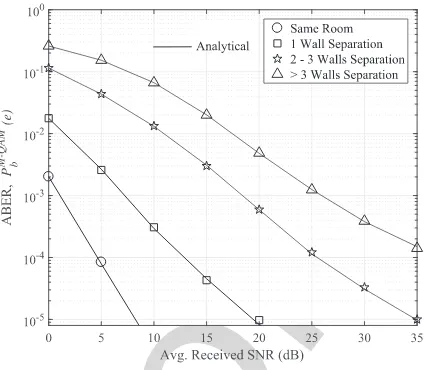
Fig. 1. Comparative simulation and analytical average bit error rate performances of coherent M-PSK and M-QAM over a JFTS faded / shadowed communication link.
Fig. 2. Average simulated bit error rate performances of 16-QAM over JFTS faded / shadowed communication link with (a) Sh= 6 dB,= 0.3 and (b) Sh =−4 dB,= 0.9.
results are plotted for each modulation scheme. All the results 371 are generated for a fixed set of JFTS parameters, K =6.5 dB, 372
Sh = 5 dB and = 0.8. This set of parameters are 373 encountered when the mobile WLAN user and the access point 374 are separated by 1 set of dry-wall or partition, as tabulated in 375 Table I. It is evident from Fig. 1 that the derived analytical 376 results from (9) and (11) offer a good agreement with that 377 of the simulation results and they fall within 1−2 dB of 378 the simulation results. It is to be noted that in many cases 379 analytical results do not exactly match the simulation results as 380 the analytical expressions involve the approximation index m. 381
IEEE Proof
Fig. 3. Average bit error rate performances of 16-QAM over JFTS faded / shadowed communication link with (a) K = 6.5 dB, = 0.8 and (b) K=6 dB, Sh= −4 dB.
Simulation and analytical ABER performances are plotted 388
for 16-QAM. The performance of 16-QAM deteriorates as 389
the value of K decreases with fixed Sh and . This is due
390
to the fact that as K decreases, the power contributed by the 391
strong specular components decreases in comparison to that 392
contributed by the diffused and scattered components, resulting 393
in degradation of overall system performance. 394
The improvement in performance due to the increase in 395
K -factor from 2 dB to 5 dB or 5 dB to 8 dB is not
396
proportional to the improvement for increasing K from 8 dB 397
to 11 dB. This is due to the fact that for a JFTS channel, 398
the Sh andparameters also influence the channel behavior.
399
A high Sh factor corresponds to a low severity in shadowing.
400
A low represents a scenario where only one scattering 401
cluster dominates instead of two thereby also resulting in low 402
shadowing severity. Hence, with a high Shand lowcoupled
403
with high K -factors, the communication channel approaches 404
the “no fading” scenario. As a result changing the K -factor 405
from 8 dB to 11 dB does not cause any further improvement 406
in performance. 407
To emphasize the effect of Sh and , the ABER
perfor-408
mance of 16-QAM is plotted for only K =2 dB and 8 dB 409
in the second subplot of Fig. 2. In this case a low Sh factor
410
of−4 dB and a highfactor of 0.9 is used. This represents 411
a condition where the user and the access point are separated 412
by 2−3 partitions. The difference in performance due to the 413
increase in K -factor is completely obliterated for this set of 414
shadowing parameters. A low Shand a highcorresponds to
415
a very high severity in shadowing and further degrading fading 416
by a reduction in K does not further degrade performance in 417
any significant way. 418
Fig. 3(a), is generated by varying the Sh parameter of the
419
JFTS distribution with fixed K and at 6.5 dB and 0.8 420
respectively. This set of K and parameters represent a 421
scenario where the user and the access point are separated by 422
2−3 dry-walls or partitions. It is evident from Fig. 3(a) that 423
lowering the Sh-parameter value results in deteriorated system
424
performance. A larger Sh factor represents large variations
425
Fig. 4. Average bit error rate performances of 16-QAM over JFTS faded / shadowed communication link, where the curves are generated by varying all the JFTS parameters, K , Shandsimultaneously.
in the main wave amplitudes contributed by each scattering 426 neighborhood resulting in approximately equable number of 427 high and low, thereby reducing the overall severity of shad- 428 owing. On the other hand, a low Sh factor depicts a scenario 429 where each scattering cluster contributes a very small range of 430 discrete shadowing values, higher in magnitude and encoun- 431 tered repeatedly. This condition results in an increased severity 432 in shadowing, thereby degrading overall system performance. 433 The curves in Fig. 3(b) are generated by varying only the 434 -parameter of the JFTS distribution but keeping a fixed 435
K and Sh at 6 dB and −4 dB respectively. This set of 436
IEEE Proof
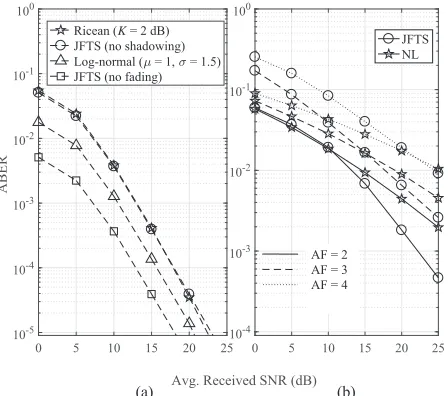
Fig. 5. Comparative average bit error rate of (a) QPSK over JFTS link with that over traditional channel models and (b) 16-QAM over a JFTS link with that over composite Nakagami - log-normal (NL) link.
is a result of the different small-scale fading and shadowing 464
statistics imposed by the JFTS model. 465
The average SNR per symbol requirement increases even 466
further by around 10 dB, if the user and the access point 467
is separated by 2 −3 sets of partitions (K = 6.5 dB, 468
Sh = −1.5 dB and = 0.25). This happens due to the
469
lack of strong specular components and the presence of at 470
least two scattering clusters between the transmitter and the 471
receiver, which jointly deteriorates the overall system perfor-472
mance. However, for propagation conditions that correspond 473
to an increase in the number of separations by more than 3 474
(i.e. K = 5.5 dB, Sh = −7.5 dB, = 0.15), the average
475
SNR per symbol requirement only increases by a maximum 476
of 5 dB, in order to achieve the same ABER performance. The 477
reason for this can be imparted to the low-factor, where the 478
effect of one scattering cluster is much stronger than the other 479
one. As a result, system performance is effectively affected 480
by only one scattering cluster, even in the presence of at least 481
two scattering clusters. 482
3) Comparison With Outdoor Channel Models: To
demon-483
strate how JFTS channel performance compares to con-484
ventional channel models, Fig. 5(a) is used to compare 485
performances of QPSK over JFTS, Ricean and log-normal 486
distributed communication channels. We have chosen the 487
Ricean distribution (K = 2 dB) to compare its impact on 488
performance with that of the JFTS channel with no shadowing 489
condition (K =2 dB, Sh=1000 dB,=0). The log-normal
490
distribution (μ=1,σ =1.5) is selected to compare with the 491
special case of JFTS channel with no fading (K =1000 dB, 492
Sh = −3 dB,=0.2). These particular set of JFTS
parame-493
ters is selected for comparison as they correspond to a TWDP 494
distribution with the same mean and standard deviation. The 495
performance over Ricean channel is almost equivalent to the 496
no shadowing JFTS case, as with=0, the JFTS distribution 497
reduces approximately to Ricean distribution. However, there 498
exists a small difference in performance owing to the minute 499
amount of shadowing still present in the JFTS channel with 500
Sh = 1000 dB. However, that is not the case with the 501 log-normal and the no fading JFTS channels. This is because, 502 putting a very high K in the JFTS distribution reduces it 503 approximately to the TWDP distribution accounting for max- 504 imum of two scattering clusters. The TWDP distribution is 505 very different from the log-normal distribution which accounts 506 for the transition through several local neighborhoods, each of 507 which consisting of different clusters of scattering objects. 508 To illustrate how the JFTS channel performance compares 509 to more conventional outdoor composite fading/shadowing 510 channel models, Fig. 5(b) is used to compare the performance 511 of 16-QAM over JFTS and Nakagami - log-normal (NL) 512 faded / shadowed communication channels. We have chosen 513 the NL distribution, as the Nakagami-m can be varied to model 514 a variety of fading distributions including the Rayleigh and the 515 Ricean distributions. The channel parameters are chosen so 516 that the JFTS and NL channels contribute the same amount 517 of fading (AF). As shown in [6], a JFTS distribution with 518
K =7 dB, Sh =6 dB and=0.7, contributes an AF of 2 519 which is same as that contributed by NL distribution with 520
m = 1 and σ =2.8 (4.4 dB). For these sets of parameters, 521 performance over a JFTS channel is worse than that over 522 a NL channel for SNRs less than 10 dB (γ ≤ 10 dB). 523 For higher SNRs per bit of around 10 dB and more, JFTS 524 offers a performance gain over NL. While only the simulation 525 results are shown for brevity, this same pattern in performance 526 repeats itself even for the set of JFTS (K = 5,2 dB, Sh = 527
−5,−10 dB, = 0.3,0.5) and NL (m = 1,1, μ = 1,1, 528 σ =3.6,4.2 (5.5, 6.2 dB)) parameters that contribute AFs of 529 3 and 4 respectively. This improvement in performance for the 530 JFTS distribution at higher SNRs occurs due to the fact that 531 for the JFTS distribution, there still exists a very small group 532 of specular components as long as K = 0. While, m = 1 533 for NL distribution represents a small scale fading condition, 534 which is equivalent to Rayleigh fading with the absence of 535 any specular component. 536 In addition, in order to visualize the difference between 537 JFTS and NL distributions, Fig. 6 exhibits their PDFs. The 538 model parameters for both the distributions are selected such 539 that they contribute the same amount of AF. The PDF of a 540 NL distributed variablew is given by 541
fW(w)=
∞
0
mmwm−1
vm(m) e− mw
v √4.3429 2πσv e
−(10 log10v−μ)2
2σ2 dv (19) 542
where m is the Nakagami m-factor, and μ and σ are the 543 mean and standard deviation of the log-normal shadowing 544 distribution, respectively. It is evident from Fig. 6 that the 545 NL distribution fails to adequately characterize indoor large 546 office wireless communication scenarios where a mobile user 547 can traverse through at most two distinct scattering clusters 548 within a time-frame of interest. 549
B. Achievable Capacity Analysis 550
IEEE Proof
Fig. 6. Comparative PDFs of JFTS and NL distributions (a) AF = 2 (JFTS :
K = 7 dB, Sh = 6 dB and = 0.7, NL : m = 1 and σ = 2.8) and (b) AF=3 (JFTS : K=5 dB, Sh= −5 dB,=0.3, NL : m=1,μ=1,
[image:8.612.101.251.56.320.2]σ =3.6).
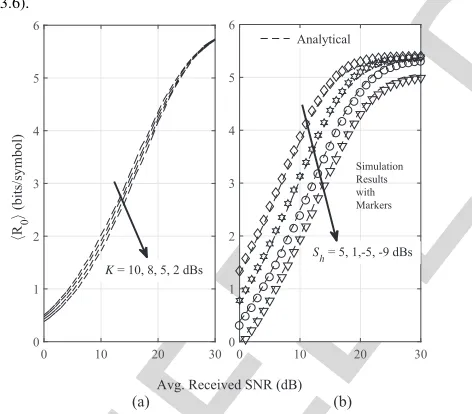
Fig. 7. Channel cutoff rate, R0of JFTS channel (with CSI) as a function of average received signal-to-noise ratio (a) with fixed Sh=1 dB,=0.4 and (b) with fixed K=5 dB,=0.9.
(refer to Fig. 7(a)) is much less compared to the decrease in 556
achievable cutoff rate due to the lowering of Sh-factor from
557
5 dB to −5 dB (refer to Fig. 7(b)). These results do not 558
agree with the observations made in [20], where bit error rate 559
performance of BPSK is found to degrade equally either due 560
to the decrease in the K -factor or the Sh-factor. The reason for
561
this can be attributed to the-value chosen for each plot. For 562
Fig. 7(a), a low of 0.4 is chosen. In this case, shadowing 563
severity is reduced by the fact that only one scattering cluster 564
dominates instead of two clusters. For Fig. 7(b) a high of 565
0.9 is chosen, where the magnitudes of the shadowing values 566
contributed by each scattering cluster are almost equal. 567
Fig. 8. Channel cutoff rate, R0of JFTS channel under different modulation techniques (a) with different constellation size M and (b) presence/absence of CSI with K=7 dB, Sh=6 dB and=0.7.
It is worth mentioning that the channel cutoff results 568 plotted in Fig. 7 are analytical results, as these results are 569 only estimates of the achievable throughput, neither exact 570 nor approximate bounds on the actual system performance. 571 However, we have plotted the achievable throughput over JFTS 572 channel with K = 5 dB, Sh = −9 dB, = 0.9 through 573 Monte-Carlo simulation for comparison. Plotting simulation 574 results for all values of K and Sh have been avoided due to 575
space constraint. 576
2) Performance of Modulation Techniques: Fig. 8 demon- 577 strates the cutoff rate for different modulation schemes in the 578 JFTS channel. The curves in Fig. 8(a) are used to compare 579 performances of M-QAM/PSK over JFTS faded / shadowed 580 communication links with K =7 dB, Sh=6 dB and=0.7. 581 The channel cutoff rate curves are generated using (17). The 582 unrestricted upper bound or the average achievable channel 583 capacity under this particular channel condition is also plotted 584 for reference. In this case, the unrestricted upper bound on 585 achievable channel capacity over a JFTS fading/shadowing 586 channel can be evaluated using CJFTS = EZ
Bτ log2(1+ 587
zγ ) [bits/symbol], where the expectation is taken over z, 588
[image:8.612.65.301.360.567.2]IEEE Proof
of the presence of shadowing. Therefore, though there still605
exists a group of waves arriving directly at the receiver over 606
the LOS path, they are obstructed due to the presence of 607
in-building structures like the thin set of dry-walls between 608
the transmitter and the receiver. 609
However, for the JFTS channel, QAM without CSI still 610
performs better than PSK, as is the case in the presence of 611
perfect CSI (refer to Fig. 8(b)). This contrasting behavior 612
between outdoor and indoor channels can be attributed to that 613
fact that in an indoor environment, shadowing varies quickly 614
enough to have an impact on the decision region boundaries 615
along with fading. In case of PSK receivers, the decision 616
boundaries are not independent of the shadowing depth and 617
therefore performs equally poorly as QAM receivers over a 618
JFTS faded/shadowed communication link. 619
VI. CONCLUSIONS
620
The primary contribution of this paper is to derive easy-to-621
evaluate closed-form analytical expressions for the ABER of a 622
wireless communication system using M-QAM and coherent 623
M-PSK modulation techniques over JFTS fading / shadowing
624
channels. In order to do so, closed-form expressions for the 625
PDF and the CDF of the received instantaneous composite 626
signal-to-noise ratio (SNR) are utilized. The derived analytical 627
expressions for ABER are numerically evaluated and plotted 628
as functions of the parameters of the communication channel 629
model and the modulation techniques. Performance degrades 630
as K and Shdecreases and enhances asdecreases. The
ana-631
lytical results are found to be in agreement with the simulation 632
results verifying the validity of the derived expressions. It can 633
also be concluded that for higher SNRs, performance over a 634
JFTS channel model is better than the NL channel model for 635
the same AF. 636
APPENDIXA 637
PROOF OFPROPOSITION1 638
The CDF of γ can be defined as 639
Fγ(γ )=
γ
−∞ fγ(u)du=1−
∞
γ fγ(u)du. (A.20) 640
Putting (5) back in (A.20), we can rewrite (A.20) mathemati-641
cally as 642
Fγ(γ ) =1−
4
i=1
m
h=1
∞
t=0 Ai,h
γ (t!)2
C1iC
t
3i
γt +C2i
C4it
γt 643 × ∞ γ u
te−Bhγudu
. (A.21) 644
Using the integral solution from [17, p. 340, eq. (3.351.2)], 645
we can express (A.20) as 646
Fγ(γ ) =1−
4
i=1
m
h=1
∞
t=0 Ai,h
γ (t!)2
C1iC
t
3i
γt +C2i
C4it
γt 647 × γ Bh t+1
t+1,Bhγ
γ
648
=1−
4
i=1
m
h=1
∞
t=0
Ai,h(t+1,Bhγ /γ )
(t!)2Bt+1
h
649
×
C1iC3it +C2iCt4i
. (A.22) 650
Following the same steps as above, we can arrive at the 651 approximate form of Fγ(γ )as 652
Fγ(γ )≈1−
4
i=1
m
h=1
tmax
t=0
Ai,h(t+1,Bhγ /γ )
(t!)2Bt+1
h
653
×
D1tC1iC3it +D2tC2iC4it
. (A.23) 654
The results obtained in (A.22) and (A.23) are put back in (7) 655 to obtain the final expressions in Proposition 1. 656
APPENDIXB 657
PROOF OFPROPOSITION2 658 Starting from (8) and putting back the first line of (7) back 659 in (8), we can rewrite (8) as 660
PbBinary(e)= α β
2(β)
∞
0
γβ−1 e−αγ
1−
4
i=1
m
h=1
∞
t=0 Ai,h
(t!)2 661
×(t+1,Bhγ /γ )
Bht+1
C1iC3it +C2iC4it
dγ. 662
(B.24) 663
Using the integral solution from[17, p. 340, eq. (3.351.3)], we 664 can express (B.24) as 665
PbBinary(e)= 1
2 −
4
i=1
m
h=1
∞
t=0 Ai,h
(t!)2Bt+1
h
C1iC3it +C2iC4it
666
× αβ
2(β)
∞
0
γβ−1e−αγ(t+1,B
hγ /γ )dγ
. 667 (B.25) 668
Using the integral solution from [17, eq. 6.455.1, p. 657], we 669
can obtain 670
PbBinary(e)= 1
2−
4
i=1
m
h=1
∞
t=0 Ai,h
(t!)2
C1iC3it +C2iC4it
671
× αβγβ
2β(β)
(β+t+1) (αγ +Bh)β+t+1
672
×2F1
1, β+t+1;β+1; αγ αγ +Bh
. 673
(B.26) 674
Following the same steps as above and putting the second line 675 of (7), we can arrive at the approximate form of PbBinary(e)as 676
PbBinary(e)≈ 1
2−
4
i=1
m
h=1
tmax
t=0 Ai,h
(t!)2
D1tC1iC3it +D2tC2iC4it
677
× αβγβ
2β(β)
(β+t+1) (αγ +Bh)β+t+1
678
×2F1
1, β+t+1;β+1; αγ αγ +Bh
. 679
IEEE Proof
The results obtained in (B.26) and (B.27) are put back in (9)681
to obtain the final expressions in Proposition 2. 682
APPENDIXC 683
PROOF OFPROPOSITION3 684
Starting from (10) and putting back the first line of (7) back 685
in (10), we can rewrite (10) as 686
PbM−ary(e,g)= √1
2
∞
0
e−v2/2
1−
4
i=1
m
h=1
∞
t=0 Ai,h
(t!)2
687
×(t+1,Bhv2/gγ ) Bht+1
C1iC3it +C2iC4it
dγ. 688
(C.28) 689
Using the integral solution from [17, p.340, eq. (3.351)], we 690
can express (C.28) as 691
PbM-ary(e,g)= 1
2 −
4
i=1
m
h=1
∞
t=0 Ai,h
(t!)2Bt+1
h
C1iC3it +C2i
692
×Ct4i
1
√
2
∞
0
e−v2/2(t+1,Bhv2/gγ )dγ
. 693
(C.29) 694
Puttingv2=r with change of variables and using the integral
695
solution from [17, p. 657, eq. (6.455.1)], we can obtain 696
PbM-ary(e,g)
697
= 1
2−
4
i=1
m
h=1
∞
t=0 Ai,h
(t!)2
C1iC3it +C2iC4it
698
×2t+1 √
gγ (t+3/2) (gγ+2Bh)t+3/2
2F1
1,t+3
2; 3 2;
gγ gγ+2Bh
. 699
(C.30) 700
Following the same steps as above and putting the second line 701
of (7), we can arrive at the approximate form of PbM-ary(e,g)
702 as 703
PbM-ary(e,g)
704
≈ 1
2 −
4
i=1
m
h=1
tmax
t=0
D1tC1iC3it +D2tC2iC4it
705
×Ai,h
(t!)2
2t+1√gγ (t+3/2) (gγ+2Bh)t+3/2
2F1
1,t+3
2; 3 2;
gγ gγ+2Bh
. 706
(C.31) 707
The results obtained in (C.30) and (C.31) are put back in (11) 708
to obtain the final expressions in Proposition 3. 709
REFERENCES
710
[1] H. Suzuki, “A statistical model for urban radio propogation,” IEEE
711
Trans. Commun., vol. COM-25, no. 7, pp. 673–680, Jul. 1977.
712
[2] T. T. Tjhung and C. C. Chai, “Fade statistics in Nakagami-lognormal
713
channels,” IEEE Trans. Commun., vol. 47, no. 12, pp. 1769–1772,
714
Dec. 1999.
715
[3] P. S. Bithas, N. C. Sagias, P. T. Mathiopoulos, G. K. Karagiannidis,
716
and A. A. Rontogiannis, “On the performance analysis of digital
717
communications over generalized-K fading channels,” IEEE Commun.
718
Lett., vol. 10, no. 5, pp. 353–355, May 2006.
719
[4] I. Dey, G. G. Messier, and S. Magierowski, “Joint fading and shadowing 720
model for large office indoor WLAN environments,” IEEE Trans. 721
Antennas Propag., vol. 62, no. 4, pp. 2209–2222, Apr. 2014. 722
[5] G. D. Durgin, T. S. Rappaport, and D. A. D. Wolf, “New analytical 723
models and probability density functions for fading in wireless com- 724
munications,” IEEE Trans. Commun., vol. 50, no. 6, pp. 1005–1015, 725
Jun. 2002. 726
[6] I. Dey, G. G. Messier, and S. Magierowski, “Fading statistics for the 727
joint fading and two path shadowing channel,” IEEE Wireless Commun. 728
Lett., vol. 3, no. 3, pp. 301–304, Jun. 2014. 729
[7] I. Dey, G. G. Messier, and S. Magierowski, “The cumulative distribution 730
function for the joint fading and two path shadowing channel: Expression 731
and application,” in Proc. IEEE VTC-Fall, Sep. 2014, pp. 1–5. 732
[8] I. Dey, G. G. Messier, and S. Magierowski, “On the capacity of joint 733
fading and two-path shadowing channels,” IEEE Trans. Veh. Technol., 734
vol. 65, no. 1, pp. 403–408, Jan. 2016. 735
[9] G. P. Efthymoglou, N. Y. Ermolova, and V. A. Aalo, “Channel 736
capacity and average error rates in generalised-K fading channels,” 737
IET Commun., vol. 4, no. 11, pp. 1364–1372, Jul. 2010. 738
[10] I. Dey, T. A. Tsiftsis, and C. Rowell, “Achievable channel cutoff rate 739
and bandwidth efficiency in indoor wireless environments,” IEEE Trans. 740
Veh. Technol., vol. 65, no. 12, pp. 10074–10079, Dec. 2016. 741
[11] W. T. Webb, L. Hanzo, and R. Steele, “Bandwidth efficient QAM 742
schemes for Rayleigh fading channels,” IEE Proc. I-Commun., Speech 743
Vis., vol. 138, no. 3, pp. 169–175, Jun. 1991. 744
[12] M. Abramowitz and I. A. Stegun, Handbook of Mathematical Functions: 745
With Formulas, Graphs, and Mathematical Tables, 9th ed. New York, 746
NY, USA: Dover, 1972. 747
[13] M. K. Simon and M.-S. Alouini, Digital Communication Over Fading 748
Channels, 2nd ed. Hoboken, NJ, USA: Wiley, 2005. 749
[14] Y. Zhao, P. Adve, and T. J. Lim, “Symbol error rate of selection amplify- 750
and-forward relay systems,” IEEE Commun. Lett., vol. 10, no. 11, 751
pp. 757–759, Nov. 2006. 752
[15] A. Abdi and M. Kaveh, “Comparison of DPSK and MSK bit error rates 753
for K and Rayleigh-lognormal fading distributions,” IEEE Commun. 754
Lett., vol. 4, no. 4, pp. 122–124, Apr. 2000. 755
[16] R. Steele and L. Hanzo, Mobile Radio Communications: Second and 756
Third-Generation Cellular and WATM Systems, 2nd ed. New York, NY, 757
USA: Wiley, 1999. 758
[17] I. S. Gradshteyn and I. M. Ryzhik, Table of Integrals, Series, and 759
Products, 7th ed. New York, NY, USA: Elsevier, 2007. 760
[18] C. Schlegel and D. J. Costello, Jr., “Bandwidth efficient coding for fading 761
channels: Code construction and performance analysis,” IEEE J. Sel. 762
Areas Commun., vol. 7, no. 9, pp. 1356–1368, Dec. 1989. 763
[19] D. Divsalar and M. Simon, “Trellis coded modulation for 764
4800–9600 bits/s transmission over a fading mobile satellite channel,” 765
IEEE J. Sel. Areas Commun., vol. SAC-5, no. 2, pp. 162–177, Feb. 1987. 766
[20] I. Dey, G. G. Messier, and S. Magierowski, “Performance analysis of 767
BPSK over joint fading and two-path shadowing channels,” in Proc. 768
IEEE VTC-Fall, Sep. 2014, pp. 1–5. 769
[21] W. T. Webb and R. Steele, “Variable rate QAM for mobile radio,” IEEE 770
Trans. Commun., vol. COM-43, no. 7, pp. 2223–2230, Jul. 1995. 771
Indrakshi Dey received the B.Tech. degree (Hons.) 772
in electronics and communication engineering from 773
the West Bengal University of Technology, Kolkata, 774
India, in 2005, the M.Sc. degree in wireless com- 775
munications from the University of Southampton, 776
Southampton, U.K., in 2010, and the Ph.D. degree 777
in electrical engineering from the University of 778
Calgary, Calgary, Canada, in 2015. From 2015 to 779
2016, she was a Post-Doctoral Research Fellow with 780
the Ultra-Maritime Digital Communication Center, 781
Dalhousie University, Halifax, Canada. She was a 782
Research Fellow with the Department of Electronics and Telecommunications, 783
Norwegian University of Science and Technology, Trondheim, Norway, from 784
2016 to 2017. Her current research interests include channel modeling, 785
channel estimation and prediction, adaptive modulation, and dirty tape coding 786
for different wireless propagation environments, and wireless sensor networks. 787
In 2016, she received the prestigious research fellowship from the European 788
IEEE Proof
Geoffrey G. Messier received the B.S. degree790
(Hons.) in electrical engineering and the B.S. degree
791
(Hons.) in computer science from the University of
792
Saskatchewan, Canada, in 1996, the M.Sc. degree
793
in electrical engineering from the University of
794
Calgary, Canada in 1998, and the Ph.D. degree in
795
electrical and computer engineering from the
Uni-796
versity of Alberta, Canada, in 2004. From 1998 to
797
2004, he was with the Nortel Networks CDMA Base
798
Station Hardware Systems Design Group, Calgary,
799
Canada. At Nortel Networks, he was responsible for
800
radio channel propagation measurements and simulating the physical layer
801
performance of high speed CDMA and multiple antenna wireless systems.
802
He is currently an Associate Professor with the Department of Electrical and
803
Computer Engineering, University of Calgary. His research interests include
804
data networks, physical layer communications, and communications channel
805
propagation measurements.
806
Sebastian Magierowski received the Ph.D. degree 807
in electrical engineering from the University of 808
Toronto in 2004. From 2004 to 2012, he served as an 809
Assistant/Associate Professor with the Department 810
of Electrical and Computer Engineering, University 811
of Calgary, after which, he joined the Faculty of the 812
Department of Electrical Engineering and Computer 813
Science with the Lassonde School of Engineer- 814
ing, York University, Toronto, Canada, where he 815
is currently an Associate Professor. As part of his 816
industrial experience (Nortel Networks, PMC-Sierra, 817
and Protolinx Corporation), he has involved in CMOS device modeling, 818
high-speed mixed-signal IC design, and data networks. His research interests 819
include analog/digital CMOS circuit design, communication systems, and 820