A Database of Computer Attacks for the Evaluation of Intrusion
Detection Systems
by
Kristopher Kendall
Submitted to the Department of Electrical Engineering and Computer Science in partial fulfillment of the requirements for the degrees of
Bachelor of Science in Computer Science and Engineering
and Master of Engineering in Electrical Engineering and Computer Science
at the
MASSACHUSETTS INSTITUTE OF TECHNOLOGY
June 1999
Kristopher Kendall, MCMXCVIV. All rights reserved.
The author hereby grants to MIT permission to reproduce and distribute publicly paper and electronic copies of this thesis document in whole or in part, and to grant others the
right to do so.
Author ………... Department of Electrical Engineering and Computer Science,
May 21, 1999
Certified by……… Richard Lippmann Senior Scientist, MIT Lincoln Laboratory Thesis Supervisor
Accepted by………... Arthur C. Smith Chairman, Department Committee on Graduate Theses
A Database of Computer Attacks for the Evaluation of
Intrusion Detection Systems
by
Kristopher Kendall
Submitted to the Department of Electrical Engineering and Computer Science
May 21, 1999
In Partial Fulfillment of the Requirements for the Degree of Bachelor of Science in Computer Science and Engineering
and Master of Engineering in Electrical Engineering and Computer Science
Abstract
The 1998 DARPA intrusion detection evaluation created the first standard corpus for evaluating computer intrusion detection systems. This corpus was designed to evaluate both false alarm rates and detection rates of intrusion detection systems using many types of both known and new attacks embedded in a large amount of normal background traffic. The corpus was collected from a simulation network that was used to automatically generate realistic traffic—including attempted attacks.
The focus of this thesis is the attacks that were developed for use in the 1998 DARPA intrusion detection evaluation. In all, over 300 attacks were included in the 9 weeks of data collected for the evaluation. These 300 attacks were drawn from 32 different attack types and 7 different attack scenarios. The attack types covered the different classes of computer attacks and included older, well-known attacks, newer attacks that have recently been released to publicly available forums, and some novel attacks developed specifically for this evaluation.
The development of a high quality corpus for evaluating intrusion detection systems required not only a variety of attack types, but also required realistic variance in the methods used by the attacker. The attacks included in the 1998 DARPA intrusion detection evaluation were developed to provide a reasonable amount of such variance in attacker methods. Some attacks occur in a single session with all actions occurring in the clear, while others are broken up into several sessions spread out over a long period of time with the attacker taking deliberate steps to minimize the chances of detection by a human administrator or an intrusion detection system. In some attacks, the attacker breaks into a computer system just for fun, while in others the attacker is interested in collecting confidential information or causing damage. In addition to providing detailed descriptions of each attack type, this thesis also describes the methods of stealthiness and the attack scenarios that were developed to provide a better simulation of realistic computer attacks.
Thesis Supervisor: Richard Lippmann
Acknowledgments
First, I would like to thank my thesis advisor, Rich Lippmann, for keeping my thesis on
track and for providing me with many valuable ideas and insights. I would also like to
thank Rob Cunningham and Dave Fried for taking the time to read and comment on early
drafts of this thesis. I appreciate the support of Rich, Rob, Dave, Isaac Graf, Seth
Webster, Dan Weber, and Jonathon Korba, and the rest of the intrusion detection
evaluation staff, who made working in this group a fun and highly educational
experience. Finally, I would like to thank Debbie and my parents, whose love and
Contents
Chapter 1 Introduction
8
1.1 1998 DARPA Intrusion Detection System Evaluation... 8
1.2 The Development of Attacks for the 1998 DARPA Evaluation... 10
1.3 Outline of the Thesis... 10
Chapter 2 Background
12
2.1 Overview of Computer Attacks ... 122.2 Intrusion Detection Systems ... 13
2.3 Strategies for Intrusion Detection ... 15
Chapter 3 Simulation Network
20
3.1 Modeling an Air Force Local Area Network... 203.2 Simulation Hardware and Network Topology... 21
3.3 Simulation Software ... 23
3.3.1 Virtual Machines ... 23
3.3.2 Traffic Generation ... 24
Chapter 4 Exploits
26
4.1 Sources... 264.2 Age of an Exploit... 27
4.3 A Taxonomy for Computer Attacks ... 28
4.3.1 Privilege Levels... 29
4.3.2 Methods of Transition or Exploitation ... 30
4.3.3 Transitions Between Privilege Levels... 31
4.3.4 Actions ... 31
4.3.5 Using the Taxonomy to Describe Attacks... 34
4.3.6 Examples ... 35
Chapter 5 Exploits for the 1998 DARPA Evaluation
37
Chapter 6 Denial of Service Attacks
39
6.1 Apache2 R-a-Deny(Temporary/Administrative) ... 406.3 Land R-b-Deny(Administrative)... 43
6.4 Mailbomb R-a-Deny(Administrative) ... 44
6.5 SYN Flood (Neptune) R-a-Deny(Temporary)... 45
6.6 Ping Of Death R-b-Deny(Temporary) ... 47
6.7 Process Table R-a-Deny(Temporary) ... 48
6.8 Smurf R-a-Deny(Temporary) ... 51
6.9 Syslogd R-b-Deny(Administrative)... 54
6.10 Teardrop R-a-Deny(Temporary)... 55
6.11 Udpstorm R-a-Deny(Administrative) ... 56
Chapter 7 User to Root Attacks
58
7.1 Eject U-b-S ... 607.2 Ffbconfig U-b-S ... 63
7.3 Fdformat U-b-S... 64
7.4 Loadmodule U-b-S ... 65
7.5 Perl U-b-S ... 67
7.6 Ps U-b-S... 68
7.7 Xterm U-b-S ... 69
Chapter 8 Remote to User Attacks
70
8.1 Dictionary R-a-U ... 708.2 Ftp-write R-c-U... 74
8.3 Guest R-c-U ... 75
8.4 Imap R-b-S... 76
8.5 Named R-b-S ... 77
8.6 Phf R-b-U... 78
8.7 Sendmail R-b-S... 79
8.8 Xlock R-cs-Intecept(Keystrokes) ... 81
8.9 Xsnoop R-c-Intecept(Keystrokes) ... 83
Chapter 9 Probes
85
9.1 Ipsweep R-a-Probe(Machines) ... 869.2 Mscan R-a-Probe(Known Vulnerabilities) ... 87
9.5 Satan R-a-Probe(Known Vulnerabilities) ... 93
Chapter 10 Realistic Intrusion Scenarios
95
10.1 Attack Scenarios ... 9510.1.1 Cracker ... 96
10.1.2 Spy... 96
10.1.3 Rootkit ... 96
10.1.4 Http Tunnel ... 97
10.1.5 SNMP Monitoring... 98
10.1.6 Multihop ... 98
10.1.7 Disgruntled/Malicious User ... 99
Chapter 11 Stealthiness and Actions
100
11.1 Avoiding Detection of Denial of Service (R-Deny) ... 10011.2 Avoiding Detection of Probes (R-Probe)... 101
11.3 Avoiding Detection of User to Root (L-?-S) Attacks ... 102
11.4 Avoiding Detection of Remote to Local (R-?-L) Attacks ... 106
11.5 Actions ... 107
Chapter 12 Attack Planning and Data Collection
109
12.1 Planning and Keeping Track of Attacks ... 10912.2 Numbers of Attacks ... 110
12.3 Verification of Attack Success ... 111
Chapter 13 Results and Future Work
113
13.1 Results of the 1998 Evaluation ... 11313.2 Future Work ... 116
13.2.1 Inclusion of Windows NT and Other Systems in the Evaluation... 116
13.2.2 Better Automation of Attack Planning and Verification... 116
13.2.3 Improved Stealthy Attacks ... 117
List of Figures
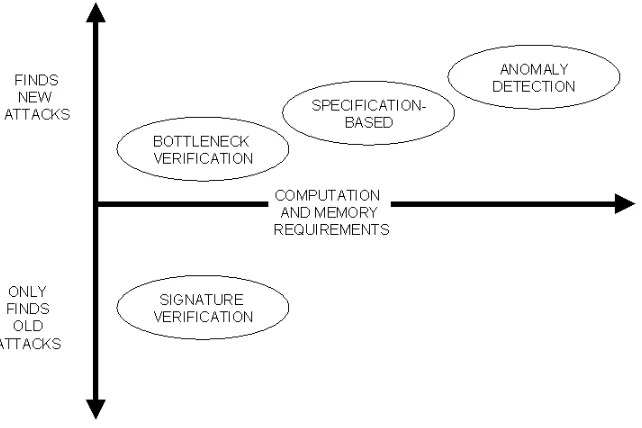
2-1 Approches to Intrusion Detection………. 16
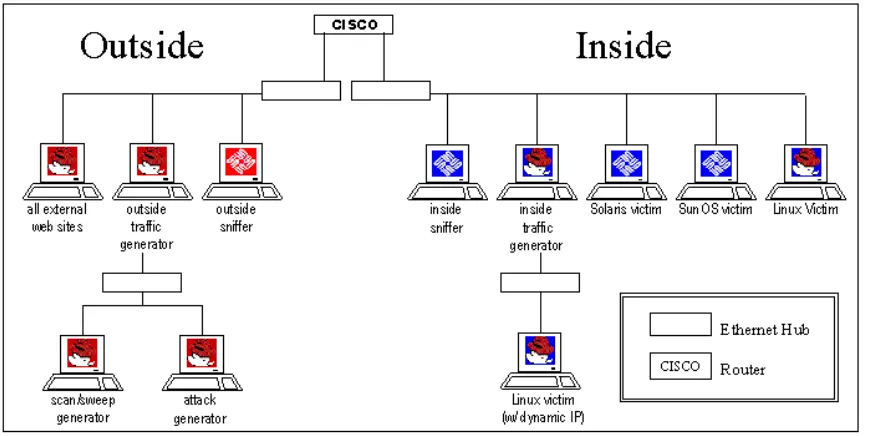
3-1 Simulation Network Topology………. 22
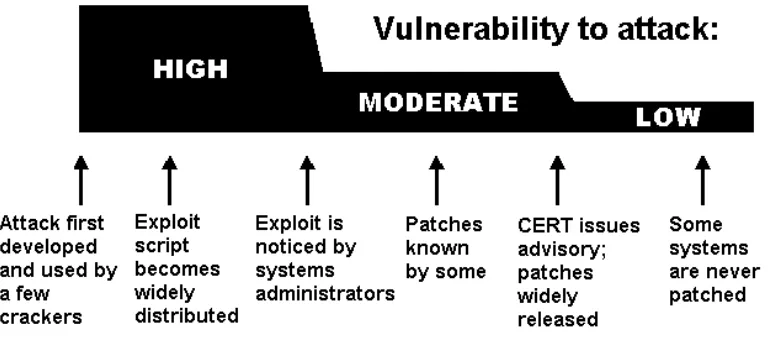
4-1 Vulnerability Decreases as Time Passes……….. 27
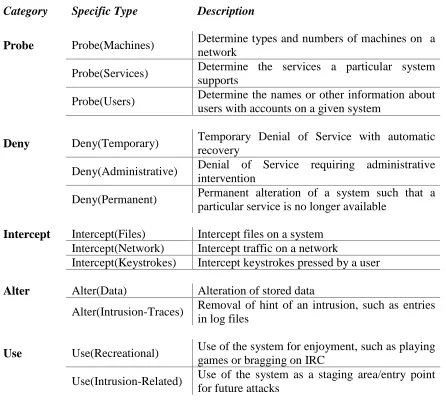
4-2 Summary of Possible Types of Actions………... 32
4-3 A Summary of Possible Attack Descriptions………... 34
5-1 The Attacks Used in the 1998 DARPA Intrusion Detection Evaluation…….. 37
6-1 Summary of Denial of Service Attacks……… 40
6-2 The Internet is Used to Amplify a Ping Flood and Create a Smurf Attack….. 52
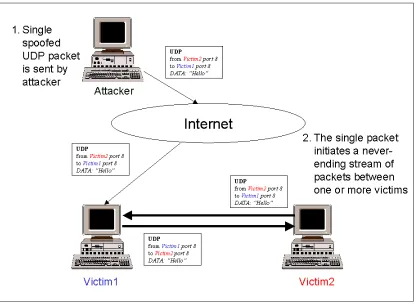
6-3 UDPStorm is Triggered by a Single Spoofed Packet………... 57
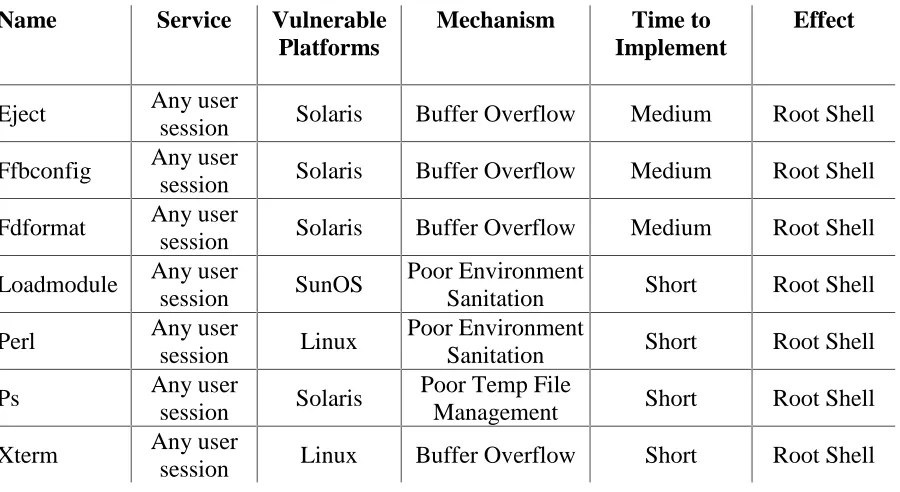
7-1 Summary of User to Root Attacks……… 59
7-2 C Code for the Eject Exploit………. 61
8-1 Summary of Remote to Local Attacks………. 71
8-2 Plot of Connections to Pop3 Service During a Dictionary Attack…………... 72
8-3 Illustration of Sendmail Attack………. 80
9-1 Summary of Probes……….. 85
9-2 Plot of Connections During a Medium Level Saint Scan………. 91
9-3 Plot of Connections During a Medium Level Satan Scan……… 94
10-1 Attacker Uses Http to Tunnel Through a Firewall………... 98
11-1 Attacker Can Use “at” to Temporally Disassociate the Time of Access and Time of Attack……….. 104
11-2 Transcript of a Stealthy Eject Attack……… 105
12-1 Instances of Non-Scenario Attacks………... 111
13-1 Current Intrusion Detection Systems Cannot Find New DoS and Remote to User Attacks………. 114
Chapter 1
Introduction
1.1
1998 DARPA Intrusion Detection System Evaluation
Heavy reliance on networked computer resources and the increasing connectivity of these
networks has greatly increased the potential damage that can be caused by attacks
launched against computers from remote sources. These attacks are difficult to prevent
with firewalls, security policies, or other mechanisms because system and application
software is changing at a rapid pace, and this rapid pace often leads to software that
contains unknown weaknesses or bugs. Intrusion detection systems are designed to
detect those attacks that inevitably occur despite security precautions. Some intrusion
detection systems detect attacks in real time and can be used to stop an attack in progress.
Others provide after-the-fact information about attacks that can be used to repair damage,
understand the attack mechanism, and reduce the possibility of future attacks of the same
type [43].
Many parties are working on the development of intrusion detection systems,
including universities, commercial software companies, and organizations within the
Department of Defense. As these groups explore different methods and develop various
new systems for intrusion detection, it is clearly advantageous to have a means of
testing and evaluation of an intrusion detection system is the actual environment in which
it will be used. However, research groups often do not have access to operational
networks on which to test their systems, and these systems (especially while they are still
in early development) are tested in a simulated environment. The ability to perform
accurate testing and evaluation in a simulated environment requires high-quality data that
is similar to the traffic (including attacks) that one finds on operational networks. In
general, this data is difficult to acquire because it contains private information and reveals
potential vulnerabilities of the networks from which the data is collected. These factors
led to DARPA sponsorship of MIT Lincoln Laboratory’s 1998 intrusion detection
evaluation, which created the first standard corpus for the evaluation of intrusion
detection systems.
The 1998 intrusion detection evaluation was the first of an ongoing series of
yearly evaluations conducted by MIT Lincoln Laboratory under DARPA ITO and Air
Force Research Laboratory sponsorship. These evaluations contribute significantly to the
intrusion detection research field by providing direction for research efforts and
calibration of current technical capabilities. The 1998 evaluation was designed to be
simple, to focus on core technology issues, and to encourage the widest possible
participation by eliminating security and privacy concerns and by providing data types
that are used by the majority of intrusion detection systems. Data for the first evaluation
was made available in the summer of 1998. The evaluation itself occurred towards the
end of the summer. A follow-up meeting for evaluation participants and other interested
1.2
The Development of Attacks for the 1998 DARPA
Evaluation
This thesis describes the computer attacks that were included in the 1998 DARPA
intrusion detection evaluation. A large sample of actual computer attacks was needed to
accurately test the performance of intrusion detection systems. These attacks needed to
cover the different classes of attack types. Many of the attacks used in the evaluation
were drawn from public sources, but some novel attacks were developed specifically for
use in this evaluation. In all cases, these attacks had to be adapted to work reliably in the
largely automated simulation network from which the 1998 DARPA evaluation data were
collected. Later sections of this thesis discuss the methods that were developed to create
realistic simulations of computer intrusion scenarios, and the methods that were
developed to vary the degree of attack stealthiness. People who attack computer
networks often have goals beyond simply gaining access to a system. Some attackers
break into computers simply for the challenge, others are interested in collecting
information, and some are motivated by the desire to cause damage. Attackers also vary
in their level of sophistication, and an accurate evaluation of intrusion detection systems
requires testing how well the systems are able to detect attacks from all types of
attackers—from the relative novice who is not aware that an intrusion detection system is
monitoring a network, to the sophisticated, experienced cracker who knows about
intrusion detection systems and takes steps to avoid being caught.
1.3
Outline of the Thesis
Chapter 2 presents background information about computer attacks and intrusion
attacks for use in evaluating these systems. The different types of computer attacks and
some of the many intrusion detection strategies that are currently being developed are
discussed.
Chapter 3 describes the simulation network that was used to collect data for the
1998 DARPA intrusion detection evaluation. This network consisted of 11 computers
and one router that, with the aid of software developed for use in the evaluation,
simulated a large network consisting of hundreds of machines, and thousands of users.
Chapters 4, 5, 6, 7, 8, and 9 focus on the different types of attacks that were
developed for use in the evaluation. Chapter 4 presents a taxonomy of computer attacks
that was useful in choosing attack types to include in the evaluation. Chapter 5 is an
introduction to Chapters 6 through 9 which discuss in detail the specific attacks within
each of the four broad categories of attacks included in the evaluation (denial of service
attacks, attacks that give a local user superuser access, attacks that give a remote user
local access, and probes).
Chapters 10 and 11 discuss the attack scenarios and stealthy methods that were
used to create a more realistic simulation of actual computer attacks.
Chapter 12 describes the processes that were used to plan, collect, and verify the
attack instances that were included in the 1998 DARPA intrusion detection evaluation.
Finally, in Chapter 13 the results of the 1998 DARPA intrusion detection
evaluation are summarized and discussed with a focus on the implications of these results
for both the intrusion detection research community, and the Lincoln Laboratory group
Chapter 2
Background
2.1
Overview of Computer Attacks
In its broadest definition, a computer attack is any malicious activity directed at a
computer system or the services it provides. Examples of computer attacks are viruses,
use of a system by an unauthorized individual, denial-of-service by exploitation of a bug
or abuse of a feature, probing of a system to gather information, or a physical attack
against computer hardware. A subset of the possible types of computer attacks were
included in the 1998 DARPA intrusion detection system evaluation, including: (1)
Attacks that allow an intruder to operate on a system with more privileges than are
allowed by the system security policy, (2) Attacks that deny someone else access to some
service that a system provides, or (3) Attempts to probe a system to find potential
weaknesses.
The following paragraphs provide some examples of the many ways that an attacker
can either gain access to a system or deny legitimate access by others.
Social Engineering: An attacker can gain access to a system by fooling an authorized
user into providing information that can be used to break into a system. For
example, an attacker can call an individual on the telephone impersonating a network
information (passwords, file names, details about security policies). Or an attacker
can deliver a piece of software to a user of a system which is actually a trojan horse
containing malicious code that gives the attacker system access.
Implementation Bug: Bugs in trusted programs can be exploited by an attacker to gain
unauthorized access to a computer system. Specific examples of implementation
bugs are buffer overflows, race conditions, and mishandled of temporary files.
Abuse of Feature: There are legitimate actions that one can perform that when taken to
the extreme can lead to system failure. Examples include opening hundreds of telnet
connections to a machine to fill its process table, or filling up a mail spool with junk
e-mail.
System Misconfiguration: An attacker can gain access because of an error in the
configuration of a system. For example, the default configuration of some systems
includes a “guest” account that is not protected with a password.
Masquerading: In some cases it is possible to fool a system into giving access by
misrepresenting oneself. An example is sending a TCP packet that has a forged
source address that makes the packet appear to come from a trusted host.
2.2
Intrusion Detection Systems
Intrusion detection systems gather information from a computer or network of computers
and attempt to detect intruders or system abuse. Generally, an intrusion detection system
Although there are many possible sources of data an intrusion detection system
can use, three types of data were provided to participants in the 1998 Lincoln Laboratory
intrusion detection evaluation. Most intrusion detection systems in existence today use
one or more of these three types of data. The first of these data sources is traffic sent
over the network. All data that is transmitted over an ethernet network is visible to any
machine that is present on the local network segment. Because this data is visible to
every machine on the network, one machine connected to this ethernet can be used to
monitor traffic for all the hosts on the network. During the DARPA evaluation, network
traffic was sniffed using a single machine running the tcpdump program [39] to save the
network traffic. A second source of data for an intrusion detection system is system-level
audit data. Most operating systems offer some level of auditing of operating system
events. The amount of data that is collected could be as limited as logging failed
attempts to log in, or as verbose as logging every system call. Basic Security Module
(BSM) [62] data from a Solaris victim machine was collected and distributed as part of
the DARPA evaluation data. A third source of data distributed to the evaluation
participants was information about file system state. Daily file system dumps were
collected from each of the machines used in the simulation. An intrusion detection
system that examines this file system data can alert an administrator whenever a system
binary file (such as the ps, login, or ls program) is modified. Normal users have no
legitimate reason to alter these files, so a change to a system binary file indicates that the
system has been compromised. Although there are many other potential sources of data
that can be used by an intrusion detection system to find attacks (such as real-time
host-level audit files, and file-system state) were provided to participants in the 1998
Lincoln Laboratory DARPA intrusion detection evaluation because they were determined
to be the sources most commonly used by the evaluation participants.
After the three types of data were collected and aggregated, the data was
distributed to participants via CD-ROM. Once participants obtained this data, each group
used its particular intrusion detection system to the find intrusions and abuses that were
inserted into the collected traffic. Although the 1998 DARPA evaluation tested only the
ability to find attacks offline, some intrusion detection systems can evaluate data in
real-time, allowing administrators (or the system itself) to take defensive action against the
intruder.
2.3
Strategies for Intrusion Detection
The different approaches that have been pursued to develop intrusion detection systems
are described in many papers, including [3][44][63]. Figure 2-1 shows four major
approaches to intrusion detection and the different characteristics of these approaches.
The lower part of this figure shows approaches that detect only known attacks, while the
upper part shows approaches that detect novel attacks. Simpler approaches are shown on
the left and approaches that are both computationally more complex and have greater
The most common approach to intrusion detection, denoted as “signature
verification” is shown on the bottom of Figure 2-1. Signature verification schemes look
for an invariant sequence of events that match a known type of attack. For example, a
signature verification system that is looking for a Ping Of Death denial-of-service attack
(an oversize ping packet that causes some machines to reboot) would have a simple rule
that says “any ping packet of length greater than 64 kilobytes is an attack.” Attack
signatures can be devised that detect attempts to exploit many possible system
vulnerabilities, but a large drawback of this strategy is that it is difficult to establish rules
that identify novel types of attacks. The Network Security Monitor (NSM) was an early
signature-based intrusion detection system that found attacks by searching for keywords
in network traffic captured using a sniffer. Early versions of the NSM [29][28] were the
[image:16.612.125.446.91.305.2]foundation of many government and commercial intrusion detection systems, including
NetRanger [23] and NID [41]. Signature verification systems are popular because one
sniffer can monitor traffic to many workstations and the computation required to
reconstruct network sessions and search for keywords is not excessive. In practice, these
systems can have high false-alarm rates (e.g. 100’s of false-alarms per day) because it is
often difficult to select keywords by hand that successfully detect real attacks without
creating false alarms for normal traffic. In addition, signature verification schemes must
be updated frequently to detect new attacks as they are discovered. Recent research on
systems which rely on signature verification includes BRO [47] and NSTAT [38].
The approaches shown in the upper half of Figure 2-1 can be used to find novel
attacks. This capability is essential to protect critical hosts because new attacks and
attack variants are constantly being developed.
Anomaly detection, shown in the upper right of Figure 2-1, is one of the most
frequently suggested approaches to detect novel new attacks. Anomaly detection
schemes construct statistical models of the typical behavior of a system and issue
warnings when they observe actions that deviate significantly from those models.
NIDES was one of the first statistical-based anomaly detection systems used to detect
unusual user [36] and unusual program [1] behavior. The statistical component of
NIDES forms a model of a user, system, or network activity during an initial training
phase. After training, anomalies are detected and flagged as attacks. Of course,
anomalous behavior does not always signal that an attack is taking place, so anomaly
detection systems need to be carefully tuned to avoid high false alarm rates. This level of
tuning is only possible if normal user or system activity is stable over time and does not
any intruder attempting to masquerade as such a user would likely exhibit behavior that
deviated significantly from the user’s normal activity. The actions of a system
administrator, however, might be more irregular and harder to distinguish from the
actions of an attacker. In addition, a hacker may be able to slowly change the
characteristics that an anomaly detection system considers “normal” by deviating only
slightly from normal behavior over a long period of time. After the anomaly detection
system had been trained to consider more actions “normal” the attacker could mount an
attack and avoid detection. A second disadvantage of anomaly detection schemes is the
large computation and memory resources required to maintain the statistical model.
Recent research on anomaly detection includes the development of EMERALD [46],
which combines statistical anomaly detection from NIDES with signature verification.
Specification-based intrusion detection [39] is a second approach that can be used
to detect new attacks. It detects attacks that make improper use of system or application
programs. This approach involves first writing security specifications that describe the
normal intended behavior of programs. Host-based audit records are then monitored to
detect behavior that violates the security specifications. This approach was applied to 15
UNIX system programs and successfully found many attacks [39]. Specification-based
intrusion detection has the potential to provide very low false alarm rates and detect a
wide range of attacks including many forms of malicious code such as trojan horses,
viruses, attacks that take advantage of race conditions, and attacks that take advantage of
improperly synchronized distributed programs. Unfortunately, it is difficult to apply
because security specifications must be written for all monitored programs. This is
Specification-based intrusion detection is thus best applied to a small number of critical user or system
programs that might be considered prime targets for an attack.
The final strategy shown in Figure 2-1 is bottleneck verification. The bottleneck
verification approach applies to situations where there are only a few, well defined ways
to transition between two groups of states. One example of such a well-defined transition
is transitions from a normal user to superuser within a shell. If an individual is in the user
state, the only way to legally gain root privileges is by using the su command and
entering the root password. Thus, if a bottleneck verification system can detect a shell
being launched, determine the permissions of the new shell, and detect the successful use
of the su command to gain root access (or, more importantly, the lack of a successful su
command), then illegal transitions from normal user to root user can be detected—even if
the transition is being made through some novel method that did not exist when the
Chapter 3
Simulation Network
The goal of the 1998 DARPA Intrusion Detection System Evaluation was to collect and
distribute the first standard corpus for evaluation of intrusion detection systems. This
corpus was designed to evaluate both false alarm rates and detection rates of intrusion
detection systems using many types of both known and novel attacks embedded in a large
amount of normal background traffic. One roadblock that has discouraged the creation of
such a corpus is the reluctance of companies and government agencies to release data
collected from operational computer networks. Data collected from an operational
computer network is optimal for the evaluation of intrusion detection systems, but this
data may contain personal or sensitive information that could not be released to the many
parties who conduct intrusion detection research. For this reason, all data in the 1998
DARPA Intrusion Detection System evaluation was synthesized and recorded on a
network which simulated an operational network connected to the Internet [25][42].
3.1
Modeling an Air Force Local Area Network
The goal of the simulation network (or simnet) was to accurately simulate the network
traffic of a Local Area Network that one might find at a United States Air Force facility.
Automatically generated traffic used more than 20 network services, including dns,
model the features of an Air Force network, statistics were measured from months of
actual network traffic that was collected from more than fifty Air Force computer
networks. Traffic statistics for automatically generated traffic matched average Air Force
statistics. The content of email, ftp, web sites, and files was similar to actual documents.
Content was generated using open-source documentation or statistical reconstruction
from a large set of unclassified documents that preserved both unigram word frequencies
and also the frequency of two-word sequences. Generating the data from public sources
allowed the data to be distributed without security or privacy concerns.
The 32 different types of attacks that were inserted in the data collected on the
simulation network represent attacks that one would expect to see on an Air Force
network comprised mostly of UNIX workstations. These attacks were chosen to
represent a mixture of different categories of computer attacks, and to provide a mix of
older, more recent, and even some novel attacks. In some cases, transcripts of actual Air
Force intrusions were used to develop attack scenarios. When such transcripts were not
available, attacks were chosen from publicly known attacks and accounts of intrusions on
civilian computer systems. Later sections of this thesis describe the attacks in detail.
3.2
Simulation Hardware and Network Topology
The simulation network consisted of two Ethernet network segments connected to each
other through a router. A diagram of the network topology is shown in Figure 3-1. The
router is located in the top center of this picture and is labeled “CISCO”. Everything to
the left of the router in the figure is considered the “outside” of the network and
are part of the fabricated “eyrie.af.mil” domain. The computers that model the rest of the
Internet are connected to the external interface of the router.
The simulation network included eleven computers. The outside of the network
contains a traffic generator (for both background traffic and automated attacks), a web
server, a sniffer/recorder, and two machines used for non-automated attack generation.
The inside of the network (eyrie.af.mil) consisted of a background traffic generator, a
sniffer/recorder, a Solaris 2.5 victim, a SunOS 4.1.4 victim, a Linux 4.2 victim and a
Linux 5.0 victim that could dynamically change IP addresses. Although two computers
(one inside, one outside) generated all of the background traffic in the simulation, a
modification to the operating system of these computers enabled them to act as hundreds
of “virtual” machines [26]. The same modification was made to the outside web server
so this machine could mimic thousands of web servers. The modification to the
[image:22.612.92.530.84.302.2]operating system that created these virtual machines will be discussed in the next section.
3.3
Simulation Software
The hardware for the simulation network consists of only eleven machines and one
router. Custom software allows this simple network to model the interaction of
thousands of clients and servers. Without such software the simulation network would
consist of hundreds of computers and the evaluation would be impractical in terms of
both the cost and time required to maintain the network hardware.
3.3.1
Virtual Machines
The two traffic generators on the simulation network were configured with a modification
to the Linux kernel provided by the Air Force Research Laboratory [26]. The IP
swapping kernel allows each process that is started on the traffic generator to specify
which IP address should be used as the source address for all network traffic generated by
that process. At the time of invocation of a new process, an entry is added to a table
(called the IP swap table) that maps process id to IP address. Whenever a network packet
is generated, the kernel checks the process id of the process that generated the packet and
uses the entry in the IP swap table as the source address of the new packet. The modified
kernel was an important step in creating the illusion of a virtual machine, but there are
several other modifications that support the creation of a single host that can act as many
hosts. Daemons that provide network services—including telnetd, ftpd, and login—
display banners that identify the machine they are running on. These daemons were
modified to give different identification information depending on the destination IP
3.3.2
Traffic Generation
Automatic traffic regeneration was used to create automated network sessions containing
both artificial normal traffic and attacks that appear to be generated by humans working
on a system. The traffic regeneration mechanism was designed to be:
• Automatic, requiring no human intervention.
• Reproducible; when repeated, sessions produce identical results.
• Robust, so it can run for long periods without human supervision.
As suggested in [48], the expect language was used to automate interaction between a
system and a user, allowing autonomous sessions to be run as if a user were typing at a
keyboard. Unfortunately, expect cannot be used to automate the interaction between a
user and a graphical environment (such as X Windows), so any sessions that required
interaction with a graphical user interface were run by human actors during the
simulation. Because the amount of interaction included in the simulation was so large,
creating a separate expect script for each session would have been unwieldy. For this
reason, an expect program called the “regenerator” (for “traffic regenerator”) was written
that reads information about a particular session from a specially formatted “exs” file.
Each “exs” file contains a header and a body. Within the header is information about
what time to start a session, the IP address of the local machine, the IP address of the
remote machine, and a list of prompts we expect to see during this session. The body of
the “exs” file contains one or more prompt-response pairs. For each prompt-response
pair the regenerator first waits for the prompt indicated, pauses an indicated amount of
time, and then types the command. Each session within the simulation is represented by a
and passed to the regenerator which then runs all of the sessions. If an error occurs in
generating or collecting this traffic, the traffic collection can be repeated by rerunning the
regenerator with the same “exs” scripts. The regenerator satisfies the need for automatic,
Chapter 4
Exploits
A large sample of actual computer attacks is needed to test an intrusion detection system.
These attacks should cover the different classes of attack types and contain exploits for
both newly discovered as well as older well-known vulnerabilities. An attack instance
might consist of several phases. For example, an attacker might copy a program onto a
system, run this program that exploits a system vulnerability to gain root privileges, and
then use this root privilege to install a backdoor into the system for later access. This
chapter provides some background on the different types of computer exploits, including
a taxonomy that can be used to organize these exploits into meaningful groups.
4.1
Sources
Many of the exploits developed for the 1998 DARPA evaluation were drawn from ideas
or implementations available from public sources on the Internet. Rootshell [50] is a
web-site dedicated to collecting computer exploits and has a sizeable archive of attacks
for many popular operating systems. The “Bugtraq” mailing list also frequently hosts
“exploit code”—ostensibly released for the purpose of testing one’s own system for
vulnerability—when a new vulnerability is discussed. A searchable archive of the
Bugtraq mailing list can be found on the Internet at http://www.geek-girl.com. Other
CERT [22] and ISS X-force [35] that frequently release information about new
vulnerabilities. Additional sources of information about system vulnerabilities and
possible exploits were vendor-initiated bulletins posted by operating system vendors like
Sun Microsystems and Redhat Software. These bulletins are released to customers to
encourage them to download patches that eliminate a new vulnerability.
New and novel exploits were also created specifically for the purpose of the
evaluation. These new exploits are useful for determining how well an intrusion
detection system works against novel attacks that were not publicly known at the time the
intrusion detection system was developed.
4.2
Age of an Exploit
Each new exploit has a period of time during which it is most dangerous. Figure 4-1 is a
simplified illustration of the various phases of a newly discovered exploit. The vertical
axis of the figure shows vulnerability to attack and the horizontal axis represents time.
[image:27.612.112.500.83.252.2]As time progresses, more people are made aware of the vulnerability and patch their
Figure 4-1: Vulnerability Decreases as Time Passes
systems to make them resistant to the exploit. Even after news of a particular
vulnerability has become widespread, some systems might not be patched. Some
computer systems with less-experienced administrators go years without having
widely-known security holes fixed. Some of these older attacks were included in the set of
attacks used for the 1998 DARPA evaluation. Intrusion detection systems were generally
able to find these older, well-known attacks.
4.3
A Taxonomy for Computer Attacks
A taxonomy for classifying computer attacks was used to choose exploits for the
evaluation. A good taxonomy makes it possible to classify attacks into groups that share
common properties. Once these groups have been identified, the job of adequately
testing an intrusion detection system becomes easier because instead of developing every
possible attack we can choose a representative subset from each group. The taxonomy
presented here was originally presented in [64]. The features of this taxonomy are:
• Each attack can be reliably placed in one category.
• All possible intrusions have a place in the taxonomy
• The taxonomy can be extended in the future.
This taxonomy was created for the express purpose of testing and evaluating intrusion
detection systems. Within the taxonomy, each attack can be categorized as one of the
following:
• A user performs some action at one level of privilege
• A user makes an unauthorized transition from a lower privilege level to a higher
• A user stays at the same privilege level, but performs some action at a higher level
of privilege.
The taxonomy requires a way of describing each privilege level, a way to describe
transitions, and a way of categorizing actions. These three requirements are presented in
the following sections.
4.3.1
Privilege Levels
The taxonomy defines an approach to ranking levels of privilege. The privilege
categories that are applied within this thesis are:
R Remote network access L Local network access U User access
S Root/Super-user access P Physical Access to Host
Having privilege at the “Remote network access” level refers to having, via an
interconnected network of systems, minimal network access to a target system. “Local
network access” represents the ability to read from and write to the local network that the
target machine uses. “User access” refers to the ability to run normal user commands on
a system. “Root/Superuser access” gives a user total software control of a system.
“Physical Access to Host” allows the operator to physically manipulate characteristics of
the system (i.e. remove disk drives, insert floppy disks, turn the system off). This list
only represents a subset of all possible access levels, but these were the most useful
4.3.2
Methods of Transition or Exploitation
An attacker needs to exploit some failure of a security framework in order to perform an
attack. The five methods of transition that were explored for the 1998 DARPA
evaluation and the single letters (m,a,b,c,s) used to represent the methods were:
m) Masquerading: In some cases it is possible to fool a system into giving access by
misrepresenting oneself. Examples of masquerading include using a stolen
username/password or sending a TCP packet with a forged source address.
a) Abuse of Feature: There are legitimate actions that one can perform, or is even
expected to perform, that when taken to the extreme can lead to system failure.
Example include filling up a disk partition with user files or starting hundreds of
telnet connections to a host to fill its process table.
b) Implementation Bug: A bug in a trusted program might allow an attack to proceed.
Specific examples include buffer overflows and race conditions.
c) System Misconfiguration: An attacker can exploit errors in security policy
configuration that allows the attacker to operate at a higher level of privilege than
intended.
s) Social Engineering: An attacker may be able to coerce a human operator of a
computer system into giving the attacker access.
An individual attack may use more than one of these methods. For example, a bug in the
implementation of the TCP stack on some systems makes it possible to crash the system
the source address forged so as to avoid identification of the attacker. Such an attack
would be exploiting both masquerading and an implementation bug, and it would be
possible to detect the intrusion by noting either of these features.
4.3.3
Transitions Between Privilege Levels
To show a transition between two privilege levels the strings for the two levels are
written adjacent to one another with the method of transition between them. Two
examples are shown in the following table:
Examples:
Attack String Description
Format U-b-S User exploits a bug in the
format program to become root/superuser
Ftp-write R-c-U A user with remote network
access exploits a badly configured anonymous ftp server to gain local user access
4.3.4
Actions
There are many actions that can occur as part of a computer attack. Within the
taxonomy, actions are represented with a string that represents a category, and a
specification string that describes the specific action taken. For example, the string
Probe(Users), represents some action taken by an attacker to gather information about
the users of a system. The following paragraphs describe the five categories of actions
that were used to describe the actions taken during the 1998 DARPA intrusion detection
Probes are actions taken by an attacker to gather information about one or more
machine. Probes are represented within the taxonomy by the category label of “Probe”.
The specific types of probes used in the DARPA evaluation were: (1) Probing a network
to see how many and what types of machines are on that network (Probe(Machines)),
(2) Probing a system to see what services the system supports (Probe(Services)), and (3)
Probing a system to find out information about user accounts on that system
(Probe(Users)).
Category Specific Type Description
Probe Probe(Machines) Determine types and numbers of machines on a network
Probe(Services) Determine the services a particular system supports
Probe(Users) Determine the names or other information about users with accounts on a given system
Deny Deny(Temporary) Temporary Denial of Service with automatic recovery
Deny(Administrative) Denial of Service requiring administrative intervention
Deny(Permanent) Permanent alteration of a system such that a particular service is no longer available
Intercept Intercept(Files) Intercept files on a system Intercept(Network) Intercept traffic on a network
Intercept(Keystrokes) Intercept keystrokes pressed by a user
Alter Alter(Data) Alteration of stored data
Alter(Intrusion-Traces) Removal of hint of an intrusion, such as entries in log files
Use Use(Recreational) Use of the system for enjoyment, such as playing games or bragging on IRC
[image:32.612.94.540.72.474.2]Use(Intrusion-Related) Use of the system as a staging area/entry point for future attacks
Denial of service attacks are attempts to interrupt or degrade a service that a
system provides. These attacks are represented within the taxonomy by the category
label “Deny”. The classes of denial of service attacks used in the DARPA evaluation
were: (1) Temporary denial of service with automatic recovery (Deny(Temporary)), (2)
Denial of service requiring administrative action for recovery (Deny(Administrative)),
and (3) Permanent denial of service with total system reconstruction required for
recovery (Deny(Permanent)).
Another category of attacker actions is the interception of data. Interception of
data is represented within the taxonomy by the category label “Intercept”. The types of
data interception actions used in the 1998 DARPA evaluation were: (1)
Interception/Reading of files on a file system (Intercept(Files)), and (2) Interception of
packets on a network (Intercept(Network)).
An additional category of action is the alteration or creation of data on a system or
network. Actions that involve data alteration or creation are represented with the
category label “Alter”. The types of data alteration used in the 1998 DARPA evaluation
were: (1) Alteration of data stored on a system, such as a password file or any other file
(Alter(Data)), and (2) Removal of hints of an intrusion, such as entries in log files
(Alter(Intrusion-Traces)).
The final category of attacker action described in the taxonomy is “use” of a
system. Any use of the system that does not fall into the categories described above can
be placed in the category represented by the category label “Use”. The specific ways in
which an attacker might use a system that were included in the 1998 DARPA evaluation
as playing games or bragging on IRC (Use(Recreational)), and (2) Use of a system as a
staging ground or entry point for attacks on other systems ((Use(Intrusion-Related)).
The action categories and specifications described in the previous paragraphs are
summarized in Table 4-2. Each row of this table represents a specific type of action
within a category. These specific actions have been grouped according to the categories
presented above. The first column of the table is the action category, the second column
is the string that represents the action in the taxonomy, and the third column in each row
is a description of that particular type of action.
4.3.5
Using the Taxonomy to Describe Attacks
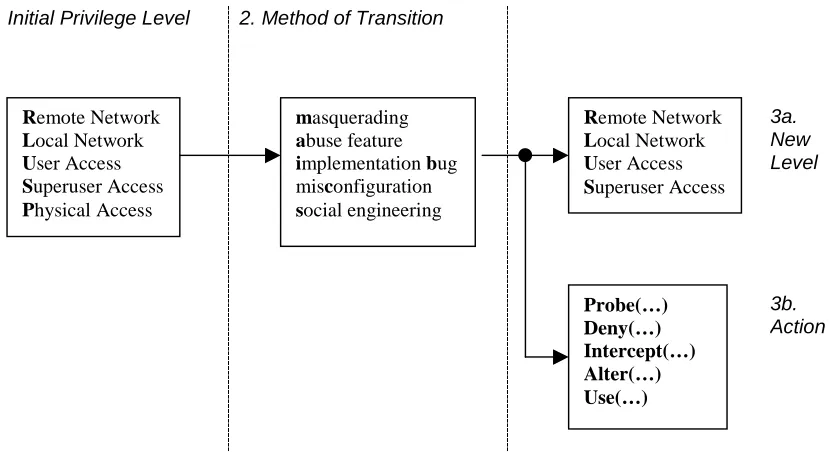
Figure 4-3 gives an overview of the approach the taxonomy uses for the classification of
attacks. Each attack classified by this taxonomy is represented as a short alpha-numeric
[image:34.612.97.512.69.295.2]string. The sub-strings in this description are the bold strings from the previous three 1. Initial Privilege Level 2. Method of Transition
sections. The initial privilege level is indicated by R, L, U, S, or P as defined in section
4.3.1, the actions are indicated by any of the strings presented in section 4.3.4, and the
method of exploitation is indicated by m, a, b, c, or s as defined in section 4.3.2.
In order to describe an attack, select the privilege level that the attacker had
before the attack occurred, from the possible choices of Remote Network, Local
Network, Local User, Superuser/Root, and Physical Access. Next, select the method of
exploitation, if the method is known. If the method is unknown, then a question mark
(“?”) is used to indicate the method of exploitation. The possible choices are
masquerading, abuse of feature, implementation bug, misconfiguration, or social
engineering. Finally, either indicate the level of privilege the attacker gained as a result
of the exploit (again with R, L, U, S, or P) or the actions the user performed at the
current level of privilege. The taxonomy presented in [64] has additional features that are
not discussed here, but the material presented in the section provides a subset of the
taxonomy that is useful for the purpose of discussing the attacks in the 1998 DARPA
intrusion detection evaluation.
4.3.6
Examples
The following table presents three examples that show the correct formatting of
the alphanumeric string that specifies an action being performed at a specific privilege
level. In a SYN flood (or neptune) attack the attacker sends a stream of SYN packets to a
port on a target machine. For a short period of time after these packets have been sent,
other users are unable to access the network services provided by that port. In the second
transition from Local User privilege to Root/Superuser privilege, and then uses this new
privilege level to alter the password file on the victim system.
Examples:
Attack String Description
SYN flood R-a-Deny(temporary) A user with remote network
access temporarily denies service
Cracking passwords U-Use(Intrusion) A user with a local account
runs a program which attempts to decrypt entries in the password file.
ffbconfig U-b-S-Alter(Files) An attacker with a local
Chapter 5
Exploits for the 1998 DARPA Evaluation
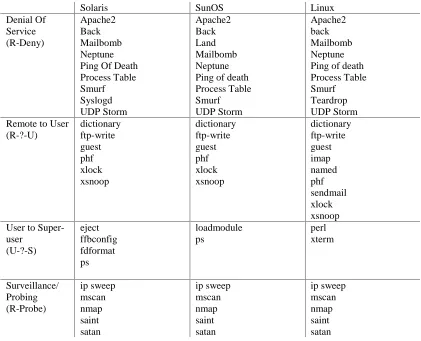
Figure 5-1 shows the 32 different exploits that were used in the 1998 DARPA intrusion
[image:37.612.102.523.320.661.2]detection evaluation. This table presents the attacks broken up into categories of type and
Figure 5-1: The Attacks Used in the 1998 DARPA Intrusion Detection Evaluation
Solaris SunOS Linux
Denial Of Service (R-Deny) Apache2 Back Mailbomb Neptune Ping Of Death Process Table Smurf Syslogd UDP Storm Apache2 Back Land Mailbomb Neptune Ping of death Process Table Smurf UDP Storm Apache2 back Mailbomb Neptune Ping of death Process Table Smurf Teardrop UDP Storm Remote to User
(R-?-U) dictionary ftp-write guest phf xlock xsnoop dictionary ftp-write guest phf xlock xsnoop dictionary ftp-write guest imap named phf sendmail xlock xsnoop User to
vulnerable operating system. The four type categories represent groupings of the
possible attack types listed in the taxonomy. These four groups are: Denial of Service
(R-?-Deny), Remote to Local User (R-?-U), Local User to Super-user (U-?-S), and
Probes (R-?-Probe). The three columns of the table divide the exploits by target
platform. Some attacks are listed in more than one column. The Smurf attack, for
example, is listed three times—in the Solaris column, the SunOS column, and the Linux
column—because all three operating systems are vulnerable to the Smurf attack. The
next four chapters present detailed descriptions of each class of attack, and the individual
attacks from that class that were included in the 1998 DARPA intrusion detection
Chapter 6
Denial of Service Attacks
A denial of service attack is an attack in which the attacker makes some computing or
memory resource too busy or too full to handle legitimate requests, or denies legitimate
users access to a machine. There are many varieties of denial of service (or DoS) attacks.
Some DoS attacks (like a mailbomb, neptune, or smurf attack) abuse a perfectly
legitimate feature. Others (teardrop, Ping of Death) create malformed packets that
confuse the TCP/IP stack of the machine that is trying to reconstruct the packet. Still
others (apache2, back, syslogd) take advantage of bugs in a particular network daemon.
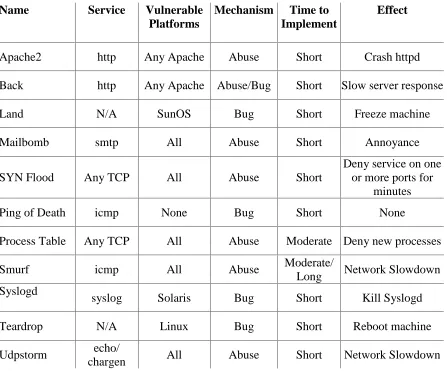
Figure 6-1 provides an overview of the denial of service attacks used in the 1998 DARPA
intrusion detection evaluation. Each row represents a single type of attack. The six
columns show the attack name, a list of the services that the attack exploits, the platforms
that are vulnerable to the attack, the type of mechanism that is exploited by the attack
(implementation bug, abuse of feature, masquerading, or misconfiguration), a
generalization of the amount of time the attack took to implement, and a summary of the
effect of the attack. The following sections describe in detail each of the Denial of
6.1
Apache2
R-a-Deny(Temporary/Administrative)
Description
The Apache2 attack is a denial of service attack against an apache web server where a
client sends a request with many http headers. If the server receives many of these
requests it will slow down, and may eventually crash [4].
Name Service Vulnerable
Platforms
Mechanism Time to Implement
Effect
Apache2 http Any Apache Abuse Short Crash httpd
Back http Any Apache Abuse/Bug Short Slow server response
Land N/A SunOS Bug Short Freeze machine
Mailbomb smtp All Abuse Short Annoyance
SYN Flood Any TCP All Abuse Short
Deny service on one or more ports for
minutes
Ping of Death icmp None Bug Short None
Process Table Any TCP All Abuse Moderate Deny new processes
Smurf icmp All Abuse Moderate/
Long Network Slowdown
Syslogd
syslog Solaris Bug Short Kill Syslogd
Teardrop N/A Linux Bug Short Reboot machine
Udpstorm echo/
[image:40.612.86.533.73.444.2]chargen All Abuse Short Network Slowdown
Simulation Details
This exploit was adapted from C code originally posted to the bugtraq mailing list. A
C-shell wrapper was also created which executes the apache2 C program in a loop until the
server being attacked is no longer responsive.
As soon as the attack was launched the load average (as reported by the “top”
program) of the victim server jumped to 5 or more. As more and more requests were
submitted to the web server the memory usage and load average of the victim continued
to climb until eventually the httpd daemon ran out of memory and crashed. At this point
the server no longer responded to http requests and the httpd daemon needed to be
restarted by the superuser for service to be restored.
Attack Signature
Every http request submitted as part of this exploit contains many http headers. Although
the exact number and value of these headers could be varied by an attacker, the particular
version of the exploit which was used in the 1998 DARPA evaluation sent http GET
requests with the header “User-Agent: sioux\r\n" repeated 10000 times in each request.
The actual content of the header is not important for the exploit—the exploit is only
dependent on the fact that http request contains many headers. A typical http request
contains twenty or fewer headers, so the 10000 headers used by this exploit are quite
6.2
Back
R-a-Deny(Temporary)
Description
In this denial of service attack against the Apache web server, an attacker submits
requests with URL’s containing many frontslashes. As the server tries to process these
requests it will slow down and becomes unable to process other requests [55].
Simulation Details
The Back attack was implemented as a C shell script that used the Netcat [31] tool to
generate network traffic. This shell script was adapted from a script originally posted to
the Bugtraq mailing list. Although the number of frontslashes in the URL sent by the
shell script could be varied, the number of frontslashes that was determined to be optimal
for denial of service against Apache running on Linux 4.2 was between six and seven
thousand.
The Back attack causes instances of the httpd process on the victim to consume excessive
CPU time. This consumption of the CPU slows down all the system’s activities,
including responses to network requests. The system recovers automatically when the
attack stops.
Attack Signature
An intrusion detection system looking for the Back attack needs to know that requests for
documents with more than some number of frontslashes in the URL should be considered
an attack. Certainly, a request with 100 frontslashes in the URL would be highly
irregular on most systems. This threshold could be varied to find the desired balance
6.3
Land
R-b-Deny(Administrative)
Description
The Land attack is a denial of service attack that is effective against some older TCP/IP
implementations. The only vulnerable platform used in the 1998 DARPA evaluation was
SunOS 4.1. The Land attack occurs when an attacker sends a spoofed SYN packet in
which the source address is the same as the destination address [17].
Simulation Details
The land exploit program used in the DARPA evaluation was adapted from a C
implementation found at http://www.rootshell.com. The exploit is quite simple and the
code could easily be rewritten in any language with access to the TCP sockets interface.
The code sends a single SYN packet with the source address spoofed to be the same as
the destination address.
Within the simulation, this exploit was run against a Sun SPARC WorkStation running
SunOS version 4.1. When a TCP SYN packet with an identical source and destination
address was received by this host, the system completely locked up. In order to restore
service, the machine had to be physically turned off and on again.
Attack Signature
The Land attack is recognizable because IP packets with identical source and destination
6.4
Mailbomb
R-a-Deny(Administrative)
Description
A Mailbomb is an attack in which the attacker sends many messages to a server,
overflowing that server’s mail queue and possible causing system failure.
Simulation Details
This exploit was implemented as a perl program that constructed mail messages and
connected to the SMTP port of the victim machine directly. The Mailbomb perl program
accepted as parameters the e-mail addresses of victims as well as the number of e-mail
messages to send.
Although the Mailbomb exploit was used several times throughout the simulation with
different parameters, a typical attack would send 10,000 one kilobyte messages (10
megabytes of total data) to a single user. This volume of messages was not enough to
adversely effect the performance of the server or cause system failure. As implemented,
this attack was more of a nuisance for a particular user than a real threat to the overall
security of a server.
Attack Signature
An intrusion detection system that is looking for a mailbomb attack can look for
thousands of mail messages coming from or sent to a particular user within a short period
of time. This identification is a somewhat subjective process. Each site might have a
different definition of how many e-mail messages can be sent by one user or to one user
6.5
SYN Flood (Neptune)
R-a-Deny(Temporary)
Description
A SYN Flood is a denial of service attack to which every TCP/IP implementation is
vulnerable (to some degree). Each half-open TCP connection made to a machine causes
the “tcpd” server to add a record to the data structure that stores information describing
all pending connections. This data structure is of finite size, and it can be made to
overflow by intentionally creating too many partially-open connections. The half-open
connections data structure on the victim server system will eventually fill and the system
will be unable to accept any new incoming connections until the table is emptied out.
Normally there is a timeout associated with a pending connection, so the half-open
connections will eventually expire and the victim server system will recover. However,
the attacking system can simply continue sending IP-spoofed packets requesting new
connections faster than the victim system can expire the pending connections. In some
cases, the system may exhaust memory, crash, or be rendered otherwise inoperative [13].
Simulation Details
The neptune exploit code used in the simulation was compiled from C code originally
posted to the bugtraq archive. The neptune program allows the user to specify a victim
host, the source address to use in the spoofed packets, the number of packets to send, and
the ports to hit on the victim machine (including an “infinity” option that would attack all
ports).
The neptune exploit was effective against all three of the victim machines used in the
simulation. Every TCP/IP implementation is vulnerable to this attack to a varying degree
timeout value associated with half-open connections. As a point of reference, sending
twenty SYN packets to a port on a Solaris 2.6 system will cause that port to drop
incoming requests for approximately ten minutes. During the simulation, a neptune
attack which sent 20 SYN packets to every port from 1 to 1024 of the Solaris server once
every ten minutes was able block incoming connections to any of these ports for more
than an hour.
Attack Signature
A neptune attack can be distinguished from normal network traffic by looking for a
number of simultaneous SYN packets destined for a particular machine that are coming
from an unreachable host. A host-based intrusion detection system can monitor the size
of the tcpd connection data structure and alert a user if this data structure nears its size
6.6
Ping Of Death
R-b-Deny(Temporary)
Description
The Ping of Death is a denial of service attack that affects many older operating systems.
Although the adverse effects of a Ping of Death could not be duplicated on any victim
systems used in the 1998 DARPA evaluation, it has been widely reported that some
systems will react in an unpredictable fashion when receiving oversized IP packets.
Possible reactions include crashing, freezing, and rebooting [14].
Simulation Details
Several implementations of the Ping of Death exploit can be found at
http://www.rootshell.com as well as many other sources on the web. This exploit is
popular because early versions of the ping program distributed with Microsoft
Windows95 would allow the user to create oversize ping packets simply by specifying a
parameter at the command line (i.e. ping –l 65510). Thus, many users could potentially
exploit this bug without even making the effort to download and compile a program.
The Ping of Death attack affected none of the victim systems used in the evaluation. The
attack was included as an example of an attempted known attack that fails to have an
effect.
Attack Signature
An attempted Ping of Death can be identified by noting the size of all ICMP packets and
6.7
Process Table
R-a-Deny(Temporary)
Description
The Process Table attack is a novel denial-of-service attack that was specifically created
for this evaluation. The Process Table attack can be waged against numerous network
services on a variety of different UNIX systems. The attack is launched against network
services which fork() or otherwise allocate a new process for each incoming TCP/IP
connection. Although the standard UNIX operating system places limits on the number
of processes that any one user may launch, there are no limits on the number of processes
that the superuser can create, other than the hard limits imposed by the operating system.
Since incoming TCP/IP connections are usually handled by servers that run as root, it is
possible to completely fill a target machine’s process table with multiple instantiations of
network servers. Properly executed, this attack prevents any other command from being
executed on the target machine.
An example of a service that is vulnerable to this attack is the finger service. On most
computers, finger is launched by inetd. The authors of inetd placed several checks into
the program’s source code that must be bypassed in order to initiate a successful process
attack. In a typical implementation