Dr Susan Schreibman Trinity Long Room Hub Assistant Professor of Digital Humanities
School of English Trinity College Dublin Dublin 2, Ireland May 2012
Digital Humanities: Centres and Peripheries
Abstract
This paper explores a history of humanities computing over the past decade as embodied in or represented by A Companion to Digital Humanities (first published in 2004), methodologically, theoretically, and in terms of community practice.
What is a field? Is it defined by what it includes or its porous outer boundaries? Is it
through people? Its thought leaders and opinion makers? or is it defined by those on the
peripheries agitating from outside. Is it defined by shared methodologies, ethics, and
theories as opposed to those embraced by other communities? Does it have linguistic and
geographic boundaries? a shared sense of history?
When in the summer of 2000, Ray Siemens and I began preparing for what eventually
became A Companion to Digital Humanities published by Blackwell in 2004, these
questions seemed simpler. Perhaps we were more naïve then. We were certainly younger,
as was the field. At that time there was no core monograph that began to address these
questions, nor was there a collection of essays that reflected the interdisciplinary and
historical aspects of this emerging discipline. Rather, there were readers that dealt with
the evolving practices at the intersections of computing and a single traditional
disciplinary practice (see, for example, Bornstein, Finneran, Greenstein, Knowles,
Schrum, Sutherland).
Just a few months ago our editor at Wiley-Blackwell, Emma Bennett, agreed that it was
time for a new Companion to Digital Humanities to be published. She was clear that this
should not be a second edition with a core of chapters from the first, but a text with
wholly newly-commissioned articles. This decision came after a decade of discussions in
which the core methods and theories underlying many of the chapters have been
could have imagined. Moreover, the methods the editors of the Companion used to help
select relevant topics and authors then, and the methods we are now discussing, are
indicative of the sweeping changes in our field. I will be using the Companion as a point
of departure for surveying Digital Humanities over the past decade, as a field, as a
practice, as a set of methodologies, and as a community of research.
In 2000, reflecting fairly traditional notions of scholarship and authority, Ray and I
established an advisory board. In our discussions we vacillated between editing a single
text and editing a series that would allow for more extended treatment of key themes and
practices. As we were discussing the options with our Board, John Unsworth, one of our
board members, was approached by Andrew McNelly of Blackwell to edit a collection of
essays for their Companion series. Blackwell Companions are mega-texts: original
essays that seek to provide the latest scholarship on a discipline or area of study. It is
expected that the contributors will engage with key concepts pointing to new and
emerging areas of scholarship. In a gesture that is indicative of John’s own generosity as a
scholar and a colleague, as well as the collaborative nature of our field, John suggested
we join forces as opposed to edit competing texts. Thus in the summer of 2001, at the
Joint International Conference of the Association for Computers and the Humanities and
the Association for Literary and Linguistic Computing (ACH/ALLC) at New York
University, John, Ray, and myself met in Greenwich Village for lunch and agreed to edit
the Companion together.
In early drafts of our correspondence and in our initial proposal to Blackwell, the title of
the volume was still A Companion to Humanities Computing. We envisioned positioning
the book to appeal to our peers as well as to the growing number of postgraduate and
undergraduate courses being offered even then. After some deliberation, we settled on
four broad sections: Part I: History; Part II: Principles; Part III: Applications; Part IV:
Production, Dissemination, Archiving, which we felt could encompass not only the
theoretical and practice-led aspects of the discipline, but the production, dissemination,
and curating of these new scholarly outputs.
3
humanities. It was felt that to make this a truly interdisciplinary volume, we would need
to provide scholars with a point of departure that created an explicit trajectory from their
traditional practice into a more computer-mediated one While we considered other points
of departure, for example linguistic or national, these approaches were abandoned as
being too divisive (how to justify including Japanese but not French, Germany but not
Australia) given the size of the volume and its scope. The disciplinary approach, however,
was considered embracive enough to reach our target audience: not only colleagues
already participating in the field, but those we wished to attract. It was important,
therefore, when a scholar first opened the book, she could immediately recognise a point
of departure.
It also sent an important message that the first chapter in this section be a history of
humanities computing itself, taking its place along more traditional disciplinary practices. Susan Hockey was commissioned to write this chapter. Hockey’s Electronic Texts in the
Humanities had recently been published by Oxford University Press. It was the first
monograph in English to capture a subfield of digital humanities comprehensively and
historically. It is telling that in her preface Hockey reminds the reader that her monograph is not about the Internet. ‘It is about tools and techniques which ought to be available via
the Internet, but at present are not.’(v). The internet present in 2000 for texts encoded in
TEI/SGML was via proprietary software called DynaWeb. DynaWeb was, compared to
database-driven solutions available today, a heavyweight solution with limited display
possibilities. Moreover, only very few higher education institutions owned a copy. My
Thomas MacGreevy Archive originated in DynaWeb at the Institute for Advanced
Technology in the Humanities (IATH) at the University of Virgina. And even when it
was converted to TEI/XML several years later it still retained traces of the DynaWeb look,
as does several of the projects that followed the same migration path.
Despite the huge changes in the World Wide Web in the following years that would
instrumentally change the nature of electronic scholarship, Hockey’s motivation is surprisingly contemporary: this ‘book seeks to explain the intellectual rationale for
electronic text technology in the humanities. It focuses on methodological issues and
shows how an emphasis on the critical assessment of method can help scholars define and
Hockey’s chapter in the Companion, ‘The History of Humanities Computing’, owed
much to her monograph. Hockey defines DH as ‘the applications of computing to research and teaching within subjects that are loosely defined as “the humanities”, or in British English “the arts.”’ (3) Moreover, Hockey reasoned that as the major applications of humanities computing involved text as ‘defined by its major publications’, it would be ‘inevitable that this essay concentrates on this area.’ (3) A decade later, this position
might seem exclusionary. But at the time, not even a decade after the advent of the World
Wide Web, only a few years after the development of XML, with the platform for
asynchronous virtual worlds being MOOs , a text-centric approach was not only
reasonable, perhaps the most practicable way to begin to historicize a set of practices that
one would recognize as unreservedly belonging to digital humanities.
In 2001 the delineation between humanities computing and new media seemed clearer:
those outer porous boundaries that I mentioned earlier. The new media folks had
different champions: Jay Bolter, Alan Liu and Lev Manovich to name but three, while in
humanities computing individuals such as Father Roberto Busa, Susan Hockey, Jerome
McGann, and Alan Renear melded theory and practice in their scholarship, and were
central to several of the field’s foundational institutions. In the United States, it seemed
that there were more academics who self-defined as being part of the new media
community who were attached to Universities in California, signaling perhaps a hipper,
silicon valley culture of embracing the new. This historical separation might be typified by two Modern Language Association Discussion Groups: ‘Computer Studies in
Language and Literature’ and ‘Media and Literature’ in which in the former the
intersection is between literature and what affordances a particular devise offers, and in
the latter the intersection can range from device (radio) to platform (World Wide Web) to
medium (film vs video). As indicative of this divide is the 2001 offerings at the MLA
Fig 1. Sessions at the Modern Language Association 2001 arranged by the
Discussion Groups on Computer Studies in Language and Literature and on Media and Literature
That year at the ACH/ALLC, the word ‘digital’ began to emerge as a term. Johanna
Drucker’s keynote entitled ‘Reality Check: Projects and Prospects in Digital Humanities’,
positioned the activities at University of Virginia in terms of novel research outputs (eg
e-learning environments, serious games) and process (collaboration and exchange as
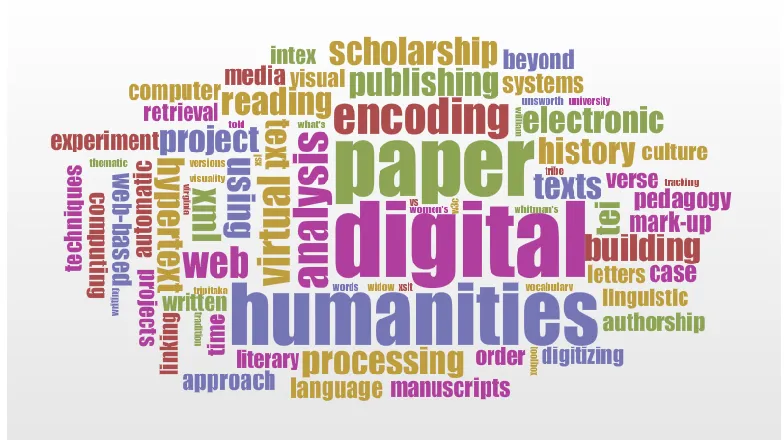
opposed to the lone scholar model). Nevertheless, text and things textual predominated
text, tei, encoding, xml, hypertext, literary, letters, verse, linguistic, mark-up, authorship.
But as you can see from Fig 2. the words that are used the most are ‘humanities’ and ‘digital’: however, the only time they are used together is in Drucker’s keynote.
570. Digital Approaches to Language and Text: Words, Images, and Beyond Program arranged by the Discussion Group on Computer Studies in Language and Literature. Presiding: Henry P. Biggs, Washington Univ.
1. "Statistical Stylistics and Authorship Attribution: An Empirical
Investigation, "David L. Hoover, New York Univ.
2. "Natural Language Processing and the Emergence of a New Theoretical Approach to the Study of Terms," Tanja L. Collet ,Univ. of Ottawa 3. "A Computation infrastructure or
Aligning Tibetan Videos with Text, "Edward J. Garrett Univ .of Virginia 4. "Perl Programming in Stylistic
Analysis and Pedagogy,” Donald E. Hardy, Northern Illinois Univ.
254. Adaptation: Literature into Film Program arranged by the Discussion Group on Media and Literature. Presiding: Everett C. Frost, New York Univ.
1. "One Novel, Five Adaptations: Proust on Film, "Pascal A. Ifri, Washington Univ.
2. "Mutating Aesthetics: The Gate Theatre's 'Beckett on
Film’Project,"Anna
McMullan,Trinity Coll., Dublin 3. "What Can a Film Make of a Book?
Fig 2. Wordle of titles of talks from the 2001 ACH/ALLC (visualisation generated by Voyant)
It was about this time that our editor at Blackwell raised the issue of the title of the
volume us. He was uncomfortable with the term ‘Humanities Computing’ as he thought
the emphasis was too narrowly focused on computing, in a way, perhaps, that the MLA
Discussion Group Computer Studies in Language and Literature conceived itself at the
time. We suggested several alternatives, but it was John’s suggestion of ‘digital
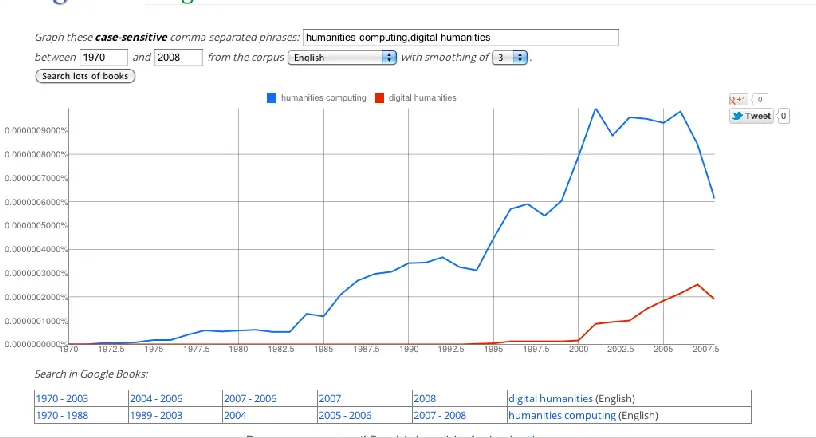
humanities’, obviously already in play at IATH, that Andrew embraced. Google’s Ngram
7
Fig 3. Google’s Ngram Viewer tracking the terms ‘humanities computing’ and ‘digital
humanities’ from 1970-2007
Two years later, in 2003, the Joint International Conference of the ACH and the ALLC
was held at University of Georgia. The theme of the conference was Web X: A Decade of
the World Wide Web, signalling perhaps the coming of age of a disruptive technology in
humanities computing. Unfortunately, the only trace of the conference site is via the
Wayback Machine, a stark reminder of the fragility and transience of dominant
distribution medium of our field.
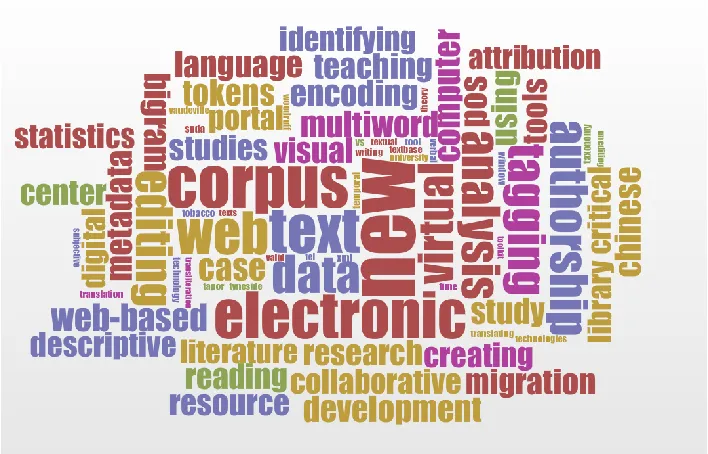
The most prominent word in the titles of papers that year was the word ‘new’ (fig 4.) ,
such as ‘Texts into Databases: The Evolving Field of New-style Prosopography’ or ‘New
Technologies, New Strategies for Integrating Information and Knowledge: Forced
Migration Online’, as well as one of the keynotes, ‘A New Library Model in the Digital
Age: the UGA Student Learning Center’. It is also (not surprisingly) filled with words having to do with text: editing, data, corpus, multiword, attribution, tagging, texts,
authorship, textual, textbase, writing, tokens, language. Rather in the minority are papers
reflecting other media, such as ‘Visual or Verbal: Two Approaches to Creating an Immersive Virtual Environment’, ‘Temporal Modeling’ or ‘Virtual Vaudeville: A Live
[image:7.595.95.503.90.309.2]Fig 2. Wordle of titles of talks from the 2003 ACH/ALLC (visualisation generated by Voyant)
John, Ray, and I commissioned chapters for the Companion between these conferences.
By the time we submitted the text to our publisher, there were contributors from seven
countries: in order of the number of contributors per country, they were from the United
States, the United Kingdom, Canada, Australia, Italy, the Czech Republic, and Denmark.
At the time the three of us were North American based (although I had recently moved
from Ireland where I completed my PhD and a PostDoc). We also all came from a
Literary studies background, although John would move before the Companion was
published to University of Illinois at Urbana Champagne as Dean of the Graduate School
of Library and Information Science, and a few years later I would become Assistant Dean
of Digital Collections and Research at University of Maryland Libraries.
The Companion too reflected our everyday concerns: both as scholars, and as
9
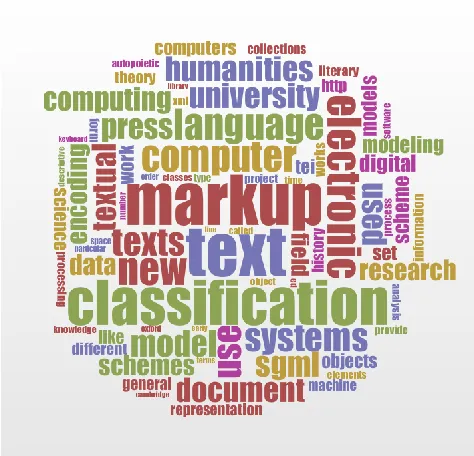
and purposes. Concepts denoting representation, modelling, classification figured
strongly (fig 5), reflecting, perhaps, not only this deep engagement with text and strong
links with the primary concerns of the of the Text Encoding Initiative, but the recognition
that there existed a set of approaches (or principles) that transcend disciplinary boundaries
through the idea creating representations for the purposes of study or in the design of
[image:9.595.179.416.230.458.2]something new (McCarty 255).
Fig 5. Wordle of the full text of the Principles section from A Companion to Digital
Humanities (visualisation generated by Voyant)
Representing and remaking figure strongly in this section: the conversion from analogue
to digital and the affordances that the new digital object offers. Alan Renear’s chapter, simply entitled ‘Text Encoding’, described a methodology and theory (OCHO [Ordered
Hierarchy of Content Objects]) for text encoding, particularly as it is embodied in the
Text Encoding Initiative Guidelines. Jerome McGann’s chapter, on the other hand,
focused on the multidimensionality of text, its bibliographic codes, and the implications
for remaking: ‘translating our archive of cultural materials’ demanding of us ‘a clarity of thought about textually that most people, even most scholars, rarely undertake.’ (198)
While both Renear and McGann focused on remodelling– they differed in their
conception of text as structure, as infrastructure, as a semantic layer in making meaning.
Susan Hockey entitled ‘What is text? A Debate on the Philosophical and Epistemological
Nature of Text in the Light of Humanities Computing Research’, Renear and McGann squared off.
(http://www2.iath.virginia.edu/ach-allc.99/proceedings/hockey-renear2.html). Their first post-debate articulation was in the Companion. However, over
the past decade, their positions have been further refined not only by their authors, but
reformulated by subsequent scholars. What was at stake was (is) the epistemology of text.
In a field that is perhaps more governed by consensus and methodology than strong
theoretical positions, this was digital humanities equivalent to the ‘theory wars’ that
divided literary studies departments in the 1970s and 1980s. The What is Text debates
had their most immediate impact in the development of the Text Encoding Initiative
which was at the same time reorganising -- moving from a fairly small organisational and
editorial base to a more inclusive distributed consortium model. The organisational
change was accompanied by concomitant shift in the nature, meaning, and purpose of
markup. Hence the TEI began to remake itself: from identifying itself as a technical
standard to a research community. Today’s textual theory wars have shifted from the
epistemology of text to the epistemology of reading. The locus of this debate has been
within the covers of Critical Inquiry as Franco Moretti and Katie Trumpener battle over
what Trumpener terms a ‘stastically-driven model of literary history’ (164), which is
forcing an examination of nothing less than the methodology that underpins the vast
majority of text-driven humanities: close reading.
The third section of the Companion was titled ‘Applications’. Here the intention was to
move from purely the disciplinary practice (of the first section) and common methods (of
the second), to the application of those methods. Perhaps even more than today, it was
key to make explicit applications that existed at the intersections between new
technologies, traditional genres, and theoretical perspectives. It was in this section that
theory turned into practice: a practice that bound us (or differentiated us) as a community
from our nearest neighbours, fields such as computer science and library and information
studies.
Carol Palmer’s chapter on ‘Thematic Research Collections’ was the first extended
11
porous than sharp (349), especially at the time her essay was written. As digital library
holdings have become larger and thematic research collections more focused and
experimental, the distinctions seem to have become clearer.
Other chapters in this section explored the application of new technologies to other
mediums: Robert Kolker’s chapter on ‘Digital Media and the Analysis of Film’ set out a
research agenda in which film could be annotated – much like print has traditionally been
done– within the same medium. His early experiments with Casablanca were fascinating
and paved the way a multi-media driven analysis that has yet to be fully realised. Marie-Laure Ryan’s ‘Multivariant Narratives’ explored the intersections between textuality,
narrativity and multimedia, deftly negotiating the technical and theoretical underpinnings
of the emerging genres of e-Literature and e-Art.
The forth and last section Production, Dissemination, Archiving were, in part, how-to
articles: how to create sustainable, digital objects and projects. What issues to think about
in terms of usability and interface, and how to convert primary sources. There are no
articles here on reusability, harvesting, or integrating collections; that would all come
much later as the technology matured to enable such practices. This section contains two
chapters that deal with issues as relevant to the community today as it was a decade ago;
valuing digital scholarship and the creation, valuing, and maintenance of domain-specific
tools.
The Companion was published in December 2004. The following summer, at the
ACH/ALLC conference at the University of Victoria, the editors invited all of the
contributors who would be attending to participate in a panel.
(http://grape.hcmc.uvic.ca:8080/ach/site/xhtml.xq?id=96) In addition to Ray, John, and
myself, Willard McCarty, Martha Nell Smith, Geoffrey Rockwell, Abby Smith, Claire
Warwick, Perry Willett participated. Our goal was to discuss how the Companion served
as both a historical record of the field as well as a snap-shot of the field at the time of its
publication We asked the contributors, not to summarise their chapters, but, as a way of
demonstrating just how fast the field was changing, to talk about how, if they were
writing their chapters today, they would differ from what they submitted less than two
years earlier. I still remember Perry Willett’s response: it was a two word answer: Google
Google HQ. Google Books had changed everything he wrote about: the scale, the
technology, the research possibilities.
Over the next decade aspects of the field would change so profoundly that by the time the
paperback was published only three years later, many of its chapters were, possibly not
out of date, but did not reflect the latest technologies and thinking in the field. When our
editor, Emma Benett, approached us about bringing out a paperback, we asked if
Blackwell would consider allowing us to make the text freely-available online. I
remember John’s response when I expressed my surprise when they gave us permission.
He said, sometimes publishers surprise you.
The electronic version, along with a later text that Ray and I edited, A Companion to
Digital Literary Studies, also published by Blackwell, were one of the first core texts that
the newly-established Alliance of Digital Humanities Organisations hosted. The move
from calling the conference the Joint International Conference of the Association for
Computers and the Humanities and the Association for Literary and Linguistic
Computing to ‘Digital Humanities’ under the auspices of a linguistically and
symbolically-neutral umbrella organization, the Alliance Digital Humanities
Organizations, signalled a singular turning point in digital humanities, not simply as a
disciplinary practice, but as a community.
Although discussions began in 2002, it was not until 2006, at the Paris conference, that
the new nomenclature was used. The more neutral sounding ADHO not only broke the
Anglo-American bias, but it served to lesson links with certain historical methodological
approaches, however tacitly, associated with these two organisations. It also signalled a
more inclusive environment, as exemplified by the title of the 2011 conference at Stanford: Big Tent Digital Humanities, which in its call for papers reached out to ‘Latin
American scholars (welcoming digital scholarship from underrepresented regions in what
had now become a North American/European bias), scholars in the digital arts and music, in spatial history, and in the public humanities’
13
from publishers: that our field moved so fast that they had no publication model to keep
up with it. But last year she agreed that the time had come for a new Companion to
Digital Humanities: a decade after we began commissioning chapters for the first. This
new text will have to reflect immense shifts: not simply a reshaping from a predominately
textual focus, but wholly new methodological practices, new theories, a plethora of new
technologies, devices, and business practices, and publication models. At a time when one
of the bestselling apps for the iPad is TS Eliot’s The Waste Land , a cross between a
scholarly edition, a multimedia teaching resource, and a pretty cool app, the Companion
will be entering a conversation about the pervasive role and nature of technology in
virtually all aspects of our lives, not simply how we engage with it as scholars and
teachers, but as human beings. The boundaries that seemed clearer around digital
humanities in 2001 seem more porous today.
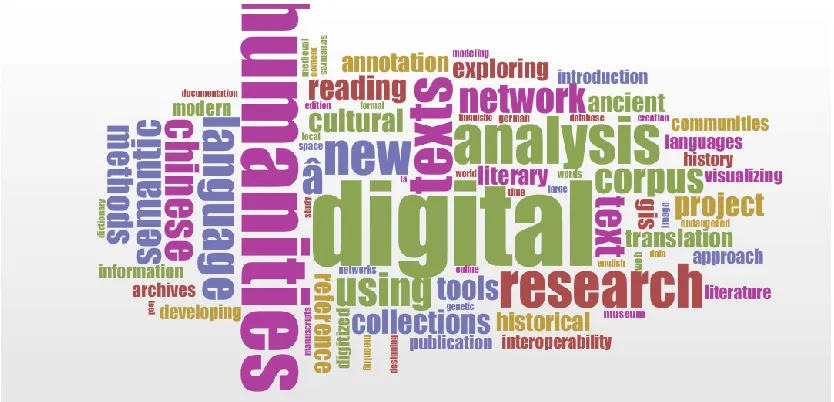
Fig 6 is a word cloud of the titles from the 2012 DH conference in Hamburg. The word ‘text’ has receded (although not disappeared) and other concerns have taken its place:
languages: Chinese, German, and the much smaller English; methods, such as research,
analysis, and exploring; the World Web that was so prominent in 2003 has become
[image:13.595.90.507.487.688.2]normalised.
Fig 6. Wordle from titles of the 2012 Digital Humanities Conference (visualisation
At the 2012 MLA the distinctions between the Discussion Groups mentioned earlier have
also disappeared. The session sponsored by the Discussion Group on Media and
Literature was entitled‘ Digital Literary Studies: When Will it End?’ The title caught the
eye of Stanley Fish, a distinguished Professor of Literature and Law at the Florida
International University, and a contributor to the New York times in their online ‘Opinionator” blog. On 26 December he published a critique of the MLA’s 2012
conference programme in which he discovered a new and heretofore unknown force (at
least to him) in literary scholarship:
So what exactly is that new insurgency? What rough beast has slouched into the
neighborhood threatening to upset everyone’s applecart? The program’s statistics
deliver a clear answer. Upward of 40 sessions are devoted to what is called the “digital humanities,” an umbrella term for new and fast-moving developments
across a range of topics: the organization and administration of libraries, the
rethinking of peer review, the study of social networks, the expansion of digital
archives, the refining of search engines, the production of scholarly editions, the
restructuring of undergraduate instruction, the transformation of scholarly
publishing, the re-conception of the doctoral dissertation, the teaching of foreign
languages, the proliferation of online journals, the redefinition of what it means to
be a text, the changing face of tenure — in short, everything.
Although Fish’s critique is somewhat tongue-in cheek, he does capture the present
moment of digital scholarship, or at least how it is represented in literary studies. He notes the confidence of the rhetoric of those who are ‘in’ – ‘while those who are not are made to feel ignorant, passed by, left behind, old. If you see a session on “Digital Humanities versus New Media”’, he writes, ‘and you’re not quite sure what either term
means you might think you have wandered into the wrong convention. . . And when a session’s title is “Digital Literary Studies: When Will it End?”, you might find yourself muttering, “Not soon enough.’
Perhaps what Fish is reflecting is a growing awareness (or resignation) of the ‘digital’ as
15
collection. To this end, John, Ray, and I are planning a community-based exercise this
summer that will invite suggestions as to the structure and content of the new Companion.
It seemed fitting for a discipline that carries out so much of its knowledge exchange
electronically, that this time we would dispense with the idea of an advisory board in
Bibliography
Bornstein, George and Theresa Tinkle, eds. The Iconic Page in Manuscript, Print, and Digital Culture. Ann Arbor: University of Michigan Press, 1998.
Finneran, Richard J., ed. The Literary Text in the Digital Age. Ann Arbor: University of Michigan Press, 1996.
Fish, Stanley, ‘The Old Order Changeth’. New York Times. 26 December 2011.
http://opinionator.blogs.nytimes.com/2011/12/26/the-old-order-changeth/ . Accessed 1
May 2012.
Gold, Matthew K. Debates in the Digital Humanities. (Minneapolis: University of Minnesota Press, 2011).
Greenstein, Daniel I. A Historian's Guide to Computing (Oxford: Oxford University Press, 1994).
Hockey, Susan. Electronic Texts in the Humanities. Oxford: Oxford University Press, 2000.
Knowles, Anne Kelly, ed. Past Time, Past Place: GIS for History. Redlands, CA: ESRI, 2002
McCarty, Willard. ‘Modeling: A Study in Words and Meanings’. Companion to Digital Humanities . Eds Susan Schreibman, Ray Siemens, John Unsworth. Eds. (Oxford: Blackwell, 2004). 254-270.
McGann, Jerome. ‘Making Texts of Many Dimentions’. Companion to Digital Humanities . Eds Susan Schreibman, Ray Siemens, John Unsworth. Eds. (Oxford: Blackwell, 2004). 198-217.
Moretti, Franco. ‘Style, Inc.: Reflections on Seven Thousand Titles (British Novels,
1740-1850)’. Critical Inquiry, (36:1), 2009 Autumn, 134-158. (2009). Print.
Schreibman, Susan, Ray Siemens, John Unsworth, eds. A Companion to Digital Humanities (Oxford: Blackwell, 2004).
Schrum, Stephen A., ed. Theater in Cyberspace: Issues of Teaching, Acting, and Directing (New York: Peter Lang, 1999).
Sutherland, Katherine, ed. Electronic Text: Investigations in Method and Theory. Oxford: Clarendon Press, 1997.
Trumpener, Katie: “Paratext and Genre System: A Response to Franco Moretti” Critical