EFFECT OF DELTAMETHRIN AND NEEM
PHOSPHATASES IN TISSUES OF ZEBRAFISH
D.K. Sharma, M.K. Ahmad, S.
Department of Zoology, D.D.U. Gorakhpur University, Gorakhpur
ARTICLE INFO ABSTRACT
The present study is aimed to investigate the changes in activities of acid
alkaline phosphatase (ALP) in liver, ovary and muscle of Zebrafish after exposure to 96 h LC LC10
found that the activities of ACP and ALP in tr
response to treatments of both the pesticides compared with controls. The activity of ACP was reduced to
Deltamethrin whereas 9
Also, the activity of ALP was reduced to muscle respectively after 16 days exposure to LC was 75, 65 & 67%
concentration and exposure period as that of Deltamethrin. There was a concentration and time dependent inhibition in the activities of both ACP & ALP enzym
exposure to both the pesticides. The natural pesticides may not be treated safe to the fish and should be used with great cautions.
INTRODUCTION
Pollution of the aquatic environment is a serious and growing problem. Increasing amount of industrial, agricultural and commercial chemicals into the aquatic environment having led to various deleterious effects on the aquatic organisms. Also, it is reported that the drainage waters discharged into the lake are high in solids, nutrients, pesticides, heavy metals and organics. The aquatic ecosystem is the greater part of natural environment which is facing the threat of shrinking genetic base and biodiversity due to indiscriminate use of pesticides
(Rahman et al., 2002). Pesticides are useful to control
economically important crops, but are found very much hazardous to the aquatic flora and fauna and in turn, the entire
food chain including human beings(Paul and Simonin, 2006).
Synthetic pyrethroids, the newest major class of insecticides are synthesized derivatives of naturally occurring pyrethrins, which are taken from pyrethrum, the oleo
genus Chrysanthemum flowers. Because of their beneficial
qualities, synthetic pyrethroids, such as Deltameth
attracted farmers and health departments to use them in pest control. Type-II pyrethroids including Deltamethrin are potentially toxic to fish and least toxic to mammals. They are reported to alter the biochemical constituents in different
tissues of fish (Anita Susan et al., 2010; Sharma and Ansari,
2011). All pyrethroids are potent neurotoxicant and due to their lipo-philicity, biological membranes and tissues readily
take up them (Oros et al., 2005). Cost-effective, non
*Corresponding author: [email protected]
ISSN: 0975-833X
Article History:
Received 9th November, 2011
Received in revised form 8th December, 2011
Accepted 10th January, 2011
Published online 29th February, 2012
Key words:
Zebrafish, Deltamethrin, Achook, Phosphatases, Toxicity.
RESEARCH ARTICLE
EFFECT OF DELTAMETHRIN AND NEEM-BASED FORMULATION ACHOOK ON ACTIVITIES OF
PHOSPHATASES IN TISSUES OF ZEBRAFISH
DANIO RERIO
D.K. Sharma, M.K. Ahmad, S.
Ansari and B.A. Ansari*
Department of Zoology, D.D.U. Gorakhpur University, Gorakhpur - 273 009 (U.P.) India
ABSTRACT
The present study is aimed to investigate the changes in activities of acid
alkaline phosphatase (ALP) in liver, ovary and muscle of Zebrafish after exposure to 96 h LC
10 and LC20 of synthetic pyrethroid Deltamethrin and neem based formulation Achook. It was
found that the activities of ACP and ALP in treated fishes was significantly reduced (p<0.001) in response to treatments of both the pesticides compared with controls. The activity of ACP was reduced to 91, 96 & 92% of controls (100%) in liver, ovary and muscle, respectively for Deltamethrin whereas 96, 98 & 97% for Achook treated fishes after LC
Also, the activity of ALP was reduced to65, 60 & 57% of controls (100%) in liver, ovary and muscle respectively after 16 days exposure to LC20 of Deltamethrin. The reduction in ALP activ
was 75, 65 & 67%of controls in liver, ovary and muscle, respectively due to Achook at the same concentration and exposure period as that of Deltamethrin. There was a concentration and time dependent inhibition in the activities of both ACP & ALP enzym
exposure to both the pesticides. The natural pesticides may not be treated safe to the fish and should be used with great cautions.
Copy Right, IJCR, 2012, Academic Journals
Pollution of the aquatic environment is a serious and growing problem. Increasing amount of industrial, agricultural and ial chemicals into the aquatic environment having led to various deleterious effects on the aquatic organisms. Also, it is reported that the drainage waters discharged into the lake are high in solids, nutrients, pesticides, heavy metals and aquatic ecosystem is the greater part of natural environment which is facing the threat of shrinking genetic base and biodiversity due to indiscriminate use of pesticides 2002). Pesticides are useful to control economically important crops, but are found very much hazardous to the aquatic flora and fauna and in turn, the entire (Paul and Simonin, 2006). ajor class of insecticides are synthesized derivatives of naturally occurring pyrethrins, which are taken from pyrethrum, the oleo-resin extract of flowers. Because of their beneficial qualities, synthetic pyrethroids, such as Deltamethrin, have attracted farmers and health departments to use them in pest II pyrethroids including Deltamethrin are potentially toxic to fish and least toxic to mammals. They are reported to alter the biochemical constituents in different 2010; Sharma and Ansari, 2011). All pyrethroids are potent neurotoxicant and due to philicity, biological membranes and tissues readily
effective, non-toxic,
bio-degradable, eco-friendly and botanical soft
the need of present day agriculture as an alternative to hazardous and synthetic pesticides. The neem (
indica A. Juss) is a tropical evergreen tr
sub-continent which is a natural source of insecticides and agrochemicals along with a number other properties. Azadirachtin (a tetranotriterpenoid) is one of a major component of neem, which have pesticidal property (Anon, 1992). However, the disturbance in the total protein level due to different neem extracts have been reported (Ibrahim
1992; Mahdi et al., 2003; Winkaler
various pesticides were found toxic to adult, embryo and fingerlings of Zebrafish (Ansari and Sharma, 2009; Ansari and Ahmad, 2010; Ahmad and Ansari, 2011; Ansari and Ansari,
2011; Ahmad et al., 2011) and cause skeletal deformities
(Kumar and Ansari, 1984) and reduced reproductive ability (Sharma and Ansari, 2010).
Fish, among the group of non
represent the largest and most diverse group of vertebrates. A number of characteristics make them excellent experimental models for toxicological research, especially for the contaminants which are likely to exert their impact on aquatic systems. Cells contain enzymes that are necessary to their function. When the integrity of a cell is disrupted, enzymes escape into plasma/serum, where their activity can be measured as a useful index of cell integrity
estimating the enzyme activities in an organism, we can easily identify disturbance in its metabolism. Hence, a need was felt to investigate the changes in activities of acid phosphatase
International Journal of Current Research
Vol. 4, Issue, 02, pp.012-016, February-2012
INTERNATIONAL
BASED FORMULATION ACHOOK ON ACTIVITIES OF
DANIO RERIO
B.A. Ansari*
273 009 (U.P.) India
The present study is aimed to investigate the changes in activities of acid phosphatase (ACP) and alkaline phosphatase (ALP) in liver, ovary and muscle of Zebrafish after exposure to 96 h LC5,
of synthetic pyrethroid Deltamethrin and neem based formulation Achook. It was eated fishes was significantly reduced (p<0.001) in response to treatments of both the pesticides compared with controls. The activity of ACP was 91, 96 & 92% of controls (100%) in liver, ovary and muscle, respectively for 6, 98 & 97% for Achook treated fishes after LC5 exposure for 4 days.
65, 60 & 57% of controls (100%) in liver, ovary and of Deltamethrin. The reduction in ALP activity of controls in liver, ovary and muscle, respectively due to Achook at the same concentration and exposure period as that of Deltamethrin. There was a concentration and time dependent inhibition in the activities of both ACP & ALP enzymes after 4, 8, 12 & 16 days of exposure to both the pesticides. The natural pesticides may not be treated safe to the fish and
, Academic Journals. All rights reserved.
friendly and botanical soft-pesticides are the need of present day agriculture as an alternative to
hazardous and synthetic pesticides. The neem (Azadirachta
A. Juss) is a tropical evergreen tree, native to Indian continent which is a natural source of insecticides and agrochemicals along with a number other properties. Azadirachtin (a tetranotriterpenoid) is one of a major component of neem, which have pesticidal property (Anon, ver, the disturbance in the total protein level due
to different neem extracts have been reported (Ibrahim et al.,
2003; Winkaler et al., 2007). Recently,
various pesticides were found toxic to adult, embryo and (Ansari and Sharma, 2009; Ansari and Ahmad, 2010; Ahmad and Ansari, 2011; Ansari and Ansari, 2011) and cause skeletal deformities (Kumar and Ansari, 1984) and reduced reproductive ability
Fish, among the group of non-target aquatic organisms, represent the largest and most diverse group of vertebrates. A number of characteristics make them excellent experimental models for toxicological research, especially for the kely to exert their impact on aquatic systems. Cells contain enzymes that are necessary to their function. When the integrity of a cell is disrupted, enzymes escape into plasma/serum, where their activity can be measured as a useful index of cell integrity. Thus, by estimating the enzyme activities in an organism, we can easily identify disturbance in its metabolism. Hence, a need was felt to investigate the changes in activities of acid phosphatase
(ACP) and alkaline phosphatase (ALP) in the liver, ovary and
muscle of Zebrafish (Danio rerio) after sub-lethal exposure of
Deltamethrin (synthetic pyrethroid) and Achook (neem pesticide). Zebrafish was used as the test species as per recommendation of the International Organization for Standardization and the Organization for Economic Co-operation and Development (OECD, 1992).
MATERIALS AND METHODS
For the present experiment Zebrafish were procured from our stock aquarium. The water of the stock aquarium was aerated continuously through stone diffusers connected to a mechanical air compressor. Water temperature ranged
between 25±2oC and the pH was maintained between 6.6 and
8.5. Fish were fed twice daily alternately with raw chopped goat liver and brine shrimps. The diet was supplemented with Drosophila flies once daily. For the present study, matured
adult fishes were exposed to different concentrations viz., 96-h
LC5, LC10 and LC20 of Deltamethrin and Achook for 16 days
continuously. Fifty fishes for each concentration of the pesticides were used. In these aquaria water was replaced daily with fresh treatment of pesticides. Each experiment was accompanied by its respective control.
After the expiry of the exposure periods (4, 8, 12 & 16 days), required number of exposed fishes were taken out from experimental and control groups. Activities of acid phosphatase (ACP) and alkaline phosphatase (ALP) in the liver, ovary and muscle of Zebrafish were estimated according to the method proposed by Andersch and Szcypinski (1947)
later modified by Bergmeyer (1967) using
p-nitrophenylphosphate as substrate. The activities of
phosphatases have been expressed as µM substrate hydrolyzed/30 minutes/mg protein. Two way ANOVA was employed to test the significance of the data.
RESULT AND DISCUSSION
In the present investigation we observed significant (p<0.001) alterations in activities of ACP and ALP enzymes in liver, ovary and muscle of Zebrafish exposed to Deltamethrin and Achook pesticides at different concentrations and exposure
periods. The activity of ACP was reduced to91, 96 & 92% of
controls (100%) in liver, ovary and muscle, respectively for Deltamethrin whereas 96, 98 & 97% for Achook treated fishes
after LC5 exposure for 4 days. The 8 days exposure of LC10
reduced the ACP activity to84, 73 & 85% in liver, ovary and
muscle, respectively for Deltamethrin while 86, 84 & 89% for Achook treatment. Further increase in concentration caused
drastic inactivation of the enzyme activity. At the LC20
exposure for 16 days ACP activity remained only 58, 59 & 60% in liver, ovary and muscle, respectively for Deltamethrin whereas 66, 65 & 64% for Achook (Table 1). Also, from results it is evident that in the liver, ovary and muscle of
Zebrafish LC5 and LC10 of Deltamethrin causes greater
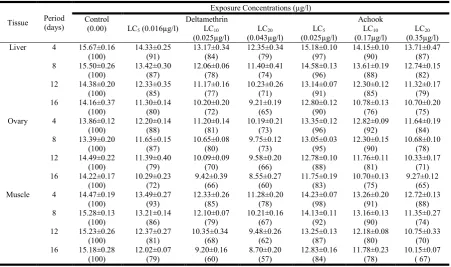
decrease in activity of ALP than Achook (Table 2). The ALP
activity was reduced to 65, 60 & 57%of controls (100%) in
liver, ovary and muscle respectively after 16 days exposure to
LC20 of Deltamethrin.The reduction inALP activity from the
control was 75, 65 & 67% in liver, ovary and muscle
respectively due to Achook at the same concentration and
exposure period as that of Deltamethrin. There was a
concentration-dependent inhibition in the activities of both ACP & ALP enzymes. Thus the result showed that Deltamethrin is more toxic than Achook.
In the treated group of fishes abnormal behaviour such as restlessness, sudden quick and jerky movements were observed at low concentration of pesticides whereas, increased opercular movements accompanied with surface to bottom movements and loss of equilibrium was observed in the fishes exposed to high concentrations. Similar observation has been
reported by Rahman et al. (2002) in some fishes. The organ
most associated with the detoxification and biomarker process is liver and due to its function, position and blood supply, it is also one of the organs most affected by contaminants in the water (Camargo and Martinez, 2007). Fish is a good indicator of changes in water because under stress conditions biochemical changes such as alterations in enzyme activities and metabolic products occur in their body. Enzymes are relatively fragile substances with a tendency to undergo denaturation and inactivation under suitable conditions (Lopez et al., 2003). The majority of insecticides are biotransformed in metabolites by liver through various enzyme systems (Roy, 2002) and as a consequence of this process, liver undergoes different levels of damages. Lysosomal enzymes, both acid alkaline phosphatase participate in degradation of proteins,
carbohydrates and lipids (Pipe et al., 1993; Xue and Renault,
2000). These enzymes are released by the lysosomes for the hydrolysis of foreign material; hence it has a role in certain
detoxification functions. Das et al. (2004) have been reported
the changes in phosphatase activity in fishes due to exposure to industrial effluents.
ALP is composed of several isoenzymes that are present in practically all tissues of the body, especially in cell membranes. Any damage in hepatic cells may result in alteration in ALP activity. The concentration-dependent inhibition observed in this investigation is in agreement with the earlier report of Sastry and Sharma (1980). More reasonably this can be explained that like acetylcholinesterase the ALP has serine residue at its active site and the organophosphate compounds are generally inhibitors of serine
containing enzymes (Bell et al., 1970). Similarly, Das and
Mukherjee (2003) reported depletion of alkaline phosphatase
due to sub-lethal exposure of Labeo rohita fingerlings to
cypermethrin. In our earlier experiment we also observed inhibition in protein content (Sharma and Ansari, 2011). The inhibition in protein level may also be due to the decrease in ALP activity as it plays an important role in protein synthesis
(Pilo et al., 1972). The decreased activity in these enzymes in
intoxicated Zebrafish as observed in present investigation may be due to the labilization of the lysosomal membrane releasing the enzyme. Similar observations were also made by
Abou-Donia (1978) and Tayyaba et al. (1981)after treatment with
pesticides. Zebrafish, exposed to diazinon is known to affect the nervous tissue (brain) by inhibition of
acetyl-cholinesterase (AChE) and phosphatases activity (Ansari et
al., 1987). The inhibition of ACP in liver, ovary and muscle
fish, being in the range of LC50<100 µg/l. The plant based
pesticidal toxic effects on the environment are not too detrimental (Das and Mukherjee, 2003). But, some studies have shown that plant toxins at low concentrations are very
toxic to all groups of aquatic fauna (Goktepe et al., 2004). The
toxicity of two neem based pesticides Nimbecidine and
Neemgold on a fresh water loach, Lepidocephalichthys guntea
has been reported (Mondal et al., 2007). Recently, Achook a
neem based pesticide was found toxic to adult Zebrafish (Ansari and Sharma, 2009) and causes alterations in
[image:3.595.61.531.77.345.2]reproductive ability (Sharma and Ansari, 2010). Our results indicate the inert ingredients do have a toxic effect on the aquatic fishes and changes the phosphatases activities which in turn will affect the overall health of fish. We, therefore, recommend that the commercial formulations of neem pesticides should be redesigned. These pesticides should be used with great caution and in sustainable way so that, it may not be hazardous to aquatic environment and human beings.
Table 1.Effect of Deltamethrin and Achook on ACP (µM substrate hydrolyzed/30 minutes/mg protein) in Zebrafish
Tissue Period
(days)
Exposure Concentrations (µg/l) Control
(0.00)
Deltamethrin Achook
LC5 (0.016µg/l) LC10
(0.025µg/l) LC20 (0.043µg/l) LC5 (0.025µg/l) LC10 (0.17µg/l) LC20 (0.35µg/l)
Liver 4 18.59±0.19
(100) 16.94±0.07 (91) 15.79±0.10 (85) 14.59±0.33 (78) 17.82±0.38 (96) 16.52±0.58 (89) 14.88±0.58 (80)
8 18.44±0.36
(100) 16.66±0.34 (90) 15.54±0.23 (84) 12.66±0.37 (69) 16.96±0.26 (92) 15.93±0.39 (86) 13.30±0.30 (72)
12 17.66±0.34
(100) 15.67±0.16 (89) 13.86±0.12 (78) 11.30±0.33 (64) 15.84±0.29 (90) 14.60±0.43 (83) 12.06±0.51 (68)
16 17.58±0.32
(100) 14.50±0.26 (82) 13.39±0.20 (76) 10.20±0.17 (58) 14.83±0.18 (84) 14.04±0.80 (80) 11.64±0.50 (66)
Ovary 4 17.46±0.34
(100) 16.80±0.11 (96) 14.73±0.18 (84) 13.43±0.33 (77) 17.15±0.04 (98) 16.55±0.14 (95) 15.08±0.05 (86)
8 17.16±0.16
(100) 14.50±0.26 (84) 12.54±0.30 (73) 11.68±0.27 (68) 16.12±0.12 (93) 14.44±0.08 (84) 12.67±0.21 (74)
12 16.86±0.12
(100) 12.59±0.22 (75) 11.30±0.34 (67) 10.59±0.28 (63) 15.36±0.14 (91) 13.82±0.10 (83) 12.11±0.18 (72)
16 16.38±0.20
(100) 11.46±0.27 (70) 10.24±0.14 (63) 9.63±0.28 (59) 14.17±0.15 (86) 11.10±0.06 (68) 10.72±0.17 (65)
Muscle 4 18.80±0.14
(100) 17.29±0.17 (92) 16.69±0.20 (89) 15.48±0.30 (82) 18.18±0.09 (97) 17.67±0.12 (94) 17.12±0.05 (91)
8 18.42±0.26
(100) 16.28±0.21 (88) 15.64±0.27 (85) 14.73±0.18 (80) 17.28±0.07 (94) 16.43±0.09 (89) 15.36±0.12 (83)
12 17.52±0.32
(100) 14.52±0.25 (83) 13.46±0.29 (77) 12.50±0.25 (71) 16.12±0.10 (92) 15.19±0.17 (87) 13.36±0.05 (76)
16 17.43±0.24
(100) 13.68±0.23 (78) 12.50±0.29 (72) 10.47±0.27 (60) 15.75±0.15 (90) 14.63±0.13 (84) 11.23±0.18 ( 64) Values are mean ± SD of six individual observations; Values are significant at p<0.001 (two-way ANOVA).
Table 2.Effect of Deltamethrin and Achook on ALP (µM substrate hydrolyzed/30 minutes/mg protein) in Zebrafish
Tissue Period (days)
Exposure Concentrations (µg/l) Control
(0.00)
Deltamethrin Achook
LC5 (0.016µg/l) LC10
(0.025µg/l) LC20 (0.043µg/l) LC5 (0.025µg/l) LC10 (0.17µg/l) LC20 (0.35µg/l)
Liver 4 15.67±0.16
(100) 14.33±0.25 (91) 13.17±0.34 (84) 12.35±0.34 (79) 15.18±0.10 (97) 14.15±0.10 (90) 13.71±0.47 (87)
8 15.50±0.26
(100) 13.42±0.30 (87) 12.06±0.06 (78) 11.40±0.41 (74) 14.58±0.13 (96) 13.61±0.19 (88) 12.74±0.15 (82)
12 14.38±0.20
(100) 12.33±0.35 (85) 11.17±0.16 (77) 10.23±0.26 (71) 13.14±0.07 (91) 12.30±0.12 (85) 11.32±0.17 (79)
16 14.16±0.37
(100) 11.30±0.14 (80) 10.20±0.20 (72) 9.21±0.19 (65) 12.80±0.12 (90) 10.78±0.13 (76) 10.70±0.20 (75)
Ovary 4 13.86±0.12
(100) 12.20±0.14 (88) 11.20±0.14 (81) 10.19±0.21 (73) 13.35±0.12 (96) 12.82±0.09 (92) 11.64±0.19 (84)
8 13.39±0.20
(100) 11.65±0.15 (87) 10.65±0.08 (80) 9.75±0.12 (73) 13.05±0.03 (95) 12.30±0.15 (90) 10.68±0.10 (78)
12 14.49±0.22
(100) 11.39±0.40 (79) 10.09±0.09 (70) 9.58±0.20 (66) 12.78±0.10 (88) 11.76±0.11 (81) 10.33±0.17 (71)
16 14.22±0.17
(100) 10.29±0.23 (72) 9.42±0.39 (66) 8.55±0.27 (60) 11.75±0.19 (83) 10.70±0.13 (75) 9.27±0.12 (65)
Muscle 4 14.47±0.19
(100) 13.49±0.27 (93) 12.33±0.26 (85) 11.28±0.20 (78) 14.23±0.07 (98) 13.26±0.20 (91) 12.72±0.13 (88)
8 15.28±0.13
(100) 13.21±0.14 (86) 12.10±0.07 (79) 10.21±0.16 (67) 14.13±0.11 (92) 13.16±0.13 (90) 11.35±0.27 (74)
12 15.23±0.26
(100) 12.37±0.27 (81) 10.35±0.34 (68) 9.48±0.26 (62) 13.25±0.13 (87) 12.18±0.08 (80) 10.75±0.33 (70)
16 15.18±0.28
[image:3.595.71.523.382.649.2]ACKNOWLEDGEMENT
The authors thankfully acknowledge the Council of Science and Technology, U.P. (Project No. CST/AAS/D-2609) for financial assistance and to Prof. V.B. Upadhyay, Head of the Department of Zoology, D.D.U. Gorakhpur University, Gorakhpur for providing laboratory facilities.
REFERENCES
Abou-Donia, M.B. 1978. Increased acid phosphatase activity
in hens following an oral dose of leptophos. Toxicol.
Lett., 2: 199-203.
Ahmad, M.K. and Ansari, B.A. 2011.Toxicity of Neem based
pesticide Azacel to the embryo and fingerlings of
Zebrafish, Danio rerio (Cyprinidae). World J. Zool., 6(1):
47-51
Ahmad, M.K., Sharma D.K., Ansari S. and Ansari B.A. 2011. Comparative Study of Synthetic Pyrethroid Lambda-cyhalothrin and Neem based Pesticide Neemgold on the
Fingerlings of Zebrafish Danio rerio (Cyprinidae). Res. J.
Chem. Sci. (In Press)
Andersch, M.A. and Szcypinski, A.J. 1947. American Journal
of Clinical Pathology, 17: 571, From: Bergmeyer, U.H. (Eds.), Methods of Enzymatic Analysis. New York Academic Press, 1967.
Anita Susan, T., Sobha K., Veeraiah, K. and Tilak, K.S. 2010.
Studies on biochemical changes in the tissues of Labeo
rohita and Cirrhinus mrigala exposed to fenvalerate
technical grade. J. Toxicol. Environ. Health Sci., 2(5):
53-62.
Anon, 1992. A tree for solving global problems. National Academy Press, Washington, D.C.
Ansari, B.A. and D.K. Sharma, 2009. Toxic effect of synthetic pyrethroid Deltamethrin and Neem Based formulation
Achook on Zebrafish, Danio rerio. Trends in Biosci.,
2(2): 18-20.
Ansari, B.A. and M.K. Ahmad, 2010. Toxicity of pyrethroid Lambda-cyhalothrin and Neemgold to the embryo of
Zebrafish, Danio rerio (Cyprinidae). J. Appl. Biosci.,
36(1): 97-100.
Ansari, B.A., Aslam, M. and Kumar, K. 1987. Diazinon
Toxicity: Activities of acetyl cholinesterase and Phosphatases in the Nervous Tissue of Zebrafish,
Brachydanio rerio (Cyprinidae). Act. Hydroch.
Hydrobiol., 15(3): 301-306.
Ansari, S. and Ansari, B.A. 2011. Embryo and fingerling toxicity of Dimethoate and effect on fecundity, viability and survival of Zebrafish, Danio rerio (Cyprinidae). World J. Fish Marine Sci., 3(2): 167-173.
Bell, G.H., Davidson, J.N. and Smith, D.E. 1970. A text book of physiology and biochemistry. London, Tinling and Co., 103-105.
Camargo, M.M. and Martinez, C.B. 2007. Histopathology of gills, kidney and liver of a Neotropical fish caged in an
urban stream. Neotrop. Ichthyol., 5: 327-336.
Das, B.K. and Mukherjee, S.C. 2003. Toxicity of
cypermethrin in Labeo rohita fingerlings: Biochemical
enzymatic and hematological consequences. Comp.
Biochem. Physiol. C Toxicol. Pharmacol., 134: 109-121. Das, P.C., Ayyappan, S., Das, B.K. and Jena, J.K. 2004.
Nitrate toxicity in Indian major carps: sub-lethal effect on
selected enzymes in fingerlings of Catla catla, Labeo
rohita and Cirrhinus mrigala. Com. Bio. Physiol. Part C. Toxicol. Pharmacol., 138(1): 3-10.
Goktepe, I., Portier, R. and Ahmedna, M. 2004. Ecological
assessment of neem based pesticides. J. Environ. Sci.
Health, B 39: 311-320.
Ibrahim, I.A., Khalid, S.A., Omer, S.A. and Adam, S.E.I.
1992. On the toxicity of Azadirachta indica leaves. J.
Ethnopharmacol., 35: 267-273.
Kumar, K. and Ansari, B.A. 1984. Malathion Toxicity:
Skeletal Deformities in Zebrafish (Brachydanio rerio,
Cyprinidae). Pestic. Sci., 15: 107-111.
Lopez, L.E., Favari, L., Martinez, T.L., Madrigal, M. and Soto, C. 2003. Hazard assessment of a mixture of pollutants from a sugar industry to three fish species of western Maxico by the responses of enzymes and lipid
peroxidation. Bull. Environ. Contam. Toxicol., 70(4):
739-745.
Mahdi, A.A., Chandra, A., Singh, R.K., Shukla, S., Mishra, L.C. and Ahmad, S. 2003. Effect of herbal hypoglycemic agents on oxidative stress and antioxidant status in
diabetic rats. Indian J. Clin. Biochem., 18(2): 8-15.
Mondal, D., Barat, S. and Mukhopadhyay, M.K. 2007. Toxicity of neem pesticides on a freshwater loach,
Lepidocephalichthys guntea (Hamilton Buchanan) of
Darjeeling district in West Bengal. J. Environ. Biol., 28
(1): 119-122.
OECD, 1992. Guidelines for Testing of Chemicals, Guideline 210 “Fish, Early-life Stage Toxicity Test.” Adopted July 17.
Oros, D.R., Hoover, D., Rodigary, F., Crane, D. and Sericano, J. 2005. Levels and distribution of polybrominated diphenyl ethers in water, surface sediments and bivalves
from the San Francisco Estuary. Environ. Sci. Tech., 39:
33-41.
Paul, E.A. and Simonin, H.A. 2006. Toxicology of Three
Mosquito Insecticides to Crayfish. Bull. Evironm.
Contam. Toxicol., 76: 614-621.
Pilo, B., Asnani, M.V. and Shah, R.V. 1972. Studies on wound healing and repairs in pigeon liver: III. Histochemical studies on acid and alkaline phosphatase
during the process. J. Anim. Morphol. Physiol., 19:
205-212.
Pipe, R.K., Porte, C. and Livingstone, D.R. 1993. Antioxidant enzymes associated with the blood cells and haemolymph
of the mussels, Mytilus edulis. Fish Shellfish Immunol., 3:
21-23.
Rahman, M.Z, Hossain, Z., Mollah, M.F.A. and Ahmad, G.U.
2002. Effect of diazinum 60EC on Anabas testudineus,
Channa punctatus and Barbodes gonionotus ‘Naga’. The
ICLARM Quarterly, 25: 8-12.
Roy, S.S. 2002. Some toxicological aspects of chlorpyrifos to
the intertidal fish Boleopthalmus dussumieri. Ph.D. Thesis
University of Mumbai, India, 52-71.
Sastry, K.V. and Sharma, S.K. 1980. Diazinon effect on the
activites of brain enzymes from Ophiocephalus (Channa)
punctatus. Bull. Environ. Contam. Toxicol., 24: 326-332. Sharma, D.K. and Ansari, B.A. 2010. Effect of the synthetic
Pyrethroid Deltamethrin and the neem based pesticide
Achook on the reproductive ability of Zebrafish, Danio
rerio (Cyprinidae). Arch. Pol. Fish., 18: 157-161.
Muscle of Zebrafish Danio rerio (Cyprinidae). Res. J. Chem. Sci., 1(4): 125-134.
Tayyaba, K., Hasan, M., Islam, F. and Khan, N.H. 1981. Organophosphate pesticide Metasystox-induced regional
alterations in brain nucleic acids metabolism. Indian J.
Exp. Biol., 19: 688-690.
WHO, 1990. Deltamethrin, environmental health criteria 97. World Health Organization, Geneva, 133p.
Winkaler, E.U., Santos, T.R.M., Machado-Neto, J.G. and Martinez, C.B.R. 2007. Acute lethal and sub-lethal effects of neem leaf extract on the Neotropical freshwater fish, Prochilodus lineatus. Com. Biochem. Physiol., Part C, 145: 236-244.
Xue, Q. and Renault, T. 2000. Enzymatic activities in
European flat oyster, Ostrea edulis and pacific oyster,
Crassostrea giges haemolymph. J. Invert. Pathol., 76: 155-163.