ISSN Online: 2169-3323 ISSN Print: 2169-3285
DOI: 10.4236/sn.2018.73012 Jul. 18, 2018 147 Social Networking
Interaction Dynamics in a Social Network Using
Hidden Markov Model
Davis Bundi Ntwiga, Carolyne Ogutu
School of Mathematics, University of Nairobi, Nairobi, Kenya
Abstract
Agents interactions in a social network are dynamic and stochastic. We model the dynamic interactions using the hidden Markov model, a probability model which has a wide array of applications. The transition matrix with three states, forgetting, reinforcement and exploration is estimated using simulation. Sin-gular value decomposition estimates the observation matrix for emission of low, medium and high interaction rates. This is achieved when the rank ap-proximation is applied to the transition matrix. The initial state probabilities are then estimated with rank approximation of the observation matrix. The transition and the observation matrices estimate the state and observed sym-bols in the model. Agents interactions in a social network account for between 20% and 50% of all the activities in the network. Noise contributes to the oth-er portion due to intoth-eraction dynamics and rapid changes obsoth-ervable from the agents transitions in the network. In the model, the interaction proportions are low with 11%, medium with 56% and high with 33%. Hidden Markov model has a strong statistical and mathematical structure to model interac-tions in a social network.
Keywords
Agents, Interactions, Social Network, Hidden Markov Model, Singular Value Decomposition
1. Introduction
A social network is a set of people, each of whom is acquainted with some subset of the others. This set of people is referred to as agents. The interactions of agents form a social network where they link and stochastically evolve over time [1]. Evolution has history of past and current interactions that contain the in-formation about the agent abilities and dispositions [2]. The social interactions How to cite this paper: Ntwiga, D.B. and
Ogutu, C. (2018) Interaction Dynamics in a Social Network Using Hidden Markov Model. Social Networking, 7, 147-155. https://doi.org/10.4236/sn.2018.73012
Received: May 8, 2018 Accepted: July 15, 2018 Published: July 18, 2018
Copyright © 2018 by authors and Scientific Research Publishing Inc. This work is licensed under the Creative Commons Attribution International License (CC BY 4.0).
http://creativecommons.org/licenses/by/4.0/
DOI: 10.4236/sn.2018.73012 148 Social Networking affect user activity and pairs of individuals with strong ties are likely to exhibit greater similarity than those with weak ties [3]. The social interactions evolve due to agents strategies that are random in order to reinforce the benefits gained. The evolution can lead to decay, forgetting or reinforcement of existing interac-tions [4][5].
Networks have vast amount of social networking data necessary to understand the properties and the behavior of social networks [1][6][7][8]. Human inte-ractions study found that the use of networks was important as inteinte-ractions were dynamic and this had an impact on the properties exhibited by the network evolution [8]. The dynamics, complexities and stochasticity in the network inte-ractions can be captured through Hidden Markov Model (HMM). An analysis of HMM shows that the model is adaptable to a wide array of applications due to its strong statistical foundation; evaluation and training algorithms; ability to handle new data robustly and predict similar patterns efficiently [9]. A number of models of social network interactions have been studied based on different forms and structures [1][5][10][11][12][13][14].
In this paper, we seek to enhance research in this area of interactions in social networks by introducing the use of HMM. We found no similar work that has used HMM and singular value decomposition (SVD) in social network interac-tion studies. We model social network interacinterac-tions with a three state transiinterac-tion matrix: forgetting, reinforcement and exploration processes as they drive the dynamics of the network [15]. The observation matrix outputs are low, medium and high interaction levels and the initial state probabilities for the social dy-namics are estimated using SVD technique.
2. Dynamic Interactions
DOI: 10.4236/sn.2018.73012 149 Social Networking exploration processes in online social network is undertaken where a user has a forgetting behavior that shows decline in pairs of user attraction. A user counte-racts this by exhibiting a reinforcing behavior to keep the important relation-ships alive. Also, each user has an exploring behavior to continuously explore new interaction relationships [15].
Studies involving the use of HMM for varied applications due to its flexible general purpose approach to modeling dynamical systems are presented. HMM do not have a limitation for their applications [18]. HMM modeled trust in a dynamic environment that changes with time [16]. A probabilistic approach used the HMM to model a social network dynamics [2]. The agents’ dynamics behavior feedback mechanism was modeled using HMM to enhance the trust and reputation evaluations about the trustee [19]. A HMM approach and SVD estimated trust levels by extracting reputation ratings from the network matrix and a 20% discounting with SVD is found to provide an optimal trust levels in a social network [6].
We model the interaction dynamics of users in a social network using HMM with simulation data. The transition matrix has three processes of forgetting, reinforcement and exploration [15]. The observation matrix is estimated from the transition matrix using the matrix factorization method [20]. The initial state probabilities are estimated from the errors of the matrix factorization method when estimating the observation matrix.
3. Hidden Markov Model
The characterization of HMM is outlined [1][21].
• The number of states
(
M =3)
in the model with the set of states denotedas S=
{
S S S1, ,2 3} {
= F R E, ,} {
= Forgetting,Reinforcement,Exploration}
.• The state transition probability distribution A=
{ }
aij , where1 |
ij t j t i
a =P q + =S q S= , where 1 ,≤i j M t≤ , =1,T.
• The number of distinct observation symbols
(
K=3)
per state. We denote the set of observation symbols corresponding to the physical output of the sys-tem being modeled as V ={
v v v1, ,2 3} {
= Low,Medium,High} {
= L M H, ,}
.• The observation symbol probability matrix B=
{
b kj( )
}
, where( )
| ,1 ,1j k j
b k =P v S ≤ ≤j M ≤ ≤k K.
• The initial state probability vector π=
{ }
πi , where[
1 i]
,1P q S i M
π = = ≤ ≤ .
• Observation sequence O O O= 1, , ,2 OT, where each observation Ot is one of the symbols from V and T is the number of observations in the sequence.
A complete set of parameters of the HMM model is represented as
(
A B, ,)
elimi-DOI: 10.4236/sn.2018.73012 150 Social Networking nating errors in matrix A while the initial state probabilities are estimated from the errors eliminated while estimating the observation matrix. The transitions when the noise component was reduced led to the observation of the actual in-teraction dynamics exhibited by the agents. Noise in the observation matrix represents the component that does not enhance the interactions as it is difficult to decode in the formation of relationships. The decision of who to interact or not interact with increases the noise component in the transition and observa-tion matrix due to the uncertainty of the agent’s behavior.
4. User Interaction Analysis
The rate of user interactions across different social networks has been hig-hlighted by different research work. Nearly all interactions can be attributed to only the top 5% of the users in facebook [17]. 30% of facebook user’s pairs inte-ract consistently from one month to the next. Inteinte-raction edges only accounts for 32% of the total edges, meaning users only interact with a small subset of their friends. Nearly 78% of interactions account for total wall posts which represents the friendship maintenance effort [15].
We conclude that reinforcement is at 32%, exploration at 46% and forgetting is at 22% of all the user activities in a social network. These form the main di-agonal of the transition matrix and the other real valued entries of the matrix are derived through simulation. This approach is applied due to lack of real life so-cial networking data. The study varied the entries of the main diagonal of the transition matrix at the analysis level.
5. Singular Value Decomposition
Matrix approximation technique is widely researched and a common tool used heavily in recommendation systems, bioinformatics, computer vision and text processing. SVD is a matrix factorization method that has been used widely in different applications ever since an efficient algorithm for its computation was developed [20]. SVD is a stable and effective method to split the system into a set of linearly independent components, each of them bearing its own energy con-tribution [22].
The SVD eliminated the noise in the transition matrix A to estimate the ob-servation matrix. The noise in the transition and obob-servation matrices is elimi-nated by adopting an accuracy threshold level of α. A reduced rank approxi-mation with error of 1−α of matrix A to represent matrix B is selected. Let
ˆ
A be the matrix for the retained α and A be the matrix for the eliminated 1−α of matrix A. The term error in SVD is defined by [23] as:
2 1 2 1 ˆ 1 k i i N i i σ α σ = = = −
∑
∑
DOI: 10.4236/sn.2018.73012 151 Social Networking a partial SVD can be used to construct a rank k approximation. The retained α of the singular values of matrix A are reconstructed to estimate matrix Aˆ which is normalized to estimate the observation matrix B. The initial state probability vector is then estimated from matrix A of 1−α of the singular value of matrix
A that was eliminated as noise, due to uncertainty in the agents interactions.
6. Results and Discussions
[image:5.595.208.539.556.641.2]This section highlights the results and discussions from the agents interactions in a social network.
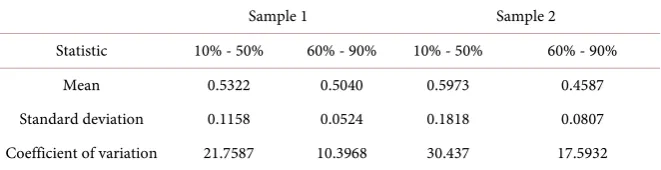
Table 1 shows the descriptive statistics for two samples generated with two random generators. Each sample has two parts, the first 40% and the second 30% with the error estimation in each case. When compared, the first section of each of the two samples has higher variability as compared to the second part of each sample. This is due to changes observable in the social interactions as agents’ in-teractions in a social network account for around 50% of social dynamics.
In Table 2, the observation probabilities increased from low to high when in-teraction rates ranges between 10% and 50%. The inin-teractions intensity is higher in the high interactions rate for the first partition compared to the second parti-tion. Thus, the most active proportion of agents’ is estimated at around 50%.
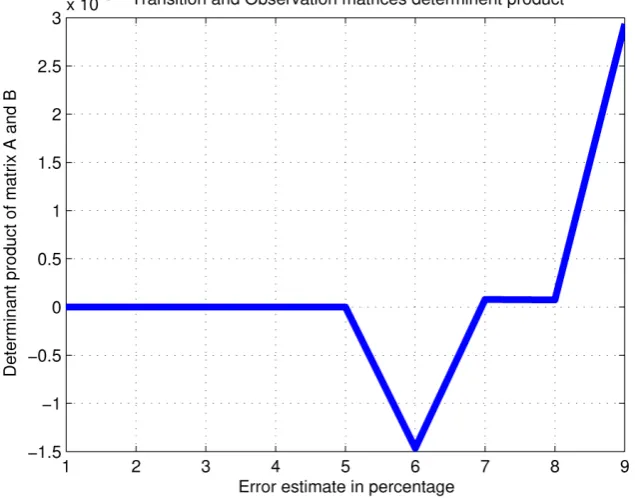
In Figure 1, the determinants of the product between the observation and transition matrices with different rank approximation are plotted. The figure shows the changes observable in a social network in terms of interdependence and independence of the agents interactions. At 10% to 50% interaction rate, the matrix product has a determinant of zero. This high level of dependency amongst the agents shows high levels of interactions. This dependency through the singular matrix as a product of the transition and observation matrices shows that the activities of an agent can be expressed as a linear combination of the other agents in the network. The interactions are intense and agents actively change their positions during these times to achieve their desired relationship le-vels. This slows down from the error estimation above 50% where independence
Table 1. Descriptive statistics and the interaction rates.
Sample 1 Sample 2 Statistic 10% - 50% 60% - 90% 10% - 50% 60% - 90%
[image:5.595.207.539.675.726.2]Mean 0.5322 0.5040 0.5973 0.4587 Standard deviation 0.1158 0.0524 0.1818 0.0807 Coefficient of variation 21.7587 10.3968 30.437 17.5932
Table 2. Observation probabilities and interaction rates.
DOI: 10.4236/sn.2018.73012 152 Social Networking
Figure 1. Dynamics of the determinant of the product between the observation and transition matrices.
[image:6.595.217.535.82.331.2]levels increases.
Figure 1 and Table 1 highlight that agents are more active in changing posi-tions as they interact with the interaction rates of between 10% and 50%. Table 1 has high variability estimated by the coefficient of variation. Above 60%, low le-vels of interdependency are exhibited, an indication of minimum interaction rates in the social network.
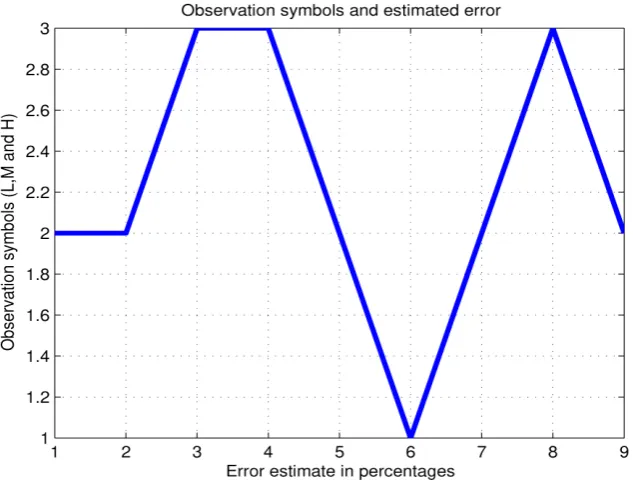
In Figure 2, the medium and high interaction rates were observable with the estimate error of between 10% and 50%. At 60%, the interaction rates falls to low and then increases again to medium and high as estimation error increases. This compares well with Figure 1 of the singular matrix emitted by the transitions and observations of the agents. Further observations from Figure 2 is that low interactions accounts for 11% of all the activities, medium interactions with 56% and high interaction rates accounts for 33%. We used simulation but similar ob-servations were noted [3][17] [24]. Agents’ reinforce and explore new interac-tions at the start and this dips and increases again with time. A general trend in a social network is for the agents to actively pursue new relationships, some wan-ing with time, others bewan-ing reinforced and new ones bewan-ing formed. The other component of the social network is the noise due to these dynamic changes in the network.
7. Conclusion
DOI: 10.4236/sn.2018.73012 153 Social Networking
Figure 2. Observation symbols (L = 1, M = 2 and H = 3) versus the estimated errors.
observed. The interaction rate of medium and high is observed within the first 50% of error estimation as the other component is noise in the network due to interaction dynamics and rapid changes from the agents activities. The SVD is an ideal method to estimate the observation matrix from the transition matrix and the initial probabilities from the observation matrix. The HMM is a tech-nique that can model interaction dynamics in a social network due to its adapta-bility to model stochastic processes.
References
[1] Ntwiga, D.B. (2016) Social Network Analysis for Credit Risk Modeling. Unpub-lished Ph.D. Thesis, School of Mathematics, University of Nairobi, Nairobi. [2] Raghavan, V., Steeg, G., Galstyan, A. and Tartakovsky, A.G. (2014) Modeling
Tem-poral Activity Patterns in Dynamic Social Networks. IEEE Transactions on Com-putational Social Systems, 1, 89-107. https://doi.org/10.1109/TCSS.2014.2307453
[3] Xiang, R., Neville, J. and Rogati, M. (2010) Modeling Relationship Strength in On-line Social Networks. Proceedings of the 19th International Conference on World Wide Web, Raleigh, 26-30 April 2010, 981-990.
https://doi.org/10.1145/1772690.1772790
[4] Meyers, R.A. (2009) Complex Systems in Finance and Economics (Selected Entries from the Encyclopedia of Complexity and Systems Science). Springer, New York. [5] Skyrms, B. and Pemantle, R. (2000) Dynamic Model of Social Network Formation.
Proceedings of the National Academy of Sciences of the United States of America, 97, 9340-9346.https://doi.org/10.1073/pnas.97.16.9340
DOI: 10.4236/sn.2018.73012 154 Social Networking [7] Netrvalova, A. and Safarik, J. (2011) Trust Model for Social Network. 2011 IEEE
10th International Conference on Trust, Security and Privacy in Computing and Communications, Changsha, 16-18 November 2011, 102-107.
[8] Pupazan, E. (2011) Social Networking Analytics. BMI paper, Vrije University Ams-terdam, Amsterdam.
[9] Dymarski, P. (2011) Hidden Markov Models, Theory and Applications. Intech Open Access. http://www.intechopen.com
https://doi.org/10.5772/601
[10] Starnini, M., Baronchelli, A. and Romualdo, P. (2013) Modeling Human Dynamics of Face-to-Face Interaction Networks. Physical Review Letters, 110, Article ID: 168701. https://doi.org/10.1103/PhysRevLett.110.168701
[11] Zhao, K., Stehle, J., Bianconi, G. and Barrat, A. (2011) Social Network Dynamics of Face-to-Face Interactions. Physical Review E, 83, Article ID: 056109.
https://doi.org/10.1103/PhysRevE.83.056109
[12] Gonzalez, M.C., Lind, P.G. and Herrmann, H.J. (2006) Model of Mobile Agents for Sexual Interactions Networks. The European Physical Journal B—Condensed Mat-ter and Complex Systems, 49, 371-376.https://doi.org/10.1140/epjb/e2006-00068-2
[13] Ntwiga, D.B., Weke, P., Manene, M. and Mwaniki, J. (2016) Modeling Trust in So-cial Network. International Journal of Mathematical Archive, 7, 64-68.
[14] Resnick, P., Zeckhouse, R., Friedman, E. and Kuwabara, K. (2000) Reputation Sys-tem. Communications of the Association of Computing Machinery, 43, 45-48. https://doi.org/10.1145/355112.355122
[15] Yang, Z., Xue, J., Wilson, C., Zhao, B.Y. and Dai, Y. (2015) Uncovering User Inte-raction Dynamics in Online Social Networks. Proceedings of the 9th International Association for the Advancement of Artificial Intelligence (AAAI) Conference on Web and Social Media, Oxford, 26-29 May 2015, 698-701.
[16] Liu, X. and Datta, A. (2012) Modeling Context Aware Dynamic Trust Using Hidden Markov Model. Proceedings of the 26th AAAI Conference on Artificial Intelligence, Toronto, 22-26 July 2012, 1938-1944.
[17] Wilson, C., Boe, B., Sala, A., Puttaswamy, K.P.N. and Zhao, B.Y. (2009) User Inte-ractions in Social Networks and Their Implications. Association of Computing Machinery, New York.
[18] Bilmes, J.A. (2006) What Hidden Markov Models Can Do. IEICE Transactions, In-formation and Systems, E89-D, 869-891.https://doi.org/10.1093/ietisy/e89-d.3.869
[19] Ehab, E. and Sassone, V. (2013) A HMM Based Reputation Model. Advances in Se-curity of Information and Communication Networks, 381, 111-121.
[20] Musco, C. and Musco, C. (2015) Stronger and Faster Approximate Singular Value Decomposition via Block Lanczos Method. arXiv:1504.05477v2
[21] Rabiner, L.R. (1989) A Tutorial on Hidden Markov Models and Selected Applica-tions in Speech Recognition. Proceedings of the IEEE, 77, 257-286.
https://doi.org/10.1109/5.18626
[22] Lee, J., Kim, S., Lebanon, G. and Singer, Y. (2013) Local Low-Rank Matrix Ap-proximation. Proceedings of the 30th International Conference on Machine Learn-ing, Atlanta, 16-21 June 2013, 82-90.
[23] Kalman, D. (1996) A Singularly Valuable Decomposition: The SVD of a Matrix. The College Mathematics Journal, 27, 1-23.
DOI: 10.4236/sn.2018.73012 155 Social Networking [24] Viswanath, B., Mislove, A., Cha, M. and Gummadi, K.P. (2009) On the Evolution of
User Interaction in Facebook. Association of Computing Machinery, New York.