A New Maturity Model for Requirements Engineering
Process: An Overview
Badariah Solemon1, Shamsul Sahibuddin2, Abdul Azim Abdul Ghani3
1
Department of Software Engineering, College of IT, Universiti Tenaga Nasional, Kajang, Malaysia; 2Advanced Informatics School, Universiti Teknologi Malaysia, Kuala Lumpur, Malaysia; 3Faculty of Computer Science and Information Technology, Universiti Putra Malaysia, Serdang, Malaysia.
Email: [email protected], [email protected], [email protected]
Received January 2nd, 2012; revised February 7th, 2012; accepted March 29th, 2012
ABSTRACT
It is widely acknowledged that Requirements Engineering (RE) has an important implication for the overall success of software or system development projects. As more and more organizations consider RE as the principal problem areas in the projects, improving RE process therefore appears critical for future business success. Moreover, nowadays there are evidences that support improving RE process maturity can contributes to improved business performance. There exist generic Software Process Improvement (SPI) standards, specialised RE process improvement models as well as guidance and advices on RE. However, they suffer from various issues that limit their adoption by organizations that are interested to assess and improve their RE process capability. Therefore, the research presented in this paper proposes a new RE process improvement model. The model is built by adapting and expanding the structure of the continuous rep-resentation of the formal maturity framework Capability Maturity Model Integration for Development (CMMI-DEV) developed by the Software Engineering Institute (SEI) through three rounds of development and validation stages, which involved RE and CMMI expert panel in the software industry. This paper aims to provide an overview on what, why and how we build the maturity model for RE. The intention is to provide a foundation for future development in the area of RE process improvement.
Keywords: Requirements Engineering (RE); Process Improvement; Maturity Model
1. Introduction
System and software development projects have been plagued with problems since the 1960s [1]. Since then, Requirements Engineering (RE) has become one of the central research topics in the field of software engineer-ing. Although progress in RE has been painfully slow with software development projects continue to experi-enced problems associated with RE [2], research effort in the area continues to be done. These research are mainly motivated by the list of potential benefits expected to be brought about by the successful implementation of an improved RE process. It is widely acknowledged that RE process has an important implication for the overall suc-cess of the projects [3,4]. Moreover, there is now em-pirical evidence, such as demonstrated in [5,6], that sup-port the claimed benefits of RE in improving a software project by improving productivity [7,8], assuring quality [7,9], and reducing project risk [10].
A RE process is a structured set of activities which are followed to gather, evaluate, document, and manage re-quirements for a software or software containing-product
throughout its development lifecycle. There exist RE standards that set out general principles and give detailed guidance for performing the RE process. Examples of RE standards include the IEEE Guide for Developing System Requirements Specifications [11], and the IEEE Rec-ommended Practice for Software Requirements Specifi-cations [12]. However, these standards offer no aid for selecting appropriate methods or for designing a RE process optimized for a particular organization [13]. An expert panel consists of both practitioners and academics agreed that RE process remains the most problematic of all software engineering activities, in a survey performed in [14]. Moreover, results of three surveys involving soft- ware development companies in UK [15,16], Australia [17], and Malaysia [18] confirmed that these companies still considered RE problems very significant.
Institute’s (SEI’s) Capability Maturity Model (CMM) and Capability Maturity Model for Integration (CMMI) [21], ISO/IEC 15504, and Six Sigma [22]. However, a European survey of organizations engaged in SPI pro-grams during the 1980s confirmed that the SPI models then available offered no cure for Requirements Engi-neering problems [13]. These enthusiastic adopters of SPI programs found that while SPI brought them signifi-cant benefits, their problems in handling requirements remain hard to solve.
This and several other problems related to the process have motivated the development of several specialised RE process improvement models. They include the Re- quirements Engineering Good Practice Guide (REGPG) [1]; the Requirements Capability Maturity Model (R- CMM) [14,23]; the Requirements Engineering Process Maturity Model (REPM) [24], and the Market-Driven Requirements Engineering Process Model (MDREPM) [25]. However, these models also suffer from problems and issues that could hinder organizations from adopting them. The models not only are integrated with the obsolete and unsupported CMM or SW_CMM since the release of the new maturity model CMMI, but they are also either too complex or applicable to only limited type of RE process and application domain or exist in draft form and yet to be completely developed and validated.
Inspired by the strengths of the existing generic SPI and RE process improvement models, we started a study to build a new, complete model that can be used to assist organizations in assessing and improving their RE pro- cess maturity levels. The model is known as REPAIM that stands for Requirements Engineering Process As-sessment and Improvement Model. Based on prior work, to our knowledge, the new RE maturity model compo-nent of the REPAIM has been completely and consis-tency provided with detailed, explicit guidance and ad-vices on RE practices and that centres improvement on RE best-practices, which is presented within the CMMI-DEV standard. Therefore, the maturity model can be used to interpret the implementation of RD and REQM process areas of CMMI-DEV perhaps without being dependent highly on consultants. Also, our model can provide in-sights into the effects of SPI to software organisations mainly in the country that are yet to be certified, in par-ticular with the CMMI-DEV certification.
In this paper we explain the stages involved in devel-oping the RE maturity model and the motivations on building the REPAIM as well the rationales for building the model based on existing framework and assessment methods. In section three, we present an overview of model components, and section four summarizes and concludes this paper.
2. Methodology
The RE process improvement model was developed
through multiple rounds of development and validation stages, which involved expert panel from the industry. Three rounds of model developments were performed to deal with the results of the first two rounds of validation, which were fed back to the development stage to im-prove the model. The multiple rounds of validation were designed based the Delphi method, which has been modified to fit the purpose of the model validation from the one originally developed by Norman Dalkey in 1950s [26]. Besides being acknowledged by some as a popular and well-known research method [27], the Delphi me- thod is also considered by others as the technique that can be ‘effectively modified’ to meet the needs and na-ture of the study [28]. Reviews of how the Delphi method has been implemented by others show that the number of Delphi rounds range between one to five and a three round is typical [29,30]. Although Cantrill, Sibbald, and Buetow [31] stated that the expert panel sizes in the Delphi studies vary from 4 to 3000, the panel size can be as small as 3 experts only. In this research, the validation stage involved three rounds and 32 experts [32]. The panel size in this research is determined in line with recommendation by Cantrill and colleagues that panel size “should be governed by the purpose of the investiga-tion”.
with detailed information. Finally the tools to support the assessment method were prepared.
2.1. Motivations for Developing the Model
They are various motivators for this work. We embark on this study for the same reason that Linscomb [37] stressed in his article, that an organization should define and measure the RE process maturity because it is eco-nomic (to get more business and retain existing business) and it is the right thing to do. This research is also moti-vated by potential benefits expected to be brought about by successful implementation of an improved RE process to the overall success of projects [3,4] as demonstrated by empirical research in Chisan [5] and Damian et al. [6]. Most importantly, review to other research in the recent years such as Beecham et al. [38], Beecham, Hall, and Rainer [14], Gomes and Pettersson [39], Gorschek and Tejle [24], Sommerville and Ransom [40], Wiegers [41], and Young [2] has shown that there remain the need for an alternative RE process improvement model. This is mainly due to the fact that existing RE textbooks or ge- neric SPI models and standards in particular CMMI-DEV or even the RE specialised process improvement models such as REGPG, REPM, R-CMM and MDREPM seem unable to help software organisations in assessing and improving their RE process capability and maturity.
Inspired to offer a solution to organizations interested to improve their RE processes, we performed an empiri-cal study to justify our then future research work, which is to develop this model, detailed in [18]. To our surprise, results of the study involving software development companies appraised with various maturity levels of CMMI-DEV indicate that high-maturity ratings do not correlate with better performance and do not indicate effective, high-maturity practices. Possible reason for this include what Humphrey stressed in [42] that “… with increasing marketplace pressure, organization often fo- cus on maturity levels rather than process capability… we now see cases where high-maturity ratings do not indicate effective, high-maturity practices. It is not that their appraisal process is faulty or that organizations are dishonest, merely that the maturity framework does not look deeply enough into all organizational practices”. When further investigated, we found out that many “good” practices were omitted from the CMMI because they could not be generalized to the broad audience of the model as stated by Moore [43]. In the case of RE process, omissions can be seen in practices of Require- ments Development Process Area (RD PA) when com- pared with the RE process practices or activities com- monly found in the literature.
Apart from the earlier mentioned motivations, we are also interested to offer a way out of the following issues
that surround the CMMI-DEV:
1) The CMMI-DEV does not define RE maturity the way it should be defined based on industry standard and practices as elaborated in [37]. In the staged representa-tion, CMMI-DEV splits the entire RE domain into two PAs in two separate maturity levels, with the order Re-quirements Engineering Process Area (REQM PA) first then followed by Requirements Development Process Area (RD PA). Hence, this order of RE implementation and institutionalizations is not always logical and can create issue [37]. For example, if an organization does not have an institutionalized way of eliciting require-ments (at maturity level 3), by right the organization would not have any requirements to be managed at lower maturity level 2. In the continuous representation, for another example, there might be a case where an organi-zation with a high capability for REQM (for example, 5) has a low capability level (for example, 0) for RD PA is not always logical.
2) Like ISO 9000, CMMI-DEV does not tell specifi-cally how to actually do the REQM and RD work as stated by Leffingwell and Widrig [44] and Humphrey [42]. Thus, to create a comprehensive software, or RE, process improvement approach that would satisfy the demanding ISO 9000 or CMMI assessors, organizations are forced to depend highly on paid consultants or CMMI training and/or experiences of their team members or reference books, causing the cost associated with the model to be very high.
3) The CMMI-DEV process maturity profile, pub- lished in September 2011 and accessible from the SEI website, shows that the numbers of organizations adopt- ing the model in most countries are still low with 58% countries only have 10 or fewer appraisals [45]. The primary reason of not-adopting CMMI is high cost asso- ciated with the model apart from other reasons including organizations were too small, organizations had no time, organizations were unsure of the SPI benefits, organiza- tions had other priorities, and organizations were using another SPI approach [46,47].
Despite those issues that surround the CMMI-DEV, we chose to build our model based on this known matur- ity framework for several reasons as detailed in the next sub-section.
2.2. Rationales for Developing the RE Maturity Model Based on CMMI-DEV
the latest version of a known formal software process improvement framework offers the practitioners several advantages. Amongst the rationale for basing our model on this maturity framework is that:
1) The CMMI framework is being adopted worldwide and is one of the few process models that attempts to define maturity levels of IT-related processes [37]. The CMMI also remains a de facto standard for “software- intensive system development” [21].
2) The CMMI framework is based on best practices derived from many years of empirical study and contains guidelines for RE practices. Even though these RE prac-tices are treated differently from the standards RE com-ponents found in the literature and lack implementation details, the RE processes are integrated with software development.
3) The CMMI-DEV is designed to be tailored and adapted to focus on specific needs as it is a normative model [49]. As suggested by Philips [50], community that is interested in focusing at specific area of process improvement may need to “provide interpretive guidance or expanded coverage of specific practices and goals” for the area. This is basically what we aimed to achieve in our model.
4) While our model can be used independently to as-sess RE process maturity (or capability), basing it on CMMI-DEV will enable practitioners to use it in con-junction with an on-going CMMI-DEV programme.
Our model, the REPAIM, taps into the strengths of the CMMI-DEV and reflect the update made to the frame-work to form a specialised best practice RE model. Like the other RE process improvement models, our model will take practitioners from a high level view of the RE practices, through to a detailed descriptions and to a process assessment method to guide companies towards satisfying their specific RE process improvement and general company goals.
2.3. Rationales for Developing the RE Assessment Method Based on Existing Methods
The RE process maturity model is built based on the CMMI-DEV and initially SCAMPI Class C seems ap-propriate for the reference model as according to Hayes
et al. [34], the SCAMPI is “applicable to a wide range of appraisal usage modes, including both internal process improvement and external capability determinations”. But, SCAMPI Class C method (just like CMMI group of standards) was initially written for large organization and is consequently difficult to apply in small company set-tings because of its complex requirements and the need to commit significant resources to achieve the CMMI cer- tification [51]. On the other hand, both MMA and Adepts
methods have a set of guidelines for conducting CMM or CMMI conformant software process assessment, respect- tively, and focus on small companies.
However, both SCAMPI Class C and MMA methods focus only at reviewing an organization’s processes. Whereas, the Adepts provides additional steps for estab- lishing process improvements initiatives and to see the progress that could have been accomplished from im- plementing the initiatives. Hence, the approach in the research is to combine several features and functions of these three assessment methods in a single process as- sessment method. The aim is to optimize the applicability and usefulness of the developed assessment method. Moreover, the new RE process maturity model is a spe- cialised reference model. Hence, a specialised process assessment that can help organizations particularly small companies, examine their RE process against the model should be developed too. This approach is actually very similar with the way MA-MPS is developed for MR- MPS Process Reference Model [52]. The term assess- ment used in this thesis implies that an organization can perform informal assessments to and for itself. These assessments are intended to motivate organizations to initiate or continue the RE process improvement pro- grams.
3. Overview of the RE Maturity Model
The new proposed model, REPAIM, is a specialized RE process improvement and assessment model. The model aims to be recognised as an applicable model to organi-zations which develop system and software products. The REPAIM also defines rules to implement and assess itself, hence it support and assures a coherent use ac- cording to its definitions. As mentioned earlier, REPAIM has two components: PMM-RE reference model and the FLA-RE assessment method. Both model components are currently described in a single document called a REPAIM model guide, which was given to the expert panel during the validation stage. This is as shown in Figure 1.
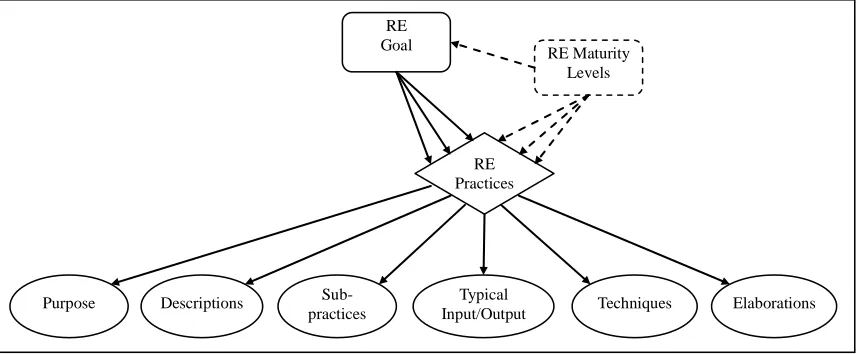
Like the CMMI-DEV capability levels, the PMM-RE maturity levels consists of a generic goal and its related generic practices which can improve organizations’ RE processes. At each RE maturity level, organizations need to implement several RE practices to achieve the RE goal for the specific level. Unlike CMMI-DEV that separate goals and practices into generic and specific goals and practices to be satisfied by several process areas for a specific capability level, in this model, we consider all practices as RE practices since this model focuses at a single process area only.
REPAIM Model
CMMI-DEV
Assessment Method (FLA-RE) Reference
Model (PMM-RE)
REPAIM Model Guide
SCAMPI C Adept MMA
[image:5.595.58.288.85.228.2]A RE practice is an essential task that must be per- formed as part of RE process. Practices may be performed formally or informally. However, it does not mean that it is done frequently or that most practitioners will neces- sarily perform the practices. Each RE practice in the PMM-RE has its practice guideline, which consists of components similar to the example shown in Figure 2. Each RE practice has a set of consistent components as follows:
Figure 1. Components of the RE maturity model.
indicators and assessors’ requirements. While FLA-RE is applicable to organizations developing software or soft- ware-containing product, it is mainly oriented to the small and medium-size enterprises (SMEs). The FLA-RE assessment stages and steps are based on characteristics of several process assessment methods. However, details
of this assessment method are not covered in this paper. 1) Purpose—describes the aim that the practice is in-tended to achieve.
3.1. PMM-RE Model Descriptions 2) Descriptions—statements that explain what the prac- tice is, and why the practice is performed.
The PMM-RE is a direct adaptation of the CMMI-DEV continuous representation where as an organization pro-gresses in capability for a RE process, this mean the or-ganization is becoming more mature in the RE process. The PMM-RE initially has 6 maturity levels numbered 0 through 5, which were adapted from the six capability levels of the CMMI-DEV version 1.2 [21] as explained in our other paper [33] and thesis [53]. However, to en-sure that the proposed model can complement the latest version 1.3 that was released in November 2010 [48], PMM-RE has been tuned to contain four RE maturity levels only: 0 (Incomplete), 1 (Performed), 2 (Managed), and 3 (Defined).
3) Sub-practices—statements that provide guidance for interpreting and implementing the practice. They are meant only to provide ideas that may be useful for RE process improvement.
4) Typical Input/Output—lists examples input neces- sary for a practice to begin, and output produced by the practice. Input should not be optional component and out- put, generally, should be produced by one and only one practice. The examples are called typical output be- cause there are often other outputs that may not listed.
5) Techniques—lists all techniques to performing the practice or different forms the output of the practice may
RE Goal
Typical Input/Output
RE Practices
Techniques Sub-
practices
RE Maturity Levels
Descriptions
Purpose Elaborations
[image:5.595.84.513.539.716.2]take. A practice may have none, one, or more related techniques. A technique must be related to at least one practice. The techniques listed in this document are in- tended to cover the most common and widespread use in the community.
6) Elaborations—statements that provide more details or information about the practice and its components. Explanations of techniques may be provided in this com- ponent.
3.2. RE Maturity Levels
Each RE maturity level of REPAIM consist of a RE goal and its related RE practices, which can help improve the organization’s RE processes. The four RE maturity levels of the model provide a way to measure how well organi-zations can and do improve their RE processes. These RE maturity levels describe an evolutionary path for an organization that wants to improve its RE process. RE maturity levels may be determined by performing an assessment to the RE practices. Like the CMMI-DEV, the assessment can be performed for organizations that comprise entire companies (usually for small companies), or group of projects within a company. For an organiza-tion to reach a particular RE maturity level, it must sat-isfy all of the set of RE practices that are targeted for improvement.
In general, various sources of references were referred and consulted in defining the components of the PMM- RE model, as follows:
1) The generic practices (GPs) and specific practices (SPs) of the CMMI for Development [21,48].
2) The tasks of the Guide to the Business Analysis Body of Knowledge (BABOK Guide) version 2.0 [54].
3) The Education Units (EUs) of the IREB Certified Professional for Requirements Engineering Syllabus, Foundation Level, version 2.0 [55].
4)IEEE Guide for Developing System Requirements Specifications, IEEE Standard 1233, 1998 Edition [11].
5) IEEE Guide for Software Engineering Body of Knowledge (SWEBOK), version 2004 [56].
6)Other sources such as books, conference and journal articles.
A short description of each RE maturity level follows.
3.2.1. Level 0: Incomplete RE Process
A RE maturity level 0 process is characterized as an “in- complete RE process”, which is similar to the character- istics of the capability level 0 of the CMMI-DEV. An incomplete RE process is a process that either is not per- formed or partially performed. This means one or more of the RE practices are not implemented. There is no RE goal exists for this level since there is no reason to insti-tutionalize a partially performed RE process.
3.2.2. Level 1: Performed RE Process
A RE maturity level 1 process is characterized as a “per- formed RE process”. At maturity level 1, the RE goal of level 1 is satisfied and all of the RE practices are imple- mented. At this maturity level, requirements are elicited, analysed, prioritised, documented, verified and validated; requirements changes are managed, requirements trace- ability is maintained; and requirements status tracking is established to the extent that it can demonstrate that all requirements have been implemented. In addition, re- quirements are allocated among product releases and components, and inconsistencies between requirements and the project work products related to the RE process are identified and resolved.
RE maturity level 1 often results in important im- provements. However, those improvements cannot be maintained if they are not institutionalized, which can only be achieved through the implementation of RE practices at levels 2 and 3. Also, a performed RE process usually does not have the basic infrastructure in place to support the RE process. Therefore, organizations mature at level 1 RE maturity level 1 often produce products that work but they frequently exceed their budgets and do not meet their schedules [57]. According to them, amongst the common problems found in such organizations relate to vague requirements, lack of traceability, undefined RE process, insufficient RE resource, lack of training and poor levels of skills.
There are all together sixteen RE practices imple- mented in this RE maturity level. The RE practices im- plemented at 1evel 1 includes:
RP 1.1 Conduct Requirements Elicitation;
RP 1.2 Establish a Standard Requirements Document Structure;
RP 1.3 Obtain an Understanding of Requirements; RP 1.4 Obtain Commitment to Requirements; RP 1.5 Analyze Requirements;
RP 1.6 Analyze Requirements to Achieve Balance; RP 1.7 Prioritize Requirements;
RP 1.8 Model Requirements;
RP 1.9 Develop the Customer Requirements; RP 1.10 Develop the Product Specifications; RP 1.11 Verify Requirements;
RP 1.12 Validate Requirements;
RP 1.13 Manage Requirements Traceability; RP 1.14 Allocate Requirements;
RP 1.15 Manage Requirements Changes;
RP 1.16 Identify Inconsistencies between Project Work and Requirements.
expand the detailed guidelines of the RE practices to help organizations approach these practices. At the same time, the other sources of references helped add new or re- phrase or exclude certain practices from the CMMI-DEV. Thirteen out of the sixteen RE practices of level 1 are initially adapted from the specific practices of the REQM and RD process areas of the CMMI-DEV. Some of these CMMI-DEV’s specific practices have been renamed to ease understanding and to reflect better visibility of what the practice is all about, while some others simply inherit the name from the maturity framework. For example, the adapted RD SP 3.2 Establish a Definition of Required Functionality has been renamed to RP 1.8 Model Re- quirements to reflect better visibility of the practice.
In another case, managing requirements traceability is one of the main tasks in requirements management activi -ty [53]. In the PMM-RE, REQM SP 1.4 Maintain Bidi-rectional Traceability of Requirements practice though adapted has been renamed to RP 1.13 Manage Require-ments Traceability. Bidirectional traceability is “the abil- ity to trace both forward and backward (i.e., from re- quirements to end products and from end product back to requirements” [58] and adoption of CASE tools can ease the implementation of this practice [59]. However, it appears that CASE tool adoption is still one of the chal- lenges experienced by practitioners and in other related studies [60-62]. Therefore, it is reasonable to say that if the REQM SP 1.4 is to be maintained as it is, it might makes the PMM-RE model to appear less practical to the organizations. By renaming the practice, it means that any form of traceability implementation should be suffi- cient, which implies that bidirectional traceability is now an optional practice and so is adoption of CASE tool. This kind of decision is mainly motivated by the practi- cality success criteria of the model development.
The remaining three practices, RP 1.11 Verify Re- quirements, RP 1.2 Establish a Standard Requirements Documents Structure, and RP 1.7 Prioritize Require-ments have been added to the model because they are considered as common RE practices [41,54-55,63-64]. For example, although requirements verification is known as another critical RE practice on top of the requirements validation, only the RD SP 3.5 Validate Requirements practice is present in CMMI-DEV. Therefore, this prac- tice has been added and known as RP 1.11 Verify Re- quirements. Nevertheless, it has been added to the model by being adapted from the specific goal of the Verfica- tion (VER) process area of the CMMI-DEV [21].
3.2.3. Level 2: Managed RE Process
A RE maturity level 2 process is characterized as a “man- aged RE process”. At maturity level 2, RE process is plan- ed, institutionalised for consistent performance, and exe- cuted in accordance with policy; involves relevant stake-
holders; allocated with adequate resources; people are trained with the appropriate skills; RE process is moni-tored, controlled and reviewed; RE process work prod-ucts are placed under appropriate levels of control; RE process adherence is evaluated; and RE status is re- viewed by higher management. The process discipline reflected by this RE maturity level helps to ensure that existing RE practices are retained even during time of stress. For a managed RE process, the process descrip- tions, standards, and procedures are applicable to a par- ticular project, or organizational.
There are ten RE practices implemented at this RE maturity level. The RE practices implemented at level 2 includes:
RP 2.1 Establish an Organizational Requirements En-gineering Policy;
RP 2.2 Plan the Requirements Engineering Process; RP 2.3 Provide Adequate Resources;
RP 2.4 Identify and Involve Relevant Stakeholders; RP 2.5 Assign Responsibility;
RP 2.6 Train People;
RP 2.7 Manage Configurations;
RP 2.8 Monitor and Control the RE Process; RP 2.9 Objectively Evaluate Adherence;
RP 2.10 Review Status with Higher Level Management. These ten RE practices are mostly adapted from the generic goal (GG) 2 of the CMMI-DEV and its generic practices. However, detailed guidelines for several of these practices are also constructed by referring to three other CMMI process areas namely Project Planning (PP), Pro- ject Management and Control (PMC) and Process and Product Quality Assurance (PPQA). In addition, books and articles on software project management are also referred to create the detailed description of the ten prac- tices such as the Project Management Body of Knowl- edge (PMBOK) [65], Schwalbe [66], Hughes and Cotte- rell [67], Olson [68], and Wysocki, Beck, and Crane [69]. The BABOK version 2.0 and IREB CPRE Foundation Level Syllabus version 2.0 are also referred.
3.2.4. Level 3: Defined RE Process
ensure that the defined RE processes of two or more pro-jects in the same organization are consistent. Hence, the organizational standard RE process should be established and improved over time. A standard RE process is the one that describes the fundamental RE process element that are expected in the defined RE process.
This maturity level also involves collecting informa- tion such as work products, process and product meas- ures, measurement data and other improvement informa- tion. Two examples of commonly used RE process and product measures include number of requirements chan- ges, and estimates of work product size, effort, and cost. These items are then stored in the organization’s mea- surement repository and the organization’s process assets library. The improvement proposals for the organiza- tional RE process assets should also be collected. These activities are required to support the future use and im-provement of the organization’s RE processes and pro- cess assets. There are only two RE practices imple- mented in this RE maturity level. The two RE practices implemented at level 3 are:
RP 3.1 Establish a Defined RE Process; RP 3.2 Collect Improvement Information.
The two RE practices implemented in this maturity level are adapted from the two generic practices (GP3.1 Establish a Defined Process and GP 3.2 Collect Im-provement Information) of the CMMI-DEV [21]. Still, the detailed guidelines of these practices are constructed by referring to one specific practice of the CMMI-DEV’s Integrated Project Management (IPM) process area (IPM SP 1.1 Establish the project’s Defined Process) and to four specific practices of the Organizational Process Definition (OPD) process area (OPD SP 1.1, 1.3, 1.4, 1.5) [21].
All RE practices in the model are given unique num-bers and listed in a sequence. However, the way the prac-tices are listed in the sequence does not dictate any spe-cific order of implementation or requirements engineer-ing lifecycle. Iterative or agile methodology may require that the practices be performed in parallel, whereas phased methodology (e.g. waterfall model) may require multiple practices to be performed in every phase. Or- ganizations may implement the practices in any order, as long as the necessary input to the practice is present.
4. Conclusion and Future Work
In this paper, we describe what, why and how we con- struct a specialised RE process improvement and as- sessment model—called the REPAIM—with the aim to assist organizations in assessing and improving their RE process based on a proven maturity framework. The REPAIM has four RE maturity levels, which is adopted from the latest version 1.3 of the CMMI-DEV and has
been constructed with the following characteristics: The entire RE domain is considered as a single pro-
cess area which consist of both requirements devel-opment (elicitation, analysis, specification, verifica-tion and validaverifica-tion) and requirements management. This is to eliminate any possibility for an organization (or project) to encounter issues or illogical order of RE implementation and institutionalisation.
The model looks deeply into all its RE practices as it comprise adequate components (i.e. purpose, descrip- tions, sub-practices, typical input/output, techniques, and elaborations) to provide detailed guidance for practitioners in improving and assessing their RE processes.
The model is designed mainly oriented for SMEs to allow higher adoption rate among practitioners. The model is constructed by referring to various
sources of reference to ensure that it reflect the industry standards and practices.
The REPAIM has gone through three rounds of de-velopment and validation stages involving RE and CMMI experts in the industry. Results of the validation performed, involving 33 experts [53] indicates that 80% of the experts support that the REPAIM is complete, consistent, practical, useful and verifiable. The high support of the experts therefore suggests that the RE-PAIM generally meets its development success criteria. The experts agreed that the REPAIM:
is able to help assess RE processes and prioritise their improvement;
adapts and complements existing maturity standards and assessment methods;
adaptable to the needs of organizations.
Therefore, future research also should work on exploring Experience Management (EM)-like [73] software tool to support the self-training packages in quest to help soft- ware developers self-trained the proposed REPAIM or any other model-based process improvement approach.
5. Acknowledgements
We thank all the experts for their participations in the validation rounds of the model. The validation stage is part of a project funded by Universiti Tenaga Nasional through grant number J5100-50-184.
REFERENCES
[1] I. Sommerville and P. Sawyer, “Requirements Engineer-ing: A Good Practice Guide,” John Wiley & Sons, Chichester, 1997.
[2] R. R. Young, “Effective Requirements Practices,” Addi-son-Wesley Longman Publishing Co., Inc., Boston, 2001.
[3] H. F. Hofmann and F. Lehner, “Requirements Engineer-ing as a Success Factor in Software Projects,” Software,
IEEE,Vol. 18, No. 4, 2001, pp. 58-66. doi:10.1109/MS.2001.936219
[4] S. Martin, A. Aurum, R. Jeffery and B. Paech, “Require-ments Engineering Process Models in Pactice,” Proceed-ings of the Seventh Australian Workshop in Requirements
Engineering (AWRE’2002), Deakin University, Melbourne,
2-3 December 2002, pp. 141-155.
[5] J. Chisan, “Theory in Practice: A Case Study of Require-ments Engineering Process Improvement,” Master Thesis, the University of Victoria, Victoria, 2005.
[6] D. Damian, D. Zowghi, L. Vaidyanathasamy and Y. Pal, “An Industrial Case Study of Immediate Benefits of Re-quirements Engineering Process Improvement at the Aus-tralian Center for Unisys Software,” Empirical Software
Engineering,Vol. 9, No. 1, 2004, pp. 45-75.
doi:10.1007/s10664-005-1288-4
[7] H. Wohlwend and S. Rosenbaum, “Software Improve-ments in an International Company,” Proceedings of the
15th International Conference on Software Engineering
(ICSE 93), Baltimore, Maryland, 17-21 May 1993, pp. 212-
220.
[8] S. Lauesen and O. Vinter, “Preventing Requirement De-fects: An Experiment in Process Improvement,”
Re-quirements Engineering,Vol. 6, No. 1, 2001, pp. 37-50.
doi:10.1007/PL00010355
[9] J. D. Herbsleb and D. R. Goldenson, “A Systematic Survey of CMM Experience and Results,” Proceedings of the 18th
International Conference on Software Engineering—ICSE,
Berlin, 25-29 March 1996, pp. 323-330.
[10] J. G. Brodman and D. L. Johnson, “Return on Investment (ROI) from Software Process Improvement as Measured by US Industry,” Software Process: Improvement and
Practice, Vol. 1, No. 1, 1995, pp. 35-47.
[11] IEEE, “IEEE Guide for Developing System Requirements Specifications. IEEE Std 1233, 1998 Edition,” Institute of
Electrical and Electronics Engineers, Inc., New York, 1998.
[12] IEEE, “IEEE Recommended Practice for Software Require- ments Specifications. IEEE Std 830-1998,” Institute of Elec- trical and Electronics Engineers, Inc., New York, 1998.
[13] P. Sawyer, “Maturing Requirements Engineering Process Maturity Models,” In: J. L. Mate and A. Silva, Eds.,
Re-quirements Engineering for Sociotechnical Systems, Idea
Group Inc., Hershey, 2004, pp. 84-99.
[14] S. Beecham, T. Hall and A. Rainer, “Defining a Require- ments Process Improvement Model,” Software Quality Jour- nal,Vol. 13, No. 3, 2005, pp. 247-279.
doi:10.1007/s11219-005-1752-9
[15] S. Beecham, T. Hall and A. Rainer, “Software Process Improvement Problems in Twelve Software Companies: An Empirical Analysis,” Empirical Software Engineering, Vol. 8, No. 1, 2003, pp. 7-42.
doi:10.1023/A:1021764731148
[16] T. Hall, S. Beecham and A. Rainer, “Requirements Prob-lems in Twelve Software Companies: An Empirical Analy-sis,” IEEE Proceedings of Software,Vol. 149, No. 5, 2002, pp. 153-160. doi:10.1049/ip-sen:20020694
[17] M. Niazi and S. Shastry, “Role of Requirements Engi-neering in Software Development Process: An Empirical Study,” Proceedings of the Multi Topic Conference ( IN-MIC 2003), Islamabad, 8-9 December 2003, pp. 402-407.
[18] B. Solemon, S. Sahibuddin and A. A. A. Ghani, “Re-quirements Engineering Problems and Practices in Soft-ware Companies: An Industrial Survey,” Advances in
Software Engineering, Vol. 59, 2009, pp. 70-77.
doi:10.1007/978-3-642-10619-4_9
[19] M. Ibanez and H. Rempp, “European Survey Analysis,” European Software Institute, Technical Report, 1996.
[20] N. P. Napier, J. Kim and L. Mathiassen, “Software Proc- ess Re Engineering: A Model and Its Application to an Industrial Case Study,” Software Process: Improvement
and Practice,Vol. 13, No. 5, 2008, pp. 451-471.
doi:10.1002/spip.390
[21] M. B. Chrissis, M. Konrad and S. Shrum, “CMMI: Guidelines for Process Integration and Product Improve-ment,” 2nd Edition, Upper Saddle River, Addison-Wesley, Boston, 2007.
[22] J. R. Persse, “Process Improvement Essentials: CMMI, Six SIGMA, and ISO 9001,” O’Reilly Media, Inc., Sebastopol, 2006.
[23] S. Beecham, T. Hall and A. Rainer, “Building a Require-ments Process Improvement Model,” University of Hert-fordshire, Technical Report, Hatfield, 2003.
[24] T. Gorschek and K. Tejle, “A Method for Assessing Re-quirements Engineering Process Maturity in Software Pro-jects,” Master Thesis, Blekinge Institute of Technology, Ronneby, 2002.
[25] F. Pettersson, M. Ivarsson, T. Gorschek and P. Ohman, “A Practitioner’s Guide to Light Weight Software Process Assessment and Improvement Planning,” Journal of
Sys-tems and Software,Vol. 81, No. 6, 2007, pp. 972-995.
doi:10.1016/j.jss.2007.08.032
of the Delphi Method to the Use of Experts,”
Manage-ment Science,Vol. 9, No. 3, 1963, pp. 458-467.
doi:10.1287/mnsc.9.3.458
[27] B. F. Beech, “Changes: The Delphi Technique Adapted for Classroom Evaluation of Clinical Placements,” Nurse
Education Today,Vol. 11, No. 3, 1991, pp. 207-212.
doi:10.1016/0260-6917(91)90061-E
[28] F. T. Hartman and A. Baldwin, “Using Technology to Improve Delphi Method,” Journal of Computing in Civil
Engineering,Vol. 9, No. 4, 1995, pp. 244-249.
doi:10.1061/(ASCE)0887-3801(1995)9:4(244)
[29] P. M. Mullen, “Delphi: Myths and Reality,” Journal of Heal-
th Organization and Management,Vol. 17, No. 1, 2003, pp.
37-52. doi:10.1108/14777260310469319
[30] G. J. Skulmoski, F. T. Hartman and J. Krahn, “The Del-phi Method for Graduate Research,” Journal of
Informa-tion Technology EducaInforma-tion, Vol. 6, 2007, pp. 1-21.
[31] J. A. Cantrill, B. Sibbald and S. Buetow, “The Delphi and Nominal Group Techniques in Health Services Research,”
International Journal of Pharmacy Practice,Vol. 4, No. 2,
1996, pp. 67-74. doi:10.1111/j.2042-7174.1996.tb00844.x
[32] S. S. Y. Lam, K. L. Petri and A. E. Smith, “Prediction and Optimization of a Ceramic Casting Process Using a Hier-archical Hybrid System of Neural Networks and Fuzzy Logic,” IIE Transactions,Vol. 32, No. 1, 2000, pp. 83-91. doi:10.1023/A:1007659531734
[33] B. Solemon, S. Shahibuddin and A. A. A. Ghani, “Redefin- ing the Requirements Engineering Process Improvement Model,” Proceedings of the Asia-Pacific Software Engineer-
ing Conference, APSEC 2009, Penang, 1-3 December 2009,
pp. 87-92.
[34] W. Hayes, E. E. Miluk, L. Ming and M. Glover, “Hand-book for Conducting Standard CMMI Appraisal Method for Process Improvement (SCAMPI) B and C Appraisals, Version 1.1,” Software Engineering Institute (SEI), Pitts- burgh, 2005.
[35] F. McCaffery, D. McFall and F. G. Wilkie, “Improving the Express Process Appraisal Method,” In: F. Bomarius and S. KomiSirvio, Eds., Product Focused Software Process
Im-provement, Springer, 2005, pp. 286-298.
[36] K. E. Wiegers and D. C. Sturzenberger, “A Modular Soft-ware Process Mini-Assessment Method,” IEEE Software, Vol. 17, No. 1, 2000, pp. 62-69.
[37] D. Linscomb, “Requirements Engineering Maturity in the CMMI,” 5 June 2008. http://www.stsc.hill.af.mil
[38] S. Beecham, T. Hall, C. Britton, M. Cottee and A. Rainer, “Using an Expert Panel to Validate a Requirements Proc-ess Improvement Model,” Journal of Systems and Soft-ware,Vol. 76, No. 3, 2005, pp. 251-275.
doi:10.1016/j.jss.2004.06.004
[39] A. Gomes and A. Pettersson, “Market-Driven Require- ments Engineering Process Model-MDREPM,” Master Thesis, Blekinge Institute of Technology, Ronneby, 2007.
[40] I. Sommerville and J. Ransom, “An Empirical Study of Industrial Requirements Engineering Process Assessment and Improvement,” ACM Transactions on Software Engi-
neering and Methodology (TOSEM),Vol. 14, No. 1, 2005,
pp. 85-117. doi:10.1145/1044834.1044837
[41] K. E. Wiegers, “Software Requirements,” 2nd Edition, Microsoft Press, Redmond, 2003.
[42] W. S. Humphrey, “CMMI: History and Direction,” In: M. B. Chrissis, et al., Eds., CMMI: Guidelines for Process
Integration and Product Improvement, 2nd Edition, Up-
per Saddle River, Addison-Wesley, Boston, 2007, pp. 5-8.
[43] J. W. Moore, “The Role of Process Standards in Process Definition,” In: M. B. Chrisses, et al., Eds., CMMI: Guide-
lines for Process Integration and Product Improvement,
Upper Saddle River, Addison-Wesley, Boston, 2007, pp. 93-97.
[44] D. Leffingwell and D. Widrig, “Managing Software Re- quirements: A Use Case Approach,” 2nd Edition, Addi- son-Wesley Professional, Boston, 2003.
[45] SEI, “Process Maturity Profile, September 2011,” 7 Oc- tober 2011.
http://www.sei.cmu.edu/cmmi/casestudies/profiles/pdfs/u pload/2011SeptCMMI-2.pdf
[46] N. Khurshid, P. L. Bannerman and M. Staples, “Over- coming the First Hurdle: Why Organizations Do not Adopt CMMI,” Proceedings of the ICSP 2009-Interna-
tional Conference on Software Process (Co-Located with
ICSE 2009), Vancouver, 16-17 May 2009, pp. 38-49.
[47] M. Staples, et al., “An Exploratory Study of Why Or-ganizations Do not Adopt CMMI,” The Journal of System
and Software,Vol. 80, No. 6, 2007, pp. 883-895.
doi:10.1016/j.jss.2006.09.008
[48] SEI, “CMMI® for Development, Version 1.3,” Software Engineering Institute, Pittsburgh, Technical Report, 2010.
[49] M. C. Paulk, C. Weber, B. Curtis and M. B. Chrisses, “The Capability Maturity Model: Guidelines for Improving the Software Process,”Addison-Wesley, Reading, 1995.
[50] M. Philips, “CMMI: From the Past and Into the Future,” In: M. B. Chrissis, et al., Eds., CMMI: Guidelines for Process
Integration and Product Improvement, 2nd Edition, Upper
Saddle River, Addison-Wesley, Boston, 2007, pp. 11-15.
[51] S. P. Sun, “MSC Malaysia APEC Workshop on Software Standards for SMEs and VSEs—A New Global Standard for Today’s International Economy,” 2010.
http://newscentre.msc.com.my/articles/1312/1/MSC-Mala sia-APEC-Workshop-on-Software-Standards-for-SMEs-a nd-VSEs--A-New-Global-Standard-for-Todays-Internatio nal-Economy/Page1.html
[52] K. Weber, et al., “Brazilian Software Process Reference Model and Assessment Method,” Computer and
Informa-tion Sciences-ISCIS 2005,Vol.3733, 2005, pp. 402-411.
doi:10.1007/11569596 43
[53] B. Solemon, “Requirements Engineering Process Assess-ment and ImproveAssess-ment Approach for Malaysian Software Industry,” PhD Thesis, Department of Computer Science and Information System, Universiti Teknologi Malaysia, Skudai, Johor, 2012.
[54] IIBA, “A Guide to the Business Analysis Body of Knowledge (BABOK Guide) Version 2.0,” International Institute of Business Analysis, Ontario, 2009.
lish,” 2010.
http://www.certified-re.de/fileadmin/IREB/Lehrplaene/Le hrplan_CPRE_Foundation_Level_english_2.1.pdf
[56] IEEE, “IEEE Guide for Software Engineering Body of Knowledge (SWEBOK) version 2004,” Institute of Elec-trical and Electronics Engineers, Inc., New York, 2004.
[57] S. Beecham, T. Hall, and A. Rainer, “Defining a Require-ments Process Improvement Model,” University of Hert-fordshire, Hatfield, 2003.
[58] SEI, “CMMI Models,” 2009.
http://www.sei.cmu.edu/cmmi/start/faq/models-faq.cfm
[59] L. K. Meisenbacher, “The Challenges of Tool Integration for Requirements Engineering,” Proceedings of the
Situ-ational Requirements Engineering Processes (SREP’05)
In Conjunction with 13th IEEE International
Require-ments Engineering Conference, Paris, 29-30 August 2005,
pp. 188-195.
[60] I. Aaen, A. Siltanen, C. Sørensen and V. P. Tahvanainen, “A Tale of Two Countries: CASE Experiences and Expec- tations,” In: K. E. Kendall, et al., Eds., The Impact of Computer Supported Technologies on Information Systems
Development, IFIP Transactions A-8, North-Holland Pub-
lishing Co., Amsterdam, 1992, pp. 61-93.
[61] R. J. Kusters and G. M. Wijers, “On the Practical Use of CASE-tools: Results of a Survey,” Proceedings of the 6th
International Workshop on CASE, Singapore, 19-23 July
1993, pp. 2-10.
[62] A. Kannenberg and D. H. Saiedian, “Why Software Re-quirements Traceability Remains a Challenge,” CrossTalk:
The Journal of Defense Software Engineering,2009, pp.
14-19.
[63] I. Sommerville, “Software Engineering,” 8th Edition, Ad- dison-Wesley, Boston, 2007.
[64] S. Robertson and J. Robertson, “Mastering the Require-ments Process,” Addison-Wesley, Harlow, 1999.
[65] PMI, “A Guide to the Project Management Body of Knowledge (PMBOK Guide),” PMI Project Management Institute, Newtown Square, 2004.
[66] K. Schwalbe, “Information Technology Project Manage-ment,” 2nd Edition, Course Technology, Thomson Learning, Massachusetts, 2002.
[67] B. Hughes and M. Cotterell, “Software Project Manage-ment,” 3rd Edition, McGraw-Hill Companies, London, 2002.
[68] D. L. Olson, “Introduction to Information System Project Management,” McGraw-Hill, Boston, 2001.
[69] R. K. Wysocki, J. R. Beck and D. B. Crane, “Effective Project Management,” 2nd Edition, Wiley Computer Publishing, New York, 2000.
[70] R. Conradi and T. Dyba, “An Empirical Study on the Util-ity of Formal Routines to Transfer Knowledge and Experi-ence,” ACM SIGSOFT Software Engineering Notes, Vol. 26, No. 5, 2001, pp. 268-276.
[71] J. A. Calvo-Manzano Villalón, et al., “Experiences in the Application of Software Process Improvement in SMES,”
Software Quality Journal,Vol. 10, No. 3, 2002, pp. 261-273.
[72] P. Saliou and V. Ribaud, “ISO-Standardized Requirements Activities for Very Small Entities,” Proceedings of the 16th International Working Conference on Requirements
Engi-neering: Foundation for Software Quality, Essen, 30 June-2
July 2010, pp. 145-157.
[73] V. Ribaud, P. Saliou and C. Y. Laporte, “Towards Ex-perience Management for Very Small Entities,”
Interna-tional Journal on Advances in Software,Vol. 4, No. 1-2,