© 2019, IRJET | Impact Factor value: 7.211 | ISO 9001:2008 Certified Journal | Page 1479
Review on effect of process parameter on Mechanical properties of
Al-based MMC
Yogesh Patel
1, Prof. A. S. Patel
21
Students,
Dept. of Mechanical Engineering, D. N. Patel College of Engineering, Shahada, Maharashtra India
2
Professor,
Dept. of Mechanical Engineering, D. N. Patel College of Engineering, Shahada, Maharashtra India
---***---Abstract -
Aluminum alloys are extensively used in aerospace and automobile industries due to their low density, better
mechanical properties, good corrosion resistance, thermal shock resistance and wear resistance as compared to usual metals and alloys. The outstanding mechanical properties of these materials with relatively low production cost make them a very competitive for a variety of applications both from scientific and technological. Aluminium based metal matrix composites are used in a variety of fields such as automobile, aerospace, aircrafts, underwater, electronics, connecting rods, piston rings, brake pads etc. Several fabrication techniques are available for the production of Al/SiC metal matrix composites. Among the variety of methods, stir casting route is easy and economical. The main limitations of stir cast Al-SiC MMC are non-homogenous distribution of SiC reinforcement in matrix and a lesser amount of wettablity of SiC ceramic particle with molten matrix of Al. In this paper the brief process parameters are discussed which affect the homogenous distribution of particles. Among this parameters reinforcement %, size of particles, fabrication route are more affecting.Key Words: Stircasting, MMC properties, process parameters
1. INTRODUCTION
Aluminum based MMC are the mainly used MMC in the automotive and aerospace applications. This is mainly due to its unique properties like greater strength, improved stiffness, reduced density, improved temperature properties, controlled thermal expansion and improved wear resistance. The modern development in the field of science and technology demands the developments of advanced engineering materials for various engineering applications, especially in the field of transportation, aerospace and military engineering related areas. These area demands light weight high strength having good tribological properties. Such demands can only be met by development and processing of aluminum metal matrix composite materials. The aluminum metal matrix composite materials is the combination of two or more constituents in which one is matrix and other is filler materials (reinforcements). Aluminum metal matrix may be laminated, fibers or particulates composites. These materials are usually processed through powder metallurgy route, liquid cast metal technology or by using special manufacturing process. Various techniques are used for manufacturing of MMC’s; they can be classified into two main groups:
I. Liquid state processes, such as casting, melt stirring and in-situ and infiltration.
II. Solid state processes, such as powder metallurgy, diffusion bonding and physical vapour deposition.
Melt stirring method has a good potential in all-purpose applications as it is a low cost MMCs production method [4-6]. Stir casting is a liquid state method of composite materials fabrication, in which a dispersed phase (ceramic particles, short fibers) is mixed with a molten matrix metal by means of mechanical stirring. The liquid composite material is then cast by conventional casting methods and may also be processed by conventional Metal forming technologies [7]. In preparing metal matrix composites by stir casting process, some of the factors that need considerable attention, which are [8]: To achieve uniform distribution of the reinforcement material. To obtain sufficient wettability between the two main substances. To reduce porosity in the cast metal matrix composite. Various process parameters of stir casting should be properly controlled to obtain good metallurgical properties of AMMC’s [9-10]. These parameters are stirrer design, stirrer speed, stirring time (Holding time), preheat temperature of reinforcement, preheated temperature of mould, reinforcement feed rate, wettability-promoting agent and pouring of melt.
© 2019, IRJET | Impact Factor value: 7.211 | ISO 9001:2008 Certified Journal | Page 1480
2. LITERATURE REVIEW ON FABRICATION ROUTE
The manufacturing methods available are generally classified into three categories. They are solid phase such as powder metallurgy and diffusion bonding, liquid phase as stir casting, infiltration route and semi-solid route spray and rheo casting and compo casting [1]. These fabrication methods determine the micro-structure and interfacial bonding condition between ceramics and matrix phase. Solid phase process powder metallurgy, diffusion bonding, are expensive because it needs expensive starting materials powder or foil matrix etc. Stir casting process is generally less expensive than solid phase process. In the casting process, high temperature melt is used. High temperature often promotes the between the melt and the reinforcements. The reaction will be form due to reinforcement. The predictable properties of the MMC would not be obtained if this reaction occurs. So in order to obtain MMC with good characteristics special techniques are required. The comparisons of different manufacturing techniques are discussed in Table I. Among various fabrication routes stir casting is as a promising route low cost, little damage to ceramic particles and stir cast samples are not restricted by its size and shape [2]. It also has advantages like simplicity, flexibility and applicability to large quantity production [3].
Table no. 1 A comparative evaluation of the different techniques used for MMC fabrication [4]
The effects of SiCp in Al-4.5% Cu-1.5% Mg alloy on mechanical properties of ceramic particles were investigated by Stefanos [11]. Author prepared composite material using stir casting method and concludes good results on fatigue and tensile strength in heat treated condition with addition of SiCp. The stir cast MMC and process parameters were in detail investigated by Pai et. al.[12]. They conclude from literature that stir casting route is quite simple and economical as compared to other processing methods. They also highlight that properties of cast composite materials depend upon uniformity of distribution, wetting of reinforcement particles and containing minimum defects. Balasivanandha [13] studied stirring speed and stirring time on distribution of reinforcement particles in MMC using SiCp reinforced in A348 aluminum matrix. They recommended that 600 rpm stirring speed and 10 minutes stirring time gave best results on properties of cast aluminum composites. A 7075 aluminum alloy matrix reinforced with 15 volume % of SiCp was prepared by using liquid metallurgy route by Rupa and Meenia [14]. The properties comparisons were made with base alloy. Author found progressed in mechanical properties and sliding wear resistance in aluminum cast composite materials. A low cost AMMCs product having cost $2.20 per kg using rapid mixing process technique was developed by Darrel, et. al. [15], using SiCp in 359 aluminum matrix. A10wt % and 20wt % SiCp reinforced in A535 and Al6061aluminum matrix using stir casting route was investigated by Zhou and Xu [17]. They had recommended two step mixing method and preheat treatment for achieving better mechanical properties. The processing, microstructure and mechanical properties of aluminum base metal matrix composite materials produce using casting route were investigated by Gupta and Surappa [16]. They had used SiC reinforced in 6061 aluminum matrix and reported the improvements in the mechanical properties up to 15% SiCp. Das [18] has reported up to date information regarding SiCp reinforced in aluminum metal matrix composites for engineering applications.
[image:2.595.39.557.279.433.2]© 2019, IRJET | Impact Factor value: 7.211 | ISO 9001:2008 Certified Journal | Page 1481
discussed in this paper. The most widely applied methods for the production of composite materials and composite parts are based on casting techniques such as the squeeze casting of porous ceramic performs with liquid metal alloys and powder metallurgy methods. On account of the excellent physical, mechanical and development properties of composite materials, they are applied widely in aircraft technology and electronic engineering, and recently in passenger-car technology also.3. STIR CASTING ROUTE
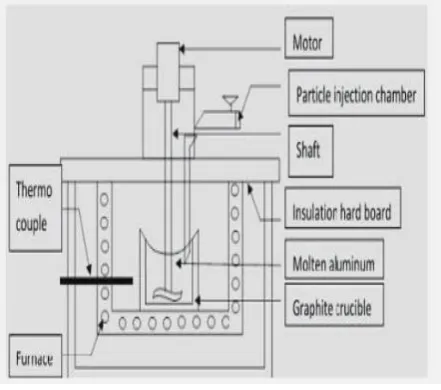
[image:3.595.187.408.374.569.2]Stir casting process setup is shown in Figure 1. In a stir casting process, the reinforcing phases (usually in powder form) are distributed into molten aluminium by mechanical stirring. Prior to mechanical stirring, the surfaces of both must be properly cleaned in order to minimize the reaction between these two. Introducing reinforcement particles to the stirred molten matrix sometimes will entrap not only the particles but also other impurities such as metal oxide and slag, which is formed on the surface of the melt. During pouring, air envelopes may form between particles, which can alter the interface properties between particles and the melt, and also retarding the wettability between them. A major concern associated with the stir casting process is the segregation of reinforcing particles which is caused by the surfacing or settling of reinforcement particles during melting and casting process. To prevent settling of particles a motor driven agitator is used. Aluminium silicon carbide metal matrix composite will reach a state called mushy state before solidification. Once the mushy state is reached the reinforcement particles remain in its position during solidification. The final distribution of the particles in the solid depends on material properties and process parameters such as the wetting condition of the particles with the melt, strength of mixing, relative density, and rate of solidification. The distribution of the particles in the molten matrix also depends on the geometry of the mechanical stirrer, stirring parameters, placement of the mechanical stirrer in the melt, melting temperature, and the characteristics of the articles added. To create and maintain a good distribution of the reinforcement material in molten matrix a vortex method is used. In this method, after the matrix material is melted, it stirred vigorously to form a vortex at the surface of the melt, and the reinforcement material is then introduced at the side of the vortex.
Fig. No. 1 Stir casting route
The stirring is continued for a few minutes before the slurry is cast [19]. An interesting recent development in stir casting is a two-step mixing process. In this process, the matrix material is first heated above its liquidus temperature. Then it is cooled down to a temperature between the liquidus and solidus points and kept in a semi-solid state. At this stage, the preheated reinforcement particles are added and mixed. The slurry is again heated to liquid state and mixed thoroughly. The results indicate that the two-step mixing process is quite successful to obtain a uniform dispersion of reinforcement in the matrix. An increasing trend for hardness and impact strength with increase in weight percentage of SiC has been observed [20]. For preheating the reinforcement particles, different researchers have used varying temperature and time (10000C for 1.5h in air
[21], 11000C for 1-3h [22], 8500C for 8h [23]). Preheating of reinforcement particles prevents the reaction between matrix and
© 2019, IRJET | Impact Factor value: 7.211 | ISO 9001:2008 Certified Journal | Page 1482
4. EFFECT OF PROCESS PARAMETERS
The following variable parameters are to be considered, while preparing the MMC by stir casting.
1. Stirring speed: It is reported by several authors that uniform distribution of the reinforcement particles is necessary for the improvement in the properties of the particulate MMCs like hardness, toughness, tensile strength etc. The low rpm of the stirrer applies less shearing force on the matrix metal and there is no space for the reinforcement particles (dispersed phase) to distribute uniformly throughout the matrix [28]. Moreover the dispersed phase has the tendency to agglomerate and form clusters. This happens due to the absence of the required force to resist it. At higher speeds of the stirrer the shearing force applied on the matrix metal is higher which creates the passage for the dispersed phase to move inside through the vortex created by stirring. For successful production of casting, the control of speed is very important. Rotational speed also influences the structure; increase of speed promotes refinement and very low speed results in instability of the liquid mass. It is logical to use the highest speed to avoid tearing. Stirring speed is one of the most important process parameters as wettability is promoted by stirring i.e. bonding between matrix & reinforcement. The flow pattern of the molten metal is directly controlled by the stirring speed. Research work carried out by Rajesh Kumar et.al [25] suggested that the speed range between 300 and 600 rpm is optimum. As solidifying rate is faster it will increase the percentage of wettability.
2. Stirring time: It plays a very important role in uniform distribution of dispersed phase into the matrix. Less time duration of stirring causes the clustering of the particles of reinforcement [29]. It is also seen that some portions of the matrix were found without inclusions of the reinforcement particles. Uniform distribution of the particles in the liquid and perfect interface bond between reinforcement and matrix is promoted by stirring. In the processing of composite, the stirring time between matrix and reinforcement is considered as important factor.
3. Stirring temperature: It is also one of the most prominent parameters which affect the stir casting process. [25] On increasing the temperature of the matrix metal the viscosity decreases and the distribution of the particles is affected. The chemical reaction between reinforcement particles and metal matrix is accelerated on increasing the temperature of the melt.The viscosity of Al matrix is influenced by the processing temperature. The particle distribution in the matrix is subjective to the change of viscosity. When processing temperature is increased along with increasing holding time of stirring, there is a decrease in the viscosity of liquid. There is also acceleration in the chemical reaction between matrix and reinforcement. Once again, the research work carried out by Rajesh Kumar et.al [25] observed that operating temperature at 6300C keeps the Al (6061) in semisolid state.
4. Stirrer design:
It is very important parameter in stir casting process which is required for vortex formation. The blade angle and number of blades decides the flow pattern of the liquid metal. The stirrer is immersed till two third depth of molten metal. All these are required for uniform distribution of reinforcement in liquid metal, perfect interface bonding and to avoid clustering [26].
5. Pouring temperature: A major role is played by the pouring temperature on the mode of solidification and determines relation partly to the required structure type. Low temperature is associated with maximum grain refinement and equiaxed structure while higher temperature promotes columnar growth in many alloys. However, the range is limited in practical scenarios. To ensure satisfactory metal flow and freedom from collapse whilst avoiding coarse structures, the pouring temperature must be sufficiently high [27].
6. Mould temperature: Its principal signification lies in the degree of expansion of the die with preheating. The risk of tearing in casting is diminished by expansion. The mould temperature should neither be too low nor be too high, in non-ferrous casting. The mould should be at least 25 mm thick with the thickness increasing with size and weight of casting. 7. Reinforcement pre-heat temperature: According to the research work by Pradeep Sharma et. al. [26] in order to remove moisture or any other gases present within reinforcement, the reinforcement was preheated at a specified 5000C
temperature for 30 minutes. The wettability of reinforcement with matrix is promoted by preheating.
5. CONCLUSION
© 2019, IRJET | Impact Factor value: 7.211 | ISO 9001:2008 Certified Journal | Page 1483
Preheating of mould reduced the porosity in the cast composite materials. Preheating of the reinforcement particle leads to the increase in wetability and good interfacial bonding between the reinforced particle and matrix.REFERENCES
[1] S. Naher, D Brabazon and L Looney, “Development and Assessment of a New Quick Quench Stir Caster Design for the Production of Metal Matrix Composites”, Journal of Material Processing Technology, Vol. 166, 2004, pp 430-439.
[2] J. Hashim , L Looney and M S J Hashmi, “ Metal Matrix Composites: Production by the Stir Casting Method”, Journal of Material Processing and Technology, Vol. 92, 1999, pp 1-7.
[3] Y. H. Seo and C. G. Kang, “Effects of Hot Extrusion Through a Curved Die on the Mechanical Properties of Al-SiC Composites Fabricated by Melt-Stirring”, Composites Science and Technology, Vol.59, 1999, pp 643-654.
[4] M.K. Surappa, J. Mater. Proc. Tech. 63 (1997) 325±333.
[5] R. Calin, M. Pul and Z. Pehlivanli: “The Effect of Reinforcement Volume Ratio on Porosity and Thermal Conductivity in Al-Mgo Composites”, Materials Research, 2012; 15(6): 1057-1063.
[6] N. Jit, A. Tyagi and N. Singh; “Al-Cu-Si - (Al2O3)p composites using A 384.1 Al Alloys”, Asian Journal of Chemistry Vol. 21, No. 10 (2009), S066-071.
[7] B. Kandpal, J. Kumar and H. Singh; “ Production Technologies of Metal Matrix Composite: A Review”, IJRMET Vol. 4, Issue 2, Spl - 2 May - October 2014.
[8] S. Kulkarni, J. Meghnani and A. Lal; “Effect of Fly Ash Hybrid Reinforcement on Mechanical Property and Porosity of Aluminium 356 alloy”, Elsevier, Procedia Materials Science 5 (2014) 746-754.
[9] S. Shinde; “Manufacturing of Aluminum Matrix Composite Using Stir Casting Method”, IJIERT, Vol. 2, Issue 5, May-2015.
[10] P. Sharma; “ Production of AMC by stir casting – An Overview”, International Journal of Contemporary Practices, ISSN: 2231-5608, Vol.2, Issue 1.
[11] Stefanos S., "Mechanical Behaviour of Cast SiC Reinforced with Al 4.5% Cu-1.5% Mg Alloy", Journal of Materials Science and Engineering, Volume 210, pp. 76-82, 1996.
[12] Pai, B.C., Pllia, R.M., and Satyanaryanak, G., "Stir Cast Aluminum Alloy Matrix", Key Engineering Materials, Volume 79-80, pp. 117 128, 1993.
[13] Balasivanandha, S., "Influence of Stirring Speed and Stirring Time on Distribution of Particles in Cast Metal Matrix Composites", Jounral of Material Processing Technology, Volume 171, pp. 268-273, 2006.
[14] Rupa, D.G., and Meenia, H., "SiC Particulate Distribution Dispersed Composites of An AL-Zn-Mg-Cu Alloy Property Comparison with Parent Alloy", Jounral of Materials Characterizations, Volume 54, pp. 438-445, 2005.
[15] Darell, R., Herling, G., Glenn J, and Wrrent, H.Jr., "Low Cost Metal Matrix composites" Journal of Advanced Materials and Process, pp. 37-40, July, 2001.
[16] Gupta, and Surappa, “Processing Microstructure Properties of Al Based Metal Matrix Composites”, Journal of Key to Engineering Materials, Volume 104-107, pp. 259-274.
[17] Zhou, W., and. Xu, Z.M., "Casting of SiCp Reinforced Metal Matrix Composites", Jounral of Materials and Processing Technology, Volume 63, pp. 358-363, 1997.
[18] Das, S., "Development of Aluminum Alloy Composite for Engineering Applications”, Indian Institute of Meterials, Volume 27, No. 4, pp. 325-334, August, 2004.
[19] P. K Jayashree , M. C Gowri Shankar , Achutha Kini, S. S Sharma and Raviraj Shetty, “Review on Effect of Silicon Carbide (SiC) on Stir Cast Aluminium Metal Matrix Composites”, International Journal of Current Engineering and Technology, 2013.
[20] D Manoj Singla, Deepak Dwivedi, Lakhvir Singh, Vikas Chawla, “Development of Aluminium Based Silicon Carbide Particulate Metal Matrix Composite”, Journal of Minerals & Materials Characterization & Engineering, Vol. 8, No.6, 2009, pp 455-467.
[21] M. Yilmaz and S. Altintas, “Properties of Al-Mg-SiC Composites Produced by a Modified Compo Casting Technique”, In Proceeding of the 2nd Bienniel European joint conference on Engineering Systems, 1994, pp 119-124.
[22] W. Zhou, Z. M. Xu, “Casting of SiC Reinforced Metal Matrix Composites”, Journal of Materials Processing Technology,Vol. 63 , 1997, pp 358-363.
[23] V. M. Kevorkijan and B. Sustarsic, “A new production Technology For Discontinuously reinforced Al-SiC Composites”, Key. Eng. Mater, 1997, pp 127-131.
[24] Gowri Shankar, M.C, Jayashree, “Individual and Combined Effect of Reinforcements on Stir Cast Aluminium Metal Matrix Composites. A Review”, International Journal of Current Engineering and Technology, Vol.3, No.3, 2013.
[25] Rajesh Kumar, Gangaram Bhandare, Parshuram M. Sonawane; “Preparation of Aluminium Matrix Composite by Using Stir Casting
Method”, International Journal of Engineering and Advanced Technology, Vol, 3, Issue 2, 2013.
© 2019, IRJET | Impact Factor value: 7.211 | ISO 9001:2008 Certified Journal | Page 1484
[27] Ravichandran, M. and Dineshkumar, S.; “Synthesis of Al-TiO2 Composites through Liquid Powder Metallurgy Route”, InternationalJournal of Mechanical Engineering, Vol. 1 Issue 1, 2014.
[28] Aqida, S.N., Ghazali, M.I., Hashim.J.,”The Effects Of Stirring Speed and Reinforcement Particles on Porosity Formation in Cast MMC” pp. 1, 2
![Table no. 1 A comparative evaluation of the different techniques used for MMC fabrication [4]](https://thumb-us.123doks.com/thumbv2/123dok_us/9332502.435257/2.595.39.557.279.433/table-comparative-evaluation-different-techniques-used-mmc-fabrication.webp)