Effect of the Spin-Spin Interaction on the Coulomb’s Law:
Application to Ferromagnetism
Voicu Dolocan1*, Voicu Octavian Dolocan2
1Faculty of Physics, University of Bucharest, Bucharest, Romania; 2Aix-Marseille University & IM2NP, Marseille, France. Email: *[email protected]
Received April 11th,2012; revised May 15th, 2012; accepted May 25th, 2012
ABSTRACT
In this work we present a model for the determination of the interaction energy for triplet and singlet states in atoms with incomplete filled shells. Our model includes the modification of the Coulomb’s law by the interaction between the magnetic moments of the electrons. We find that the energy of the triplet state is lower than the energy of the singlet state. We calculate the interaction energy between the electrons from the adjacent atoms in fcc lattices and we find that the minimum interaction energy is attained for the triplet state. The result is presented for the interaction between the electrons of the first coordination group and those of the second coordination group. The interaction energy which aligns the spins is used to evaluate the Curie temperature in a mean field model.
Keywords: Spin-Spin Interaction; Magnetic Moment; Ferromagnetism
1. Introduction
In condensed matter physics we are often interested on the importance that interactions between particles have on ground and excited states of the system and on its physical properties. To solve the many-body problem is a very difficult task and different methods and mo- dels are used which explain more or less accurate the physical effects that are measured. For example, mag- netism in materials remains a very hot topic of re- search but the fundamental question of the magnetic order is based on the assumptions of the model used. Recent notable research in magnetism includes the nature of the ground state of an interacting two-dimen- sional (2D) electron gas in a magnetic field, as in quantum Hall effect and giant magnetoresistance [1- 4].
An important problem is that of the origin of ferro-magnetism. The physical effect that produces magnetic ordering of adjacent magnetic moments is the same that leads to magnetic ordering within an ion and produces Hund’s rules. Interactions between spins are actually just a convenient way to record the end result of electrostatic repulsion [5]. Two electrons circling a nucleus reduce their Coulomb interaction by adopting an anti-symmetric wave function that vanishes whenever they come near each other. The Pauli principle demands that the overall
wave function must be anti-symmetric, so the spin wave function must be symmetric. The electrons lower their energy by adopting the same spin state and developing a local magnetic moment. The important concepts were introduced by Heisenberg [6] and Stoner [7]. It was shown by Hubbard [8] that the correlation effects will lower the energy of non-magnetic states more than that of the ferromagnetic states and make the condition for ferromagnetism more stringent. The spin wave excita-tions give a way to explain the temperature dependence of the magnetization in magnetic materials at low tem- peratures [9].
In this paper, using an effective field Hamiltonian (de-tailed in [10]), we investigate the influence of the mag-netic moments on the electron-electron interaction. We first discuss the modification of Coulomb’s law by the interaction between the magnetic moments of the elec-trons. Next, we present the case of an isolated atom with applications to Hund’s rules and the condition for ferro-magnetism in fcc lattices.
2. Model and Formalism
In this Section, we review the electron-electron interac-tion by using an effective field Hamiltonian [9] and ex-tend the results to the case of the interaction between the magnetic moments of the electrons. The energy of the electron-electron interaction is given by the expression (see Appendix):
Effect of the Spin-Spin Interaction on the Coulomb’s Law: Application to Ferromagnetism 118
2 2 3 2 2 2 , , 2 2 2 1 2 32 1 1 1 i I n o D E e DR m R cn n n n
. o n
o o
o
o q R
2 q q k q q
q q k k q
k k q q
q q
(1)
where D is a coupling constant, m is the mass of an elec-tron, R is the distance between the two electrons, ρo is the massive density of the interacting field, DR/c2 is the
“massless density” of the interacting field, ωq =cq is the
classical oscillation frequency of the interacting field,
o
q
is the oscillation frequency of an electron, q is the wave vector of the interacting field, qo is the wave vector
of the boson associated with the electron, k is the wave vector of the electron and k2 2m
k , nq is the
occu-pation number of the bosons associated with the inter-acting field, qo is the occupation number of the bosons associated with the electrons, nk is the occupation
num-ber for the electrons. When the interacting field is a pho-ton field, then ρo = 0. For a quasi free electron
q
n
kk q , qo qo2 2m ( m is an effective elec-tron mass) and by using that nq, =0, nk, nk–q = 1,
Equation (1) becomes:
nqo
2 23 4
. 2 4 3 2
, , . 1 2 32 n o i I n c E
m R
oo o
q R q q k q q
q q
e (2)
To calculate Equation (2) we consider the two sums separately. The first sum can be easily calculated as:
2 2 π
2
3 2 2 3 2
0 0
2 3 3
. 2 1
cos sin d d
2π 2 9π o o q o o m q q q c m R c
q q q
q q
and from the second one we obtain for q1 = q2 = qo, R2 –
R1 = R:
2
0.94π/ π
2 2
0 0
2 1 cos 2 1 cos
2 2 d cos cos sin d
2π 3.3 n i n R
o o o
e
q q q R
o ο o o q R q o q q q R (3)where Γ = q2 R2 – q1R1 for n = 1, 2.
The interaction energy becomes:
0.00729 I
c E
R R
c (4)
Taking the upper limit of qoas0.94π/R, which is with 6% lower than π/R one obtains the value of α just as ex-perimental value. The relation (4) represents the Cou-lomb’s law, which now is obtained without taken into account the electric charge concept. It can be shown [9] that for the charges of opposite sign the interaction energy (4) has the sign minus.
In presence of a magnetic field in the above equations we introduce the vector potential and thus we substitute qo·r by q ro e
A rd . The second sum becomes: (See
Equation (5), below).
The energy levels of atomic electrons are affected by the interaction between the electron spin magnetic mo-ment and the orbital magnetic momo-mentum of the electron. It can be visualized as a magnetic field caused by the electron’s orbital motion interacting with the spin mag-netic moment. The effective magmag-netic field can be ex- pressed in terms of the electron orbital angular momen- tum. We consider the vector potential 3
r
r
A where μ
is the magnetic dipole moment and r is a vector from the middle of the loop to an observation point. An electron in a stationary state in an atom, having a definite angular momentum projection Lz=ħml (mlthe quantum magnetic number), has a magnetic moment ( )l
z Bml
where
2
B e m
is the Bohr magneton. The theory and ex-periments demonstrate that the free electron has a mag-netic moment equal to the Bohr magneton μB, and a spin
s, the projection of which on a specified direction are 2
z s
s m where ms 1 2 is the spin quantum number. For ( )s
z Bgms
with g = 2 we obtain:
2 3 2 3 2 3 2 3 1 2 1 2 d 4π d 4π 2 d4π m 2
d
4π
i j i j i j i j
lj i i i li j j j si ij ij ij sj ji ji ji
e e h
m e R
e e h
m e R
e e h
e R
e e h
e R
q q R R
q q R R
m R R m R R m R R m R R
22 2 1 1 2 2
1,2
2 1 cos d d 2 1 cos
n n i n e e
q R
1 1
q R q R A R R A R R
where
h e mli and
h e msi are the flux vectors. Forqi=qj=qo:
2
2
2 2
2
2
2
2
2
cos d
2
d d 2
2 2
d
2 cos 2
2π 2π
2
2π 2 2π 2
2
li
o ij i
i
lj ij
j si j
ji
2
ij sj o
ji
o li lj
t j
sj si
ij ji
m e
q R R
m R
m R
e e
R m
m R m R
R e
m q R
m R
e
m m
m R R
m m
e
m R R
o
In these conditions, 2
22
ˆ2
l s o o
m m
e
m R
q q x where
ˆ
x is a unit vector perpendicular to R and μ. The interac-tion energy between two electrons, by taken into account their magnetic moments, becomes:
2 1.3cos 144π
I c E
R
o (6)
For msi= msj= 1/2, Γo reduces to:
2 πo li
o e
m m
mR
lj
(7a)where Ro = Ri= Rj is the radius of the electron orbit and R = Rij. For mli – mlj=1, we obtain:
triplet π 2
o
o e mR
(7b)
For msi = 1/2, msj = –1/2, we obtain:
2 2
π π
o li lj
o
e m m
mR mR
2 e (8)
For mli= mlj the above relation reduces to:
singlet 2π 2
o
e mR
(9)
For an average value of R equal to Ro, = 2 .
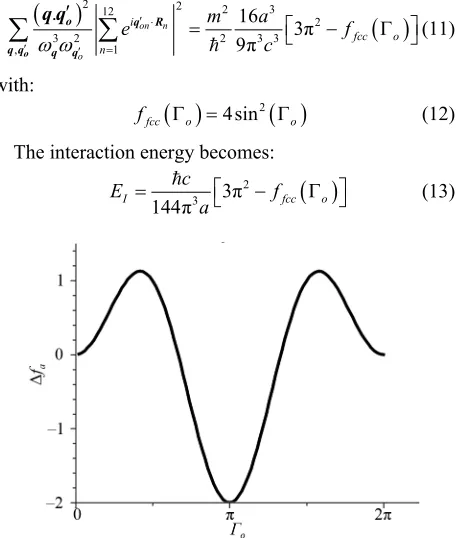
In Figure 1, we plot a o o , that is
the difference between the function for the triplet state and the function for the singlet state. It is observed that for Γo= π the amplitude of this function has an absolute maximum, which is negative and therefore the interac-tion energy for the triplet state is lower than that associ-ated with the singlet state. Thus for an atom with two valence electrons in a shell with l > 1, the interaction energy between the two electrons when they occupy dif-ferent Lz states (all degenerate in energy) and adopt a
singlet o
cos 2
triplet
o
cos
f
triplet spin state, is smaller than the interaction energy when they occupy the same Lz state, in which case they
must have opposite spins. Therefore, the triplet state is favorable. This may explain Hund’s rules related to the organization of electrons in incompletely filled shells.
3. Condition for Ferromagnetism
We consider an atom that has its total spin in the up di-rection. The intra-atomic interactions are of such a nature that this atom tends to attract electrons with spin up and repel those with spin down. In the case of the face-cen- tered cubic lattice every atom is surrounded by 12 nearest neighbors, which have the coordinates
a 2 1, 1,0
,
a 2 1, 0, 1 ,
a 2 0, 1, 1
. Suppose the magnetic moment μ(0, 0, μ). Then, the vector potential can be chosen in the following form A(Ax, Ay, 0). We obtain:2 12
1
4 3 cos cos
2 2
cos cos
2 2
cos cos
2 2
n oy
i ox
o o
n
ox oz
o
oy oz
o
aq aq
e
aq aq
aq aq
q Ro (10)
where Γo is given by Equation (7b) for the triplet state and by Equation (9) for the singlet state. The sum in the interaction energy becomes:
2 12 2 2 3
2
3 2 2 3 3
, 1
. 16
3π
9π
on n
o i
fcc o
n
m a
e f
c
o
o q R
q q q q
q q
(11)
with:
4sin2
fcc o o
f (12) The interaction energy becomes:
2 3 3π
144π
I c
E f
a fcc o
[image:3.595.311.539.428.697.2] (13)
Figure 1. Difference between the functions for the triplet and singlet states Δfa, as a function of Γoin an isolated atom
Effect of the Spin-Spin Interaction on the Coulomb’s Law: Application to Ferromagnetism 120
From Equations (12) and (13), it appears that there is an oscillating interaction between the two electrons be-longing to different atoms. The nature of this interaction may be not different of that which is encountered in the case of interaction between two ions by indirect ex-change [11]. In the later case, the electrons belonging to an ion flip a conduction electron which then travels to another site and interacts with the spin of the ion of the second site. Perhaps the most significant application of the RKKY theory has been to the theory of giant mag-neto resistance (GMR) [3,4]. GMR was discovered when the coupling between thin layers of magnetic materials separated by a non-magnetic spacer material was found to oscillate between ferromagnetic and anti ferromag-netic as a function of the distance between the layers. The period of an oscillation is determined by the Fermi wave vector, in the case of free electron gas, via
2π2kF πkF
. The phase of the cosine in RKKY
theory is kFR while in our theory this phase is
2
Γo πe mR1k Ro where
2 π
o
k m e . In this case the “period” of an oscillation is dependent of R. From the
condition , one obtains
1 1
n n n o n n
1
Γn Γn 2π
o o
2
R R k R R
The effective mass of the
electron in d-band is larger than the free electron mass. For Rn ~ 3.3 Ǻ and m = 5mo resultsλn ~ 0.4 Ǻ a value which is larger than the Compton wavelength, ħ/mc = 8 × 10⁻³Ǻ, and is lower than the period of the RKKY
oscil-lation, which is of the order of 3 Ǻ. The oscillatory be- haviour is the result of the interference of two oscillating fields generated by the magnetic moments of the two electrons. Each fringe arises from a definite difference in phase. The effect is an oscillatory polarization of the conduction electrons as it occurs in RKKY model.
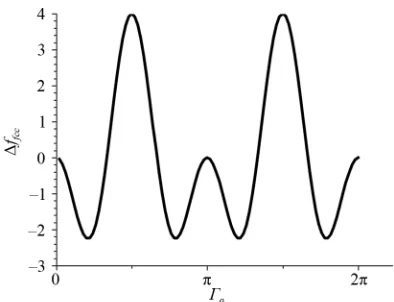
In Figure 2, we show ffcc ffcc
o ffcc
2o
,that is the difference between the function ffcc for the triplet state and the singlet state. It is observed that this function attains its absolute maximum at
Γoπ 2 or 2n1 π 2 and therefore the interaction energy between the two electrons for the triplet state is lower than that for the singlet state. The component of EI
which aligns the spins in the triplet state is:
3
π 0.492 eV
2 144π
I fcc
c
E f
a
for a = 3.55 Ǻ. We must now take into account the screening effect due to the conduction electrons. The appropriate screening constant is κ2 = me k2 F π2 2 o ,
where the wave vector at the Fermi level is
2
1 33π
F
k n . In the Co fcc lattice, the density of elec- trons is n8 a3 1.8 10 m 29 3. For the effective mass
of the conduction electrons, m = 0.76 mo,where mo is the free electron mass, one obtains κ = 2.8 × 10⁹ m–1. If we
substitute in Equation (12) q'osby q'os+ iκ (s = x, y, z) we obtain a multiplicative factor e–κa (Yukawa form) to the
above estimate ΔEI reducing it to the order of magnitude –0.18 eV. The Curie temperature may be estimated as in the mean field theory applied to the spin-wave model [12,13]:
6 o
B c o
B
M
k T E
q
q
where M is the magnetic moment per atom, μB is the Bohr magneton, E(qo) is the spin-wave energy which is related to the exchange parameter Jojby a simple Fourier transformation:
0
4
1 exp
B
oj o ij
j
E J i
M
q q R
Substituting the exchange parameter by our interaction parameter used in Equation (2), finally we obtain:
2 3
B c I
k T E
where ΔEI is given by the above expression. For cobalt results Tc= 1411 K. A more elaborate method is the ran-dom phase approximation [12-14]. The Curie tempera-ture can be also estimated numerically by employing the method of Monte Carlo simulations applied to effective Heisenberg Hamiltonian [15].
We take now into account the interaction with the at-oms of the second group of coordination. If in a fcc structure we take into account the fact that every atom is surrounded by 6 neighbours of second order, which have the coordinates a(±1, 0, 0), a(0, ±1, 0), a(0, 0, ±1), then we must add to Equation (10) the term:
2 6
'
1
2 3 cos cos cos
n
i n
x o y o z o
e
aq aq aq
qonR [image:4.595.324.521.543.694.2]and the corresponding energy of interaction is:
Figure 2. Difference between the functions for the triplet and singlet state, Δffcc, as a function of Γo, in an fcc lattice
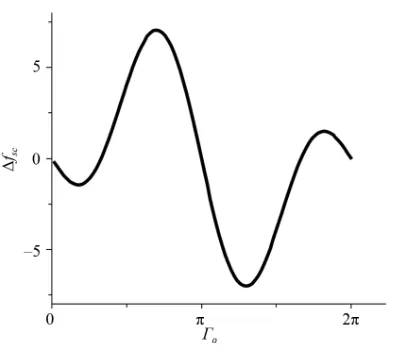
Figure 3. Difference between the function of the triplet and the singlet state, Δffcc, as a function of Γo in a simple cubic
lattice.
( )
2 3π ( )
288π
sc I
c E
a
fsc o
(15)with fsc( ) 4sin o
oIn Figure 3 Δfsc = fsc(Γo) – fsc(2Γo) as a function of Γo is shown. It is observed that depending on the distance between the atoms the coupling may be ferromagnetic at
Γo = 2.1 + 2sπ, as well as antiferromagnetic at
This situation is also adequate for a simple cubic lattice. We note that in an fcc lattice of transition metals the ferromagnetic state is deter-mined by the interaction between nearest neighbours.
Γo 2π2.1 2s sπ, = 0, 1, 2
4. Conclusion
Using an effective field Hamiltonian we have shown that the Coulomb’s law is modified by the spin-spin interac-tion. If we take into account the spin magnetic moment, when the spins are oriented antiparallel, the Coulomb interaction is modulated by a cosine term whose argu-ment depends on the spin magnetic moargu-ment and on the distance between the two electrons. Evidently, this situa-tion occurs in the absence of the magnetic field, for ex-ample in superconductors. Further, we have studied the influence of the electron magnetic moments, both orbital and spin, on the electron-electron interaction in an iso-lated atom. We have found that in an incomplete shell the interaction energy of the triplet state is smaller than the energy of the singlet state. On this basis may be explained Hund’s rules. The condition of ferromagnetism is studied in a fcc lattice of transition metals and the obtained re-sults are in a good agreement with experimental data. By using the mean field approximation, we have estimated the Curie temperature. The coupling, due to the magnetic field generated by the two interacting electrons, oscillate with a “period” 1/koR where ko = m/πe2. This period of oscillation is dependent of R and for R = 3.3 Ǻ and m/mo
= 5, is equal to 0.4 Ǻ, a value which is smaller than the RKKY period of ~3 Ǻ. This means that the magnetic field generated by the magnetic moments of the electrons is modulated by an oscillation which has a period of π/kF, where kF is the Fermi wave vector.
REFERENCES
[1] R. B. Laughlin, “Anomalous Quantum Hall Effect: An Incompressible Quantum Fluid with Fractionally Charged Excitations,” Physical Review Letters, Vol. 50, No. 11, 1981, pp. 1395-1398. doi:10.1103/PhysRevLett.50.1395 [2] K. von Klitzing, “The Quantized Hall Effect,” Review of
Modern Physics, Vol. 58, No. 2, 1986, pp. 519-531. doi:10.1103/RevModPhys.58.519
[3] P. Grünberg, R. Schreiber, Y. Pang, M. B. Brodsky and H. Sowers, “Layered Magnetic Structures: Evidence for An- tiferromagnetic Coupling for Fe Layers across Cr Inter- layers,” Physical Review Letters, Vol. 57, No. 19, 1986, pp. 2442-2445. doi:10.1103/PhysRevLett.57.2442
[4] M. N. Baibich, et al., “Giant Magnetoresistance of (001)Fe/(001)Cr Magnetic Superlattices,” Physjcal Re- view Letters, Vol. 61, No. 19, 1988, pp. 2472-2475. doi:10.1103/PhysRevLett.61.2472
[5] W. Heitler and F. London, “Interaction of Neutral Atoms and Homopolar Binding in Quantum Mechanics,” Zeit- schrift für Physik, Vol. 44, No. 2, 1927, pp. 455-472. [6] W. Heisenberg, “On the Theory of Ferromagnetism,”
Zeitschrift für Physik, Vol. 49, No. 4, 1926, pp. 619-636. [7] E. C. Stoner, “Magnetism and Matter,” Methuen, London,
1934.
[8] J. Hubbard, “Electron Correlations in Narrow Energy Bands,” Proceedings of the Royal Society of London, Vol. A276, No. 1365, 1963, pp. 238-257.
doi:10.1098/rspa.1963.0204
[9] K. Hüller, “The Spin Wave Excitations and the Tempera- ture Dependence of the Magnetization in Iron, Cobalt, Nickel and Their Alloys,” Journal of Magnetism and Magnetic Materials, Vol. 61, No. 3, 1986, pp. 347-358. doi:10.1016/0304-8853(86)90048-X
[10] V. Dolocan, A. Dolocan and V. O. Dolocan, “Quantum Mechanical Treatment of the Electron-Boson Interaction Viewed as a Coupling through Flux Lines. Polarons,” In- ternational Journal of Modern Physics B, Vol. 24, No. 4, 2010, pp. 479-495.
[11] C. Kittel, “Indirect Exchange Interaction in Metals,” Solid State Physics: Advances in Research and Applications, Vol. 22, 1968, pp. 1-26.
[12] C. S. Wang, R. E. Prange and V. Korenman, “Magnetism in Iron and Nickel,” Physical Review B, Vol. 25, No. 9, 1982, pp. 5766-5777. doi:10.1103/PhysRevB.25.5766 [13] M. Pajda, J. Kudmovsky, I. Turek, V. Drchal and P.
Bruno, “Ab Initio Calculations of Exchange Interactions, Spin-Wave Stiffness Constants, and Curie Temperatures of Fe, Co, and Ni,” Physical Review B, Vol. 64, No. 5, 2001, Article ID: 174402.
Effect of the Spin-Spin Interaction on the Coulomb’s Law: Application to Ferromagnetism 122
[14] A. Loref, E. Sasioglu and I. Gulanakis, “Exchange Inter- action, Spin Waves, and Curie Temperatre in Zinc-Blende Half-Metallic Sp-Electrons Ferromagnets: The Case of CaZ (Z = N, P, As, Sb),” Journal of Physics: Condensed Matter, Vol.23, No. 29, 2011, Article ID: 296001. [15] Q. Niu, S. Wang, L. Kleinman, W. M. Liu, D. M. C.
Nicholson and G. M. Stocks, “Adyabatic Dynamics of
Local Spin Moments IN Itinerant Magnets,” Physical Re- view Letters, Vol. 83, No. 1, 1999, pp. 207-210. doi:10.1103/PhysRevLett.83.207
[16] A. Dolocan, V. O. Dolocan and V. Dolocan, “A New Hamiltonian of Interaction for Fermions,” Modern Phy- sics Letters, Vol. 19, No. 13-14, 2005, pp. 669-681. doi:10.1142/S0217984905008700
Appendix
where
1/ 2
,
,
,
1
2
1
1
1 1
;
2
i i
l l
l l
i
i
i n
a e a e
NR
c e NR
c e NR
s S e S b b
N R m
o no o o
q z q z
q q q
q q
k z k k
k z k k q z z
q q q
q q q
u z e
z
z
The electron will always carry with it a lattice polariza- tion field. The composite particle, electron plus phonon field, is called a polaron; it has a larger effective mass than the electron in the unperturbed lattice. By analogy, in our model, we consider a coupling between an elec- tron and a boson.
l
q
Consider a linear chain of N bodies, separated at a dis- tance R. The Hamiltonian operator of the interacting bodies (electrons) and the boson connecting field takes the general form:
, ,
o el o ph I
HH H H
,
b b
o o
q q are creation and annihilation operators
associ-ated with the electron oscillations, eql denotes the polari-zation vectors and χ(σ) is the spin wave function. sn is the displacement of a body near its equilibrium position in the direction of R and, in the approximation of nearest neighbours, it is assumed that D does not depend on n. The Hamiltonian of interaction between electrons via bosons becomes:
where
2
, ,
, 2
o el
k
,
H c c
m
2 k kk
is the Hamiltonian of the electrons of mass m, c,,c,
k k are
the electron creation and annihilation operators, k is the wave vector of an electron and σ is the spin quantum number,
3 2
, , , , , ,
( )
1 .
2 2
2
d
o
o n
I
n
i i
D
H b
m
N R
e a a a a c c e
,
1/ 2 2
1 2
o ph
H a a
DRq
q q q qq
b
z
o oo
o
q q
k k q q q q q
q z q q k k q z
q q q q k k
q q
q, q' are the wave vectors associated with the bosons of the connecting field, qo is the wave vector associated with the oscillations of the electron, and k, k' are the where q is the classical oscillation frequency, α is the
restoring force constant, D is the coupling constant, ρ is the linear density of flux lines, , are the boson creation and annihilation operators and
a
q aq
2
o DR c
,
ρo is the density of the interacting field, if this is a mas- sive field, c is the velocity of the boson waves. The in- teraction Hamiltonian operator HI is given by the expres- sion [16]:
wave vectors of the electrons. Consider the integral over z:
( )
ei dz
NR
q q k k qo zo
q q k k q (A1)
where Δ(x) = 1 for x = 0 and Δ(x) = 0, otherwise. In the bulk crystal NR is replaced by V = NΩ where Ω is the volume of a unit cell and N is the number of unit cells. We write:
2
d 2
I n
n DR
H s
u z z z
, , , , , , *
I
H g a a a a c c b
g a a b b c c b
o oo
o o o o
q q q q q k k q o
k k q q q
q q q q q k k q o
q q k k q
q q k k q
where
2 2
8 /
i n o
D g
N mR DR c
o n o
q z
q 2
q
e
Approximating
aqaq
aqaq
a aq qa aq qIn Equation (A1) we choose q' =qo, k' = k + q. In the
interaction picture the effective Hamiltonian is given by:
1 2
eff eff eff I I I
H H H
2
1 2 , ,
, ,
eff I
H g a a a a a a a a c c c c
o o o o oo
q
q q q q q q q q q k q k k k q
2 q q k
k k q q
2 2
,
1 2
eff I
H g a a c ,c,
q q q kq k k k q q
q k q
The expectation value of the energy of HI1eff is the energy
of the electron-electron interaction given by Equation (1)
in the text. The expectation value of the energy of HI2eff is