Educational Advisor System Implemented by Web-Based
Fuzzy Expert Systems
Mahdi Hassani Goodarzi1, Vahid Rafe2
1Department of Computer Engineering, Islamic Azad University-Malayer Branch, Malayer, Iran; 2Department of Computer Engi-neering, Faculty of EngiEngi-neering, Arak University, Arak, Iran.
Email: [email protected], [email protected]
Received April 12th, 2012; revised May 19th, 2012; accepted May 30th, 2012
ABSTRACT
Using of the Internet technology and the field of Fuzzy expert systems has proposed new branches of sharing and dis-tributing knowledge. However, there has been a general lack of investigation in the area of web-based Fuzzy expert systems (FES). In this paper the issues associated with the design, development, and use of web-based FES from a standpoint of the benefits and challenges of developing and using them. The original theory and concepts in conven-tional FES were reviewed and a knowledge engineering framework for developing them was revisited. Student in an educational place need an educational advisor for solve problems. Some of educational circulars order changing be-cause advisor must update information away. The student’s request is linguistic and crisp Expert System cannot solve problems completely. In my approach we build Web-Based Fuzzy Expert System for Student Education Advisor (FES-SEA) and stays in university portal. This system implemented with ASP.NET, SQL-SERVER 2008.
Keywords: Fuzzy Expert Systems (FES); Knowledge Based Systems; Web-Based; Grade Point Average (GPA)
1. Introduction
Decision Support Systems as a field of study in artificial intelligence, are based in mimicking the behavior of hu-man in problem solving and finding the pattern of solu-tions. In real world, if no certain and straight-forward solution cannot be found for a specific problem, experts are asked for help. Experts, in their own way, which of-ten includes trial-and-error methods, solve the problem. Since there is no specific solution for this kind of prob-lem, defining the method of achieving the solution for a computer is difficult. Therefore, expert systems are used to reach that goal. In these systems, the program consists of asset of a set of rules. The knowledge in human’s brain is also a set of if-then rules. M. H. Goodarzi [1,2] proposed the fuzzy application in Student Evaluating System, Portfolio Advisor System, in which fuzzy con-cepts can help in converting many crisp inputs to specific linguistic variables and covering many entries with fuzzy rules and inference. In [3] a web-based fuzzy expert sys-tem is used to help inexperienced Indian farmers in pes-ticide of their farms. The first version of this system was introduced in 1995 in a single-user form. In [4], a web- based fuzzy expert system is proposed in the field of e-commerce. In forums, usually somebody starts a dis-cussion and expresses his/her opinions and approaches to a particular problem [5]. Proposes a model for creating a
fuzzy-based expert forum that intelligently responds to questions asked by users. Finding the right broker at the right time is another issue that requires expertise. This may be the reason for which inexperienced investors loose in stock markets. In [6] a stock expert system mod-el is proposed. The goal of this system is to make a good suggestion based on information about goods and market in order to reduce the loss and increase the benefit. Edu-cational consulting system tries to mimic the behavior of the staff addressing the educational consulting issues.
Current paper includes four major sections: in Section 2, offers some examples of fuzzy rule-based systems and introduces the proposed model. In third section describe proposed systems are discussed, in Section 4 the educa-tional consulting expert system is discussed. Finally, a conclusion is provided. In [7] a fuzzy expert system for Intelligent Tutoring Systems with a cognitive mapping is proposed. Human cognition has become one of the cutest areas in artificial intelligence to emulate human suscepti-bility. [8] Suggest the new fuzzy method for hotel selec-tion and made the hotel advisory system (HAS). In [9] the intelligent method for Modeling Human Cognition is recommended.
2. Literature Review
attack because inadequate experience of the farmers. The loss was about 6.3 billion dollars in 2001. Soybean Pest Expert System (SOYPEST) [3], a fuzzy expert system, asks fuzzy questions in order to generate a web-based response for the user. SOYPEST is created by using JESS and gradually became more accurate by receiving feedback from the users and the experts.
In e-business, the buyers should be assisted when fac-ing ambiguities durfac-ing shoppfac-ing and fuzzy expert sys-tems can play an important role regarding that. In [4] a business-to-customer (B2C) model is proposed which seems to have a fundamental problem: the access level and competition are considered as fuzzy system rules. The major part of this work, concentrates on that and other issues in e-commerce like demand for purchase, production of goods and the price are not included in the rule base. It is also considerable that provider sites can be included as a set of fuzzy rules in which various fuzzy sets (like the quality of goods, the number of customers on-line, the price, available number of goods, …) are taken into account in decision making.
Interactive information interchange and creating fo-rums on the web are important issues which attract many researchers. One of the best known tools for this purpose is VBulletin. There are reasons that support the possibil-ity of receiving:
1) Irrelevant answers. 2) No answers at all.
3) Different confusing answers from several other us-ers.
4) Unclear answers.
These reasons can be considered as the Achilles heel of such systems. In [5], linguistic expressions are catego-rized and then n-gram algorithm is used to edit and con-vert the sentences to a proper format. This system sup-ports 15 languages and by default the questions are mul-tiple choice questions. Although the strong point of this system is its gradually improving knowledge base, the extended number and the expanded fields of topics, no considerable effort is done to find the best answer and the problem is solved through partial simulation of hu-man’s brain.
3. Decision Support System (Student
Consulting Expert System)
Most of students face problems related to educational rules and regulations during their education. These rules and regulations are changing every now and then and therefore an expert is needed to memorize these rules in order to be able to help students in their issues. The state of any student, according to the rules and regulations may differ from that of other students. Student State (SS) is a member of a fuzzy set with a degree of membership
equal to SS.
The First Step: determining and fuzzificating the in-puts to the system by using fuzzy rules. Following are some of the fuzzy sets of the system in hand:
Fuzzy set for GPA
Fuzzy set for passed courses
Fuzzy set for marks of selected courses
Fuzzy set for the rank and grade of student in the en-trance exam
and so on…
3.1. Fuzzification of the Crisp Variables of the Model
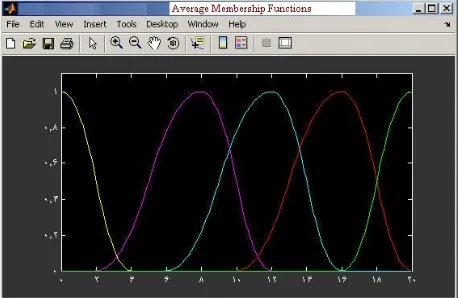
Students can be categorized according to their GPA into groups like A, B, C, D and E. This categorization can be expressed through linguistic terms like Excellent, Good, Middle, Week, Very Week.
The Second Step: determining the degree of member-ship of linguistic terms including 3 following phases:
Phase 1: for each term, the value nearest to the nu-meric equivalent of the linguistic term which has the maximum degree of membership is selected.
Here the highest value for the linguistic term “ Excel-lent” is 20 and 0 has the highest value in “Very Week” fuzzy set.
Phase 2: for each term, the value (or values) which has (have) the membership degree of 0 is (are) determined.
Phase 3: point with 1 are connected to points with 0 by lines to form a Gaussian (exponential) membership function. In cases in which there are more than one point with 1, a Gaussian membership tion is obtained. In the current model, membership func-tions can be Gaussian, Z-shaped and S-shaped. The membership function of GPA variable is shown in Fig-ure 1.
3.2. Rule Extraction
[image:2.595.309.538.566.715.2]Before After an interactive negotiation with experts, the
obtained data are fuzzified. The previous section illus-trates how GPA can be fuzzified. The following rules are the result of the negotiations:
If The GPA is MiddleAnd The number of semesters which the student is smallAnd
The courses that are not passed can be taken and passed in one semesterAnd
The student hasn’t given any pledgesAnd
The student hasn’t received any disciplinary notices And The student hasn’t reached the maximum time period for his/her studiesAnd
The student has 5 marks between 10 - 12 And
Some other student has had conditions similar to this Student
Then
To a large degree, it is possible that the student is allowed to continue his/her studies in the university by giving an Official pledge of achieving a GPA over 12 in the next semester.
Else
The Expert System cannot solve your problem.
3.3. Data Centralization
Define If the profiles of students are available in a cen-tralized storage device, even these negotiations are not necessary and the system can provide the answer by di-rectly accessing a student’s profile.
3.4. Putting the Information on the Web
Day by day development of the World Wide Web and applying multimedia tools along with the accessibility of web sites from any place in the world makes it feasible to design the user interface compatible with the web. Many expert systems in different fields of expertise are devel-oped (EXSYS CORVID, XpertRuleKnowledge Build-er, …) but few are applied. Since linguistic terms and fuzzy sets are used, the process for inference should be done on the client rater than the server so the server’s busy time is reduced. This procedure can be done by us-ing browser executable languages like JavaScript, Java, VB Script, XML, AJAX and Applet.
3.5. Considering the Exclusion Issue of a Student Before selecting the courses for the next semester, the students are checked and those who should be excluded are determined and prevented from registration for the next semester. The student’s advisor should address his/ her issue according to rules and regulations. Below are shown some questions and answers asked and answered by advisor and the student (respectively).
4. A Look Inside the System
First of all this approach is built by UML methodology.
Investigation, analysis, design and Implementation docu- ments are generated with Rational Rose case tool.
Then software is built on 5-tier layers and it is flexible, when one of layers is reconfigured or rebuild, another layers don’t changed.
1) Beginning, user selects type of consultation and en-ters crisp data in web application layer.
2) Control the input data same GPA, eventual count, educational level … is executed in Business Facade and Business rules layer.
3) Send a request for fuzzification the Crisp variables and rules generation to knowledge of system by data ac-cess layer with ADO.NET, then generate the linguistic variables just with view select, Stored Procedure & User Define Function Execution. This section makes a data-base abstraction and control the SQL-injection.
4) Linguistic variables send to inference engine and process with mamdani model [10]. This section accom-plish by one stored procedure in database, by name Stp_Inference.
5) Fuzzy answers defuzzyfies and output crisp values generate, this section accomplish by one user defined function in database, by name Udf_Defuzzifier.
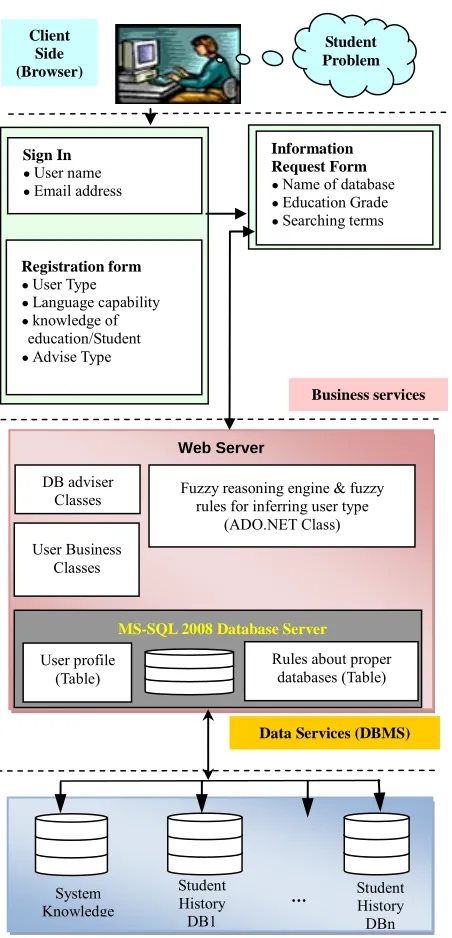
Finally advisor system evicts answer to user. Frame-work of system is shown in Figure 2 and data object model of system exist in Appendix 1.
5. Implementation Environment
System solution has 3 layers:
Web application layer include: boundary classes, web pages, functions and enumerations.
Business facade, business rules layer includes: control classes and methods, business classes and methods.
List of C# classes are: 1) FuzzyDecision.cs, 2) FuzzyLogic.cs, 3) FuzzyNumber.cs, 4) FuzzyPattern.cs, 5) FuzzyRuleInference.cs, 6) FuzzySet.cs,
7) FuzzyWords.cs.
Student Problem Client
Side (Browser)
Information Request Form ●Name of database
●Education Grade
●Searching terms Sign In
●User name
●Email address
Registration form ●User Type
●Language capability
●knowledge of education/Student
●Advise Type
Business services
Web Server
DB adviser
Classes Fuzzy reasoning engine & fuzzy rules for inferring user type (ADO.NET Class) User Business
Classes
MS-SQL 2008 Database Server
Rules about proper databases (Table) User profile
(Table)
Data Services (DBMS)
System Knowledge
Student History DB1
[image:4.595.60.286.80.549.2]Student History DBn …
Figure 2. Implementation architecture.
The framework of FES is shown in Figure 3.
6. Advantages of Fuzzy Expert Systems
The major advantage of these systems is that knowledge gradually turns into wisdom and can be used as a deci-sion making tool in critical situations which replaces the conventional FAQ. Some other features are:
More accessibility: Many experiments can be done. Simply an expert system is a mass production of experi-ments.
Cost reduction:The cost of gaining experience by the user is decreased considerably.
Crisp Variable 1
Crisp Variable 2
Crisp Variable n
Fuzzification
Fuzzification
Fuzzification DB
Ligustic Variable1
Ligustic Variable2
Ligustic Variable n
Inference Engine
DB Defuzzification
Crisp Answer
Figure 3. Framework of this fuzzy system.
Risk reduction: The expert system can work in envi-ronments dangerous, harmful or unpleasant for human.
Eternality: these systems don’t die.
Multiple experts: An expert system can be the result of knowledge elicitation of several experts.
More reliability: These systems don’t get tired or sick, they don’t go on a strike and they don’t conspire against their managers. On the contrary, these are often done by experts.
Explanation capability: An expert system can explain the way in which the results are obtained. On the con-trary, due to many reasons (fatigue, unwillingness, etc.) experts are not able to provide such explanations all the times.
Quick response: Expert systems respond quickly. Responsibility in any condition: In critical conditions and/or emergencies an expert may be unable to make the right decision due to stress or other factors while an ex-pert system’s decision making is not affected by these events.
Experience base: An expert system can provide access to a massive amount of experience.
User training: An expert system can act like an intel-ligent tutor: problems are presented to the system and the way of reasoning can be obtained.
Ease of knowledge transmission: one of the most im-portant advantages of expert systems is it is convenient to move the knowledge of the system somewhere else on the globe.
7. Environment of Software
[image:4.595.306.538.85.332.2]9. Inference Phase
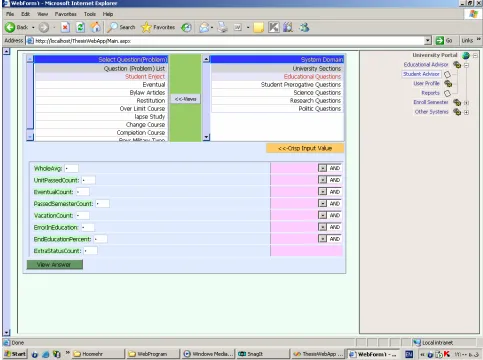
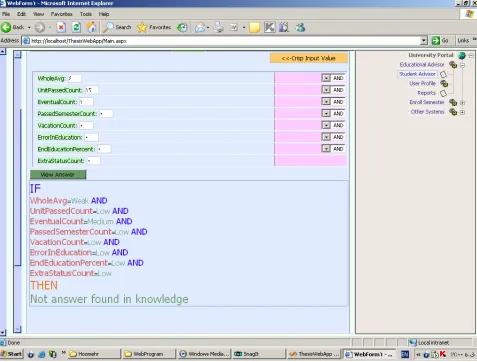
web forms of application is shown in Figures 4 and 5.
IF fv1 is middle And
8. One Real Experiment of Advisor System
fv2 is small Andfv3 is small And Student eviction mutual conversation:
fv4 is middle And 1:
Q :
What is your total average?
fv5 is high And 12.18
1 A
fv6 is high And fv7 is high 2
: :
Q How many units remain to pass?
THEN 8
2 A
You are probably 20 percent evicting. 3
: :
Q How many pledges did you get before?
ELSE 0
2 A
Not in knowledge base. 4
: :
Q How many disciplinary did you get before? 1
4 A
10. Conclusion
5
: :
Q How many semesters did you study? 9
5
A In the beginning of this paper a glance to definitions and
introduction to fuzzy logic and fuzzy decision making was taken. Then, some implemented examples of such systems are presented and finally, a web-based student consulting expert system is proposed. In the end, the ca-pability of the system in enhancing the consulting proc-ess is shown.
6:
Q How many marks under score 10? 6:
A 8
7:
Q How many units do you passed? 7:
A 130
[image:5.595.55.538.355.715.2]The crisp student’s answers, fuzzy values and the lin-guistic values of each question are shown in Table 1.
Figure 5. Inference and defuzzification and make answer.
Table 1. Fuzzification experiment entries.
Question Answer Fuzzy variable/(fv) μ(x) Linguistic Variable
1 12.18 0.85 Middle
2 8 0.86 Small
3 0 1 Small
4 1 0.25 Middle
5 9 0.65 High
6 8 0.76 High
7 130 0.94 High
11. Acknowledgements
This project supporting by the Islamic Azad University, Malayar Branch.
REFERENCES
[1] M. H. Goodarzi, “Evaluating Students’ Learning Progress
by Using Fuzzy Expert Systems,” 6th International Con-ference on Fuzzy Systems and Knowledge Discovery, Tianjin, 14-16 August 2009, pp. 248-252.
doi:10.1109/FSKD.2009.313
[2] M. H. Goodarzi, “A Web-Based Implementation of a Portfolio Advisor System Based on Fuzzy Expert Sys-tems,” IEEE 6th International Conference on Information & Communication Technology and System ICTS, Sura-baya, 28 September 2010, pp. 15-22.
[3] H. S. Saini, R. Kamal and A. N. Sharma, “Web Based Fuzzy Expert System For Integrated Pest Management in Soybean,” International Journal of Information Techno- logy, Vol. 8, No. 1, 2002, pp. 55-74.
[4] F. Akhter, D. Hobbs and Z. Maamar, “A Fuzzy Logic- Based System for Assessing the Level of Business- to-Consumer (B2C) Trust in Electronic Commerce,” El-sevier, Vol. 28, No. 4, 2005, pp. 623-628.
[5] Y. M. Huang, J. N. Chen, Y. H. Kuo and Y.-L. Jeng, “An Intelligent Human-Expert forum System Based on Fuzzy Information Retrieval Technique,” Expert Systems with Applications, Elsevier, Vol. 34, No. 1, 2008, pp. 446-458.
doi:10.1016/j.eswa.2006.09.037
[image:6.595.57.287.492.634.2]www.merlotti.com/EngHome/Computing/fes.pdf. [7] M. H. F. Zarandi, M. Khademian and B. Minaei-Bidgoli,
“A Fuzzy Expert System Architecture for Intelligent Tu-toring Systems: A Cognitive Mapping Approach,” Jour-nal of Intelligent Learning Systems and Applications, Vol. 4, No. 1, 2012, pp. 29-40. doi:10.4236/jilsa.2012.41003 [8] E. W. T Ngai and F. K. T. Wat, “Design and
Develop-ment of a Fuzzy Expert System for Hotel Selection,”
El-sevier, Vol. 31, No. 4, 2003, pp. 275-286.
[9] Y. Joo and Y. An, “Intelligent System Modeling for Hu-man Cognition,” 5th International Conference on Con- vergence and Hybrid Information Technology ICHIT, Springer, Daejeon, 22-24 September 2011, pp. 529-536. [10] W. Siler and J. J. Buckley, “Fuzzy Expert Systems and
Appendix 1: Entity Relationship of System in Database
ERD & Data Objects Model
Tbl_SystemDomain (1) Tbl_DomainSection_REL_InputFuzzySet (7)
Relation Relation Data Type Column Name Primary Key smallint DomainId varchar(300) DomainDesc FK(11) smallint knowledgeEnginnerID Data Type Column Name PK int SectionStatementId FK(2) int DomainSectionId FK(8) int InputFuzzySetId
Tbl_DomainSection (2) Tbl_InputFuzzySet (8)
Relation Data Type Column Name PK int DomainSectionId FK(1) smallint DomainId varchar(300) DomainSectionDesc FK(12) smallint knowledgeEnginnerID Relation Data Type Column Name PK int InputFuzzySetId varchar(100) InputFuzzySetDesc varchar(50) InputFuzzySetLatinDesc int MinLimit int MaxLimit FK(12) smallint knowledgeEnginnerID
Tbl_OutPutFuzzySet (3)
Relation Data Type Column Name PK int OutPutFuzzySetId varchar(100) OutPutFuzzySetDesc FK(12) smallint knowledgeEnginnerID
Tbl_MembershipFunctions (9)
Relation Data Type Column Name PK tinyint MemberShipFunctId varchar(100) MembershipFuncDesc varchar(50) PersianDesc FK(12) smallint knowledgeEnginnerID
Tbl_OutputLinguisticVariables (4)
Relation Data Type Column Name PK int OutPutLinguisticVarId FK(3) int OutPutFuzzySetId varchar(50) OutPutLingusticVarDesc varchar(50) OutPutLingusticVarLatinDesc real MinValue real MaxValue FK(9) tinyint MemberShipFunctId real Param1 real Param2 real Param3 FK(11) smallint knowledgeEnginnerID
Tbl_InputLinguisticVariables (10)
Relation Data Type Column Name PK int InputLinguisticVarId FK(8) int InputFuzzySetId varchar(50) InputLingusticVarDesc varchar(50) InputLingusticVarLatinDesc real MinValue real MaxValue FK(9) tinyint MemberShipFunctId real Param1 real Param2 real Param3 FK(12) Smallint knowledgeEnginnerID
Tbl_Rules (5) Tbl_KnowledgeEngineerUsers (11)
Relation Data Type Column Name PK int RuleId FK(2) int DomainSectionId FK(4) int OutPutLinguisticVarId FK(11) smallint knowledgeEnginnerID Relation Data Type Column Name PK smallint knowledgeEnginnerID varchar(50) KEName varchar(50) KESurName tinyint Skill Tbl_RulesStep (6)
Important Stored Procedure: Relation
Data Type
Column Name Stp_Inference: Do the fuzzy inference.
PK int
RuleStepId
Important User Define Functions: FK(5)
int
RuleId Udf_Defuzzifier: Fuzzification the crisp inputs. FK(10)
int
InputLinguisticVarId Udf_Fuzzifier: Defuzzyfies the fuzzy number after inference. varchar(5)
Operation Important Views: tinyint
StepNo View_InputLinguisticVariables: Generate the linguistic FK(11)
smallint
knowledgeEnginnerID variables for fuzzification.