RESEARCH ARTICLE
EFFECT OF LOADING FREQUENCY ON DYNAMIC MODULUS OF RUBBER LATEX-MODIFIED
ASPHALT CONCRETE
*Emmanuel O. Ekwulo and Enwuso A. Igwe
Department of Civil Engineering, Rivers State University of Science and Technology, Nkpolu Oroworukwo, P. M. B 5080, Port Harcourt, Rivers State Nigeria.
ARTICLE INFO ABSTRACT
One of the key material properties in Mechanistic design of flexible pavement design is the dynamic modulus of asphalt concrete. In order to improve the performance of asphalt pavement, various techniques of modifications of the physical properties of bitumen have evolved over the years using different materials like natural rubber (rubber latex). Research has also proved that dynamic modulus of asphalt concrete is influenced by loading frequency. It is on this basis that the present study was indented to investigate the effect of loading frequency on the dynamic modulus of rubber latex-modified asphalt concrete. The result of the study showed that the dynamic modulus of the modified asphalt concrete at 0.5%, 1%, 1.5%, 2%, 2.5% and 3% rubber latex increased from 73,188.27 to 198,703.64 PSI, 70,879.34 to 192,442.87 PSI, 69,197.70 to 187,877.09 PSI, 65953.17 to 179,067.94 PSI, 64,388.41 to 174,819.48 PSI and 64,388.41 to 160,086.18 PSI at loading frequencies of 0.1HZ, 1HZ, 5Hz, 10Hz and 25Hz respectively. This behaviour is comparable with that of unmodified asphalt concrete indicating that rubber latex-modified asphalt concrete is adequate for design and construction of asphalt pavement. The result however, showed an optimum dynamic modulus at 0.5% rubber latex at all loading frequencies investigated.
Copy Right, IJCR, 2011, Academic Journals. All rights reserved
INTRODUCTION
Since the early 1800’s when the first paved highways were built, construction of roads has being on the increase as well as improved method of construction. The need for stronger, long-lasting and all-weather pavements has become a priority as a result of rapid growth in the automobile traffic and the development of modern civilization. But despite advancements in pavement engineering, there still exists gap in understanding which needs to be examined through the measurement of the mechanical and rational material properties of pavements. Most attention has been given to material technology and construction techniques and less was given to material properties and their behaviour. One of the key material properties in Mechanistic or rational design of flexible pavement design is the dynamic modulus of asphalt concrete which influences tensile strain and fatigue cracking of asphalt pavements. Therefore, it is necessary to investigate this property to adequately predict fatigue cracking in asphalt pavement. In mechanistic pavement design, material characterization requires the determination of the material stiffness as defined by the dynamic modulus and Poisson’s ratio. In some cases where there is need for laboratory testing,
*Corresponding author:[email protected]; [email protected]
the method of testing the modulus should reproduce field conditions as accurately as possible. Accurate representation of material characteristics is imperative to a successful and reliable design. The Hot Mix Asphalt (HMA) dynamic modulus helps to define the visco-elastic nature of HMA by quantifying the effects of temperature and frequency on stiffness under dynamic loading. This is necessary to accurately predict the in-situ pavement responses to varying speeds, and temperatures throughout the pavement’s cross-section. Asphalt concrete dynamic modulus can be determined directly by laboratory testing or it can be estimated using predictive equations as a function of mixture properties. The more recently developed M-E design program, the Mechanistic-Empirical Pavement Design Guide (NCHRP 1-37A, 2004), offers both methods to characterize dynamic modulus. Dynamic modulus can be determined in the laboratory, it can also be predicted by one of many dynamic modulus predictive models; the Asphalt Institute (1999), Bari and Witczak (2006), Witczak et al. (2002) and Christensen
et al. (2003) models. Prediction of dynamic modulus requires
viscosity testing, determination of gradation information and volumetric testing. Dynamic modulus of an asphalt mixture is a significant parameter that determines the ability of material to resist compressive deformation when subjected to cyclic compressive loading and unloading (Rowe et al., 2008).
ISSN: 0975-833X
International Journal of Current Research
Vol. 3, Issue, 09, pp.026-030, September, 2011
INTERNATIONAL JOURNAL OF CURRENT RESEARCH
Article History:
Received 24th
June, 2011 Received in revised form 27th
July, 2011 Accepted 18th
August, 2011 Published online 17th
September, 2011
Key words:
Research carried out by NCHRP Projects 9-19 and 9-29 suggests dynamic modulus as a simple performance test (SPT) to verify the performance characteristics of Super-pave mixture designs (Witczak and Pellinen, 2000). It has also been suggested as the potential quality control-quality assurance parameter in the field Bonaquist (2003). Dynamic modulus is also an input to the Mechanistic-Empirical Pavement Design guide (MEPDG) – Design Guide (2003) and supports the predictive performance models developed as part of NCHRP project 1-37A Witczak (2005). Although dynamic modulus can be measured directly in the laboratory, it is very difficult to accurately measure it in the field. Given the difficulty of direct measurements, focus should be placed on the factors that influence changes in the dynamic modulus of asphalt concrete. Dynamic modulus has been proven to be dependent on two parameters: temperature and loading frequency (rate of loading). The decrease in dynamic modulus with increase in temperature and decrease in loading frequency has been consistently reported by researchers for many years (Tashman and Elangovan, 2007). While temperature is a relatively easy parameters to measure in the field, rate of loading frequency is much more difficult to measure in the field. This is due to the shape of the loading waveforms transmitted throughout the pavement. Because of the complexity in measuring frequency of loading, some design procedures simply use a fixed value for frequency regardless of the conditions (Asphalt Institute, 1999). Other factors that affect dynamic modulus are aggregate size and binder type.
HMA has two main components: aggregate and binder. Each component has numerous properties which influence the overall response of the mixture. It is common knowledge that bitumen is a good binder material for asphalt pavement construction due to its good cementing ability. Research has shown that the limitations of bitumen as a road-paving material are associated with the problems of oxidation Othmer (1963), which results in the cracking of the pavement and its instability with respect to local temperature variations, hence, various forms of modifications of the physical properties of bitumen have evolved over the years using different materials like natural rubber (Van-Rooijen, 1938; Decker and Nijveld, 1951; Mason et al., 1957; Mummah and Muktar, 2001), recycled polyethylene from grocery bags (Flynn,1993), recycled plastics composed predominantly of polypropylene and low density polyethylene (Collins and Ciesielski, 1993; Federal Highway Administration, 1993; Khan et al., 1999; Zoorob, 2000; Zoorob and Suparma, 2000) and processed plastic bags (Punith, 2001). It is also logical that the properties of the modified binder may influence the dynamic modulus of the mixture. While it is necessary to modify bitumen in order to improve the mechanistic properties of asphalt concrete, is also it is necessary to investigate factors such as loading frequency that influence changes in the dynamic modulus of asphalt concrete, in this case rubber latex-modified asphalt concrete. The present study, therefore, is geared towards investigating the effect of loading frequency on the dynamic modulus of rubber latex-modied asphalt concrete.
MATERIALS AND METHODS
The materials used for this study were bitumen, rubber latex, coarse and fine aggregates. The rubber latex used was obtained from Ikot Essien in Ibiono Ibom Local Government
Area of Akwa Ibom State in Nigeria while the bitumen used was collected from the Federal Ministry of Works in Rivers State, Nigeria. Commercial aggregates were, however, used. After sampling of the materials, laboratory tests such as specific gravity, grading of bitumen and sieve analysis of aggregates. The Straight line method was adopted in the mix-proportioning of the aggregates. Samples were prepared using Marshal Design Procedures for asphalt concrete mixes (Asphalt Institute 1999; and Roberts et al., 1996). The procedures involved the preparation of a series of test specimens for a range of asphalt (bitumen) contents such that test data curves showed well defined optimum values. Tests were scheduled based on 0.5 percent increments of asphalt content with at least 3-asphalt contents above and below the optimum asphalt content. Three replicate test specimens were prepared for each set of asphalt content used. The test specimen were prepared with a compacting effort of 35 blows using a 6.5kg-rammer falling freely from a height of 450mm. Compacted specimens were subjected to bulk specific gravity test, stability and flow, density and voids analyses at a temperature of 600C and frequencies of 0.1, 1, 5, 10 and 25Hz respectively as specified by Design Guide (2002). The results obtained were used to determine the optimum asphalt content of the pure asphalt concrete. Rubber latex was then added at varying amounts (0.5 – 3.0 percent) to the samples at optimum asphalt content and then redesigned using the same Marshal Design Procedures already stated above to produce rubberized asphalt concretes having varying mix design properties particularly air voids content which greatly affects dynamic modulus. The optimum asphalt content (O.A.C.) for the pure concrete was obtained using equation 1, in accordance with the Marshal Design Procedure (Asphalt Institute, 1999) as follows:
AC stability AC density ACmedian itsofairvoids
C A
Q 3 max. max. lim
1 . . . . .
. .
. (1)
Dynamic modulus E* =100,000 (10β1) (2)
1 . 1 2 2 3
1 0.000005 0.00189
f
(3)
5 5 . 0 4 2
T
(4) 0.1703 0.02774
200
3 0.553833 0.028829 0.03476 0.07037 0.931757
P f Va f
(5)
b V 483 . 0 4
(6)f log 49825 . 0 3 . 1
5
(7)Where;
E* = dynamic modulus (psi) F =loading frequency (Hz) T = temperature (°F) Va = volume of air voids (%)
λ = asphalt viscosity at 77°F (106 poises)
P200 = percentage by weight of aggregates passing No. 200
(%)
Vb = volume of bitumen
P77°F = penetration at 77°F or 25°C
The varying values of air voids were used to determine the dynamic modulus using the Asphalt Institute dynamic modulus prediction model in equations 2-7 at loading frequencies of 0.1, 1, 5, 10 and 25Hz.
RESULTS AND DISCUSSIONS
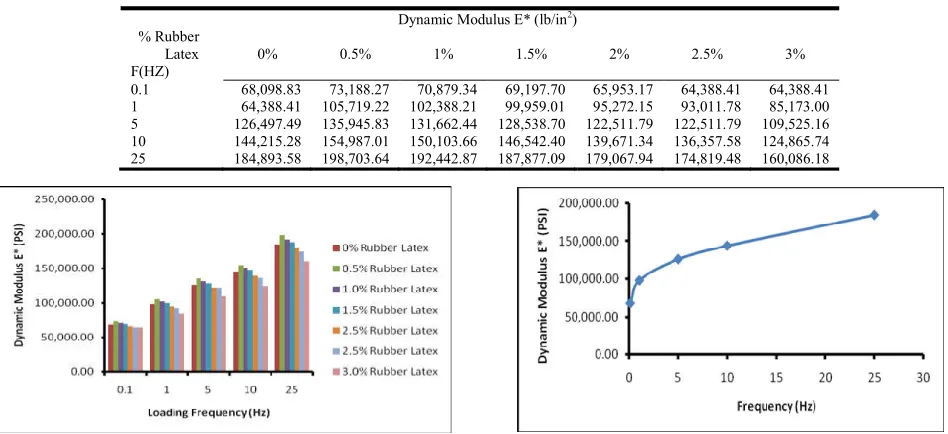
Fig.1: Variation of Dynamic Modulus with Loading Frequency Fig. 2: Variation of Dynamic Modulus with Frequency at 0% Rubber Latex Table 1: Schedule of Aggregates used for mix proportion
Sieve size (mm)
Specification limit
Aggregate A (Sand)
Aggregate B (Gravel)
Mix proportion (0.42A+0.58B)
19.0 100 100 100 100
12.5 86-100 100 97 98
9.5 70-90 100 62 78
6.3 45-70 100 26 57
4.75 40-60 99 10 47
2.36 30-52 96 0 40
1.18 22-40 90 0 38
0.6 16-30 73 0 31
0.3 9-19 23 0 10
0.15 3-7 3 0 1.26
[image:3.612.158.454.218.282.2]0.075 0 0 0 0
Table 2: Laboratory test results of asphalt concrete materials
Material Rubber asphalt Sand Gravel
Specific gravity 0.90 1.36 2.66 2.90
Grade of binder material - 40/50 - -
Mix proportion (%) - - 42 58
Viscosity of binder (poise) - 0.45*(10-6
) - -
Softening point - 48ºC - -
Penetration value - 44mm - -
[image:3.612.131.480.306.378.2]
Table 3: Mix design properties for unmodified asphalt concrete
Asphalt Content (%) Stability (N) Flow (0.25mm) Density (kg/m3
) Air voids (%) VMA (%)
6.0 722 17.4 2410 3.6 19.0
5.5 909 21.6 2420 4.0 18.0
5.0 936 21.2 2440 4.0 17.0
4.5 1979 17.8 2460 4.0 16.0
4.0 1952 17.04 2430 5.8 16.5
3.5 1284 16.4 2380 7.0 17.8
[image:3.612.133.480.404.477.2]3.0 936 13.4 2330 8.3 19.0
Table 4: Mix design properties for rubberized bituminous concrete at 4.72% optimum asphalt content
Rubber Content (%) Stability (N) Flow (0.25mm) Density (kg/m3
) Air voids (%) VMA (%)
0.0 1520 17.6 2450 4.0 16.4
0.5 2326 15.0 2510 2.7 13.8
1.0 2941 13.6 2520 3.1 13.4
1.5 3290 13.4 2530 3.4 13.0
2.0 1551 13.0 2500 4.0 14.0
2.5 1451 12.6 2470 4.3 15.0
[image:3.612.67.541.498.715.2]3.0 321 10.4 2440 5.4 16.0
Table 5: Variation of Dynamic Modulus E* with Rubber Latex (%) at varying frequencies (Hz)
Dynamic Modulus E* (lb/in2
) % Rubber
Latex F(HZ)
0% 0.5% 1% 1.5% 2% 2.5% 3%
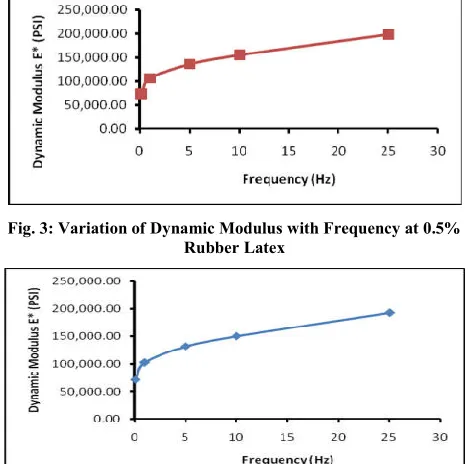
Fig. 3: Variation of Dynamic Modulus with Frequency at 0.5% Rubber Latex
Fig. 4: Variation of Dynamic Modulus with Frequency at 1% Rubber Latex
Fig. 5: Variation of Dynamic Modulus with Frequency at 1.5% Rubber Latex
Fig. 6: Variation of Dynamic Modulus with Frequency at 2% Rubber Latex
Fig. 7: Variation of Dynamic Modulus with Frequency at 2.5% Rubber Latex
Fig. 8: Variation of Dynamic Modulus with Frequency at 3% Rubber Latex
showed that at a loading frequency of 0.1Hz the Dynamic Modulus increased from 68,098.83 PSI at 0% rubber latex content to a maximum of 73,188.27 PSI at 0.5% rubber latex and decreased to 64,388.41 PSI at 3% rubber latex content. The same trend was observed for frequencies of 1Hz, 5Hz, 10Hz and 25Hz with optimum dynamic modulI values of 105,719.22 PSI, 135,945.83 PSI, 154,987.01 PSI, and 198,703.64 PSI respectively at 0.5% rubber latex content. From Figure 2, result indicated that the dynamic modulus of the unmodified asphalt concrete (0% rubber latex) increased as the loading frequency increases; i.e the dynamic modulus increased from 68,098.83 PSI at 0.1Hz to 184,893.58 PSI at 25Hz. Also, from Figures 3 – 8 for the modified asphalt concrete at 0.5%, 1%, 1.5%, 2%, 2.5% and 3% rubber latex content, the dynamic modulus increased from 73,188.27 to 198,703.64 PSI, 70,879.34 to 192,442.87 PSI, 69,197.70 to 187,877.09 PSI, 65953.17 to 179,067.94 PSI, 64,388.41 to 174,819.48 PSI and 64,388.41 to 160,086.18 PSI at loading frequencies of 0.1HZ, 1HZ, 5Hz, 10Hz and 25Hz respectively. This results indicates that the rubber latex-modified asphalt concrete showed similar behaviour as the normal (unmodified) asphalt concrete. In general, the dynamic modulus of rubber latex-modified asphalt concrete increased with increase in loading frequency, however, with an optimum value attained at 0.5% latex content for all loading frequencies.
CONCLUSIONS
From the result of both the unmodified and rubber latex-modified HMA concrete, it is evident that the dynamic modulus of both unmodified and rubber latex-modified asphalt concrete increases with increase in loading frequency. This result is in line with result of previous researches (Robbins, 2009; Yoon et al., 2010) on unmodified asphalt concrete.
From the above result, the following conclusions are made:
1. Dynamic modulus of rubber latex-modified asphalt concrete increases with increase in loading frequency.
2. The effect of loading frequency on dynamic modulus of asphalt concrete is comparable with that of unmodified asphalt concrete.
3. The optimum dynamic modulus of the investigated rubber latex-modified asphalt concrete is obtained at 0.5% rubber latex content.
[image:4.612.61.297.54.286.2] [image:4.612.61.296.289.718.2]REFERENCES
Asphalt Institute 1999. Thickness Design, Asphalt Pavements for Highways and Streets Report’, MS-1.
Bari J, Witczak M.W. 2006. Development of a New Revised Version of the Witczak E* Predictive Model of Hot Mix Asphalt Mixtures, Journal of the Association of Asphalt
Paving Technologist, 75,381–424.
Bonaquist, R.F. 2003. Simple Performance Tester for Super-pave Mix Design, Quarterly Progress Report. NCHRP
Project 9-29. Transportation Research Board of the
National Research Council, Washington, D.C.Bridges. (58)2; 32 – 41.
Christensen D.W, Pellinen T, Bonaquist R.F. 2003. Hirsch Model for Estimating the Modulus of Asphalt Concrete, Journal of the Association of Asphalt Paving
Technologist, 72, 97–121.
Cho Y.H., Park D.W. and Hwang S.D. 2010. A prediction Equation for Dynamic Modulus of Asphalt Mixtures Used in Korea. Journal of Construction and Building Material, Vol. 24, Issue 4 pp. 513-519, Elsevier Ltd.
Collins R.J., Ciesielski, S.K. 1993. Recycling of Waste
Materials and by Products in Highway Construction, (1
& 2); Office of Research and Development, U.S. Federal Highway Administration. Washington, DC.
Decker H.C.J., Nijveld H.A.W. 1951. Influence of Rubber Additions on Some Mechanical Properties of Asphaltic Bitumen, Proc. III World Pet. Congress Section VII),
Leiden, Holland. p496.
Design Guide Draft 2002. Modulus of Elasticity for Major Material Groups, NCHRP Project 1-37A.
Federal Highway Administration 1993. Engineering and Environmental Aspects of Recycled Materials for
Highway Construction’, (1): Final Report FHWA
Contract No. DTFH61-92-COO60, Washington DC. Flynn, L. 1993. Recycled Plastic Finds Home in Asphalt
Binder, Journal of Roads and Bridges. (58)2; 32 – 41.
Guide for Mechanistic-Empirical Design of New and
rehabilitated Pavement Structures 2003. NCHRP 1-37A
Project, Transportation Research Board of the National
academies, Washington, D.C.
Khan A, Mohan M, Raykar V, 1999. Effective Utilization of
Waste Plastics in Maryland, Manual Series No.2.
Lexington.
Mason P.E., Thrower E.N., Smith L.M. 1957. Influence of Rubber on the Brittleness and Viscosity of Bituminous Materials, Journal of Applied. Chemistry’. (7); London, p451.
Mummah S.N., Muktar S. 2001. Improving road pavements with natural rubber, Journal of Engineering Technology
and Industrial Applications, Vol. 1, No. 3, pp. 208-220.
NCHRP 2004. Guide for Rational Design of New and
Rehabilitated Pavement Structures, National Cooperative
Highway Research Programme, Washington D.C.
Othmer K. 1963. Encyclopaedia of Chemical Technology, (2nd ed.) (2), Interscience Publishers, A Division of John Wiley & Sons Inc. New York, pp762 – 765.
Punith V.S. 2001. Effect of plastic modifiers on bituminous mix properties, Seminar Report, II Semester in M.E. Highway Engineering, Department of Civil Engineering, Bangalore University, Bangalore, India.
Roberts F.L., Kandhal P.S, Brown E.R., Lee D.Y., Kennedy T.W. 1996. Hot-Mix Asphalt Materials, Mixture Design, and Construction. National Asphalt Pavement Association
Education Foundation Lanham, MD.
Robbins M.M. 2009. An investigation into dynamic complex modulus of Hot Mix Asphalt an it’s contributing factor, Thesis presented to the Department of Civil Engineering, University of Toledo, USA, MSc Civil Engineering, Directed by David H. Timm.
Rowe G.M., Hakimzadeh S., Blankenship P. 2008. Evaluation of Aspects of E* Test Using HMA Specimens with varying Void Contents’ accessed online.
Tashman L., Elangovan M.A. 2007. Dynamic Modulus Test-Laboratory Investigation and Future Implementation in
the State of Washington”Washington State Department
ofTransportation. Final Report. Final Research Report No. WARD 704.1,
Van Rooijen J.M. 1938. The Effect of Rubber upon some Properties of Asphaltic Bitumen, Rubber Foundation
Communication No. 7, Amsterdam.
Witczak M.W., Pellinen T.K. 2000. AC Mixture Response comparison to Performance |E*| and Sm Prediction Equation Methodology Results. Super-pave Support and Performance Models Management, Task C: Simple
Performance Test. NCHRP Project 9-19, Team Report
SPT-ALF-2(L), Transportation Research Board of the National Research Council.
Witczak M.W., Pellinen T.K, El-Basyouny M.M. 2002. Pursuit of the Simple Performance Test for Asphalt Concrete Fracture/Cracking, Association of Asphalt Paving Technologists (AAPT) Annual Meeting, Colorado Springs, CO.
Witczak M.W. 2005. NCHRP Report 547: Simple Performance Tests: Summary of Recommended Methods and Database, Transportation Research Board of the National Academies, Washington, D.C.
Zoorob S.E. 2000. Laboratory Design and Performance of Improved Bituminous Composites Utilizing Plastics Packaging Waste. Conference on Technology Watch and Innovation in Construction Industry. Building Research Institute, Brussels, Belgium (April, 2000).
Zoorob S.E. and Suparma L.B. 2000. Laboratory Design and Investigation of proportion of bituminous composite containing waste recycled plastics aggregate replacement (Plastiphalt), CIB Symposium on Construction and Environment: Theory into practic Sao Paulo, Brazil. (November, 2000).