Defending Adversarial Attacks on Cloud-aided Automatic
Speech Recognition Systems
Jiajie Zhang
[email protected]Lancaster University
Bingsheng Zhang
[email protected]Lancaster University
Bingcheng Zhang
[email protected]Jinan University
ABSTRACT
With the advancement of deep learning based speech recognition technology, an increasing number of cloud-aided automatic voice as-sistant applications, such as Google Home, Amazon Echo, and cloud AI services, such as IBM Watson, are emerging in our daily life. In a typical usage scenario, after keyword activation, the user’s voice will be recorded and submitted to the cloud for automatic speech recognition (ASR) and then further action(s) might be triggered depending on the user’s command(s). However, recent researches show that the deep learning based systems could be easily attacked by adversarial examples. Subsequently, the ASR systems are found being vulnerable to audio adversarial examples. Unfortunately, very few works about defending audio adversarial attack are known in the literature. Constructing a generic and robust defense mecha-nism to resolve this issue remains an open problem. In this work, we propose several proactive defense mechanisms against targeted audio adversarial examples in the ASR systems via code modula-tion and audio compression. We then show the effectiveness of the proposed strategies through extensive evaluation on natural dataset.
CCS CONCEPTS
•Security and privacy→Security services;Systems security; •
Computing methodologies→Speech recognition.
KEYWORDS
Adversarial Examples; Deep Learning; Cloud-aided Speech Recog-nition
ACM Reference Format:
Jiajie Zhang, Bingsheng Zhang, and Bingcheng Zhang. 2019. Defending Adversarial Attacks on Cloud-aided Automatic Speech Recognition Systems. In7th Int’l Workshop on Security in Cloud Computing (SCC ’19), July 8, 2019, Auckland, New Zealand.ACM, New York, NY, USA, 9 pages. https: //doi.org/10.1145/XXXXXX.XXXXXX
1
INTRODUCTION
Automatic Speech Recognition (ASR) technology aims at convert-ing the phrases or words spoken by human into text. Durconvert-ing the
Permission to make digital or hard copies of all or part of this work for personal or classroom use is granted without fee provided that copies are not made or distributed for profit or commercial advantage and that copies bear this notice and the full citation on the first page. Copyrights for components of this work owned by others than the author(s) must be honored. Abstracting with credit is permitted. To copy otherwise, or republish, to post on servers or to redistribute to lists, requires prior specific permission and/or a fee. Request permissions from [email protected].
SCC ’19, July 8, 2019, Auckland, New Zealand
© 2019 Copyright held by the owner/author(s). Publication rights licensed to ACM. ACM ISBN 978-1-4503-6788-2/19/07. . . $15.00
https://doi.org/10.1145/XXXXXX.XXXXXX
past years, cloud-aided ASR technology has been successfully com-mercialized and gradually moving from the laboratory to our daily life, especially in the areas of smart home. The related applications, such as Apple’s Siri, Google Home, and Amazon Echo, have been adopted to millions of end users. In a typical usage scenario, after keyword activation, the user’s voice will be recorded and submitted to the cloud for speech recognition and then further action(s) might be triggered depending on the user’s command(s).
Meanwhile, an increasing number of cloud AI outsourcing ser-vices are emerging to facilitate computationally limited deser-vices. Backed by Google machine learning techniques and Google Cloud Platform, Google Cloud Speech-to-Text [13] and Dialogflow [15] provide API to developers, and enable real-time audio processing. Another Speech to Text system from Access Watson services on IBM Cloud has been used in various applications, such as customer self-service virtual assistant to speed-up customer response. Moreover, Speechmatics [46] offers cloud-based service for multiple language ASR even in a noisy environment.
In common practice, to solve the problem of the cumbersome multistep exercise including hand-engineered processing when building ASR systems,end-to-endlearning is adopted to simplify the sophisticated pipelines and supersede these processing stages by using deep learning technologies [1, 43]. However, recent re-searches show that these deep learning-driven systems are vul-nerable to adversarial attacks [49]. In those attacks, the attackers maliciously inject tailor-made small perturbations into the source data, which cannot be detected by human recognition, while they are able to compromise the integrity of the decisions made by the deep learning systems or algorithms.
In the literature, the concerns of adversarial examples have been raised not only in a broad range of image processing tasks, such as image classification [4, 20, 28, 38, 48], semantic segmentation [3, 19], human pose estimation [11], and object detection [52], but also in reinforcement learning agent [5]. Moreover, adversarial attacks are also emerged in the audio processing domain recently [2, 10, 12]. More specifically, the malicious attackers can construct targeted and/or untargeted audio adversarial examples to launch adversarial attacks against ASR systems, which draws a widely public attention to the security problems caused by these types of attacks.
noise in the input data. A classical evasion attack [18, 38] is that the attacker alters theSTOPsign, which is still aSTOPsign from human perceptional perspective, but recognised as aSPEEDsign by the recognition system of autonomous vehicle, this may lead to serious traffic accidents and even life-threatening matters. Another kind is data poisoning attacks which mainly happen during the training phase, since it’s obvious that the real world interacted with the deep learning algorithms is continuously changing, the applications based on deep learning algorithms should be never-ending learning and continual [35] or life-long learning [29, 45]. The attackers can take advantages of this situation by injecting wrong data in the training data to make the algorithms do error modeling. As an example, Tay bot developed by Microsoft learned from the people during interaction and made offensive or racist statements [40].
Most known defense strategies against adversarial examples mainly focus on image processing, however, those types of strate-gies cannot be directly applied to audio processing. The main dif-ference between audio and image processing is rate of statistical redundancies. Audio data shows much more repetitions than im-ages, which makes techniques non-portable from one context to another. As a practical example, consider a 16-bit coded WAC au-dio for example, the range of the sample values is [−32768,32767]. Comparing with the pixel value range of the image [0,255], the former one is 256 times wider than the latter one, which signifi-cantly increases the difficulty of detecting the adversarial attacks. Unfortunately, with regard to the defense strategies against au-dio adversarial examples in cloud-aided ASR systems, very few progress has been made. We here ask the following challenging question:
Is it possible to introduce a proactive defense mechanism that can be integrated with the off-the-shelf cloud-aided ASR systems to protect them from being abused by the potential audio adver-sarial examples?
We very much expect an affirmative answer because we need to ensure that the robustness of those cloud-aided ASR systems to enable their wide adoption in security critical applications.
Our contributions.In this work, we, for the very first time, study the proactive defense strategies for the cloud-aided ASR systems against audio adversarial examples. The defense strategy is indepen-dent of the protected cloud-aided ASR systems, which means that our proposed defense mechanism can be readily deployed to protect extensive off-the-shelf audio processing systems. Furthermore, the structure of the protected cloud-aided ASR systems needn’t to be modified. We summarize our main contributions as follows:
•We initiate the study of proactive defense strategy to mitigate the risk of adversarial examples in cloud-aided ASR systems. In particular, we propose the world’s first proactive defense mechanism to protect existing cloud-aided ASR systems from adversarial attacks. The proposed protection mechanism can be deployed on existing systems and run as an online watchdog to detect and defend with little computational overhead.
•This work also studies and formulates the properties of au-dio adversarial examples and security model of a defense
strategy, enabling us to directly measure the effectiveness and efficiency of the defense approaches.
• With evaluated by a natural dataset, the effectiveness of our proposed defense approach is measured by the recogni-tion time, the edit distance of the transcribed text and the difference of the processing audio. To the best of our knowl-edge, this is the first study aiming at mitigating the effects of adversarial attacks on cloud-aided ASR systems.
Organisation.The rest of this article is organized as follows. Prob-lem statement of audio adversarial examples, security model, and adversarial attack are presented in Section 2. Next, the proposed active transformation defense approach is described in Section 3, followed by the experimental analysis based on a real-world radio dataset. In Section 5, we review the related work about generating and defending adversarial examples. Finally, we draw our conclu-sion and discuss future research directions.
2
PROBLEM STATEMENT
2.1
Audio Adversarial Examples
Before giving the definitions about generating audio adversarial examples against ASR systems as described in [10], we will make a succinct introduction of the recognition process of the ASR systems [23], which helps the readers understand the attack process and our defense strategy. ConsideringRis the set of all the audio samples
in the input domain space,X is a single frame of the input audio inR,Yis the range of the recognition results, such as the a to z
characters, the space and the specialϵof the output domainO. A
normal neural network in ASR systems is to return a probability distribution overO, based on the input sequences, which can be
insulted as a functionf : R →[0,1]|Y|. Relatively, f(·)means
a probability distribution over the characters of every frame. To get the probability distribution of all the phrases, Connectionist temporal classification (CTC) [21] is applied to train the ASR sys-tems without knowing the alignment between the input and output sequences, by minimizing the CTC loss:
CTC-Loss(f(x),p)=−log Pr[p|f(x)]
where Pr(p|f(x))stands for the probability of a given phrasepover the distributiony=f(x).
In terms of the attacking procedure, following the work in [10], targeted adversarial examples are considered in this article. Firstly, we defineN=x|x ∈R, in this definition,xoccurs naturally with
regard to the ASR systems. We limit the scope ofxto study the manifold of the input domain, as stated in [26]. Considering the space ofRis much larger thanN, we can formalizeR→N∪ ⊥,
where⊥represents that the input ofxis unlikely to be judged from the data generation process ofR. The manifold of input space is
one of the issues that needs clarifying, the challenge is to determine whether there are differences between the natural audio examples and the audio adversarial examples. Additionally, we follow Carlini and Wagner’s work, choosing the Mozilla Common Voice dataset as the natural dataset for audio recognition.
(1) The perturbation ofx′andxshould be imperceptible to hu-man, which can be quantified using the distortion in Decibels (dB), as the opposite idea against the pointless adversarial fooling examples in [6, 37].
(2) x′must be assigned by the neural network with a specific label chosen by the adversary, not the type of untargeted adversarial examples. As stated in [10], the untargeted audio adversarial examples are not usually so interesting and do little help to the adversary.
(3) x′should follow these two constraints:f(x′),f(x)andx ∈ R\N,f(x′),f(x), which point out that when ASR systems
make a wrong decision given a nature input sample, this source of error is not considered as the so called adversarial example, since no system is perfect. If this is the case, then the attacker needs to find out all the natural examples which can lead to system error through brute force search. That will be a very time-consuming and laborious collection task, which requires the annotation of all natural samples by human. Therefore, we have introduced the constrain off(x′),f(x)
to limit the countermeasures causing errors. Only artificial modifications can be used to deceive the system rather than a natural sample.
2.2
Security Model
We assume that the attacker knows everything of the ASR systems that he wishes to attack, which can be called white box attack. The knowledge of the attacker contains the model structure, parameters, and the training procedure, excluding the defense approachdf. In this type of attack, the attackers are allowed to have the maximum power, which is considered as the most taken situation in prior works [20, 25, 38]. The adversary transcripts the given audio wave-formxtox′, by constructingx′=x+σ, additionally,x′sounds similar toxbutf(x′)=y.
What’s more, the defense strategy in our secure system knows nothing about how the adversary generates the audio adversarial examples. More specifically, we give a system security definition as follows: A defense strategy against the adversarial attack is to construct a filter which destructs the robustness of audio adversar-ial examples. We define the original radio waveform is a random variablecwith probability distribution ofPc, the attacking process is a function defined overc, andPastands for the probability distri-bution of all perturbations produced during the attack. Besides, we formalize the defense process asPa→Pf, by generating the prob-ability distributionPf of all the adversarial examples after defense reconstructing. This defense strategy is to make the reconstruc-tion probability distribureconstruc-tionPf similar to the original probability distributionPc.
2.3
Adversarial Attack
In this section, we briefly introduce the adversarial attack presented in [10]. At first, the attacking process is to solve the formulation:
minimize dBx(δ)
[image:3.612.320.561.89.165.2]subject to f(x+δ)=t x+δ∈[−M,M]
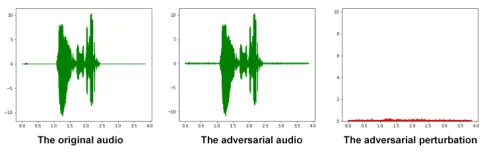
Figure 1: Adversarial audio examples and corresponding perturbation.
whereMis the maximum representable value (215used in this article). By clipping the value ofδ, the constraint can be handled. To solve non-linearity difficulty off(x+δ)=t, the non-trivial loss function constructing, and thel∞ distortion metric, the authors applied the trick ofC&Wattack, and initially solve the formulation:
minimize |δ|22+c·l(x+δ,t) subject to dBx(δ)≤τ
x+δ∈[−M,M]
wherecis a hyperparameter that balances the length and deceiving effect, the boundδis defined to have distortion at mostτ, andτis initialized to some sufficiently large constant.
The loss function is the CTC loss:
l(x+δ,t)=CTC-Loss(x+δ,t)
By reducingτand resuming minimization until no solutionδ∗ can be found, the optimization results with the minimum distortion are returned, with satisfying the box constraints to be a valid audio. Normally, for a fixed audio waveformx, the adversarial attack is to find the minimum perturbationδthat is small enough in length and can deceive the ASR systems at the same time.
3
COUNTERMEASURE DESIGN
The adversarial attacks may change the specific statistics of the in-put audio waveform to fool the ASR systems, in fact, the adversarial perturbation has a specific structure, as shown in Fig.1.
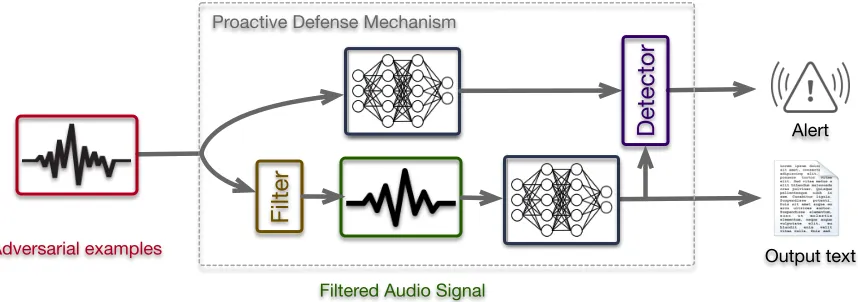
We design a proactive defense mechanism to recover the struc-ture of the original input and remove the perturbations, then in-vestigate whether these changes can eliminate the impact of the adversarial attacks. As shown in Fig.2, we construct a filter and a detector. The audio, as an input will be processed by two compo-nents simultaneously. The first one is the ASR system, the output recognition result will be sent to the detector. The second part is the filter that will process the audio firstly and send the audio to ASR system. After that, the detector gets two types of recognition results, it will calculate the difference between these two recog-nition results. Once the difference is larger than the predefined threshold, the detector will alarm and classify the input audio as an adversarial example. If the difference is below the threshold, the input sample will be marked as a clean one, then the output text recognised by ASR systems will be sent to the user.
Proactive Defense Mechanism
Filter
Adversarial examples
Filtered Audio Signal
Output text
[image:4.612.95.524.89.240.2]Detector
AlertFigure 2: The proposed proactive defense mechanism.
the user of the defense system, filter is activated to mitigate the adversarial attack. After filtering the adversarial audios, they are directly recognised by the server-aided ASR system. In terms of filter, we propose two categories of transformation technologies as a pre-processing step before running the server-aided ASR system: (i). Code Modulation, (ii). Audio Compression.
3.1
Code Modulation
Code Modulation is divided into two parts in our work. Firstly, we remove the heading of the input radio waveform, and apply the G.729 [42] narrow-band vocoder-based audio data compres-sion algorithm to compress the processed radio into bits. Secondly, pulse-code modulation (PCM) [16] is used to reconstruct the au-dio waveform based on the bits with adding the aforementioned heading.
G.729 is an audio coding algorithm defined by ITU Telecom-munication Standardization Sector (ITU-T), with a frame length of 10 milliseconds and 25 ms point-to-point delay. G.729 is based on the Code-Excited Linear Prediction (CELP) mode and applies CS-ACELP (Conjugate-Structure Algebraic Code Excited Linear Prediction) to encode the audio at a baud rate of 8 Kbps, which is almost always used for Voice over IP (VoIP) with low bandwidth requirements.
PCM is a method for digitally representing sampled analog sig-nals. It is a standard form of digital audio in computers, compact discs, digital phones, and other digital audio applications. In the PCM stream, the amplitude of the analog signal is sampled at regu-lar intervals. Each sample is quantized to the nearest value within the digital step range, and expresses a good reproduction of the perceptual quality of the original uncompressed audio. On this ac-count, the amount of data required to represent the audio signal recorded as PCM is tremendously reduced.
3.2
Audio Compression
To provide resilience to attack in the study of image adversarial examples, the authors in [14, 17, 22] explored systematic JPEG compression as a pre-processing step. Their method significantly
reduces adversarial perturbation. For the reason that adversarial at-tacks are deployed by introducing adversarial perturbations which are beyond human psychovisual awareness, we apply audio com-pression as one of the active transformation approaches to remove the artifacts in the adversarial examples.
As for audio compression, MP3 has been one of the most popular and trusted audio compression standards. A core principle behind MP3 compression is the lossy data compression, which encodes data using inaccurate approximations and partially discarded data. This type of technology can greatly reduce the file size compared to uncompressed audio. MP3 compression records the residual audio information in a space-saving manner by reducing (or approaching) the accuracy of certain sound components considered to exceed the hearing capabilities of human. This approach is commonly referred to as perceptual coding or psychoacoustic modeling, which reduces the storage space without perceptible difference.
4
IMPLEMENTATION AND EVALUATION
In this section, we perform four experiments to evaluate the ef-ficiency and the properties of the active transformation defense strategy described in Section 3, against the audio adversarial at-tacks stated in [10] with a natural dataset: the Common Voice [36]. As described in our security model, the adversary is considered to access the model architecture of the ASR systems and parameters, but unknown to the specific defense strategy.
4.1
Experimental Setup
Table 1: The precision measurements of proposed defense approach in different thresholds setting.
Defense Approach Threshold FNR FPR
Code Modulation 0.4375 0.0462 0.0002
MP3 Compression 64Kb/s 0.3556 0.1069 0.0002
MP3 Compression 96Kb/s 0.4219 0.0494 0.0002
MP3 Compression 128Kb/s 0.4219 0.0509 0.0002
(the recognition results of generated audio adversarial examples) is fixed with 64 bytes during the whole experiment, and finally we get 4070 adversarial radio waveforms (discard 6 failed audio adversarial examples).
According to the aforementioned security model defined in Sec-tion 3, the security definiSec-tion of the protected system is related to the reconstruction probability distributionPf and the original probability distributionPc, we measure the correlation in terms of Minkowski Distance, Signal-Noise Ratio (SNR), and edit distance. The Minkowski distance is a metric in the norm vector space which generalizes a wide range of distances such as the Hamming distance, the Euclidean distance, the geometric distance, and the normalized harmonic distance. To measure the Minkowski distance of dimensionn, we construct a mappingdm:Rn×Rn7→R, such
that:
dm(A,B)=*
, 1
n
n
X
i=1
|ai−bi|λ+
-1/λ
(1)
whereai andbi are theith elements of the setsAandB,λis a variable parameter such thatλ∈(−∞,+∞). In particular, ifλ=1, the Minkowski distance is precisely the Hamming distance;λ=2 stands for the Euclidean distance; whenλ→ ∞, the Minkowski distance can be considered as Chebyshev distance. We mainly con-sider the Chebyshev distance measurement in our experiment to evaluate the distance among the original audios, the adversarial audios and the transformed audios after filtrating relatively.
SNR is often used in science and engineering to compare the level of desired signal and the background noise, which stands for the ratio of signal power to noise power. Normally, when the ratio is greater than 1:1 (or higher than 0 dB), it means that there are more signals than noise. In our work, we use the difference between two audios to verify the performance of proposed machnism. SNR is defined as:
SNR(dB)=10 log10 Psignal
Padv
!
=10 log10*.
,
A2
signal
A2
adv
+ /
-(2)
wherePsiдnalis the power of signal,Padvis the power of adver-sarial perturbation,Asiдnalis the amplitude of signal, andAadvis the amplitude of adversarial perturbation.
In the standard approach to ASR systems, given the acoustic informationA, the optimization goal is to find the sentence hy-pothesis that maximizes the posterior probabilityP(W|A)of the word sequenceW. However, the general difficulty of measuring performance is that the recognized word sequence may be of differ-ent length than the reference word sequence (presumably correct). For this reason, the distance metrics like Euclidean distance are no longer applicable to quantify the mutual relationship of two
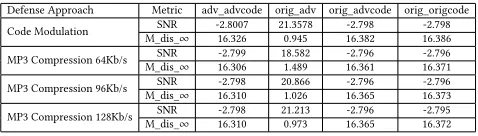
Table 2: SNR and Chebyshev distance evaluation.
Defense Approach Metric adv_advcode orig_adv orig_advcode orig_origcode
Code Modulation SNR -2.8007 21.3578 -2.798 -2.798 M_dis_∞ 16.326 0.945 16.382 16.386
MP3 Compression 64Kb/s SNR -2.799 18.582 -2.796 -2.796 M_dis_∞ 16.306 1.489 16.361 16.371
MP3 Compression 96Kb/s SNR -2.798 20.866 -2.796 -2.796 M_dis_∞ 16.310 1.026 16.365 16.373
MP3 Compression 128Kb/s SNR -2.798 21.213 -2.796 -2.795 M_dis_∞ 16.310 0.973 16.365 16.372
word sequences. The commonly used performance metric in ASR systems is edit distancesW E(W,R)between a hypothesisW and the reference stringR.W E(W,R)is defined as the number of sub-stitutions, deletions, and insertions relative toRin the alignment of two strings, which minimizes the weighted combination of these types of errors. In this article, to more fully measure our defensive performance, we choose Levenshtein distance and the Word error rate (WER) which is derived from the Levenshtein distance as the measurements.
4.2
Overall Performance
In this section, we mainly evaluate the proposed defense approach and explore the properties of audio adversarial examples against ASR systems. To be specific, the performance is evaluated by two metrics: (1) the difference between the original audio waveform, the adversarial audio waveform, and the audio waveform after defense. (2) the efficiency of the proposed mechanism. We compare the two proposed approaches, code modulation and MP3 compression, and calculate the average results for all the audio sampls. For MP3 com-pression, we set three different compression rates, namely 64Kb/s, 96Kb/s, and 128Kb/s.
Our proposed defense mechanism adopts thresholding to detect the adversarial attack. It counts an audio as an adversarial example if the difference between the original recognition result and the result after filtering is above a threshold, and vice versa. Fig.5 shows the performance of the proposed detection mechanism in terms of ROC curve. To maximise the detection efficiency, we predefine a threshold for each defense approach, and calculate the related False Negative Rate (FNR) and False Positive Rate (FPR), the related precision measurements results are shown in Table.1.
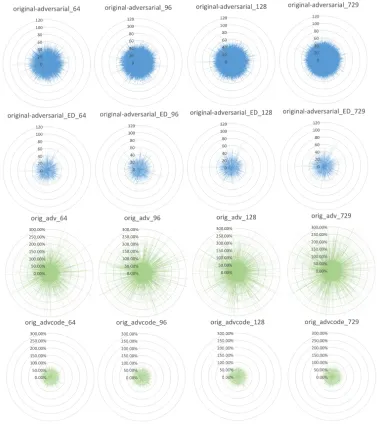
Figure 3: The edit distance of the recognition sentences for attacking and defense. The first three columns are MP3 compres-sion, the number behind (64, 96, and 128) is the compression ratio, and the last column is the code modulation.
The Chebyshev distance shows interesting properties of audio adversarial examples in Table.2. In these four defense approaches, the distances in group orig_adv are the smallest comparing with other groups. Considering about the reason, in the adversarial at-tacks against ASR systems, the goal of the adversary is to construct the most similar but fooled examples to mislead the system, as defined in Section 2. Therefore, the defense aims at increasing this difference, while being clipped to the normal scope, according the values in the normal reference groups, which can be proved by the distances for orig_advcode group.
As for the SNR evaluation, the group of orig_adv shows the high-est values, which means that the noise in the adversarial examples is still obvious; whereas, after being processed by the defense ap-proaches, the differences of SNR values between the original audio
and the adversarial audio are much smaller and even closed to the nonmoral reference groups.
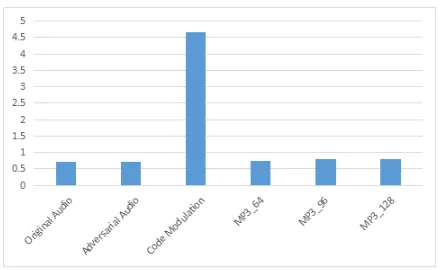
Figure 4: The defense effectiveness evaluated with the recog-nition time and processing-recogrecog-nition time (for defense).
The first line with blue circles shows the difference between the original audio waveform and the adversarial audio, and the second line is the difference between the original audio waveform and the adversarial audio after defense, both measured by the Levenshtein distance. WER edit distance is evaluated in the third and fourth line with the green circles, the former one is the original audio waveform and the adversarial audio, and the latter one is the original audio waveform and the adversarial audio after defense. For both edit distance metrics, the smaller sizes of the circles reflect that our defense approach is much more efficient.
As mentioned before, defense effectiveness is also important when discussing the security problems especially in commercial use. Taking an example of security checking in the airport, the setting of the checkpoint is to increase the security of the airport, but it cannot cause pressure on the normal passage for passengers when guaranteeing the safety of the passenger. Consistent with this situation, we compare the recognition processing time for four types, original audio waveform, adversarial audio waveform and the whole defense and recognition time, the results are shown in Fig.4. We calculate the average time for processing the whole 4070 audio waveforms. The results show that to some extent, the consuming time for defense including the transmitting and recognition just a little longer than recognising the original and adversarial examples, this is reasonable and can be acceptable.
5
RELATED WORK
In the context of two intriguing properties of neural networks, a for-mal definition of “adversarial examples” was proposed by Szegedy et al. [49]. This was caused by the fact that the input and output mapping of the deep neural work was largely incoherent, the mali-cious users can make the network incorrectly classify the images by applying some sort of subtle perturbation to maximize the pre-diction error of the network.
Nonetheless, the work of Goodfellow et al. [20] made a state-ment that the disturbance of neural networks was caused by their linear characteristics instead of their nonlinearity and overfitting. Furthermore, they proposed a method named fast gradient sign method (FGSM) for finding similar adversarial examplesx∗in the
L∞neighborhood of the original samplex, with the optimization
[image:7.612.332.534.87.249.2]strategy of performing one step gradient update fromxin the input
Figure 5: Adversarial attack detection. False Positive Rate is the probability of adversarial audios that are identified as clean audio samples. True Positive Rate measures the per-centage of clean audio samples which are correctly identi-fied.
space with a volumeϵ. However, this kind of attack was designed to be fast but not to minimize the adversarial perturbations, which shifted all the elements of the input and made easier to be detected by the recently proposed defense approach defense distillation [39], since FGSM may fail to generate successful attacks while other iterative optimization based methods could succeed.
To make the adversarial examples more robust, Carlini and Wag-ner presented a powerful attack against defensive distillation [9], also known as theC&Wattack, which generated adversarial exam-ples with smaller perturbations for both targeted and untargeted attacks for three metrics includingL0,L2 andL∞, and showed more efficient than other published attacks. Naturally, it became the benchmark and considered as an ideal evaluation method for potential defenses. This is exactly the attack mechanism we defend in this article in the audio field.
Just as mentioned before, generating adversarial examples be-comes an critical step to evaluate and improve the robustness of machine learning technologies when dealing with the hard per-ceptual problems. Over the past two years, many researches have been conducted on the theoretics, application scenarios and defense mechanisms of adversarial examples, an interesting Grundy’s game competition situation is presented.
adversarial examples, evaluated on the DenseNet40, InceptionV3 and ResNet50 for MNIST, CIFAR10 and ImageNet.
As the representative work of studying adversarial examples in generative models, Fischer, and Song [27] appliedC&Wattack as the optimization method to generate adversarial examples. They generated adversarial examples for both targeted and untargeted attack against variational autoencoders (VAEs) and VAEs composed with a generative adversarial network (VAE-GANs). In their work, they indirectly manipulated the latent representation and gener-ated a targeted adversarial reconstruction of the input and directly optimized against differences in source and target.
The work in [31] explored the transferability of both targeted and untargeted adversarial examples based onC&W attack and other attacks, which showed that the adversarial examples generated to evade some model could mislead other models trained for the same work.
To defend neural network classifers against adversarial examples, Meng and Chen [34] pointed that adding affiliated classifiers can help the protected model classify the normal examples and adver-sarial examples. In their work, they constructed separate detector networks and a reformer network to learn to differentiate between normal and adversarial examples by approximating the manifold of normal examples. Finally moved adversarial examples towards the manifold of normal examples, which seemed effective for correctly classifying adversarial examples with small perturbation. Lately, Carlini and Wagner [8] stated that the MagNet and the work in [53] were not robust to adversarial examples, and they could construct adversarial examples that defeat these defenses with only a slight increase in distortion based on theC&Wattack.
Ensemble adversarial training presented in [50] incorporated the disturbed inputs which were transferred from other pre-trained models, exhibit increased robustness to the transferring adversarial examples generated by various single-step and multi-step attacks includingC&W attack. However, this kind of defense requires a large amount of adversarial examples to model the defense training. Moreover, the adversarial training strategy is specific to certain adversarial examples generating approaches. Considering about the numerous defense approaches, it’s normal to wonder whether a strong defense can be created by combining multiple (possibly weak) defenses. However, the work in [24] implied that ensemble of weak defenses is not sufficient to provide strong defense against adversarial examples. As announced in [10, 47], there are still a number of open research challenges in the research of adversarial examples, including the formation mechanism and especially the effective defense.
The aforementioned adversarial examples show us the facts that even the simplest machine learning algorithms, including super-vised learning, unsupersuper-vised learning and reinforcement learn-ing, can all be attacked and perform unexpected way contrary to the original intention of the designer. Despite the aforemen-tioned generating approaches of adversarial examples in image processing domain. Considering about the huge development and wide applications of audio processing systems, such as the Google Home and Amazon Alexa, recently, Carlini and Wagner [10] con-structed the audio adversarial examples on Speech-to-Text systems. They applied white-box iterative optimization-basedC&W attack to Mozilla’s implementation DeepSpeech end-to-end. They turned
any audio waveform into any target adversarial transcription with a 100% success rate, which showed a new domain to explore the intriguing properties of neural networks. In this article, we mainly focus on the defense strategies against the attack in [10].
To the best of the authors’ knowledge, all the existing defense approaches against adversarial examples mainly focus on the image processing domain, there are few works about defending the audio adversarial examples. Considering about the natural differences between images and audios, especially the statistical redundancy mentioned before, the defense strategies can’t be directly applied to deal with the audio adversarial examples. To address this problem, in this article, as the first attempt to mitigate the audio adversarial examples, we propose a new defense strategy for protecting Speech-to-Text systems against adversarial examples.
6
CONCLUSION AND FUTURE WORK
This article explored the properties of adversarial audio examples against Cloud-aided ASR systems, and showed that primitive sig-nal processing transformations may have the potential to defend the adversarial perturbations. Furthermore, we proposed a uni-versal defense against speech recognition systems, including code modulation and audio compression. Code modulation combines the G.729 narrow-band vocoder-based audio data compression al-gorithm and PCM to transform and convert the audio waveform. Audio compression reduces the residual audio information exceed to human hearing by using MP3 compression. The experimental results showed that our proposed defense approach achieved high performance in terms of the difference between the audio, and the difference between the transformation sequences and the efficiency, based on the metrics of Minkowski distance, SNR, edit distance, and processing time.
The proposed mechanism will inspire more work in defending adversarial attack in audio domain. Furthermore, considering the transferability of adversarial examples in images, the defense strat-egy should be noticed to deal with the transferability in audio. Additionally, studying the possible behaviors by the attackers and extending the proposed approach to effectively resist the attacks is very crucial, such as gray-box attack and black-box attack depend-ing on the adversary’s knowledge about the defense approaches.
REFERENCES
[1] 2012. Deep Neural Networks for Acoustic Modeling in Speech Recognition: The Shared Views of Four Research Groups.IEEE Signal Process. Mag.29, 6 (2012), 82–97. https://doi.org/10.1109/MSP.2012.2205597
[2] Moustafa Alzantot, Bharathan Balaji, and Mani B. Srivastava. 2018. Did you hear that? Adversarial Examples Against Automatic Speech Recognition.CoRR
abs/1801.00554 (2018).
[3] Anurag Arnab, Ondrej Miksik, and Philip H. S. Torr. 2017. On the Robustness of Semantic Segmentation Models to Adversarial Attacks.CoRRabs/1711.09856 (2017).
[4] Anish Athalye, Logan Engstrom, Andrew Ilyas, and Kevin Kwok. 2017. Synthe-sizing Robust Adversarial Examples.CoRRabs/1707.07397 (2017).
[5] Vahid Behzadan and Arslan Munir. 2017. Vulnerability of Deep Reinforcement Learning to Policy Induction Attacks. InMachine Learning and Data Mining in Pattern Recognition - 13th International Conference, MLDM 2017, New York, NY, USA, July 15-20, 2017, Proceedings. 262–275.
[6] Nicholas Carlini, Pratyush Mishra, Tavish Vaidya, Yuankai Zhang, Micah Sherr, Clay Shields, David A. Wagner, and Wenchao Zhou. 2016. Hidden Voice Com-mands. In25th USENIX Security Symposium, USENIX Security 16, Austin, TX, USA, August 10-12, 2016.513–530.
ACM Workshop on Artificial Intelligence and Security, AISec@CCS 2017, Dallas, TX, USA, November 3, 2017. 3–14.
[8] Nicholas Carlini and David A. Wagner. 2017. MagNet and "Efficient Defenses Against Adversarial Attacks" are Not Robust to Adversarial Examples. CoRR
abs/1711.08478 (2017).
[9] Nicholas Carlini and David A. Wagner. 2017. Towards Evaluating the Robustness of Neural Networks. In2017 IEEE Symposium on Security and Privacy, SP 2017, San Jose, CA, USA, May 22-26, 2017. 39–57.
[10] Nicholas Carlini and David A. Wagner. 2018. Audio Adversarial Examples: Targeted Attacks on Speech-to-Text. In2018 IEEE Security and Privacy Workshops, SP Workshops 2018, San Francisco, CA, USA, May 24, 2018. 1–7. https://doi.org/10. 1109/SPW.2018.00009
[11] Moustapha Cissé, Yossi Adi, Natalia Neverova, and Joseph Keshet. 2017. Houdini: Fooling Deep Structured Prediction Models.CoRRabs/1707.05373 (2017). [12] Moustapha Cissé, Yossi Adi, Natalia Neverova, and Joseph Keshet. 2017. Houdini:
Fooling Deep Structured Visual and Speech Recognition Models with Adversar-ial Examples. InAdvances in Neural Information Processing Systems 30: Annual Conference on Neural Information Processing Systems 2017, 4-9 December 2017, Long Beach, CA, USA. 6980–6990.
[13] Google Cloud. [n.d.]. Google Cloud Speech-to-Text. https://cloud.google.com/ speech-to-text/. Accessed March 3, 2019.
[14] Nilaksh Das, Madhuri Shanbhogue, Shang-Tse Chen, Fred Hohman, Li Chen, Michael E. Kounavis, and Duen Horng Chau. 2017. Keeping the Bad Guys Out: Protecting and Vaccinating Deep Learning with JPEG Compression.CoRR
abs/1705.02900 (2017).
[15] Dialogflow. [n.d.]. Dialogflow. https://dialogflow.com/. Accessed March 3, 2019. [16] R. Donaldson and D. Chan. 2003. Analysis and Subjective Evaluation of Differen-tial Pulse-Code Modulation Voice Communication Systems.IEEE Transactions on Communication Technology17, 1 (2003), 10–19.
[17] Gintare Karolina Dziugaite, Zoubin Ghahramani, and Daniel M. Roy. 2016. A study of the effect of JPG compression on adversarial images.CoRRabs/1608.00853 (2016).
[18] Ivan Evtimov, Kevin Eykholt, Earlence Fernandes, Tadayoshi Kohno, Bo Li, Atul Prakash, Amir Rahmati, and Dawn Song. 2017. Robust Physical-World Attacks on Deep Learning Models.arXiv preprint arXiv:1707.089451 (2017).
[19] Volker Fischer, Mummadi Chaithanya Kumar, Jan Hendrik Metzen, and Thomas Brox. 2017. Adversarial Examples for Semantic Image Segmentation. CoRR
abs/1703.01101 (2017).
[20] Ian J. Goodfellow, Jonathon Shlens, and Christian Szegedy. 2014. Explaining and Harnessing Adversarial Examples.CoRRabs/1412.6572 (2014).
[21] Alex Graves, Santiago Fernández, Faustino J. Gomez, and Jürgen Schmidhuber. 2006. Connectionist temporal classification: labelling unsegmented sequence data with recurrent neural networks. InMachine Learning, Proceedings of the Twenty-Third International Conference (ICML 2006), Pittsburgh, Pennsylvania, USA, June 25-29, 2006. 369–376.
[22] Chuan Guo, Mayank Rana, Moustapha Cissé, and Laurens van der Maaten. 2017. Countering Adversarial Images using Input Transformations. CoRR
abs/1711.00117 (2017).
[23] Awni Hannun. 2017. Sequence Modeling with CTC.Distill2, 11 (2017), e8. [24] Warren He, James Wei, Xinyun Chen, Nicholas Carlini, and Dawn Song. 2017.
Adversarial Example Defense: Ensembles of Weak Defenses are not Strong. In
11th USENIX Workshop on Offensive Technologies, WOOT 2017, Vancouver, BC, Canada, August 14-15, 2017.
[25] Andrew Ilyas, Logan Engstrom, Anish Athalye, and Jessy Lin. 2017. Query-Efficient Black-box Adversarial Examples.CoRRabs/1712.07113 (2017). [26] Robin Jia and Percy Liang. 2017. Adversarial Examples for Evaluating Reading
Comprehension Systems. InProceedings of the 2017 Conference on Empirical Methods in Natural Language Processing, EMNLP 2017, Copenhagen, Denmark, September 9-11, 2017. 2021–2031.
[27] Jernej Kos, Ian Fischer, and Dawn Song. 2017. Adversarial examples for generative models.CoRRabs/1702.06832 (2017).
[28] Alexey Kurakin, Ian J. Goodfellow, and Samy Bengio. 2016. Adversarial examples in the physical world.CoRRabs/1607.02533 (2016).
[29] Zhizhong Li and Derek Hoiem. 2016. Learning Without Forgetting. InComputer Vision - ECCV 2016 - 14th European Conference, Amsterdam, The Netherlands, October 11-14, 2016, Proceedings, Part IV. 614–629.
[30] Yen-Chen Lin, Ming-Yu Liu, Min Sun, and Jia-Bin Huang. 2017. Detecting Adversarial Attacks on Neural Network Policies with Visual Foresight.CoRR
abs/1710.00814 (2017).
[31] Yanpei Liu, Xinyun Chen, Chang Liu, and Dawn Song. 2016. Delving into Transferable Adversarial Examples and Black-box Attacks.CoRRabs/1611.02770 (2016).
[32] Shike Mei and Xiaojin Zhu. 2015. The Security of Latent Dirichlet Allocation. InProceedings of the Eighteenth International Conference on Artificial Intelligence and Statistics, AISTATS 2015, San Diego, California, USA, May 9-12, 2015. [33] Shike Mei and Xiaojin Zhu. 2015. Using Machine Teaching to Identify Optimal
Training-Set Attacks on Machine Learners. InProceedings of the Twenty-Ninth AAAI Conference on Artificial Intelligence, January 25-30, 2015, Austin, Texas, USA.
2871–2877.
[34] Dongyu Meng and Hao Chen. 2017. MagNet: A Two-Pronged Defense against Adversarial Examples. InProceedings of the 2017 ACM SIGSAC Conference on Computer and Communications Security, CCS 2017, Dallas, TX, USA, October 30 -November 03, 2017. 135–147.
[35] Tom M. Mitchell, William W. Cohen, Estevam R. Hruschka Jr., Partha Pratim Talukdar, Justin Betteridge, Andrew Carlson, Bhavana Dalvi Mishra, Matthew Gardner, Bryan Kisiel, Jayant Krishnamurthy, Ni Lao, Kathryn Mazaitis, Thahir Mohamed, Ndapandula Nakashole, Emmanouil Antonios Platanios, Alan Ritter, Mehdi Samadi, Burr Settles, Richard C. Wang, Derry Tanti Wijaya, Abhinav Gupta, Xinlei Chen, Abulhair Saparov, Malcolm Greaves, and Joel Welling. 2015. Never-Ending Learning. InProceedings of the Twenty-Ninth AAAI Conference on Artificial Intelligence, January 25-30, 2015, Austin, Texas, USA.2302–2310. [36] Mozilla. [n.d.]. Project deepspeech. https://github.com/mozilla/DeepSpeech.
2017.
[37] Anh Mai Nguyen, Jason Yosinski, and Jeff Clune. 2015. Deep neural networks are easily fooled: High confidence predictions for unrecognizable images. InIEEE Conference on Computer Vision and Pattern Recognition, CVPR 2015, Boston, MA, USA, June 7-12, 2015. 427–436.
[38] Nicolas Papernot, Patrick D. McDaniel, Ian J. Goodfellow, Somesh Jha, Z. Berkay Celik, and Ananthram Swami. 2016. Practical Black-Box Attacks against Deep Learning Systems using Adversarial Examples.CoRRabs/1602.02697 (2016). [39] Nicolas Papernot, Patrick D. McDaniel, Xi Wu, Somesh Jha, and Ananthram
Swami. 2016. Distillation as a Defense to Adversarial Perturbations Against Deep Neural Networks. InIEEE Symposium on Security and Privacy, SP 2016, San Jose, CA, USA, May 22-26, 2016. 582–597.
[40] Sarah Perez. [n.d.]. Microsoft silences its new A.I. bot Tay, after Twitter users teach it racism. https://techcrunch.com/2016/03/24/microsoft-silences-its-new-a-i-bot-tay-after-twitter-users-teach-it-racism/. Accessed Mar 24, 2016. [41] Aaditya Prakash, Nick Moran, Solomon Garber, Antonella DiLillo, and James A.
Storer. 2018. Deflecting Adversarial Attacks with Pixel Deflection. CoRR
abs/1801.08926 (2018).
[42] ITUT Rec. 1996. G. 729, Coding of Speech at 8 kbit/s Using Conjugate-Structure Algebraic-Code-Excited Linear Prediction (CS-ACELP).International Telecommu-nication Union, Geneva(1996).
[43] Tara N. Sainath, Ron J. Weiss, Kevin W. Wilson, Bo Li, Arun Narayanan, Ehsan Variani, Michiel Bacchiani, Izhak Shafran, Andrew W. Senior, Kean K. Chin, Ananya Misra, and Chanwoo Kim. 2017. Multichannel Signal Processing With Deep Neural Networks for Automatic Speech Recognition. IEEE/ACM Trans. Audio, Speech & Language Processing25, 5 (2017), 965–979. https://doi.org/10. 1109/TASLP.2017.2672401
[44] Shiwei Shen, Guoqing Jin, Ke Gao, and Yongdong Zhang. 2017. Ape-gan: Adversar-ial perturbation elimination with gan.ICLR Submission, available on OpenReview
(2017).
[45] Daniel L. Silver, Qiang Yang, and Lianghao Li. 2013. Lifelong Machine Learning Systems: Beyond Learning Algorithms. InLifelong Machine Learning, Papers from the 2013 AAAI Spring Symposium, Palo Alto, California, USA, March 25-27, 2013. [46] SPEECHMATICS. [n.d.]. SPEECHMATICS. https://www.speechmatics.com/.
Accessed March 3, 2019.
[47] Ion Stoica, Dawn Song, Raluca Ada Popa, David A. Patterson, Michael W. Ma-honey, Randy H. Katz, Anthony D. Joseph, Michael I. Jordan, Joseph M. Hellerstein, Joseph E. Gonzalez, Ken Goldberg, Ali Ghodsi, David Culler, and Pieter Abbeel. 2017. A Berkeley View of Systems Challenges for AI. CoRRabs/1712.05855 (2017).
[48] Jiawei Su, Danilo Vasconcellos Vargas, and Kouichi Sakurai. 2017. One pixel attack for fooling deep neural networks.CoRRabs/1710.08864 (2017). [49] Christian Szegedy, Wojciech Zaremba, Ilya Sutskever, Joan Bruna, Dumitru Erhan,
Ian J. Goodfellow, and Rob Fergus. 2013. Intriguing properties of neural networks.
CoRRabs/1312.6199 (2013).
[50] Florian Tramèr, Alexey Kurakin, Nicolas Papernot, Dan Boneh, and Patrick D. McDaniel. 2017. Ensemble Adversarial Training: Attacks and Defenses.CoRR
abs/1705.07204 (2017).
[51] Eric Tzeng, Judy Hoffman, Ning Zhang, Kate Saenko, and Trevor Darrell. 2014. Deep Domain Confusion: Maximizing for Domain Invariance.CoRRabs/1412.3474 (2014).
[52] Cihang Xie, Jianyu Wang, Zhishuai Zhang, Yuyin Zhou, Lingxi Xie, and Alan L. Yuille. 2017. Adversarial Examples for Semantic Segmentation and Object De-tection. InIEEE International Conference on Computer Vision, ICCV 2017, Venice, Italy, October 22-29, 2017. 1378–1387.