© 2019, IRJET | Impact Factor value: 7.34 | ISO 9001:2008 Certified Journal
| Page
545
A Review on Parametric Optimization of MIG Welding by Taguchi’s
Method
Chetan B. Vyavahare
1,
Vaibhav N. Jadhav
2, Rushabh V. Bhagate
3, Niranjan R. Gadade
4,
Arvind J. Bhosale
51,2,3,4
BE Scholar, Department of Automobile Engineering, Govt. College of Engineering and Research, Avasari,
Pune, INDIA
5
Assistant Professor, Department of Automobile Engineering, Govt. College of Engineering and Research,
Avasari, Pune, INDIA
---***---ABSTRACT -
MIG welding is process that is now widelyused for welding a variety of materials, ferrous and nonferrous. MIG welding parameters are very important factors affecting the quality, productivity and cost of welding. This paper represents the influence of parameters like welding current, welding voltage, feed rate, gas flow rate, etc on the factors like weld strength, weld pool geometry of medium carbon steel material by using Taguchi’s DOE method. Parameters can be optimized, and the best parameters are obtained for target quality. A plan of equipment’s based on Taguchi’s technique has been used to acquire the data (ANOVA) are employed to investigate the welding characteristics of MS and optimize the welding parameters. Finally, the conformation test has been carried out to compare the predicted values with experimental values confirm its effectiveness in the analysis of weld strength and depth of penetration.
Keywords:
MIG welding, Voltage, Current, WeldStrength, Feed rate.
1. INTRODUCTION
In any manufacturing industry, welding is the widely used to assemble various products. It is well known fact that during welding unequal temperature field produces unwanted residues and deformation in the assemble component. Welding is a joining method. Welding technology was applied as major joining technique in Hi-tech industry to welding od steels for manufacturing of different structure like pressure vessel, aerospace application. MIG welding is multi objective, multi factor metal fabrication technique.
MIG is the welding process that is now used for welding variety of material, ferrous and nonferrous. In manual welding operation welder must control over a welding variable which affect the weld penetration, weld geometry and overall weld quality. Proper chances of weld material like welding current, welding voltage, travel speed, wire electrode size and type shielding gas, weld joint position and electrode angle will increase chance of producing welds of satisfactory quality.
MIG welding process finds wide application because all commercially applicable metal such as carbon steel, low alloy steel, Aluminium, Copper, Titanium, etc can be welded in all positions with process of choosing approximate shielding gas electrode and welding variables.
1.1 Working Principle of MIG welding
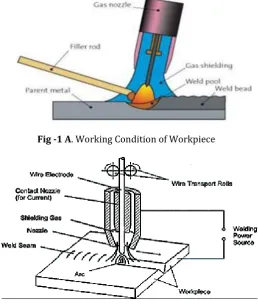
[image:1.595.307.566.446.751.2]The electrode in this process is in the form of coil and continuously fed towards the work during process. At the same time inert gas is passed through electrode from same torch. Inert gas usually argon, helium on a suitable mixture of these used to present atmosphere from contacting the molten metal and HAZ when gas is supplied, it gets ionized and arc is initiated in between electrode and work piece.
Fig -1 A. Working Condition of Workpiece
© 2019, IRJET | Impact Factor value: 7.34 | ISO 9001:2008 Certified Journal
| Page
546
The arc may be produced between a continuously fed wireand the work. Continuous welding with coiled wire helps high metal deposition rate and high welding speed, the filler wire is generally connected to positive polarity of DC source forming one of the two electrodes. The workpiece is connected to negative polarity. The power source could be constant voltage DC power source with electrode positive and it yields a stable arc and smooth metal transfer with least pattern for entire current range.
1.2 MIG can be divided in three ways
Semi-automatic welding
Equipment control only the electrode wire feeding; movement of welding gun is controlled by hand and this may be called as handheld welding.
Machine Welding
Uses a gun that is connected to manipulation of some kind and operation must constantly set and adjust controls that move the manipulation automatically.
Automatic Welding
Uses an equipment which welds without constant adjustment of control by welder or operator on some equipment controls the correct gun alignment in the weld joint.
1.3 Application
MIG may be operated in semi-automatic, machine and automatic modes. All commercially applicable such as carbon steel, low alloy steel, high strength, stainless steel, aluminium, copper, titanium, and nickel alloys can be welded in all position with this process by choosing appropriate shielding gas, electrode and welding variables.
1.4 Parameters
Parameters is a quantity whose value is selected for the particular circumstances and in relation to which other variable quantities may be expressed, these are the one which influence the result. There are 6 parameters Involved in MIG welding.
1. Welding current
2. Arc voltage
3. Welding Speed
4. Electrode
5. Gas flow rate
6. Shielding gas composition
1. Welding Current - The value of welding current used in MIG has the greatest effect on deposition rate, the weld bead size, shape and penetration. In MIG welding metals are generally welded with direct current polarity electrode positive, because it provides the maximum heat input to work and therefore a relatively deep penetration can be obtained.
2. Arc voltage: - An arc voltage discharges an electrical breakdown of a gas that produces an ongoing electrical discharge the current through a normally non-conductive medium, such as air produces a plasma, the plasma may produce visible light. The Arc voltage to be used depends metal thickness type of joints electrode composition and size, shielding gas composition and welding position types of welds.
3. Welding Speed-travel speed is a function of time and distance travelled represent the actual length for which weld metal is deposited from initiation of arc to the termination of arc. This is quite is quite simple to calculate for a given welding process.
4. Electrode - Gas metal arc welding, sometimes referred to by its sub types metal inert gas welding or metal active gas welding, is a welding process in which an electric arc forms between a consumable wire electrode and the work piece metal which heats e work piece metals causing them to meet and join.
2. LITERATURE REVIEW
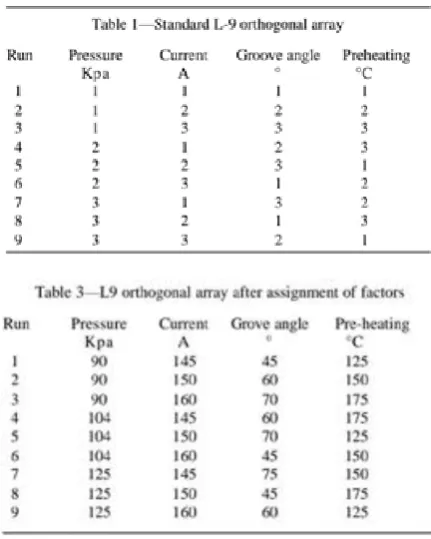
G. Haragopal. PVR Ravindra Reddy. G Chandra Mohan Reddy and J V Subrahmanyam[1] this author presented Taguchi method to design process parameters that optimize mechanical properties of weld specimen for aluminium alloy (Al-65032), used for construction of aerospace wings. Process parameters of MIG welding setup considered are gas pressure, current grove angle and pre-heat. Assigning process parameters to L9 orthogonal array, experiments were conducted, and optimization condition was obtained along with the identification of most influencing parameters using S/N analysis, mean response analysis and ANOVA.
© 2019, IRJET | Impact Factor value: 7.34 | ISO 9001:2008 Certified Journal
| Page
547
direct or indirect influence on weld bead geometrymechanical properties and weld chemistry. Studying the design parameters one at a time or by trial and error is a common approach to design optimization. However, this leads either to a very long and expensive time span for completing the design or to a premature termination of design process due to budget or schedule pressures Taguchi's approach provides a systematic and efficient method to determine near optimum design parameters for performance and cost with an objective of selecting best combination of control parameters so that the product or process is most robust with respect to noise 4.6. This study presents Taguchi method to design process parameters that optimize mechanical properties of weld specimen for aluminium alloy (Al-65032)
Fig -2. L-9 orthogonal array before and after assignment of factor
Amit Pal [4] this author presented that the MIG welding is one of the most popular welding techniques used in industries. This uses a consumable metal electrode. The input parameters in MIG welding play a significant role in deciding the weld quality, strength, cost and speed. Most of times manufacturer faces a problem to select optimum process parameters for a good quality weld. This paper tries to present the effect of different welding parameters like welding voltage, filler wire rate and v-butt angle on the strength of the weld joint and elongation produced during the tensile test. These all parameters have different effect on welding quality. In order to optimize these parameters for better weld quality Taguchi Orthogonal array has been used. The medium carbon steel slabs have been used as welding material. The ANOVA is also
employed to predict the percentage effect of each parameter on results.
The observed value of Ultimate Tensile strength (UTS) and corresponding values of S/N ratio are listed in Table V and the response values for S/N ratio of UTS are listed in Table VI. The graphical plots for showing S/N ratio with each parameter are presented. By analysing these values, the optimize MIG parameters values for Maximizing the Ultimate Tensile strength of welding joint comes out are Maximum wire feed, middle are voltage and maximum v-butt angle
The observed value of Percentage elongation and corresponding values of S/N ratio are listed in table V and the response values of S/N ratio of percentage elongation are listed in table VIL The graphical plots for showing S/N ratio with each parameter are presented by analysing these values the optimize MIG parameters values for minimization of Percentage elongation are maximum wire feed, middle arc voltage and maximum v butt angle(A3B2C3).
[image:3.595.52.268.276.546.2]In this research work, the Taguchi orthogonal array and ANOVA method were used for parameter optimization of MIG weilding for two responses i.e Ultimate tensile strength and percentage elongation. This research can be found very useful for obtaining best combination of parameters for both output responses individually, results variation will be small from desired value.
[image:3.595.321.547.448.637.2]© 2019, IRJET | Impact Factor value: 7.34 | ISO 9001:2008 Certified Journal
| Page
548
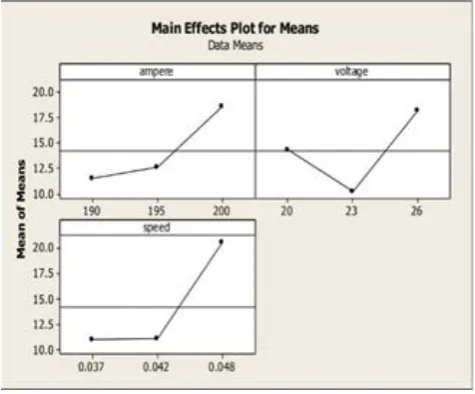
Fig -3B. Main Effects Plot for S/N ratioC. Labesh kumar, T. Vanaja, Dr. KGK Murti, VVSH Prasad[2]this author presented The MIG welding parameters are the most important factors affecting the quality, productivity and cost of welding. These welding parameters are welding current, welding voltage, Gas flow rate, wire feed rate, etc. they influence weld strength, weld pool geometry of Steel material during welding. By using DOE method, the parameters can be optimizing and have the best parameters combination for target quality. The analysis from DOE method can give the significance of the parameters which effect change of the quality and strength of product. A plan of experiments based on Taguchi technique will be used to acquire the data. An Orthogonal array, signal to noise (S/N) ratio and analysis of variance (ANOVA) will be employed to study the welding characteristics of material & optimize the welding parameters. The result computed will be in form of contribution from each parameter, through which optimal parameters will be identified for maximum tensile strength.
Fig -4. Main effect plots for mean.
Rakesh Kumar and Gurinder Singh Brar[3] this author presented Manufacturer's often face the problem to achieve a good welded joint with the required quality due to control of the input process variables. The main objective of this investigation is to find best process parameters for good quality weld in MIG welding. Taguchi Method with Lo orthogonal array was used to find best settings of welding current, welding voltage, welding travel speed and number of welding passes. The study of the welding parameter's effect on residual stresses and hardness of weld specimen were carried out by statistical technique e. analysis of variance (ANOVA) and Signal to Noise (S/N) ratio. The optimum parametric conditions were found out by Taguchi method. Confirmatory test was performed to achieve the validity of the results. By performing investigation procedure, it was found by the analysis based on S/N ratio and ANOVA that the welding voltage contributes 57.3% towards the total variation observed in residual stresses. The welding current contributes 26.14% of the total variation observed in residual stresses. The welding voltage contributes 61.59% towards the total variation observed in hardness. The variable travel speed contributes 32.28% of the total variation observed in hardness.
% Contribution= Sea SS/Total 100
Effect of welding parameters:
The percent contribution indicates that the variable welding voltage all by itself (57.3%) contribute the most towards the variation observed in residual stresses. The variable welding current contributes over 26.14%of the total variation observed. The variable travel speed has less contribution towards the total variation in residual stresses.
Similarly, the welding voltage and travel speed have main effect on the variation of hardness. The percent contribution show that the variable welding voltage all by itself (61.594%) contribute the most towards the variation observed in hardness. The variable travel speed contributes over 32.28 % of the total variation observed. The variable welding current has less contribution towards the total variation in hardness.
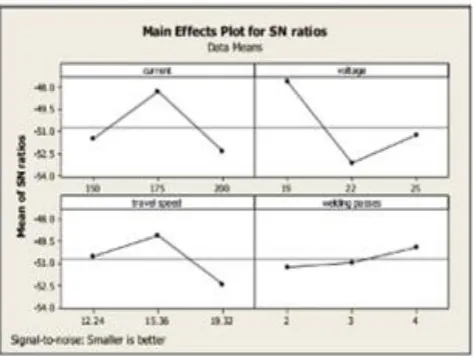
S/N ratio of hardness and residual stresses is calculated for each parametric combination using Taguchi method. On examination of S/N ratio of hardness it was found from Delta values, voltage is found to be most significant factor, next is travel speed, next is welding passes and followed by welding current
[image:4.595.42.280.556.753.2]© 2019, IRJET | Impact Factor value: 7.34 | ISO 9001:2008 Certified Journal
| Page
549
By using these S/N ratio values given. the main effect plots [image:5.595.40.283.279.461.2]have been made using MINITAB 16 software and shown in figure I and figure 2 While calculating S/N ratio values, larger the better criteria have been applied for hardness, because hardness needs to be maximized. But smaller the better criteria have been applied for residual stresses, because residual stresses need to be minimized. Optimal parametric setting can be found from the main effect plots at highest S/N ratio values to each corresponding factor. It is observed that the optimum condition for maximum hardness is AIB2CID2 (i.e. current 150 ampere, voltage=22 volts, travel speed 12.24 cm and welding passes 3.) and for minimum residual stresses are A3B2C3D1(i.e. current 200 amperes, voltage 22 travel speed 19.32 cm/min and welding passes 2).
Fig -5A. Main effect plots for S/N ratio for hardness
Fig -5B. Main effect plots for S/N ratio for residual stresses
3. DESIGN OF EXPERIMENT [DOE]
DOE is the powerful statically technique introduce by R.A. Fisher in England in 1920 studies, the effect of multiple variables simultaneously. The DOE using Taguchi’s approach can economically satisfy the needs of problem solving and product process design optimization project. DOE is also useful to combine the factors at appropriate levels, each with respectable acceptable range to produce best result and yet exhibit minimum variation around the optimum results.
The Advantages of DOE:
1. Numbers of trials is significantly reduced.
2. Important decision variables which controls and improve the performance of product or process can be identified.
3. Optimal setting of parameters can be found out.
4. Qualitative estimation of parameters can be made.
5. Experimental error can estimate.
4. CONCLUSION
This research work describes the use of taguchi’s orthogonal array and ANOVA method for parametric optimization of MIG welding for better response maximum hardness and minimum residual stresses. Welding voltage, welding current, welding speed, type of shielding gas, gas flow rate, wire feed rate, diameter of electrode, etc are the important control parameters of MIG welding process. Design of experiments with optimization of control parameters to find best result is attend in the taguchi’s method. [Orthogonal array] gives a set of well-balanced experiments and Dr.Taguchi signal – Noise ratio which are log functions of desire output.
5. SCOPE OF THE WORK
Metal inert gas welding is one of the widely used techniques for joining ferrous and non-ferrous metals. MIG welding offers several advantages like joining of dissimilar metals, low heat affected zone, there is no slag to clean off after welding because no flux used. MIG weld quality is strongly characterized by weld bead geometry.
[image:5.595.42.280.500.678.2]© 2019, IRJET | Impact Factor value: 7.34 | ISO 9001:2008 Certified Journal
| Page
550
Taguchi's DOE or ANOVA, Orthogonal Array shall be usedto conduct the experiments. The parameters selected for controlling the process are welding voltage, current and gas flow rate, wire feed rate, wire diameter. Strength of welded joints shall be tested by a UTM. From the results of the experiments, DOE- FEA models shall be developed to study the effect of process parameters on tensile strength and weld pool geometry. Optimization shall be done to find optimum welding conditions to maximize tensile strength and weld pool geometry, depth of penetration etc. of welded specimen. Confirmation tests shall also be conducted to validate the optimum parameter settings.
REFERENCES
1) G. Haragopal, P V R Ravindra Reddy, G Chandra Mohan Reddy and J V Subrahmanyam, “Parametric design for MIG welding of Al-65032 alloy using Taguchi Technique”, Journal of Scientific and industrial Research, Vol. 700, October 2011, pp.844-858
2) Labesh kumar, T. Vanaja, Dr. KGK Murti, VVSH Prasad, (2017), Optimization of MiG Welding Process Parameters for Improving Welding Strength of Steel, International Journal of Engineering Trends and Technology (IJETT) – Volume 50 Number 1 August 2017
3) Rakesh Kumar, and Gurinder Singh Brar, Optimization of Process Parameters for MIG Welding by Taguchi Method International Journal of Scientific Research Engineering & Technology (IJSRET), ISSN 2278 – 0882 Volume 6, Issue 7, July 2017
4) Amit Pal, Mig Welding Parametric Optimization Using Taguchi’s Orthogonal Array and Analysis of Variance, International Journal of Research Review in Engineering Science & Technology (ISSN 2278–6643) Volume-4, ISSUE-1, APRIL-2015
5) Kamaleshwar Dhar Dwivedi, Anurag Srivastava, (a2017), Parametric Optimization of MIG Welding for Dissimilar Metals Using Taguchi Design Method, IJSRST173455 -Volume 3 May 2017
6) Raj Kumar Yadav, Sandhaya Yadav, Anurag Singh and Pankaj Singh, (2016),Optimization Of MiG Welding Technique Parameters With The Help Of Taguchi Method, International Journal of Production Technology and Management (IJPTM) Volume 7, Issue 2, July-December, 2016, pp. 16–27, Article ID: IJPTM_07_02_003.
7) A. K. Panday, M.I. Khan, K.M. Moeed, (2013), Optimization of resistance welding parameters using Taguchi method. International Journal of Engineering Science and Technology, pp. 243-240.
8) S. R. Patil, C. A. Waghmare, (2013), Optimization of MIG welding parameters for improving strength of
welded joints. International Journal of Advanced Engineering and Studies, pp.14-16
9) Ajit Hooda, Ashwani Dhingra and Satpal Sharma, (2012), Optimization of Welding process parameters to predict maximum yield strength in AISI 1040. International Journal of mechanical Engineering and Robotics Research India, pp. 204-212
COURTESY
[1] Fig -1 A. Working Condition of Workpiece. Labesh
Kumar, T. Vanaja, Dr. KGK Murti, VVSH Prasad, (2017), Optimization of MiG Welding Process Parameters for Improving Welding Strength of Steel, International Journal of Engineering Trends and Technology (IJETT) – Volume 50 Number 1 August 2017. Page No. 30 Fig -1 B. Working principles of GMAW www.wikipedia.com
[2] Fig 2. L-9 orthogonal array before and after
assignment of factor. G. Haragopal, P V R Ravindra Reddy, G Chandra Mohan Reddy and J V Subrahmanyam, “Parametric design for MIG welding of Al-65032 alloy using Taguchi Technique”, Journal of Scientific and industrial Research, Vol. 700, October 2011, pp.844-858.
[3] Fig 3A, Fig -3B. Main effect plot for S/N ratio. Amit Pal,
Mig Welding Parametric Optimization Using Taguchi’s Orthogonal Array and Analysis of Variance, International Journal of Research Review in Engineering Science & Technology (ISSN 2278–6643) Volume-4, ISSUE-1, APRIL-2015. Page No. 216
[4] Fig 4. Main effect plots for mean. Labesh Kumar, T.
Vanaja, Dr. KGK Murti, VVSH Prasad, (2017), Optimization of MiG Welding Process Parameters for Improving Welding Strength of Steel, International Journal of Engineering Trends and Technology (IJETT) – Volume 50 Number 1 August 2017. Page No. 32
[5] Fig -5A, Fig -5B. Main effect plots for S/N ratio for