The Package Concept for Enforcing Usage Control
Patricia Ghann, Changda Wang, Conghua Zhou
School of Computer Science and Telecommunication Engineering, Jiangsu University, Jiangsu, China Email: [email protected], [email protected], [email protected]
Received December 5, 2012; revised January 3, 2013; accepted January 11, 2013
Copyright © 2013 Patricia Ghann et al. This is an open access article distributed under the Creative Commons Attribution License,
which permits unrestricted use, distribution, and reproduction in any medium, provided the original work is properly cited.
ABSTRACT
Access and usage control is a major challenge in information and computer security in a distributed network connected environment. Many models have been proposed such as traditional access control and UCONABC. Though these mod-els have achieved their objectives in some areas, there are some issues both have not dealt with. The issue of what hap-pens to a resource once it has been accessed rightfully. In view of this, this paper comes out with how to control re-source usage by a concept known as the package concept. This concept can be implemented both with internet connec-tion and without the internet connecconnec-tion to ensure continual control of resource. It packages the various types of re-sources with the required policies and obligations that pertain to the use of these different rere-sources. The package con-cept of ensuring usage control focuses on resource by classifying them into three: Intellectual, sensitive and non-sensi-tive resources. Also this concept classifies access or right into three as: access to purchase, access to use temporally online and access to modify. The concept also uses biometric mechanism such as fingerprints for authentication to check redistribution of resource and a logic bomb to help ensure the fulfillment of obligations.
Keywords: Access Control; Usage Control; Policies; Obligation; User or Subject; Biometric Finger Print; Logic Bomb; Remote Client
1. Introduction
Computers and computer systems play a vital role in the lives of the individual. The use of computer systems is seen almost everywhere. For example, insurance compa- nies, healthcare services, banking, education and many more. The advancement in computer and information technology has increased the amount of data collected, whereas the improvement in network infrastructure has resulted in the uncontrolled distribution of information. Although the impact of these technologies cannot be over emphasized, a critical issue in computer security con- cerns how data and resources can be protected. Access control and usage control are challenging issues that face information security currently. Access control has been given adequate attention by researchers in the past. Us- age control on the other hand is a new concept proposed by Park and Sandhu (2000) that seeks to enhance on ac- cess control. By controlling who has access to which data, traditional access control mechanisms such as DAC, MAC and RBAC, dealt with just an aspect of the prob- lem. Usage control has been proposed to argument access control by controlling what happens to data after access has been granted. UCON introduces authorization, obli-
method of ensuring the enforcement of obligation on a remote client server. Section 3.1 is about biometric fin- gerprint authorization, 3.2 is about logic bomb. Sections 4 and the last part are conclusion and references accordingly.
2. Traditional Access Control
Access control determines which subjects can access which resources under which circumstances. In the his- tory of computer and information security, various at-tempts have been made to ensure trusted control in terms of information or digital resource usage. The earliest ap- proach has been traditional access controls such as man- datory access control (MAC), discretionary access con- trol (DAC) and role-based access control (RBAC). In a distributed networking environment recently, access con- trol still remains a major challenge for computer and in- formation security. Providers of services, resources and digital content need to selectively determine who can access these and exactly what access is provided [2]. Hence the objective of access controls. There has been much research with progress in access control for the past thirty years with prominence centered on access control matrix. With access matrix, a right is unambigu- ously granted to a subject to access an object in a specific mode for example, read or write mode. This right exists whether or not the subject is currently accessing the ob- ject. It is also a presumed that, the right enables repeated access until it is finally revoked. According to research, access matrix is not explicitly represented in practical terms. Instead access control lists (ACLs), capabilities or access relations are often used [3]. A variety of DAC, MAC and RBAC models have emerged to accommodate a diverse range of real-world access control policies. However, the practice of access control has grown very far away from the access matrix abstraction; nonetheless the core idea that, access is driven by rights granted to a subject to access an object had still remained. Tradition- ally, access control has focused on the protection of computer and information resources in a closed system environment. The enforcement of control has been pri- marily based on identities and attributes of known users by using a reference monitor and specified authorization rules [4]. In today’s network-connected, highly dynamic and distributed computing environments, digital informa- tion is likely to be used and stored at various locations, hence has to be protected regardless of user location and information location.
2.1. Prior Work
Trust management emerged as an enhancement on tradi- tional access control by giving consideration to unknown users and utilizing their credentials in an open environ- ment. However it focused on static entities with charac-
teristics that do not change with time [5]. Recent research came out with digital right management which uses a client-side reference monitor to control usage of already disseminated digital objects. This model has brought out a significant new perspective on access control problems. Various efforts have been made by researchers to ensure trusted client-side computing. For example Microsoft’s Palladium and Intel-driven trusted computing platform alliance (TCPA) [TCPA 2002] originating from AEGIS [6]. These have gained serious attention and concern be- cause of their potential impacts on security and privacy issues. Because of DRM’s potential opportunity for com- mercial sector; current DRM solutions have been largely driven by commercial entities and are mainly focused on intellectual property rights protection which is based on payment functions [7-9]. All these models discussed above have tried to protected information or digital re- sources in one way or another. The fact however remains, in a modernized and computerized era currently, where digital resource are available and can be shared and stored in various devices, these models are inadequate in ensuring access control and hence achieving confidenti- ality, integrity and availability [10,11].
2.2. Limitations of Traditional Access Control
Traditional access control models are not adequate for today’s distributed, network-connected digital environ- ment [12].
Authorization only—No obligation or condition based control
Decision is made before access—No ongoing control
No consumable rights—No mutable attributes
Rights are pre-defined and granted to subjects
In view of the above enlisted problems of traditional access control, the need to have a flexible access control in a highly dynamic and distributed environment such as currently seems laudable. This is because information or digital resources can be located in various places and thus the need for a general client-side platform [13]. The multi aspect nature of access control decisions in terms of subject and object attributes, obligations, conditions and the dynamism of subject and object attributes has necessitated the need for a more comprehensive model such as usage control by Sandhu and Park.
2.3. Usage Control (UCON)
central control authority is not available. UCON also deals with privacy issues in both commercial and non-commercial environments. The main advantage of UCON lies in its strength to express diverse access cases [1]. The concept of usage control encompasses tradi- tional access control, trust management and digital right management in a single framework. As a result of this, UCON’s objectives include privacy protection, intellec- tual right protection and sensitive information protection. In terms of domain control and reference monitor, UCON authorization system can be situated either on server-side reference monitor or a client-side reference monitor or on both. This architecture provides a two-tier usage control over digital resources.
A usage decision in UCON is made by policies of au- thorizations, obligations, and conditions (also referred as UCONABCcore models). In terms of continuity of deci- sion, usage control can be enforced before or during an access process. The distinguishing properties of UCON, beyond traditional access control models are the continu- ity of access decisions and the mutability of subject and object attributes [14]. In UCON as compared to tradi- tional access control, authorization decisions are not only checked and made before an access, but may be repeat- edly checked during the access and may revoke the ac- cess if some policies are not satisfied, according to changes of the subject or object attributes, or environ- mental conditions. The concept of UCON fails to con- sider what happens to data or information after it has been granted in the absence of internet connection; in other words, the concept of mutability and continuity, only is achieved once a subject is using the internet. In light of this, we propose a means of ensuring the fulfill- ment of obligations a on a remote client server. We do this by a concept we have termed the “package concept”. Much attention and research have focused on the archi- tectural aspect of enforcing obligations without any at- tention on the information itself. As mentioned previ- ously, Usage control does not answer the question of what happens to resource after it has been rightfully accessed and has now become the subject’s property literally. Thus if a subject uses usage controls decision factors, authorization, obligation and conditions with mutability and continuity to rightfully access a music file, movie or a white paper, he can redistribute these resources since he has paid for it. This however would affect the provider or owner of such resource in terms of revenue generation. In the next section we introduce the package concept of enforcing obligation to ensure usage control.
3. The Package Concept of Enforcing
Obligation and Ensuring Control of
Resource on a Remote Client
We propose a system that would use the various archi-
tectural designs that has already been proposed so far to help ensure control of resource. A method that would help enforce obligation in remote client server by focus- ing on the resource itself. Firstly, we classify objects or digital resources as follows:
Intellectual resource (INTELL)
Sensitive resource (SEN)
Non-sensitive resource (NSEN)
We make this division as most of the resources avail- able on the internet basically fall within this classifica- tion. This classification is in line with the coverage of UCON, except that we have captured privacy protection under sensitive resources and other resources that do not belong to intellectual or sensitive resources as non-sen- sitive resources. This is to ensure that policies and obli- gations required for the accessibility of resources are formulated appropriately and attached to these resources; thus help a subjects to know what exactly they are going in for and what is required from them.
Based on the above classification, we formulate the appropriate obligations and encapsulated them with each group of resource. Thus instead of stating obligation and policies separately from a resource, obligation and poli- cies covering these groups of objects or resource are stated and attached to each group by the service provider. Secondly, access to a particular resource must be through authorization using a biometric mechanism such as fin- gerprints. The subjects would have to input three differ- ent fingerprints from among ten fingers. This would en- sure that resource is not given to an unauthorized person as the requested resource, would have subject’s finger- prints embedded into it. Obligations consist of actions and time within which they are supposed to be fulfilled. This is to ensure that when access is granted, to a par- ticular group of resource, the subject cannot give re- source to any other person. For example if a subject want to purchase an eBook, movie or music CD, he is suppose to register, if the registration is by finger prints, the ser- vice provider accepts the finger prints and encrypt it into these resource before it access to purchase is granted. This is done so that subject cannot redistribute resources.
3.1. Biometric Authorization by Fingerprints
the characteristics which are acquired naturally over a time and is mostly used for verification. For instance speaker recognition for analyzing vocal behavior, signa- ture for analyzing signature dynamics and keystroke for measuring the time spacing of two typed words.
Physical biometrics on the other hand, measures the inherent physical characteristics on the individual and as such can be used for either identification or verification. Examples of physical biometric include; fingerprint for analyzing fingertip patterns, facial recognition for meas- uring facial characteristics, iris scan for analyzing fea- tures of colored ring of the eye and many more.
We propose a biometric authorization by fingerprints for analyzing fingertip patterns to help ensure usage con- trol. This is because most sites require attributes of sub- ject such as password and user name for authorization. This however can be stolen or verbally transferred to other people. However a random selection of three fin- gerprints from among ten fingers is difficult to steal or be verbally transferred to other people. A subject who wants to have access to a particular type of resource would have to provide a random sample of his or her three fin- gerprints. Once the fingerprints are collected, the type of access and the type of resources are selected by the sub- ject.
Resources or digital information are accessed on online in three main ways. These include the following:
Access to purchase
Access to read, listen or watch or download online
Access to modify or use online
Access to Purchase: This type of access employs UCON pre-authorization by fingerprints as the decision factor. In this type of access, a subject may want to pur- chase an eBook, music or movie online. These types of resources are classified as intellectual resources. As a result, the main policy may be non-redistribution by sub- jects. To enforce this policy, the fingerprints of the sub- ject are encrypted into the resource. Thus limiting redis- tribution by location; in other words, the subject would have to move from place to place in order to redistribute this resource.
Access to Read, Listen or Watch Online: Resources involved in this type of access include intellectual, sensi- tive and non-sensitive. Intellectual resource may include access to read a book, journal and articles. Sensitive re- source can include access to read a bank statement or a medical report. Non-sensitive resource can include intel- lectual resource such as music, movie or wiki document. With this type of access, UCONABC model is very ef- fective in ensuring usage control. With sensitive infor- mation like, bank statement and medical report, finger- print of identifee subject is required in the form of pre-authorization and this is encrypted into the said re- source before access is granted.
Access to Modify or Use: This type of access is most- ly required in the health services; for instance, a doctor requiring patient’s record for treatment, on the patient’s day of appointment. Since the resource involve is sensi- tive, the doctor is requested for his fingerprint as a pre- authorization. There can also be ongoing check to ensure that the doctor is indeed authorized. Furthermore, since sensitive information is been handled, a logic bomb can be implement in the resource with an obligation that specifies the duration of access to such a record or re- source. For example, a logic bomb can be implemented so that, the doctor is allowed a maximum of one hour on a patient, after which the record is temporary destroyed. When this happens, the doctor would be asked for his or her fingerprints again but this time around with a “mark” which would enable management to request for some explanations as well as investigations.
3.2. A Logic Bomb Mechanism
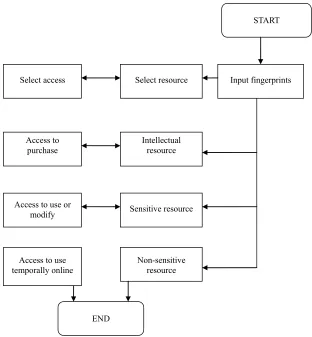
In order to ensure that obligations that are encapsulated with resources are fulfilled, we proposed a logic bomb to help accomplish this task. A logic bomb or slag code is a program, or portion of a program, which lies dormant until a specific piece of program logic is activated. The common activator for a logic bomb is a date. The logic bomb checks the system date and does nothing until a pre-programmed date and time is reached. At that point, the logic bomb activates and executes its code. The logic bomb can also be programmed so as to wait for a certain message from the subject. When the logic bomb sees that message, or when the logic bomb stops seeing that mes- sage, it activates and executes its code. The most dan- gerous form of the logic bomb is a logic bomb that acti- vates when something doesn’t happen. We therefore use a logic bomb programmed along these two dimensions; date and message from subject. With date, obligations that need to be fulfilled with certain durations can be implemented. For example delete within 90 days. This is however similar to the classic use for a logic bomb to ensure payment for software. If payment is not made by a certain date, the logic bomb activates and the software automatically deletes itself. With the message, the logic bomb would be programmed to receive fingerprints of user at certain random interval for verification especially in the case of access to purchase or modify. This would ensure that only authorized subjects have access to re- source and minimized redistribution of resources. Figure 1 is an illustration of how a particular resource can be accessed in the package.
How to Access a Particular Resource 1) Input three finger prints
START
Input fingerprints Select resource
Intellectual resource
Sensitive resource
Non-sensitive resource Select access
Access to purchase
Access to use or modify
Access to use temporally online
[image:5.595.141.453.84.421.2]END
Figure 1. Packaged concept of resources with different access.
3) Select type of resource
If access is to purchase an intellectual or sensitive resource, fingerprints are encrypted into resource be- fore resource is accessed for purchase.
If access is to modify, fingerprints are obtained for authorization and encrypted into modified section for accountability.
If access is to use online, fingerprints is obtained for authorization and access is permitted based on UCONABC.
With usage control, actions are classified into two. Ac- tions performed by a subject and actions performed by the system. These actions are as follows:
1) Tryaccess(s, o, r): generating a new access request (s, o, r), performed by subjects.
2) Permitaccess(s, o, r): granting the access request of (s, o, r), performed by the system.
3) Denyaccess(s, o, r): rejecting the access request of (s, o, r), performed by the system.
4) Revokeaccess(s, o, r): revoking an ongoing access (s, o, r), performed by the system.
5) Endaccess(s, o, r): ending an access(s, o, r), per- formed by a subjects.
6) Preupdate(attribute): updating a subject or an ob-
ject attribute before granting access or after denying an access, performed by the system.
7) On update (attribute): updating a subject or an ob- ject attribute during the usage phase, performed by the system.
It should be emphasized that onupdate actions may be performed repeatedly by a system in order to continu- ously update an attribute and s, o, r refers to subject, ob- ject and right respectively.
A logical model of UCON consist of a 5-tuple; M = (S, PA, PC, AA, AB) where
S is a set of sequences of system states
PA is a finite set of authorization predicates built from the attributes of subjects and objects
PC is a finite set of usage control predicates built from the system attributes
AA is a finite set of usage control actions AB is a finite set of obligation actions
A logical Formula is also defined in UCON by the fol-lowing in BNF grammar:
ø::= a|p(t1, ··· , tn)|(¬ø)|(ø˄ø)|(ø → ø)|□ø|◊ø|Oø|øUø|■ø|♦ø|Oø|øSø|,
tn are terms.
If in a state sequence sq of a model M, a state s satis- fies a formula ø, we write M, sq, s| = ø. The satisfaction relation | is defined by induction on the structure of ø and only for s0 sq. specifically, M,sq,s0 | p if f s0 [[p]], where pPAPC.
Access to Purchase: an e-book online the following rules are applied
1) Permitacess(s, o, purchase) → ♦tryaccess(s, o, pur- chase) ˄ (s. fingerprints ≥ 3) ˄ (encrypt.o.intell)
2) Permitaccess(s, o, purchase) → ◊onupdate(s. fin-gerprints ≥ 3) ˄ ◊(endaccess(s, o, purchase) ˅ revokeac-cess(s, o. purchase))
The first policy says permit access once a subject tries access and has input his fingerprints to be encrypted into the resource to be purchased. The second policy says al- though the subject has purchased the resource, he is ex- pected eventually to provide his fingerprints at some point when accessing. Otherwise access is ended or revoked in- dicating that he is not the rightful owner of the resource.
Access to Modify: (Doctor-patient relationship) the following rules can be applied
1) Permitacess(s, osen, modify) →♦tryaccess(s, osen, modify) ˄ (s. fingerprints ≥ 3) ˄ (encrypt. osen)
2) Permitaccess(s, osen, modify) →◊onupdate(s. fin- gerprints ≥ 3) ˄ ◊(endaccess(s, osen, modify) ˅ revoke- access(s, osen, modify))
3) Endaccess(s, osen, modify) →◊postupdate(records. fingerprints)
4) Revokeaccess(s, osen, modify) → postupdate(re- cords. fingerprints)
Access to Use Temporary: e.g. watch, listen and read the following rules can be applied
1) Permitacess(s, o, watch) →♦tryaccess(s, o, watch) ˄ (♦ob1 ˄♦ob2 ˄···˄♦obi)
2) Permitaccess(s, o, watch) → ◊onupdate(s. finger- prints ≥ 3) ˄◊(endaccess(s, o, watch) ˅ revokeaccess(s, o. watch))
The first policy regarding this type of access is, per-mitaccess to watch once there is a tryaccess and the nec-essary obligations is fulfilled like click and advertisement every 30 minutes. The second policy states that in the event that the resource is downloaded and used off-line, the subject needs to fulfill some obligations. For example delete movie or music within 90 days. To ensure that is obligation is adhere to; we use a logic bomb and program it to explode within the stipulated time. This will limit unauthorized redistribution of resource to some extent and hence protect resources.
4. Conclusion
To ensure that control is still exerted on resources no matter the location, the package concept is proposed to be used with UCONABC to enforce usage control. With he implementation of biometric fingerprints and logic
bomb in a particular resource, the unauthorized dissemi- nation or redistribution of resources can be minimized and obligations would be enforced through the package concept.
t
REFERENCES
[1] A. Lazouski, F. Martinelli and P. Mori, “Usage Control in Computer Security, a Survey,” Computer Science Review,
Vol. 4, No. 2, 2010, pp. 81-99.
[2] J. Park and R. Sandhu, “A Usage Control (UCON) Model for Social Network Privacy,” 2010.
[3] J. Park, X. Zhang and R. S. Sandhu, “Attribute Mutability in Usage Control,” Proceedings of IFIP TC11/WG, Eighteen Annual Conferences on Data and Application Security, Kluwer, Vol. 144, 2004, pp.15-29.
[4] J. Wu and S. Shimatoto, “Usage Control Based Security Access Scheme for Wireless Sensor Network,” Proceed- ings of IEEE International Conference on Communica- tion (ICC 2010),Cape Town, 23-27 May 2010, pp. 1-5. [5] M. Sastry, R. Krishnan and R. Sandhu, “A New Modeling
Paradigm for Dynamic Authorization in Multi-Domain Systems,” In: Communications in Computer and Informa- tion Science, Springer, Berlin, 2007, pp. 153-158.
[6] R. Alnemr, et al., “Enabling Usage Control Reputation
Objects, A Discussion on e-Commerce and Internet of Services Environments,” Journal of Theoretical and Ap-plied Electronic Commerce Research Electronic Version, Vol. 5, No. 2, 2010, pp. 59-79.
[7] W. Shin and S. B. Yoo, “Secured Web Services Based on Extended Usage Control,” In: PAKDD Workshops, Lec-ture Notes in Computer Science, Springer, Berlin, 2007,
pp. 656-663.
[8] B. X. Zhao, et al., “Towards a Time—Based Usage Con- trol Model,” W3C Privacy and Data Usage Control Workshop, Cambridge, 2010.
[9] C. Moucha, E. Lovat and A. Pretschner, “A Virtual Usage Control Bus System,” Journal of Wireless Mobile Net- works, Ubiquitous Computing and Dependable, Vol. 2 No. 4, 2010, pp. 84-101.
[10] C. Bettini, S. Jajodia, X. S. Wang and D. Wijesekera, “Obligation Monitoring in Policy Management,” Pro- ceedings of 3rd IEEE International Workshop for Dis- tributed Systems and Networks Policy, Monterey, 2002, pp. 2-12.
[11] D. Basin, et al., “Monitoring Usage Control Policies in
Distributed Systems,” IEEE, 2011, pp. 88-95.
[12] D. Basin, et al., “MONPOLY: Monitoring Usage Control Policies,” Lecture Notes in Computer Science, Vol. 7186,
2012, pp. 360-364.doi:10.1007/978-3-642-29860-8_27 [13] E. Maler, “Controlling Data Usage with User—Managed
Access (UMA),” W3C Privacy and Data Usage Control Workshop, Cambridge, 2010.
[14] G. D. Bai, et al., “Context-Aware Usage Control for An-