Comparison of Different Confidence Intervals of
Intensities for an Open Queueing Network
with Feedback
Vinayak Kawaduji Gedam
1, Suresh Bajirao Pathare
2 1Department of Statistics, University of Pune, Pune, India
2
Indira College of Commerce and Science, Pune, India Email: [email protected], [email protected]
Received March 14, 2012; revised April 30, 2012; accepted May 10, 2012
ABSTRACT
In this paper we propose a consistent and asymptotically normal estimator (CAN) of intensities
1,
2for a queueing
network with feedback (in which a job may return to previously visited nodes) with distribution-free inter-arrival and
service times. Using this estimator and its estimated variance, some
100 1
%
asymptotic confidence intervals of
intensities are constructed. Also bootstrap approaches such as Standard bootstrap, Bayesian bootstrap, Percentile
boot-strap and Bias-corrected and accelerated bootboot-strap are also applied to develop the confidence intervals of intensities. A
comparative analysis is conducted to demonstrate performances of the confidence intervals of intensities for a queueing
network with short run data.
Keywords:
Coverage Percentage; Relative Coverage; Bayesian Bootstrap; Bias-Corrected and Accelerated Bootstrap;
Percentile Bootstrap; Standard Bootstrap
1. Introduction
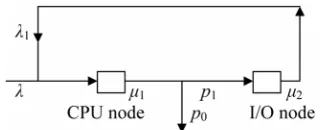
Consider a queueing network of a computer system with
feedback (in which a job may return to previously visited
nodes) as shown in
Figure 1
. This queueing network
con-sists of a CPU node and an Input/Output (I/O) node.
Ex-ternal jobs arrive at the CPU node according to the rate
. After service completion at CPU node, the job
pro-ceeds to the I/O node with probability p
1, and with
prob-ability p
0the job departs from the system, where
0
1
1p
p
. Jobs leaving the I/O node are always fed back
to the CPU node (see
Figure 1
). The service times at each
node are with rates
1and
2respectively. The
suc-cessive service times at both nodes are assumed to be
mutually independent and independent of the state of the
system. The traffic intensity at the CPU node and I/O
node is given by
1
1 2
0 1 0 2
,
p
p
p
(1)
respectively. Intensity
1and
2can be interpreted as
expected number of arrivals per mean service time. The
condition for stability of the system is both
1,
2are
less unity.
Basic properties of queueing networks are introduced
in Disney [1]. Burke [2], Beautler and Melamed [3]
showed that the input process to a service center in a
network with feedback is not Poisson in general. It is for
this reason that Jacksons result is remarkable. Jacksons
[4] theorem states that each node behaves like an
inde-pendent queue.
Figure 1. An open queueing network with feedback.
developed by Buzen and Denning [11]. Efron [12-14] the
greatest statistician in the field of nonparametric
resam-pling approach, originally developed and proposed the
bootstrap, which is a resampling technique that can be
effectively applied to estimate the sampling distribution
of any statistic. Specifically, one can utilize the bootstrap
method to approximate the sampling distribution of a
statistic defined by a random sample from a population
with unknown probability distribution. And due to the
popularity of PC and statistical software, today the
boot-strap becomes the most powerful nonparametric
estima-tion procedure. Based upon the bootstrap resampling
technique, most statisticians utilize the standard bootstrap
(SB), percentile bootstrap (PB), and bias-corrected and
accelerated bootstrap (BCaB) approaches to produce
confidence intervals for practical problems.
Besides the standard bootstrap (SB) technique, Rubin
[15] presented the Bayesian bootstrap (BB) technique of
resampling. Miller [16] showed that the SB can be
re-garded as an extension of the jackknife. The BB is a
natural Bayesian analogue of the SB. The BB simulates
the posterior distribution of parameters under particular
model specifications, whereas the SB simulates the
esti-mated sampling distribution of a statistic estimating the
parameters. Both SB and BB can be applied to construct
confidence intervals of intensity for a queueing system
with distribution-free inter-arrival and service times.
Chu and Ke [17] constructed new confidence intervals
of mean response time for an M/G/1 FCFS queueing
system. Also, they performed the accuracy of bootstrap
confidence intervals through calculating the coverage
probability and the average length of confidence intervals.
Chu and Ke [18] proposed a consistent and
asymptoti-cally normal (CAN) estimator of the mean response time
for a G/M/1 queueing system, which is based on the
fixed point of empirical Laplace function. Ke and Chu
[19] proposed a consistent and asymptotically normal
estimator of intensity for a queueing system with
distri-bution-free interarrival and service times. Also, they
computed confidence intervals, testing statistical
hy-pothesis of intensity and power function associated with it
in this paper. Ke and Chu [20] constructed new
confi-dence intervals of intensity for a queueing system, which
are based on different bootstrap methods. They also
per-formed the accuracy of these bootstrap confidence
inter-vals through calculating the coverage probability and the
expected length of confidence intervals. They first
pro-posed bootstrapping technique and concept of relative
coverage to queueing system. They studied five
estima-tion approaches of intensity for a queueing system with
distribution free inter-arrival and service times for short
run. They have introduced a new measure called relative
coverage to assess the efficient performances of
confi-dence intervals.
In this paper we propose non parametric interval
esti-mation approach to intensities
1,
2for a open
queue-ing network with feedback. In Section 2 we prove that
the natural estimators
ˆ
1,
ˆ
2of intensities
1and
2are strongly consistent and asymptotically normal (CAN).
Based on the asymptotical normality of
ˆ
1,
ˆ
2, we can
construct a CAN confidence interval of
1and
2. Next
in Section 3 we establish the SB confidence interval of
1
,
2via the standard bootstrap approach. In Section 4
we developed the derivation of the BB confidence
inter-val of
1,
2in terms of the Bayesian bootstrap
ap-proach. The percentile bootstrap (PB) confidence
inter-vals of
1,
2are developed in Section 5. In Section 6
we developed the bias-corrected and accelerated
boot-strap (BCaB) confidence intervals. A numerical
simula-tion study is conducted in Secsimula-tion 7 to demonstrate
per-formances of the interval estimation approaches for an
open queueing network with feedback using short run
data. All simulation results are shown by appropriate
tables for illustrating performances of the five interval
estimation approaches. Finally, we make some
conclu-sions in Section 8.
2. Nonparametric Statistical Inference of
Intensities
Let
X
1and Y
1be nonnegative random variables
repre-sents the inter-arrival and service time at CPU node.
Similarly
X
2and Y
2be nonnegative random variables
represents the inter-arrival and service time at I/O node
respectively. Given that a job just completed CPU node
burst, it will next request I/O node service with probability
1
p
and with probability
p
0, where
p
0
1
p
1departs
from the system. The random variables at CPU node and
I/O node are independent. The intensities are defined as
follows:
1 1
0 1
Y
X
p
and
22
0 2
1
Y
X
p
p
, (2)
where
X1,
X2denote the mean inter-arrival times at
CPU node and I/O node respectively. Similarly
Y1,
Y2denote the mean service times at CPU node and I/O node
respectively. Equation (2) is equivalent to Equation (1).
2.1. Estimating Intensities
from
X
1and
p Y p Y
0 11,
0 12,
,
p Y
0 1nis a random sample
drawn from Y
1. Let
X
1i,
p Y
0 1i
represents inter-arrival
time and service time for the i
thcustomer of CPU node.
Similarly assume
p X
1 21,
p X
1 22,
,
p X
1 2mis a random
sample drawn from X
2and
p Y
0 21,
p Y
0 22,
,
p Y
0 2mis a
random sample drawn from Y
2. Let
p X
1 2i,
p Y
0 2i
represents inter-arrival time and service time for the i
thcustomer of I/O node.
Let
X X Y Y
1,
2,
1,
2be the sample means of X
1, X
2, Y
1,
Y
2respectively.
1 1 2 1 2
1 1
1 0 1 2 0 2
1 1
1
1
,
1
1
,
n m i i i i n m i i i iX
X
X
p X
n
m
Y
p Y Y
p Y
n
m
According to the Strong Law of Large Numbers, we
know that
X X Y Y
1,
2,
1,
2are strongly consistent
estima-tor of
1
,
2,
1,
2X X Y Y
respectively. Thus a strongly
consistent estimator of intensities are given by
1 2
1 2
1 2
ˆ
Y
,
ˆ
Y
X
X
(3)
In practical queueing network, the true distributions of
X
1, X
2,
Y
1, Y
2are rarely known, so the exact distributions
of
ˆ
1,
ˆ
2cannot be derived. But under the assumption
that X
1and Y
1,
X
2and Y
2being independent, the
asymp-totic distributions of
ˆ
1,
ˆ
2can be developed by the
following procedures.
Firstly, according to the Central Limit Theorem (see
[21] p. 234), we have
11
11
2 1 2 1 0
0,
and
0,
D X X D Y Yn X
N
n Y
p
N
(4)
where
1
2
X
and
1
2
Y
are variances of X
1and Y
1,
respec-tively.
Also,
2
2
2
22 2 1 2 2 0
0,
and
0,
,
D X X D Y Ym X
p
N
m Y
p
N
(5)
where
2
2
X
and
2
2
Y
are variances of X
2and Y
2,
re-spectively, and
Ddenotes convergence in
distribu-tion.
Next note that
1 1
1 1 1 1
1
1 1 0 1
1
1 0 0 1
1
ˆ
.
Y
X
X Y Y X
X
n
p
Y
n
X
n
Y
p
p
X
X
Also,
2 22 2 2 2
2
2 2 0 2
2 1
1 2 0 0 2 1
1 2
ˆ
.
Y
X
X Y Y X
X
m
p
Y
m
X
p
m p
Y
p
p
X
p
p
X
(6)
Therefore by the Slutsky’s theorem [see [21] p. 227],
we get
2
1 1 1
ˆ
D0,
n
N
,
where
1 1 1 11
2 2 2 2 2
0 2
1 4
X Y Y X X
p
.
And
2
2 2 2
ˆ
D0,
m
N
(7)
where
2 2 2 22
2 2 2 2 2 2
1 0
2
2 2 4
1
X Y Y X X
p
p
p
.
Now, set
1 1 2 22 2 2 2 2
1 0 1
2
1 4
1
2 2 2 2 2 2
1 2 0 2
2
2 2 4
1 2
ˆ
and
ˆ
,
Y X
Y X
X S
p Y S
X
p X S
p Y S
p X
(8)
where
1 1 2 2 2 2 2 21 1 0 1 1
1 1
2 2
2 2
1 2 2 0 2 2
1 1
1
1
,
1
1
and
.
n nX i Y i
i i
m m
X i Y i
i i
S
X
X
S
p Y
Y
n
n
S
p X
X
S
p Y
Y
m
m
Then
ˆ
12,
ˆ
22are strongly consistent estimators of
2 21
,
2
respectively. Applying the Slutsky’s theorem
once again, we deduce that
1 1 1 2 2 2ˆ
0,1 and
ˆ
ˆ
0,1
ˆ
D Dn
N
m
N
(9)
Thus
ˆ
1,
ˆ
2are strongly consistent and
asymptoti-cally normal (CAN) estimators with approximate vari-
ances
2 2 1 2ˆ
ˆ
,
n
m
respectively.
2.2. Confidence Intervals
Using the CAN estimators
ˆ
1,
ˆ
2and its associated
approximate variances
2 2 1 2ˆ
ˆ
,
n
m
dence intervals of intensities
1&
2for a open
queue-ing network with feedback. Let
z
be the upper
thquantile of the standard normal distribution, by the as-
ymptotic distribution of
1 1
2 2
1 2
ˆ
ˆ
&
ˆ
ˆ
n
m
in expression (9), an approximate
100 1
%
confi-dence interval of
1&
2are obtained as
1 1
2 2
1
2 1 2 1
1 1 1
ˆ
1
ˆ
ˆ
ˆ
ˆ
ˆ
n
P
z
z
z
z
P
n
n
Consequently, an approximate
100 1
%
confi-dence interval of
1is
2 1 2 1
1 1
ˆ
ˆ
ˆ
z
,
ˆ
z
n
n
. (10)
Similarly, an approximate
100 1
%
confidence
interval of
2is
2 2 2 2
2 2
ˆ
ˆ
ˆ
z
,
ˆ
z
m
m
. (11)
3. Standard Bootstrap Confidence Intervals
of Intensities
Now the bootstrap confidence intervals are developed as
follows:
Let
x x
11,
12,
,
x
1nbe a random sample of n
observa-tions taken from the population X
1and
p y p y
0 11,
0 12,
,
0 1np y
be a random sample of n observations taken from
the population Y
1. According to the bootstrap procedure,
a simple random sample
x x
11,
12,
,
x
1n
can be taken
from the empirical distribution function of
x x
11,
12,
,
x
1ncalled a bootstrap sample from
x x
11,
12,
,
x
1n. Also, we
can draw a bootstrap sample
p y p y
0 11,
0 12,
,
p y
0 1n
from
0 11
,
0 12,
,
0 1np y
p y
p y
. It follows from Equation (2) that
an estimate of intensity
1can be calculated from
boot-strap samples as
1 1 1
ˆ
y
x
, (12)
where
x
1 and
y
1 are the sample means of
x x
11,
12,
,
1n
x
and
p y
0 11,
p y
0 12,
,
p y
0 1n
respectively and
ˆ
1 is
called a bootstrap estimate of
1. The above resampling
process can be repeated N
1times. The N
1bootstrap
esti-mates
ˆ
11,
ˆ
12,
,
ˆ
1N1
can be computed from the
boot-strap resamples. Averaging the N
1bootstrap estimates we
obtain that
1 1 1 1 11
ˆ
ˆ
N N i iN
(13)
is the bootstrap estimate of
1. And the standard
devia-tion of
ˆ
1can be estimated by
1
1 1 1 2 2 1 1 1
1
ˆ
ˆ
ˆ
.
1
N
N i N
i
sd
N
(14)
Because the central limit theorem implies that the
dis-tribution of
ˆ
1is approximately normal. A
100 1
%
SB confidence interval for
1is
ˆ
1
z sd
2
ˆ
N1,
ˆ
1
z sd
2
ˆ
N1
,
(15)
Similarly
p x
1 21,
p x
1 22,
,
p x
1 2mis a random sample
of m observation drawn from population X
2and
p y
0 21,
0 22,
,
0 2mp y
p y
is a sample of m observations taken
from the population
Y
2. According to the bootstrap
pro-cedure, a simple random sample
p x
1 21,
p x
1 22,
,
p x
1 2m
can be taken from the empirical distribution function of
1 21
,
1 22,
,
1 2mp x
p x
p x
called a bootstrap sample from
1 21,
1 22,
,
1 2mp x
p x
p x
. Also, we can draw a bootstrap
sample
p y
0 21,
p y
0 22,
,
p y
0 2m
from
p y
0 21,
p y
0 22,
,
0 2mp y
. An estimate of intensity
2can be calculated
from bootstrap samples as
2 2 2
ˆ
y
x
, (16)
where
x
2 and
y
2 are the sample means of
p x
1 21,
1 22
,
,
1 2mp x
p x
and
p y
0 21,
p y
0 22,
,
p y
0 2mrespec-tively and
ˆ
2 is called a bootstrap estimate of
2. The
above resampling process can be repeated M
1times. The
M
1bootstrap estimates
ˆ
21,
ˆ
22,
,
ˆ
2M1can be
com-puted from the bootstrap resamples. Averaging the M
1bootstrap estimates we obtain that
1 1 2 1 1
1
ˆ
ˆ
M M i iM
(17)
is the bootstrap estimate of
2. And the standard
devia-tion of
ˆ
2can be estimated by
1
1
1 2 2 2 1 1
1
ˆ
ˆ
ˆ
.
1
M
M i M
i
sd
M
(18)
Because the central limit theorem implies that the
dis-tribution of
ˆ
2is approximately normal. A
100 1
%
SB confidence interval for
2is
ˆ
2
z sd
2
ˆ
M1,
ˆ
2
z sd
2
ˆ
M1
,
(19)
4. Bayesian Bootstrap Confidence Intervals
of Intensities
The Bayesian bootstrap is analogous to the standard
bootstrap. Each BB replication generates a posterior
probability for each
x
1i. Specifically, one BB replication
n
1
r
. Then
w
1i
w w
11,
12,
,
w
1n
is the vector of
probabilities attached to the inter-arrival data values
11
,
12,
,
1nx x
x
in that BB replication. Considering all BB
replications gives the BB distribution of the distribution
of
X
1and thus of any parameter of this distribution.
Hence for
X1(the mean of X
1), in each BB replication
we calculate
X1as if
w
1iwere the probability that
1 i
X
x
that is, we calculate
1 1 1 1n i i i
x
w x
. The dis-
tribution of the values of
x
1 overall BB replications is
the BB distribution of
1
X
.
Also, generating a vector of probabilities
1 11
,
12,
,
1nv
v v
v
attached to the service time data
values
p y
0 11,
p y
0 12,
,
p y
0 1nin a BB replication, and we
calculate
1 0 1 1 1n i i i
y
p
v y
for
1
Y
(the mean of Y
1).
Then in terms of equation (2) an estimate of intensity
1can be calculated from BB replications as
1 1 1
ˆ
y
x
, (20)
where
ˆ
1 is called a Bayesian bootstrap estimate of
1
. The above BB process can be repeated N
1times. The
N
1BB estimates,
ˆ
11,
ˆ
12,
,
ˆ
1N1
can be computed
from the BB replications. Averaging the N
1BB estimates,
we obtain that
1 1 1 1
1
ˆ
ˆ
N BB j jN
, (21)
is the BB estimate of
1. And the standard deviation of
1ˆ
can be estimated by
1
1 2 2 1 BB 1 1
1
ˆ
ˆ
ˆ
1
N BB j jsd
N
. (22)
Applying the asymptotical normality of
ˆ
1, a
100 1
%
BB confidence interval for
1is
ˆ
1
z sd
2
ˆ
BB
,
ˆ
1
z sd
2
ˆ
BB
. (23)
Similarly each BB replication generates a posterior
probability for each
x
2i. Specifically, one BB
replica-tion is generated by drawing
m
1
uniform
0,1
ran-dom numbers
r r
1, ,
2
,
r
m1, ordering them and
calculat-ing the gaps
w
2i
r
i
r
i1,
i
1, 2,
,
m
, where
r
0
0
and
r
m
1
. Then
w
2i
w w
21,
22,
,
w
2m
is the
vec-tor of probabilities attached to the inter-arrival data
val-ues
p x
1 21,
p x
1 22,
,
p x
1 2min that BB replication.
Con-sidering all BB replications gives the BB distribution of
the distribution of X
2and thus of any parameter of this
distribution. Hence for
X2(the mean of X
2), in each
BB replication we calculate
X2as if
w
2iwere the
probability that
X
2
x
2ithat is, we calculate
2 1 2 2
1
m i i i
x
p
w x
. The distribution of the values of
x
2 over all BB replications is the BB distribution of
X2.
Also, generating a vector of probabilities
2 21
,
22,
,
2mv
v v
v
attached to the service time data
values
p y
0 21,
p y
0 22,
,
p y
0 2min a BB replication, and
we calculate
2 0 2 2 1m i i i
y
p
v y
for
Y2(the mean of
Y
2).
Then in terms of Equation (2) an estimate of intensity
2
can be calculated from BB replications as
2 2 2ˆ
y
x
, (24)
where
ˆ
2 is called a Bayesian bootstrap estimate of
2
. The above BB process can be repeated M
1times.
The
M
1BB estimates,
ˆ
21,
ˆ
22,
,
ˆ
2M1
can be
com-puted from the BB replications. Averaging the M
1BB
estimates, we obtain that
1 2 1 1
1
ˆ
ˆ
M BB j jM
, (25)
is the BB estimate of
2. And the standard deviation of
2ˆ
can be estimated by
1
22 1 1
1
ˆ
ˆ
ˆ
1
MBB j BB
j
sd
M
. (26)
Applying the asymptotical normality of
ˆ
2, a
100 1
%
BB confidence interval for
2is
ˆ
2
z sd
2
ˆ
BB
,
ˆ
2
z sd
2
ˆ
BB
(27)
5. Percentile Bootstrap Confidence Intervals
of Intensities
Let
1
11 12 1
ˆ
,
ˆ
,
,
ˆ
N
and
1
21 22 2
ˆ
,
ˆ
,
,
ˆ
M
call the
boot-strap distribution of
ˆ
1,
ˆ
2respectively. Let
ˆ 1
1
,
1 1 1
ˆ
2 ,
,
ˆ
N
and
ˆ
2
1 ,
ˆ
2
2 ,
,
ˆ
2
M
1
be
order statistics of
1
11 12 1
ˆ
,
ˆ
,
,
ˆ
N
and
1
21 22 2
ˆ
,
ˆ
,
,
ˆ
M
respectively. Then utilizing the
100
2 th
and
100 1
2 th
percentage points of the bootstrap
dis-tribution, a
100 1
%
PB confidence interval for
1,
2
are obtained as
1 1 1 1
ˆ
,
ˆ
1
,
2
2
N
N
(28)
2 1 2 1
ˆ
,
ˆ
1
,
2
2
M
M
(29)
where [x] denotes the greatest integer less than or equal
to x.
6. Bias-Corrected and Accelerated Bootstrap
Confidence Intervals of Intensities
The bootstrap distribution
1
11 12 1
ˆ
,
ˆ
,
,
ˆ
N
1
22 2
ˆ
,
,
ˆ
M
may be biased. This method is designed to
correct this potential bias of the bootstrap designed. Set
1 1 1
1 1
ˆ
ˆ
N j jI
p
N
and
1 2 2
1 1
ˆ
ˆ
M j jI
p
M
,
where
I
is the indicator function. Define
z
ˆ
0
1
p
and
1
1
ˆ
z
p
, where
1denotes the inverse
func-tion of the standard normal distribufunc-tion
. Except for
correcting the potential bias of the bootstrap distribution,
we can accelerate convergence of bootstrap distribution.
Let
X i
1
and
p Y i
0 1
denote the original samples
with the i
thobservation x
1i
and
p y
0 1ideleted, also let
1
ˆ
i
be the estimator of
1calculated by using
X i
1
and
p Y i
0 1
Define
1 11
1
ˆ
n i in
, Similarly
p X i
1
2
,
0 2
p Y i
denote the original samples with the i
thobser-vation
p x
1 2iand
p y
0 2ideleted, also
ˆ
2ibe the
esti-mator of
2calculated by using
p X i
1
2
and
p Y i
0 2
.
Define
2 21
1
ˆ
m i im
And
3 2 3 2 3 1 1 1 1 2 1 1 1 3 2 2 1 2 2 2 2 1ˆ
ˆ
,
ˆ
6
ˆ
ˆ
ˆ
6
n i i n i i m i i m i ia
a
(30)
where
z z a
ˆ
0,
ˆ
1,
ˆ
1, and
a
ˆ
2are named bias-correction and
acceleration respectively.
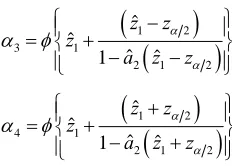
Thus a
100 1
%
Bias-corrected and accelerated
bootstrap (BCaB) Confidence Interval of intensities
1,
2
are constructed by
ˆ
1N
1
1,
ˆ
1N
1
2
(31)
ˆ
2M
1
3,
ˆ
2M
1
4
(32)
where
0 2 1 01 0 2
ˆ
ˆ
ˆ
ˆ
1
z
z
z
a z
z
0 2 2 01 0 2
ˆ
ˆ
ˆ
ˆ
1
z
z
z
a z
z
1 2 3 12 1 2
ˆ
ˆ
ˆ
ˆ
1
z
z
z
a z
z
1 2 4 12 1 2
ˆ
ˆ
ˆ
ˆ
1
z
z
z
a z
z
7. Simulation Study
To evaluate performances of the different interval
esti-mation approaches mentioned above for an open
queue-ing network with feedback usqueue-ing short run data, a
nu-merical simulation study was undertaken. Most of the
statisticians assess performances of interval estimations
in terms of coverage percentages or average lengths of
confidence intervals. However, through simulation study
in the research work, we find that larger coverage
per-centages of confidence interval may often be due to
wider standard deviation of interval estimation methods.
Moreover, narrower confidence intervals may often lead
to smaller coverage percentages. Hence, both coverage
percentage and average length are not efficient for
ap-praising interval estimation methods. In order to
over-come above two shortcomings, we propose a measure
called relative coverage to evaluate performances of
in-terval estimation methods where,
Coverage percentage
Relative coverage
Average length
.
The larger of the relative coverage implies the better
performance of the corresponding confidence interval. In
order to reach this goal, we set a continuous distribution
with mean
1
on inter-arrival time X
1and X
2. Also set
continuous distribution with mean
1
1on the service
time
Y
1at CPU node and continuous distribution with
mean
1
2on the service time Y
2at I/O node. The
lev-els of p
0considered in the simulation study are 0.1 to 0.9
where as levels of p
1are 0.9 to 0.1, where p
0is the
prob-ability that the job departs from the system and p
1is the
probability that after service completion at CPU node, the
job proceeds to the I/O node. This means with probability
0
0.1
p
the job departs from the system and with
probability
p
1
0.9
, after service completion at CPU
node, the job proceeds to the I/O node and so on. Also we
have considered the values of
1and
2such that
1
1
[image:6.595.364.480.84.167.2] [image:6.595.58.288.168.501.2]
and
2
1
for simulation study. Note that in
Table 1
wherever
1
1
and
2
1
such values of
1
and
2are not considered for simulation study.
The intensity parameters
1and
2are calculated
using Equation (1). The different values of
,
µ
1,
µ
2,
p
0and p
1are considered for simulation study as shown in
Table 1
.
Table 1. Different levels of intensity parameters considered in the simulation study.
λ = 0.1, µ1 = 1, µ2 = 1 λ = 0.1, µ1 = 1, µ2 = 2 λ = 0.1, µ1 = 2, µ2 = 1
p0 p1 ρ1 ρ2 p0 p1 ρ1 ρ2 p0 p1 ρ1 ρ2
0.1 0.9 1 0.9 0.1 0.9 1 0.45 0.1 0.9 0.5 0.9
0.2 0.8 0.5 0.4 0.2 0.8 0.5 0.2 0.2 0.8 0.25 0.4
0.3 0.7 0.33 0.23 0.3 0.7 0.33 0.12 0.3 0.7 0.17 0.23
0.4 0.6 0.25 0.15 0.4 0.6 0.25 0.08 0.4 0.6 0.13 0.15
0.5 0.5 0.2 0.1 0.5 0.5 0.2 0.05 0.5 0.5 0.1 0.1
0.6 0.4 0.17 0.07 0.6 0.4 0.17 0.03 0.6 0.4 0.08 0.07
0.7 0.3 0.14 0.04 0.7 0.3 0.14 0.02 0.7 0.3 0.07 0.04
0.8 0.2 0.13 0.03 0.8 0.2 0.13 0.01 0.8 0.2 0.06 0.03
0.9 0.1 0.11 0.01 0.9 0.1 0.11 0.01 0.9 0.1 0.06 0.01
λ = 0.5, µ1 = 1, µ2 = 1 λ = 0.5, µ1 = 1, µ2 = 2 λ = 0.5, µ1 = 2, µ2 = 1
p0 p1 ρ1 ρ2 p0 p1 ρ1 ρ2 p0 p1 ρ1 ρ2
0.1 0.9 5 4.5 0.1 0.9 5 2.25 0.1 0.9 2.5 4.5
0.2 0.8 2.5 2 0.2 0.8 2.5 1 0.2 0.8 1.25 2
0.3 0.7 1.67 1.17 0.3 0.7 1.67 0.58 0.3 0.7 0.83 1.17
0.4 0.6 1.25 0.75 0.4 0.6 1.25 0.38 0.4 0.6 0.63 0.75
0.5 0.5 1 0.5 0.5 0.5 1 0.25 0.5 0.5 0.5 0.5
0.6 0.4 0.83 0.33 0.6 0.4 0.83 0.17 0.6 0.4 0.42 0.33
0.7 0.3 0.71 0.21 0.7 0.3 0.71 0.11 0.7 0.3 0.36 0.21
0.8 0.2 0.63 0.13 0.8 0.2 0.63 0.06 0.8 0.2 0.31 0.13
0.9 0.1 0.56 0.06 0.9 0.1 0.56 0.03 0.9 0.1 0.28 0.06
λ = 0.9, µ1 = 1, µ2 = 1 λ = 0.9, µ1 = 1, µ2 = 2 λ = 0.9, µ1 = 2, µ2 = 1
p0 p1 ρ1 ρ2 p0 p1 ρ1 ρ2 p0 p1 ρ1 ρ2
0.1 0.9 9 8.1 0.1 0.9 9 4.05 0.1 0.9 4.5 8.1
0.2 0.8 4.5 3.6 0.2 0.8 4.5 1.8 0.2 0.8 2.25 3.6
0.3 0.7 3 2.1 0.3 0.7 3 1.05 0.3 0.7 1.5 2.1
0.4 0.6 2.25 1.35 0.4 0.6 2.25 0.68 0.4 0.6 1.13 1.35
0.5 0.5 1.8 0.9 0.5 0.5 1.8 0.45 0.5 0.5 0.9 0.9
0.6 0.4 1.5 0.6 0.6 0.4 1.5 0.3 0.6 0.4 0.75 0.6
0.7 0.3 1.29 0.39 0.7 0.3 1.29 0.19 0.7 0.3 0.64 0.39
0.8 0.2 1.13 0.23 0.8 0.2 1.13 0.11 0.8 0.2 0.56 0.23
0.9 0.1 1 0.1 0.9 0.1 1 0.05 0.9 0.1 0.5 0.1
0 12
,
,
0 1np Y
p Y
are drawn from X
1and Y
1respectively.
Also for each level of
2random samples of inter-ar-
rival times
p X
1 21,
p X
1 22,
,
p X
1 2mand service times
0 21
,
0 22,
,
0 2mp Y
p Y
p Y
are drawn from X
2and Y
2respec-tively. Next N = 1000 bootstrap resamples each of size n
and m = 10, 20, 29 are drawn from the original samples,
as well as N = 1000 BB replications are simulated for the
original samples. According to Equations (10), (11), (15),
(19), (23), (27)-(29), (31) and (32) in respective, we
ob-tain CAN1, CAN2, SB1, SB2, BB1, BB2, PB1, PB2,
BCaB1 and BCaB2 confidence intervals of intensities
1and
2with confidence level 90%. The above
simula-tion process is replicated N
= 1000 times and we
com-pute coverage percentages, average lengths and relative
coverage of the above mentioned confidence intervals.
We utilize a PC Dual Core and apply Matlab
®7.0.1 to
accomplish all simulations.
Here
M represents exponential distribution, E
4a 4-
stage Erlang distribution,
4Pe
H
a 4-stage hyper-expo-
nential distribution and
4Po
H
a 4-stage hypo-exponen-
tial distribution.
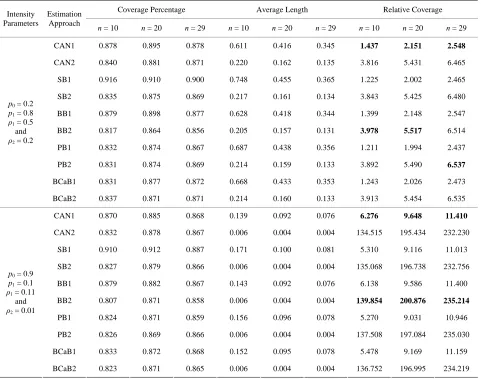
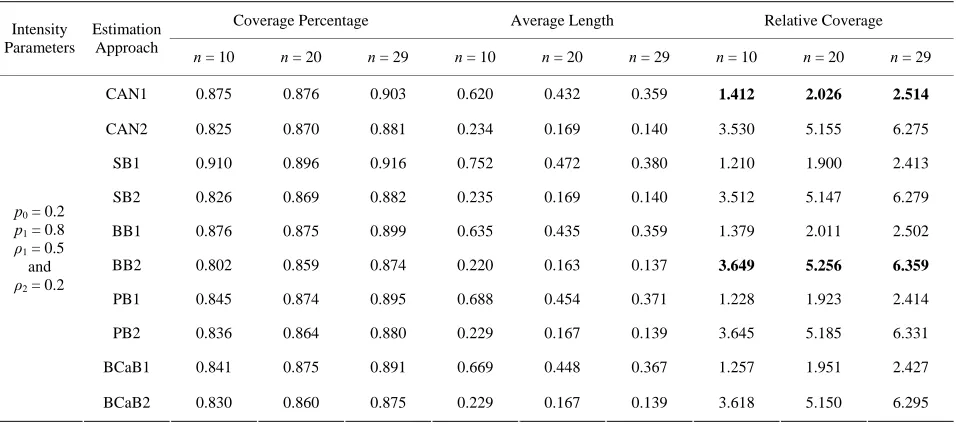
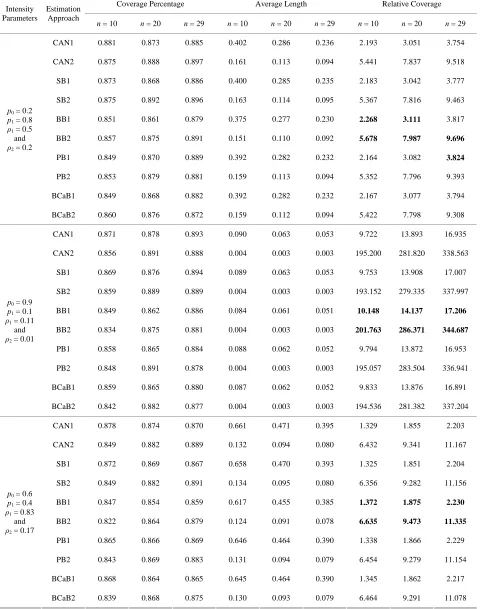
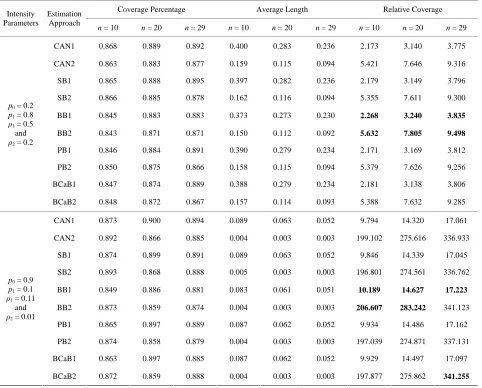
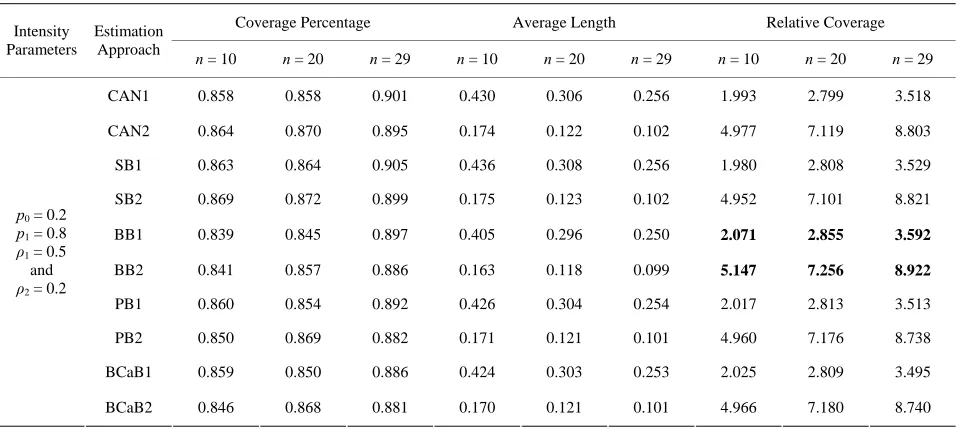
Based on the above mentioned interval estimation
ap-proaches, the coverage percentage, average lengths and
relative coverage of intensities
1and
2are shown in
[image:8.595.312.537.210.313.2]Tables 3
to
7
for queueing network models (presented in
Table 2
) with short run data, we find that average lengths
Table 2. Different queueing network models simulated for study.
Queueing Networks Models Simulated
41
M E to E M4 1
1
M G to G M 1
4 1
Pe
M H to 4 1
Pe
H M
4 4 1
Pe
E H to 4 41
Pe
H E
4 4 1
Po
E H to 4 4 1
Po
H E
1
G G to G G1
4 4 1
Pe Po
H H to 4 4 1
Po Pe
[image:8.595.59.540.356.735.2]H H
Table 3. Simulation results of coverage percentage, average lengths, and relative coverage for 90% confidence intervals un-der queueing network. M E4 1 to E4 M 1.
Coverage Percentage Average Length Relative Coverage Intensity
Parameters
Estimation Approach n
= 10 n = 20 n = 29 n = 10 n = 20 n = 29 n = 10 n = 20 n = 29 CAN1 0.878 0.895 0.878 0.611 0.416 0.345 1.437 2.151 2.548
CAN2 0.840 0.881 0.871 0.220 0.162 0.135 3.816 5.431 6.465 SB1 0.916 0.910 0.900 0.748 0.455 0.365 1.225 2.002 2.465 SB2 0.835 0.875 0.869 0.217 0.161 0.134 3.843 5.425 6.480 BB1 0.879 0.898 0.877 0.628 0.418 0.344 1.399 2.148 2.547 BB2 0.817 0.864 0.856 0.205 0.157 0.131 3.978 5.517 6.514 PB1 0.832 0.874 0.867 0.687 0.438 0.356 1.211 1.994 2.437 PB2 0.831 0.874 0.869 0.214 0.159 0.133 3.892 5.490 6.537
BCaB1 0.831 0.877 0.872 0.668 0.433 0.353 1.243 2.026 2.473
p0 = 0.2
p1 = 0.8
ρ1 = 0.5
and
ρ2 = 0.2
BCaB2 0.837 0.871 0.871 0.214 0.160 0.133 3.913 5.454 6.535 CAN1 0.870 0.885 0.868 0.139 0.092 0.076 6.276 9.648 11.410
CAN2 0.832 0.878 0.867 0.006 0.004 0.004 134.515 195.434 232.230 SB1 0.910 0.912 0.887 0.171 0.100 0.081 5.310 9.116 11.013 SB2 0.827 0.879 0.866 0.006 0.004 0.004 135.068 196.738 232.756 BB1 0.879 0.882 0.867 0.143 0.092 0.076 6.138 9.586 11.400 BB2 0.807 0.871 0.858 0.006 0.004 0.004 139.854 200.876 235.214
PB1 0.824 0.871 0.859 0.156 0.096 0.078 5.270 9.031 10.946 PB2 0.826 0.869 0.866 0.006 0.004 0.004 137.508 197.084 235.030 BCaB1 0.833 0.872 0.868 0.152 0.095 0.078 5.478 9.169 11.159
p0 = 0.9
p1 = 0.1
ρ1 = 0.11
and
ρ2 = 0.01
Continued
CAN1 0.851 0.876 0.866 1.012 0.697 0.579 0.841 1.258 1.496
CAN2 0.829 0.891 0.891 0.186 0.135 0.112 4.459 6.600 7.935
SB1 0.893 0.894 0.882 1.249 0.760 0.613 0.715 1.176 1.438
SB2 0.826 0.890 0.887 0.184 0.134 0.112 4.492 6.631 7.925
BB1 0.856 0.879 0.865 1.045 0.700 0.578 0.819 1.256 1.496
BB2 0.814 0.886 0.878 0.173 0.131 0.110 4.693 6.783 8.010
PB1 0.827 0.866 0.848 1.135 0.732 0.598 0.729 1.184 1.418
PB2 0.830 0.884 0.886 0.181 0.132 0.111 4.595 6.673 7.993
BCaB1 0.827 0.866 0.848 1.108 0.722 0.593 0.747 1.199 1.431
p0 = 0.6
p1 = 0.4
ρ1 = 0.83
and
ρ2 = 0.17
BCaB2 0.824 0.883 0.881 0.181 0.133 0.111 4.553 6.636 7.934
CAN1 0.882 0.891 0.879 0.682 0.470 0.384 1.293 1.895 2.286
CAN2 0.859 0.861 0.875 0.031 0.022 0.019 27.501 38.453 46.779
SB1 0.915 0.912 0.893 0.841 0.515 0.408 1.088 1.771 2.189
SB2 0.850 0.858 0.873 0.031 0.022 0.019 27.505 38.524 46.903
BB1 0.889 0.892 0.878 0.704 0.472 0.385 1.262 1.889 2.283
BB2 0.831 0.850 0.867 0.029 0.022 0.018 28.516 39.337 47.492
PB1 0.847 0.861 0.852 0.767 0.496 0.397 1.104 1.737 2.144
PB2 0.850 0.848 0.877 0.030 0.022 0.018 28.019 38.473 47.602
BCaB1 0.846 0.856 0.852 0.746 0.490 0.394 1.133 1.749 2.163
p0 = 0.9
p1 = 0.1
ρ1 = 0.56
and
ρ2 = 0.03
BCaB2 0.857 0.850 0.877 0.030 0.022 0.018 28.158 38.438 47.496
CAN1 0.842 0.893 0.880 0.588 0.418 0.342 1.431 2.138 2.570
CAN2 0.842 0.856 0.879 1.016 0.730 0.618 0.829 1.173 1.423
SB1 0.894 0.909 0.899 0.716 0.456 0.362 1.249 1.993 2.481
SB2 0.839 0.856 0.877 1.005 0.725 0.615 0.835 1.181 1.425
BB1 0.850 0.890 0.875 0.605 0.420 0.342 1.406 2.119 2.560
BB2 0.830 0.847 0.874 0.948 0.705 0.603 0.875 1.201 1.449
PB1 0.810 0.866 0.874 0.658 0.439 0.353 1.230 1.972 2.475
PB2 0.834 0.846 0.870 0.986 0.717 0.610 0.846 1.180 1.427
BCaB1 0.810 0.865 0.875 0.639 0.433 0.349 1.267 1.998 2.504
p0 = 0.1
p1 = 0.9
ρ1 = 0.5
and
ρ2 = 0.9
Continued
CAN1 0.841 0.868 0.878 0.764 0.523 0.431 1.101 1.659 2.037
CAN2 0.851 0.863 0.875 0.837 0.600 0.505 1.016 1.439 1.732 SB1 0.891 0.888 0.890 0.944 0.572 0.455 0.944 1.552 1.955 SB2 0.850 0.859 0.875 0.828 0.596 0.503 1.026 1.440 1.739 BB1 0.849 0.871 0.873 0.790 0.526 0.431 1.075 1.657 2.025 BB2 0.832 0.849 0.864 0.781 0.580 0.494 1.066 1.465 1.748 PB1 0.810 0.849 0.863 0.864 0.551 0.444 0.937 1.540 1.943 PB2 0.843 0.854 0.881 0.813 0.589 0.498 1.037 1.449 1.767
BCaB1 0.817 0.853 0.862 0.840 0.544 0.441 0.973 1.569 1.957
p0 = 0.4
p1 = 0.6
ρ1 = 0.63
and
ρ2 = 0.75
BCaB2 0.841 0.854 0.869 0.814 0.592 0.499 1.033 1.443 1.740
CAN1 0.853 0.887 0.896 0.334 0.231 0.193 2.554 3.841 4.639 CAN2 0.831 0.873 0.862 0.063 0.045 0.037 13.279 19.278 23.249
SB1 0.893 0.906 0.911 0.411 0.251 0.205 2.171 3.611 4.452 SB2 0.828 0.869 0.859 0.062 0.045 0.037 13.405 19.311 23.232 BB1 0.856 0.890 0.897 0.345 0.232 0.193 2.484 3.844 4.645
BB2 0.815 0.861 0.861 0.058 0.044 0.036 13.972 19.708 23.773
PB1 0.824 0.858 0.877 0.377 0.242 0.199 2.187 3.546 4.398 PB2 0.838 0.872 0.861 0.061 0.044 0.037 13.825 19.620 23.521 BCaB1 0.830 0.857 0.880 0.364 0.238 0.198 2.278 3.595 4.449
p0 = 0.9
p1 = 0.1
ρ1 = 0.28
and
ρ2 = 0.06
BCaB2 0.837 0.873 0.862 0.061 0.045 0.037 13.803 19.574 23.512
[image:10.595.60.538.522.734.2]Note that: 1) boldface denotes the greatest relative coverage among the five estimation approach; 2) Confidence intervals of ρ1 under different estimation ap-proaches are denoted by CAN1, SB1, BB1, PB1 and BCaB1; 3) Confidence intervals of ρ2 under different estimation approaches are denoted by CAN2, SB2, BB2, PB2 and BCaB2.
Table 4. Simulation results of coverage percentage, average lengths, and relative coverage for 90% confidence intervals un-der queueing network. 4Pe 1
M H to 4Pe 1
H M .
Coverage Percentage Average Length Relative Coverage Intensity
Parameters
Estimation Approach n
= 10 n = 20 n = 29 n = 10 n = 20 n = 29 n = 10 n = 20 n = 29
CAN1 0.875 0.876 0.903 0.620 0.432 0.359 1.412 2.026 2.514
CAN2 0.825 0.870 0.881 0.234 0.169 0.140 3.530 5.155 6.275 SB1 0.910 0.896 0.916 0.752 0.472 0.380 1.210 1.900 2.413 SB2 0.826 0.869 0.882 0.235 0.169 0.140 3.512 5.147 6.279 BB1 0.876 0.875 0.899 0.635 0.435 0.359 1.379 2.011 2.502 BB2 0.802 0.859 0.874 0.220 0.163 0.137 3.649 5.256 6.359
PB1 0.845 0.874 0.895 0.688 0.454 0.371 1.228 1.923 2.414 PB2 0.836 0.864 0.880 0.229 0.167 0.139 3.645 5.185 6.331 BCaB1 0.841 0.875 0.891 0.669 0.448 0.367 1.257 1.951 2.427
p0 = 0.2
p1 = 0.8
ρ1 = 0.5
and
ρ2 = 0.2
Continued
CAN1 0.887 0.900 0.885 0.140 0.097 0.080 6.315 9.299 11.041
CAN2 0.824 0.866 0.884 0.006 0.005 0.004 127.283 186.510 225.524
SB1 0.911 0.917 0.904 0.171 0.105 0.085 5.313 8.711 10.681
SB2 0.824 0.863 0.885 0.006 0.005 0.004 127.040 185.644 225.329
BB1 0.894 0.901 0.885 0.145 0.097 0.080 6.166 9.256 11.057
BB2 0.805 0.855 0.879 0.006 0.005 0.004 132.218 189.933 229.041
PB1 0.852 0.872 0.881 0.157 0.102 0.083 5.429 8.588 10.676
PB2 0.815 0.851 0.890 0.006 0.005 0.004 128.530 185.849 229.244
BCaB1 0.856 0.877 0.882 0.152 0.100 0.082 5.622 8.761 10.783
p0 = 0.9
p1 = 0.1
ρ1 = 0.11
and
ρ2 = 0.01
BCaB2 0.812 0.860 0.889 0.006 0.005 0.004 127.997 187.752 228.755
CAN1 0.871 0.883 0.876 1.082 0.730 0.599 0.805 1.209 1.463
CAN2 0.834 0.873 0.897 0.199 0.143 0.117 4.186 6.097 7.688
SB1 0.904 0.904 0.896 1.339 0.795 0.633 0.675 1.137 1.415
SB2 0.831 0.872 0.896 0.200 0.144 0.117 4.156 6.075 7.668
BB1 0.879 0.884 0.878 1.118 0.734 0.599 0.786 1.205 1.467
BB2 0.816 0.863 0.889 0.187 0.139 0.114 4.362 6.218 7.780
PB1 0.837 0.858 0.870 1.223 0.766 0.618 0.685 1.120 1.409
PB2 0.824 0.869 0.895 0.195 0.142 0.116 4.219 6.140 7.746
BCaB1 0.843 0.855 0.872 1.183 0.756 0.611 0.712 1.131 1.426
p0 = 0.6
p1 = 0.4
ρ1 = 0.83
and
ρ2 = 0.17
BCaB2 0.816 0.866 0.890 0.196 0.142 0.116 4.172 6.110 7.690
CAN1 0.866 0.880 0.874 0.700 0.489 0.399 1.238 1.800 2.192
CAN2 0.837 0.868 0.894 0.032 0.023 0.020 26.164 37.301 44.908
SB1 0.897 0.900 0.896 0.855 0.532 0.421 1.049 1.691 2.126
SB2 0.828 0.871 0.898 0.032 0.023 0.020 25.819 37.366 44.974
BB1 0.870 0.881 0.880 0.720 0.492 0.398 1.209 1.790 2.211
BB2 0.807 0.860 0.889 0.030 0.023 0.019 26.877 38.147 45.675
PB1 0.844 0.868 0.864 0.784 0.513 0.411 1.076 1.693 2.103
PB2 0.827 0.872 0.897 0.031 0.023 0.020 26.381 37.956 45.425
BCaB1 0.845 0.868 0.865 0.763 0.506 0.407 1.107 1.716 2.123
p0 = 0.9
p1 = 0.1
ρ1 = 0.56
and
ρ2 = 0.03
Continued
CAN1 0.859 0.889 0.901 0.629 0.434 0.363 1.366 2.046 2.483
CAN2 0.863 0.888 0.875 1.045 0.748 0.628 0.826 1.188 1.394
SB1 0.908 0.911 0.918 0.776 0.473 0.384 1.170 1.927 2.391
SB2 0.860 0.887 0.880 1.049 0.749 0.628 0.820 1.184 1.400
BB1 0.861 0.890 0.903 0.649 0.437 0.363 1.326 2.037 2.491
BB2 0.845 0.875 0.865 0.981 0.724 0.614 0.861 1.208 1.409
PB1 0.831 0.866 0.895 0.706 0.456 0.375 1.178 1.899 2.390
PB2 0.855 0.885 0.866 1.027 0.738 0.622 0.833 1.199 1.393
BCaB1 0.839 0.865 0.892 0.687 0.451 0.371 1.221 1.919 2.404
p0 = 0.1
p1 = 0.9
ρ1 = 0.5
and
ρ2 = 0.9
BCaB2 0.851 0.886 0.868 1.026 0.739 0.622 0.829 1.198 1.395
CAN1 0.881 0.899 0.900 0.778 0.551 0.451 1.133 1.632 1.995
CAN2 0.848 0.879 0.862 0.884 0.635 0.529 0.959 1.385 1.629
SB1 0.909 0.920 0.913 0.954 0.601 0.478 0.953 1.532 1.912
SB2 0.843 0.883 0.862 0.887 0.635 0.530 0.950 1.390 1.627
BB1 0.881 0.900 0.903 0.804 0.554 0.451 1.096 1.624 2.001
BB2 0.831 0.871 0.856 0.831 0.616 0.518 1.000 1.415 1.652
PB1 0.849 0.877 0.891 0.873 0.579 0.466 0.972 1.515 1.913
PB2 0.833 0.884 0.867 0.868 0.626 0.523 0.960 1.412 1.657
BCaB1 0.848 0.888 0.886 0.850 0.570 0.461 0.997 1.558 1.920
p0 = 0.4
p1 = 0.6
ρ1 = 0.63
and
ρ2 = 0.75
BCaB2 0.831 0.874 0.883 0.868 0.628 0.524 0.957 1.392 1.685
CAN1 0.859 0.876 0.891 0.347 0.242 0.200 2.477 3.615 4.452
CAN2 0.849 0.848 0.872 0.067 0.047 0.039 12.746 18.094 22.514
SB1 0.894 0.898 0.902 0.422 0.264 0.212 2.117 3.402 4.263
SB2 0.851 0.845 0.871 0.067 0.047 0.039 12.716 18.010 22.461
BB1 0.861 0.881 0.887 0.357 0.244 0.200 2.415 3.613 4.437
BB2 0.831 0.845 0.867 0.063 0.045 0.038 13.279 18.605 22.872
PB1 0.822 0.860 0.874 0.386 0.254 0.206 2.130 3.382 4.239
PB2 0.848 0.849 0.880 0.065 0.046 0.038 12.964 18.347 22.926
BCaB1 0.828 0.866 0.875 0.375 0.251 0.204 2.207 3.448 4.282
p0 = 0.9
p1 = 0.1
ρ1 = 0.28
and
ρ2 = 0.06
BCaB2 0.849 0.849 0.882 0.066 0.046 0.038 12.959 18.325 22.919