Depression prevention program for workers of private
companies: A randomized controlled trial
Mariko Kawaharada1, Izumi Ueda2*, Eiji Yoshioka3, Michiyo Hirano1, Tamiko Ikeno4, Yukari Shindou1, Reiko Kishi4
1
Department of Comprehensive Development Nursing, Faculty of Health Sciences, Hokkaido University, Sapporo, Japan 2
Graduate School of Health Sciences, Sapporo Medical University, Sapporo, Japan 3
Department of Health Science, Asahikawa Medical College, Asahikawa, Japan 4
Center of Environmental and Health Sciences, Hokkaido University, Sapporo, Japan Email: *[email protected]
Received 29 January 2013; revised 5 March 2013; accepted 14 March 2013
ABSTRACT
Objective: The aim of this study was to examine the effects of a depression prevention program based on stress inoculation training (SIT) for workers of two private companies, by means of a randomized con- trolled trial. Method: Ninety three workers of two private companies were assigned to intervention and control groups, and two sessions were conducted in the intervention group of each company at an interval of four weeks. The sessions included lectures on re- sponses to stress and coping skills, problem-solving training, cognitive restructuring training, relaxation, group discussions and self-monitoring. After com- pleting the sessions, two follow-up letters were sent to the participants at two-month intervals. Data from 38 intervention subjects and 39 control subjects were analyzed. Results: There were no major differences between the variables of intervention subjects and control subjects. After two sessions, there was a mar- ginally significant increase of seeking social support in the intervention group (P = 0.052) and a significant decrease of avoidance in both groups (P < 0.05). Con- cerning the depression score changes, the “Improve- ment” group of the intervention subjects showed an adjusted OR of 6.83 that was higher compared to the control group, indicating a marginally significant dif- ference (P = 0.083). Conclusion: The results suggest the possibility that the SIT-based program of this study was effective for improving coping and pre- venting depression. Further research is necessary to develop a depression prevention program adjusted to gender, individual, occupational and other differences of subjects.
Keywords:Job Stress; Depression; Prevention; Stress
Management; Intervention; Work-Place
1. INTRODUCTION
Depressive illness is projected to be the second leading cause of disability worldwide in 2020 [1]. Job stress is a risk factor for depression as well as for many other kinds of disorders [2,3]. The mental health condition of work- ers in Japan is deteriorating and mental health at work- places is now becoming an important issue. In 2000, the Ministry of Health, Labor and Welfare established the “Guidelines for the promotion of worker’s mental health in the workplace”. The results of a survey carried out among Japanese companies show that the number of workers who suffer psychiatric disorders is increasing in about a half of the companies surveyed [4]. Therefore, mental health is an important workplace issue in Japan. Occupational health nurses conduct counseling for per- sons who experience problems with their mental health conditions, organize stress prevention education activi- ties and perform other kinds of work to protect and pro- mote mental health among workers at Japanese enter- prises [5].
that a cognitive-behavioral approach was the most effec- tive in reducing complaints, improving the perceived quality of work and enhancing psychological resources and responses [7].
Stress management at the workplace is widely ac- claimed, but the results of research into its effects on depression are insufficient [9]. A cognitive-behavioral therapy is known to be effective against psychiatric dis- orders including depression [10-12], but the effect of occupational stress management based on a cognitive- behavioral approach in preventing depression is unclear. Mino et al. carried out intervention among workers in high stress situations in the manufacturing industry, em- ploying a combination of group sessions using cognitive- behavioral programs and individual counseling. As a re- sult, depression improved in the intervention group, dem- onstrating that a stress management program at work- places could help to reduce depression scores [9]. How- ever, the development of stress management programs at workplaces is still rather limited. Along with improving working environments, it is necessary to provide health education offering ways of coping with stress and pre- venting development of depression among workers.
Stress inoculation training (SIT) is one of the major theories that support cognitive-behavioral therapy. It is a multidimensional intervention technique used both for treatment and prevention [13]. SIT consists of three overlapping stages: 1) conceptualization, 2) skill acquisi- tion and rehearsal, and 3) application and follow-through. SIT aims at reducing and preventing stress response by increasing one’s ability to cope with stress through the acquisition of coping skills and rehearsal of such skills in real life. The anxiety levels of teachers and nurses were lowered by SIT in previous studies conducted at work- places [14,15]. In a study carried out among employees of insurance companies, SIT helped increase coping abil- ity levels [16]. Those results suggest that SIT can be ef- fectively used for depression prevention. In 2008, we carried out SIT-based stress management sessions among public servants and showed that SIT could improve stress coping skills [17]. However, that stress manage- ment intervention study had a number of limitations since it targeted only male workers at a public center, used no depression measurement nor was it a random- ized controlled study. The aim of our present study was to examine the effects of a SIT-based depression preven- tion program conducted among male and female em- ployees of two private companies through a randomized controlled trial.
2. METHODS
2.1. Subjects and Study Design
The subjects of this study were 51 (approximately 10%)
employees of a company involved in electrical work and 50 (approximately 10%) employees of a telecommunica- tions company. We asked several private companies es- pecially those which employ occupational health nurse for their staff’s well-being to participate this study. Two of them accepted. The employees of the companies re- ceived written explanations of the purpose and methods of the study and those who expressed their wish to par- ticipate were chosen as subjects. After excluding eight persons who were able to participate only for a limited period of time, the subjects of each company were ran- domly assigned to either an intervention group (n1 = 26, n2 = 21) or control group (n1 = 25, n2 = 21) using a table of random numbers.
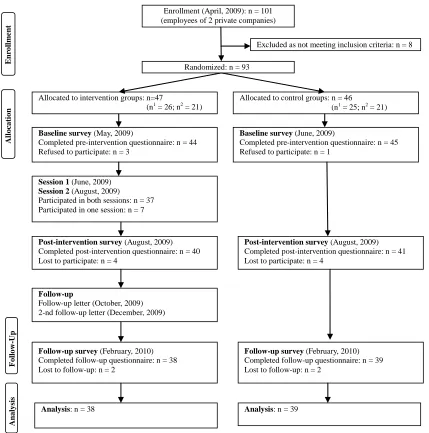
Before starting the intervention in June, 2009, written explanations of the purpose and details of the research were distributed to the subjects along with questionnaires. Two sessions with the intervention subjects were carried with a four-week interval, and two follow-up letters were sent to the participants after completing the sessions at two-month intervals. Forty-four intervention subjects participated in the sessions, with 37 persons (84.1%) attending both sessions. A post-test was conducted im- mediately after the sessions, and a follow-up test was conducted two months after the last letter was sent. Data from 38 intervention group members and data from 39 control group members who had returned all the ques- tionnaires were analyzed (see Figure 1). In the following year, the same sessions were provided for the subjects in the control groups.
2.2. Intervention Program
The SIT-based depression prevention program of this study was developed by our research group. This pro- gram represented an improved version of our previous program and consisted of three phases: education, cogni- tive-behavioral skill development, and application [17]. To increase the participation rate, the number of sessions was decreased from three to two, and the length of each session was increased from 60 min to 90 min. The ses- sions took place during office hours in the meeting rooms of the companies. They included lectures on re- sponses to stress and coping skills, problem-solving training, cognitive restructuring training, relaxation, group discussions and self-monitoring diaries as homework between the sessions [18]. The occupational health nurses acted as instructors during the sessions. The in- structors had acquired necessary skills through training organized by the research group. The instructors con- ducted the sessions based on the detailed health educa- tion guidance and textbooks developed by the research group. One member of the research group took part in
Enrollment (April, 2009): n = 101 (employees of 2 private companies)
Excluded as not meeting inclusion criteria: n = 8
Randomized: n = 93
Allocated to intervention groups: n=47
(n1 = 26; n2 = 21)
Allocated to control groups: n = 46
(n1 = 25; n2 = 21)
Baseline survey (May, 2009)
Completed pre-intervention questionnaire: n = 44 Refused to participate: n = 3
Baseline survey (June, 2009)
Completed pre-intervention questionnaire: n = 45 Refused to participate: n = 1
Session 1 (June, 2009) Session 2 (August, 2009)
Participated in both sessions: n = 37 Participated in one session: n = 7
Post-intervention survey (August, 2009) Completed post-intervention questionnaire: n = 40 Lost to participate: n = 4
Post-intervention survey (August, 2009) Completed post-intervention questionnaire: n = 41 Lost to participate: n = 4
Follow-up
Follow-up letter (October, 2009) 2-nd follow-up letter (December, 2009)
Follow-up survey (February, 2010) Completed follow-up questionnaire: n = 38 Lost to follow-up: n = 2
Follow-up survey (February, 2010) Completed follow-up questionnaire: n = 39 Lost to follow-up: n = 2
Analysis: n = 38 Analysis: n = 39
En
ro
ll
m
en
t
A
llo
ca
ti
on
Fo
ll
o
w-U
p
An
a
ly
si
[image:3.595.85.514.82.515.2]s
Figure 1. Flow of participants through trial.
2.2.1. Session 1
The purpose of the first session was to enhance the sub- jects’ understanding of stress and help them acquire skills for coping with stress. The participants listened to a lec- ture on mental and physical reactions to stress and cop- ing as an intermediate stress factor. Next, they learned skills that would help the participants cope with stress. It consisted of cognitive restructuring and training in prob- lem-solving skills. During the cognitive restructuring, the participants learned to modify the thought that automati- cally occur to them in stressful situations and develop a well-balanced way of thinking using training sheets. Problem-solving training was conducted in pairs, and used the stressful experiences brought up the participants. The subjects were asked to record stressful experiences, their feelings, physical reactions, thoughts, coping ac-
tions and the results of such actions, and whether any better alternatives could be used to cope with each situa- tion.
2.2.2. Session 2
2.2.3. Follow-Up Letters
After completing the sessions, two follow-up letters were sent at two-month intervals to encourage the participants to continue their stress management activities. The fol- low-up letters contained 15-item checklists on how the participants were using the methods of coping they had learned during the two sessions.
2.3. Measurement Scales
2.3.1. Outcome Measures
1) Primary outcome measure
Response to stress was assessed using 20 items from the Japanese version of the Center for Epidemiologic Studies for Depression Scale (CES-D) scored on a four- point Likert scale [19]. CES-D had been used as an out- come measure by Mino et al. to assess a stress-man- agement program based on the cognitive behavioral ap- proach and aimed to prevent depression among workers [9]. This study was based on SIT, one of the methods of cognitive behavioral approach, so we considered it ap- propriate to use CES-D for our stress-management pro- gram assessment. The score range is from 0 to 60. A higher total score means a higher response to stress. Six- teen points or more indicate depression. Cronbach’s al- pha coefficient for CES-D was 0.86.
2) Secondary outcome measures
Coping was assessed using the Ways of Coping Check- list (WCCL) (47 items), scored on a four-point Likert scale (from 1 point to 4 points) [20]. The coping scale had the following six subscales: problem-solving (14 items), positive cognitive coping (10 items), seeking so- cial support (6 items), wishful thinking (6 items), self- blame (4 items), and avoidance (7 items). Higher scores indicate a higher level of coping. Cronbach’s alpha coef- ficient for WCCL was 0.88.
2.3.2. Other Measures
Demographic information on the participants was ob- tained through questions on gender, age and marital sta- tus, regular exercise, working position and working hours per day. The questionnaire also contained items from the Japanese version of the sense of coherence scale (SOC) (13 items) to measure personal ability to manage psychological stressors [21].
2.4. Statistical Analysis
First, the baseline demographic and stress-related vari- ables of the intervention and control subjects were ana- lyzed using χ2
testing and t-testing. Second, intention to treat analysis was performed to ascertain the effects of intervention. These effects were evaluated by comparing depression and the stress-coping skills of the intervention and control subjects at the pre-, post- and follow-up sur-
vey stages. One-way analysis of variance with repeated measurement and Bonferroni multiple comparison pro- cedure were used to test the statistical significance of the intervention effects for each indicator.
Third, the changes in depression scores after the in- tervention were sorted into two groups: “Improvement” (depression (CES-D score 16 points and more)) changing to normal condition (CES-D score 15 points and less) and “No improvement”. Then, logistic regression analy- sis was conducted to obtain odds ratios (OR) and 95% confidence intervals (95% CI) of each group before and after adjustment for workplace. The estimated prevalence OR of the “Improvement” group and its 95% CI were calculated taking the control group as a reference group. A p value of <0.05 was considered to be significant. All analyses were conducted using the SPSS software Ver- sion 18 for Windows. A CONSORT checklist was used to improve the quality of the research [22,23].
2.5. Ethical Considerations
To guarantee anonymity, each participant was asked to create a six-digit ID number and use it instead of his/her name when completing the questionnaires, which were submitted in sealed envelopes and opened directly by the researchers. The study was conducted with permission from and in line with the ethical regulations of the Board of Ethics for Medical Studies at Hokkaido University’s Faculty of Health Sciences.
3. RESULTS
3.1. Comparison of Pre-Survey Variables
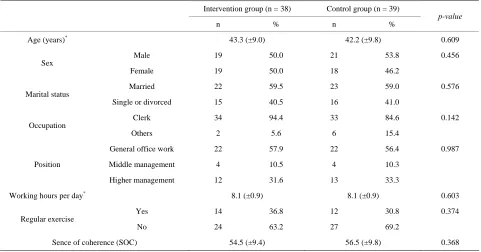
There were no significant differences in the demographic variables between the intervention and control subjects (Table 1). No significant difference was found in coping scores. The average depression scores showed a margin- ally significant difference, with 13.8 points (±6.7) for the intervention subjects and 11.0 points (±6.4) for the con- trol subjects.
3.2. Effects of Intervention among All Participants
Table 1. Demographic variables of participants.
Intervention group (n = 38) Control group (n = 39)
n % n %
p-value
Age (years)* 43.3 (±9.0) 42.2 (±9.8) 0.609
Male 19 50.0 21 53.8 0.456
Sex
Female 19 50.0 18 46.2
Married 22 59.5 23 59.0 0.576
Marital status
Single or divorced 15 40.5 16 41.0
Clerk 34 94.4 33 84.6 0.142
Occupation
Others 2 5.6 6 15.4
General office work 22 57.9 22 56.4 0.987
Middle management 4 10.5 4 10.3
Position
Higher management 12 31.6 13 33.3
Working hours per day* 8.1 (±0.9) 8.1 (±0.9) 0.603
Yes 14 36.8 12 30.8 0.374
Regular exercise
No 24 63.2 27 69.2
Sence of coherence (SOC) 54.5 (±9.4) 56.5 (±9.8) 0.368
*Means ± SD. p values refer to the χ2
test for categorical variables or t-test for continuous variables.
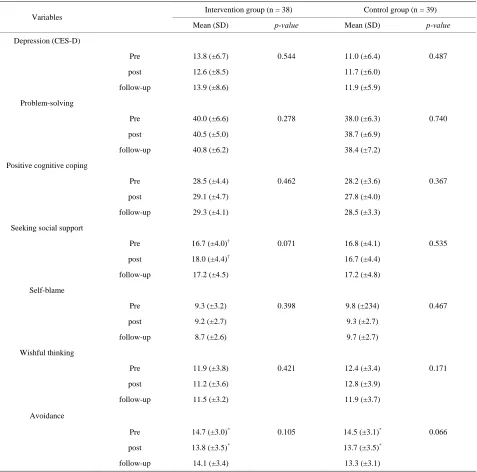
0.011) subjects. There were no significant changes in depression scores between the intervention group and control group.
Table 3 shows intervention effects on CES-D for im- provement change. In post survey, the adjusted OR of the “Improvement” group of the intervention subjects was higher compared to the control group, indicating a mar- ginally significant difference.
4. DISCUSSION
After two sessions, the CES-D scores of the intervention group decreased, but the change was not significant. However, when the depression score changes were sorted into “Improvement” and “No improvement” groups, the “Improvement” group showed an adjusted OR of 6.83 that was higher compared to the control group, indicating a marginally significant difference. The result suggests a possibility of the intervention effect. Group education is less effective than individual coaching, but on the other hand it targets a large number of people and thus plays an important role as preventive education. Though the depression prevention program of this study only in- cluded two sessions there is a possibility it had a certain positive influence on many participants.
Individual differences in stress response depend largely on differences in coping [13,24]. According to the Job Demands-Control-Social support model, social support by seniors and coworkers is an important stress factor, apart from job demand and job control. Social support in
the workplace can diminish the influence of stressors [25]. The number of intervention subjects seeking social support increased in the result of the intervention. One of the reasons explaining the increase might be the effect of the lecture about the importance of social support for coping with stress. In cases where changing a stressful situation is difficult, such as the death of a loved one, temporary avoidance of the stressor is said to be an ef- fective method. However, long-term avoidance could possibly drag out the stressful situation and damage health [13,20]. In a survey conducted by Takaya et al. among workers in Japanese private companies, factor analysis was used to categorize coping attributes into problem-focused coping, emotion-focused active coping and escape-avoidance coping and it was shown that less avoidance led to less stress response [26]. In this study, avoidance scores decreased significantly after two ses- sions both in the intervention and control subjects. These results suggest that the intervention might have helped to reduce avoidance in subjects. The control group did not participate in the sessions, but they, probably, got influ- enced by completing the self-check questionnaires on depression and coping scales and knowing that mental health sessions were held in their workplace.
[image:5.595.58.539.102.354.2]Table 2. Intervention effects on stress coping.
Intervention group (n = 38) Control group (n = 39) Variables
Mean (SD) p-value Mean (SD) p-value
Depression (CES-D)
Pre 13.8 (±6.7) 0.544 11.0 (±6.4) 0.487
post 12.6 (±8.5) 11.7 (±6.0)
follow-up 13.9 (±8.6) 11.9 (±5.9)
Problem-solving
Pre 40.0 (±6.6) 0.278 38.0 (±6.3) 0.740
post 40.5 (±5.0) 38.7 (±6.9)
follow-up 40.8 (±6.2) 38.4 (±7.2)
Positive cognitive coping
Pre 28.5 (±4.4) 0.462 28.2 (±3.6) 0.367
post 29.1 (±4.7) 27.8 (±4.0)
follow-up 29.3 (±4.1) 28.5 (±3.3)
Seeking social support
Pre 16.7 (±4.0)† 0.071 16.8 (±4.1) 0.535
post 18.0 (±4.4)† 16.7 (±4.4)
follow-up 17.2 (±4.5) 17.2 (±4.8)
Self-blame
Pre 9.3 (±3.2) 0.398 9.8 (±234) 0.467
post 9.2 (±2.7) 9.3 (±2.7)
follow-up 8.7 (±2.6) 9.7 (±2.7)
Wishful thinking
Pre 11.9 (±3.8) 0.421 12.4 (±3.4) 0.171
post 11.2 (±3.6) 12.8 (±3.9)
follow-up 11.5 (±3.2) 11.9 (±3.7)
Avoidance
Pre 14.7 (±3.0)* 0.105 14.5 (±3.1)* 0.066
post 13.8 (±3.5)* 13.7 (±3.5)*
follow-up 14.1 (±3.4) 13.3 (±3.1)
Means ± SD. p values refer to one-way analysis of variance. †p < 0.1, *p < 0.05.
Table 3. Intervention effects on CES-D for improvement change.
stage n Improvement Unadjusted OR (95%CI) p-value Adjusted OR (95%CI) p-value
Post survey
Control group 20 1 1.00 1.00
Intervention group 26 6 6.94 (0.79 - 60.71) 0.080 6.83 (0.78 - 59.93) 0.083
Follow-up survey
Control group 17 1 1.00 1.00
Intervention group 21 4 4.75 (0.51 - 44.67) 0.173 4.88 (0.52 - 46.22) 0.167
[image:6.595.61.538.101.573.2]ways of coping. The differences in the results of the two studies may be explained by the differences in the sub- jects and session structures. Umanodan et al. conducted a multi-component worksite stress management training (SIT) among workers of a Japanese steel company that included six 30-minute sessions, with one session per month [27]. In per-protocol analyses of those who at- tended all sessions, significant favorable effects were observed on psychological distress, suggesting that stress prevention education is effective for preventing stress even with short sessions if they are carried out continu- ously. Our previous study included three sessions, but only half of the subjects participated in all of them [17]. In this study we held two sessions and the participation rate increased to 84.1%. In addition, at the third SIT stage of application and follow-through the participants received two follow-up letters concerning stress man- agement [13]. This study did not demonstrate any evi- dent effect on depression prevention but it definitely stimulated the participants’ stress management activities. The limitations of this study must also be mentioned here. First, both the intervention and control subjects were chosen from the same sections, which might have made it possible to exchanged information that influ- enced the results in the control groups. In our further research we need to take measures such as randomized sampling using sections, departments or branches as blocks etc. to prevent the influence of intervention on control subjects. Secondly, the sample size was small. We had planned to recruit subjects from three companies but only two companies agreed to cooperate. Besides, the sample from each company also was rather small and the data of the male and female participants from both com- panies were put together in order to perform analysis by gender. Thirdly, while no differences were found in the variables between the intervention and control groups of the same company, the differences between the compa- nies were not examined. The existence of such differ- ences could have affected the results. Fourthly, the valid- ity of the measurement was insufficient. Depression is only one of the numerous reactions triggered by stress. A measurement dealing with multiple aspects of stress is needed to thoroughly assess effects of an intervention [6].
5. CONCLUSIONS
The SIT-based depression prevention program within this study resulted in a marginally significant increase of seeking social support in the intervention participants and a significant decrease of avoidance after two ses- sions in the intervention and control participants. There was no significant difference between the depression scores before and after the intervention, indicating no
intervention effect on depression. However, when the depression score changes were divided into “Improve- ment” and “No improvement” groups, the “Improve- ment” group showed an adjusted OR of 6.83 after two sessions that was higher compared to the control group, indicating a marginally significant difference. The results suggest the possibility that the SIT-based program of this study was effective for improving coping and preventing depression.
Further research in this field is necessary for develop- ing a simple and effective educational program adjusted to individual, occupational and other differences to pre- vent depression and other mental health problems among Japanese workers.
6. ACKNOWLEDGEMENTS
We would like to thank the occupational health nurses and employees of the targeted companies for their participation in this study. This study was supported by the National Science Foundation of Japan.
REFERENCES
[1] Murray, C.J. and Lopez, A.D. (1997) Global mortality, disability, and the contribution of risk factors: Global burden of disease study. Lancet, 349, 1436-1442.
doi:10.1016/S0140-6736(96)07495-8
[2] Stansfeld, S.A., Fuhrer, R., Shipley, M.J. and Marmot, M.G. (1999) Work characteristics predict psychiatric dis-order: Prospective results from the Whitehall 2 study. Occupational Environment Medicine, 56, 302-307.
doi:10.1136/oem.56.5.302
[3] Xu, W., Hang, J., Cao, T., Shi, R., Zeng, W., Deng, Y., Gao, W., Zhao, Y. and Guo, L. (2010) Job stress and ca-rotid intima-media thickness in Chinese workers. Journal of Occupational Health, 52, 257-262.
doi:10.1539/joh.L9157
[4] Mental Health Research Institute (2010) FY2010 White paper on mental health of industrial workers. Japan Pro-ductivity Center for Socio-Economic Development, To-kyo (in Japanese).
[5] Japanese Ministry of Health, Labor and Welfare (2000) Guideline for promoting mental health of workers at en-terprises. Japanese Ministry of Health, Labor and Welfare, Tokyo (in Japanese).
[6] Murphy, L.R. (1996) Stress management in work settings: A critical review of the health effects. American Journal of Health Promotion, 11, 112-135.
doi:10.4278/0890-1171-11.2.112
[7] van der Klink, J.J.L., Blonk, R.W., Schene, A.H. and van Dijk, F.J.H. (2001) The benefits of interventions for work- related stress. American Journal of Public Health, 91, 270- 276. doi:10.2105/AJPH.91.2.270
[9] Mino, Y., Babazono, A., Tsuda, T. and Yasuda, N. (2006) Can stress management at the workplace prevent depres-sion? A randomized controlled trial. Psychotherapy and Psychosomatics, 75, 177-182. doi:10.1159/000091775
[10] Beck, A.T. (1993) Cognitive therapy: Past, present, and future. Journal of Consulting and Clinical Psychology, 61, 194-198. doi:10.1037/0022-006X.61.2.194
[11] Butler, A.C., Chapman, J.E., Forman, E.M. and Beck, A.T. (2006) The empirical status of cognitive-behavioral therapy: A review of meta-analyses. Clinical Psychology Review, 26, 17-31. doi:10.1016/j.cpr.2005.07.003
[12] Paykel, E.S., Scott, J., Cornwall, P.L., Abbott, R., Crane, C., Pope, M. and Johnson, L. (2005) Duration of relapse prevention after cognitive therapy in residual depression: Follow-up of controlled trial. Psychological Medicine, 35, 59-68. doi:10.1017/S003329170400282X
[13] Meichenbaum, D.H. (1989) Stress Inoculation Training. Plenum Press, New York.
[14] Sharp, J.J. and Forman, S.G. (1985) A comparison of two approaches to anxiety management for teachers. Behav-ioral Therapy, 16, 370-383.
doi:10.1016/S0005-7894(85)80004-6
[15] West, D.L., Horan, J.J. and Games, P.A. (1984) Compo-nent analysis of occupational stress inoculation applied to registered nurses in an acute care hospital setting. Journal of Consulting and Clinical Psychology, 31, 209-218. [16] Gronningsaeter, H., Hytten, K., Skauli, G., Christensen,
C.C. and Ursin, H. (1992) Improved health and coping by physical exercise or cognitive behavioral stress manage-ment-training in a work-environment. Psychology and Health, 7, 147-163. doi:10.1080/08870449208520016
[17] Kawaharada, M., Yoshioka, E., Saijo, Y., Fukui, T., Ueno, T. and Kishi, R. (2009) The effects of a stress inoculation training program for civil servants in Japan: A pilot study of a non-randomized controlled trial. Industrial Health, 47, 173-182. doi:10.2486/indhealth.47.173
[18] Greenberger, D. and Padesky, C.A. (1995) Mind over mood: Change how you feel by changing the way you
think. Guilford Press, New York.
[19] Shima, S., Shikako, T., Kitamura, T. and Asai, M. (1985) New self-rating scales for depression. Psychiatry, 27, 717-723 (in Japanese).
[20] Nakano, K. (1991) The role of coping strategies on psy-chological and physical well-being. Japanese Psychologi-cal Research, 33, 160-167.
[21] Antonovsky, A. (1987) Unraveling the mystery of health: How people manage stress and stay well. Jossey-Bass Publishers, San Francisco.
[22] Tango, I. (2003) Randomized controlled trial: Design and statistical analysis. Asakurashoten, Tokyo (in Japanese).
[23] Schulz, K.F., Altman, D.G. and Moher, D. (2010) CON-SORT 2010 statement update guideline for reporting par-allel group randomized trials. British Medical Journal, 340, c332. doi:10.1136/bmj.c332
[24] Folkman, S. and Lasarus, R. (1985) If it changes it must be a process: Study of an emotion and coping during three stage of a college examination. Journal of Person-ality and Social Psychology, 48, 150-170.
doi:10.1037/0022-3514.48.1.150
[25] Jonson, J.V. and Hall, E.M. (1988) Job strain, work place social support, and cardiovascular disease: A cross-sec- tional study of a random sample of the Swedish working population. American Journal of Public Health, 78, 1336- 1342. doi:10.2105/AJPH.78.10.1336
[26] Takaya, M. and Hasegawa, Y. (2010) An analysis of the relation between stress coping profile and job stress using structural equation modeling (SEM). Sangyo Eiseigaku Zasshi, 52, 209-215 (in Japanese).
doi:10.1539/sangyoeisei.E9011
[27] Umanodan, R., Kobayashi, Y., Nakamura, M., Kitaoka, K., Kawakami, N. and Shimazu, A. (2009) Effects of a worksite stress management training program with six short-hour sessions: A controlled trial among Japanese employees. Journal of Occupational Health, 51, 294-304.