Munich Personal RePEc Archive
The economic efficiency of beef cattle in
extensive system
Iurchevici, Lidia and Chetroiu, Rodica
Research Institute for Agriculture Economy and Rural Development,
Research Institute for Agriculture Economy and Rural Development
20 November 2014
Online at
https://mpra.ub.uni-muenchen.de/61775/
THE ECONOMIC EFFICIENCY OF BEEF CATTLE IN EXTENSIVE
SYSTEM
IURCHEVICI LIDIA1 CHETROIU RODICA 2
Abstract:In Romania there are large areas of unused pasture, which are well suited for the meat breeds and the geo-climatic conditions are favorable for beef. The beef breeds are more profitable than the milk ones. They have a yield of 65-70% cut, the meat quality is very good and the animals are not at all pretentious for food, they consume all plant debris. One advantage is that the growth rate of animals is faster, a calf, for example, can reach in 15-20 months at a weight of 550-650 kg.
Keywords:
cattle, meat, meadow, efficiency
INTRODUCTION
The livestock sector in Romania has passed and still passing through a difficult situation, due to rising of production costs, to competition generated by imports, increasing prices for forages necessary to feed animals, rising prices for energy, fuel and other utilities. Currently, the beef breed is not very common in Romania, livestock being around 29,000 heads, meaning no more than 2.3% of the total number. Romania has a total area of 5 million hectares of pastures and meadows, and the implementation of the systems of raising beef breeds is possible in all areas of the country, including the mountain.
On the other hand, the demand for beef cattle increased and is still growing, while the deficit is increasing from year to year. The solution to reduce the deficit of the beef on European market is transforming grass from Romanian pastures in beef of very good quality.
With the disappearance of milk quotas starting the next year, Romanian farmers are turning to beef breeds, especially because the demand on market increased and consumers have begun to conscious more about the quality of this product, although the beef remains the more expensive. So, in Romania is a real need of raising beef cattle. If until now, most of those who have established beef cattle farms were oriented toward mixed breeds, particularly effective is Aberdeen Angus cattle breed that arouses the interest for many farmers in Romania. Beef, especially from specialized categories, is considered a meat considered as medicine, containing special amino acids and is correspondent in Omega 3 with salmon meat. One advantage is that the growth rate of animals is faster, a calf, for example, can reach in 15-20 months at a weight of 550-650 kg.
The purpose of this paper is to promote the cattle breed Aberdeen Angus that are well suited to pasture, thus naturally achieving a beef production of top quality, with a minimum of concentrates feed.
MATERIAL AND METHOD
The paper is based on estimating the economic efficiency and profitability of raising Aberdeen Angus beef cattle breed, extensive operating system. This breed is more profitable than domestic mixed breeds, the beef quality is very good, has an efficiency of 65-70% cut, the ratio meat / bone is 5: 1 and the animals are not at all pretentious for food, they eat all the vegetal debris. The ideal place for raising beef cattle is hilly mountain area and where the owners of agricultural land do not cultivate these areas.
1
Eng. Iurchevici Lidia – Scientific researcher III, Research Institute for Agriculture Economy and Rural Development, e-mail: [email protected]
2
RESULTS AND DISCUSSIONS
The establishment of farms for raising and fattening cattle from mother cows specialized for beef is a profitable activity, which contributes to increased income from this activity, when seeking to obtain the greatest possible quantity of meat in a short time, with high quality and at a lower production cost.
Calculations have studied a module of 50 head of steers, obtained from mother cows of Aberdeen Angus breed, whose fattening take place on pasture reseeded and plotted, with addition of concentrate fodder with PVM, ensuring the achievement of weight gain of about 1200 g / day / head and a delivery weight of 550 kg / head. The start of fattening is at a weight of about 200 kg / head, until this weight the calves growing near mothers (approx. 5-6 months), all production of milk being used only for breastfeeding. Along with feeding with mother’s milk, the daily ration of calves are gradually introduced different kinds of feed (concentrate, fiber, green forage), in accordance with age. During this period is given food ad libitum, consisting of 20% chopped hay, 50% juicy feed and 30% combined feed. The completing of the food is made with a protein - vitamin - mineral supplement introduced into mixture. In the success of fattening an important role is of proper feeding of calves with mixed feed administrated ad libitum, providing fresh water, salt and microelements bricks for licking.
Fattening in extensive system can take place in several variants: only on pasture, on pasture with addition of green forage from conveyor, on pasture with addition of concentrated supplements, on green forage cut with addition of concentrates etc. Whichever chosen variant, will meet daily some methodological indications:
daily ensuring the mineral supplement required in food, consisting of calcium and salt;
providing water sources on pasture, bowers and troughs needed to ensure the supplement of concentrate food;
grouping animals on pasture on sex and lots, parceling pastures (grazing a plot not being indicated more than 7 days, and during the day of 12-14 hours). Raising is profitable only if the farm has enough land for grazing, but it should be noted that the pasture is not sufficient without over-seeding with clover, trefoil and grasses like fescue, Lolium etc.
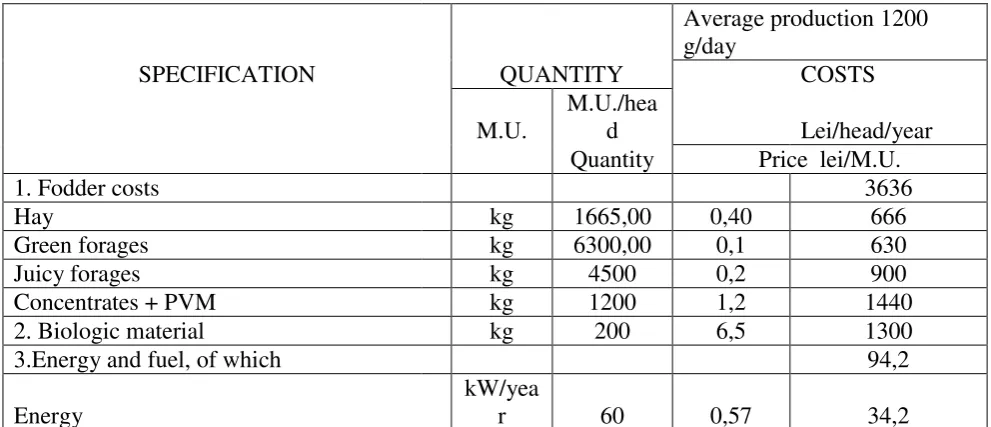
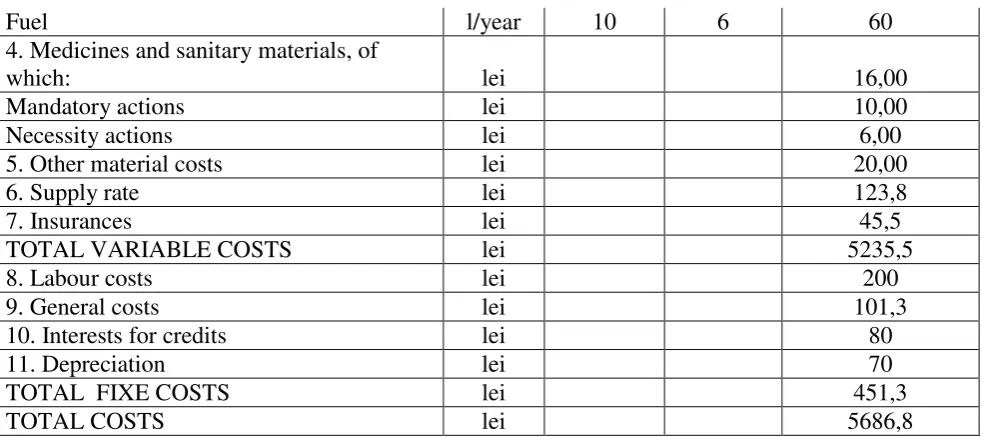
[image:3.595.50.546.564.777.2]On a cultivated pasture, the daily gain may be between 1 and 2 kg. In these conditions, feeding costs have the largest share of the cost of meat, about 64% of total expenditure, while the remaining costs are represented by the value of biological material (22.8%) and other expenses with inputs (medicine, energy and fuels). It is worth noting that, of the total, about 3.9% is the labor costs, since this operating system does not require special care of animals (Table 1).
Table 1 – The estimate of costs of Angus beef breed
Average production 1200 g/day
SPECIFICATION QUANTITY COSTS
M.U.
M.U./hea
d Lei/head/year
Quantity Price lei/M.U.
1. Fodder costs 3636
Hay kg 1665,00 0,40 666
Green forages kg 6300,00 0,1 630
Juicy forages kg 4500 0,2 900
Concentrates + PVM kg 1200 1,2 1440 2. Biologic material kg 200 6,5 1300
3.Energy and fuel, of which 94,2
Energy
kW/yea
Fuel l/year 10 6 60 4. Medicines and sanitary materials, of
which: lei 16,00
Mandatory actions lei 10,00
Necessity actions lei 6,00
5. Other material costs lei 20,00
6. Supply rate lei 123,8
7. Insurances lei 45,5
TOTAL VARIABLE COSTS lei 5235,5
8. Labour costs lei 200
9. General costs lei 101,3
10. Interests for credits lei 80
11. Depreciation lei 70
TOTAL FIXE COSTS lei 451,3
TOTAL COSTS lei 5686,8
[image:4.595.54.546.53.275.2]In order to farm become economically viable, it is necessary to raise at least 50 head, the income obtained from beef cattle being more encouraging when receive subsidy. Thus, since 2012, the farmers from deprived areas have benefited of a financial support of 300 euros per animal, for the breeds with a certificate of origin. At the same time, the steers for fattening may be delivered out generally in countries such as Spain or Greece, at a price of over 3.5 euros per kilogram live that is the price of beef in Romania stores. The local producers could benefit from the deficit of beef on the European market (300,000 tones per year). In addition, it might find a place on the local market, where about 80% of consumption is ensured by imports. The estimates in this study show that the activity of breeding beef cattle from Angus breed is profitable (Table 2).
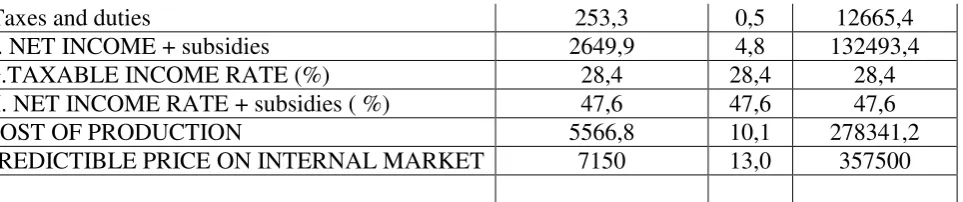
Table 2 – The budget of beef with subsidies for deprived areas
INDICATORS Average production Lei/farm
1200 g/day
Lei/head Lei/kg 50 heads
A. VALUE OF PRODUCTION 7270 13,2 363500 A1. Of which, main production 7150 13,0 357500
B. SUBSIDIES 1320 2,4 66000
C. GROSS PRODUCT 8590 15,6 429500
D. TOTAL COSTS 5686,8 10,3 284341,2 D1Of which for main production* 5566,8 10,1 278341,2 I. VARIABLE COSTS 5235,5 9,5 261775,0
1.Fodder costs 3636 6,6 181800
2.Biologic material 1300 2,4 65000
3.Energy + fuel 94,2 0,2 4710
4.Medicines and sanitary material 16,00 0,0 800 5.Other materials + water 20,00 0,0 1000
6.Supply rate 123,8 0,2 6190,0
7.Insurance 45,5 0,1 2275
II. FIXED COSTS 451,3 0,8 22566,2
-Labour costs 200 0,4 10000
-General costs 101,3 0,2 5066,2
-Interest on credits 80 0,1 4000
-Depreciation 70,0 0,1 3500
Taxes and duties 253,3 0,5 12665,4 F. NET INCOME + subsidies 2649,9 4,8 132493,4 G.TAXABLE INCOME RATE (%) 28,4 28,4 28,4 H. NET INCOME RATE + subsidies ( %) 47,6 47,6 47,6 COST OF PRODUCTION 5566,8 10,1 278341,2 PREDICTIBLE PRICE ON INTERNAL MARKET 7150 13,0 357500
[image:5.595.65.547.55.156.2]The economic efficiency calculations reveal the beef cost and the profit that farmer can get for developing this activity, during a production cycle. Analyzing the data in Table 2, it can be seen that for a steer of 550 kg is spent 5566.8 lei / year and receive 7150 lei and taxable income obtained is 1583.2, which means a rate of taxable profit of 28.4%. By giving subsidies of 300 euro / fattening cattle (equivalent to 1320 lei), the net profit rate increases to 47.6%. Thus, for a 50 head farm, the net income plus subsidy is 132,493.4 lei / year. If the subsidy is only 450 lei / capita, net income plus subsidy is just, 88993.4 lei / head (Table 3).
Table 3 - The budget of beef with subsidies for other areas
INDICATORS Average production Lei/farm
1200 g/day
Lei/head Lei/kg 50 heads
A. VALUE OF PRODUCTION 7270 13,2 363500 A1. Of which, main production 7150 13,0 357500
B. SUBSIDIES 450 0,8 22500
C. GROSS PRODUCT 7720 14,0 386000
D. TOTAL COSTS 5686,8 10,3 284341,2 D1Of which for main production* 5566,8 10,1 278341,2 I. VARIABLE COSTS 5235,5 9,5 261775,0
1.Fodder costs 3636 6,6 181800
2.Biologic material 1300 2,4 65000
3.Energy + fuel 94,2 0,2 4710
4.Medicines and sanitary material 16,00 0,0 800 5.Other materials + water 20,00 0,0 1000
6.Supply rate 123,8 0,2 6190,0
7.Insurance 45,5 0,1 2275
II. FIXED COSTS 451,3 0,8 22566,2
-Labour costs 200 0,4 10000
-General costs 101,3 0,2 5066,2
-Interest on credits 80 0,1 4000
-Depreciation 70,0 0,1 3500
E.TAXABLE INCOME 1583,2 2,9 79158,8 Taxes and duties 253,3 0,5 12665,4 F. NET INCOME + subsidies 1779,9 3,2 88993,4 G.TAXABLE INCOME RATE (%) 28,4 28,4 28,4 H. NET INCOME RATE + subsidies ( %) 32,0 32,0 32,0 COST OF PRODUCTION 5566,8 10,1 278341,2 PREDICTIBLE PRICE ON INTERNAL MARKET 7150 13,0 357500
CONCLUSIONS
Aberdeen Angus beef breed has the best growth potential in Romania (better than the country of origin -Scotland) in the context of drought and lack of forages. Cattle fattened on pasture are a good alternative to conventional fattening (fattening by feeding in the stable).
The extensive fattening of cattle reduces effort, the cattle management is simpler and lower cost compared to usually intensive growth.
Angus cattle have an increased degree of transformation natural forage, high average daily gain (up to 2 kg / day / head), high yield at slaughter (65-70%) and highly appreciated meat.
Also, the breed is well adapted to grazing, achieving a production of the highest quality meat naturally, with a minimum of concentrated forage. It is a long-live breed, living on average 19 years, which means 17 calves. Investments for maintenance and breeding are small, because it is a breed accustomed to adversity.
Raising Angus cattle can be an interesting opportunity for land owners who do not cultivate the land.
Given the need to increase meat production in our country, Angus cattle breed can be used with great efficiency in industrial crosses with our breeds, the disadvantage would be that they can not give the same subsidies (€ 300), as in the case of an animal with certificate of origin.
These grants are awarded following animal identification and registration in the schemes and support measures for farmers in Romania in disadvantaged areas (Annex 4A-PNDR).
The specific support is provided in the form of additional annual payment under the following conditions: holding is entered in the National Register of Holdings (RNE), farmer to have a document certifying the meat breed / hybrid breed eligible and animals must be held in the farm of the beneficiary of financial support, at least a period of 8 months (individual farm register R1760 / 2000).
BIBLIOGRAPHY
1. Proiect ADER 211 - Faza 9 - Studiu privind conservarea eficienţei economice a producţiei vegetale şi
animale, în condiţiile intervenţiilor pentru creşterea performanţelor de mediu, Bucureşti, 2014; 2. Raport tehnic-operativ asupra situaţiei din zootehnie, 31 martie, 2014;
3. Revista Ferma, Creşterea taurinelor în fermele organice şi în conversie, 09.02.2010;
4. Revista Ferma, Aberdeen Angus sprijină fermierii pentru dezvoltarea acestei rase şi hibrizii obţinuţi, 14.04.2014;