http://www.scirp.org/journal/ojmsi ISSN Online: 2327-4026
ISSN Print: 2327-4018
Analyzing Collaborative Development of
E-Commerce and Logistics Based on DEA
Lianhua Wang, Wei Qi, Shi Hui
School of Information, Beijing Wuzi University, Beijing, China
Abstract
In order to know the current collaborative development situation and rela-tionship of E-commerce and logistics, the paper evaluates the whole collabor-ative development level of Chinese E-commerce and logistics from 2008 to 2014 using the DEA model. Fund, infrastructure, labor and collaborative de-velopment are evaluated and analyzed in this model. The research indicates that E-commerce facilitates the logistics development but logistics can’t sup-port E-commerce development well due to the lag effect which leads to lower collaborative development level. So optimizing the ratio of logistics invest-ment and output, promoting logistics service quality and accelerating logistics development have been the key factors for promoting the collaborative devel-opment of E-commerce and logistics.
Keywords
E-Commerce, Logistics, EDA Model, Collaborative Development, Assessment
1. Introduction
E-commerce is a new commerce circulation form with the development of In-ternet, electronic information technology and telecommunications industry. The E-commerce with various products and convenient payment process promotes rapid increase of correspond logistics need. Meanwhile, the development of lo-gistics can facilitate circulation efficiency and customer service which support the development ofE-commerce. However, the gap between E-commerce and logistics is becoming large due to incomplete logistics system, backward infor-mation level and weak infrastructure. The development speed of our national E-commerce is 200% to 300% but the increase rate of logistics development is only 40% according to the data from China E-commerce research center. The unbalanced phenomenon has caused many problems such as the lose of parcels
How to cite this paper: Wang, L.H., Qi, W. and Hui, S. (2017) Analyzing Collabor-ative Development of E-Commerce and Lo- gistics Based on DEA. Open Journal of Mo- delling and Simulation, 5, 158-167.
https://doi.org/10.4236/ojmsi.2017.52011
Received: December 27, 2016 Accepted: April 9, 2017 Published: April 12, 2017 Copyright © 2017 by authors and Scientific Research Publishing Inc. This work is licensed under the Creative Commons Attribution International License (CC BY 4.0).
and spoilage of commodities. So balancing and assessing the relationship be-tween them are essential to form a synergistic development effect.
Now scholars mainly focus on the following three aspects: Firstly, the mutual effect between E-commerce and logistics. About logistics influence on E-com- merce: Aldin, N. [1] analyzed how marketing channels and logistics operation promoted E-commerce development. Colin, J. [2] states logistics which connects sellers and customers is important to push commodities circulation under E- commerce. And about E-commerce influence on logistics, Chen and Zhang [3] think E-commerce enlarges logistics needs and enhances logistics industry status. Wu [4] analyzes influence of E-commerce on logistics from four angles include distribution form, information condition, technology level and service scale; se-condly, logistics development strategies under E-commerce environment. Lu and Cheng [5] put forward strategies from society recognition, infrastructure, development institution and talent based on the analysis between E-commerce and logistics. Cheng and Yang [6] analyzed current problems existed in E- commerce logistics and suggested to build an open, interactive and economic socialization distribution system from the perspective of the whole industry; thirdly, the collaborative development models about E-commerce and logistics [7] [8]. At the beginning of the research, scholars focus more on concrete opera-tion aspects. For example, integrate supply chain, coordinate logistics network and operate different logistics models at the same time. With the deeper research, Jun [9] adds the strategy and policy aspects to the collaborative analysis which perfects system between E-commerce and logistics. In short, now scholars pay more attention to explore effect factors and development models based on qua- litative analysis but ignore quantitative analysis such as specific effect size and degree of collaborative development.
On the base of current practical development status and research achievement author takes the collaborative development status and factors as the main re-search content. In order to assess collaborative development objectively DEA model is used to analyze investment and output efficiency of two industries, re-levant data are collected and assessment indicator system is built. In general, the paper provides theoretical and practical value for pushing collaborative devel-opment between E-commerce and logistics.
2. The Assessment Model of E-Commerce and
Logistics Collaborative Development
2.1. DEA Collaborative Assessment Model
between regional logistics and economics of Sichuan province in recent 10 years. This paper evaluates E-commerce and logistics collaborative development using DEA and summarizes development future at different time. Reasons and im-provement measures are presented according to the assessment result in order to advance two industries collaborative development.
Assuming in a production activity the DEA input vector is
(
)
T1, 2, , m
x= x x x , output vector is y=
(
y y1, 2,,ys)
. So(
x y,)
can be used to denote the wholeactivities.
Assuming that the number of decision making units DMU 1j
(
≤ ≤j n)
for n, there are corresponding input and output variables:(
)
(
)
T 1 2 T 1 2, , , 0 1, 2, , ,
, , , 0 1, 2, , ,
0, 0, 1, 2, , , 1, 2, , .
j j j mj
j j j sj
ij rj
x x x x j n
y y y y j n
x y i m r s
= > =
= > =
> > = =
This means that each decision unit has m types of input and s types on output ,
ij j
x y are j decision making unit in volume of the i type of input and output of the r type of output capacity.
2.1.1. C2R Comprehensive Validity Assessment Model about A System to B System
E-commerce and logistics depend on and promote each other mutually, so the relationship between them can be regarded as the relationship between input and output. In the evaluation using the model [8], the “relative efficiency” of the A system input to the B system output is regarded as the integrated development validity of A system relative B system, Where u, v represents the input and out-put weight vector. The concrete assessment formula as follow:
(
)
(
)
T T T T max ,. . 1,
1, 2, , , 0, 0.
B A B
A
u y h A B
v x
u y s t
v x
j n v u
=
≤
= ≥ ≥
(1)
In C2R model, objective function is the efficiency indicator of 0
j decision
making unit and constraint condition is efficiency index of all the decision making units. At the same time slack variable s+ and the surplus variable s− are brought into linear programming D on the basis of Charnes-Cooper. The colla-borative development validity of system A to system B is θ (A B).
( )
(
)
(
)
0 0 0 1 0 1 min . . .0, 0, 0, 1, 2, ,
n
A Bj Aj A
j n
A Bj Bj B
j A Bj
A B
s t x s x A B
D
x s y
s s j n
1) If the optimal value of Equation (2) is θ =0 1 and 0
0
s −= , s0+ =0,
0
DMUj is efficiency. It means that the inputs and outputs of each DMU reach the optimal state.
2) If the optimal value of Equation (2) is θ =0 1, DMUj0 is weak efficiency.
It shows the need for further adjustment between the two system inputs and outputs.
3) If the optimal value of Equation (2) is θ <0 1, DMUj0 is under have no
efficiency.
2.1.2. C2GS2 Collaborative Validity and Developmental Validity Assessment Model about A System to B System
C2R is used to measure comprehensive validity of collaborative development between two systems which include technology validity and scale validity. Con-crete reason can’t be identified caused by technology invalidity or scale invalidity when the decision making unit j0 is invalid. So C
2GS2 must be introduced to further determine the invalid condition [13]. In this paper, the technical effi-ciency and scale effieffi-ciency are used to represent the collaborative and develop-mental validity of the system, and to judge whether there is scale restriction and low resource utilization in the collaborative of E-commerce and logistics. In or-der to achieve the purpose of promoting collaborative development, for A and B systems, if the input of system A corresponds to the output of system B, the col-laborative validity of system A to system B is σ
(
A B)
, the model as follows:( )
(
)
(
)
0 0 0 1 0 1 1 min . . . 10, 0, 0, 1, 2, ,
n
A Bj Aj A j
n
A Bj Bj B j n A Bj j A Bj A B
s t x s x A B
y s y
D
s s j n
σ λ σ λ λ λ + = − = = + − + = − = = ≥ ≥ ≥ =
∑
∑
∑
(3)1) If the optimal value of Equation (3) is σ =0 1 and 0
0
s− = , s0+=0,
0
DMUj is collaborative efficiency. It shows that the optimal allocation of re-sources and technology utilization.
2) If the optimal value of equation is σ =0 1, DMUj0 is weak collaborative
efficiency. It shows that collaborative resources are underutilized.
3) If the optimal value of equation is σ =0 1, DMUj0 is weak collaborative
efficiency. It shows that collaborative resources are underutilized. The development validity of system A to system B is ϕS
(
A B)
:(
A B)
(
(
A B)
)
.A B
θ ϕ
σ
= (4)
2.1.3. Collaborative Development Model between Two Systems
collaborative development evaluation between two systems we need to combine above two results using DEA model and sustainable development assessment theory [14] among different systems.
(
,)
min{
{
(
(
) (
) (
,)
)
}
}
.max ,
A B B A A B
A B B A
θ θ
θ
θ θ
= (5)
2.2. Building Indicators of Collaborative Development System
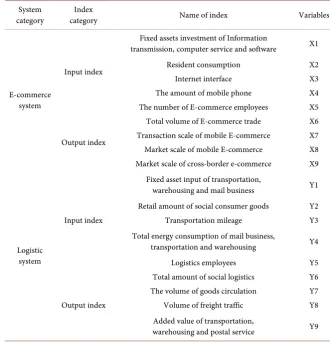
[image:5.595.205.536.391.740.2]In order to measure the collaborative development level of Chinese E-commerce and logistics during different period of time. Two industries need to be divided into correspond subsystem and corresponding indicator system should be built. Firstly, the amount of indicators which can reflect system characteristics com-prehensively need to be simplified; secondly, building the index system prelimi-nary by referring analysis of Huo [15] and He [12], then selecting the most rep-resentative index. Finally, we consider current situation of E-commerce and then add mobile internet factor. The eventual index system is made up of five dimen-sions. They are fund, labor, infrastructure, the whole consumption level and the scale of industry development which were used to measure input and output situation of these two industries (Table 1).
Table 1. Assessment index of collaborative development between E-commerce and logis-tics.
System
category category Index Name of index Variables
E-commerce system
Input index
Fixed assets investment of Information
transmission, computer service and software X1 Resident consumption X2 Internet interface X3 The amount of mobile phone X4 The number of E-commerce employees X5
Output index
Total volume of E-commerce trade X6 Transaction scale of mobile E-commerce X7 Market scale of mobile E-commerce X8 Market scale of cross-border e-commerce X9
Logistic system
Input index
Fixed asset input of transportation,
warehousing and mail business Y1 Retail amount of social consumer goods Y2 Transportation mileage Y3 Total energy consumption of mail business,
transportation and warehousing Y4 Logistics employees Y5
Output index
Total amount of social logistics Y6 The volume of goods circulation Y7 Volume of freight traffic Y8 Added value of transportation,
3. The Analysis of Collaborative Situation
between E-Commerce and Logistics
3.1. Abbreviations and Acronyms
Collaborative development between logistics and E-commerce during 2008 to 2014 will be analyzed and assessed. All the date come from China Statistical Yearbook, Logistics Statistical Yearbook, I Research and China E-Business Re-search Center. However, there is lack of complete statistics in logistics filed; in-dividual data that cannot be obtained requires a simple calculation: transporta-tion mileage is calculated by the sum of railway operating mileage, highway mi-leage, inland waterway mileage and regular flight routes. The whole logistics employees can be presented by direct employees from transport service, storage service and mail business.
3.2. Analysis of Synergy Conditions
The paper use DEA method to calculate the input-output efficiency and find out the effect between E-commerce and logistics industry through software DEAP2.1. In this process, according to the characteristics of the two industries, DEAP2.1 software in the ins file is set to INPUT and VRS for the development of the level of collaboration [16]. The paper can judge that E-commerce and logistics show collaborative development tendency when these two situation are DEA validity.
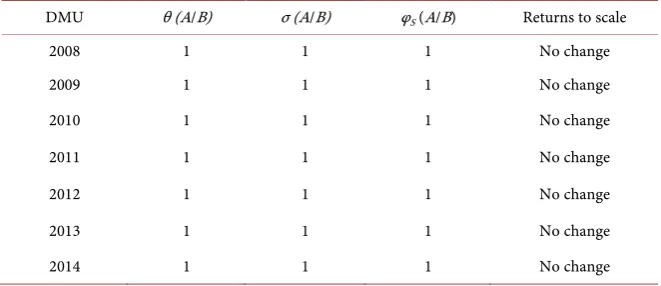
(1) Select E-commerce indicator as input data and logistics as output. The analysis result as shown in Table 2.
Evaluation index of comprehensive efficiency, pure technical efficiency and scale efficiency are all one in DMU model from 2008 to 2014 according to Table 3, which means every evaluation unit shows DEA validity. One phenomenon can be concluded that our country get equivalent increase of logistics scale and rela-tive revenue when enlarge investment to E-commerce. During this process there is no phenomenon of resource waste and insufficient output. During these seven years the origin and development of E-commerce promote logistics development no matter in logistics transportation ability and in logistics market need.
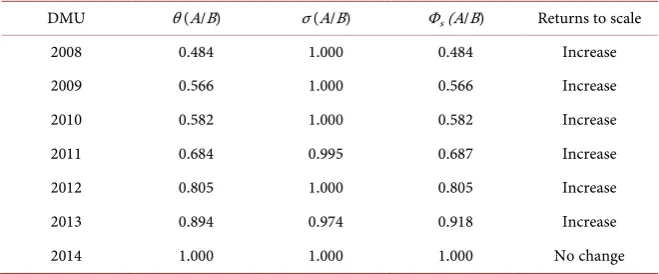
[image:6.595.209.540.592.735.2](2) Select logistics indicator as input data and E-commerce as output. The analysis result as shown in Table 3. Specific redundant balance of investment
Table 2. Analysis result of collaborative development situation.
DMU θ (A/B) σ (A/B) φS (A/B) Returns to scale
Table 3. Analysis result of collaboration development situation.
DMU θ (A/B) σ (A/B) Φs (A/B) Returns to scale
2008 0.484 1.000 0.484 Increase 2009 0.566 1.000 0.566 Increase 2010 0.582 1.000 0.582 Increase 2011 0.684 0.995 0.687 Increase 2012 0.805 1.000 0.805 Increase 2013 0.894 0.974 0.918 Increase 2014 1.000 1.000 1.000 No change
and insufficient balance of output as shown in Table 4.
Comprehensive efficiency is rising continually and input and output efficiency is improving gradually during the whole process, which means collaborative cir- cumstance is optimizing gradually according to the Table 3. Specifically, only 2014 DEA is valid which means relative efficiency of input and output resource reaches balanced state in this system. There is no waste of input resource and de- ficiency of output resource in 2014. But during 2008 to 2013 DEA is invalid which means the infrastructure, technology, management and scale can’t meet the development need of modern logistics. This phenomenon confines the E-com- merce development.
In view of the ineffective year of DEA, it is necessary to further investigate the influence of the pure technical efficiency and scale efficiency on the comprehen-sive efficiency. From the point of view of scale benefit, the state of scale income is increasing from 2008 to 2014 which shows Chinese logistics level can’t meet E-commerce development. We can see the comprehensive efficiency and scale efficiency are less than one and the data shows the scale incomes increasing during 2008, 2009, 2010 and 2012, which means logistics confines E-commerce devel-opment. It’s essential to enlarge resource investment of logistics. From the point of view of technology efficiency, the number of 2008, 2009, 2010 and 2012 are all one, which means the situation of resource allocation and technology utilization is well. Comparing with 2012 and 2013, DEA pure technology efficiency is inva- lid which indicates the utilization of resource is bad and collaborative validity is slow. In order to deal with this problem we’d better to adjust the ratio of input and output. From Table 4, We can find on 2013 fixed assets investment of trans- portation, warehousing and postal service declined by, the total volume of con-sumption retail sales decrease by, transportation mileage reduce by, the energy consumption reduce by, logistics employees reduce by and at the same time shipment turnover volume increase by, volume of goods transported increase by, transportation, storage and postal service increase by. The output efficiency of E- commerce caused by logistics will get efficient promotion and achieve DEA va-lidity.
Table 4. Input redundancy and under capacity.
Category Variables 2008 2009 2010 2011 2012 2013 2014
Redundant balance of logistics input
X1 0 0 0 144.12 0 960.595 0 X2 0 0 0 6220.758 0 13787.502 0 X3 0 0 0 49.602 0 22.693 0 X4 0 0 0 145.362 0 2192.289 0 X5 0 0 0 3.376 0 55.138 0
Deficit of E-commerce
output
Y1 0 0 0 261.189 0 0 0 Y2 0 0 0 1185.25 0 1300.745 0 Y3 0 0 0 702.857 0 3222.008 0 Y4 0 0 0 0 0 811.114 0
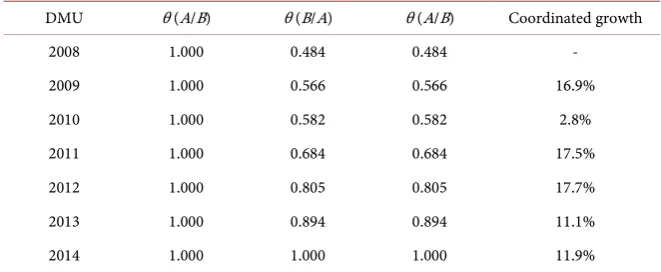
Table 5. Comprehensive analysis of collaboration between E-commerce and logistics.
DMU θ (A/B) θ (B/A) θ (A/B) Coordinated growth 2008 1.000 0.484 0.484 - 2009 1.000 0.566 0.566 16.9% 2010 1.000 0.582 0.582 2.8% 2011 1.000 0.684 0.684 17.5% 2012 1.000 0.805 0.805 17.7% 2013 1.000 0.894 0.894 11.1% 2014 1.000 1.000 1.000 11.9%
On the support of relative policy, fund and infrastructure E-commerce has improved rapidly during 2008 to 2014 according to Table 5. In order to enlarge the needs of logistics and push it develop healthily we must enhance the effi-ciency of logistics service. Even though the comprehensive effieffi-ciency is rising the DEA is still invalid overall. So there is hysteresis effect in logistic development which can’t support E-commerce development.
There exist development speed and scale differences between E-commerce and logistics which lead to worse collaborative level. According to the comprehen-sive analysis of cooperation, logistics can’t follow up E-commerce development which confines E-commerce development. From the point of view of collaborative speed, collaborative difference between E-commerce and logistics is becoming smaller with the high value from government. Now government takes different ac-tions to greatly improve logistics operation ability, circulation efficiency and ser-vice quality. The synergy degree is developing rapidly at the rate of more than 10% except 2010. And eventually E-commerce and logistics development achieved an ideal situation where they promote collaboratively and mutually.
4. Conclusion
[image:8.595.208.539.279.415.2]from 2008 to 2014. The result indicates lower rate of resource utilization and collaborative development. Standing at technology and scale perspective, we find development efficiency and scale of logistics are the key factors for synergy de-velopment. In order to advance logistics and E-commerce collaborative devel-opment, the process of building logistics infrastructure and information Internet should be sped up; the usage efficiency of resource and logistics service quality should be enhanced; logistics service scale should be enlarged; input and output ratio of logistics system should be improved and collaborative development model should be optimized.
Project Funding
Beijing Intelligent Logistics System Collaborative Innovation Center.
References
[1] Aldin, N. and Stahre, F. (2003) Electronic Commerce, Marketing Channels and Lo-gistics Platforms—A Wholesaler Perspective. European Journal of Operational Re-search, 144, 270-279.
[2] Pache, G. and Colin, J. (1999) Exploring the Evolution of the Logistics Channel in Electronic Commerce: A Research Program. Proceedings of the 9th Biennial World Marketing Congress, 5-10.
[3] Chen, D.B. and Zang, J. (2008) The Influence of Electronic Commerce on Modern Logistics. Modern Business Trade Industry, No. 1, 264-265.
[4] Wu, H.G. (2002) The Influence of E-Commerce on China’s Logistics Industry and the Counter-Measures. China Coal, No. 8, 32-33.
[5] Lu, N. and Chen, H.M. (2011) Analysis on the Development Tactics of Logistics Industry under E-Commerce Environment. China Business & Trade, 15, 152-153. [6] Chen, J. and Yang, K.Z. (2001) China Logistics Development Adjusting to E-Com-
merce. Economic Geography, No. 5, 554-558.
[7] Ji, F. and Zang, X.H. (2015) Innovation and Development Trend of Cross-Border E-Commerce Logistics. China Business and Market, No. 6, 14-20.
[8] Lu, J.M., Chen, W. and Cao, S.G. (2016) Research on E-Commerce Logistics Coor-dination Pattern of Fresh Agricultural Products. Prices Monthly, No. 2, 72-75. [9] Ma, J. (2014) Study on Collaborative Development of E-Commerce and Logistics in
China. Logistics Technology, No. 9, 6-7+14.
[10] Du, D., Pang, Q.H. and Wu, Y. (2008) Modern Comprehensive Evaluation Method and Case Selection. Tsinghua University Press, Beijing.
[11] Yang, Y.B. and Li, M.F. (2015) Research on Logistics Efficiency Analysis Based on DEA Model for Beijing, Tianjin and Hebei. Journal of Hebei University of Science and Technology, No. 1, 21-26+64.
[12] He, Y.D. and Ma, Z.J. (2015) Study on CRITIT-DEA for Regional Logistics and Re-gional Economic Coordinated Development Model and Evaluation—A Case Study of Sichuan Province. Soft Science, No. 3, 102-106.
[13] Wang, L., Xue, G.L. and Zang, H.L. (2014) Evaluation of Northern Xinjiang’s Logis-tics Efficiency Based on a DEA Mode. Resources Science, No. 7, 1425-1433.
[15] Hu, Y.F. and Wang, Y.C. (2013) Comparison of E-Commerce Competitiveness of City Commerce Circulation Based on DEA. Management and Administration, No. 6, 71-73.
[16] Wu, X. (2015) Study on Coordinated Development of Logistics and Manufacturing in Guiyang Economic Development Based on DEA. China Journal of Commerce, No. 23, 175-177.
Submit or recommend next manuscript to SCIRP and we will provide best service for you:
Accepting pre-submission inquiries through Email, Facebook, LinkedIn, Twitter, etc. A wide selection of journals (inclusive of 9 subjects, more than 200 journals)
Providing 24-hour high-quality service User-friendly online submission system Fair and swift peer-review system
Efficient typesetting and proofreading procedure
Display of the result of downloads and visits, as well as the number of cited articles Maximum dissemination of your research work