doi:10.4236/wsn.2011.38027 Published Online August 2011 (http://www.SciRP.org/journal/wsn)
Multiple Targets Tracking Using Kinematics in Wireless
Sensor Networks
Akond Ashfaque Ur Rahman1, Atiqul Islam Mollah2, Mahmuda Naznin3
1Software Engineer-Dohatec New Media, Dhaka, Bangladesh 2Quantitative Software Developer-Stochastic Logic, Dhaka, Bangladesh
3Associate Professor-Department of C.S.E., BUET, Dhaka, Bangladesh
E-mail:{ashfaque, atiqul.islam}@csebuet.org, [email protected] Received June 18, 2011; revised July 21, 2011; accepted July 31, 2011
Abstract
Target tracking is considered as one of the cardinal applications of a wireless sensor network. Tracking mul-tiple targets is more challenging than tracking a single target in a wireless sensor network due to targets’ movement in different directions, targets’ speed variations and frequent connectivity failures of low powered sensor nodes. If all the low-powered sensor nodes are kept active in tracking multiple targets coming from different directions of the network, there is high probability of network failure due to wastage of power. It would be more realistic if the tracking area can be reduced so that less number of sensor nodes will be active and therefore, the network will consume less energy. Tracking area can be reduced by using the target’s ki-nematics. There is almost no method to track multiple targets based on targets’ kiki-nematics. In our paper, we propose a distributed tracking method for tracking multiple targets considering targets’ kinematics. We si-mulate our method by a sensor network simulator OMNeT++ and empirical results state that our proposed methodology outperforms traditional tracking algorithms.
Keywords:Wireless Sensor Network, Multiple Targets, Tracking, Target Kinematics
1. Introduction
Now-a-days, from military applications (battlefield sur-veillance and intelligence data acquisition), the use of sensor networks has extended to many civilian, industrial and environmental applications [1-2]. Among the diver-sified applications of sensor networks, target detection is one of the most important applications. In this context, the primary tasks of a sensor network are targets ‘identi-fication and classi‘identi-fication, data acquisition, targets’ track- ing or localizing and data transmission over multi-hop networks [3]. Local information collected from sensor nodes in a particular time frame is used to obtain the global information regarding the location of the target. But due to power constraint and frequent connectivity failure of a sensor network, energy-efficient target track-ing is a very challengtrack-ing problem in the domain of sen-sor networks. Not only we need to ensure the service quality of the network, but also energy consumption should also be minimized. A popular method to optimize energy consumption in target tracking is the minimiza-tion of tracking area; the region which is reachable by a
target from its current position with a certain speed. Pre-vious works such as [4,5] employ this approach to track targets efficiently. But they do not consider multiple types of targets at a single time. In practical scenario, a network has to detect multiple types of targets in a cer-tain time frame. For example, in border surveillance, sensor nodes have to detect multiple targets such as wheeled vehicles or tracked vehicles such as tanks, or biological entities (human, animals). A target tracking methodology is desired to track all targets efficiently, regardless of their types or numbers. In our paper, we propose a novel, distributed, energy efficient multiple targets tracking method which includes target classifica-tion, data acquisition and transmission.
tracking area, we can save energy consumption of the whole network as fewer number of sensor nodes of the tracking area are active. We have tried to reduce the tracking area using heuristics based on overlapping crite-ria. We have considered two ways of how these tracking areas can overlap: one-one and one-two overlapping. In the case of one-one overlapping, the tracking area of one target simultaneously overlaps with one and only one tracking area of one single target. In the case of one-two overlapping, the tracking area of one target simultane-ously overlaps with the tracking area of two targets. We have provided heuristics and later explained those through illustrative figures. We have simulated our algo-rithm using a standard sensor network simulator OM-NeT++ [7] to validate our method. Our proposed method outperforms the traditional circular tracking area based approaches in [4,5]. The remainder of this paper is or-ganized as follows: section 2 describes the related re-search work. In section 3, we give the preliminaries. In section 4, we describe our tracking algorithm in details. In section 5, we report the experimental results and em-pirical analysis in form of tables and graphs. Finally, section 6 gives the summary of our work with a direction of future extension.
2. Related Work
In this section, we discuss some related research work. Bar-Shalom et al. propose a centralized tracking method where each sensor node transmits its sensing information towards a processing node which acts as a central proc-essor and fuses the report collected from all sensing nodes [8]. Then, that processing node performs a long distance transmission to the base station. But, this ap-proach suffers from network latency and synchronization problem, consumes huge amount of bandwidth and eventually introduces a single point of failure. Besides, the central node will be overloaded with computation.
In most of the sensor network applications, scalability is an essential requirement also [3]. It can be achieved by distributed tracking methods. In [4], Zhang et al. provide a distributed, tree based algorithm which they call Dy-namic Convoy Tree based Collaboration (DCTC), where the sensor nodes track a single target. As a target moves along its trajectory, the tree formed by the sensor nodes, is continually reconfigured. Some nodes are added along the predicted path and are pruned if they are not required. Unfortunately, the construction of this convoy tree puts an additional computational overhead over the sensor nodes and it is almost impractical to implement.
In [9], Sikdar et al. use a linear prediction model to track a single target. This prediction model performs tracking based on the previous two observations. Even
though the model can be extended to predict higher order predictions; these approaches require that all the sensor nodes to be kept alive, which eventually minimizes the lifetime of the network.
MCTA (Minimal Contour Tracking Algorithm), pro-posed by Tian He et al. in their paper [5], is also another centralized approach to track multiple targets. In their method, each sensor node is assigned to track a particular type of target which is a four-wheeled vehicle and sen-sors nodes send tracking information to the base station. Their computation is only applicable for tracking a cer-tain type of targets, at a time. If there are other types of targets such as a tank or any biological entity passing through the network field, their algorithm will not be able to track. Therefore, for this approach to work prop-erly, all possible target entities and their kinematics properties must be known.
3. System Architecture and Preliminaries
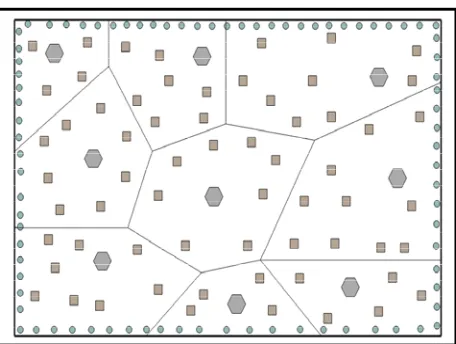
In this section, we describe our assumptions and defini-tions which are relevant to our work. From the perspec-tive of energy levels, we assume that the network sists of two types of sensor nodes. A large portion con-sists of typical low powered sensor nodes and a small number of nodes with higher energy level are randomly deployed. The high energetic nodes provide better con-nectivity support [10]. According to responsibilities, we classify the sensor nodes in to three categories namely, Boundary Node (BN), Worker Node (WN) and Computa-tional Node (CN). The sensor nodes that lie on the boundary of the network field are called BN. We call the high energetic nodes CN, as it will perform the necessary calculations for detection, classification, tracking and sleep-wake scheduling of the low powered sensor nodes. Each CN is capable to relay target information to the base station or to other CNs [10]. A WN senses and transfers the target information. The whole tracking field is mapped into Voronoi polygons with the CN as the Vo-ronoi center [11-13]. We call each Voronoi polygon a cell. Figure 1 describes a typical scenario of the network field. Targets can enter into the network field from any point on the boundary. There may be four types of tar-gets: tracked vehicle, wheeled vehicle, biological entity such as human being and animal.
265
Figure 1. Proposed sensor network. Circles indicate the BNs along the boundary of the tracking field, squares indi-cate the WNs and the hexagons indiindi-cate the CNs.
near about the same time, the presence of targets will not be detected and detection failure rate will increase. This priority based task assignment to the sensor nodes shows an improvement in network energy consumption which is observed by empirical analysis later in section 6. Fo-cusing on energy preserving issue, we assume that we have only one layer of BNs. Now, we define some terms that are needed to explain our tracking method.
Definition A. Refresh Time. The longevity of the tra- cking area is defined as refresh time which implies that the old tracking area be replaced with the new tracking area according to the target’s movement at every refresh time.
Definition B. Traverse Region. is the circular tracking area where the target can visit with its current position, speed and direction during refresh time.
Definition C. Polygon of Interest. By applying target kinematics a certain portion of the Traverse Region is obtained where the target is unable to reach [5]. Omitting the unnecessary tracking area from the Traverse Region results the Polygon of Interest for a particular refresh time.
Definition D. Overlapped Area of Interest. The com-mon region covered by two or more overlapping Polygon of Interests is defined as Overlapped Area of Interest. This situation occurs when more than one target come close.
4. Multiple Targets` Tracking using Polygon
of Interest Algorithm (MTTP)
After detecting targets, to classify targets we use a linear classifier classify the targets described in [16]. Accord-ing to the classification decision provided by the linear classifier, our algorithm MTTP, uses tracking schemes on the basis of target kinematics [6]. Intuitive mathematical
modeling provides the kinematic properties of the targets present in cells. The details of the detection, classifica-tion and mathematical models are available in [16]. The Polygon of Interests is computed by each CN in the rele-vant cell where the target is tracked.
Algorithm 1 MTTP (tracking_field_info) 1. for each CN, ζi in χ do
2. Δi = Create_Self_Cell (ζi);
{Creating cell and eventually partition the whole tracking field into cells dynamically.}
3. Perform_Detection_Job (detection signal from BNs);
{Differentiate between a false alarm and a real target appearance.}
4. Classification_Job (acoustic features from BNs);
{The classifier will classify the targets present in cell Δi. }
5. λi = Know_WNs_Cell (Δi)
6. Get_Kinematics_Info (tracking_info from each active λi);
{Speed, velocity, time for sampling, angle respect to the co-ordinate system will be obtained from this proce-dure.}
7. t = Get_Refresh_Time (v);
8. γtp = Form_Polygon_of_Interest (X, Y, t,
θ, v);
{Using the position, orientation and speed of a target, this module creates the corresponding Polygon of Interest. }
9. Assign_WN_Identity (λi, γtp ); 10. κ = Find_Total(Δi,γtp );
{Determines the total number of Polygon of Interests in the cell.} 11. Overlap (t, κ);
12. Go to 6 13. end for
Algorithm 2 ASSIGN_WN_IDENTITY (λij, γtp) 1. for each λijελi do
2. if (Check_Inclusion(λij, γtp)) then 3. Activate(λij) ;
4. Assign_Identity(λij, γtp) ; 5. else
6. Skip 7. end if 8. end for
tracking field χ, where, ζi ε ζ is the set of CNs in the tracking field χ, and Δiε Δ, is the set of cells formed in the tracking field, χ. Here we consider the total network which will track multiple targets as tracking field. We also assume λijas the jth WN for ithcell Δi, in the tracking field χ, where λijελi, the set of the WNs in ithcell Δi and true for all i = 1. n in χ. Here, n is also the total number of active cells in the tracking field χ, as the number of active cells will be as same as the number of CNs in the tracking field χ. Let us assume k to be the total number of Polygon of Interests present in the ithcell, Δ
i, at time t. Let, γtp be the corresponding Polygon of Interest of target
p at any time t, in tracking field χ andμtp, be the corre-sponding area covered by the Polygon of Interest γtp at time t. The number of active WNs in a Polygon of Inter-est γtp is ηtp, for target p. We also call μtp,k to be the
Overlapped Area of Interest between μtp and μtk, the cor-responding area of Polygon of Interests, γtp and γtk re-spectively.
Algorithm 1 is the main module of MTTP. It provides all the provisions to detect, classify and track multiple targets. Algorithm 2 works as a sub-module to give the identity of the WNs in a Polygon of Interest. Algorithm 3 is associated with overlap detection and calls the corre-sponding modules. Algorithm 4, 5 and 6 are completely responsible for overlap operations.
Algorithm 3 Overlap (t, κ) 1. for q = 1 to κ– 2 2. for w = q + 1 to κ– 1 3. for e = w + 1 to κ
4. if ((( Check_Overlap (γtq, γtw)) && (Check_Overlap (γtq, γte)) && (Check_Overlap (γtw, γte)) = = true)
5. Get overlapped region of the three Poly gon of Interests, γtq ,γtw, γte; let it be denoted as γtq,w,e = γtr.
6. Get overlapped region of the two Polygon of Interests, γtq, γtw; let it be denoted as γtq,w
7.
Get overlapped region of the two Polygon of Interests, γtq , γte; let it be denoted as γtq,e
8.
Get overlapped region of the two Polygon of Interests, γtw, γte; let it be denoted as γtw,e
9. Simultaneous Overlapping of Three Polygon of Interests (γtq, γtw, γte, γtr,
γtq,w , γtq,e, γtw,e) 10. else
11. Take no action. Report that simultaneous overlapping of
three Polygon of Interests have not occurred.
12. end if 13. end for 14. end for 15. end for 16. for q = 1 to κ– 1 17. for w = q + 1 to κ
18. if ( Check_Overlap (γtq, γtw))
19. Simultaneous Overlapping of Two Polygon of Interests (γtq, γtw) 20. else
Take no action. Report that simultaneous overlapping of two Polygon of Interests have not occurred.
21. end if 22. end for 23. end for
For making WNs awake or asleep, we use the concept of Polygon of Interest with the help of point in polygon algorithm [13]. In case of overlapping, Overlapped Polygon of Interests, are reconstructed on the basis of mutual relativity, in size and properties of the Polygon of Interests. We explore the internal details of our algorithm in this section.
Algorithm 4 Simultaneous Overlapping of Three Polygon of Interests (γta, γtb, γtc, γtd, γte, γtf, γtg)
1. Get the area of the following contours γta , γtb, γtcand
γtd. Let it be denoted as µta, µtb, µtc and µtd respec-tively.
2. Compute γta1, which will be the portion of γta in-cluded in γtd.
3. Compute γtb1, which will be the portion of γtb in-cluded in γtd.
4. Compute γtc1, which will be the portion of γtc in-cluded in γtd.
5. Compute γte1, which will be the portion of γte in-cluded in γtd.
6. Compute γtf1, which will be the portion of γtf in-cluded in γtd.
7. Compute γtg1, which will be the portion of γtg in-cluded in γtd.
8. Compute µta1, µtb1 and µtc1 from γta1, γtb1 and γtc1 re-spectively.
9. Get the updated area µ`ta , µ`tb and µ`tc using µ`ta =
µta – µta1, µ`tb = µtb – µtb1 and µ`tc = µtc – µtc1 respec-tively and update γta, γtb , γtc asγ`ta, γ`tb and γ`tc re-spectively.
267 µte – µte1, µ`tf= µtf – µtf1 and µ`tg = µtg – µtg1
respec-tively and update γte, γtf , γtg as γ`te, γ`tfand γ`tg re-spectively.
11. Calculate ηt1, ηt2 and ηt3 from γ`ta, γ`tb and γ`tc re-spectively.
12. If (ηt1=> 3)
13. Individual Minimization (γ`ta, γ`te, γ`tf) 14. Else
15. Preserve γta. No minimization will take place. Return γta
16. If (ηt2 => 3)
17. Individual Minimization (γ`tb, γ`te, γ`tg) 18. Else
19. Preserve γtb. No minimization will take place. Return γtb
20. If (ηt3 => 3)
21. Individual Minimization (γ`tc, γ`tf, γ`tg) 22. Else
23. Preserve γtc. No minimization will take place. Return γtc
For simplicity, to describe the overlapping issue we consider two Polygon of Interests of two targets at a cer-tain time t. We check overlapping, by relatively detecting the inclusion of one Polygon of Interest into another. The WNs remain completely static during tracking. The Polygon of Interests is reconstructed in such a way that each of the Polygon of Interest possesses the sufficient number of WNs to track the targets. Let two Polygon of Interests be, γta and γtb where μta and μtb, are respectively their areas. The number of WNs in γta and γtb is respec-tively denoted as, ηta and ηtb. We check the inclusion of
γtb, which we call the Compared Polygon of Interest into the Comparing Polygon of Interest, γta. If the inclusion is true we consider the two Polygon of Interests to be over-lapped. Then we calculate the area common between the Polygon of Interests, γta, γtb and denote it as μta,b. We then adjust μtb, which represents the area of Compared
Poly-gon of Interestγtb, by subtracting μta,b from it.ηta, ηtb, ηta,b is also adjusted accordingly. We illustrate three cases based on the value of ηtb .
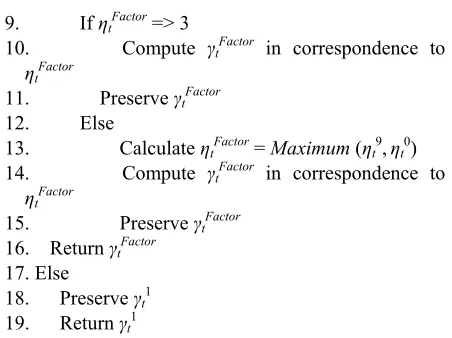
Algorithm 5 Individual Minimization (γt1, γt2, γt3) 1. Compute γtx as the area of γt1 which is included in
the area of γt2
2. Compute γty as the area of γt1 which is included in the area of γt3
3. Compute µtx and µtyfrom γtx and γty respectively 4. Calculate γt1 asγt0 usingµt0 = µt1 – µtx
5. Calculate γt1 asγt9 usingµt9 =µt1 – µty 6. Calculate ηt9 andηt0.
7. If (η
t9 => 3 || ηt0 => 3)
8. Calculate ηtFactor = Minimum (ηt9,ηt0)
9. If ηtFactor => 3
10. Compute γtFactor in correspondence to
ηtFactor
11. Preserve γtFactor 12. Else
13. Calculate ηtFactor= Maximum (ηt9,ηt0) 14. Compute γtFactor in correspondence to
ηtFactor
15. Preserve γtFactor 16. Return γtFactor
17. Else
18. Preserve γt1 19. Return γt1
In the following illustration we study how Overlapped Area of Interests effect the tracking decision policy while tracking multiple targets. Larger Overlapped Area of Interest between two Polygon of Interests results in smaller number of WNs in that Polygon of Interest.
CASE 1. Here, we describe a certain situation that can take place in the sensor network when two targets are very close to each other. In this case, the corresponding Polygon of Interests overlap each other by a large amount. Figure 2 is the illustration of CASE 1. Here in Figure 2(a), X and Y represent the Polygon of Interests of two different targets, where X and Y are the Comparing Polygon of Interest and Compared Polygon of Interest respectively. According to our algorithm, size of Y is reduced by the overlapped portion after detecting over-lapping. Therefore, the number of WNs included in Compared Polygon of Interest, but not in Overlapped Area of Interest, is zero as indicated in Figure 2(b) (no WNs in Y).
[image:5.595.316.542.74.243.2]Algorithm 6 states that when the number of WNs in the Compared Polygon of Interest, i.e., ηtb is less than or equal to one, the number of WNs in the Comparing Polygon of Interest is divided by two and the similar number of WNs is allocated to the both, Comparing Polygon of Interest (X in Figure 2(c)) and Compared Polygon of Interest (X in Figure 2(c)).
[image:5.595.307.540.586.706.2]Algorithm 6 Simultaneous Overlapping of Two Poly-gon of Interests (γtq , γtl)
1. Get the overlapped area µtq,l from µtqand µtl. 2. Update µtlusing µtl= µtl – µtq,l and adjust ηtl,
accord-ingly. 3. if ηtl <= 1 then
4. η`tq = Floor (ηtq/ 2) 5. end if
6. if ηtl == 2 then
7. η`tq = Floor (ηtq / 3) 8. end if
9. Update γtq such that ηtq = ηtq – η`tq 10. Update γtl such that ηtl = ηtl + η`tl
CASE 2. Here, the margin of overlap among two tar-gets is not as large in CASE 1. In Figure 3(a), X and Y, represent the Polygon of Interest of two targets. As they come close to each other, their respective Polygon of Interests overlap. Necessary reduction is done from the two Polygon of Interests and the number of WNs is cal-culated. According to Figure 3(b), the number of WNs in Compared Polygon of Interest (Y) but not in Overlapped Area of Interest, is two. Algorithm 6 states when ηtb, the number of WNs in the present Compared Polygon of In-terest is equal to two, the number of active WNs in the Comparing Polygon of Interest γta, is divided by three and the floor of the quotient is taken. We then add this number of WNs to ηtb. Subtraction from ηta is done by the same amount. The reallocation of WNs sets up the two Polygon of Interests track their corresponding targets.
CASE 3. CASE 3 is also very simple. As the overlap between the two Polygon of Interests are low, no sig-nificant change occurs in the two Polygon of Interests as stated in Figure 4. When the number of active WNs in the Polygon of Interest ηtb is equal to or greater than three we consider it sufficient to track target with proper id management. The value of ηta and ηtb is kept un-changed.
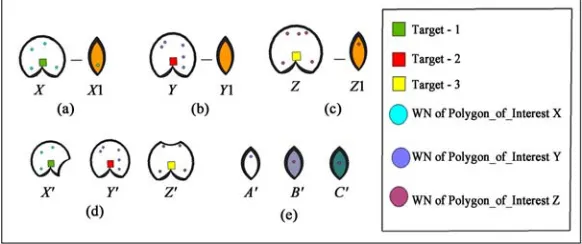
CASE 4. We use Figures 5, 6 and 7 to explore the mechanisms of our proposed methodology to describe a scenario where three Polygon of Interests are overlapping. There are three Polygon of Interests X, Y and Z according to Figure 5(a). As Figure 5(b) states, there are three Polygon of Interests namely; X, Y and Z are overlapped with each other. As the condition (according to Algo-rithm 3, line 4) to check overlap is fulfilled, according to our algorithm (according to Algorithm 3, line 5) first of all we need to get the common area of these three Poly-gon of Interests.
Let this Polygon of Interest be named as D. We will also calculate the Overlapped Area of Interest, A be-tween X and Y; Overlapped Area of Interest, B between X and Z; Overlapped Area of Interest, C between Y and Z.
Figure 3.Illustration of Case 2.
Figure 4.Illustration of Case 3.
Figure 5. Illustration of CASE 4.
269 5). We illustrate the calculation of X0 in Now we will calculate the Overlapped Area of Interest
between the Polygon of Interests X and Y, X and Z and Y and Z and name them respectively as A, B and C. Now we have to find that portion of A which is included in D; we name it as D1. In the same manner we calculate D2 for B and D3 for C. We will then calculate A`, B` and C` using A` = A – D1, B`= B – D2 and C`= C – D3 (accord-ing to Algorithm 4, line 9). Result of these calculations are shown in Figure 6(e) and it is evident from the figure that then number of WNs in the Polygon of Interests A`, B` and C` is one for each of the Polygon of Interests.
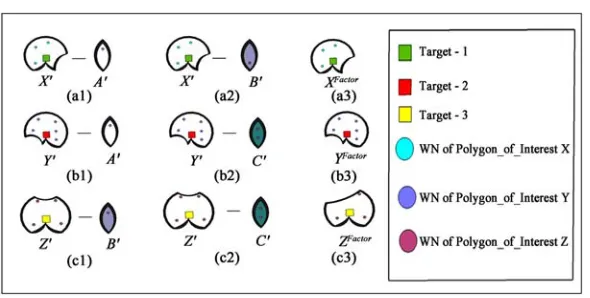
Figure 7(a1) and the calculation of X9 in Figure 7(a2). We calculate the number of WNs of X0 and X9 and denote them respectively as n(X0) and n(X9). It is
evident that n(X0) = 3 and n(X9) = 3. We now need to find the Polygon of Interest
XFactor, whose number of WNs included in the Polygon of Interest is denoted as
n(XFactor) and which will be the final result of the algorithm Individual Minimization. According to the figure Minimum (n(X0), We will now calculate the number of WNs in X`, Y`
and Z` and we denote them as n(X`), n(Y`) and n (Z`) respectively (according to Algorithm 4, line 12). Ac-cording to Figure 5(f), 5(g) and 5(h), n(X`) = 3, n(Y`) = 5 and n (Z`) = 4. As the numbers of WNs in each of the minimized Polygon of Interests are greater than or equal to 3, according to our algorithm the condition to call al-gorithm Individual Minimization is fulfilled.
n(X9)) = 3. So, n(XFactor) = 3 (according to Algorithm 5, line 8). As n(XFactor) fulfills the condition so Polygon of InterestXFactor as shown in Figure 7(a3) will be computed, preserved and will be
returned (according to Algorithm 5, line 10).
The algorithm Individual Minimization will be called (according to Algorithm 4, line 13) with the following parameters: Polygon of InterestX`, A` and B`.
Calling algorithm Individual Minimization (Algorithm 5) with the following parameters, Polygon of InterestY`, A` and C`:
The algorithm Individual Minimization will be called (according to Algorithm 4, line 17) with the following parameters: Polygon of InterestY`, A` and C`.
First of all, we will calculate the portion of Y` which is included in A`; we name this area as A2`. Then we calculate the portion The algorithm Individual Minimization will be called
(according to Algorithm 4, line 21) with the following parameters: Polygon of InterestZ`, B` and C`.
of Y` which is included in C` and name this area as C2`. We update Y1 as Y1 = Y` – A2` and Y2 as Y2 = Y` – C2` which is shown in Figure 7(b1) and 7(b2). We calculate the Calling algorithm Individual Minimization (Algorithm
5) with the following parameters, Polygon of InterestX`, A` and B`:
number of WNs of Y1 and Y2 and denote them respectively as n(Y1) and n(Y2). We now need to find the Polygon of Interest First of all, we will calculate the portion of
X` which is included in A` (according to YFactor, whose number of WNs included in the Polygon of Interest is denoted as Algorithm 5, line 1); we name this area as
A1`. Then we calculate the portion of X` n(YFactor) and which will be the final result which is included in B` (according to of the algorithm Individual Minimization.
According to the figure Minimum (n (Y1), n Algorithm 5, line 2) and name this area as
B1`. We will create two Polygon of Interests (Y2)) = 4. So, n(YFactor) = 4. As n(YFactor) fulfills the condition so Polygon of Interest, X0 and X9 using X0 = X` – A1`
YFactor will be computed, preserved and (according to Algorithm 5, line 4) and
[image:7.595.152.443.584.706.2]X9 = X` – B1`(according to Algorithm 5, line will be returned.
Figure 7.Illustration of CASE 4 (Contd.).
Calling algorithm Individual Minimization (Algorithm 5) with the following parameters, Polygon of InterestZ`, B` and C`:
First of all, we will calculate the portion of Z` which is included in B`; we name this area as B3`. Then we calculate the portion of Z` which is included in C`and name this area as C3`. We update Z1 as Z1 = Z` – B3` and Z2 as Z2 = Z` – C3` which is shown in Figure 7(c1) and 7(c2). We calculate the number of WNs of Z1 and Z2 and denote them respectively as n(Z1) and n(Z2). We now need to find the Polygon of Interest ZFactor, whose number of WNs included in the Polygon of Interest is denoted as n(ZFactor) and which will be the final result of the algorithm Individual Minimization. As n(Z1)= 3 and n(Z2) = 3, according to the figure Minimum (n(Z1), n(Z2)) = 3. So, n(XFactor) = 3 (according to
Algorithm 5, line 8). As n(XFactor) fulfills the condition (according to Algorithm 5, line 9) so Polygon of InterestXFactor
as shown in Figure 7(a3) will be computed (according to Algorithm 5, line 10), preserved (according to
Algorithm 5, line 11) and will be returned (according to Algorithm 5, line 16).
The algorithm Simultaneous Overlapping of Three Polygon of Interests can be reduced to describe the mechanisms when one Polygon of Interest overlaps with another Polygon of Interest, at a certain time. We call it the Simultaneous Overlapping of Three Polygon of In-terests Reduced to Two algorithm denoted by Algorithm 7. We assume it will need at least three WNs in one sin-gle Polygon of Interest to track one single target.
Algorithm 7: Simultaneous Overlapping of Three Polygon of InterestsReduced to Two (γta, γtb)
1. Get the area of the Polygon of Interests γtaand γtb. Let it be denoted as µta and µtb respectively. 2. Compute the overlapped area between µta and µtb
and let it be denoted as µtc.
3. Compute γta1, which will be the portion of γta in-cluded in γtc.
4. Compute γtb1, which will be the portion of γtb in-cluded in γtc.
5. Compute µta1 and µtb1 from γta1 and γtb1 respectively. 6. Get the updated area µ`taand µ`tb using µ`ta = µta –
µta1and µ`tb= µtb– µtb1 respectively and update γta and γtb as γ`taand γ`tbrespectively.
7. Calculate η1 and η2 from γ`
taand γ`tb respectively. 8. If (η1 => 3 )
9. Preserve minimization. Return γ`ta . 10. Else
11. Preserve γta. No minimization will take place. Return γta
12. If (η2 => 3 )
13. Preserve minimization. Return γ`tb . 14. Else
15. Preserve γtb. No minimization will take place. Return γtb.
We describe some case studies below to further illus-trate the algorithm.
271 respectively. We will now calculate X` and Y` using X` = X
– X1 and Y` = Y – Y1 respectively (algorithm 7, line 6). The calculations to find X` and Y` is represented in Figure 8(c) and 8(d) respectively. Now we calculate the number of WNs in X` and Y` and denote them as n(X`) and n(Y`). Ac-cording to Figure 8(e), n(X`) = 3 and Figure 8(f), n(Y`) = 5.
Thus minimization will be preserved according to our algorithm (line 9 and line 13). Polygon of Interests X` and Y` is the final outcome of this study.
CASE 6. In this case, the corresponding Polygon of In-terests overlaps each other by a small amount. Figure 9 is the illustration of CASE 6. Here in Figure 9(a), X and Y represent the Polygon of Interests of two different targets. Figure 9(b) represents the overlap between the two Poly-gon of Interests. According to our algorithm, first the Overlapped Area of Interest of the two Polygon of Interests namely, X and Y will be calculated. Let it be named as Z. Then the area of X and Y included in Z will be calculated; let them be denoted as X1 and Y1 respectively. We will now calculate X` and Y` using X` = X – X1 and Y` = Y – Y1 respectively. Now we calculate the number of WNs in X` and Y` and denote them as n(X`) and n(Y`). According to
Figure 9(c), n(X`) = 3 (Algorithm 7, line 7) and n(Y`) = 2.The minimization for Polygon of Interest X will be preserved but minimization for Polygon of InterestY will not be preserved according to our algorithm 7 (line 15). We will restore Polygon of InterestY by adding Y = Y` + Y1. The outcome of this case study are the Polygon of Interests are X` and Y` as indicated in Figure 9(e) and 9(f) respectively.
CASE 7. Figure 10 is the illustration of CASE 7. Here in Figure 10(a), X and Y represent the Polygon of Inter-ests of two different targets. In this case, the correspond-ing Polygon of Interests overlaps each other by a small amount as indicated in Figure 10(b). According to our algorithm, first the Overlapped Area of Interest of the two Polygon of Interests, X and Y will be calculated. Let it be named as Z. Then the area of X and Y included in Z will be calculated; let them be denoted as X1 and Y1 re-spectively. We will now calculate X` and Y` using X` = X – X1 and Y` = Y – Y1 respectively. Now we calculate the number of WNs in X` and Y` and denote them as n(X`) and n(Y`). According to Figure 10, n(X`) = 5 and n(Y`) = 5 and so the minimization will be preserved according to our algorithm.
Figure 8. Illustration of CASE 5.
Figure 10.Illustration of CASE 7.
The minimizations for both the Polygon of Interests X and Y have not occurred in terms of number of WNs as the Overlapped Area of Interest Z did not contain any WNs and hence the number of WNs in both the Polygon of Interests remains unchanged.
5. Evaluation and Comparison
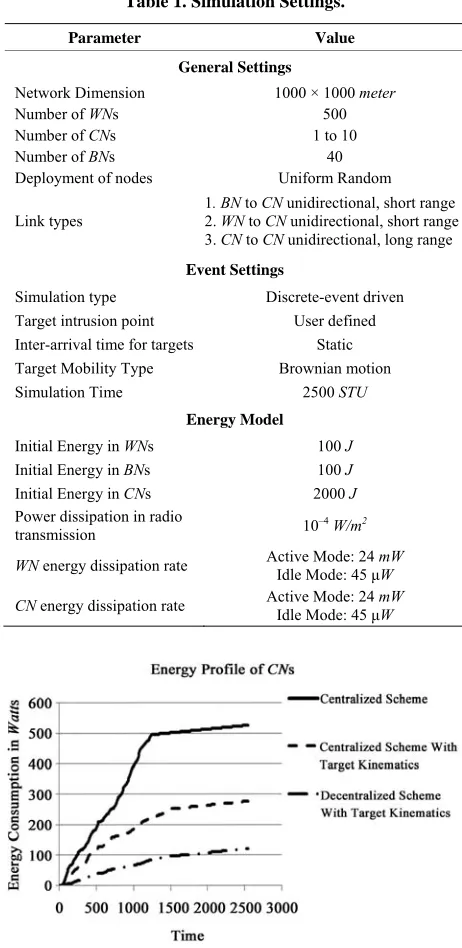
We simulate using a widely used sensor network simu-lator OMNeT++ for validating our method. We keep the settings (Table 1) same for all the simulation runs. We set a realistic range for target speed to be 5 – 12 ms–1 (18
– 42 km per hour). For wheeled vehicles, the steering angle is 20˚ in most of the cases [17]. A greater steering angle at such speed is not realistic, and if it is considered, the vehicle is expected to loop within a circular path well inside the Polygon of Interest. The size of the Polygon of Interest is dependent on the refresh time. Appropriate algorithms [17] are used to determine an optimal refresh time. To observe the performance of our tracking algo-rithm, we simulate using two/three targets moving across the sensor network at the same time, in all the simulation runs. In our first experiment, we implement such a tracking methodology where circular tracking area is used.
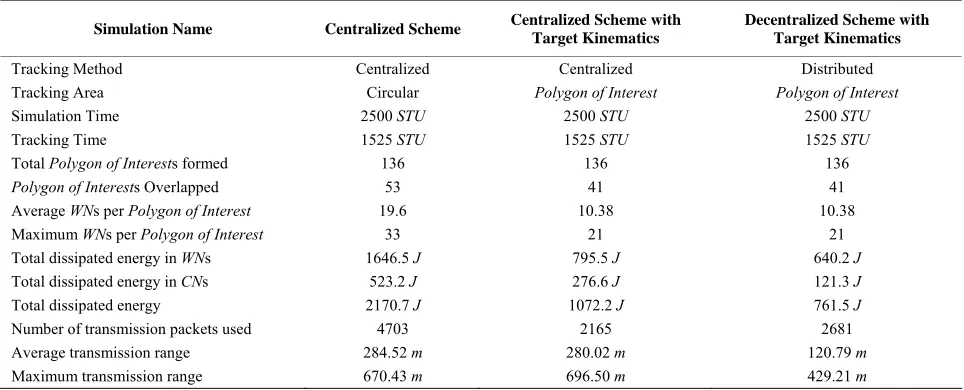
[image:10.595.306.537.233.707.2]We call it ‘Centralized Scheme’. We name our second experiment as ‘Centralized Scheme with Target Kine-matics’. In this experiment we implement MCTA [5]. In the final experiment, we implement our tracking algo-rithm, MTTP. In accordance to MTTP, we partition the whole tracking field into cells, giving each CN authority over the WNs in the relevant cell. Figure 11, 12 and 13 respectively; show the amount of energy consumed by the CNs, WNs and the total network. Clearly, the first approach that used circular tracking area consumes more energy at each phase of the simulation. In Table 2, the comparison among three methods is given. We find that our method MTTP outperforms the circular tracking area based algorithms as it prunes out the tracking area ap-proximately by 50% while preserving up to 60% of total energy.
Table 1. Simulation Settings.
Parameter Value
General Settings
Network Dimension 1000 × 1000 meter
Number of WNs 500
Number of CNs 1 to 10
Number of BNs 40
Deployment of nodes Uniform Random
Link types 1. BN to CN unidirectional, short range2. WN to CN unidirectional, short range 3. CN to CN unidirectional, long range
Event Settings
Simulation type Discrete-event driven
Target intrusion point User defined
Inter-arrival time for targets Static
Target Mobility Type Brownian motion
Simulation Time 2500 STU
Energy Model
Initial Energy in WNs 100 J
Initial Energy in BNs 100 J
Initial Energy in CNs 2000 J
Power dissipation in radio
transmission 10–4 W/m2
WN energy dissipation rate Active Mode: 24 mW Idle Mode: 45 μW
CN energy dissipation rate Active Mode: 24 mW Idle Mode: 45 μW
[image:10.595.308.539.243.577.2]273
[image:11.595.55.285.79.227.2]Figure 12. Comparison of energy consumption at WNs.
Figure 13. Comparison of energy consumption in the total network.
Table 2. Simulation results.
Simulation Name Centralized Scheme Centralized Scheme with Target Kinematics
Decentralized Scheme with Target Kinematics
Tracking Method Centralized Centralized Distributed
Tracking Area Circular Polygon of Interest Polygon of Interest
Simulation Time 2500 STU 2500 STU 2500 STU
Tracking Time 1525 STU 1525 STU 1525 STU
Total Polygon of Interests formed 136 136 136
Polygon of Interests Overlapped 53 41 41
Average WNs per Polygon of Interest 19.6 10.38 10.38
Maximum WNs per Polygon of Interest 33 21 21
Total dissipated energy in WNs 1646.5 J 795.5 J 640.2 J
Total dissipated energy in CNs 523.2 J 276.6 J 121.3 J
Total dissipated energy 2170.7 J 1072.2 J 761.5 J
Number of transmission packets used 4703 2165 2681
Average transmission range 284.52 m 280.02 m 120.79 m
Maximum transmission range 670.43 m 696.50 m 429.21 m
6. Conclusions
In our paper, we propose a distributed energy efficient tracking method for tracking multiple targets in a large scale sensor network. We simulate our algorithm with a sensor network simulator and compare with other popu-lar methods. We find our method significantly saves sensor nodes’ energy. In future, we want to implement our algorithm in a real life scenario. We would like to explore multiple layers deployment of boundary sensors nodes which will increase good tracking service but will increase network cost. This trade-off is still an open re-search problem.
7. References
[1] C. Sharp, S. Schaffet, A. Woo, N. Sastri, C. Karlof, S. Sastry and D. Culler, “Design and Implementation of a Sensor Network and Autonomous Interception,” Pro-ceedings of the 2nd European Workshop on Wireless
Sensor Networks, Berkeley, 2005.
[2] G. W. Allen, K. Lorincz, M. Welsh, O. Marcillo, J. Johnson, M. Ruiz and J. Lees, “Deploying a Wireless Sensor Network on an Active Volcano,” IEEE Internet Computing, Vol. 10, No. 2, March-April 2006, pp. 18-25.
doi:10.1109/MIC.2006.26
[3] E. Yoneki and J. Bacon, “A Survey of Wireless Sensor Network Technologies: Research Trends and Middle-ware’s Role,” Ph.D. Dissertation, University of Cam-bridge, CamCam-bridge, 2005.
[4] W. Zhang and G. Cao, “Dynamic Convoy Tree based Collaboration for Target Tracking in Sensor Networks,” IEEE Transactions on Wireless Communication, Vol. 3, No. 5, September 2004, pp. 1689-1701.
doi:10.1109/TWC.2004.833443
[5] J. Jeong, T. Hwang, T. He and D. Du, “(MCTA) Target Tracking Algorithm based on Minimal Contour in Wire-less Sensor Networks,” Technical Report, University of Minnesota, Twin Cities, 2007.
[image:11.595.57.539.276.471.2][7] OMNeT++ Community Site. http://www.omnetpp.org [8] Y. Bar-Shalom and T. E. Fortmann, “Tracking and Data
Association,” Academic Press Professional, San Diego, 1987.
[9] H. Yang and B. Sikdar, “A Protocol for Tracking Mobile Targets Using Sensor Networks,” Proceedings of the IEEE Workshop on Sensor Network Protocols and Ap-plications, Vol. 7, 2003, pp. 71-81.
doi:10.1109/SNPA.2003.1203358
[10] Tinynode. http://www.tinynode.com
[11] W. AlSalih, K. Islam, Y. N. Rodriguez and H. Xiao, “Distributed Voronoi Diagram Computation in Wireless Sensor Networks,” Proceedings of the 20th ACM Sympo-sium on Parallelism in Algorithms and Architectures (SPAA), 2008, p. 364. doi:10.1145/1378533.1378597
[12] X. Du and F. Lin, “Maintaining Differentaited Coverage in Heterogenous Sensor Networks,” EURASIP Journal on Wireless Communication and Networking, Vol. 2005, No. 54, August 2002, pp. 459-461.
doi:10.1155/WCN.2005.565
[13] Bob Stein, “A Point About Polygons,” Linux Journal, March 1997.
[14] J. A. Stankovic, T. Abdelzaher, and T. He, “Lightweight Detection and Classification for Wireless Sensor Net-works in Realistic Environments,” Proceedings of the 3rd ACM Conference on Embedded Networked Sensor Sys-tems, San Diego, November 02 - 04 2005, pp. 205-217.
doi:10.1145/1098918.1098941
[15] R. R. Brooks, P. Ramanathan and A. M. Sayeed, “Dis-tributed Target Classification and Tracking in Sensor Networks,” Proceedings of the IEEE, Vol. 31, No. 8, 2003, pp. 1163-1171. doi:10.1109/JPROC.2003.814923