ISSN Online: 2327-4344 ISSN Print: 2327-4336
DOI: 10.4236/gep.2019.76007 Jun. 25, 2019 83 Journal of Geoscience and Environment Protection
An Experimental Method for Effectively
Digesting Geological Samples
Weiguo Zhang
1,2,3, Fan Yang
4, Chi Zhang
4, Wentao Wang
41College of Geology and Environment, Xi’an University of Science and Technology, Xi’an, China 2Shaanxi Provincial Key Laboratory of Geological Support for Coal Green Exploitation, Xi’an, China
3Key Laboratory of Coal Resources Exploration and Comprehensive Utilization, Ministry of Land and Resources, Xi’an, China 4Shenmu Zhangjiamao Mining Co., Ltd., Shaanxi Coal Industry Group, Shenmu, China
Abstract
The material composition of geological samples is very complicated. Gener-ally, the method for accurately determining trace elements in geological sam-ples needs to digest the solid samsam-ples into liquid state, which is convenient for inductively coupled plasma mass spectrometry. The previous digestion me-thod takes a long time and the operation process is complicated. The Ultra CLAVE microwave digestion instrument was used to digest the geological samples. The types and dosages of the acid used for digestion and the optimal conditions for instrumental testing were published. The results show that this method has short processing time, small data error, safer operation and good digestion effect. This method is suitable for geological sample analysis.
Keywords
Microwave Digestion, Geological Sample, Acid Ratio, Time
1. Introduction
The analysis of the sample digestion is elemental analysis of an important part of the development of digestion technology which is crucial for the development of chemical analysis(Liu & Tang, 2012). The traditional digestion technology (dry digestion and wet digestion) plays an important role in chemical analysis, which has good universality, but it needs relatively longer pretreatment time, complex procedure which has some impact on the results. To solve these problems, a new way of Digestion-microwave Digestion has been developed fast in recent years. The microwave digestion is a fast, accurate, reproducible digestion method. Compared with conventional digestion methods, microwave digestion is mainly
How to cite this paper: Zhang, W. G., Yang, F., Zhang, C., & Wang, W. T. (2019). An Experimental Method for Effectively Digesting Geological Samples. Journal of Geoscience and Environment Protection, 7, 83-89.
https://doi.org/10.4236/gep.2019.76007
Received: May 14, 2019 Accepted: June 22, 2019 Published: June 25, 2019
Copyright © 2019 by author(s) and Scientific Research Publishing Inc. This work is licensed under the Creative Commons Attribution International License (CC BY 4.0).
http://creativecommons.org/licenses/by/4.0/
DOI: 10.4236/gep.2019.76007 84 Journal of Geoscience and Environment Protection carried out in a closed container with a small amount of acid, for the determina-tion of volatile elements with high precision. After Years of research and appli-cation, microwave digestion technology has evolved into a powerful, technolo-gically advanced sample pretreatment method(Zeng, 2012). Most digestion aims to remove organic impurities in the sample to obtain the desired trace amounts of elements. But the major inorganic component is not easy digestion in geolog-ical samples. Accurate determination of elements in geologgeolog-ical samples, for recy-cling, minerals and other elements of the assessment is important. Therefore, quickly and efficiently digested sample is a question of Geology Geological workers that have been concerned.
Geological samples are the most common minerals, soils, and stream sedi-ments, and its composition is a mixture of various minerals, commonly used method of acid-soluble and alkali fusion decomposition. This experiment uses UltraCLAVE microwave digester to digest geological samples, and then discuss on experimental procedure, and parameters and matters need attention.
2. The Instrument and Reagent
The instrument: UltraCLAVE IV Microwave digestion instrument, Milestone of Italy; Milli-Q Ultrapure water system (18.7 MΩ∙cm); Acid purification system, Milestone of Italy; Acid cleaning system, Milestone of Italy; Electric heating plate.
The reagent: Hydrogen peroxide, Perchlorate, Sulfuric acid, Nitric acid, Hy-drofluoric acid.
3. Microwave Digestion Process
1) Experimental preparation
The experiment required container (PTFE and PFA digestion vessel flask) should soaked in 5% HNO3 (superior grade pure) in more than 24 h. then use acid cleaning system for cleaning (260˚C, 3 - 4 h). After acid cleaning, remove the container and promptly washed 3 - 5 times with ultrapure water (resistance rate 18.7 MΩ∙cm) placed in a fume cupboard t to dry for next experiment.
2) Weigh the sample
The samples were crushed to 200 meshes, and then grinded 20 min in a mor-tar. Accurately weigh about 50 mg of sample in accuracy of 0.1 mg. The sample was carefully transferred to a digestion tube to avoid sample attaching to tube inner surface.
3) Add acid
DOI: 10.4236/gep.2019.76007 85 Journal of Geoscience and Environment Protection tube digestion which adheres to the wall, after the addition of acid, covered the tube with a lid, ready for digestion. Digestion tube according to the above-described method for simultaneous processing of two rock reference material and two full blank, as a quality control and a control sample. After the sample with acid, if the reaction is severe, you need to put some time and then be reacted by micro-wave heating. For the initial violent reaction of the sample with acid, the acid may be added for several times, in order to avoid acid spill out.
Experimental study focused on acid system and digestion temperature, beside the use of HF, conventional acid digestion method to destroy the mineral lattice, and to break down completely, add HNO3, H2SO4, HClO4 in mixed acid (Yang & Li, 2011). However, H2SO4 is tending to form char residue that hard to destroy. alkaline metals in earth and lead the formation of insolubility of the compound; difference HClO4 purity easily into impurity, prone to violent reaction with or-ganic explosion, do not recommend using hydroelectric acid is the only decom-posed to silicon. Inorganic acid matrix sample digestion is suitable for all types of geological samples, when heated, H2SiF6 decompose into gaseous SiF4, sili-con-free solution obtained, and without HF acid digestion system was unable to remove the silicon(Liu, 2001).
4) Microwave digestion
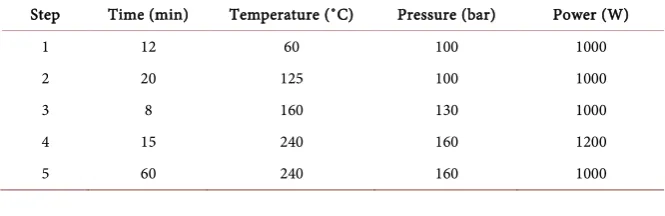
Add about 330 mL of ultra-pure water, 30 mL of H2O2 and 1mL of H2SO4 to the reaction tank. After putting the reaction tank into the microwave digestion reaction chamber, carefully fix digestion tube to rack, start the microwave di-gestion procedure (Table 1). The program runs about two hours. Digestion could separate in two stages, organic matter easily oxidized at 1000 W, difficult to break down organic matter when 1200 W, digestion experiments show good results.
[image:3.595.206.539.629.737.2]Microwave digestion conditions directly determine the final results of the analysis. After digestion large amount of solid residues will affect the subsequent determination. The energy required to break down the sample depends on the composition and amount of sample, the type of container, reagent type and proportion and so on. Seal pressure generated inside the container lead the boil-ing point of the reagent increased. Thus digestion requires higher temperatures. Temperature and pressure can significantly shorten the time of sample decom-position, and lead some of the more insoluble compounds to be digested. Vola-tile elements, such as, Cr, Hg, Sb, Se, Sn will be retained within the container,
Table 1. Program parameter of microwave digestion
Step Time (min) Temperature (˚C) Pressure (bar) Power (W)
1 12 60 100 1000
2 20 125 100 1000
3 8 160 130 1000
4 15 240 160 1200
DOI: 10.4236/gep.2019.76007 86 Journal of Geoscience and Environment Protection can be well preserved in solution, reduce evaporation losses. In order to ensure and thus safe sample dissolution, Microwave digestion instrument used in this experiment using dual monitoring and control of temperature and pressure. Microwave program uses pre-digestion heating system and the power increases by stepwise, avoid leaving violent reaction and pressure soared.
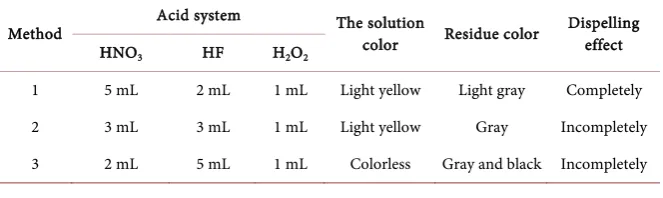
Since HNO3 and HF in different roles in the digestion process, the ratio of the two has great impacts for the digestion effect. To solve this problem, experiment take different acid ratio on the same geological samples (50 mg) digestion, and digestion effect is obvious difference (Table 2). Experiments show that when HNO3 and HF are respectively 2 mL and 5 mL, complete digestion is better.
5) Transfer and dilute
Transfer sample digested with ultrapure water to a 100 mL PFA volumetric flask, seal, shake and let stand, test.
4. Catch Acid and Extract
Catch the acid and extraction process: When the program execution is com-pleted, and the tank pressure has eliminated, Transfer sample digested with ul-trapure water to a 100 mL PFA volumetric flask, control liquid volume stand about 60 mL. Add 2 - 3 drops of HClO4 into beaker, the beaker was placed on a hot plate heated (150˚C), heated the beaker (including cup wall) until it out of any liquid, add HNO3 With the volume of water in one to one into beaker. When the 5 mL HNO3 in beaker evaporate completely, Then add 5 mL HNO3 (1:1) and extract for 15 min. Transfer the liquid in beaker with ultra-pure water to a 100 mL PFA volumetric flask, seal, shake and let stand, test.
[image:4.595.208.540.630.729.2]Element exist in complex form in the Geological sample, in a certain extent; limit the dissolution of rare earth elements. Adding hydrofluoric acid, samples can be effectively open when HNO3-HF-H2O2 mixed in acid, and dissolve the sample efficiently. As a result, get higher dissolution rate of the rare earth ele-ment (Chen et al., 2011). HF, H2O2 can enhance the dissolution rate of rare earth elements, HF can effectively silicate becomes volatile SiF4, use a small amount of HF in combination with other acid, prevents the formation of analyte in the sample silicate(Zhang et al., 2010). Because HF can form insoluble fluoride com-plex precipitation and rare earth elements (especially light rare earth element), thereby enabling the measurement result is low(Wang et al., 2000;Liu, Yun, & Wang, 2005). Therefore, accurate determination of rare earth elements needed
Table 2. Method of microwave digestion and evaluation.
Method Acid system The solution color Residue color Dispelling effect
HNO3 HF H2O2
1 5 mL 2 mL 1 mL Light yellow Light gray Completely
2 3 mL 3 mL 1 mL Light yellow Gray Incompletely
DOI: 10.4236/gep.2019.76007 87 Journal of Geoscience and Environment Protection to catch the acid extraction, acid extraction experiments show catch Process for the determination of volatile elements unstable element or influential.
5. ICP-MS Test
Inductively Coupled Plasma Mass Spectrometry (ICP-MS) is a new technology developed in the 1980s, plasma is source of mass spectrometry, sample in the ion source produce a variety of positively charged ions after ionization. And under the influence of the acceleration electric field, form a particle beam incident on the analyzer. Since the electromagnetic field, according to mass the various ions charge ratio of the size separated, and then the mass spectrum obtained by the recording system, the position of each line of the spectrum in accordance with and the number of charges corresponding qualitative analysis of ions, and pressing the appropriate ionic strength were quantitatively analyzed the ionic based on ionic strength.
5.1. The Prototype and the Internal Standard
ICP-MS linear range is relatively wide, linear dynamic range up to 9 orders of magnitude (Liu et al., 2005).What standard that experiment. Followed is the Standard Series 1 ppb, 10 ppb, 50 ppb, 100 ppb, control 2% HNO3 system; ul-tra-pure water preparation 2% HNO3 (via sub-boiling purification) do standard blank, and regularly updated internal standard. Test procedure adopts Rh103 correction method; through online add internal standard solution to monitor changes in the signal. Using internal standard calibration analyte results can be effectively overcome the impact generated by the instrument drift, improve the accuracy of analysis(Ai et al., 2002; Luo et al., 2009).
5.2. The Main Working Parameters of ICP-MS
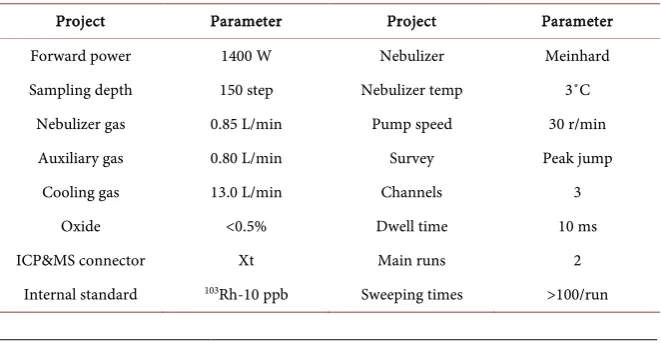
[image:5.595.208.539.568.740.2]Radio frequency power, sampling depth, nebulizer gas, auxiliary gas, and cooling gas flow rates are the main operating parameters of ICP-MS analysis (Table 3). The instrument will meet thermal drift in the beginning of 1 - 2 hours; we should pay attention to control the time in stable.
Table 3. Work parameter of ICP-MS.
Project Parameter Project Parameter
Forward power 1400 W Nebulizer Meinhard
Sampling depth 150 step Nebulizer temp 3˚C
Nebulizer gas 0.85 L/min Pump speed 30 r/min
Auxiliary gas 0.80 L/min Survey Peak jump
Cooling gas 13.0 L/min Channels 3
Oxide <0.5% Dwell time 10 ms
ICP&MS connector Xt Main runs 2
DOI: 10.4236/gep.2019.76007 88 Journal of Geoscience and Environment Protection
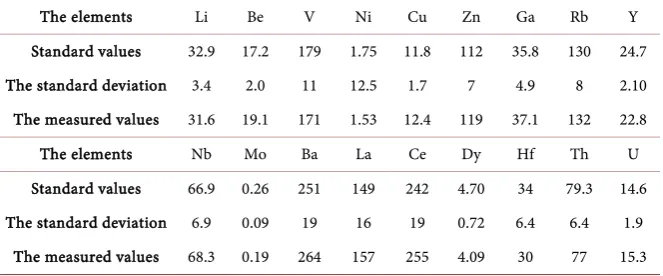
Table 4. The result of rock sample (10−6).
The elements Li Be V Ni Cu Zn Ga Rb Y
Standard values 32.9 17.2 179 1.75 11.8 112 35.8 130 24.7
The standard deviation 3.4 2.0 11 12.5 1.7 7 4.9 8 2.10
The measured values 31.6 19.1 171 1.53 12.4 119 37.1 132 22.8
The elements Nb Mo Ba La Ce Dy Hf Th U
Standard values 66.9 0.26 251 149 242 4.70 34 79.3 14.6 The standard deviation 6.9 0.09 19 16 19 0.72 6.4 6.4 1.9
The measured values 68.3 0.19 264 157 255 4.09 30 77 15.3
5.3. The Determination Results of ICP-MS
The result of ICP-MS measurement not only has detected low detection limit, and its work curve is good at linear correlation, can effectively guarantee the ac-curacy of the measured data. It determines each concentration point of calibra-tion curve to calculate the linear regression equacalibra-tion and the correlacalibra-tion coeffi-cient R, and all measured elements linear correlation coefficoeffi-cient are greater than 0.9995.
In order to evaluate the accuracy of the method, the experiment choose GBW07109 rock composition as standard analysis material, this material was ca-librated with a variety of methods as X-ray fluorescence, colorimetry and weighing method, by the China Institute of Metrology sciences and other 18 test experi-mental determination units. The measurement results consistent well with stan-dard values, within the accepted error range (Table 4).
6. Conclusion
Use microwave digestion, which inductively coupled plasma mass spectrometer and atomic absorption spectroscopy as a unit; make the test period short, loss and low, and precision high; speed up the pace of geology and mineral resources research. This approach optimizes the experimental conditions of microwave digestion, shortens the period, reduces pollution, ensures safe performance, and simplifies the operation. Because those common geological samples mainly formed by silicate mineral partly made of organic matter have better digestion and could meet the demand of simple, rapid, geological samples which are in simple, rapid and batch analysis.
Acknowledgements
(Bei-DOI: 10.4236/gep.2019.76007 89 Journal of Geoscience and Environment Protection jing).
Conflicts of Interest
The authors declare no conflicts of interest regarding the publication of this pa-per.
References
Ai, J., Hu, S., Shuai, Q. et al. (2002). Determination of Trace Rare Earth Elements, SC and Y in Ground Water by ICP-MS with Preconcentration Method. Chinese Journal of Analytical Chemistry, 30, 1226-1230.
Chen, Y., Li, X., Wei, X. et al. (2011). Determination of Trace Rare Earth Elements in Soils and Sediments by Inductively Coupled Plasma-Mass Spectrometry with Micro-wave Digestion. Rock and Mineral Analysis, 30, 560-565.
Liu, D., & Tang, X. (2012). Research on Microwave Digestion Technology in Chemical Analysis. China Petroleum and Chemical Industry Standard and Quality, 3, 40. Liu, H. (2001). The Technical Application of the Method Breaking Down the Food
Sam-ple in the Special Microwave Oven for Analysing Microelement. Chinese Journal of Health Laboratory Technology, 11, 406-408.
Liu, L., Zhang, N., Zhang, L. et al. (2005). Determination of 23 Elements in Drinking Natural Mineral Water by ICP-MS. Journal of Chinese Mass Spectrometry Society, 26, 27-31.
Liu, W., Yun, Y., & Wang, L. (2005). Processing Study of Static Xeransis Fluorination for Preparing Rare Earth Fluoride. Chinese Rare Earths, 26, 20-22.
Luo, Z., Liang, X., Li, M. et al. (2009). Determination of Drinking Water Distribution Equipment Safety Testing of 15 Kinds of Elements in the Samples by ICP-MS. South China Journal of Preventive Medicine, 35, 56-59.
Wang, Y., Liu, Q., Suo, Q. et al. (2000). Precipitation Method and Component of Rare Earth Fluoride. Chinese Rare Earths, 21, 14-18.
Yang, R., & Li, Y. (2011). Determination of Main Elements in Soil by Microwave-Aided Digestion and ICP-MS. Experimental Technology and Management, 28, 26-28. Zeng, Q. (2012). Research Progress of Microwave Digestion on Food Analysis. Journal of
Sichuan Vocational and Technical College, 22, 142-144.