ESL PARENT PERCEPTIONS OF USING EDUCATIONAL MOBILE APPLICATIONS TO DEVELOP THE
LANGUAGE SKILLS OF ESL ELEMENTARY SCHOOL STUDENTS
1
Jarrah Mohammad Al-Jarrah,
1
Department of Curriculum and Instruction, Faculty of Education, Yarmouk University, Jordan
2Department of Educational Studies, Faculty of Islamic Studies, Islamic
3
Department of Language and Communication, Universiti Malaysia Terengganu, 21300 Kuala
ARTICLE INFO ABSTRACT
The purpose of this mixed
parents regarding the use of educational mobile applications to help ESL elementary school students develop their language skills. Quantitative data were collected via surveys taken by a sample of 72 ESL parents from Unity Point Elementary School, Carbond
collected through in
positive perceptions of using educational mobile applications to develop the language skills of students. This
English learning and teaching.
Copyright © 2018, Jarrah Mohammad Al-Jarrah et al.
unrestricted use, distribution, and reproduction in any medium,
INTRODUCTION
In the last three decades, digital technology has made great changes in our lives, particularly in the field of education (Mollaei and Riasati, 2013). Şad and Gökta
that digital technology helps teachers develop innovative teaching methods and moves them from a traditional teaching environment to a highly motivating environment that supports
diverse learning styles, creativity, and effect
communication. On the other hand, digital technology has some drawbacks that may hinder the learning and teaching process (Kukulska-Hulme and Shield, 2007). In addition to the high cost and lack of technical support, the lack of expertise in technology among some teachers and learners may hinder the educational process and cause it to become more time consuming. This lack of expertise may also interrupt teaching and distract students, particularly when they are connected to the Internet (Al Aamri, 2011). Over the past five years, the number of ESL software products that can support the language and literacy development of ESL learners has increased.
*Corresponding author: Tamer Mohammad Al-Jarrah
Department of Language and Communication, Universiti Terengganu, 21300 Kuala Nerus, Terengganu, Malaysia.
ISSN: 0975-833X
Article History:
Received 28th September, 2018
Received in revised form 05th October, 2018
Accepted 10th November, 2018
Published online 31st December, 2018
Citation: Jarrah Mohammad Al-Jarrah, Rania Hassan Talafhah,
mobile applications to develop the language skills of esl elementary school students
Key Words:
Perceptions, educational mobile Applications, ESL.
RESEARCH ARTICLE
ESL PARENT PERCEPTIONS OF USING EDUCATIONAL MOBILE APPLICATIONS TO DEVELOP THE
LANGUAGE SKILLS OF ESL ELEMENTARY SCHOOL STUDENTS
Jarrah,
2Rania Hassan Talafhah,
3,*Tamer Mohammad Al
Department of Curriculum and Instruction, Faculty of Education, Yarmouk University, Jordan
Department of Educational Studies, Faculty of Islamic Studies, Islamic University of Minnesota, USA
Department of Language and Communication, Universiti Malaysia Terengganu, 21300 Kuala
Nerus, Terengganu, Malaysia
ABSTRACT
The purpose of this mixed-methods sequential explanatory study is to explore the perceptions of ESL parents regarding the use of educational mobile applications to help ESL elementary school students develop their language skills. Quantitative data were collected via surveys taken by a sample of 72 ESL parents from Unity Point Elementary School, Carbondale, Illinois. Later, qualitative data were collected through in-depth interviews from eight ESL parents from Unity Point. Participants reported positive perceptions of using educational mobile applications to develop the language skills of students. This study provides some recommendations for the successful integration of technology in English learning and teaching.
et al. This is an open access article distributed under the Creative Commons
medium, provided the original work is properly cited.
In the last three decades, digital technology has made great changes in our lives, particularly in the field of education ad and Göktaş (2014) indicated that digital technology helps teachers develop innovative teaching methods and moves them from a traditional teaching environment to a highly motivating environment that supports
diverse learning styles, creativity, and effective
communication. On the other hand, digital technology has some drawbacks that may hinder the learning and teaching Hulme and Shield, 2007). In addition to the high cost and lack of technical support, the lack of y among some teachers and learners may hinder the educational process and cause it to become more time consuming. This lack of expertise may also interrupt teaching and distract students, particularly when they are 1). Over the past five years, the number of ESL software products that can support the language and literacy development of ESL learners has
Jarrah
Department of Language and Communication, Universiti Malaysia Terengganu, 21300 Kuala Nerus, Terengganu, Malaysia.
Meskill and Mossop (2000) stated, many new software products currently marketed for ESL capitalize on both the capacity of multimedia to engage non
language development activity and the widely perceived need for efficient, supplemental materials to meet the challenge of serving this population (p. 2).
Problem Statement: With the rapid increase of immigration
to the United States and other English many challenges face minority
public schools, as well as their parents. Minority
students need to improve their English skills, particularly academic language, in order to integrate into mainstream curriculum and to achieve linguistic, social, and academic success. In recent years, digital technology has been widely used to help ESL students master the academic English, literacy skills, and subject matter knowledge needed to achieve academic success. Although a large number
in the potential of new technology in improving the learning and teaching process, they are not taking full advantage of such technology. According to Al Aamri (2011), different factors may affect the success of integrating technology in classrooms. Especially important are individuals’ beliefs (Merç, 2015). Therefore, more research is needed to identify individuals’ perceptions about integrating technology into the International Journal of Current Research
Vol. 10, Issue, 12, pp.76839-76849, December, 2018
DOI: https://doi.org/10.24941/ijcr.33609.12.2018
Jarrah, Rania Hassan Talafhah, Tamer Mohammad Al-Jarrah, 2018. “ESL Parent perceptions of using
mobile applications to develop the language skills of esl elementary school students”, International Journal of Current Research
ESL PARENT PERCEPTIONS OF USING EDUCATIONAL MOBILE APPLICATIONS TO DEVELOP THE
LANGUAGE SKILLS OF ESL ELEMENTARY SCHOOL STUDENTS
Tamer Mohammad Al-Jarrah
Department of Curriculum and Instruction, Faculty of Education, Yarmouk University, Jordan
University of Minnesota, USA
Department of Language and Communication, Universiti Malaysia Terengganu, 21300 Kuala
methods sequential explanatory study is to explore the perceptions of ESL parents regarding the use of educational mobile applications to help ESL elementary school students develop their language skills. Quantitative data were collected via surveys taken by a sample of 72 ale, Illinois. Later, qualitative data were depth interviews from eight ESL parents from Unity Point. Participants reported positive perceptions of using educational mobile applications to develop the language skills of study provides some recommendations for the successful integration of technology in
Commons Attribution License, which permits
Meskill and Mossop (2000) stated, many new software products currently marketed for ESL capitalize on both the capacity of multimedia to engage non-native speakers in activity and the widely perceived need for efficient, supplemental materials to meet the challenge of
With the rapid increase of immigration to the United States and other English-speaking countries, challenges face minority-language students who enter public schools, as well as their parents. Minority-language students need to improve their English skills, particularly academic language, in order to integrate into mainstream linguistic, social, and academic success. In recent years, digital technology has been widely used to help ESL students master the academic English, literacy skills, and subject matter knowledge needed to achieve academic success. Although a large number of parents believe in the potential of new technology in improving the learning and teaching process, they are not taking full advantage of such technology. According to Al Aamri (2011), different factors may affect the success of integrating technology in ESL classrooms. Especially important are individuals’ beliefs (Merç, 2015). Therefore, more research is needed to identify individuals’ perceptions about integrating technology into the
INTERNATIONAL JOURNAL OF CURRENT RESEARCH
ESL Parent perceptions of using educational
teaching and learning process. The present study aims to investigate ESL parents' perceptions regarding the use of educational mobile applications to help ESL elementary school students develop their language skills.
Technology Use in the ESL Classroom: According to de
Lourdes Andrade (2014), the use of technology in the classroom can bring certain benefits to learners of English. Technology is a beneficial educational tool; if it is used appropriately, it is a beneficial resource to help learners solve problems and explore information, it can enhance and improve students’ learning, and it provides the learners with suitable resources to manage their school activities. Erben, Ban, and Castañeda (2009) stated that technology is a beneficial resource for ESL students because it gives them an opportunity to practice without facing criticism from classmates or even the teacher. It is important for teachers to be familiar with new technology in order to help students with its use since students might not automatically know how to use technological devices for educational purposes. Technology has thus caused classes to shift from being teacher-centered with a focus on transferring knowledge to the student to being more student-centered, providing a more effective learning environment for students and increasing students’ desire and ability to acquire knowledge. Sharma (2009) stated that the use of software applications in ESL classes is beneficial for both teachers and learners. These programs support learners’ basic skills, including vocabulary, grammar, pronunciation, spelling, reading, and writing, to create a more suitable environment to promote their English language skills. Different educational programs are more suitable for different skills and have a significant influence on the learning process of each area of the language. English language skills can be classified as input skills (listening and reading) and output skills (writing and speaking). Constantinescu (2007) mentioned that reading is an important input skill that depends on reading a text, processing it, and understanding its meaning to improve vocabulary, acquire new ideas, and enhance real-world knowledge. Using different educational programs can improve learners’ reading ability and increase motivation to improve vocabulary and reading skills; and technology devices can likewise increase learner interest in reading skills. Reading-based software programs can be utilized to enable English language learners to interact with texts and help users pay more attention to individual needs when reading (Ybarra and Green, 2003).
Research Purpose and Questions: The purpose of this
mixed-methods sequential explanatory study is to explore the perceptions of ESL parents regarding the use of educational mobile applications to help ESL elementary school students develop their language skills. This study gathered and analyzed quantitative results from an online survey of ESL parents and collected qualitative data through interviews in order to refine and explain the quantitative results in more depth. In the first phase, an online survey was administrated to ESL parents to examine their perceptions of using of educational mobile applications to help ESL elementary school students develop their language skills. In the second phase, I gathered qualitative data through semi-structured interviews with ESL parents in order to explain the quantitative data gathered in the first phase and to fully explore their perceptions of using educational mobile applications to improve their language skills.
This study is significant because it contributes to the body of research on using mobile learning in ESL instruction, which is still an emerging field (Sad and Göktas, 2014). It could also raise awareness among ESL parents and curriculum designers regarding mobile devices and applications as an education tool that can be used to help ESL students in mainstream English classrooms (see Ozdamli and Uzunboylu, 2015).
Research Question: The following questions guided this
study, What are the perceptions among ESL parents regarding the use of educational mobile applications to help ESL elementary school students develop their language skills?. This study adds to the growing body of knowledge in this field by analyzing certain aspects of ESL learning and teaching in greater depth. It also investigates parents’ perceptions which increases awareness about the role of parents in second
language learning and teaching (Kanthawongs and
Kanthawongs, 2013). This study contributes to the body of research in this field and the knowledge about teaching and learning English as a second language. Additionally, ESL parent beliefs about mobile learning might provide a better understanding of their actual practices inside and outside the classroom (see Merç, 2015).
Literature review: This section reviewed relevant literature
on mobile learning; technology integration in ESL classrooms and parent perceptions.
Technology Integration in ESL Classrooms: Teachers are an
essential part of the integration process as they are considered the gatekeepers to technology integration in the classroom. This means that they play a vital role in the success or failure of mobile phones in the integration process (O'Bannon and Thomas, 2015). Additionally, integration is based on the teachers’ experience in effectively facilitating the use of technologies in ESL classrooms (Bitner and Bitner, 2002). In Hismanoglu’s study (2012a), the lecturers were shown to increase ESL teachers’ motivation in the teaching and learning process and make the class more student-centered by integrating a variety of educational tools into the ESL classroom. Ertmer, Ottenbreit-Leftwich, Sadik, Sendurur, and Sendurur (2012) used a purposeful sampling of 12 teachers to discover a variance between teacher beliefs and technology integration practices. The findings revealed that external barriers, such as time and money, and teachers’ attitudes and beliefs were still the greatest obstacle to technology integration in the classroom. Additionally, teacher beliefs showed a strong link between technology integration and student-centered instruction (Chan and Elliott, 2004; Ottenbreit-Leftwich, Glazewski, Newby, and Ertmer, 2010).
Parents’ Perceptions: Parents play a crucial role in
technology use in terms of acquiring knowledge and maintaining safety online, and they must find age-appropriate online content of educational value and prepare their children to deal with inappropriate content (Lenhart and Madden, 2007). To understand how technology influences reading skills, according to parents’ perceptions, Sinek and Sparkman (2013) surveyed 2,090 parents, focusing on “attitudes and behaviors about reading books for fun and how technology may be influencing and changing them” (p. 2). Their findings showed electronic or digital devices influenced reading skills. Parental involvement can improve children’s readiness and increase motivation to learn by using technology as a developmental support (Gonzalez-DeHass, Willems, and Holbein, 2005). For example, parents can assist their children while searching on the Internet to help them with their homework (Cranmer, 2006). It is important to mention that parents should closely monitor their children’s online activity when using the Internet to do homework. Parents also seem to be sufficiently literate in technology to use it as part of the educational process and are thus capable of instructing their children to use technology properly (Delen, Kaya, Ritter, and Sahin, 2015). According to Anastasiades, Vitalaki, and Gertzakis (2008), parents confessed that exposure to technology was necessary for their children to learn 21st-century skills, although parents understood these technologies involved some potential risks. They also found that parents could not monitor their children all of the time, making it important to regulate when children were allowed to use the Internet. Parents also try to utilize the monitoring procedures of these technologies to safeguard their children (Beale and Hall, 2007). For instance, parents may choose to share their children’s accounts and select the privacy settings before browsing for educational materials to guarantee their children have a safe and positive experience online. Some parents were enthusiastic in encouraging their children’s effective use of technology because they saw it as necessary for a successful future. Plowman, McPake, and Stephen (2010) used parental reports and observations to suggest that children’s interactions with technology can facilitate the four main fields of learning: obtaining operational skills, providing understanding of the world, promoting configuration to learning, and utilizing the role of technology in daily life. In addition, de Lourdes Andrade (2014) reported that parents had a very positive perception about the use of technology in their children’s classroom, and the use of technology was one of the reasons why parents visited her class.
MATERIALS AND METHOD
This section describes the mixed-methods design, the rationale for its selection, the sampling method, data collection procedures, and data analysis plan.
Research Methodology: A mixed-methods sequential
explanatory design was an appropriate approach to this research. According to Ivankova, Creswell, and Stick (2006), combining quantitative and qualitative methods in mixed-methods designs helped researchers benefit from the strength of each and gained a better understanding of the research problem. As they stated, “when used in combination, quantitative and qualitative methods complement each other
andallowforamore robust analysis, taking advantage of the
strengths of each” (p. 3). According to Creswell (2014), the mixed-methods sequential explanatory design was one of the most popular mixed-methods designs and consists of two
phases. In the first phase, the researcher collected and analyzed the quantitative data. In the second phase, the researcher gathered qualitative data to interpret, refine, and elaborate the
quantitative results collected in the first phase. Ivankova et al.
(2006) illustrated this point when they stated the following. The rationale for this approach is that the quantitative data and their subsequent analysis provide a general understanding of the research problem. The qualitative data and their analysis refine and explain those statistical results by exploring participants’ views in more depth (p. 5). In the first phase of this study, I used the online survey design method to examine ESL parent perceptions regarding the use of educational mobile applications to help ESL elementary school students develop their language skills. This design allowed me to collect a large amount of data about individual beliefs in a short period of time with little expense (see Creswell and Plano Clark, 2011). In the second phase, I used a case study design that involves the use of in-depth interviews. The mixed-methods sequential explanatory design was well suited for this study because the quantitative results collected through the survey helped me choose unique participants for the qualitative phase (Creswell and Plano Clark, 2011). Additionally, the interview data supplemented the quantitative data and helped explain and explore the factors that shaped these perceptions because this design gives participants an opportunity to reflect on their responses and to provide more details than those collected solely by quantitative methods (Mollaei and Riasati, 2013). Integrating the quantitative results and the qualitative results in this study hopefully provided a general understanding of using educational mobile applications to help ESL learners and bridge a gap in previous studies in this field that only used one type of results (see Valk, Rashid, and Elder, 2010; Al Aamri, 2011; Vázquez-Cano, 2014).
Population and Sample: This study entirely took place in
According to Ary, Jacobs, and Sorensen (2006), cluster random sampling is appropriate when “it is very difficult, if not impossible, to list all the members of a target population and select the sample from among them” (p. 154). For the second phase, I used purposive sampling to choose eight participants in order to collect qualitative data through in-depth interviews. This process involved choosing the participants who would provide a richness of data (Patton, 2002), and it also addressed the purpose of the study.
Data Gathering Procedures: After using cluster sampling to
select one public elementary school from 4th to 8th grade among six elementary schools in Carbondale—including Unity Point Elementary School, Giant City School, Lewis School, Thomas Elementary School, Parrish Elementary School, and Carbondale Middle School—Unity Point Elementary School was randomly chosen, selecting all ESL parents in that school. After receiving approval from the SIU IRB, I requested permission from Unity Point to begin data gathering procedures through an online survey and interview. In addition, I asked the Unity Point school administration to send consent forms and cover letters to ESL students’ parents or guardians asking them to sign and provide their email address if they agreed to be participants in the study. After collecting the signed consent forms returned to Unity Point, I sent the online questionnaires to the emails provided along with a cover letter explaining the study’s purpose and goals. I provided all information necessary to reduce any concerns that the participants may have had about the study. The deadline for the online survey to be completed and collected was three weeks. I sent follow-up emails to the participants every Monday during the three-week period. The 72 parents’ surveys were completed within that timeframe. Because the online survey required all items to be completed, there were no missing items on the online surveys. After collecting and analyzing the data from the online surveys, I used purposive sampling to choose eight participants in order to collect qualitative data through in-depth interviews during the 2016-2017 academic year. This number of participants was chosen to enrich the data. Lincoln and Guba (1985) stated, “in purposeful sampling, the size of the sample is determined by informational consideration” (p. 202). Furthermore, Creswell and Clark (2011) stated, “The sample size relates to the question and the type of qualitative approach used” (p. 174). Interviews took place at a place and time most convenient to the participants. Most of the parent participants chose their households (8 interviews) and the other 4 interviews took place in community room of Evergreen Terrace, while interview with teachers took place in their schools. Before the interview, interviewees provided demographic information. I notified the interviewees that all information they provided was for research purposes only. The primary language used in the interviews was English. The average duration of each interview was 30–40 minutes. They were recorded for accurate data transcription. I avoided guiding the interviewees toward any particular answers and encouraged them to express their opinions freely. The interviews were conducted over a two-week period.
RESULTS
I used both quantitative and qualitative techniques for data collection and analysis. The study explored the perceptions of parents regarding the educational mobile applications used to help ESL elementary school students develop their language
skills. The study sought to answer the following research question, what are the perceptions among ESL parents regarding the use of educational mobile applications to help ESL elementary school students develop their language skills? To answer these question, I utilized a questionnaire with ESL parents at Unity Point Elementary School in Carbondale, Illinois. I also conducted in-depth interviews with eight ESL parents from Unity Point School. Statistical analysis of the quantitative data involved both descriptive and inferential statistics. According to Howell (2012), descriptive statistics are important because they help the researcher summarize, organize, and present the data in a meaningful way. In this study, I used measures of central tendency (e.g., mean), frequency and percentage, distributions, and dispersion measures (e.g., range and standard deviation). Then I presented
the data in tables (Gliner et al., 2009). Howell (2012) also
stated that inferential statistics help researchers make inferences or come to conclusions about the target population. Some of the inferential statistics I used in the survey data analysis included analysis of variance (ANOVA), Levene’s test for equality of variances, using educational mobile applications in the teaching and learning process, and educational mobile applications and language acquisition, I used five responses (strongly disagree, disagree, undecided, agree, and strongly agree). For positive items in the survey, I coded the responses accordingly: strongly disagree = 1, disagree = 2, undecided = 3, agree = 4, and strongly agree = 5; and for negative items, I used reverse codes accordingly: strongly disagree = 5, disagree = 4, undecided = 3, agree = 2, and strongly agree = 1.
Research Question: Research Question was, “What are the
perceptions among ESL parents regarding the use of ESL educational mobile applications to help ESL elementary school students develop their language skills?” To answer this question, data from parents were collected through a parent perception survey and in- depth interviews. The parent instrument included two sections. The first section, consisting of seven items, gathered demographic information about the participants that could be semantic indicators for the results.
The second section consisted of 34 items divided into three subsections
1
-
Parent self-efficacy (5 items). 2
-
Using educational mobile applications in the teachingand learning process (21 items).
3
-
Educational mobile applications and languageacquisition (8 items).
Parent Demographics: The parent survey (see Appendix B)
[image:4.595.307.559.755.798.2]was emailed to the ESL parents at Unity Point. Out of 95 questionnaires sent, 72 were completed and returned (75.78% response rate). Tables 1 - 6 describe parent participants’ distribution by gender, number of children, primary language, level of education, number of mobile devices in household, and their children’s screen time. Tables 1-2 show participants’ distribution by gender and number of children.
Table 1. Number of Children
Gender Number Percentage
Female 41 56.95
Male 31 43.05
Table 2.Number of Children
Children Number Percentage
One 24 33.33
Two 21 29.16
Three 15 20.83
Four 5 6.94
Five or more 7 9.74
Total 72 100
Table 1 shows that 41 female parents (56.95%) and 31 male parents (43.05%) completed the survey. In total, 83.32% of parents reported having three or fewer children, while 16.68% reported having four or more. Tables 3-4 show participant distribution by primary language and level of education.
Table 3. Primary Language
Language Number Percentage
Arabic 41 56.96
Bangla 5 6.94
Chinese 9 12.5
Kurdish 5 6.94
Spanish 8 11.11
Telugu 4 5.55
Total 72 100
Table 3 shows that participants speaking Arabic as a primary language comprised the majority of parent participants (56.96%), with other primary languages including Chinese (12.5%), Spanish (11.11%), Bangla (6.94%), Kurdish (6.94%), and Telugu (5.55%). Table 4 shows that nearly two thirds of parent participants (65.28%) reported having a postgraduate degree, while 30.56% reported having a bachelor’s degree. Very few participants (4.16%) reported only having a diploma or less. Tables 5 - 6 present participant distribution by number of mobile devices in household and children’s screen time.
Table 4. Level of Education
Level of Education Number Percentage
High School 2 2.77
Diploma 1 1.39
Bachelor’s 22 30.56
Postgraduate 47 65.28
Total 72 100
Table 5 shows that 27.77% of parent participants reported having one mobile device in their household, and 72.23% reported having two or more. Table 6 shows that 66.66 % reported that their children spent two hours or less per day in front of a screen (e.g., TV, tablets, smartphones), while 33.34% reported that their children spent three or more hours in front of a screen.
Table 5. Number of Mobile Devices in Household
Devices Number Percentage
One 2 2.77
Two 36 51
Three 13 18.46
Four or more 20 27.77
Total 72 100
Parents’ Perceptions: Data from parents were collected
through a parent perception survey that was divided into three main domains: parent self-efficacy, the use of educational mobile applications in the teaching and learning process, and educational mobile applications and language acquisition. Rank order, level, mean, and standard deviation of parent
responses to the items of the self-efficacy domain are presented in Table 7.
Table 6. Children’s Screen Time in Hours Per Day
Screen Time Hours Number Percentage
One 20 27.77
Two 28 38.89
Three 15 20.84
Four or more 9 12.5
Total 72 100
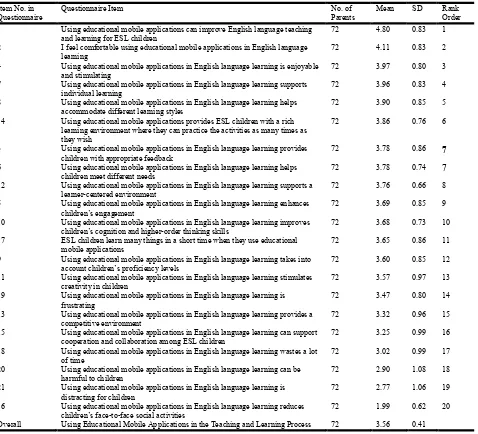
Table 7 shows that the majority of parent participants reported a strong sense of self-efficacy regarding using mobile technologies in general and ESL educational mobile applications in particular (M = 4.13, SD = 0. 49). The questionnaire items 4 (“I promote, monitor, and model the ethical use of mobile technologies in my household”) and 5 (“I like to learn a lot about educational mobile applications and can support my children's English language progress”) obtained the highest rank in this domain (M = 4.29, SD = 0.76). Item 3 (“I know how to solve technical problems with mobile technologies”) obtained the lowest rank (M = 3.56, SD = 0.82). Table 8 shows the statistics for parent responses to the domain of using educational mobile applications in the teaching and learning process. Table 8 shows that most parent participants reported that using educational mobile applications could improve the English language learning of ESL children (M = 4.80, SD = 0.83, RO = 1) and provide opportunities for enjoyable and stimulating learning (M = 4.11, SD = 0.83, RO = 3). They also reported that these applications could support individual learning (M = 3.96, SD = 0.83, RO = 4), different styles of learning (M = 3.90, SD = 0.85, RO = 5), more frequent practice (M = 3.86, SD = 0.76, RO = 6), and satisfy the learner’s individual needs (M = 3.78, SD = 0.74, RO = 7). However, a few of parent participants agreed that using such applications in language leaning and teaching might be harmful (M = 3.10, SD = 1.08, RO = 18) and distracting (M = 2.77, SD = 1.06, RO =19). A very few of them also reported some concerns about their children becoming socially disconnected as a result of using these applications for language learning (M = 1.99, SD = 0.62, RO = 20). The overall mean of the scale was 3.56 with SD 0.41. The statistics for the parent responses to the educational mobile applications and language acquisition domain are given in Table 9.
Table 9 shows that most parent participants reported that using educational mobile applications improved the language skills of ESL children, including listening (M = 4.08, SD = 0.84), vocabulary (M = 4.06, SD = 0.73, RO = 2), reading (M = 3.85, SD = 0.73, RO = 3), pronunciation (M = 3.83, SD = 0.90. RO = 4), constructing new forms of meaning (M = 3.75, SD = 0.87, RO = 5), spelling (M = 3.68, SD = 0.92, RO = 6), speaking (M = 3.46, SD = 1.01, RO = 7), and writing (M = 3.22, SD = 1.02, RO = 8). The overall mean of the scale was 3.74 with SD 0.52. Table 10 summarizes the statistics for parent responses on the three domains of the questionnaire. Table 10 shows that most parent participants reported high perceptions toward the three domains of the questionnaire,
includingparent self-efficacy (M = 4.13, SD = 0.49, RO = 1),
The next section will summarize the role of gender and educational level variables in parents’ perceptions toward using educational mobile applications to help ESL elementary school students develop their language skills. Statistics for the parent questionnaire based on gender are given in Table 11.
Gender comparisons of parents’ perceptions: Table 12
shows the means and standard deviations of parent responses within the domains of the parent survey: parent self-efficacy, teaching and learning process and language acquisition based on gender. The total number of parent participants who completed the survey was 72 (41 females and 31 male).
The overall mean of male parent participant responses was 3.87 with SD 0.42. The overall mean of female parent participant responses was 3.80 with SD 0.30.
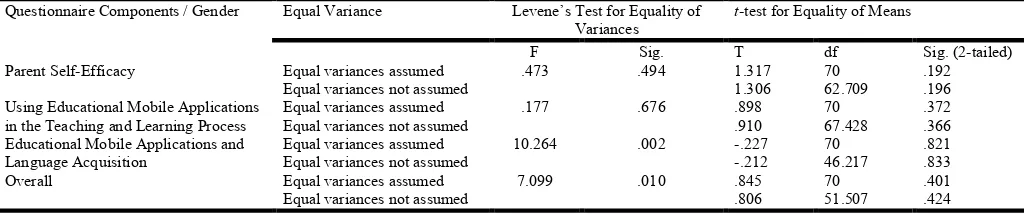
Table 13 assesses the equality of variances and means for the male and female parent groups.
The results of the t-test for equality of means revealed no
significant differences between male and female parents on
parent self-efficacy, t(70) = 1.317, p = .192, teaching and
learning process, t(70) = .898, p = .372, or language
[image:6.595.50.549.75.185.2]acquisition, t(70) = -.227, p = .821.
Table 7. Parent Responses to the Self-Efficacy Domain
Item No. in Questionnaire
Questionnaire Item No. of
Parents
Mean SD Rank Order
4 I promote, monitor, and model the ethical use of mobile technologies in my household
72 4.29 0.76 1
5 I like to learn a lot about educational mobile applications and can support my children's English language progress
72 4.29 0.76 1
1 I can use different types of mobile technologies 72 4.25 0.69 2
2 I think deeply about how mobile technologies influence children's English language progress
72 4.24 0.85 3
3 I know how to solve technical problems with mobile technologies 72 3.56 0.82 4
[image:6.595.64.542.212.646.2]Overall Parent Self-Efficacy 72 4.13 0.49
Table 8. Parent Responses to Educational Mobile Applications in the Teaching and Learning Process
Item No. in Questionnaire
Questionnaire Item No. of
Parents
Mean SD Rank
Order 1 Using educational mobile applications can improve English language teaching
and learning for ESL children
72 4.80 0.83 1
2 I feel comfortable using educational mobile applications in English language learning
72 4.11 0.83 2
4 Using educational mobile applications in English language learning is enjoyable and stimulating
72 3.97 0.80 3
7 Using educational mobile applications in English language learning supports individual learning
72 3.96 0.83 4
8 Using educational mobile applications in English language learning helps accommodate different learning styles
72 3.90 0.85 5
14 Using educational mobile applications provides ESL children with a rich learning environment where they can practice the activities as many times as they wish
72 3.86 0.76 6
3 Using educational mobile applications in English language learning provides children with appropriate feedback
72 3.78 0.86 7
6 Using educational mobile applications in English language learning helps children meet different needs
72 3.78 0.74 7
12 Using educational mobile applications in English language learning supports a learner-centered environment
72 3.76 0.66 8
5 Using educational mobile applications in English language learning enhances children’s engagement
72 3.69 0.85 9
10 Using educational mobile applications in English language learning improves children’s cognition and higher-order thinking skills
72 3.68 0.73 10
17 ESL children learn many things in a short time when they use educational mobile applications
72 3.65 0.86 11
9 Using educational mobile applications in English language learning takes into account children’s proficiency levels
72 3.60 0.85 12
11 Using educational mobile applications in English language learning stimulates creativity in children
72 3.57 0.97 13
19 Using educational mobile applications in English language learning is frustrating
72 3.47 0.80 14
13 Using educational mobile applications in English language learning provides a competitive environment
72 3.32 0.96 15
15 Using educational mobile applications in English language learning can support cooperation and collaboration among ESL children
72 3.25 0.99 16
18 Using educational mobile applications in English language learning wastes a lot of time
72 3.02 0.99 17
20 Using educational mobile applications in English language learning can be harmful to children
72 2.90 1.08 18
21 Using educational mobile applications in English language learning is distracting for children
72 2.77 1.06 19
16 Using educational mobile applications in English language learning reduces children’s face-to-face social activities
72 1.99 0.62 20
The significance level was α = 0.05. These results suggested that gender did not affect ESL parents’ perceptions of using educational mobile applications in English language learning and teaching.
Educational-level comparisons of parents’ perceptions:
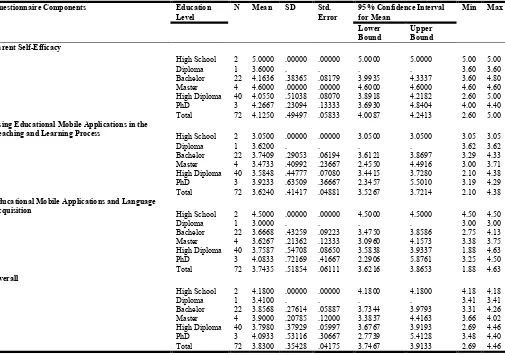
Table 29 presents statistics for the components of the parent questionnaire based on education level. Table 14 presents the results of an ANOVA for the components of the parent questionnaire. The confidence interval calculations and the ANOVA for the entire survey revealed no significant differences (α = 0.05) between parents’ perceptions of using educational mobile applications in teaching and learning English based on educational level. The results revealed no significant differences in two subscales of the survey: using educational mobile applications in the teaching and learning process and language acquisition.
However, there were significant differences (α = 0.05) in the first subscale: parent self-efficacy based on educational level. Although the questionnaires provided a large amount of data in the first phase of the study, they did not allow parent participants to provide more detailed information and to clarify their responses. Accordingly, the open-ended questions and conversational discussions in the in-depth interviews in the second phase of the study gave me the opportunity to collect more comprehensive information about parents’ perceptions. Eight ESL parents were purposefully selected and interviewed. Parent participants were selected based on their scores on the online survey (Barclay, 2012) to include individuals with both positive and negative perceptions about using ESL educational mobile applications to improve the teaching and learning process of ESL elementary school students. Parent participants voluntarily agreed to participate in the interview and completed consent forms.
Table 9. Parent Responses to Educational Mobile Applications and Language Acquisition
Item No. in Questionnaire
Questionnaire Item No. of
Parents
Mean SD Rank
Order
3 Using educational mobile applications in English language learning helps ESL
children improve their listening skills
72 4.08 0.835 1
5 Using educational mobile applications in English language learning helps ESL
children enhance their vocabulary
72 4.06 0.73 2
1 Using educational mobile applications in English language learning helps ESL
children improve their reading skills
72 3.85 0.73 3
6 Using educational mobile applications in English language learning supports ESL
children’s accurate pronunciation
72 3.83 0.90 4
8 Using educational mobile applications in English language learning allows ESL
children to build new forms of meaning
72 3.75 0.87 5
7 Using educational mobile applications in English language learning supports ESL
children’s correct spelling
72 3.68 0.92 6
4 Using educational mobile applications in English language learning helps ESL
children improve their speaking skills
72 3.46 1.01 7
2 Using educational mobile applications in English language learning helps ESL
children improve their writing skills
72 3.22 1.02 8
[image:7.595.46.562.76.259.2]Overall Educational Mobile Applications and Language Acquisition 72 3.74 0.52
Table 10. Statistics for Parent Responses on the Three Domains of the Questionnaire
Item No. in Questionnaire Domain No. of Parents Mean SD Rank Order
1 Parent Self-Efficacy 72 4.13 0.49 1
3 Educational Mobile Applications and Language Acquisition 72 3.74 0.52 2
2 Using Educational Mobile Applications in the Teaching and Learning Process 72 3.56 0.41 3
[image:7.595.56.559.289.341.2]Overall 72 3.81 0.35
Table 11. Gender Comparisons of Parents’ Perceptions
Components of the Questionnaire Gender N Mean SD Standard Error Mean
Parent Self-Efficacy Male 31 4.2129 0.50842 0.09132
Female 41 4.0585 0.48009 0.07498
Using Educational Mobile Applications in the Teaching and Learning Process Male 31 3.6745 0.39334 0.07065
Female 41 3.5859 0.43009 0.06717
Educational Mobile Applications and Language Acquisition Male 31 3.7274 0.65392 0.11745
Female 41 3.7556 0.39524 0.06173
Overall Male 31 3.8706 0.41980 0.07540
Female 41 3.7993 0.29727 0.04643
Table 12. Equality of Variances and t-test for Equality of Means for Gender in Parent Questionnaire
Questionnaire Components / Gender Equal Variance Levene’s Test for Equality of
Variances
t-test for Equality of Means
F Sig. T df Sig. (2-tailed)
Parent Self-Efficacy Equal variances assumed .473 .494 1.317 70 .192
Equal variances not assumed 1.306 62.709 .196
Using Educational Mobile Applications in the Teaching and Learning Process
Equal variances assumed .177 .676 .898 70 .372
Equal variances not assumed .910 67.428 .366
Educational Mobile Applications and Language Acquisition
Equal variances assumed 10.264 .002 -.227 70 .821
Equal variances not assumed -.212 46.217 .833
Overall Equal variances assumed 7.099 .010 .845 70 .401
[image:7.595.46.564.373.459.2] [image:7.595.44.556.493.600.2]Tables 15 presents detailed information about the interviewees. The results of the in-depth interviews indicated that most parent participants did not have clear guidelines for their children’s usage of mobile devices. As ESLP 3 commented, “It depends on my time, I allow them to use iPad for three hours daily, but when I have exams or assignments, they use it until I
[image:8.595.50.555.71.426.2]finish my work.” Only three participants stated that they had conversations with their children about when, where, and how to use mobile devices. The rest stated that they took the devices away from their children or used software that blocked applications in the child’s device. ESLP 4 stated, “I use an application called ‘Our Pact’ that allows me control my son Table 13. Statistics for Education Level in Parent Questionnaire
Questionnaire Components Education
Level
N Mean SD Std.
Error
95% Confidence Interval for Mean
Min Max
Lower Bound
Upper Bound Parent Self-Efficacy
High School 2 5.0000 .00000 .00000 5.0000 5.0000 5.00 5.00
Diploma 1 3.6000 . . . . 3.60 3.60
Bachelor 22 4.1636 .38365 .08179 3.9935 4.3337 3.60 4.80
Master 4 4.6000 .00000 .00000 4.6000 4.6000 4.60 4.60
High Diploma 40 4.0550 .51038 .08070 3.8918 4.2182 2.60 5.00
PhD 3 4.2667 .23094 .13333 3.6930 4.8404 4.00 4.40
Total 72 4.1250 .49497 .05833 4.0087 4.2413 2.60 5.00
Using Educational Mobile Applications in the
Teaching and Learning Process High School 2 3.0500 .00000 .00000 3.0500 3.0500 3.05 3.05
Diploma 1 3.6200 . . . . 3.62 3.62
Bachelor 22 3.7409 .29053 .06194 3.6121 3.8697 3.29 4.33
Master 4 3.4733 .40992 .23667 2.4550 4.4916 3.00 3.71
High Diploma 40 3.5848 .44777 .07080 3.4415 3.7280 2.10 4.38
PhD 3 3.9233 .63509 .36667 2.3457 5.5010 3.19 4.29
Total 72 3.6240 .41417 .04881 3.5267 3.7214 2.10 4.38
Educational Mobile Applications and Language
Acquisition High School 2 4.5000 .00000 .00000 4.5000 4.5000 4.50 4.50
Diploma 1 3.0000 . . . . 3.00 3.00
Bachelor 22 3.6668 .43259 .09223 3.4750 3.8586 2.75 4.13
Master 4 3.6267 .21362 .12333 3.0960 4.1573 3.38 3.75
High Diploma 40 3.7587 .54708 .08650 3.5838 3.9337 1.88 4.63
PhD 3 4.0833 .72169 .41667 2.2906 5.8761 3.25 4.50
Total 72 3.7435 .51854 .06111 3.6216 3.8653 1.88 4.63
Overall
High School 2 4.1800 .00000 .00000 4.1800 4.1800 4.18 4.18
Diploma 1 3.4100 . . . . 3.41 3.41
Bachelor 22 3.8568 .27614 .05887 3.7344 3.9793 3.31 4.26
Master 4 3.9000 .20785 .12000 3.3837 4.4163 3.66 4.02
High Diploma 40 3.7980 .37929 .05997 3.6767 3.9193 2.69 4.46
PhD 3 4.0933 .53116 .30667 2.7739 5.4128 3.48 4.40
[image:8.595.38.561.456.582.2]Total 72 3.8300 .35428 .04175 3.7467 3.9133 2.69 4.46
Table 14. ANOVA Related to Components of Parent Questionnaire
Questionnaire Components Sum of Squares df Mean Square F Sig.
Parent Self-Efficacy Between Groups 4.038 6 .673 3.276 .007
Within Groups 13.357 65 .205
Total 17.395 71
Using Educational Mobile Applications in the Teaching and Learning Process
Between Groups 1.445 6 .241 1.458 .207
Within Groups 10.735 65 .165
Total 12.179 71
Educational Mobile Applications and Language Acquisition
Between Groups 2.356 6 .393 1.525 .184
Within Groups 16.735 65 .257
Total 19.091 71
Overall Between Groups 1.049 6 .175 1.445 .211
Within Groups 7.863 65 .121
[image:8.595.37.560.614.722.2]Total 8.912 71
Table 15. Background of Interviewees (ESL Parents)
No. Name Grade level of children
Number of children
Highest level of education
Primary language
Number of mobile devices in household
Hours of child’s daily screen time
1 ESLP 1 4 and 5 2 Bachelor Arabic 4 or more 1
2 ESLP 2 7 1 Master Bangla 3 2
3 ESLP 3 5 1 Doctoral Chinese 1 4
4 ESLP 4 6 and 7 2 High School Kurdish 2 3
5 ESLP 5 8 1 Bachelor Spanish 3 4
6 ESLP 6 8 and 5 2 High School Telugu and
English 4 2
7 ESLP 7 5 and 7 2 Master Arabic 3 1
device from everywhere without screaming.” Most parent participants tried to learn how to help their children improve their learning, particularly English language learning. ESLP 1, for example, “read articles about language learning for children.” ESLP 6 stated, “I try to find extra resources for English language learning.” In addition, parent participants reported using educational mobile applications as a resource to help children improve their language skills, particularly listening and pronunciation. As ESLP 1 stated, “Unfortunately, I speak English with strong accent, so I used an audio storytelling application to improve listening of my son. When he is listening to people speak English he will improve listening and speaking rather than listening to my poor English.” Similarly, ESLP 4 stated, “I mostly use applications that offer pronunciation and translation to words because I pronounce some words wrongly and I do not want them to learn from me.” Furthermore, some participants claimed that using educational mobile applications increased learner motivation and engagement. ESLP 4 stated, “They offer different types of activities and my children continue doing them without complaints. When I use paper activities, only after 10 minutes, they start to complain that they feel bored.” They also reported that using these applications supported autonomous learning. As ESLP 2 commented, “I just download the appropriate app. Then, they take decisions regarding what to learn and how to learn.” In addition, they reported that many educational mobile applications took into account the learner’s level and learning style. As ESLP 6 stated, “You can choose the level you want ‘beginner, intermediate, or advanced’ […] also, some of them offer different options to users, such as watching videos, pictures, playing games…” However, some parent participants voiced concerns about using such applications for English language learning, which will be discussed under Questions 4 and 5.
DISCUSSION
The findings of the study and how the results relate to the existing literature. This study explored the perceptions of parents regarding the educational mobile applications used to help ESL elementary school students develop their language skills. Both quantitative and qualitative techniques were used for data collection to answer the following research question, what are the perceptions among ESL parents regarding the use of educational mobile applications to help ESL elementary school students develop their language skills? To answer these research questions, the quantitative and qualitative results are discussed below.
Discussion of the Findings
Parent Perceptions: The majority of parent participants
reported a strong sense of self-efficacy regarding mobile technology in general and ESL educational mobile applications in particular. Most parent participants reported that they could use different types of mobile technologies and could promote and monitor the ethical use of mobile technology in their household. In addition, they were considering different ways to support their children’s language learning, including educational mobile applications and other technology. According to Levy (2008), parents play a central role in shaping the self-efficacy and attitudes of their children toward technology. Thus, the role of parents should be taken into account because they can help improve their children’s
self-efficacy and positive attitudes about technology integration in classrooms. With respect to gender, the results revealed no significant differences between male and female parents in mobile technology self-efficacy. This result was consistent with a study conducted by Levy (2008), which likewise found no significant differences between male and female parents in self-efficacy, perceptions, or attitudes toward using computers in the teaching and learning process.
However, the results did reveal significant differences in parents’ self-efficacy based on education level. According to Kanthawongs and Kanthawongs (2013), parents with higher levels of education have higher technology self-efficacy and are more likely to use technology for teaching and learning compared to parents with lower levels of education. In both the quantitative and qualitative results, parents reported positive perceptions toward using educational mobile applications in the teaching and learning process. Most parent participants reported that using such applications could improve the English of ESL children and provide opportunities for enjoyable and stimulating learning. They also reported that these applications could support individualized learning and different styles of learning, provide more frequent practice, and satisfy the learner’s individual needs. These results were consistent with those of Levy (2008) and Kanthawongs and Kanthawongs (2013), which reported parents having positive perceptions of using technology, such as computers, smartphones, and tablets, to teach and learn English. According to Levy (2008) and Kanthawongs and Kanthawongs (2013), parents believed that technology provided a motivating environment for students and supported a more learner-centered approach because it gave them more control over the learning process and more opportunities to choose the content and activities that could best meet their needs. However, a few parent participants suggested that using such applications in language leaning and teaching might be harmful and distracting.
A small number of them also reported concerns about their children becoming socially disconnected as a result of using these applications for language learning. These results supported Kanthawongs and Kanthawongs (2013), who showed that parents had some concerns about the safety of using mobile devices for children in elementary schools because they might become addicted to those devices and spend too much time on them. Mobile devices could also be more harmful if there is a lack of communication between parents and children about the risks of mobile technologies and a lack of rules that promote the responsible use of technology. According to Beale and Hall (2007), children and parents should work together to create a safe environment for using mobile devices at home. Parents should raise their children’s awareness about the benefits and risks of mobile technology through meaningful discussion. Parents should also identify clear guidelines that promote safe and ethical use of technology. Finally, most parent participants reported that using educational mobile applications improved the language skills of ESL elementary school children, including listening, vocabulary, reading, pronunciation, constructing new forms of meaning, spelling, speaking, and writing. These results
supported several studies (e.g., Kanthawongs and
Conclusion
The purpose of this explanatory sequential mixed-methods study was to understand ESL parent perceptions and to identify the barriers they perceived might hinder the effective use of educational mobile applications to help ESL elementary school students develop their language skills.
REFERENCES
Al Aamri, K. S. 2011. The use of mobile phones in learning English language by Sultan Qaboos University students:
Practices, attitudes and challenges. Canadian Journal on
Scientific and Industrial Research, 2(3), 143–152.
Al-Fahad, F. 2009. Students’ attitudes and perceptions towards the effectiveness of mobile learning in King Saud University,
Saudi Arabia. The Turkish Online Journal of Educational
Technology, 8(2), 111–119.
Alqallaf, N. 2016. Mathematical teachers’ perception: Mobile learning and constructing 21st century collaborative cloud-computing environments in elementary public schools in the state of Kuwait (Doctoral dissertation, University of Northern Colorado, Greeley, Colorado.
Ary, D., Jacobs, L. and Sorensen, C. (2006). Introduction to
research in education. Belmont, CA: Thomson/Wadsworth. Bank, S. R, and Graham, M. J. 2000. Young children’s initial
exploration of computers. In D. Rothenberg (Ed.), Issues in
Early Childhood Education: Curriculum, Teacher Education,
and Dissemination of Information. Champaign, IL: Early Childhood and Parenting (ECAP) Collaborative, University of Illinois Urbana-Champaign.
Beale, A. V. and Hall, K. R. 2007. Cyberbullying: What school
administrators (and parents) can do. The Clearing House: A
Journal of Educational Strategies, Issues and Ideas, 81(1), 8– 12. doi:10.3200/TCHS.81.1.8-12
Bitner, N. and Bitner, J. 2002. Integrating technology into the
classroom: Eight keys to success. Journal of Technology and
Teacher Education, 10(1), 95–100.
Cavus, N. and Ibrahim, D. 2009. M-Learning: An experiment in using SMS to support learning new English language words.
British Journal of Educational Technology, 40(1), 78–91.
Creswell, J. 2014. Research design: Qualitative, quantitative, and
mixed methods approaches. Thousand Oaks, CA: Sage.
Creswell, J. and Plano Clark, V. 2011. Designing and conducting
mixed methods research (2nd ed.). Thousand Oaks, CA: Sage.
De Lourdes Andrade, M. 2014. Role of technology in supporting
English language learners in
Ertmer, P. A., Ottenbreit-Leftwich, A. T., Sadik, O., Sendurur, E. and Sendurur, P. 2012. Teacher beliefs and technology
integration practices: A critical relationship. Computers and
Education, 59, 423–435.
Gliner, J. A., Morgan, G. A., and Leech, N. L. 2009. Research methods in applied settings: An integrated approach to design and analysis. New York, NY: Routledge.
Gonzalez-DeHass, A. R., Willems, P. A. and Holbein, M. F. D.
2005. Examining the relationship between parental
involvement and student motivation. Educational Psychology
Review, 17(2), 95–119. doi:10.1007/s10648-005- 3949-7 Hew, K. F. and Brush, T. 2007. Integrating technology into K-12
teaching and learning: Current knowledge gaps and
recommendations for future research. Educational Technology
Research and Development, 55(3), 223–252.
Hill, T., Smith, N. D. and Mann, M. F. 1987. Role of efficacy expectations in predicting the decision to use advanced
technologies: The case of computers. Journal of Applied
Psychology, 72(2), 307–313.
Hismanoglu, M. 2012a. Prospective EFL teachers' perceptions of ICT integration: A study of distance higher education in
Turkey. Educational Technology and Society, 15(1), 185–196.
Hismanoglu, M. 2012b. The impact of a curricular innovation on prospective EFL teachers' attitudes towards ICT integration
into language instruction. Online Submission, 5(1), 183–202.
Howell, D. 2012. Statistical methods for psychology. Belmonet,
CA: Cengage Learning.
Ivankova, N. V., Creswell, J. W., and Stick, S. L. (2006). Using mixed-methods sequential explanatory design: From theory to
practice. Field Methods, 18(1), 3–20.
Kanthawongs, P., and Kanthawongs, P. 2013. Perception of primary school students, parents and teachers toward the use of computers, the internet and social networking sites.
Procedia-Social and Behavioral Sciences, 88, 282–290. Kukulska-Hulme, A. and Shield, L. 2007. An overview of mobile
assisted language learning: Can mobile devices support
collaborative practice in speaking and listening? ReCALL,
20(3), 1–20.
Lenhart, A. and Madden, M. 2007. Teens, privacy and online social networks: How teens manage their online identities and personal information in the age of MySpace. Washington, DC: Pew Internet and American Life Project.
Levy, L. Z. 2008. Computer attitudes, self-efficacy, and usage of children and their parents: Viewed through the gender lens (Doctoral dissertation). Texas Woman’s University.
Lichtman, M. 2013. Qualitative research in education (3rd ed.).
Thousand Oaks, CA: Sage.
Likert, R. 1932. A technique for the measurement of attitudes.
Archives of Psychology, No. 140. New York, NY: The Science Press.
Lincoln, Y. S. and Guba, E. G. 1985. Naturalistic inquiry. Thousand Oaks, CA: Sage.
Merç, A. 2015. Using technology in the classroom: A study with
Turkish pre-service EFL teachers. The Turkish Online Journal
of Educational Technology, 14(2), 229–240.
Meskill, C. and Mossop, J. 2000. Technologies use with ESL
learners in New York State: Preliminary report. Journal of
Educational Computing Research, 22(3), 265–284.
Messinger, J. 2012. M-learning: An exploration of the attitudes and perceptions of high school students versus teachers regarding the current and future use of mobile devices for learning (Unpublished doctoral dissertation). Pepperdine University.
Mollaei, F. and Riasati, M. J. 2013. Teachers’ perceptions of using
technology in teaching EFL. International Journal of Applied
Linguistics and English Literature, 2(1), 13–22.
Nomass, B. B. 2013. The impact of using technology in teaching
English as a second language. English Language and
Literature Studies, 3(1), 111–116.
O'Bannon, B. W. and Thomas, K. M. 2015. Mobile phones in the
classroom: Preservice teachers answer the call. Computers
and Education, 85, 110–122.
Ottenbreit-Leftwich, A. T., Glazewski, K. D., Newby, T. J. and Ertmer, P. A. 2010. Teacher value beliefs associated with using technology: Addressing professional and student needs.
Computers and Education, 55, 1321–1355.
Ozdamli, F. and Uzunboylu, H. 2015. M-learning adequacy and perceptions of students and teachers in secondary schools.
British Journal of Educational Technology, 46(1), 159–172. Patton, M. Q. 2002. Two decades of developments in qualitative
inquiry a personal, experiential perspective. Qualitative social
work, 1(3), 261-283.
Plowman, L., McPake, J. and Stephen, C. 2010. The technologisation of childhood? Young children and technology
in the home. Children and Society, 24(1), 63–74.
Şad, S. N. and Göktaş, Ö. 2014. Preservice teachers' perceptions about using mobile phones and laptops in education as mobile
learning tools. British Journal of Educational Technology,
45(4), 606–618.
Scherer, C. 1990. Parent perceptions of the importance of
computer knowledge for young children. (ERIC Document Reproduction Services No. ED337290).
Sharma, P. 2009. Controversies in using technology in language
teaching. In BBC Teaching English. Retrieved from
http://www.teachingenglish.org.uk/articles/controvers
ies-using-technology-language-teaching
Sinek, S. and Sparkman, A. 2013. Scholastic kids and family
reading report. New York, NY: Scholastic.
Valk, J. H., Rashid, A. T. and Elder, L. 2010. Using mobile phones to improve educational outcomes: An analysis of
evidence from Asia. The International Review of Research in
Open and Distributed Learning, 11(1), 117–140.
Vázquez-Cano, E. 2014. Mobile distance learning with
smartphones and apps in higher education. Educational
Sciences: Theory and Practice, 14(4), 1505–1520.
Wentworth, N. M. and Connell, M. L. 1995. An investigation of parent perceptions of education, teaching, mathematics, and
computers. Computers in the Schools, 11(4), 35–53.
Ybarra, R. and Green T. 2003. Using technology to help ESL/EFL
students develop language skills. The Internet TESL Journal,
9(3).