Liquid Marble Interaction Gate for Collision-Based
Computing
Thomas C. Drapera, Claire Fullartona, Neil Phillipsa, Ben P. J. de Lacy Costellob, Andrew Adamatzkya,∗
aUnconventional Computing Laboratory, University of the West of England, Bristol, United
Kingdom
bInstitute of Biosensing Technology, Centre for Research in Biosciences, University of the
West of England, Bristol, United Kingdom
Abstract
Liquid marbles are microlitre droplets of liquid, encapsulated by self-organised hydrophobic particles at the liquid/air interface. They offer an efficient ap-proach for manipulating liquid droplets and compartmentalising reactions in droplets. Digital fluidic devices employing liquid marbles might benefit from having embedded computing circuits without electronics and moving mechani-cal parts (apart from the marbles). We present an experimental implementation of a collision gate with liquid marbles. Mechanics of the gate follows principles of Margolus’ soft-sphere collision gate. Boolean values of the inputs are given by the absence (False) or presence (True) of a liquid marble. There are three outputs: two outputs are trajectories of undisturbed marbles (they only report
True when just one marble is present at one of the inputs), one output is
represented by trajectories of colliding marbles (when two marbles collide they lose their horizontal momentum and fall), this output reportsTrueonly when two marbles are present at inputs. Thus the gate implementsANDand
AND-NOTlogical functions. We speculate that by merging trajectories representing AND-NOToutput into a single channel one can produce a one-bit half-adder.
Potential design of a one-bit full-adder is discussed, and the synthesis of both a pure nickel metal and hybrid nickel/polymer liquid marble is reported.
Keywords: Liquid marble, Unconventional computing, Collision computing, Adder, Logic gate, Microfluidic
1. Introduction
Since their inception in 2001 [1], liquid marbles (LMs) have been a source of growing interest across fields as diverse as medicine [2, 3], engineering [4, 5]
∗Corresponding author
and chemistry [6, 7]. LMs are constructed from microlitre droplets of water, supported by a layer of hydrophobic particles on the surface. In this manner, the 5
hydrophobic particles minimise the comparatively high surface energy of water by encapsulating the droplet, and keeping it near spherical. This permits the water droplet to remain non-wetting on many (traditionally wettable) surfaces. There are two major variables affecting the properties of a LM: the core and the coating. Traditionally the encapsulated liquid is water, although there are 10
a range of both common (glycerol [1]) and uncommon (petroleum [8]) alterna-tives. The coating provides the largest affect on the mechanical properties of the marble, as it is the coating that interacts with the surface the LM is resting on. Coating parameters that can be modified to impart the desired proper-ties include the composition, grain size, and mix ratio. By varying these, it is 15
possible to adapt a liquid marble to many different situations.
Liquid marbles have previously been investigated as fluidic transport devices. They are ideally suited to the transport of microlitre quantities of liquid, due to their non-wetting nature. Recent progress have been made in this area, with LM movement initiated by magnets [9], electrostatic fields [10], gravity [1], lasers 20
[6] and the Marangoni effect [11] all reported. The movement of LMs can be exploited for chemical reactions, by controlling the time and place of reagent mixing. This has been demonstrated both with the coalescing of LMs [12], and in the controlled destruction of LMs once they arrive at a chosen location [13, 14].
25
In interaction gates, Boolean values of inputs and outputs are represented by presence of physical objects at given site at a given time. If an object is present at input/output we assume that logical value of the input/output is
True; if the object is absent the logical value is False. The signal-object
realise a logical function when they pass through a collision site. The objects 30
might fuse, annihilate or deflect on impact.
The fusion gate (figure 1(a)) was first implemented in fluidic devices in the 1960s. The gate is the most well known (on a par with the bistable amplifier) device in fluidics [15, 16]: two nozzles are placed at right angles to each other, when there are jet flows in both nozzle they collide and merge into a single jet 35
entering the central outlet. If the jet flow is present only in one of the input nozzles it goes into the vent. The central outlet representsand and the vent represent and-not. The fusion-based gate was also employed in designs of computing circuits in Belousov-Zhabotinsky medium [17–20], where excitation wave-fragments merge when collide; in the actions of slime mould [21], when 40
distributing vesicles collide; and a crab-based gate [22], were swarms of solider crabs merge into a single swarm.
In the annihilation gate (figure 1(b)) signals disappear on impact. This gates has two-inputs and two-outputs, each of the outputs representsand-not. Computational universality of the Conway’s Game of Life cellular automata was 45
demonstrated using annihilation based collisions between gliders [23]. We can also implement the annihilation gate by colliding excitation wave-fragments at certain angles [24].
X Y XY XY XY XY X Y XY XY XY XY X Y XY XY X Y XY XY XY (a) X Y XY XY XY XY X Y XY XY XY XY X Y XY XY X Y XY XY XY (b) X Y XY XY XY XY X Y XY XY XY XY X Y XY XY X Y XY XY XY (c) X Y XY XY XY XY X Y XY XY XY XY X Y XY XY X Y XY XY XY (d)
Figure 1: Interaction-based gates. (a) Fusion of signals. (b) Annihilation of signals. (c) Elastic deflection of signals. (d) Quasi-elastic deflection of compressible signals.
in media other than excitable spatially-extended systems, they do not preserve 50
physical quantity of signals, e.g. when two signals merge the output signal will have a double mass of a signal input signal. This deficiency is overcome in the conservative logic, proposed by Fredkin and Toffoli in 1978 [25]. The logical value are represented by solid elastic bodies, aka billiard balls, which deflect when made to collide with one another (figure 1(c)). Intact output trajectories 55
of the balls representand-not function, output trajectories of deflected balls representandfunction. The gates based on elastic collision led to development of a reversible (both logically and physically) gate: Fredkin [25] and Toffoli [26] gates, which are the key elements of low-power computing circuits [27, 28], and amongst the key components of quantum [29–32] and optical [33] computing 60
circuits.
The soft-sphere collision gate proposed by Margolus [34] gives us a rather realistic representation of interaction gates with real-life physical and biological bodies, interacting in a quasi-elastic compressible manner (figure 1(d)). Logical valuex= 1 is given by a ball presented in input trajectory markedx, andx= 0 65
by the absence of the ball in the input trajectoryx; the same applies toy = 1 and y = 0, respectively. When the two balls, approaching the collision gate along paths x and y collide, they compress but then spring back and reflect. As a result, the balls come out along the paths marked xy. If only one ball approaches the gate, that is for inputsx= 1 andy= 0 orx= 0 andy= 1, the 70
balls exit the gate via pathxy(for inputx= 1 andy= 0) orxy(for inputx= 0 andy= 1). Soft-sphere-like gates have been implemented using microlitre sized water droplets on a superhydrophobic copper surface [35]. Using channels cut into the surface,not-fanout,and-orandflip-flopgates were demonstrated. The water droplets only rebounded in a very narrow collision property window, 75
and a thorough & complete superhydrophobic surface treatment was required. In this paper, we report the first exploitation of liquid marbles for imple-mentation of interaction gates. The gate realised in the experimental laboratory conditions is a combination of the fusion and the Margolus gate: output tra-jectories of collided liquid marbles are so close that they can be interpreted as 80
be diverted along different paths to conserve a number of signals. By taking advantage of the liquid marbles’ inherently low hysteresis, high tunability and capacity for enhanced versatility, we demonstrate the first step toward liquid marble facilitated, collision-based computing.
85
2. Materials & Method
2.1. Regular & Reliable Liquid Marble Formation
We first developed a technique for the regular and automatic formation of invariable LMs. This was achieved by programming a syringe driver (Care-Fusion Alaris GH) to feed a 21 gauge needle (0.8 mm diameter) at a typi-90
cal rate of 7.0 ml h−1. The rate can be easily increased or decreased, and
this rate gave sufficiently fast LM formation for our purpose. The produced droplets (11.60±0.16µl) were permitted to fall onto a sheet of acrylic, slanted to 20◦from horizontal, and surface-treated with a commercial hydrophobic spray (Rust-OleumR NeverWetR). This formed beads of water, which were allowed 95
to roll over a bed of appropriate hydrophobic powder. The result was a con-tinuous ‘stream’ of LMs with the same volume, coating and coating thickness. It should be noted that whilst the forming of LMs by running droplets down a powder slope has been separately developed by another group [14], our system prevents premature destruction of the powder bed by initially preforming the 100
droplet on a treated hydrophobic surface.
2.2. Maintaining Timing for Collisions
In collision based computing, accurate timing is essential. As signals prop-agate through the system they must remain in sync, or the operation of many logic gates fails. In order to address this, an innovative system of electromag-105
nets (EMs) was implemented. This was possible due to the generation of novel LMs with a mix of ultra-high density polyethylene (UHDPE) (Sigma-Aldrich, 3–6×10⁶ g mol−1, grain size approximately 100µm) and nickel (GoodFellow
Metals, 99.8 %, grain size 4µm to 7µm). A typical Ni/UHDPE coating was 2.5 mg. The use of UHDPE provides strength and durability, and the inclusion 110
of ferromagnetic nickel allows for a versatile magnetic LM.
By positioning an electromagnet (100 N, 12.0 V DC, 29 mm×22 mm) be-hind the acrylic slope, the rolling LM can be captured and released at will, by the switching on and off of said electromagnet. By controlling multiple, spatially-isolated electromagnets in series, non-concurrent LMs can be easily 115
synchronised. To our knowledge, this is the first time electromagnets have been used to provide timing control with liquid marbles.
2.3. Gate Design for Liquid Marble Collisions
The collision gate was designed to allow for the colliding LMs to have a free path post-collision. This enabled the monitoring of the LM paths, and the 120
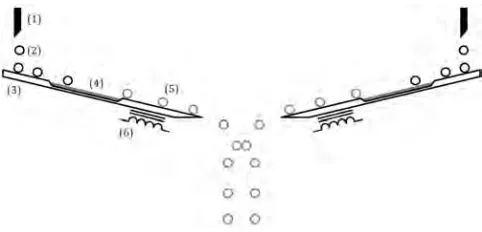
Figure 2: Schematic of our LM collider. Labelled numbers are: (1) syringe needle, (2) un-coated water droplet, (3) acrylic ramp, (4) hydrophobic powder bed, (5) liquid marble, and (6) electromagnet. Droplets form and fall out of the two syringe needles, landing on a super-hydrophobic surface. They then roll over a bed of Ni/UHDPE powder, before being stopped and held stationary by the electromagnets. These electromagnets are then deactivated simul-taneously, allowing the LMs to roll off and collide.
Two 16.0 cm acrylic pathways were slanted towards each other at 20◦, affixed to an acrylic base sheet (3.0 mm thick). The acrylic base sheet was then aligned with a pitch of 38◦from horizontal, giving a final LM pathway slope of 16◦from the horizontal plane. This gave reliable LM rolling without extreme angles. The 125
gap between the two slanted pathways was set at 1.6 cm, after empirical testing. A 2.0 cm, length at the top of each pathway was made hydrophobic, as discussed above. Parallel auto-formation of hybrid LMs was achieved using the syringe driver, delivering 11.6µl of water per syringe per drop. Each droplet of water was permitted to land on the treated section of each slope, before rolling across 130
the powder beds of UHDPE and Ni to form LMs. The two rolling LMs were then captured using the electromagnets, allowing for any slight timing deviations to be accounted for. On controlled synchronous (or asynchronous) release of the electromagnets, the LMs simultaneously roll off the acrylic ramps on collision trajectories. Collisions were recorded at 120 fps using a Nikon Coolpix P900, 135
and played back frame-by-frame for analysis. A schematic of our LM collider can be seen in figure 2, and photographs of our LM collider can be seen in figure 3.
3. Discussion
3.1. Liquid Marble Lifetime
140
For a LM to be useful in a computing device, it has to have an appreciable lifetime. This is problematic for water based LM, as the gas permeability of LMs has previously been both established and exploited [5, 36–38]. As such, lifetime experiments were conducted on UHDPE LMs, Ni LMs, water droplets, and our new Ni/UHDPE hybrid LMs. Evaporation studies were conducted under 145
(a) (b) (c)
Figure 3: Photographs of our LM collider, showing (a) the overall layout, (b) an upclose of the magnetic breaking/release area, and (c) an upclose of the droplet formation area. Labels are: (1) syringe needle, (2) acrylic ramp, (3) hydrophobic powder bed, and (4) electromagnet location. The electromagnet is positioned at the back, out of view in these photos. All scale bars are 30 mm.
powder bed of UHDPE. Nickel LMs were made using a superhydrophobic surface (see above) to pre-form the droplet sphere, before rolling in an appropriate powder. A magnified view of both a Ni/UHDPE hybrid LM and a nickel LM 150
can be seen in figure 4.
(a) (b)
Figure 4: Magnified photographs of (a) a Ni/UHDPE LM, nickel can clearly be seen between the UHDPE particles; and (b) a pure nickel LM. Scale bars are 1.0 mm.
From the data shown in table 1, it can be seen that both the nickel and UHDPE LMs have slower evaporation rates than a pure water droplet. This is expected, as the solid particles on the surface of the liquid form an (incomplete) barrier to evaporation. It also supports previous studies [39]. Experiments also 155
indicated that pure UHDPE LMs evaporate at a comparable rate to pure nickel LMs. This is due to a balancing act between the short narrow pores of the nickel LM, the long wide channels of the UHDPE LM, and the much larger contact angle of UHDPE compared to nickel [40, 41]. The larger grain size of the UHDPE creates longer channels for water vapour to traverse. This results 160
in a smaller water vapour concentration gradient.
[image:6.612.199.412.363.490.2]Table 1: Comparison of the evaporation rates (standard deviations in brackets) for 10µl LMs and an uncoated water droplet.
LM Coating Initial Evaporation Rate
mg min−1
(Water Droplet) 0.13 (0.01)
Ni 0.12 (0.01)
UHDPE 0.12 (0.02)
Ni/UHDPE 0.10 (0.01)
in the nickel and UHDPE particle sizes. This difference is clearly visible in the magnified photograph shown in figure 4(a). The larger UHDPE particles 165
offer good resistance to evaporation, due to their thickness. However, this also leads to large gaps between the particles, due to poor packing. This problem is alleviated by the nickel particles filling the available space. The use of two differently sized spheres for 3D spherical packing is well documented [42, 43], and has been shown to increase the maximum perfect packing density beyond 170
the 0.74 limit of a single-sized 3D sphere packing, to 0.93 for an ideal binary system [44]. In this instance, due to the multilayer nature of the LM coating [13], it is more appropriate to relate to 3D sphere packing than 2D circle packing.
3.2. Liquid Marble Collisions
If the gate timings are not accurate, then the LMs will continue on their 175
separate paths and shall not collide. If the timings are accurate, and it is taken that the two LMs are identical, then there are three possible outcomes of the collision. Firstly, that the LMs collide with some elastic property, and then continue on two distinct and new paths. Secondly, that the LMs collide with no elastic property, then continue vertically as two adjacent, but distinct, LMs. 180
Thirdly, that on collision the LMs coalesce into a larger single LM with zero lateral velocity, which continues vertically down.
(a) (b)
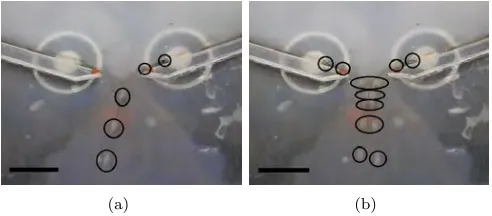
[image:7.612.183.429.514.622.2]Video snapshots showing both a single uninterrupted and a colliding pair of LMs, can be seen in figure 5. The time between the LMs leaving the ramp, colliding and being visually separated again, is 75 ms. This represents an upper 185
limit on LM collision-based computing time for a 1-bit calculation. Analysis from ten collisions show only a slight deviation in the collision exit trajectory. By taking a vertical line from the centre of the collision as the reference line, the exit trajectories for the LMs are−5.3±1.5◦ and +5.5±1.1◦.
Our experiments demonstrate that LMs collide in an elastic manner. This 190
is unsurprising, due to their previously reported soft-shell and compressible nature [1, 45]. It also supports the previously published, linear, non-coalescing collision of LMs [45]. The elastic properties and compressible nature of LMs has been discussed elsewhere in a recent review [46]. By monitoring the collisions at 120 fps, it was observed that LMs behave like two soft balls, acting in a 195
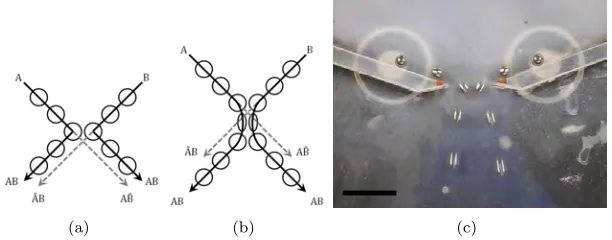
manner described in the Soft Sphere Model (SSM), known as a Margolus gate [34]. A video of a typical collision can be seen in the supporting information. The important distinction between the SSM and the better known Billiard Ball Model (BBM) [25], is the exit points of the colliding particles compared to the non-colliding particles. In the BBM, the particles are taken to be hard spheres, 200
which instantly rebound off each other — leading to theABpaths being outside the correspondingAB¯ and A ¯B paths. In contrast, the SSM accounts for the finite and appreciable amount of time required for real-world soft spheres to rebound. The result is that the AB paths move to lie inside the unchangedAB¯
andA ¯B paths. The BBM and SSM pathways can be seen in figures 6(a) and 205
6(b), respectively.
[image:8.612.153.459.430.550.2](a) (b) (c)
Figure 6: Showing the colliding and non-colliding routes for (a) BBM and (b) SSM pathways. (c) A collision of steel balls, following BBM under gravity (cf. SSM LMs above). Frame times are 0 ms, 175 ms, 242 ms, 284 ms and 325 ms. Scale bar is 20 mm.
It was possible to break the SSM analogy by increasing the speed of the LMs. The speed of the LMs was calculated by measuring the distance travelled by the LM in a certain number of frames, and knowing the recording frames per second. When the collision happens at 0.21 m s−1, the LMs bounce elastically following
210
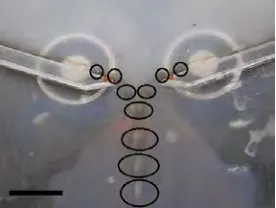
SSM paths. However, when the speed of collision is increased to 0.29 m s−1,
should be noted that the previously mentioned LM computing time is reduced to 50 ms, when the LMs are permitted to coalesce. This is measured from when the LMs leave the ramp, to when they are fully coalesced. The time is saved by 215
[image:9.612.237.375.186.290.2]not requiring the LMs to separate.
Figure 7: Overlaid still frames showing the coalescence of two colliding LMs. Frames shown at 0 ms, 117 ms, 159 ms, 184 ms, 209 ms, 234 ms and 250 ms. Scale bar is 20 mm.
Growth by coalescence of LMs is a commonly observed effect [47]. For a computing device, the physical nature of the input and output signals should be exactly the same. When two LMs coalesce, the output mass is double a single input mass. Consequently, if colliding LMs at this higher speed, a splitting 220
device would be required to reduce the mass of the output LM. The facile splitting of a LM using a superhydrophobic treated scalpel has previously been reported [48].
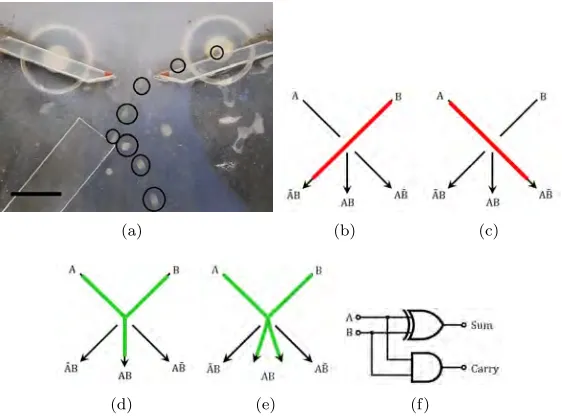
By analysing the output paths of the LM collider, it becomes apparent that the gate could be modified to act as a 1-bit half-adder, with the possible out-225
comes demonstrated in figure 8. When a single LM traverses the system from the A or B channel, it finishes at the left or right extremes, the A ¯B or AB¯
path, respectively. Once the exit pathways are combined, this is analogous to the sum output on a half-adder. An initial trial confirming feasibility of this is shown in figure 8(a), where a single LM enters from the right channel, crosses 230
the gap, and is reflected to exit on the right side.
When two synchronised LMs pass through the collider, they either rebound or coalesce, according to their velocity at impact. If the LMs coalesce, then the new LM travels straight down the onlyABpath, which can be considered to be the carry output. Alternatively if the LMs rebound, as in the SSM, then there 235
are twoABpaths. One of these paths is then considered to be the carry output, and the other is discarded (the choice between the twoABpaths is arbitrary in this case). As stated above, there are approximately 10◦ of departure between the twoABpaths, making separation facile.
3.3. One-Bit Full-Adder Proposed
240
(a) (b) (c)
(d) (e) (f)
Figure 8: (a) Overlaid frames showing the successful reflection of a LM, frames are timed at 0 ms, 234 ms, 334 ms, 375 ms, 400 ms, 434 ms, 476 ms and 517 ms. Scale bar is 20 mm. (b) & (c) The outcomes of a single unreflected LM passing through the adder. (d) The outcome of the adder when two LMs collide and coalesce. (e) The outcome of the adder when two LMs collide according to the SSM. (f) The electronic representation of a 1-bit half-adder.
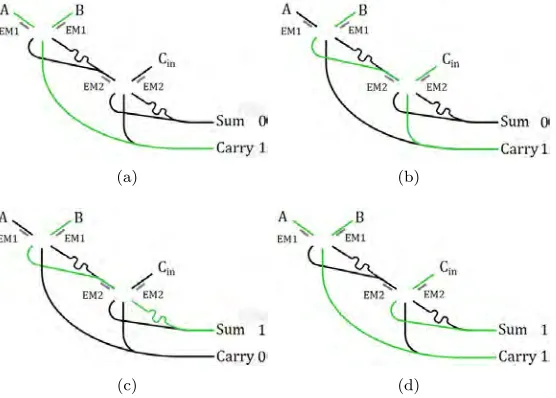
with an or gate without loss of logic, as there is no situation where two LMs will arrive simultaneously. The design schematic can be seen in figure 9. There 245
are two sets of electromagnets, which cycle on-off in pairs; first EM1 releases, then shortly after EM2 releases. This maintains synchronisation between LMs across the two collision gates. The signal delays (indicated in figures 9 and 10 by wavy lines) are useful for helping timing control for any future additional cascades. These can be implemented using channel curves, reflectors, or with 250
EMs. The EM’s delay could be controlled using capacitance. Additionally, the
Cin channel could be released simultaneously with theAandBchannel, using signal delay to ensure collision.
For this design iteration, we have used channels for the passage of LMs. This is a deviation from pure collision-based computing, where free-space is used as 255
momentary ‘wires’ on an ad hoc basis. However, in this case, we believe the use of channels to be an important intermediate step towards this goal.
For the example operations visualised in figure 10, if a LM travels down the
AandBchannel, then they will collide and travel straight to the carry output. If a LM travels down the B and Cin paths, then the B LM crosses the first 260
gate, before colliding with theCin LM and travelling straight down to join the carry output. If a single LM travels down the B path, it will cross the first and second gate, finishing on the sum output. If a LM travels down theA,B
[image:10.612.166.447.124.332.2]Figure 9: The general design schematic for a 1-bit full-adder, operated using liquid marbles.
the carry output, whilst the Cin LM will cross its gate and finish on the sum 265
output.
(a) (b)
(c) (d)
Figure 10: Example operations of the 1-bit full-adder to sum (a) 1 + 1 + 0 = 10, (b) 0 + 1 + 1 = 10, (c) 0 + 1 + 0 = 01, and (d) 1 + 1 + 1 = 11.
Based on the observations of our collision gate, we note that such a full-adder could be implemented with dimensions of approximately 15 cm×15 cm, using LMs with a volume of approximately 10µl, and a LM pre-collision run length of 2 cm. This gate could then be cascaded as required to produce an n-bit full-270
down appropriately. Using a single set of syringes, the automatic marble maker can up to eight LMs per needle per second. At this speed, synchronisation of the 275
electromagnets becomes crucial. Initial investigations into the collision lifetime of the LM are promising, with six 10.0µl LMs confined to a 2.5 cm×2.5 cm space on an orbital shaker at 100 rpm (covered to minimise evaporation), showing no signs of wear after three hours.
4. Conclusions
280
In summary, this demonstration of a collision interaction gate represents the first computing device operated by LMs. A new automatic technique for the easy and reproducible synthesis of LMs enhances the reliability of gate operations. The novel electromagnetic synchronisation of the LM collisions was made possible by the development of a new magnetic hybrid LM, with a coating 285
composed of nickel and UHDPE, used in conjunction with electromagnets for breaking, holding, and synchronised release of the LMs. This collision gate would operate as a 1-bit half-adder, once the sum outputs are combined. A design schematic for a 1-bit full-adder was proposed.
The use of LMs for collision-based computation has many advantages (ad-290
ditional degrees of freedom) over previous approaches. Due to their nature, it is possible to carry cargo in the LMs, which adds an additional dimension to the calculations. It is also possible to initiate chemical reactions within marbles by their coalescence [12]. By varying the diameters of the LMs, different sizes can represent different values, and will have different relative trajectories — 295
removing the limitations of a binary system. Use of a magnet can remove the coating from magnetic marbles, which (if done on a superhydrophobic surface) can roll freely down a slope as droplets, before being reformed using a different coating. Compared to droplet computing [35, 50], only a tiny portion of the circuit needs to be treated hydrophobic, making larger and more complicated 300
circuits easier and cheaper to construct. These points, combined with LM’s ability to be easily merged, levitated [12], divided [48], opened/closed [51], and easily propelled by a variety of methods make LMs a fascinating and potentially prosperous addition to the unconventional computing family.
We envision the continued development of LM arithmetic circuits, and are 305
currently working on producing working models of cascading standard gates.
Acknowledgements
This research was supported by the EPSRC with grant EP/P016677/1 “Com-puting with Liquid Marbles”. The authors thank Dr Richard Mayne for his help with microscope imaging.
310
Supporting Information
References
[1] P. Aussillous, D. Qu´er´e, Liquid marbles, Nature 411 (6840) (2001) 924–927. 315
doi:10.1038/35082026.
URLhttp://www.nature.com/doifinder/10.1038/35082026
[2] F. Sarvi, K. Jain, T. Arbatan, P. J. Verma, K. Hourigan, M. C. Thompson, W. Shen, P. P. Y. Chan, Cardiogenesis of Embryonic Stem Cells with Liquid Marble Micro-Bioreactor, Adv. Healthc. Mater. 4 (1) (2015) 77–86. doi: 320
10.1002/adhm.201400138.
URLhttp://doi.wiley.com/10.1002/adhm.201400138
[3] S. Ledda, A. Idda, J. Kelly, F. Ariu, L. Bogliolo, D. Bebbere, A novel technique for in vitro maturation of sheep oocytes in a liquid marble microbioreactor, J. Assist. Reprod. Genet. 33 (4) (2016) 513–518. doi: 325
10.1007/s10815-016-0666-8.
URLhttp://link.springer.com/10.1007/s10815-016-0666-8
[4] S. Fujii, S. Takeuchi, M. Edahiro, S. Yoshimi, A. Kogure, Y. Tarui, M. Kasahara, Y. Yasui, Y. Nakamura, Pressure-sensitive Adhesive Liq-uid Marble: Fabrication and Characterization of Structure and Adhesive 330
Property, J. Japan Soc. Powder Powder Metall. 64 (3) (2017) 121–125. doi:10.2497/jjspm.64.121.
URL https://www.jstage.jst.go.jp/article/jjspm/64/3/64{_}121/ {_}article/-char/ja/
[5] J. Tian, T. Arbatan, X. Li, W. Shen, Porous liquid marble shell offers 335
possibilities for gas detection and gas reactions, Chem. Eng. J. 165 (1) (2010) 347–353. doi:10.1016/j.cej.2010.06.036.
URL http://linkinghub.elsevier.com/retrieve/pii/ S1385894710005693
[6] M. Paven, H. Mayama, T. Sekido, H.-J. Butt, Y. Nakamura, S. Fujii, 340
Light-Driven Delivery and Release of Materials Using Liquid Marbles, Adv. Funct. Mater. 26 (19) (2016) 3199–3206. doi:10.1002/adfm.201600034. URLhttp://doi.wiley.com/10.1002/adfm.201600034
[7] W. Wei, R. Lu, W. Ye, J. Sun, Y. Zhu, J. Luo, X. Liu, Liquid Marbles Stabilized by Fluorine-Bearing Cyclomatrix Polyphosphazene Particles and 345
Their Application as High-Efficiency Miniature Reactors, Langmuir 32 (7) (2016) 1707–1715. doi:10.1021/acs.langmuir.5b04697.
URLhttp://pubs.acs.org/doi/abs/10.1021/acs.langmuir.5b04697
[8] E. Bormashenko, R. Pogreb, R. Balter, H. Aharoni, D. Aurbach, V. Strel-nikov, Liquid marbles containing petroleum and their properties, Pet. Sci. 350
[9] M. K. Khaw, C. H. Ooi, F. Mohd-Yasin, R. Vadivelu, J. S. John, N.-T. Nguyen, Digital microfluidics with a magnetically actuated floating liquid marble, Lab Chip 16 (12) (2016) 2211–2218. doi:10.1039/C6LC00378H. 355
URLhttp://xlink.rsc.org/?DOI=C6LC00378H
[10] P. Aussillous, D. Qu´er´e, Properties of liquid marbles, Proc. R. Soc. A Math. Phys. Eng. Sci. 462 (2067) (2006) 973–999.doi:10.1098/rspa.2005.1581. URL http://rspa.royalsocietypublishing.org/cgi/doi/10.1098/ rspa.2005.1581
360
[11] C. H. Ooi, A. van Nguyen, G. M. Evans, O. Gendelman, E. Bormashenko, N.-T. Nguyen, A floating self-propelling liquid marble containing aqueous ethanol solutions, RSC Adv. 5 (122) (2015) 101006–101012. doi:10.1039/ C5RA23946J.
URLhttp://xlink.rsc.org/?DOI=C5RA23946J 365
[12] Z. Chen, D. Zang, L. Zhao, M. Qu, X. Li, X. Li, L. Li, X. Geng, Liquid Marble Coalescence and Triggered Microreaction Driven by Acoustic Levi-tation, Langmuir 33 (25) (2017) 6232–6239. doi:10.1021/acs.langmuir. 7b00347.
URLhttp://pubs.acs.org/doi/abs/10.1021/acs.langmuir.7b00347 370
[13] D. Dupin, S. P. Armes, S. Fujii, Stimulus-responsive liquid marbles, J. Am. Chem. Soc. 131 (15) (2009) 5386–5387.
[14] S. Fujii, S. Kameyama, S. P. Armes, D. Dupin, M. Suzaki, Y. Nakamura, pH-responsive liquid marbles stabilized with poly(2-vinylpyridine) parti-cles, Soft Matter 6 (3) (2010) 635–640. doi:10.1039/B914997J.
375
URLhttp://xlink.rsc.org/?DOI=B914997J
[15] B. Peter, “and” gate, US Patent 3,191,611 (June 1965).
[16] C. A. Belsterling, Fluidic systems design, John Wiley & Sons, 1971.
[17] A. Adamatzky, Collision-based computing in Belousov–Zhabotinsky medium, Chaos Solitons Fract. 21 (5) (2004) 1259–1264.
380
[18] A. Adamatzky, B. de Lacy Costello, Binary collisions between wave-fragments in a sub-excitable Belousov–Zhabotinsky medium, Chaos Soli-tons Fract. 34 (2) (2007) 307–315.
[19] R. Toth, C. Stone, B. d. L. Costello, A. Adamatzky, L. Bull, Simple Collision-Based Chemical Logic Gates with Adaptive Computing, in: 385
Theor. Technol. Adv. Nanotechnol. Mol. Comput., IGI Global, 2010, pp. 162–175. doi:10.4018/978-1-60960-186-7.ch011.
URL http://services.igi-global.com/resolvedoi/resolve.aspx? doi=10.4018/978-1-60960-186-7.ch011
[20] A. Adamatzky, B. De Lacy Costello, L. Bull, J. Holley, Towards arithmetic 390
[21] R. Mayne, A. Adamatzky, On the Computing Potential of Intracellular Vesicles, PLoS One 10 (10) (2015) e0139617.doi:10.1371/journal.pone. 0139617.
URLhttp://dx.plos.org/10.1371/journal.pone.0139617 395
[22] Y.-P. Gunji, Y. Nishiyama, A. Adamatzky, T. E. Simos, G. Psihoyios, C. Tsitouras, Z. Anastassi, Robust soldier crab ball gate, Complex Syst. 20 (2) (2011) 93.
[23] E. R. Berlekamp, J. H. Conway, R. K. Guy, Winning Ways, for Your Math-ematical Plays: Games in particular, Vol. 2, Academic Press, 1982. 400
[24] A. Adamatzky, B. de Lacy Costello, L. Bull, On polymorphic logical gates in subexcitable chemical medium, Int. J. Bifurc. Chaos 21 (07) (2011) 1977– 1986.
[25] E. Fredkin, T. Toffoli, Conservative logic, in: Collision-based computing, Springer, 2002, pp. 47–81.
405
[26] T. Toffoli, Reversible computing, in: International Colloquium on Au-tomata, Languages, and Programming, Springer, 1980, pp. 632–644.
[27] A. De Vos, Reversible computing: fundamentals, quantum computing, and applications, John Wiley & Sons, 2011.
[28] C. H. Bennett, Notes on the history of reversible computation, IBM J. Res. 410
Dev. 32 (1) (1988) 16–23.
[29] G. P. Berman, G. D. Doolen, D. D. Holm, V. I. Tsifrinovich, Quantum computer on a class of one-dimensional Ising systems, Phys. Lett. A 193 (5-6) (1994) 444–450.
[30] A. Barenco, C. H. Bennett, R. Cleve, D. P. DiVincenzo, N. Margolus, 415
P. Shor, T. Sleator, J. A. Smolin, H. Weinfurter, Elementary gates for quantum computation, Phys. Rev. A 52 (5) (1995) 3457.
[31] J. A. Smolin, D. P. DiVincenzo, Five two-bit quantum gates are sufficient to implement the quantum Fredkin gate, Phys. Rev. A 53 (4) (1996) 2855.
[32] S.-B. Zheng, Implementation of Toffoli gates with a single asymmetric 420
Heisenberg x y interaction, Phy. Rev. A 87 (4) (2013) 042318.
[33] N. Kostinski, M. P. Fok, P. R. Prucnal, Experimental demonstration of an all-optical fiber-based Fredkin gate, Opt. Lett. 34 (18) (2009) 2766–2768.
[34] N. Margolus, Universal cellular automata based on the collisions of soft spheres, in: A. Adamatzky (Ed.), Collision-based computing, Springer, 425
[35] H. Mertaniemi, R. Forchheimer, O. Ikkala, R. H. A. Ras, Rebound-ing Droplet-Droplet Collisions on Superhydrophobic Surfaces: from the Phenomenon to Droplet Logic, Adv. Mater. 24 (42) (2012) 5738–5743. doi:10.1002/adma.201202980.
430
URLhttp://doi.wiley.com/10.1002/adma.201202980
[36] N. Eshtiaghi, J. S. Liu, W. Shen, K. P. Hapgood, Liquid marble formation: Spreading coefficients or kinetic energy?, Powder Technol. 196 (2) (2009) 126–132. doi:10.1016/j.powtec.2009.07.002.
URL http://linkinghub.elsevier.com/retrieve/pii/ 435
S0032591009004100
[37] J. Tian, T. Arbatan, X. Li, W. Shen, Liquid marble for gas sensing, Chem. Commun. 46 (26) (2010) 4734. doi:10.1039/c001317j.
URLhttp://xlink.rsc.org/?DOI=c001317j
[38] J. Tian, N. Fu, X. D. Chen, W. Shen, Respirable liquid marble for 440
the cultivation of microorganisms, Colloids Surf. B 106 (2013) 187–190. doi:10.1016/j.colsurfb.2013.01.016.
URL http://linkinghub.elsevier.com/retrieve/pii/ S0927776513000386
[39] M. Dandan, H. Y. Erbil, Evaporation Rate of Graphite Liquid Marbles: 445
Comparison with Water Droplets, Langmuir 25 (14) (2009) 8362–8367. doi:10.1021/la900729d.
URLhttp://pubs.acs.org/doi/abs/10.1021/la900729d
[40] D. J. Trevoy, H. Johnson, The Water Wettability of Metal Surfaces, J. Phys. Chem. 62 (7) (1958) 833–837. doi:10.1021/j150565a016.
450
URLhttp://pubs.acs.org/doi/abs/10.1021/j150565a016
[41] L. Ammosova, Y. Jiang, M. Suvanto, T. A. Pakkanen, Selective three-dimensional hydrophilization of microstructured polymer surfaces through confined photocatalytic oxidation, Appl. Surf. Sci. 329 (2015) 58–64. doi:10.1016/j.apsusc.2014.12.147.
455
URL http://linkinghub.elsevier.com/retrieve/pii/ S0169433214028736
[42] S. Yamada, J. Kanno, M. Miyauchi, Multi-sized Sphere Packing in Con-tainers: Optimization Formula for Obtaining the Highest Density with Two Different Sized Spheres, Inf. Media Technol. 6 (2) (2011) 493–500. 460
doi:10.11185/imt.6.493.
URL https://www.jstage.jst.go.jp/article/imt/6/2/6{_}2{_}493/ {_}article
[43] H. Y. Sohn, C. Moreland, The effect of particle size distribution on packing density, Can. J. Chem. Eng. 46 (3) (1968) 162–167. doi:10.1002/cjce. 465
5450460305.
[44] A. R. Kansal, S. Torquato, F. H. Stillinger, Computer generation of dense polydisperse sphere packings, J. Chem. Phys. 117 (18) (2002) 8212–8218. doi:10.1063/1.1511510.
470
URLhttp://aip.scitation.org/doi/10.1063/1.1511510
[45] E. Bormashenko, R. Pogreb, R. Balter, H. Aharoni, Y. Bormashenko, R. Grynyov, L. Mashkevych, D. Aurbach, O. Gendelman, Elastic prop-erties of liquid marbles, Colloid Polym. Sci. 293 (8) (2015) 2157–2164. doi:10.1007/s00396-015-3627-3.
475
URLhttp://link.springer.com/10.1007/s00396-015-3627-3
[46] E. Bormashenko, Liquid Marbles, Elastic Nonstick Droplets: From Minire-actors to Self-Propulsion, Langmuir 33 (3) (2017) 663–669. doi:10.1021/ acs.langmuir.6b03231.
URLhttp://pubs.acs.org/doi/abs/10.1021/acs.langmuir.6b03231 480
[47] P. S. Bhosale, M. V. Panchagnula, Sweating Liquid Micro-Marbles: Drop-wise Condensation on Hydrophobic Nanoparticulate Materials, Langmuir 28 (42) (2012) 14860–14866. doi:10.1021/la303133y.
URLhttp://pubs.acs.org/doi/abs/10.1021/la303133y
[48] E. Bormashenko, Y. Bormashenko, Non-Stick Droplet Surgery with a Su-485
perhydrophobic Scalpel, Langmuir 27 (7) (2011) 3266–3270.doi:10.1021/ la200258u.
URLhttp://pubs.acs.org/doi/abs/10.1021/la200258u
[49] A. Adamatzky, Binary full adder, made of fusion gates, in a subexcitable Belousov-Zhabotinsky system, Phys. Rev. E 92 (3) (2015) 032811.
490
[50] G. Katsikis, J. S. Cybulski, M. Prakash, Synchronous universal droplet logic and control, Nat. Phys. 11 (7) (2015) 588–596. doi:10.1038/nphys3341. URLhttp://www.nature.com/doifinder/10.1038/nphys3341
[51] Y. Zhao, J. Fang, H. Wang, X. Wang, T. Lin, Magnetic Liquid Mar-bles: Manipulation of Liquid Droplets Using Highly Hydrophobic Fe3O4
495
Nanoparticles, Adv. Mater. 22 (6) (2010) 707–710. doi:10.1002/adma. 200902512.