Leading with Limited Knowledge:
An Application of the Theory of Complex Responsive Processes of Relating to Leadership Practice
Robin Andrew Hay
Thesis for the degree of Doctor of Philosophy
September 2016
Leading with Limited Knowledge:
An Application of the Theory of Complex Responsive Processes of Relating to Leadership Practice
Robin Andrew Hay
A thesis submitted in partial fulfilment of the requirements of the University of the West of England, Bristol for the degree of Doctor of Philosophy
Faculty of Business and Law, University of the West of England
September 2016
Declaration
I declare that this research thesis is my own work. It is being submitted in partial fulfilment for the requirement for the degree of Doctor of Philosophy of the University of the West of England, Bristol, United Kingdom.
___________________________
Robin Andrew Hay
10 September 2016
___________________________
Acknowledgements
This research could not have been completed without the involvement, support and assistance of a lot of people:
Firstly all the people who have contributed to my life as a leader: Those people who took a chance on me, offered me a opportunity to step up and lead: from my first cub scout leader, to the Trustees of Redcliffe College.
Then to everyone who has contributed to my life as an academic and a researcher. Initially it was the ‘old guard’ of Redcliffe faculty, who helped me discover as a student, a love of learning and a tendency to ask awkward questions. For all of the Redcliffe faculty over the years from 1997 through to the present day - you have been gracious and stimulating colleagues with a passion to be ‘thinking Christians’ and I have learnt a great deal from you all. For all my leadership students over the last 14 years, now scattered across the world in over 50 different countries. You have unwittingly often been witnesses to the birth of the themes that are written about here. If you have learnt from me half of what I have learnt from you I will be a happy man! A particular thank you to Dr Peter Simpson, my Director of Studies and Dr Carol Jarvis, my second supervisor. It is testament to both the quality of your support and supervision, but also your style, that I will miss our supervision sessions...and there’s really not too much else I’ll miss at the moment, so that is high praise indeed.
keeping me company, challenging my thinking and encouraging my heart. A particular mention must go to my long suffering PA, Diane, who having seen one Principal through a PhD process, so keenly support this one as he tried to lead, teach, research...and still stay vaguely sane and get home to see his family.
And turning to family, because the most important always come last (Matt 20:26), a big thank you to my parents for helping out when I was trying to write and the use of ‘One and All’ to hide away, and to Uncle Steve for helping distract the boys when “Dad’s writing again!”
Abstract:
Leading with Limited Knowledge: An Application of the Theory of Complex Responsive Processes of Relating to Leadership Practice
Robin Andrew Hay, September 2016.
Leadership is predominantly articulated as being about knowledge, knowing what needs to be done, when it should be done, if not exactly how it should be done. When leaders don’t know what to do they are at serious risk of becoming toxic (Hay, 2004). Stacey’s Theory of Complex Responsive Processes of Relating (2011) offers a means to examine and practice leadership from a constructivist perspective but work to date had not translated theory into leadership practice.
In an age where the pace of change and the level of predictability is higher than ever, the traditional approaches to leadership fall short, leaving a disconnect between the theory and practice of leadership. I felt this in my own leadership experience and needed to bridge the gap both to sustain my own leadership and reconstruct it to cope with the experience of being a leader in these challenging times.
This longitudinal study conducted over 7 years used a mixed methods approach to examine the lived experience of leading. In particular to explore the effect on my leadership practice of acknowledging limited knowledge. It developed and integrated five different research approaches: reflective journaling, event-based reflection, longitudinal study, emerging practice observation and group reflective practice. This required the development of an approach to research ethics suitable for a constructivist approach and has application beyond this specific field of leadership studies. The research sought to live out in leadership practice, the implications of a CRPR perspective on leadership.
theory and practice. This is reinforced by the development of a conceptual framework presented as the Circles of Leadership (p.261) which brings the areas of leadership practice together in a wholistic, inter-relational model that is accessible to leaders, allowing them a way to approach leadership differently and explore the evidence and findings of the research in their own practice. In addition, it demonstrates an autoethnography flexible enough to capture the lived experience of leaders, evocative enough to portray its challenges and yet sufficiently robust in its analysis to provide credible evidence for change.
Contents
Chapter 1: Introduction 1
Leadership: experience and theory 1
Eight key themes developed 5
The primary research question: 9
Research objectives arising from the primary aim: 9
Outline of the thesis 10
Chapter 2: Leadership Literature 14
Problems of definition of leadership 16
The leadership gap 17
Traditional leadership literature 18
Emerging leadership literature 24
Complexity 28
Conclusion 32
Chapter 3: A theory of Complex Responsive Processes of Relating 33 Stacey’s development of a theory of Complex Responsive Processes of Relating 34
Key Contributors to the theory of Complex Responsive Processes of Relating 36
Philip Streatfield 36
Patricia Shaw 39
Douglas Griffin 40
Key themes in a theory of Complex Responsive Processes of Relating 42
Major themes 42
Leadership and management 42
Complexity sciences 43
Organisations 45
The role of leaders 47
Holding anxiety 50
Planning and control 52
Tools and techniques 55
...
...
Paying attention 56
Practical judgement 57
Conversation and gesture 61
Minor Themes 63
Second order abstractions 63
Particular vs general 64
Novelty and innovation 65
Good enough 65
Implications of a theory of a Complex Responsive Processes for Relating 66
Implications for research 67
Conclusion 69
Chapter 4: Research approach 70
Research aims: 71
Primary aim: 71
Research objectives arising from the primary aim: 71
Crotty’s research approach 72
Constructing an approach and making it coherent 73
Complex Responsive Processes of Relating and Research 73
A constructed approach 76
Epistemology 77
Subjectivism/subjectivist 80
Constructivism 84
Constructivism or constructionism 84
Theoretical perspective 86
Symbolic interactionism 87
Phenomenology 89
Methodology 90
Constructivist grounded theory (CGT) 92
Methods 96
Autoethnography 97
It is personal and exposes vulnerabilities in the researcher-writer 97
It remains a contested research method 98
You have to be participant and observer 100
You have to commit to regular reflections. 101
You have to write well 101
Limited application 106
Limited application in leadership 106
Limited application in organisations 108
Ethnography 110
Participant observation research (POR) 111
Case study 112
Data Analysis 113
Chang’s strategies for analysis 114
Ethical Issues 117
Established ethics need nuancing 118
Writing about myself 119
Writing about others 121
(1) Informed consent 121
(2) Harm and risk 123
(3) Honesty and trust 124
(4) Privacy, confidentiality, and anonymity 125
(5) Intervention and advocacy 126
Summary of ethical issues 127
Ethical implications and the iterative process 128
Limitations to the process 129
Conclusion 130
Chapter 5: Research Process 131
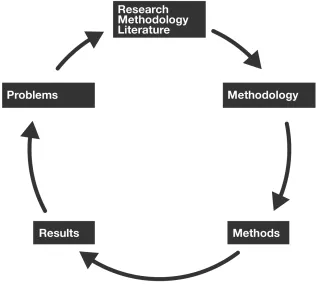
The literature cycle 133
The research cycle 134
The application cycle 135
The research process 138
Timeline of research phases correlated with chapters 140
Methodology of phases and chapters 141
Phase 1 – Becoming aware – discovering the extent of (my) limited
knowledge 141
Chapter 6 - A leader confronts his limited knowledge 141
Data gathering 141
Data analysis 142
Phase 2 - Exploring limited knowledge in leadership the light of a theory of
Complex Responsive Processes of Relating 143
Chapter 7 - A couple of weeks in the life of a busy leader 144
Data gathering 144
Data analysis 144
Chapter 8 - Attending to the microprocesses of leadership 144
Data gathering 144
Data analysis 147
Phase 3 - Changing my Leadership Practice - living the learning in my
leading 148
Chapter 9 - Observing my emerging leadership practice 148
Data gathering 148
Data analysis 148
Chapter 6: A leader confronts his limited knowledge 150
Narrative: Merger/Non-Merger 151
Inheriting a merger 151
How it all got started 153
What was the driving force for the merger? 155
How should we approach the decision? 155
How committed to the process were we? 159
Power, identity and control 160
Where on earth do we go from here? 161
Analysis: Where was the unknown and what were its effects? 162
“My predecessor stepped down….” - The departure of the leader 163
“What if?” - The unknown that still remains 169
Implications 170
The ‘unknown’ is always there 170
Limited knowledge limits action 170
Having time to pay attention is important 171
Context is vital 172
Leadership was perceived as being synonymous with the leader 173
Limited knowledge applies to past and present, as well as future 173
Conclusion 174
Chapter 7: A couple of weeks in the life of a busy leader 176
The findings 178
From the unknown to admission of limited knowledge 178
Context and well-being 180
Quality of conversation 183
Making sense 184
The priority of thinking 185
Making decisions 186
The dark-side 187
Pay attention 188
Holding 190
The certainty to act (and not act) 192
Getting things done 193
Implications 194
Conclusion 196
Chapter 8: Attending to the microprocesses of leadership 198
The issues 199
Issue 1 - Recruiting a key role 199
Data 199
Rewriting the data 201
Analysis 203
Group sense-making 205
Tentative certainty 206
Issue 2 - Managing staff conflict 208
Data 208
Rewriting the data 210
Analysis 210
Need to act 211
Holding 213
Issue 3 - Discovering a black hole in the finances 214
Data 215
Rewriting the data 221
Analysis 223
Space for mistakes 224
Need to act/and to not act 224
Causality is uncertain 225
The implications 227
Revisiting conversation 228
Quality 229
Gesture 230
Conclusion 231
Chapter 9: Observing my emerging leadership practice 233
My emerging themes 234
Tentative certainty 234
...
Good enough 235
Good enough holding of anxiety 235
Sense-making 236
Act in the grey 237
Plan differently 238
Causality is uncertain 240
Space for mistakes 241
Observing my emerging leadership practice in an unexpected story 242
The occurrence 242
Personal coming to terms 243
Sharing the occurrence 249
Looking back 250
1. Tentative certainty 251
2. Good enough 251
3. Good enough holding of anxiety 252
4. Sense-making 253
5. Acting in the grey 253
6. Plan differently 254
7. Causality is uncertain 254
8. Space for mistakes 256
Reflections on the experience - October 2014 256
Key revisions 257
Conclusion 257
Chapter 10: Concluding…and yet a continuing journey 259
Introduction 259
Revisiting the 8 themes 259
My changed leadership practice 260
Areas of Contribution 263
Theoretical contribution 263
Empirical contribution 263
Methodological contribution 264
Practice contribution 265
Continuing the journey 265
Revisiting the research questions 267
The primary research question: 267
Research objectives arising from the primary aim: 267
Areas for further research 268
How can leaders keep on keeping on paying attention? 268
Being a researching practitioner and not a practicing researcher 269
Faith and a theory of Complex Responsive Processes of Relating 269
Data analysis for autoethnography 270
The ability of social media and technology to facilitate quality conversation271
Group dynamics in the realm of unknowability 271
Do leaders consciously claim the unexpected as the expected? 271
Conclusion 272
Table of figures
Figure 1: Thorngate’s Postulate Figure 2: The leadership ‘moment’
Figure 3: The differences between systemic process and responsive processes
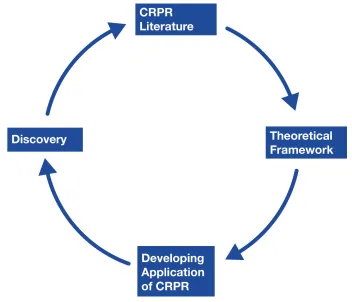
Figure 4: Literature Cycle
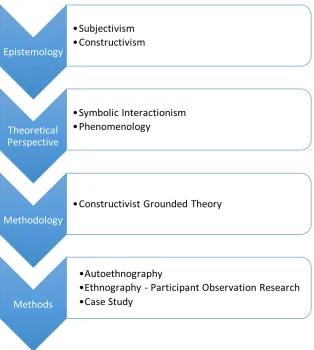
Figure 5: Crotty’s Research Approach Figure 6: Overview of Methodology
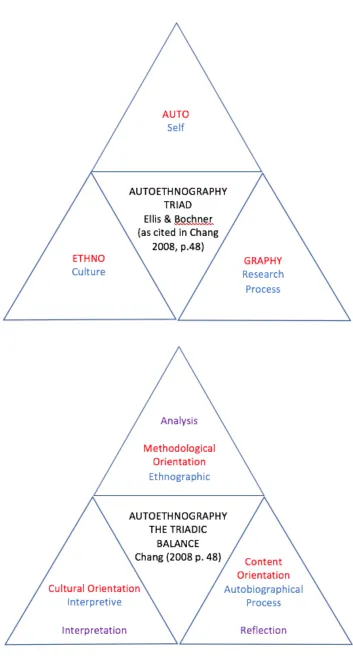
Figure 7: Chang and Ellis and Bochner’s Triads Figure 8: Iterative Ethical Process
Figure 9: Literature Cycle Figure 10: Research Cycle Figure 11: Application Cycle
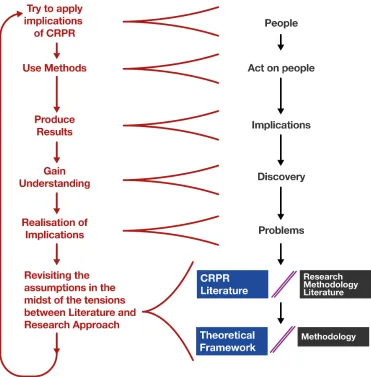
Figure 12: The Complex Responsive Processes of Relating Learning Cycles Figure 13: Examples of iOS database for longitudinal study.
Figure 14: Limited knowledge in past, present and future Figure 15: Issue 1 - Longitudinal Data
Figure 16: Issue 2 - Longitudinal Data Figure 17: Issue 3 - Longitudinal Data Figure 18: Gesture - Response in Time Figure 19: The Ski Jump
Figure 20: Whiteboard calculation of likely effect of loss of SLC funding Figure 21: Circles of Leadership Practice in a Complex Responsive Process of Relating Perspective
Table of appendices
Appendix 1: Leadership roles occupied
Appendix 2: An Epiphany - Autoethnography for UWE seminar Appendix 3: Chapter 7 - Textual analysis of experience narrative Appendix 4: Chapter 7 - Journal sample
Appendix 5: Chapter 7 - Template for reflection
Chapter 1: Introduction
This chapter introduces the research and its findings, locating its inception in the personal journey of the leader-researcher. It also briefly outlines the layout of the rest of thesis.
I am addressing the dilemma that leaders have to act even when they are not certain. Or as an academic colleague, with a somewhat pitying expression put it “These senior leaders often don’t seem to have a clue.” and he is right, often we don’t. This thesis is about how leaders can continue to act in spite of a lack of knowledge.
Leadership: experience and theory
It is rooted in my own experience of being a leader in numerous organisations over a twenty five year period and my engagement with existing leadership theory, teaching undergraduate and postgraduate leadership programmes for the last fourteen years. In particular it focuses on leadership practice since 2009 when I became Principal of a theological college and I led the organisation through a period of very significant change.
founding a start up business with a partner; this gave me more commercial experience. Three years working with an International Non-Governmental Organisation in Asia, leading a multinational team engaged in health systems capacity building, added cross-cultural experience and showed the added challenge of leading a multicultural team.
Returning to the UK I worked with Redcliffe College, initially lecturing in subjects including leadership, becoming a Director after three years and Principal four years later. Redcliffe College is an interdenominational Christian college that began in 1892 and draws students from all over the world who are training for cross-cultural Christian ministry. At the start of the research it was based on a three acre campus in Gloucester where it had moved after the first one hundred years in London. It offered an undergraduate degree and several Masters programmes, and had between 90 and 140 students. It had a regular staff team of about thirty individuals with about 30 more visiting teaching staff. As Principal I was responsible to a Board of Trustees for the operation of all aspects of the college. I operated with a leadership team, which during the life of the research was also called an Executive Team, and varied from 3 to 8 people. I was also Course Leader of the MA in Global Leadership in Intercultural Contexts, a course serving experienced leaders with extremely diverse cohorts in age, nationality and role.
From my first engagement with leadership theory in the early 1990s in the classic text by Johnson and Scholes (1997) through to beginning this doctoral research study, I have had a growing sense that leadership is approached as a scientific endeavour with the assumption that A+B, done well will equal C. However, I am increasingly convinced that leadership is also regarded as a superstition that cannot be questioned. This apparent contradiction is one example of the disconnect I experienced between being a leader and the narratives of the dominant leadership discourse, and this dissonance has made me increasingly uncomfortable.
home). She undertakes a lengthy and at times dangerous journey with her faithful dog Toto. After a lengthy period of time she finally arrives at the palace and in fear and trembling approaches the great high Wizard. The Wizard has something of the other world around about him; he is certainly distant, different and beyond reach. There is an untouchable aura about him and it is perhaps this that reinforces why he was somebody worth journeying so far to see; if there is that sense of mystery it must be worthwhile. As the Wizard makes his pronouncement in response to Dorothy’s question, Toto catches a curtain hanging to the side of the stage and pulls it down revealing the reality: a small old man working a much bigger contraption to give the impression of someone wise1.
Throughout my career as a leader it has often felt as though people are looking at me as though I am wearing a long cloak, standing in an elevated position with great wisdom to dispense. Should I demolish the presumptions that caused them to see me as something I am not, or do I cling to it tightly, fearing that I might be revealed for what I truly am?
I have had a personal need to answer these questions that have been haunting my leadership but, given my teaching role, I have also felt a responsibility to answer them for the next generation of leaders coming through.
Since my involvement in 2001 in a roundtable event2 on the leadership crisis in Christian mission, I had been aware of a reticence amongst Generation X3 to engage in leadership and I saw this caution continuing into subsequent generations. Amongst my leadership students, a number who had hesitantly reached for leadership roles, often felt themselves become toxic (Lipman-Blumen, 2005), struggling with the lack of transparency and their inability to meet expectations they felt were placed upon them (anecdotal from class discussions on Leadership Theory and The Darkside of Leadership 2004-2016).
1 With thanks to Rev Brian Mclaren for this original analogy (Mclaren, Brian, 2000)
2 This resulted in the publication of Postmission: World Mission by a Postmodern Generation (Tiplady, 2003), and from its reception and the subsequent events it is clear it resonated widely across more than one generation and across many different cultures.
In summary, much of the leadership literature, particularly the dominant discourses, are neat, straightforward and prescriptive (Hay, 2014) and are intended to impart the knowledge necessary to be effective. In contrast, my experience of leadership is that it is messy, complex and requires judgements to be made in the moment, often without the level of knowledge and certainty that one needs or would prefer. Further, much of the leadership literature has emerged out of the industrial age, finding its heyday in manufacturing and inevitably many of the key building blocks are not just shaped to fit that age but are born out of the cultural assumptions of the day (see chapter 2 for a discussion of this). Barrett, argues:
In an effort to control outcomes and deskill tasks, managers often attempt to break complex jobs down into formal descriptions of work procedures that people can follow automatically. In a perfectly rational world, such strategy makes perfect sense, but that’s rarely the way work actually gets done. (Barrett, 2012 p.26)
therefore the values and skills we teach leaders, inhibit rather than aid this process. Viewing leadership from the perspective of Complex Responsive Processes of Relating (CRPR) not only significantly challenged many assumptions inherent in these discourses but in Stacey’s view goes further, so that “If one mode of thinking resonates with, and makes sense of, our experience, then the other will not.” (2012, p.4). The CRPR perspective also offered a way of taming the unknown, enabling it to be viewed very differently (Stacey, 2012, p.54). In my leadership practice it allowed me to recognise partial knowledge and work with it to both better understand and make sense of a situation that I only partially understood, as well as to act into 'the unknown', beyond the limitation of my knowledge.
Eight key themes developed
When seeking to understand how I could lead authentically whilst acknowledging my own limited knowledge, I was examining how I was enabled or constrained to act in my role as leader. Did limited knowledge prevent me from acting? At what point did the limited knowledge become sufficient to allow me to act?
unpredictability and likely not to meet expectations or intentions. This acknowledgement of both the nature of tentative certainty and acceptance that what is being done is not perfect but only good enough, adds to a sense of increased uncertainty. Uncertainty can enable or paralyse, stimulate or inhibit individuals and an important task for me as a leader is to ensure there is a (3) good enough holding of anxiety to enable rather than inhibit. Ensuring staff are able to engage with the limited knowledge even before its extent is defined and understood, allows them to be part of the (4) sense-making process that leaders often individualise. Using the collective wisdom of multiple individuals involved in the situation allows for a fuller understanding thereby reducing the limitations on knowledge. It was this interlinked process of limited knowledge being faced,
tentative certainty being acknowledged, a good enough solution being sought, and the engagement of staff in sense-making in an environment of a good enough holding of anxiety, that that whilst being challenging, enabled me to authentically
(whether substantially or marginally) the response could be reconsidered quickly and effectively.
Beyond the specific eight themes I developed, an additional point is pertinent to note. Stacey says that the primary implication for managers of CRPR is not ‘quality of participation, conversation, diversity etc’ although all these are, in his view important, but rather a ‘quality of attention to participation’.
Certainly this could be described as the common thread underlying the theoretical framework CRPR offers, and from my own development of eight themes, this would be fundamental to them all. Despite this being evident in Stacey’s work (Griffin and Stacey, 2005, p.188) it was only in the midst of my efforts to live this leadership as a responsive process orientated leadership practice, that its full importance became evident. It is also why, in the Conclusion, I finish with a recognition of the importance and difficulty of paying attention. Paying attention is important, not as a nice to have idea - simply a recommendation from academic research; but as an essential point for survival akin to an oxygen supply that allows life to continue at altitude. Because it is both vital and so difficult, it is the first and most fundamental need in the recommendations for further research, without which the wisdom of this research may be an unsustainable ideal.
legal framework within which we could recruit overseas students with the creation of the UK Borders Agency and introduction of a new draconian inspection regime, which eventually led to the withdrawal of our Tier 4 overseas student sponsorship status. This affected Redcliffe significantly in its strategy, financial income and ethos and also threatened colleges across the sector in similar ways. In response to this, work was begun to form a consortium, recognising that a larger entity, with greater student numbers, could provide greater resilience to such threats. This consortium began with discussions among 12 colleges and eventually formed into a group of 10, investing finance and time to intentionally form a consortium. I ended up chairing this process, and with a colleague in another college, effectively provided impetus and leadership for it. Although ultimately failing, this endeavour absorbed a significant proportion of my leadership over a two-year period and, during that time and subsequently, has fostered some individual explorations of small scale cooperation, merger or takeovers, none of which have been fully realised to date.
In summer 2014 a bureaucratic error on the part of the Department of Business Innovation and Skills (BIS), led to us being threatened with the loss of Student Loan Company (SLC) funding, which at that stage was providing 60% of the undergraduate fee income. As well as causing significant turmoil, this eventually led to a decision to close the undergraduate programme and began a process of radically rethinking how Redcliffe functioned. The process resulted in the sale of the campus, relocation to a new site and reorientation of almost every aspect of Redcliffe’s work.
The primary research question:
• To explore the effect on my leadership practice of acknowledging limited knowledge.
Research objectives arising from the primary aim:
• To explore and record in a systematic way the instances, nature and extent of limited knowledge experienced by the leader
• To develop a research approach that facilitates the exploration of organisational situations characterised by limited knowledge
• To enquire into the ways in which limited knowledge affects a leader
• To articulate and operationalise a theory of Complex Responsive Processes of Relating in ways that are accessible to busy leaders seeking to lead authentically in situations characterised by limited knowledge
• To contribute to the limited literature on methodological approaches for using a theory of Complex Responsive Processes of Relating in research studies
Outline of the thesis Chapter 1 – Introduction
This introduction chapter has considered the motivation for the research and its emergence in the form of unanswered questions, from my own leadership practice over twenty five years. The main research question has been clearly stated and the initial challenges this presented, have been highlighted. The eight themes developed empirically in the research in response to the question, are briefly outlined to assist in following the development throughout the thesis, as well as a brief explanation of the theoretical framework utilised.
Chapter 2 – Literature Review
The contested nature of the term leadership is recognised and then the literature of the traditional view of leadership, as well as more recent emergent theories, are outlined, including the complexity writers retaining a systems orientation, in contrast to the process orientation adopted in this study and discussed in chapter 3. In addition it is argued that leadership practice is influenced by two dominant discourses: the academic literature and the popular literature, and summarises each, identifying important gaps in relation to the experience of leading.
Chapter 3 – A theory of Complex Responsive Processes of Relating
power of leadership. The chapter concludes with a discussion of why the theory of CRPR has been chosen as the guiding theoretical framework for this research study.
Chapter 4 – Research Approach
The research approach outlined in this chapter describes a methodology, theoretical perspective and epistemological assumptions, that are appropriate for the theoretical framework (CRPR) adopted. It is argued that this makes an important contribution to existing knowledge on research methodology, relevant both to researching the practice of leaders and to research conducted from a CRPR perspective.
Chapter 5 - Research Process
The chapter outlines how the research was done at each stage. A summary of the data collection methods used and then the analytical approaches adopted are set out. This provides a firm foundation for each stage as well as allowing the reader to see how the research builds through the overall process and the development of methodological approaches as well as theoretical learning.
Findings and Analysis
Phase 1 – Becoming Aware – Discovering the extent of (my) limited knowledge Chapter 6 – A leader confronts his limited knowledge
This chapter uses an extended narrative of the failed merger attempt that dominated my first year in a new role and extensive documentary analysis, to examines the process and identify, by correlation with field notes, where I as the leader encountered limits of knowledge. Five years on in a further analysis, I postulate the limitations of knowledge apparent in the wider process and examine their effects on me and the others individuals involved in the process.
Phase 2 - Exploring limited knowledge in leadership the light of the theory of Complex Responsive Processes of Relating
Chapter 7 – A couple of weeks in the life of a busy leader
In a shift from the previous chapter, where a large event dominated field notes and therefore the analysis, this chapter documents a daily journal process over a fourteen day period in my leadership practice. The theoretical framework developed in chapter 3 is used to pay attention to what was happening in my daily leadership. A number of activities and themes emerge and shape the focus of subsequent research chapters.
Chapter 8 – Attending to the microprocesses of leadership
with others, and the effect of time and familiarity giving me the confidence to be intentional about incorporating these insights into my own day to day leadership practice.
Phase 3 - Changing my leadership practice - living the learning in my leading Chapter 9 – Observing my emerging leadership practice
This chapter begins with a summary of the eight themes that had emerged from leading with a CRPR perspective, and how they work together to enable me to not just lead through the unknown but lead with the unknown. It observes how my leadership practice has changed in the light of the engagement with limited knowledge in the light of a theory of CRPR. Recognising that teaching and speaking on limited knowledge and a theory of CRPR, as well as continuing to lead the organisation has meant the application has been subtle, progressive and yet significant. The significance evidenced by a case study where my changed leadership practice was observed in a team context and a group reflection offered further insights as well as the confidence that this responsive process-orientated model of leadership practice, whilst still being a ‘tentative certainty’ was ‘good enough’ to work in the demanding life of a busy leader. In the light of this, the eight themes were revisited and articulated in a responsive process-orientated model.
Chapter 10 – Concluding…and yet a continuing journey
Chapter 2: Leadership Literature
Undertaking any kind of literature review in the field of leadership feels like swimming in the Atlantic but just as in the Atlantic there are primary currents that can be identified, located and traced, so too in the field of leadership. Just as there are consequences of the gulf stream on the coast of Britain for the climate of this island nation, so too are there dominant discourses that affect the key areas I am looking at: the common understandings of what leadership is, how it has evolved, how people write about ‘feeling’ leadership and what they say when they feel they lack leadership. Ladkin (2011, p.183) in particular has suggested this could reveal new insight
The literature review is often described as mapping the terrain and yet for me it has entailed revisiting the map regularly whilst journeying through the landscape I had drawn, to correct, revise and tweak. I felt more like an old style cartographer who accompanies the explorer and finds the map drawn from a distance to be wanting, than a modern day cartographer using satellite imagery that gives a perfect snapshot.
When talking about the stages of research (Cooper, 1998, p.216) talk of how “Practicing researchers often skip over one or more stages and sometimes move backward as well as forward”. This reflects my experience generally as I discuss in chapter 4, particularly the line between literature review and research methodology not just being one that is crossed in both directions but is actually blurred in certain approaches. The father of modern Grounded Theory Method (GTM) Barney Glaser, recognised this and advocated waiting to conduct the literature review until initial findings have been made, in order to not influence the researcher with preconceived ideas (Glaser et al., 1968, p.364).
experience, I was researching my own leadership and had spent the previous 10 years actively teaching leadership. I followed Charmaz’s recommendation (2006) and undertook an initial review of the literature before the first data collection. This allowed me to understand what research had been conducted in the area already and then enter into an iterative process (discussed in chapters 4 and 5).
This chapter seeks to map some of the key terrain of the leadership literature accepting that the realm is vast and the literature plentiful4. Therefore no attempt is made to be exhaustive and the approach is shaped by two key criteria: 1. the key literature that directly relates to the research questions and 2. the major landmarks in the relevant areas of the terrain, with the aim of highlighting key gaps in the literature. This will serve to position the contribution of this research within the broader field in such a way that its importance and limitations are clear.
The extensive resources available in both academic and popular realms on the subject of leadership presents challenges for the researcher. The added focus of “exploring leadership practice” significantly narrowed the literature available.
Firstly I set out the challenges related to reaching a working definition of leadership as it remains a highly contested term. Then I consider the traditional leadership literature which has provided the basis of leadership theory for much of the last century. Subsequently, I examine a number of emerging theories in the leadership literature that have particular relevance to the research. I leave a review of the CRPR literature as the main theoretical framework on which the analysis rests until the following chapter but do examine the non-CRPR leadership literature positioning CRPR within this broader complexity context. I finish this chapter where I started, seeing interesting and useful things within much of the current literature, but I conclude that I share Stacey’s view that the key problem in the current literature for practicing leaders is that it focuses on what leadership does
rather than how it actually gets done.
Problems of definition of leadership
Leadership has continued to be problematic for scholars to form a consensus of definition even after 50 years work (Grint, 2005, p.14). Grint cites Yukl (1998) believed it was “too new to be defined” (2005, p.16) or perhaps beyond definition (Grint, 2005, p17) or even worthwhile, but he does acknowledge that how it is defined has “implications or how organizations work – or don’t work” (Grint, 2005 p.17). So while I agree with Grint that it is a contested term beyond broad, even perhaps useful agreement, unlike him I feel the need to attempt a definition because it has implications as I try to examine how leadership is effected by limited knowledge.
The leadership gap
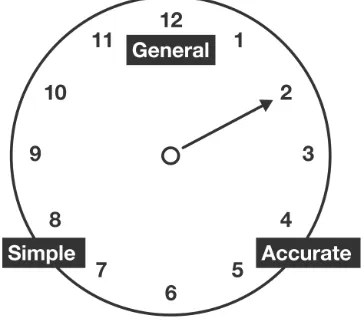
[image:34.595.242.424.474.635.2]Leadership literature is divided into two groups: the academic literature of the discipline which has emerged since early leadership studies in the 1940s, and the popular literature which has become a major industry itself, significantly since the 1980’s. This is partly attributable to the appointment of Theodore Levitt as Editor in Chief of the Harvard Business Review and the mainstreaming of the publication as a resource for practicing leaders and not simply graduates of the Harvard leadership programme. The relationship between the two streams of writing is not always entirely straightforward and easy to define as they are at times both complimentary and contradictory. In seeking to relate the two, Weick’s work (2009, p.40) building on Thorngate’s postulate, has been helpful in understanding this relationship. Thorngate’s postulate says that “It is impossible for a theory of social behaviour to be simultaneously general, simple, and accurate.” Thorngate (1976) developed a clock to illustrate the concept that a theory could be general and accurate but not simple, accurate and simple but not general, and general and simple but not accurate.
Figure 1: Thorngate’s Postulate
and foremost accurate. The ‘general’ readership that each appeals to is however different, with a gap which borders on disdain perceived by leadership academics when they view leadership practitioners (Simpson, 10/11/14) and out of touch when leadership practitioners view leadership academics.
Traditional leadership literature
Historically the divide between leadership and management has been contested (Zaleznik, 1977) and is still contested by significant numbers of scholars, for example (Alvesson and Sveningsson, 2003; Deal and Peterson, 1994; Northouse, 2009; Pfeffer, Jeffrey, 1977; Western, 2008; Williams and Deal, 2003). In examining the traditional literature I will treat leadership and management as synonymous for simplicity as the differentiation is not key to the research focus, neither is it a differentiation that Stacey (2012, pp.61-63) feels is necessary to make in CRPR, the main theoretical framework I examine in chapter 3.
Fayol’s five key management activities: planning, organization, command, coordination and control (1949) provided the foundation for the development of management as a discipline and are regarded as continuing to shape contemporary management (Golden Pryor and Taneja, 2010) cite a cross section of authors in agreement (Wren, 1994, 1995; Bartol et al., 2001; Bedian and Wren, 2001; Rodrigues, 2001; Wren, 2001; Breeze and Miner, 2002). Certainly Fayol’s five basic tools (Fayol, 1923 quoted in Golden Pryor, Mildred and Taneja, Sonia, 2010):
1. A general survey to assess - what organisational leaders want to achieve and what would be the probable future (i.e. outcomes)
2. The business plan [setting out] a series of activities which need to be performed in order to achieve the organisation’s long-term goals
3. The operations report ...used in the evaluation of performance results
5. An organisation chart … to assist in monitoring accountabilities and responsibilities
reflect the the patterns of leadership and management that underpin the dominant discourses today.
In contrasting a theory of Complex Responsive Processes of Relating with current leadership theories Stacey uses the term ‘dominant discourse’ in a simple binary opposition (see page 35) but in reality there are multiple discourses that frame the leadership narrative and taking a moment to discuss discourse will aid us later. Discourse is described by Fairhurst (2009) quoted in Mabey (2012, p.2) as “an interpretive repertoire [. . .] tool bags of terminology, tropes, themes, habitual forms of argument, and so on, that, in effect, contextualize by supplying leadership actors with a set of linguistic resources’. In other words they frame leadership in a particular way for leaders and followers but this is subsconscious (Western, 2008, p.282) . Western discerns four leadership discourses: 1. Controller, orientated to efficiency and productivity; 2. Therapist, emphasising relationships and motivation; 3. Messiah, focused on vision and culture; and Eco-leadership , prioritising connectivity and ethics. He sees them having emerged in sequence over the last one hundred years (Western, 2008, p.281 - figure 13.1) but emphasises that all of the discourses remain present and that whilst a single discourse may “dominate different sectors, organizations and departments...they usually co-exist” (Western, 2008, p282).
all encompassing dominant discourse are seen across the different discourses Western outlines: for example, the emphasis on control in discourse 1, individualism in 2, certainty in 3 and system in 4. In addition we see the coexistence and overlap between Western’s discourses by looking at a current popular leadership book, Adair’s classic - ‘Effective leadership: how to be a successful leader’ (2009) where the chapters describing the main leadership tasks are:
• Defining the task
• Planning
• Briefing
• Controlling
• Evaluating
• Motivating
• Organizing
This would suggest that not only are Fayol’s ideas foundational but remarkably unchanged (Northouse, 2009, p.9) in current popular leadership literature. Writing in 1989 Mintzberg (1989, p.9) appeared to agree when he stated “if you ask managers what they do, they will most likely tell you that they plan, organize, coordinate, and control” but his observation is that what they actually do bears no relation to this. This potential disconnect between what the dominant discourses say leaders do, what they think they do, and what they actually do, is an ongoing point of contention. When linked to Alvesson and Sveningsson’s (2003) concern that “little attention is paid in the leadership literature to the more mundane aspects of managerial work and leadership” it would suggest that further work is needed in this area.
tended to be defined from the perspectives of leaders and not of followers” (Meindl, 1995, p.329) and in an earlier paper (Meindl, 1985) developed the notion of the “Romance of Leadership” (RoL). This recognised that followers see great significance in the role of the leader “revealing a potential “bias” or “false assumption-making” regarding the relative importance of leadership factors to the functioning of groups and organizations” (Meindl, 1995, p.330). Bligh studying the twenty five years since the publication of Meindl’s original RoL paper says “we continue to have highly romanticized, heroic views of leadership: we are continually fascinated by what leaders do, what they are able to accomplish, and the general effects they have on our lives.” (Bligh, Kohles and Pillai, 2011, p.1059). This view of leadership, he suggests, can provide comfort and security, reducing anxiety and uncertainty and “providing a sense of human agency and control” (Bligh, Kohles and Pillai, 2011, p.1059) offering a way of coping with unknowable and indeterminate complexities. This view of leadership places immense expectations upon the leader both in their performance (to direct and control) and in their presence (to provide certainty and security). In leadership practice these two roles happen simultaneous and are interdependent, “control[ing] the future by acting now to reduce complexity and uncertainty and directing followers towards highly prescribed future states” (Plowman et al., 2007, p.343). These future states Plowman suggests are seen as foreseeable (Plowman et al., 2007, p.344) therefore “most approaches to the study of leadership emphasize the role of leaders in directing organizations towards seemingly knowable and controllable futures” (Plowman et al., 2007, p.342). It is clear that the traditional leadership literature placed a very high regard on the leaders knowledge.
unknowns -- the ones we don't know we don't know. And if one looks throughout the history of our country and other free countries, it is the latter category that tend to be the difficult ones.5”
Donald Rumsfeld - US Secretary of Defense
Leadership continues to be regarded as a knowing process6 (Northouse, 2009, p.3): leaders are expected to be the ones with greatest knowledge, whether that is technical or strategic knowledge (Kirkpatick and Locke, 1991, p.55), (Adair, 2005, p.136). Northhouse describes this as personal power and sees leaders deriving power by followers seeing them as ‘likeable and knowledgeable’ (Northouse, 2009, p.7). This is reflected in the popular literature (Watkins, 2012) and has a long history (Slim, 1957) but is simplistic, both because it acknowledges only one type of knowing: intellectual, and because often it sees the process of gaining knowledge as a simple acquisition (Junarso, 2009, p.215; Blanchard and Miller, 2012, pp.35-42; Sowcik, 2015, Chp.15) and it is even discernible in academic literature where a focus on knowledge acquisition is postulated as a core leadership skill (Mumford, et al., 2000). Leadership scholars have in recent years begun to explore a broader understanding of ways of knowing as well as a more emergent orientated process of discovery.
Reason and Bradbury take this understanding of different types of knowledge further with what they call an ‘extended epistemology’ (2006, p.149), so called because it “…reaches beyond the primarily theoretical, propositional knowledge of academia.” They outline four:
5 Defense.gov News Transcript: DoD News Briefing – Secretary Rumsfeld and Gen. Myers, United States Department of Defense (defense.gov)". http://www.defense.gov/transcripts/transcript.aspx? transcriptid=2636
• Experiential knowing - through ‘face to face encounter with person, place or thing’ and say it is perceived through empathy and resonance.
• Presentational knowing - ‘…emerges from experiential learning…’ but then expresses meaning out of that through presentation including dance, art etc.
• Propositional knowledge - knowing ‘about something through ideas and theories expressed in informative statements
• Practical knowing is the knowledge to do something (in Aristotle's words, ‘to act’) with “skill, knack or competence” as Heron (1992) puts it.
Knack is a helpful term as it captures the sense of hunch and intuition, something many leaders talk of (Aarum Andersen, 2000) and this resonates closely with Stacey’s ‘practical judgement’ (Stacey, 2012, pp.107-120), a term that brings out the need to act, to make a judgement, as opposed to passive knowledge pursued simply out of interest. Knowledge is rarely pursued for interest sake by leaders, they are usually driven by an urgent desire to know in order to do something.
One of the challenges for leaders is the expectations of followers on them to have knowledge. Simpson sees this as an increasing issue today
…the current focus on information and on knowledge generation and transfer has led to a situation where ignorance has a tendency to be understood as a state to be done away with as quickly as possible, rather than as a permanent and unavoidable systemic reality to be worked with and potentially to be learned from. (Simpson, and French, 2006)
(taken at face value rather than simply a way of obfuscating and avoiding answering the question) as a strength. Slavich says such situations are helpful because “…when correctly identified, situations involving known unknowns represent excellent opportunities to learn.” (Slavich, 2007, p.27) but he also, using a context of doctors involved in diagnosis of mental health patients, recognises that leaders are under “…pressure to pretend to know the unknown…”.
It is not surprising that the admission of lack of knowledge is difficult, there are not many models for leaders to learn from. There is little reflection in the literature on what “not knowing” feels like and even some scholars who have written widely on knowledge, not knowing, negative capability and the apophatic say they have been accused of not paying sufficient attention to defining this (Simpson, 10/11/14).
In addition to the different ways of knowing (types) there are also different ways to gain knowledge (processes) and Calás and Smircich (1999, pp. 649-672) speak of reflexivity that constantly assesses the relationship between ‘knowledge’ and the ‘ways of doing knowledge’. Slavich, highlighting that the knowledge lacked is often of critical importance says “One thing we know we don’t know is the future, and in such situations, especially those involving patients, our success as clinicians is influenced greatly by the heuristics that we employ to make decisions” (Slavich, 2007, p.27).
Emerging leadership literature
answers because the answers may not be self-evident and will require collaborative processes in order to make progress” (Grint, 2007, p.11).
This collective asking of questions is what Weick (1993, p.635) calls sense-making. Based on a constructivist worldview, it rejects the view of the leader being the sole source of insight and instead requires a group process to discern reality from intentional action to create order and gain retrospective understanding of what is happening in the moment. From doing this the participants are better able to explain both the situation and their own place within the situation (Gioia, 1986, p.61 cited in Lichtenstein and Plowman, 2007). (I develop the work on sense-making further in chapters 7,8 and 9 as a theme in my leadership practice.)
Grint also highlights the importance of a leaders role in ‘reframing’, something that Weick discusses whereby “leaders give meaning to emergent events by re-framing them” (Weick and Quinn, 1999 p.352 cited in Lichtenstein and Plowman, 2007).
Mindfulness is becoming a more common term in both academic and popular leadership discourses in recent years and has relevance for the sense-making that Weick and Grint emphasise but also has relevance for a key area of CRPR - the ability to pay attention.
Boyatzis and McKee, widely read writers in the popular leadership field, outline mindfulness as core to achieving the resonant leadership7 they see as effective. They summarise mindfulness as follows “Through purposeful conscious direction of our attention, we are able to see things that might normally pass right by us, giving us access to deeper insight, wisdom and choices” (Boyatzis and Mckee, 2005, p.120).
In more academic terms, Zgierska, et al. define it as “the intentional, accepting and non-judgmental focus of one's attention on the emotions, thoughts and sensations occurring in the present moment” (2009, p.2). Mindfulness has many definitions
in the academic literature, surveyed and summarised by several including (Black, 2011) and (Chiesa, 2013) but the one that best defines what a leader has to do to achieve Stacey’s state of “paying attention” to the quality of conversation is what French and Simpson describe as “…attending to what is, rather than to what used to be or might be, to reality rather than to his or others’ aspirations for reality” (2014, p.1).
This is not easy and counter-cultural to common contemporary leadership practice where multitasking is viewed as a key competency for leaders. In fact Epstein (Epstein, 1999) defines multitasking as the opposite of mindfulness. Rather than the ability to juggle many different things at the same time, it is tuning the senses and awareness to what is present happening (Epstein, 1999). Johns definition (2004 quoted in Bolton, 2010b) puts this challenge in a more action-orientated way “a conscious exclusion of other elements of life, apart from that which is being attended to” (Bolton, 2010b, p.15). The “exclusion of other elements to concentrate on the immediate in hand” is something that leaders seem to struggle with, as reflected by the lack of writing in popular leadership books on this subject. Simpson and French (2006) explore this, commenting that the concept they term ‘negative capability’8 “is not a fashionable one in organizational contexts today” and only cite Bennis (1998, p.148) and Handy (1989) as examples (Simpson and French, 2006, p.7).
Bolton (2010), and Simpson and French, both provided insights into mindfulness, but as the research progressed I saw parallels between their work and Stacey’s. Bolton’s focus on “accurate observation, communication, ability to use implicit knowledge in association with explicit knowledge, and insight into others’ perceptions” was foundational for achieving Stacey’s 'quality of conversation', and the very act of being a facilitator of conversation requires the leader to be able to think in the present (Simpson and French, 2006, p.245). Frank, (2004 quoted in
Bolton, 2010) uses the concept of phronesis, meaning practical wisdom (a concept from Aristotle and explored practically on page 23 and with specific reference to Complex Responsive Process of Relating on page 57) and says that it is the “opposite of acting on the basis of scripts and protocols” and he is in no doubt that those are crude and limiting “those are for beginners, and continuing reliance on them can doom actors to remain beginners.” The ability, as Simpson and French so beautifully put it, to find thoughts that “as yet do not have a thinker” (2006, p.246). The ability to do this, to be mindful, can be the difference between being able to lead or not. As Bolton says there is a “loss of professional agency and responsibility, because we are unaware of things of which we so need to be aware” (Bolton, 2010, p.16).
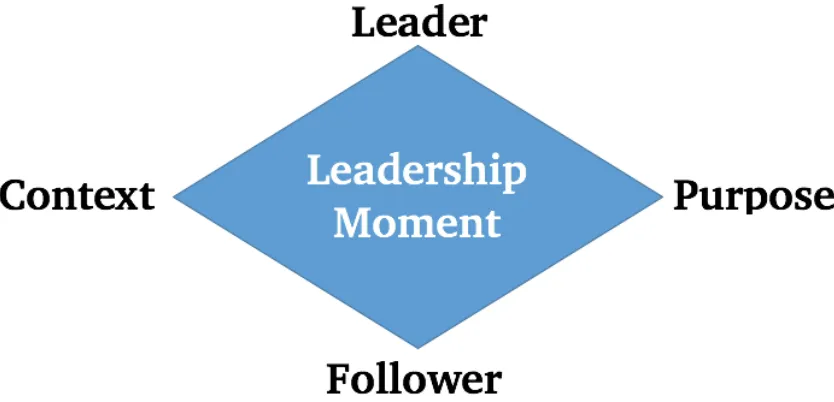
This awareness is what Ladkin (2011, p.183) focuses on in her work on aesthetics in leadership. As already cited, she suggests exploring how leaders and followers feel could reveal new insights and suggests useful ways of approaching this. Firstly encouraging attention to the “immediate, visceral response” we may have to a person or situation. This might be a means of discerning limited knowledge as Mead (1895 cited in Griffin and Stacey, 2005, p.76) suggests “emotions rise when a human being encounters a problem which cannot be resolved through instinctive action”.
Figure 2: The leadership ‘moment’ (based on Ladkin, 2011, p.28)
Complexity
An interest in and acknowledgement of the relevance of complexity for leadership and organisations has grown and developed in recent years. Marion and Uhl-Bien have written extensively on a systems-orientated complexity (SOC) perspective on leadership and organisations. The SOC perspective shares many of my frustrations with the dominant discourses on leadership:
Conventional views of leadership are based on the assumption that the world is knowable and that effective leaders can rely on planning and control mechanisms to bring about desired organisational futures. However, complexity science suggests that the world is not knowable, that systems are not predictable and that living systems cannot be forced to follow a linear path. (Uhl-Bien and Marion, 2008, p.129)
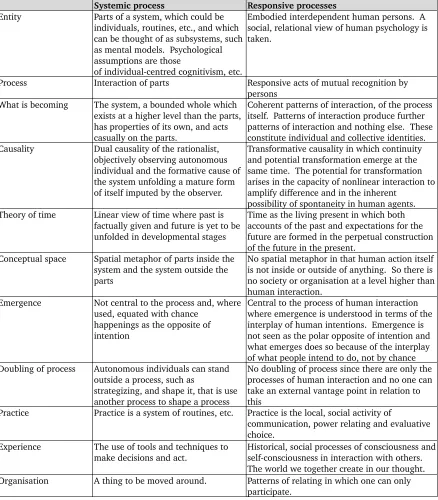
Plowman, 2009; Goldstein, Hazy and Lichtenstein, 2010; Plowman, et al., 2007; Harle, 2011; Schneider and Somers, 2006). They challenge this view using analogies drawn from the physical sciences of systems (Anderson, 1999; McKelvey, 1999; Richardson and Cilliers, 2001, cited in Plowman, et al., 2007) insisting that complex systems are characterised by “dynamic, nonlinear interactions” and see “two important implications: causality is often uncertain and it is inappropriate to study the isolated parts of these holistic systems” (Uhl-Bien and Marion, 2008, p.159). This sounds very similar to CRPR language but is in Stacey’s mind fundamentally different as will be explored in detail in chapter 3 but the diagram on page 31 is a useful overview and contrast of the main characteristics and differences between a systems approach and a responsive process.
Working from a similar base but writing for a more popular audience Wheatley’s work has opened up complexity to a broader constituency and has arguably influenced practicing leaders more than any other complexity writer. Her first leadership book (1999) which was published in 18 languages, built on a broad cross-section of articles (www.margaretwheatley.com) that have grown substantially since and the second book (Wheatley, 2007) clearly addressed a felt need illustrated by the title ‘Finding our way: Leadership for an uncertain time’. She describes a “turbulent world makes a mockery of our plans and predictions … keeps us on edge, anxious and sleepless. Nothing makes sense any more. Meaning eludes us.” (Wheatley, 2006, p.xi) and yet she sees this as positive “We live in a time of chaos, as rich in the potential for disaster as for new possibilities” the possibilities she believes we can embrace because of our “astonishing capacity to self-organise” but she warns that we “lose capacity and in fact create more chaos when we insist on hierarchy, roles, and command and control leadership” (Wheatley, 2008, p.65), something I observe later in my research.
Systemic process vs responsive processes
Figure 3: The differences between systemic process and responsive processes (adapted from Stacey, 2007, p.265)
Entity
Process
What is becoming
Causality
Theory of time
Conceptual space
Emergence
Doubling of process
Practice
Experience
Organisation
Systemic process
Parts of a system, which could be individuals, routines, etc., and which can be thought of as subsystems, such as mental models. Psychological assumptions are those
of individual-centred cognitivism, etc. Interaction of parts
The system, a bounded whole which exists at a higher level than the parts, has properties of its own, and acts casually on the parts.
Dual causality of the rationalist, objectively observing autonomous individual and the formative cause of the system unfolding a mature form of itself imputed by the observer.
Linear view of time where past is factually given and future is yet to be unfolded in developmental stages
Spatial metaphor of parts inside the system and the system outside the parts
Not central to the process and, where used, equated with chance
happenings as the opposite of intention
Autonomous individuals can stand outside a process, such as
strategizing, and shape it, that is use another process to shape a process Practice is a system of routines, etc.
The use of tools and techniques to make decisions and act.
A thing to be moved around.
Responsive processes
Embodied interdependent human persons. A social, relational view of human psychology is taken.
Responsive acts of mutual recognition by persons
Coherent patterns of interaction, of the process itself. Patterns of interaction produce further patterns of interaction and nothing else. These constitute individual and collective identities. Transformative causality in which continuity and potential transformation emerge at the same time. The potential for transformation arises in the capacity of nonlinear interaction to amplify difference and in the inherent
possibility of spontaneity in human agents. Time as the living present in which both accounts of the past and expectations for the future are formed in the perpetual construction of the future in the present.
No spatial metaphor in that human action itself is not inside or outside of anything. So there is no society or organisation at a level higher than human interaction.
Central to the process of human interaction where emergence is understood in terms of the interplay of human intentions. Emergence is not seen as the polar opposite of intention and what emerges does so because of the interplay of what people intend to do, not by chance No doubling of process since there are only the processes of human interaction and no one can take an external vantage point in relation to this
Practice is the local, social activity of
communication, power relating and evaluative choice.
Conclusion
The understanding of leadership as a social construction is a theoretical framework that underpins much of the view of leadership articulated in this research. The emergence of this view through scholars including Mead, upon whom Stacey draws and Crotty, who provides the framing of the research approach, is taken up by Grint and others as they critique the dominant discourses. Particularly the question of ‘how does leadership actually happen?’ is increasingly being debated in the light of this epistemological examination? To this question I would add my more specific question from this research: ‘When the general context constantly has aspects of limited knowledge, how do leaders get stuff done?’ Plowman et al share this concern suggesting that whilst the debate focuses on the importance of leadership, CAS (and therefore even more significantly CRPR) “challenge[s] the fundamental premise of what leadership is” (2007, p.342).
Therefore I will seek to contribute in two key and underdeveloped areas: firstly, some aspects of how leadership actually gets done rather than just what it does and secondly, how leaders cope with limited knowledge.
Chapter 3: A theory of Complex Responsive Processes of Relating
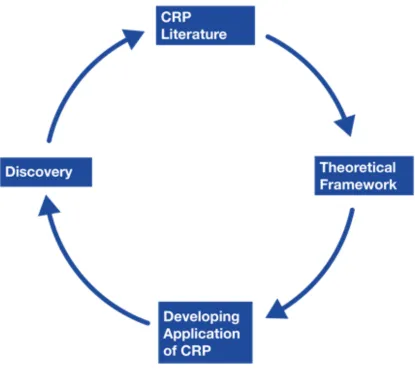
Figure 4: Literature Cycle
Stacey’s development of a theory of complex responsive processes of relating
Ralph Stacey was until recently Professor of Management and Director of the Complexity and Management Centre at the University of Hertfordshire. It was here that he began the research for which he is most well known - exploring the implications of complexity theories initially developed in the hard sciences for understanding human organisation in various forms. He began life as an economist and before becoming an academic, was briefly a management consultant and these experiences have shaped his research emphasis.
developed in response to the disconnect between how he experienced organisations and how he had been taught to see them functioning. He explained this dissatisfaction as being rooted in the way the organisation is presented in the discourse as an “abstract notion” that is not recognisable as the “ordinary, lived reality of human beings” (Stacey, 2012, p.1). He went further, suggesting that the human beings, who are actually ‘the organisation’, disappear from view (Stacey, 2012, p.1). In the light of this organisational reality he challenged what he termed the dominant discourse9 (Stacey, 2012, p.40) of leadership in the academy, as inadequate for the felt needs of leaders (Stacey, 2012, p.15) and a re-articulation began, using the language of CRPR as more adequate for the lived experience of human relationships. The level of uncertainty Stacey increasingly saw present, was a key factor in this; “if we move from assuming underlying certainty to assuming underlying uncertainty, we begin to think in ways close to our ordinary, everyday experience” (2012, p.21).
In developing his theory Stacey also drew on work pre-dating the complexity sciences, using Elias, who articulated how “population-wide patterns of civilisation emerge in many local interactions” (2012, p.21). Stacey saw this as a profound challenge to the dominant discourse, which operated on the assumption that the local interactions will follow an imposed population-wide pattern and not vice versa.
The theory of CRPR presented a radical alternative, which conceived of organisations as being “perpetually constructed”. The construction was not a separate, objective and observable entity; rather it was patterns of behaviour developed out of “many local interactions” and existing in the present in those ongoing interactions (Stacey, 2012, p.4). It is in “the ordinary narrative of
9. In this chapter I continue to use Stacey’s term of ‘dominant discourse’, as he does; as a somewhat crude shorthand for the multiple discourses discussed in chapter 2 that dominate leadership practice. I do this partly to maintain Stacey’s ‘voice’ as I described at the start of the chapter (page
everyday work life” where we see complex responsive processes in “conversation, power and ideology” where social engagement happens “with others in orderly and disorderly local interactions” (Stacey, 2012, p.38). Both the orderly and disorderly interactions are important in Stacey’s view; the emerging patterns are simultaneously predictable and unpredictable, something Stacey acknowledged as paradoxical but which ultimately makes the emerging pattern “fundamentally unknowable” (Stacey, 2007, p.305).
Key contributors to the theory of complex responsive processes of relating
Whilst his own writing remained predominantly theoretical with limited application, Stacey’s colleagues, Streatfield (2001), Shaw (2002; Shaw and Stacey, 2006) and Griffin (2002; Griffin and Stacey, 2005), sought to share practical implications from their own consulting practices and observations from client case studies.
Philip Streatfield
Streatfield, a supply chain specialist who undertook a PhD, supervised by Ralph Stacey, published a book out of his thesis (Streatfield, 2001). His work added an important element by exploring the way a leader needs to be in control but does not feel in control. He included a series of case studies from his own work. Examples of the application of a theory of CRPR to the lived experience of leading in an organisational context, are limited (even more so when I began this study) and Streatfield’s own work, which he describes as being a “management practitioner” (Streatfield, 2001, p.xii), provided case studies, which along with his writing on theory, particularly helped me grapple with understanding “who is ‘in control’?” (Streatfield, 2001, p.1) in an organisation.