N
-Benzylaniline
Richard Betz,* Cedric McCleland and Harold Marchand
Nelson Mandela Metropolitan University, Summerstrand Campus, Department of Chemistry, University Way, Summerstrand, PO Box 77000, Port Elizabeth 6031, South Africa
Correspondence e-mail: [email protected] Received 5 April 2011; accepted 18 April 2011
Key indicators: single-crystal X-ray study;T= 200 K; mean(C–C) = 0.002 A˚;
Rfactor = 0.044;wRfactor = 0.118; data-to-parameter ratio = 18.9.
The title compound, C13H13N, is anN-alkylated derivative of
aniline. The N atom is present in a nearly planar molecular geometry (angles sums at the N atom are 358 and 359in the
two molecules of the asymmetric unit). The planes defined by the aromatic rings intersect at angles of 80.76 (4) and 81.40 (4) in the two molecules. In the crystal, N—H Cg
interactions connect the two molecules of the asymmetric unit to form infinite homodromic chains along the crystallographic
baxis [N = 3.4782 (12) and 3.4642 (13) A˚ ].
Related literature
For the crystal structure analysis of a ruthenium coordination compound featuring the title compound as a ligand, see: Casey
et al. (2006). For the crystal structure analysis of a rhodium coordination compound containing the title compound as a ligand, see: Marcazzanet al.(2003).
Experimental
Crystal data
C13H13N
Mr= 183.24
Monoclinic,P21=c
a= 18.8185 (6) A˚ b= 5.7911 (2) A˚ c= 19.3911 (7) A˚
V= 2056.24 (12) A˚3
Z= 8
MoKradiation = 0.07 mm1
T= 200 K
0.600.330.13 mm
Bruker APEXII CCD diffractometer
18958 measured reflections
4929 independent reflections 4088 reflections withI> 2(I) Rint= 0.038
Refinement
R[F2> 2(F2)] = 0.044
wR(F2) = 0.118 S= 1.04 4929 reflections 261 parameters
H atoms treated by a mixture of independent and constrained refinement
max= 0.17 e A˚
3
min=0.15 e A˚
[image:1.610.315.565.253.293.2]3
Table 1
Hydrogen-bond geometry (A˚ ,).
Cg1 is the centroid of the C21–C26 ring andCg2 is the centroid of the C41– C46 ring.
D—H A D—H H A D A D—H A
N1—H71 Cg1i
0.889 (17) 2.608 (17) 3.4782 (12) 166.0 (14) N2—H72 Cg2i 0.858 (17) 2.625 (17) 3.4642 (13) 165.5 (15)
Symmetry code: (i)x;yþ1;z.
Data collection:APEX2(Bruker, 2010); cell refinement:SAINT
(Bruker, 2010); data reduction:SAINT; program(s) used to solve structure:SHELXS97(Sheldrick, 2008); program(s) used to refine structure: SHELXL97 (Sheldrick, 2008); molecular graphics:
ORTEP-3(Farrugia, 1997) andMercury(Macraeet al., 2006); soft-ware used to prepare material for publication: SHELXL97 and
PLATON(Spek, 2009).
The authors thank Mrs Anna vom Kernpoint for helpful discussions.
Supplementary data and figures for this paper are available from the IUCr electronic archives (Reference: DS2106).
References
Bruker (2010).APEX2andSAINT. Bruker AXS Inc., Madison, Wisconsin, USA.
Casey, C. P., Bikzhanova, G. A. & Guzei, I. A. (2006).J. Am. Chem. Soc.128, 2286–2293.
Farrugia, L. J. (1997).J. Appl. Cryst.30, 565.
Macrae, C. F., Edgington, P. R., McCabe, P., Pidcock, E., Shields, G. P., Taylor, R., Towler, M. & van de Streek, J. (2006).J. Appl. Cryst.39, 453–457. Marcazzan, P., Patrick, B. O. & James, B. R. (2003).Organometallics,22, 1177–
1179.
Sheldrick, G. M. (2008).Acta Cryst.A64, 112–122. Spek, A. L. (2009).Acta Cryst.D65, 148–155.
Structure Reports Online
derivatives of aniline are particularily interesting and promising compounds due to a series of reasons: first, they can act as neutral or – upon deprotonation – as anionic ligands. Second, the derivatization of the aromatic system of aniline allows for the fine-tuning of the basicity and nucleophilicity of the N atom and thus its coordination behaviour in terms of Lewis basicity. Third, the steric pretense of the ligand can be varied by applying different patterns of substituents among the aromatic regime as well as by endowing the N atom itself with sterically more demanding groups. In our continuous efforts to elucidate the coordination behaviour of N donor ligands, it seemed necessary to determine the crystal structure of the title compound to enable comparative studies with the coordination compounds obtained. So far, only two structure determinations involving the title compound as a ligand are present in the literature (Casey et al., 2006; Marcazzan et al., 2003).
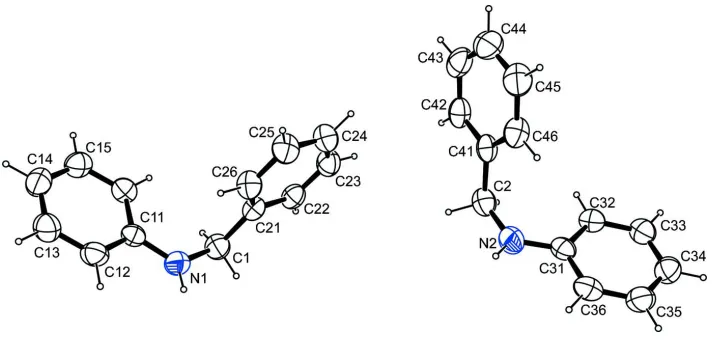
The molecular geometry around both molecules of the asymmetric unit is essentially planar with X—N—Y angles ranging from 117.0 (10)° to 124.54 (11)°. The biggest of these angles in the title compound is found for both molecules for the C—N—C angle. The phenyl rings within one molecule of the asymmetric unit are nearly orientated perpendicular to each other, the least-squares planes defined by the aromatic rings within one molecule enclose angles of 80.76 (4)° and 81.40 (4)°, respectively (Fig. 1).
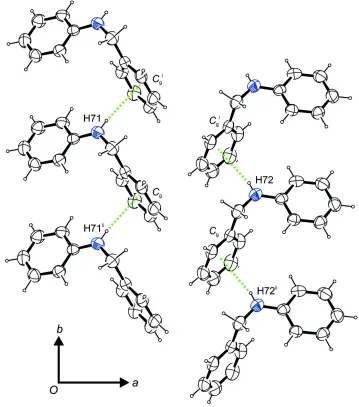
The N—H groups do not interact with each other. Instead, the formation of N—H···Cg contacts is observed in the crystal structure. These contacts exclusively use the aromatic moiety of the benzyl substituent as acceptor and are present only between one of the molecules of the asymmetric unit and its translation symmetry-generated equivalents (Fig. 2). In total, the formation of two one-dimensional chains of molecules along the crystallographic b axis is observed.
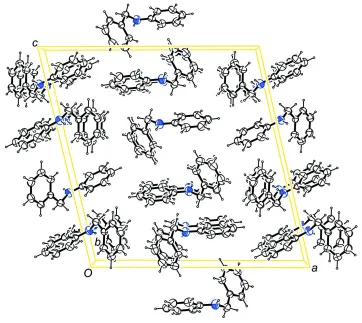
The packing of the title compound is shown in Fig. 3.
S2. Experimental
The compound was obtained commercially (Aldrich). Crystals suitable for the X-ray diffraction study were taken directly from the provided compound.
S3. Refinement
Carbon-bound H atoms were placed in calculated positions (C—H 0.95 Å for aromatic C atoms, C—H 0.99 Å for aliphatic C atoms) and were included in the refinement in the riding model approximation, with U(H) set to 1.2Ueq(C).
Figure 1
Figure 2
Figure 3
Molecular packing of the title compound, viewed along [010] (anisotropic displacement ellipsoids drawn at 50% probability level).
N-Benzylaniline
Crystal data
C13H13N Mr = 183.24
Monoclinic, P21/c
Hall symbol: -P 2ybc
a = 18.8185 (6) Å
b = 5.7911 (2) Å
c = 19.3911 (7) Å
β = 103.338 (1)°
V = 2056.24 (12) Å3 Z = 8
F(000) = 784
Dx = 1.184 Mg m−3
Mo Kα radiation, λ = 0.71073 Å Cell parameters from 9996 reflections
θ = 2.2–28.3°
µ = 0.07 mm−1 T = 200 K Block, colourless 0.60 × 0.33 × 0.13 mm
Data collection
Bruker APEXII CCD diffractometer
Radiation source: fine-focus sealed tube Graphite monochromator
4088 reflections with I > 2σ(I)
Rint = 0.038
x y z Uiso*/Ueq
H32 0.5496 0.0818 0.1994 0.052* C33 0.65154 (7) 0.1774 (2) 0.19213 (6) 0.0489 (3) H33 0.6747 0.0386 0.2116 0.059* C34 0.69271 (7) 0.3490 (2) 0.17147 (7) 0.0545 (3) H34 0.7438 0.3300 0.1766 0.065* C35 0.65833 (8) 0.5495 (2) 0.14311 (8) 0.0568 (3) H35 0.6861 0.6695 0.1287 0.068* C36 0.58427 (7) 0.5778 (2) 0.13539 (7) 0.0508 (3) H36 0.5616 0.7163 0.1152 0.061* C41 0.39244 (6) 0.0851 (2) 0.11933 (6) 0.0414 (2) C42 0.34291 (6) −0.0710 (2) 0.13551 (7) 0.0495 (3) H42 0.3284 −0.0566 0.1791 0.059* C43 0.31429 (7) −0.2472 (3) 0.08936 (8) 0.0606 (4) H43 0.2796 −0.3509 0.1008 0.073* C44 0.33613 (8) −0.2722 (3) 0.02670 (8) 0.0645 (4) H44 0.3169 −0.3940 −0.0050 0.077* C45 0.38576 (7) −0.1206 (3) 0.01009 (7) 0.0620 (4) H45 0.4011 −0.1385 −0.0330 0.074* C46 0.41358 (7) 0.0583 (2) 0.05581 (6) 0.0506 (3) H46 0.4474 0.1635 0.0436 0.061*
Atomic displacement parameters (Å2)
U11 U22 U33 U12 U13 U23
N2—H72 0.858 (17) C26—H26 0.9500 C1—C21 1.5131 (16) C31—C36 1.3940 (17) C1—H1A 0.9900 C31—C32 1.3953 (15) C1—H1B 0.9900 C32—C33 1.3840 (16) C2—C41 1.5141 (17) C32—H32 0.9500 C2—H2A 0.9900 C33—C34 1.3755 (19) C2—H2B 0.9900 C33—H33 0.9500 C11—C16 1.3915 (15) C34—C35 1.380 (2) C11—C12 1.3955 (16) C34—H34 0.9500 C12—C13 1.3766 (18) C35—C36 1.3768 (19) C12—H12 0.9500 C35—H35 0.9500 C13—C14 1.3792 (19) C36—H36 0.9500 C13—H13 0.9500 C41—C42 1.3853 (17) C14—C15 1.3757 (19) C41—C46 1.3877 (16) C14—H14 0.9500 C42—C43 1.382 (2) C15—C16 1.3863 (17) C42—H42 0.9500 C15—H15 0.9500 C43—C44 1.377 (2) C16—H16 0.9500 C43—H43 0.9500 C21—C26 1.3894 (15) C44—C45 1.373 (2) C21—C22 1.3895 (15) C44—H44 0.9500 C22—C23 1.3774 (18) C45—C46 1.3852 (19) C22—H22 0.9500 C45—H45 0.9500 C23—C24 1.3844 (19) C46—H46 0.9500
N2—C2—C41 117.01 (10) C33—C32—C31 120.21 (11) N2—C2—H2A 108.0 C33—C32—H32 119.9 C41—C2—H2A 108.0 C31—C32—H32 119.9 N2—C2—H2B 108.0 C34—C33—C32 121.28 (12) C41—C2—H2B 108.0 C34—C33—H33 119.4 H2A—C2—H2B 107.3 C32—C33—H33 119.4 N1—C11—C16 122.75 (10) C33—C34—C35 118.71 (12) N1—C11—C12 118.95 (10) C33—C34—H34 120.6 C16—C11—C12 118.29 (11) C35—C34—H34 120.6 C13—C12—C11 120.67 (11) C36—C35—C34 120.88 (12) C13—C12—H12 119.7 C36—C35—H35 119.6 C11—C12—H12 119.7 C34—C35—H35 119.6 C12—C13—C14 120.99 (12) C35—C36—C31 120.86 (12) C12—C13—H13 119.5 C35—C36—H36 119.6 C14—C13—H13 119.5 C31—C36—H36 119.6 C15—C14—C13 118.63 (12) C42—C41—C46 118.27 (12) C15—C14—H14 120.7 C42—C41—C2 118.63 (10) C13—C14—H14 120.7 C46—C41—C2 123.09 (11) C14—C15—C16 121.34 (11) C43—C42—C41 121.15 (12) C14—C15—H15 119.3 C43—C42—H42 119.4 C16—C15—H15 119.3 C41—C42—H42 119.4 C15—C16—C11 120.05 (11) C44—C43—C42 119.85 (13) C15—C16—H16 120.0 C44—C43—H43 120.1 C11—C16—H16 120.0 C42—C43—H43 120.1 C26—C21—C22 118.41 (11) C45—C44—C43 119.83 (14) C26—C21—C1 122.95 (10) C45—C44—H44 120.1 C22—C21—C1 118.63 (10) C43—C44—H44 120.1 C23—C22—C21 121.03 (11) C44—C45—C46 120.34 (13) C23—C22—H22 119.5 C44—C45—H45 119.8 C21—C22—H22 119.5 C46—C45—H45 119.8 C22—C23—C24 120.03 (11) C45—C46—C41 120.55 (12) C22—C23—H23 120.0 C45—C46—H46 119.7 C24—C23—H23 120.0 C41—C46—H46 119.7
N2—H72···Cg2i 0.858 (17) 2.625 (17) 3.4642 (13) 165.5 (15)