Page 56 IMPACT OF BIG DATAON CUSTOMER BEHAVIOUR IN TERMS OF THEIR
EXPECTATIONS & PREFERENCES B. Naveen Kumar
1, Dr. Satheesh Kumar Nagineni2
Department of Computer Science and Engineering
1,2
OPJS University, Churu (Rajasthan), India
ABSTRACT
The ascent of 'Big Data' vastly affected marketing examination and practice. In this article, we first feature sources of valuable consumer information that are presently accessible everywhere scale and next to no or no cost. We along these lines examine how this information – with the assistance of new systematic methods – can be converted into important bits of knowledge on consumers' mental states and characteristics that can, thus, be utilized to illuminate marketing methodology. At last, we talk about circumstances and difficulties identified with the utilization of Big Data as a window into consumers' brain science, and give suggestions to how to execute related innovations in a way that advantages the two organizations and consumers.
1. INTRODUCTION
The accessibility of data everywhere volume, assortment, speed and veracity, often named as 'Big Data', bigly affected marketing exploration and practice. The abundance of individual information accessible about consumers online makes it conceivable to understand and oblige the individual needs of consumers like nothing anyone's ever seen some time recently.
Regardless of whether it is their Spotify playlists, Facebook profile, Google search inquiries, or portable area, the advanced impressions consumers leave with each progression they take in the computerized condition make broad records of their own propensities and inclinations. By taking advantage of this rich pool of consumer data, organizations can improve consumers' involvement by better coordinating the marketing offering to consumers' inclinations and do as such at
the suitable minute. Utilizations of Big Data in marketing have to a great extent concentrated on (a) surveying customers' inclinations (b) foreseeing what customers are well on the way to purchase next (c) enhancing focused on promoting (d) understanding brand recognitions and (e) depicting the aggressive landscape. See Wedel and Kannan for a survey. In any case, examinations of how Big Data can help advise a portion of the more mental parts of consumer behavior that is gone for understanding – instead of only anticipating – consumer dispositions and emotions have up to this point just got insufficient consideration. Davenport et al.
take note of that holding tremendous
measures of customer data may help
organizations to 'find out about their
customers' however does not really enable
them to 'know the customers themselves'
[1]. The concentration of this paper is to
feature the current work and talk about the
Page 57 capability of utilizing Big Data as a way to
better understand consumers' steady mental characteristics and in addition more pliant mental states.
2. RECENT SOURCESFOR CONSUMER INFORMATION Conventional approaches to social occasion 'human-driven' consumer information incorporate broad customer reviews, center gatherings, interviews, perception studies and constrained extension optional data, for example, scanner board data. For instance, as a major aspect of the Nordstrom's Personal Touch program, individual customers recorded itemized information on customers different preferences, their way of life and tastes through phone and up close and personal discussions and in addition perceptions made in the store.
While the plot approaches can produce significant customer knowledge, they are not just costly and tedious – and in this way hard proportional – yet in addition inclined to various settled reaction predispositions. For instance, even the most spurred customer will think that its hard to precisely review the buys they made in the course of recent weeks or the correct inclination they encountered when acquiring a particular item [2].
On account of mechanical advances in the accumulation, stockpiling and analysis of a lot of data, organizations would now be able to increase legitimate bits of knowledge on a great many consumers by taking a gander at the computerized records that are inactively gathered as consumers approach their everyday lives.
Truth be told, watching the behavior of a consumer in a customary retail location is fundamentally the same as dissecting the trip of a customer who is perusing an organization's online store (e.g., one can inspect the qualities of items the client has taken a gander at and/or purchased, measure the time they took to settle on a choice, or execute mouse-following advancements to contemplate the choice procedure). So also, customer discussions, item audits and posts in social media make it conceivable to watch substantial and characteristic 'center gatherings' at next to no to no cost.
The sources of information organizations can take advantage of to take in more about their consumers are relatively boundless, and it would go past the extent of this paper to talk about every one of them in detail. Among the most imperative ones are chronicled acquiring data, Visa records, search inquiries, perusing histories, blog entries, social media profiles, and Smartphone sensor data (e.g., GPS area). Essentially, it is often conceivable to join the information separated from various sources to frame a more all encompassing photo of a consumer's day by day propensities and inclinations [3]. By coordinating information acquired from a consumer's social media profile, their telephone logs and sensor data and in addition their charge card spending, for instance, one can get a genuinely precise picture of what a consumer has done when and with whom.
These new sources of data originate from
different sources, as well as come in
various organizations. While customary
Page 58 data have been basically organized in a
numeric configuration, social media data, are essentially unstructured including, content, pictures, sound and video.
Accordingly, extraordinary expository approaches are expected to change over such data into knowledge and bits of knowledge.
3. CONVERTING BIG DATA INTO HUMAN-CENTRIC CUSTOMER KNOWLEDGE
The assignment of turning tremendous measures of – often unstructured – data into astute consumer knowledge isn't simple and often requires the utilization of logical systems that are outside of the standard methodological tool kit of consumer behavior researchers. In any case, late years have seen the ascent of alleged computational social science research; a train went for applying approaches from the PC sciences to questions asked by social researchers.
While the scope of conceivable uses of such procedures to social science questions is limited just by the inventiveness and creative energy of the researcher, here we concentrate on two sorts of experiences that have as of late pulled in a lot of consideration among researchers and specialists alike: the expectation of (1) moderately stable mental qualities that assistance disclose consumers' general inclination to think, feel and carry on positively, and (2) pliant mental states that express consumers' attitudes and emotions in the-minute and help to put their behavior in setting.
Foreseeing consumers' mental characteristics
The examination of stable mental
characteristics, for example, identity,
administrative concentrations, or
requirement for cognizance, has a long-
standing convention in consumer behavior
research. A standout amongst the most
reliable discoveries proposes that
consumers indicate more positive
subjective, passionate and behavioral
reactions to items, brands or marketing
messages that match their own particular
mental characteristics [4]. For instance, an
outgoing and receptive consumer may
encounter more positive emotions and
report a higher aim towards a retail brand
that works in conspicuous and strange
garments, or that utilizations outgoing and
inventive dialect to publicize their items
(e.g., 'Stand out from the crowd and feel
one of a kind with our most recent spring
accumulation'). Organizations have since a
long time ago utilized such bits of
knowledge for branding and publicizing
purposes. Be that as it may, in light of the
fact that dissimilar to demographics and
past buys, inert mental qualities can't be
watched straightforwardly, the chances to
target consumers and customize promoting
in light of mental characteristics have been
constrained. On the off chance that a cell
phone supplier, for example, chose to
make a solid outgoing brand, it was
exceptionally hard to concentrate its
promoting endeavors on outgoing
consumers shy of picking media channels
(e.g., TV appears) that are anticipated in
view of surveys or administrative
Page 59 judgment to have a bigger extent of social
butterflies. Rather, the branded marketing message had been principally centered on mass marketing, broadcasting to huge and heterogeneous gatherings of people, in this way constraining its adequacy.
In the time of Big Data, be that as it may, mental qualities – including identity, IQ and political introduction – can be precisely anticipated from consumers' advanced impressions. Researchers have exhibited the capacity to precisely derive individual attributes from (an) individual sites, (b) Facebook or Twitter profiles, (c) online journals, and (d) dialect utilize. This advanced type of psychometric appraisal guarantees to be a distinct advantage in the application and experimental assessment of psychographic marketing. In an early spearheading investigation, for instance, Hauser and partners derived subjective styles (e.g., expository versus passionate) from clickstream data and demonstrated that coordinating a site's 'look and feel' to consumers' predominant motivational introduction can expand sales by up to 20%. Likewise, Matz and partners demonstrated that deriving the identity of Facebook clients from their Likes and coordinating the substance of genuine publicizing efforts (items and marketing messages) to their prevailing identity qualities can essentially expand navigate and change rates. As the advanced evaluation of mental characteristics turns out to be more across the board and promptly accessible (e.g., LIWC for electronic content analysis;
ApplyMagicSauce and StatSocial for identity forecasts), consumer behavior
researchers will have the capacity to expand on this early research and test the adequacy of psychographic focusing in various spaces (e.g., retail, magnanimous giving, political crusading) and channels (e.g., social media, email, in-store), utilizing diverse mental attributes (e.g., identity, subjective style, motivational introductions), and distinctive result measures (e.g. clicks, buys, long haul maintenance).
Transforming customer data into significant mental profiles offers gigantic open doors for a more all encompassing Customer Relations Management that crosses over any barrier amongst on the web and offline channels [5]. For instance, realizing that a consumer takes after a psychological style that is explanatory instead of enthusiastic makes it workable for the two PCs on the web and salespeople in physical stores to adjust their communication to the inclinations of the customer.
Foreseeing consumers’ mental states
As we have plot, mental traits assume a
vital part in understanding and anticipating
consumer behavior. Notwithstanding,
marketing researchers have since quite a
while ago perceived that they can't
represent the full variety in consumer
behavior. This is, on account of mental
traits don't work in a vacuum, however
rather are communicated in a specific
setting, these traits are often affected by
situational factors. For instance,
consumers who are in a positive state of
mind utilize more heuristic – as opposed to
orderly – information preparing and assess
Page 60 items and brands all the more positively.
Thus marketers can profit by giving careful consideration to and gain by customers' mental states. Notwithstanding, as a result of the transient idea of mental states distinguishing such states continuously is considerably more difficult than recognizing mental traits. Like mental traits, mental states have customarily been fixing to poll measures [e.g., the PANAS scale for positive and negative affect]. Be that as it may, these have been primarily performed for scholastic purposes as the capacity of firms to quantify and act progressively on changing mental states utilizing overviews is to a great extent unfeasible. Luckily, new data sources and advances of analytics systems make mental traits unsurprising from a wide assortment of computerized impressions gathered progressively [6]. Consumers' state of mind and emotions have been effectively anticipated from talked and composed dialect, video, wearable gadgets, Smartphone sensor data, and even information got from the earth, for example, climate or physical area. While marketers have since quite a while ago utilized review investigations of consumer feeling in the investigation of online informal, the capacity to survey consumers' mental states and estimation progressively furnishes consumer behavior researchers and professionals with gigantic chances to customize marketing substance to the immediate mental needs of consumers. Setting mindful proposal frameworks, for instance, can utilize information on consumers' mind-set or emotions to expand the importance of the substance that is recommended to the
client. Such setting mindful recommenders, which consider consumers' emotions, have indicated enhanced suggestions for music, films, and pictures.
4. CONSOLIDATING MENTAL CHARACTERISTICS AND STATES
The mix of mental traits (fluctuation across consumers) and mental states (changeability inside consumers after some time) offers a remarkable understanding of consumers' interesting needs as they identify with the circumstance particular articulations of more steady inspirations and inclinations additionally contrast with the theory of free traits,]. For instance, outgoing consumers may probably react to identity coordinated promotions when they are in an outgoing circumstance that features and strengthens their outgoing inborn nature or when they wind up in a contemplative circumstance that does not have the fervor and incitement they have to flourish [7].
The accessibility of data and analysis
devices to examine identity traits and
states continuously, give a productive road
to investigating the fascinating
collaborations between identity traits and
states and how consumers may respond to
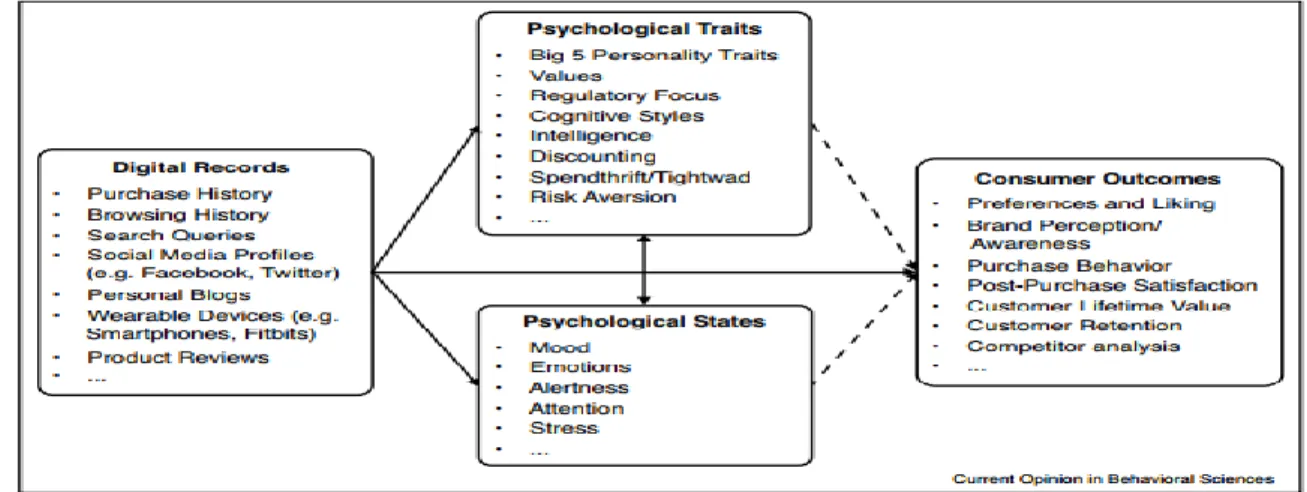
offer that use such connections. Figure 1
condenses the illustrated chances of
utilizing Big Data with regards to
consumer research. As we have talked
about all through the paper, the abundance
of individual consumer information
accessible at next to zero cost makes it
conceivable to anticipate consumer results,
as well as understand consumers' mental
needs and inspirations at both the state and
Page 61 quality levels. Understanding consumers'
mental states and traits would then be able to be utilized to better match the company's marketing offerings to customers' needs and inclinations, and consequently enhance business and consumer results [8].
5. OPPORTUNITIES AND CHALLENGES
The mix of information about 'what one does' with more profound understanding of 'who one is' offers gigantic chances to support the viability of marketing efforts as well as to enable consumers to settle on better choices. The pre-determination of substance that is in accordance with
consumers' mental needs can mitigate the issue of decision over-burden and enable consumers to expand the satisfaction and bliss they to pick up from their decisions.
Also, mentally tweaked wellbeing messages are known to be powerful in changing behaviors among patients and gatherings that are in danger [9]. Focusing on profoundly masochist people who show early indications of despondencies with promotions that guide them to self improvement pages or offer professional exhortation, for instance, could have a colossal constructive effect on the prosperity of a portion of the more helpless individuals from society, and even spare lives.
Figure 1: Leveraging Big Data to infer psychological traits and states and affect customer behavior
Nearby the advantages mentally customized marketing gives, it additionally raises new moral difficulties. While mental focusing on can enable consumers to settle on better decisions, it could likewise be utilized as a part of a way that endeavors 'shortcomings' in a man's character. For instance, one could target people who are inclined to habitual or addictive behavior
with promotions for an online gambling
club, or prohibit them from getting
protection advertisements. Truth be told,
Facebook was as of late censured for
investigating teenagers' enthusiastic or
mental state utilizing their Facebook
profiles. While Facebook said it doesn't as
of now utilize such deductions for
focusing on, even the accumulation of
Page 62 such data raised consumers' moral
concerns.
This more basic side of progressively customized marketing is reflected when all is said in done open wariness. A 2010 overview of American Internet clients demonstrated that fewer than 20%
communicated an inclination for focused promotion, while 64% saw customized publicizing as 'meddlesome'. In 2012, this suspicion achieved an open top in light of a 'scandal' including the U.S. retail monster Target [10]. Utilizing data-driven proposal algorithms, Target had elevated child gear to a pregnant teenage young lady in Minnesota, whose guardians had already been uninformed of the pregnancy.
With the presentation of significantly more modern expectation algorithms that investigate singular behaviors as well as make deductions about a consumers' cozy mental traits and states, these worries are probably not going to improve.
6. CONCLUSION
Taken together, the capacity to anticipate consumers' mental traits and states from their computerized impressions offers energizing new open doors for advanced marketing. We expect the two researchers and experts to go outside the ability to comprehend and expectation of mental states and traits and towards constant 'advancement' of marketing activities based on these forecasts. Much like in the scene in the sci-fi motion picture Minority Report, where publicizing announcements are customized to the passionate condition of the individual strolling past them, organizations will have the capacity to
enhance the promoting a consumer is presented to continuously and at a level of detail at no other time conceivable. For instance, one could utilize information about a man's transient heart rate extricated through their earphones to figure out which melody to play next, separate emotions from a man's outward appearance to change the shading plan of a site, or suggest the following vacation destination in another city as a component of the individual's anticipated identity and their present level of physical action. We urge researchers to keep on exploring these energizing open doors.
REFERENCES
1. Jacobs BJD, Donkers B, Fok D:
Model-based purchase predictions for large assortments. Mark. Sci.
2016, 35:389-404.
2. Ghose A, Ipeirotis PG, Li B:
Designing ranking systems for hotels on travel search engines by mining user-generated and crowdsourced content. Mark. Sci.
2012, 31:493-520.
3. Lu S, Xiao L, Ding M: A video- based automated recommender (VAR) system for garments. Mark.
Sci. 2016, 35:484-510.
4. Linden G, Smith B, York J:
Amazon.com recommendations:
item-to-item collaborative filtering.
IEEE Comput. Soc. 2003, 7:76-80.
5. Hauser JR, Urban GL, Liberali G,
Braun M: Website morphing.