Page 1 of 23
Test statistics for comparing two proportions with partially overlapping samples.
Abstract
Standard tests for comparing two sample proportions of a dichotomous dependent variable
where there is a combination of paired and unpaired samples are considered. Four new tests
are introduced and compared against standard tests and an alternative proposal by Choi and
Stablein (1982). The Type I error robustness is considered for each of the test statistics. The
results show that Type I error robust tests that make use of all the available data are more
powerful than Type I error robust tests that do not. The Type I error robustness and the power
among tests introduced in this paper using the phi correlation coefficient is comparable to that
of Choi and Stablein (1982). The use of the test statistics to form confidence intervals is
considered. A general recommendation of the best test statistic for practical use is made.
Key Words
Partially overlapping samples; Partially matched pairs; Partially correlated data; Equality of
proportions.
1 Introduction
Tests for comparing two sample proportions of a dichotomous dependent variable with either
two independent or two dependent samples are long established. Let 1 and 2 be the
proportions of interest for two populations or distributions. The hypothesis being tested is
2 1 0:
Page 2 of 23
combination of both paired and unpaired observations. In these cases, within a sample there
are, say a total of ‘n12’ observations from both populations, a total of ‘n1’ observations only
from population one, and a total of ‘n2’ observations only from population two. The
hypothesis being tested is the same as when either two complete independent samples or two
complete dependent samples are present. This situation with respect to comparing two means
has been treated poorly in the literature (Martinez-Camblor et al, 2012). This situation with
respect to comparing proportions has similarly been poorly treated.
Early literature in this area with respect to comparing proportions, refers to paired samples
studies in the presence of incomplete data (Choi and Stablein, 1982; Ekbohlm, 1982), or
missing data (Bhoj, 1978). These definitions have connotations suggesting that observations
are missing only by accident. Recent literature for this scenario refers to partially matched
pairs (Samawi and Vogel, 2011), however this terminology may be construed as the pairs
themselves not being directly matched. Alternatively, the situation outlined can be referred to
as part of the ‘partially overlapping samples framework’ (Martinez-Camblor et al, 2012).
This terminology is more appropriate to cover scenarios where paired and independent
samples may be present by accident or design. Illustrative scenarios where partially
overlapping samples may arise by design include:
i) Where the samples are taken from two groups with some common element. For
example, in education, when comparing the pass rate for two optional modules,
where a student may take one or both modules.
ii) Where the samples are taken at two points in time. For example, an annual survey
of employee satisfaction will include new employees that were not employed at
time point one, employees that left after time point one and employees that
Page 3 of 23
iii) When some natural pairing occurs. For example, a survey taken comparing views
of males and females, there may be some matched pairs ‘couples’ and some
independent samples ‘single’.
Repeated measures designs can have compromised internal validity through familiarity (e.g.
learning, memory or practise effects). Likewise, a matched design can have compromised
internal validity through poor matching. However, if a dependent design can avoid
extraneous systematic bias, then paired designs can be advantageous when contrasted with
between subjects or independent designs. The advantages of paired designs arise by each pair
acting as its own control helping to have a fair comparison. This allows differences or
changes between the two samples to be directly examined (i.e. focusing directly on the
phenomenon of interest). This has the result of removing systematic effects between pairs.
This leads to increased power or a reduction in the sample size required to retain power
compared with the alternative independent design. Accordingly, a method of analysis for
partially overlapping samples that takes into account any pairing, but does not lose the
unpaired information, would be beneficial.
Historically, when analysing partially overlapping samples, a practitioner will choose
between discarding the paired observations or discarding the independent observations and
proceeding to perform the corresponding ‘standard’ test. It is likely the decision will be based
on the sample sizes of the independent and paired observations. Existing ‘standard’
approaches include:
Option 1: Discarding all paired observations and performing Pearson’s Chi square test
of association on the unpaired data.
Option 2: Discarding all unpaired observations and performing McNemar’s test on the
Page 4 of 23
Option 3: Combining p-values of independent tests for paired and unpaired data. This
can be done by applying Fisher’s inverse Chi square method or Tippett’s test. These
approaches make use of all of the available data. These techniques were considered by
Samawi and Vogel (2011) and are shown to be more powerful than techniques that
discard data. However, it should be noted that the authors did not consider Type I
error rates.
Other ad-hoc approaches for using all available data include randomly pairing any unpaired
observations, or treating all observations as unpaired ignoring any pairing. These ad-hoc
approaches are clearly incorrect practice and further emphasise the need for research into
statistically valid approaches.
Choi and Stablein (1982) performed a small simulation study to consider standard approaches
and ultimately recommended an alternative test making use of all the available data as the
best practical approach. This alternative proposal uses one combined test statistic weighting
the variance of the paired and independent samples, see Section 3.2 for definition. The
authors additionally considered an approach using maximum likelihood estimators for the
proportions. This approach was found to be of little practical benefit in terms of Type I error
rate or power. Others have also considered maximum likelihood approaches. For example
Thomson (1995) considered a similar procedure, using maximum likelihood estimators, and
found the proposed procedure to perform similarly to that of Choi and Stablein (1982). It was
noted by Choi and Stablein (1982) that given the additional computation, the maximum
likelihood solution would not be a practical solution.
Tang and Tang (2004) proposed a test procedure which is a direct adaption of the best
practical approach proposed by Choi and Stablein (1982). This adaption is found to be not
Page 5 of 23
Choi and Stablein (1982) is found to be Type I error robust in this scenario. The literature
reviewed suggests that a solution to the partially overlapping samples case will have to
outperform the best practical solution by Choi and Stablein (1982). Tang and Tang (2004,
p.81) concluded that, ‘there may exist other test statistics which give better asymptotic or
unconditional exact performance’.
In this paper, we introduce four test statistics for comparing the difference between two
proportions with partially overlapping samples. These test statistics are formed so that no
observations are discarded. The statistics represent the overall difference in proportions,
divided by the combined standard error for the difference.
This paper will explore test statistics for testing H0, in the presence of partially overlapping
samples. In Section 2, existing ‘standard’ approaches and variants of are defined. In Section
3, our alternative proposals making use of all the available data are then introduced, followed
by the most practical proposal of Choi and Stablein (1982).
In Section 4, a worked example applying all of the test statistics is given, followed by the
simulation design in Section 5.
In Section 6.1, for all of the test statistics, the Type I error robustness is assessed when H0 is
true. This is measured using Bradley’s (1978) liberal criteria. This criteria states that the Type
I error rate should be betweennominal0.5nominal.
There is no standard criteria for quantifying when a statistical test can be deemed powerful.
The objective is to maximise the power of the test subject to preserving the Type I error rate
nominal
. If Type I error rates are not equal it is not possible to correctly compare the power of
Page 6 of 23
Type I error rate closest to nominal (Penfield 1994). In Section 6.2, power will be considered
under H1 for the test statistics that meet Bradley’s liberal criteria.
There is frequently too much focus on hypothesis testing. Confidence intervals may be of
more practical interest (Gardner and Altman 1986). Confidence intervals allow insight into
the estimation of a difference and the precision of the estimate. In Section 6.3, the coverage
of the true difference under H1 within 95% confidence intervals is considered. This is
considered only for the most powerful test statistics that are Type I error robust.
2 Definition of standard test statistics
Assuming a dichotomous dependent variable, where a comparison in proportions between
two samples is required, the layout of frequencies for the paired and the independent samples
[image:6.595.69.530.503.588.2]would be as per Table 1 and Table 2 respectively.
Table 1. Paired samples design for two samples and one dichotomous dependent variable.
Response Sample 1
Response Sample 2
Yes No Total
Yes a b m
No c d n12- m
Total k n12-k n12
Table 2. Independent samples design for two samples and one dichotomous dependent variable.
Response
Yes No Total
Sample 1 e f n1
[image:6.595.65.528.656.724.2]Page 7 of 23 2.1 Option 1: Discarding all paired observations
For two independent samples in terms of a dichotomous variable, as per Table 2, a
Chi-square test of association is typically performed. This test will be displayed in standard
textbooks in terms of 12. A chi square distribution on one degree of freedom is equivalent to
the square of the z-distribution. Therefore under the null hypothesis an asymptotically N(0,1)
equivalent statistic is defined as:
2 1 2 1 1 ) pˆ 1 ( pˆ ) pˆ 1 ( pˆ pˆ pˆ n n z
where
1 1 pˆ n e , 2 2 = pˆ n g and 2 1 pˆ n n g e .
For small samples, Yates’s correction is often performed to reduce the error in
approximation. Yate’s correction is given by:
2 1 2 2 1 2 1 2 ) )( ( )) ( 5 . 0 )(( ( n n h f g e n n fg eh n n z .
The statistic z is referenced against the upper tail of the standard normal distribution. 2
An alternative to the Chi square approach is Fisher’s exact test. This is computationally more
difficult. Furthermore, Fisher’s exact test is shown to deviate from Type I error robustness
(Berkson, 1978). Fisher’s exact test will not be considered for the analysis of the partially
overlapping samples design in this paper.
2.2 Option 2: Discarding all unpaired observations
For two dependent samples in terms of a dichotomous variable, as per Table 1, McNemar’s
test is typically performed. Under the null hypothesis, the asymptotically N(0,1) equivalent to
Page 8 of 23 c
b c b
=
z3 .
When the number of discordant pairs is small, a continuity correction is often performed.
McNemar’s test with continuity correction is the equivalent to:
c b
c b
2
4
1 =
z .
The statistic z is referenced against the upper tail of the standard normal distribution. 4
Test statistics based on Option 1 and Option 2 are likely to have relatively low power for
small samples when the number of discarded observations is large. A method of analysis for
partially overlapping samples that takes into account the paired design but does not lose the
unpaired information could therefore be beneficial.
2.3 Option 3: Applying an appropriate combination of the independent and paired tests
using all of the available data
Given that test statistics for the paired samples and dependent samples can be calculated
independently, an extension to these techniques which makes use of all of the available data
would be some combination of the two tests.
In terms of power, Fisher’s test and Tippett’s test are comparable to a weighted approach
using sample size as the weights (Samawi and Vogel, 2011). Tippett’s method and Fisher’s
method are not as effective as Stouffer’s weighted z-score test (Kim et al, 2013). Stouffer’s
Page 9 of 23 2 2 3 1 5 ) 1 ( z ) 1 ( z = z w w w w
where w=
2 1 12
2 1
2n n n
n n .
Under the null hypothesis, the test statistic z5 is asymptotically N(0,1).
Many other procedures for combining independent p-values are available, but these are less
effective than Stouffer’s test (Whitlock, 2005).
The drawbacks of Stouffer’s test are that it has issues in the interpretation and confidence
intervals for the true difference in population proportions cannot be easily formed.
3 Definition of alternative test statistics making use of all of the available data
The following proposals are designed to overcome the drawbacks identified of the standard
tests. In these proposals observations are not discarded and the test statistics may be
considered for the formation of confidence intervals.
3.1 Proposals using the phi correlation or the tetrachoric correlation coefficient.
It is proposed that a test statistic for comparing the difference in two proportions with two
partially overlapping samples can be formed so that the overall estimated difference in
proportions is divided by its combined standard error, i.e.
) p , p ( 2 ) p ( ) p ( p p 2 1 2 1 2 1 Cov r Var
Var x
Page 10 of 23
and rx is a correlation coefficient.
Test statistics constructed in this manner will facilitate the construction of confidence
intervals, for example a 95% confidence interval would be equivalent to:
(p1p2)1.96 Var(p1)Var(p2)2rxCov(p1,p2).
Pearson’s phi correlation coefficient or Pearson’s tetrachoric correlation coefficient are often
used for measuring the correlation rx between dichotomous variables.
Pearson’s phi correlation coefficient is calculated as
) )( )( )( (
1
d b c a d c b a
bc ad r
.
The result of r1 is numerically equivalent to Pearson’s product-moment correlation
coefficient and Spearman’s rank correlation coefficient applied to Table 1, using binary
outcomes ‘0’ and ‘1’ in the calculation. In this 2
2 case, r1 is also numerically equivalent toKendall’s Tau-a and Kendall’s Tau-b as well as Cramér's V and Somer’s d (symmetrical).
This suggests that r1 would be an appropriate correlation coefficient to use.
Alternatively, assuming the underlying distribution is normal, a polychoric correlation
coefficient may be considered. A special case of the polychoric correlation coefficient for two
dichotomous samples is the tetrachoric correlation coefficient.
An approximation to the tetrachoric correlation coefficient as defined by Edwards and
Edward (1984) is:
1 1 =
2
s s
r where
0.7854
=
bc ad
Page 11 of 23
Other approximations are available, however there is no conclusive evidence which is the
most appropriate (Digby, 1983). In any event, r1 is likely to be more practical than r2
because if any of the observed paired frequencies are equal to zero then the calculation of r2
is not possible.
Constructing a test statistic using correlation coefficients r1 and r2 respectively, the
following test statistics are proposed:
) )( ( ) p 1 ( p ) p 1 ( p 2 ) p 1 ( p ) p 1 ( p p p 2 12 1 12 12 2 2 1 1 1 2 12 2 2 1 12 1 1 2 1 6 n n n n n r n n n n z ) )( ( ) p 1 ( p ) p 1 ( p 2 ) p 1 ( p ) p 1 ( p p p 2 12 1 12 12 2 2 1 1 2 2 12 2 2 1 12 1 1 2 1 7 n n n n n r n n n n z where: 1 12 1 p n n e b a
and
2 12 2 = p n n g c a .
UnderH0, 1 2 , therefore two additional test statistics that may be considered are
Page 12 of 23
The test statistics z6, z7, z8 and z9are referenced against the standard normal distribution.
In the extreme scenario of n120, it is quickly verified that z8 z9 z1. UnderH0, in the
extreme scenario of n1 n2 0, as n12 then z8 z3. This property is not observed for
9
z . The properties of z8 give support from a mathematical perspective as a valid test statistic
to interpolate between the two established statistical tests where overlapping samples are not
present.
3.2 Test statistic proposed by Choi and Stablein (1982).
Choi and Stablein (1982) proposed the following test statistic as the best practical solution for
analysing partially overlapping sample:
D n n n n z 2 ) 1 ( ) 1 ( ) p 1 ( p p p 12 2 2 2 2 2 12 2 1 1 2 1 2 1 10 where 12 1 1 1 n n n , 12 2 2 2 n n n and 12 2 2
1)(1 )( p )
1 (
n p
D a .
The test statistic z10 is referenced against the standard normal distribution.
The authors additionally offer an extension of how optimization of w1 and w2 could be
achieved, but suggest that the additional complication is unnecessary and the difference in
results is negligible.
In common with the other statistics presented, z10 is computationally tractable but it may be
Page 13 of 23 4 Worked example
The objective of a Seasonal Affective Disorder (SAD) support group was to see if there is a
difference in the quality of life for sufferers at two different times of the year. A binary
response, ‘Yes’ or ‘No’ was required to the question whether they were satisfied with life.
Membership of the group remains fairly stable, but there is some natural turnover of
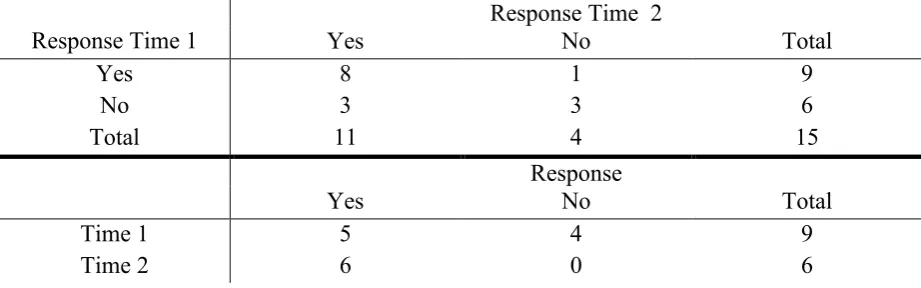
membership over time. Responses were obtained for n12 15 paired observations and a
[image:13.595.67.528.355.499.2]further n1 9 and n2 6 independent observations. The responses are given in Table 3.
Table 3. Responses to quality of life assessment.
Response Time 2
Response Time 1 Yes No Total
Yes 8 1 9
No 3 3 6
Total 11 4 15
Response
Yes No Total
Time 1 5 4 9
Time 2 6 0 6
The elements of the test statistics (rounded to 3 decimal places for display purposes), are
calculated as: pˆ10.556, pˆ2 1.000, pˆ 0.733, p1 0.583, p2 0.810, p 0.689, r10.431,
2
r 0.673, w0.333, 10.375, 2 0.286, D0.002. The resulting test statistics are
given in Table 4.
Table 4. Calculated value of test statistics (with corresponding p-values).
1
z z2 z3 z4 z5 z6 z7 z8 z9 z10
Page 14 of 23
At the 5% significance level, whether H0 is rejected depends on the test performed. It is of
note that the significant differences arise only with tests introduced in this paper, z6, z7 and
9
z .
Although the statistical conclusions differ for this particular example, the numeric difference
between many of the tests is small. To consider further the situations where differences
between the test statistics might arise, simulations are performed.
5 Simulation design
For the independent observations, a total of n1 and n2unpaired standard normal deviates are
generated. For the n12 paired observations, additional unpaired standard normal deviates Xij
are generated where i = (1,2) and j = (1,2,….,
n
12). These are converted to correlated normalbivariates Yij so that:
j
Y1 X1j X2j
2 1 2
1
and Y2j X2j X1j
2 1 2
1
where correlation between population one and population two.
The normal deviates for both the unpaired and correlated paired observations are transformed
into binary outcomes using critical values Ci of the normal distribution. IfXij Ci,Yij 1,
otherwise Yij 0
10,000 iterations of each scenario in Table 5 are performed in a 4
4
5
5
5
7=14000Page 15 of 23
Table 5. Values of parameters simulated for all test statistics.
Parameter Values
1
0.15, 0.30, 0.45, 0.502
0.15, 0.30, 0.45, 0.501
n 10, 30, 50, 100, 500
2
n 10, 30, 50, 100, 500
12
n
10, 30, 50, 100, 500 -0.75, -0.50, -0.25, 0.00, 0.25, 0.50, 0.75
A range of values for n1, n2 and n12 likely to be encountered in practical applications are
considered which offers an extension to the work done by Choi and Stablein (1982).
Simulations are conducted over the range from 0.15 to 0.5 both under H0 and H1. The
values of have been restricted to <= 0.5 due to the proposed statistics being palindromic
invariant with respect to and 1. Varying is considered as it is known that has an
impact on paired samples tests. Negative has been considered so as to provide a
comprehensive overview and for theoretical interest, although < 0 is less likely to occur in
practical applications.
Two sided tests with nominal0.05 is used in this study. For each combination of 10,000
iterations, the percentage of p-values below 0.05 is calculated to give the Type I error rate .
The Type I error rate under H0, for each combination considered in the simulation design,
should be between 0.025 and 0.075 to meet Bradley’s liberal criteria and to be Type I error
robust.
Page 16 of 23 6 Simulation Results
A comprehensive set of results with varying independent and paired sample sizes, correlation,
and proportions was obtained as outlined in Section 5.
6.1 Type I error rates
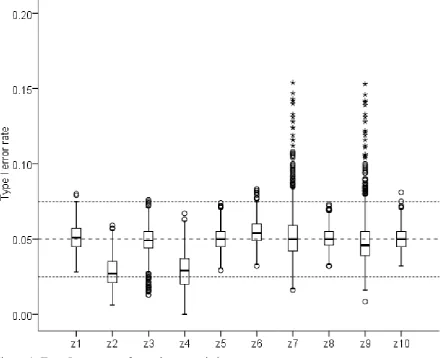
Under H0, 10,000 replicates were obtained for 4
5
5
5
7=3500 scenarios. For assessmentagainst Bradley’s (1978) liberal criteria, Figure 1 shows the Type I error rates for all
[image:16.595.78.523.361.719.2]scenarios where
1
2 using
nominal0.05.Page 17 of 23
As may be anticipated, z1 is Type I error robust because matched pairs are simply ignored.
Similarly, z3 performs as anticipated because the unpaired observations are ignored.
Deviations from robustness for z3 appear when n12 is small and is large. Although
deviations from stringent robustness are noted for z3, this is not surprising since the cross
product ratio is likely to be small when the proportion of success is low and the sample size is
low. Crucially, the deviations from Type I error robustness of z3 are conservative and will
result in less false-positives, as such the tests statistic may not be considered unacceptable.
The corrected statistics, z2 and z4, generally give Type I error rates below the nominal alpha,
particularly with small sample sizes. Ury and Fleiss (1980) found that z1 is Type I error
robust even with small samples, however applying Yate’s correction is not Type I error
robust and gives Type I error rates less than the nominal alpha. It is therefore concluded that
2
z and z4 do not provide a Type I error robust solution.
The statistics using the phi correlation coefficient, z6 and z8, are generally liberal robust. For
6
z there is some deviation from the nominal Type I error rate. The deviations occur when
min{n1,n2,n12} is small, max{n1,n2,n12} min{n1,n2,n12} is large and 0. In these
scenarios the effect of this is that z6 is not liberal robust and results in a high likelihood of
false-positives. It is therefore concluded that z6 does not universally provide a Type I error
robust solution to the partially overlapping samples situation.
The statistics using the tetrachoric correlation coefficient, z7 and z9, have more variability in
Type I errors than the statistics that use the phi correlation coefficient. The statistics using the
tetrachoric correlation coefficient inflate the Type I error when 0.25and n12 is large.
Page 18 of 23
consistently would be favoured for practical use. It is therefore concluded that z7 and z9 do
not provide a Type I error robust solution to the partially overlapping samples situation.
Three statistics making use of all of the available data, z5, z8 and z10, demonstrate liberal
robustness across all scenarios. Analysis of Type I error rates show near identical boxplots to
Figure 1 when each of the parameters are considered separately. This means these statistics
are Type I error robust across all combinations of sample sizes and correlation considered.
6.2 Power
The test statistics z2, z4, z6, z7 andz9 are not Type I error robust. Therefore only z1, z3, z5,
8
z and z10 are considered for their power properties (where H1 is true). Table 6 summarises
the power properties where
1
0.5.Table 6. Power averaged over all sample sizes.
1
2 z1 z3 z5 z8 z100.5 0.45 0 0.095
0.173 0.208 0.221 0.221
0 0.133 0.168 0.186 0.186
0
0.112 0.150 0.166 0.166
0.5 0.3 0 0.509
0.653 0.807 0.856 0.855
0 0.569 0.772 0.828 0.827
0
0.508 0.746 0.801 0.801
0.5 0.15 0 0.843
0.874 0.975 0.989 0.989
0 0.834 0.970 0.985 0.986
0
0.795 0.966 0.980 0.982
For each of the test statistics, as the correlation increases from -0.75 through to 0.75 the
Page 19 of 23
Clearly, z5 is more powerful than the other standard tests z1 and z3, but it is not as powerful
as the alternative methods that make use of all the available data.
The power of z8 and z10 are comparable. Separate comparisons of z8 and z10 indicates that
the two statistics are comparable across the factorial combinations in the simulation design.
Either test statistic could reasonably be used for hypothesis testing in the partially
overlapping samples case.
6.3 Confidence interval coverage
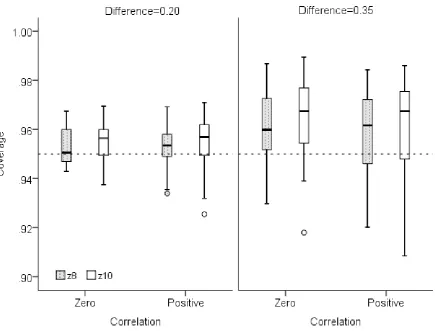
For z8 and z10, the coverage of the true difference of population proportions within 95%
confidence intervals has been calculated as per the simulation design in Table 5 where
1
2
Page 20 of 23
Figure 2: Percentage of iterations where the true difference is within the confidence interval.
Both z8 and z10 demonstrate reasonable coverage of the true population difference
1
2.However, Figure 2 shows that z8 more frequently performs closer to the desired 95% success
rate. Taking this result into account, when the objective is to form a confidence interval, z8 is
recommended as the test statistic of choice in the partially overlapping samples case.
7 Conclusion
Partially overlapping samples may occur by accident or design. Standard approaches for
analysing the difference in proportions for a dichotomous variable with partially overlapping
Page 21 of 23
unpaired sample, it may be reasonable in a practical environment to use the corresponding
standard test. For small samples, the test statistics which discard data have inferior power
properties to tests statistics that make use of all the available data. These standard approaches
and other ad-hoc approaches identified in this paper are less than desirable.
Combining the paired and independent samples z-scores using Stouffer’s method is a more
powerful standard approach, but leads to complications in interpretation, and does not readily
extend to the creation of confidence intervals for differences in proportions. The tests
introduced in this paper, as well as the test outlined by Choi and Stablein (1982) are more
powerful than the test statistics in ‘standard’ use.
The alternative tests introduced in this paper, z6, z7, z8 and z9, overcome the interpretation
barrier, in addition confidence intervals can readily be formed.
Tests introduced using the phi correlation coefficient, z6 and z8, are more robust than the
equivalent tests introduced using the tetrachoric correlation coefficient, z7 and z9.
The most powerful tests that are Type I error robust are z8 and z10. The empirical evidence
suggests that z8 is better suited for forming confidence intervals for the true population
difference than z10. Additionally, z8 has relative simplicity in calculation, strong
mathematical properties and provides ease of interpretation. In conclusion, z8 is
recommended as the best practical solution to the partially overlapping samples framework
Page 22 of 23 References
Berkson J. In dispraise of the exact test. Journal of Statistic Planning and Inference.
1978;2:27–42.
Bhoj D. Testing equality of means of correlated variates with missing observations on both
responses. Biometrika. 1978;65:225-228.
Bradley JV. Robustness?. British Journal of Mathematical and Statistical Psychology.
1978;31(2):144-152.
Choi SC, Stablein DM. Practical tests for comparing two proportions with incomplete data.
Applied Statistics. 1982;31:256-262.
Digby PG. Approximating the tetrachoric correlation coefficient. Biometrics. 1983;753-757.
Edwards JH, Edwards AWF. Approximating the tetrachoric correlation coefficient.
Biometrics. 1984;40(2):563.
Ekbohm G. On testing the equality of proportions in the paired case with incomplete data.
Psychometrika. 1982;47(1):115-118.
Gardner MJ, Altman DG. Confidence intervals rather than p values: estimation rather than
hypothesis testing. BMJ. 1986;292(6522):746-750.
Kim SC, Lee SJ, Lee WJ, Yum YN, Kim JH, Sohn S, Park JH, Jeongmi L, Johan Lim, Kwon
SW. Stouffer’s test in a large scale simultaneous hypothesis testing. Plos one.
2013;8(5):e63290.
Martinez-Camblor P, Corral N, De la Hera JM. Hypothesis test for paired samples in the
Page 23 of 23
Penfield DA. Choosing a two-sample location test. Journal of Experimental Education.
1994;62(4):343-360.
R Core Team. R: A language and environment for statistical computing. R Foundation for
Statistical Computing, Vienna, Austria. www.R-project.org. 2014; version 3.1.2.
Samawi HM, Vogel R. Tests of homogeneity for partially matched-pairs data. Statistical
Methodology. 2011;8(3):304-313.
Tang ML, Tang NS. Exact tests for comparing two paired proportions with incomplete data.
Biometrical Journal. 2004;46(1),72-82.
Thomson PC. A hybrid paired and unpaired analysis for the comparison of proportions.
Statistics in Medicine. 1995;14:1463-1470.
Ury HK, Fleiss JL. On approximate sample sizes for comparing two independent proportions
with the use of Yates' correction. Biometrics. 1980;347-351.
Whitlock MC. Combining probability from independent tests: the weighted z-method is