Onboarding: Breaking in and settling in
“A good start is half way to success.” —A Chinese Proverb
This is particularly true for those of you who have just joined a new company and wish to achieve long-term success and satisfaction in your career. This section discusses what you can do to make a good start.
What is onboarding?
Onboarding is a set of processes through which newcomers learn knowledge, information, skills, behaviours, organizational norms and values required to function effectively as a member of an organization. It is also used to describe the on-going process of orienting, socializing and engaging newcomers to ensure that they are able to make a positive start with the organization. Onboarding programmes may include a series of both formal and informal activities, aiming to speed up the process of adjustment and increase newcomers’ productivity.
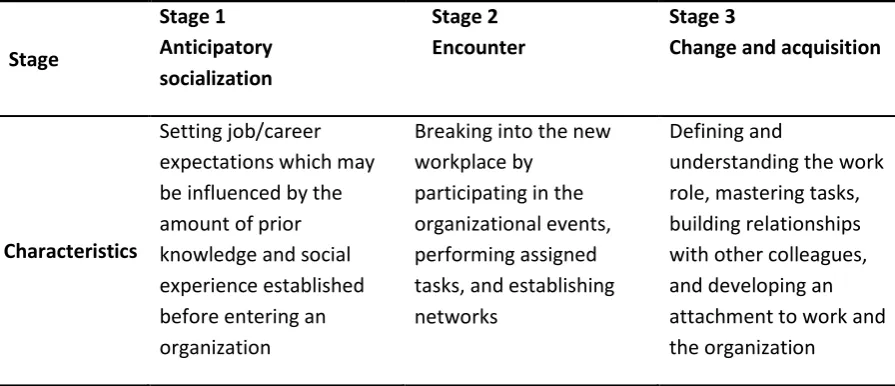
[image:1.595.81.529.468.661.2]Based on attempts of earlier socialization theorists, Feldman (1976) developed a model to demonstrate what newcomers are likely to experience after entering an organization (see Table 1).
Table 1 Feldman's stage model (1976)
Stage
Stage 1 Anticipatory
socialization
Stage 2 Encounter
Stage 3 Change and acquisition
Characteristics
Setting job/career expectations which may be influenced by the amount of prior knowledge and social experience established before entering an organization
Breaking into the new workplace by
participating in the organizational events, performing assigned tasks, and establishing networks
Defining and
understanding the work role, mastering tasks, building relationships with other colleagues, and developing an attachment to work and the organization
‘surprise’ as key features of the newcomers’ experience after organizational entry. He pointed out that individuals could not erase all the memories of former roles before settling into the new role. Therefore, newcomers were inclined to subconsciously undertake role change by interrelating with new settings and using previous experiences to manage surprise.
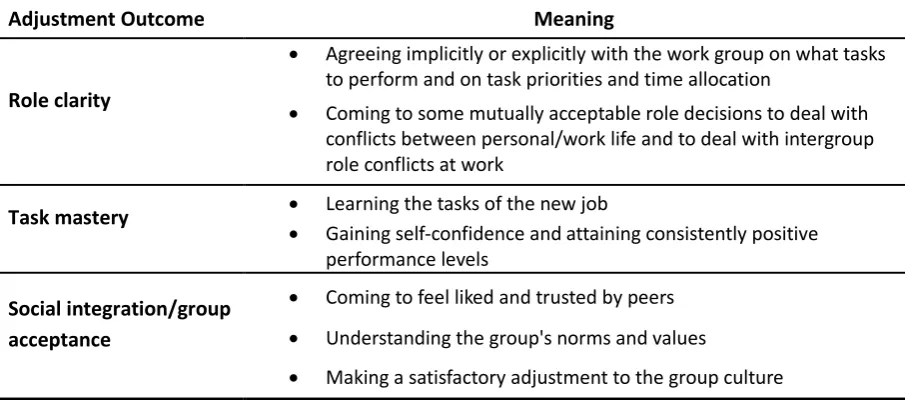
[image:2.595.78.531.228.428.2]Feldman (1981) also suggested that role clarity, task mastery and social integration are three typical adjustment outcomes that reflect to what extent you are successfully settling in the new workplace.
Table 2 Adjustment outcomes
Adjustment Outcome Meaning
Role clarity
Agreeing implicitly or explicitly with the work group on what tasks to perform and on task priorities and time allocation
Coming to some mutually acceptable role decisions to deal with conflicts between personal/work life and to deal with intergroup role conflicts at work
Task mastery Learning the tasks of the new job
Gaining self-confidence and attaining consistently positive performance levels
Social integration/group acceptance
Coming to feel liked and trusted by peers Understanding the group's norms and values
Making a satisfactory adjustment to the group culture
Note: Adapted from Feldman (1981)
These three adjustment outcomes are often regarded as ‘proximal’ socialization outcomes in organizational socialization studies, proximal in the sense of occurring in the shorter term. Closely related to these are attitudinal variables (job satisfaction and organizational commitment) and behavioural variables (performance and turnover) as indicators of ‘distal’ adjustment outcomes, distal in the sense of occurring in the longer term (see Table 3).
Table 3 Successful vs. Unsuccessful adjustment
Successful adjustment Unsuccessful adjustment Greater knowledge about the
organization and the team Role ambiguity, unstable progress Increased self-confidence Lack of confidence
Increased productivity Anxious and stressful
Trusting work relationship Lack of trust, unmet expectations
Accepted by the team members Feeling lonely and isolated Increased job satisfaction and
commitment
Unhappy, lack of commitment, and intent to leave the organization
[image:2.595.77.471.586.745.2]What can organizations do to help you settle in?
While most newcomers experience some type of onboarding programmes, the formality, expectation and breadth of the programmes can vary considerably across occupations and industries. For example, doctors and nurses are usually required to attend long periods of formal onboarding programmes before they are allowed to work on their own due to the complexity involved in the work and the consequences of getting it wrong. Another example of the formal approach is when technical workers are required to attend formal training programmes to learn how to use specialised equipment before they are allowed to perform by their own. Those formal
programmes are expected to ‘minimize risk by providing each new recruit with standard training that emphasizes the proper and accepted ways to accomplish things in the organization’ (Salisbury, 2006, p. 22). In contrast, some organizations prefer a less structured and less systematic method, where newcomers are left to the work team and learning usually takes place ‘on the job’. Under this approach, newcomers are provided with a greater control of their learning process. They learn the norms and principles usually from the interactions with other colleagues, and master the skills from assigned tasks.
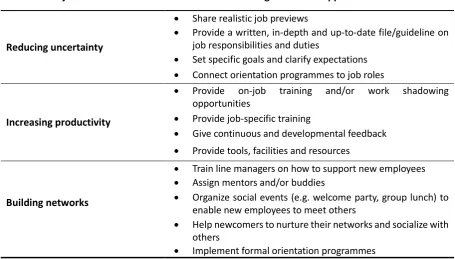
[image:3.595.76.532.469.728.2]Some organizations tend to accept newcomers as they are and newcomers are valued for what they bring to the organization, while others deny these personal attributes and ensure newcomers accept prescribed standards of membership. For example, in police onboarding training, new cadets are informed that they are no longer ordinary citizens and their behaviour needs to be strictly regulated. Table 4 highlights some of best organizational approaches used to help newcomers settle down.
Table 4 Best practices to help you settle in
Aims and objectives Organizational approach
Reducing uncertainty
Share realistic job previews
Provide a written, in-depth and up-to-date file/guideline on job responsibilities and duties
Set specific goals and clarify expectations Connect orientation programmes to job roles
Increasing productivity
Provide on-job training and/or work shadowing opportunities
Provide job-specific training
Give continuous and developmental feedback Provide tools, facilities and resources
Building networks
Train line managers on how to support new employees Assign mentors and/or buddies
Organize social events (e.g. welcome party, group lunch) to enable new employees to meet others
Help newcomers to nurture their networks and socialize with others
Implement formal orientation programmes
What can you do to settle in successfully?
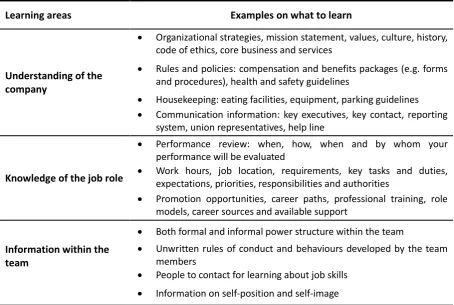
[image:4.595.77.532.169.474.2]To reduce uncertainty and stress associated with onboarding process, you should learn about your organizations, job roles and social relations (see Table 5).
Table 5 Content of learning during onboarding
Learning areas Examples on what to learn
Understanding of the company
Organizational strategies, mission statement, values, culture, history, code of ethics, core business and services
Rules and policies: compensation and benefits packages (e.g. forms and procedures), health and safety guidelines
Housekeeping: eating facilities, equipment, parking guidelines Communication information: key executives, key contact, reporting
system, union representatives, help line
Knowledge of the job role
Performance review: when, how, when and by whom your performance will be evaluated
Work hours, job location, requirements, key tasks and duties, expectations, priorities, responsibilities and authorities
Promotion opportunities, career paths, professional training, role models, career sources and available support
Information within the team
Both formal and informal power structure within the team
Unwritten rules of conduct and behaviours developed by the team members
People to contact for learning about job skills Information on self-position and self-image
Note: Adapted from Jablin (2001) and Morrison (1993)
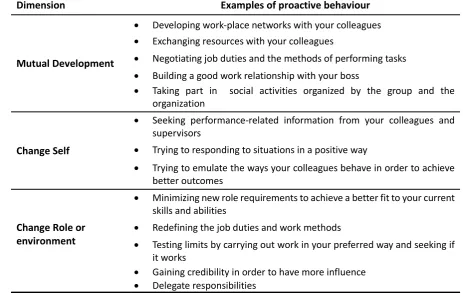
In addition to learning, research has found positive relationships between newcomers’ information seeking behaviours and a number of socialization outcomes, such as job satisfaction, organizational commitment, job performance, and negative relationships with work anxiety and intention to turnover (Chen, 2010; Bauer et al., 2007). The implication is that it is vitally important for you to engage in various proactive behaviours during and after the onboarding process. You should actively take part in those behaviours without asked.
Table 6 Your can-do list: Examples of proactive behaviour
Dimension Examples of proactive behaviour
Mutual Development
Developing work-place networks with your colleagues Exchanging resources with your colleagues
Negotiating job duties and the methods of performing tasks Building a good work relationship with your boss
Taking part in social activities organized by the group and the organization
Change Self
Seeking performance-related information from your colleagues and supervisors
Trying to responding to situations in a positive way
Trying to emulate the ways your colleagues behave in order to achieve better outcomes
Change Role or environment
Minimizing new role requirements to achieve a better fit to your current skills and abilities
Redefining the job duties and work methods
Testing limits by carrying out work in your preferred way and seeking if it works
Gaining credibility in order to have more influence Delegate responsibilities
Note: Adapted from Cooper-Thomas and Burke (2012)
Concluding Remarks
References
Ashforth, B. E., Sluss, D. M., & Saks, A. M. (2007). Socialization tactics, proactive behavior, and newcomer learning: Integrating socialization models. Journal of Vocational Behavior, 70, 447-462.
Bauer, T. N. (2011). Onboarding new employees: Maximizing success. SHRM Foundation’s Effective Practice Guideline Series. SHRM.
Bauer, T. N., Bodner, T., Erdogan, B., Truxillo, D. M., & Tucker, J. S. (2007). Newcomer adjustment during organizational socialization: A meta-analytic review of antecedents, outcomes and methods. Journal of Applied Psychology, 92, 707-721.
Chen, J. (2010). The Influence of Organizational Socialisation Tactics and Information Seeking on Newcomer Adjustment: Evidence from Two Studies in China. Unpublished PhD thesis. University of Manchester.
Cooper-Thomas, H. D., & Burke, S. E. (2012). Newcomer proactive behavior: Can there be too much of a good thing? In C. Wanberg (Ed.) Oxford Handbook of Organizational Socialization (pp. 56-77). New York, NY: Oxford University Press.
Feldman, D. C. (1976). A contingency theory of socialization. Administrative Science Quarterly, 21, 433-452.
Feldman, D. C. (1981). The multiple socialization of organization members. Academy of Management Review, 6, 309-318.
Louis, M. R. (1980). Surprise and sense making: What newcomers experience in entering unfamiliar organizational settings. Administrative Science Quarterly, 25, 226-251.
Jablin, F. M. (2001). Organizational entry, assimilation and disengagement/exit. In F. M. Jablin & L. L. Putnam. (Eds.) New handbook of organizational communication: Advances in theory, research and methods (pp. 732–818). Thousand Oaks, CA: Sage.
Morrison, E. W. (1993). Newcomer information seeking: Exploring types, modes, sources and outcomes. Academy of Management Journal, 36, 557-589.