Student engagement with lecture transcripts
Philip Phelps
Department of Computer Science & Creative Technologies University of the West of England Coldharbour Lane, Frenchay, Bristol
[email protected] http://www.zenpho.co.uk
Dr. Marcus Lynch
Department of Computer Science & Creative Technologies University of the West of England Coldharbour Lane, Frenchay, Bristol
[email protected] http://marcusdlynch.co.uk
Daniel Buzzo
Department of Computer Science & Creative Technologies University of the West of England Coldharbour Lane, Frenchay, Bristol
[email protected] http://buzzo.com
ABSTRACT
This paper first presents a summary of work completed during 2009-2010 developing software for semi-automated transcription of lecture audio recordings. Results of previous trials involving student correction of machine generated draft transcripts are presented in brief. The body of this paper focuses on current development work undertaken in the first year of a two year project funded by UWE: including alterations to support annotation of - and hyper-linking between - transcripts, improvements made to the indexing and search system, along with the machine transcription workflow, and restructuring of prototype code into a more modular system in preparation for integration with the Virtual Learning Environment at UWE.
Also included is a description of a trial involving collaborative student submission of ~1050 URLs accompanied by related keywords that complemented, corrected or in some way augmented lecture content of two separate modules. It is anticipated that this activity will positively affect assessment results; unfortunately the final examination results are not available at the time of writing but a full evaluation will be presented at the HEA-ICS conference in August 2011.
Future plans for the next iteration of the project include augmenting the transcription system to support subtitling of video recordings of lectures and potential solutions to current problems associated with scalability within our institution and dissemination to other institutions.
Keywords
Speech recognition, transcription, annotation
1. INTRODUCTION AND BACKGROUND INFORMATION (WORK DURING 2009-2010)
This paper follows on from previous work as described in Lynch & Phelps (2009 and 2010a). In 2009-10, a UWE funded project developed a single-user system for automated segmentation and machine transcription of lecture recordings. This system was targeted for lecturer use, reducing turnaround time for transcribing oneʼs own lectures, editing machine generated draft transcripts using review/correction tools.
In 2010, a HEA-ICS development-fund project extended this system to provide a multi-user system for collaborative lecturer/student editing of machine generated transcripts, along with a method for indexing and searching complete transcripts, synchronising the audio and text of any displayed search results. In this iteration of the system: “final year undergraduate students studying the module ʻMultimedia Systems: Contexts and Applicationsʼ reviewed and corrected machine-generated lecture transcripts, to collaboratively build a searchable resource of lecture content.” (Lynch & Phelps , 2010b).
Several aspects of usage statistics were gathered during the 2010 trial (e.g. time spent editing for individual students, etc). In addition to these quantitative metrics, students completed qualitative feedback questionnaires at checkpoints during their time using the system. These questionnaires asked students to evaluate the impact of the system on their study during the module, as well as the impact on revision between the end of teaching and the final examination.
Permission to make digital or hard copies of all or part of this work for personal or classroom use is granted without fee provided that copies are not made or distributed for profit or commercial advantage and that copies bear this notice and the full citation on the first page. To copy otherwise, to republish, to post on servers or to redistribute to lists, requires prior specific permission.
© 2011 Higher Education Academy
1.1
Results of the 2010 HEA-ICS funded research
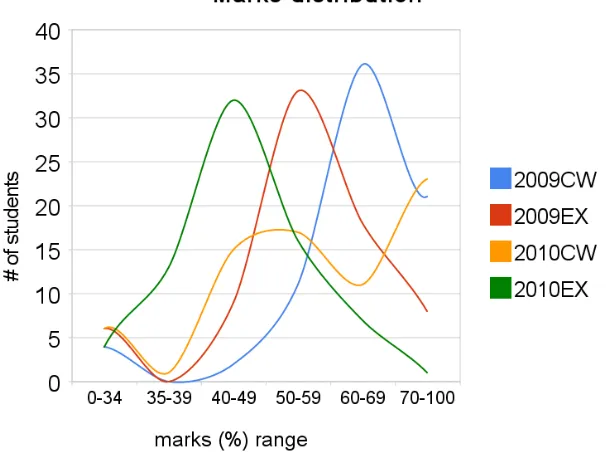
[image:2.595.139.442.170.396.2]Among our hypotheses was a belief that student participation in transcript editing would result in deep learning as a result of visual, auditory, and kinetic interaction. This was tested by comparing student exam performance (post transcription editing) to coursework performance (pre transcription editing). Figure 1 below shows the combined distribution of marks for two cohorts: 2008/09 (before the transcription editing/review system was introduced) and 2009/10 (in which the transcription editing/review system was trialed).
Figure 1 – Cohort comparison (reprinted from Lynch & Phelps 2010b)
In summary: 6 students increased their performance, 54 students reduced their performance, and 3 students improved their performance regardles (despite not participating in transcription). Qualitatively speaking: the majority of students rated the impact on their study as neutral, with a similar majority stating that their participation during module teaching was not for revision purposes.
During the 2008/09 module run (before the transcription/editing/review system was introduced) there was a strong correlation with coursework and examination. This correlation does not seem to be present for the 2009/10 module run. A logical conclusion is that our belief in deep learning through transcription was misguided. Questionnaire responses indicate that few students used the transcript system extensively for revision. It is likely that the trial inadvertently encouraged only shallow engagement by attributing marks to the task of transcript editing. Perhaps the majority of students focused on getting the task over and done with to earn marks rather than treating the task as an opportunity for learning reinforcement.
2. STUDENT ENGAGEMENT THROUGH ANNOTATION – (WORK DURING 2010-11)
Development work has so far focused on embellishing the transcript indexing and search system into a repository that supports annotation and hyper-linking between transcripts. This new approach avoids student transcription altogether (with a view to avoiding the negative effects observed during 2009-10). It is our intention to provide an environment where students are encouraged to explore and engage with lecture content through self-motivated contribution in the form of notes/annotations/hyperlinks whenever connections between related content are discovered.
The study of student annotation of hyperlinked educational materials is not a new concept. An influential 1998 study notes that annotations "are a direct reflection of a reader's engagement with the text. It is this engagement with the text that our systems may seek to promote" (Marshall, 1998). A more recent 2004 review by Azouaou et al includes mention of a system for augmenting web browser bookmarks, described as "a prototype annotation system written in Java and JavaScript [...] designed to study how the annotations can be used to improve current bookmarks" (Denoue & Vignolet, 2000).
2.1
Annotation, related URLs, and co-learning communities
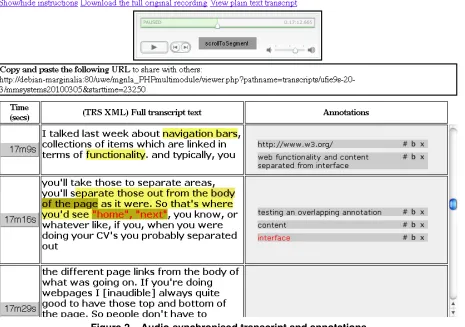
[image:3.595.69.534.247.574.2]Our recent work has involved the modification and integration of the Marginalia annotation engine (originally written by Geoff Glass between 2005-2008). Other alternatives were considered, including the Open Knowledge Foundation Annotator engine. Figure 2 shows the modifications made to the audio-synchronised transcript viewer. Specific highlighted regions in the transcript text are now accompanied by an annotation in the far right column.
Figure 2 – Audio-synchronised transcript and annotations
2.2
Related URL lists
It was intended that our annotation interface be trialed as part of an assessment regime in a similar way to that described in our earlier paper (see Lynch & Phelps 2010a). Unavoidable circumstances prevented us from testing our annotation system during 2011 - so a scaled down approach was devised.
Students used a web questionnaire (surveymonkey.com) to submit before a certain deadline, the results were exported to a file for duplicate-checking and marking, then further processed to produce two HTML documents (one for each module) containing the total compiled list of duplicate-free URLs. The result is an impressive resource of ~1050 URLs: completely searchable by keyword and lecture-topic.
One obvious criticism is that the resultant list of URLs varies in quality and relevance. It is hoped that when the full annotation system is trialed during 2011-12 a natural consequence of collaborative discussion through annotations will include peer-review, a sentiment spurred on by this description of educational value added through annotation: "YAWAS [Yet Another Web Annotation System] was customized so that ratings (*, **, ***) could be attached to each annotation. Yawas has also been extensively used to know what other students had already read. This result confirms that annotations have a clear value to future readers." (Denoue & Vignollet, 2000).
2.3
Impact on student performance
Results of the impact of our trial on student exam performance are not available at the time of writing but they will be presented at the 2011 HEA-ICS conference. It is our belief that the act of researching related URLs will promote deep learning by encouraging students to see the broad context of a given topic - and to make connections with specific personal experiences (reading/experiencing related content). Annotated lecture transcripts are the next logical step, supporting peer-review of related hyperlinks by rating contributions, and encouraging collaboration by spurring new contributions as the conversation and discussion moves on.
By observing annotations made by students, the delivery of subsequent lectures may be augmented with relevant external material (or material from other modules, or even pan-module-pan-institution material!). From a 2006 paper focused on annotations and critical writing: "Reviewing a studentʼs annotated text conveniently offers a window through which a teacher may discern a learnerʼs thinking styles and find effective ways to facilitate each learnerʼs critical thinking process" (Liu, 2006).
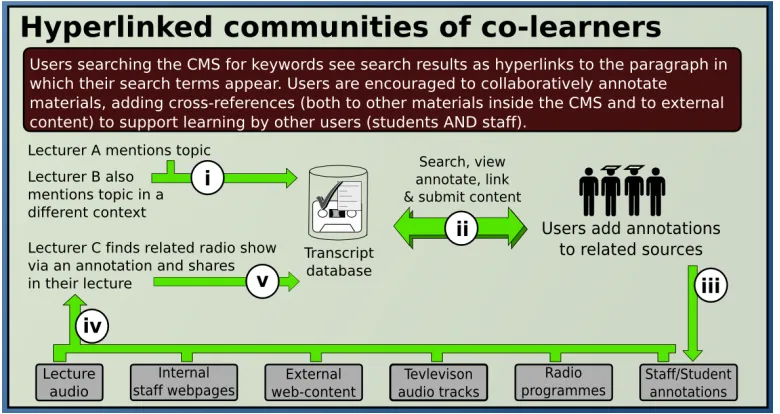
An adaptive approach to teaching is one of the core concepts behind our goal of a "hyperlinked community of co-learners". Figure 3 outlines a scenario in which students and lecturers collaborate to build a repository of searchable lecture transcripts, complete with a complex feedback path of references and discussion of related lectures and external content using a CMS (Content Management System).
[image:4.595.104.494.490.697.2]
3.
TRANSCRIPTION THROUGH SPEECH RECOGNITION
(
WORK DURING
2010-11)
Leaving annotation aside for a moment: Our previously documented workflow (see Lynch & Phelps 2009, 2010a) has now been improved such that human corrections of machine-transcribed segments automatically influence the voice-profile to reduce errors in subsequent segments. The workflow also extends to include MacOS software (Macspeech Scribe) in addition to the existing Windows based software (Nuance Naturally Speaking).
A prototype interface for controlling multiple MacOS / Windows recognition hosts via a centralised cross-platform compatible web interface has been developed, although it must be said that abusing software intended for single-user desktop applications to work as a centrally managed cluster of transcription servers does not scale very well! A more scalable solution is being investigated.
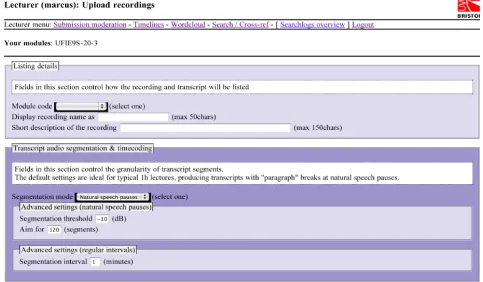
[image:5.595.56.539.325.607.2]Our existing prototype processing scripts have been improved, with significant work undertaken to add web-interfaces to command-line scripts, in preparation for integration with the Blackboard Virtual Learning Environment at our institution. An example screenshot showing the part of the interface for lecture audio segmentation is shown in Figure 4 below.
Figure 4 – Lecture audio segmentation interface
4. SUMMARY AND FUTURE THINKING
The current project - funded by UWE – is currently nearing the end of the first of two years and is likely to undergo a further shift of project focus: augmenting the transcript repository system to support video recordings of lectures by using the existing transcript automation workflow to process the speech audio element of uploaded video files and producing timecoded subtitle files for synchronised playback.
issue within even just one institution since the current multi-user system relies on single-user speech recognition software and individual licences are required for each user.
One possible solution is cross-institutional collaboration, to develop a base toolkit. This would enable educational institutions to configure a completely standalone networked server application for machine transcription in educational contexts. This would require applying for an enterprise licence and server SDK from Nuance, perhaps involving a commercial partnership.
5. REFERENCES
Azouaou. F. et al. (2004) 'Semantic annotation tools for learning material' Web Technologies for E-Learning. [online] Available from:
http://citeseerx.ist.psu.edu/viewdoc/download?doi=10.1.1.98.7162&rep=rep1&type=pdf. (Accessed 2001-April-21)
Denoue. L & Vignolet L. (2000) 'An annotation tool for Web browsers and its applications to information retrieval'. In: Proceedings of RIAO2000 [online]. pp180-195. Available from:
http://citeseerx.ist.psu.edu/viewdoc/download?doi=10.1.1.36.618&rep=rep1&type=pdf (Accessed 2001-April-21)
Liu. K. (2006). 'Annotation as an index to critical writing', Urban Education [online]. 41(2), pp192-207. Available from: http://uex.sagepub.com/cgi/reprint/41/2/192.pdf (Accessed 2011-April-21)
Lynch, M. & Phelps, P. (2009). ʻAutomated Transcription of Spoken Word Lecture Materialsʼ, Proceedings of the Higher Education Academy for Information and Computer Sciences 10th Annual Conference, University of Kent in Canterbury.
Lynch, M. & Phelps, P. (2010a). ʻDeep learning via student engagement with semi-automated lecture transcriptsʼ, Proceedings of the Higher Education Academy for Information and Computer Sciences 11th Annual Conference, Durham University.
Lynch, M. & Phelps, P. (2010b). ʻHEA-ICS Development Fund Overview of Deep learning via student engagement with semi-automated lecture transcriptsʼ [online]. Available from:
http://www.ics.heacademy.ac.uk/projects/development-fund/final_reports/131r_FinalReportMLynch.doc (Accessed 2011-April-13)
Marshall, C. (1998). Toward an ecology of hypertext annotation. In: Proceedings of Ninth ACM Hypertext and
Hypermedia Conference. Pittsburgh, PA. [online] Available from:
http://citeseerx.ist.psu.edu/viewdoc/download?doi=10.1.1.27.5676&rep=rep1&type=pdf (Accessed 2011-April-21)
Bibliography
Glass, G. (2008) Marginalia Web Annotation [online]. Available from: http://www.geof.net/code/annotation (Accessed 2011-April-20)
OKFN (2011) Annotator - Open Knowledge Foundation [online]. Available from: http://okfn.org/projects/annotator (Accessed 2011-April-21)
Jackson. H. J. (2002) Marginalia: Readers writing in books. Yale university press.
Permission to make digital or hard copies of all or part of this work for personal or classroom use is granted without fee provided that copies are not made or distributed for profit or commercial advantage and that copies bear this notice and the full citation on the first page. To copy otherwise, to republish, to post on servers or to redistribute to lists, requires prior specific permission.
© 2011 Higher Education Academy