N
-(6-Bromomethyl-2-pyridyl)acetamide
Hoong-Kun Fun,a*‡ Jia Hao Goh,a§ Nirmal Kumar Das,b Debabrata Senb and Shyamaprosad Goswamib
a
X-ray Crystallography Unit, School of Physics, Universiti Sains Malaysia, 11800 USM, Penang, Malaysia, andbDepartment of Chemistry, Bengal Engineering and Science University, Shibpur, Howrah 711 103, India
Correspondence e-mail: [email protected]
Received 30 August 2010; accepted 31 August 2010
Key indicators: single-crystal X-ray study;T= 100 K; mean(C–C) = 0.003 A˚;
Rfactor = 0.033;wRfactor = 0.100; data-to-parameter ratio = 30.1.
The title acetamide compound, C8H9BrN2O, crystallizes with three crystallographically independent molecules (A,BandC) in the asymmetric unit. In moleculeA, the mean plane through the acetamide unit is inclined at a dihedral angle of 4.40 (11)
with respect to the pyridine ring [10.31 (12) and 2.27 (11),
respectively, for moleculesBandC]. In the crystal structure, molecules are interconnected into sheets parallel to the ac plane by N—H O, C—H Br, C—H O and C—H N hydrogen bonds. The structure is further stabilized by weak intermolecular C—H interactions.
Related literature
For general background and applications of acetamide compounds, see: Goswami et al. (2000, 2005); Ghosh & Masanta (2006). For the preparation, see: Goswami et al. (2001, 2004). For the stability of the temperature controller used in the data collection, see: Cosier & Glazer (1986).
Experimental
Crystal data
C8H9BrN2O Mr= 229.08 Monoclinic,P21=c a= 4.1894 (8) A˚
b= 26.219 (5) A˚
c= 23.817 (4) A˚
= 94.148 (4)
V= 2609.2 (8) A˚3 Z= 12
MoKradiation
= 4.68 mm1
T= 100 K
0.310.140.09 mm
Data collection
Bruker APEXII DUO CCD area-detector diffractometer Absorption correction: multi-scan
(SADABS; Bruker, 2009)
Tmin= 0.323,Tmax= 0.668
72227 measured reflections 10228 independent reflections 8239 reflections withI> 2(I)
Rint= 0.058
Refinement
R[F2> 2(F2)] = 0.033 wR(F2) = 0.100
S= 1.06 10228 reflections 340 parameters
H atoms treated by a mixture of independent and constrained refinement
max= 1.37 e A˚
3 min=0.74 e A˚
[image:1.610.314.565.271.360.2]3
Table 1
Hydrogen-bond geometry (A˚ ,).
Cg1 andCg2 are the centroids of the C2A–C6A/N1Aand C2C–C6C/N1C
pyridine rings, respectively.
D—H A D—H H A D A D—H A
N2A—H2NA O1Ci
0.74 (3) 2.29 (3) 3.022 (2) 172 (4) N2B—H2NB O1A 0.93 (3) 1.97 (3) 2.885 (2) 166 (3) N2C—H2NC O1Bii
0.73 (3) 2.18 (3) 2.900 (2) 169 (3) C1B—H1BA Br1Biii
0.97 2.85 3.716 (2) 149 C8B—H8BB O1A 0.96 2.50 3.159 (3) 125 C8C—H8CA N1Aiv
0.96 2.50 3.427 (3) 162 C1A—H1AB Cg1iii
0.97 2.88 3.612 (2) 133 C1C—H1CB Cg2iii
0.97 2.81 3.447 (2) 124
Symmetry codes: (i) xþ1;yþ1 2;z
1
2; (ii) xþ1;y;zþ1; (iii) xþ1;y;z; (iv)
x1;yþ1 2;zþ
1 2.
Data collection:APEX2(Bruker, 2009); cell refinement:SAINT (Bruker, 2009); data reduction:SAINT; program(s) used to solve structure: SHELXTL (Sheldrick, 2008); program(s) used to refine structure:SHELXTL; molecular graphics:SHELXTLsoftware used to prepare material for publication:SHELXTLandPLATON(Spek, 2009).
The authors thank Universiti Sains Malaysia (USM) for the Research University Grant (No. 1001/PFIZIK/811160). JHG also thanks USM for the award of a USM Fellowship. SG and DS acknowledge the DST and CSIR, Government of India, for funding. NKD acknowedges the UGC for a fellowship.
Supplementary data and figures for this paper are available from the IUCr electronic archives (Reference: CI5177).
References
Bruker (2009).APEX2,SAINTandSADABS. Bruker AXS Inc., Madison, Wisconsin, USA.
Cosier, J. & Glazer, A. M. (1986).J. Appl. Cryst.19, 105–107. Ghosh, K. & Masanta, G. (2006).Tetrahedron Lett.47, 9233–9237.
Goswami, S., Dey, S., Jana, S. & Adak, A. K. (2004).Chem. Lett.33, 916–917. Goswami, S., Ghosh, K. & Dasgupta, S. (2000).J. Org. Chem.65, 1907–1914. Goswami, S., Ghosh, K., Mukherjee, R., Adak, A. K. & Mahapatra, A. K.
(2001).J. Heterocycl. Chem.38, 173–178.
Goswami, S., Mukherjee, R. & Roy, J. (2005).Org. Lett.7, 1283–1285. Sheldrick, G. M. (2008).Acta Cryst.A64, 112–122.
Spek, A. L. (2009).Acta Cryst.D65, 148–155.
Acta Crystallographica Section E
Structure Reports Online
ISSN 1600-5368
supporting information
Acta Cryst. (2010). E66, o2500 [doi:10.1107/S1600536810035026]
N
-(6-Bromomethyl-2-pyridyl)acetamide
Hoong-Kun Fun, Jia Hao Goh, Nirmal Kumar Das, Debabrata Sen and Shyamaprosad Goswami
S1. Comment
Pyridine amides having bromine in side chains are enormously useful as they are suitable intermediates for the synthesis
of flexible receptors for various biologically important substrates. In addition, they can easily be coupled with alcohol by
Williamson reaction and to the amine by a simple reaction with a base. These types of compounds are therefore attracting
the attention of molecular recognition chemist (Goswami et al., 2000, 2005; Ghosh & Masanta, 2006).
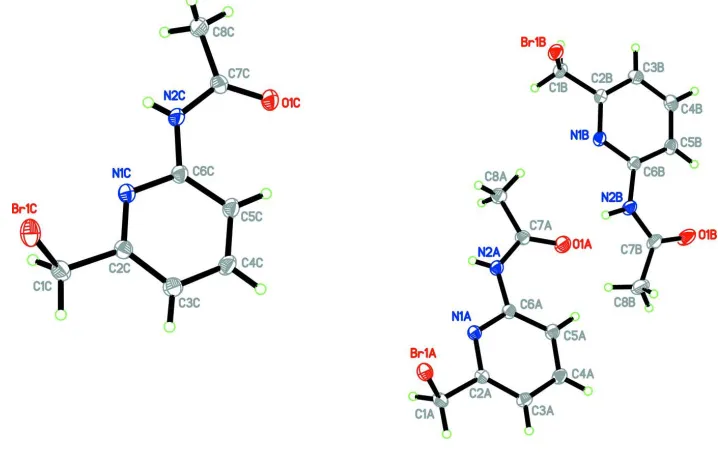
The title acetamide compound crystallizes in space group P21/c with three crystallographically independent molecules
in the asymmetric unit, designated A, B and C (Fig. 1). The molecular geometries of all molecules are essentially similar,
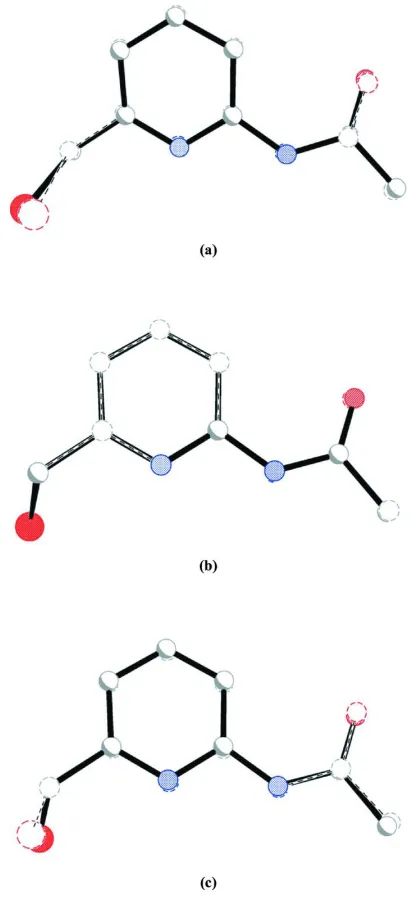
as indicated by the r.m.s. deviations for the superposition of the non-H atoms of any pair of molecules using XP in
SHELXTL (Sheldrick, 2008) being 0.137 (A/B pair), 0.026 (A/C pair) and 0.130 Å (B/C pair). The superposition of
molecular pairs are shown in Fig. 2. The corresponding geometric parameters of the three molecules agree well with each
other. In molecule A, the mean plane formed through the acetamide moiety (N2A/C7A/C8A/O1A) is inclined at an
interplanar angle of 4.40 (11)° with the pyridine ring (C2A-C6A/N1A); the respective angles for molecules B and C are
10.31 (2) and 2.27 (11)°, respectively.
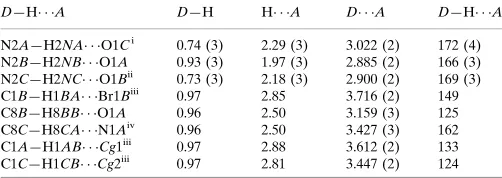
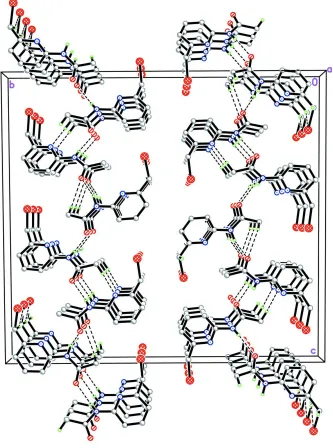
In the crystal structure, intermolecular N2A—H2NA···O1C, N2B—H2NB···O1A, N2C—H2NC···O1B, C1B—
H1BA···Br1B, C8B—H8BB···O1A and C8C—H8CA···N1A hydrogen bonds (Table 1) interconnect molecules into
two-molecule-wide arrays parallel to ac plane (Fig. 3). Further stabilization of the crystal structure is provided by weak
intermolecular C1A—H1AB···Cg1 and C1C—H1CB···Cg2 interactions (Table 1) where Cg1 and Cg2 are the centroids of
C2A-C6A/N1A and C2C-C6C/N1C pyridine rings, respectively.
S2. Experimental
The title compound was prepared according to literature procedures (Goswami et al., 2001, 2004) and was recrystallized
from a mixture of CHCl3 and CH3OH (9:1) by slow evaporation method.
S3. Refinement
H atoms bound to N atoms are located in a difference Fourier map and allowed to refine freely [range of N—H = 0.73
(3)–0.93 (3) Å]. The remaining H atoms were placed in their calculated positions, with C—H = 0.93–0.97 Å, and refined
Figure 1
The molecular structure of the title compound, showing 50% probability displacement ellipsoids for non-H atoms and the
Figure 2
Fit of (a) molecule A (dashed lines) on molecule B (solid lines), (b) molecule C (dashed lines) on molecule A (solid lines),
Figure 3
The crystal structure of the title compound, viewed along the a axis. Intermolecular hydrogen bonds are shown as dashed
lines.
N-(6-Bromomethyl-2-pyridyl)acetamide
Crystal data
C8H9BrN2O
Mr = 229.08
Monoclinic, P21/c
Hall symbol: -P 2ybc
a = 4.1894 (8) Å
b = 26.219 (5) Å
c = 23.817 (4) Å
β = 94.148 (4)°
V = 2609.2 (8) Å3
Z = 12
F(000) = 1368
Dx = 1.750 Mg m−3
Mo Kα radiation, λ = 0.71073 Å Cell parameters from 9903 reflections
θ = 3.0–33.5°
T = 100 K Plate, brown
0.31 × 0.14 × 0.09 mm
Data collection
Bruker APEXII DUO CCD area-detector diffractometer
Radiation source: fine-focus sealed tube Graphite monochromator
φ and ω scans
Absorption correction: multi-scan
(SADABS; Bruker, 2009)
Tmin = 0.323, Tmax = 0.668
72227 measured reflections 10228 independent reflections 8239 reflections with I > 2σ(I)
Rint = 0.058
θmax = 33.7°, θmin = 1.8°
h = −6→6
k = −40→40
l = −36→36
Refinement
Refinement on F2
Least-squares matrix: full
R[F2 > 2σ(F2)] = 0.033
wR(F2) = 0.100
S = 1.06
10228 reflections 340 parameters 0 restraints
Primary atom site location: structure-invariant direct methods
Secondary atom site location: difference Fourier map
Hydrogen site location: inferred from neighbouring sites
H atoms treated by a mixture of independent and constrained refinement
w = 1/[σ2(F
o2) + (0.052P)2 + 0.7624P]
where P = (Fo2 + 2Fc2)/3
(Δ/σ)max = 0.005
Δρmax = 1.37 e Å−3
Δρmin = −0.74 e Å−3
Special details
Experimental. The crystal was placed in the cold stream of an Oxford Cryosystems Cobra open-flow nitrogen cryostat (Cosier & Glazer, 1986) operating at 100.0 (1)K.
Geometry. All esds (except the esd in the dihedral angle between two l.s. planes) are estimated using the full covariance matrix. The cell esds are taken into account individually in the estimation of esds in distances, angles and torsion angles; correlations between esds in cell parameters are only used when they are defined by crystal symmetry. An approximate (isotropic) treatment of cell esds is used for estimating esds involving l.s. planes.
Refinement. Refinement of F2 against ALL reflections. The weighted R-factor wR and goodness of fit S are based on F2,
conventional R-factors R are based on F, with F set to zero for negative F2. The threshold expression of F2 > 2sigma(F2) is
used only for calculating R-factors(gt) etc. and is not relevant to the choice of reflections for refinement. R-factors based on F2 are statistically about twice as large as those based on F, and R- factors based on ALL data will be even larger.
Fractional atomic coordinates and isotropic or equivalent isotropic displacement parameters (Å2)
x y z Uiso*/Ueq
H8CC 0.8140 0.1999 0.8541 0.041* H2NA 1.062 (8) 0.2645 (13) 0.2303 (13) 0.045 (9)* H2NB 0.372 (8) 0.2135 (12) 0.0743 (12) 0.039 (8)* H2NC 0.850 (8) 0.2790 (12) 0.8879 (12) 0.033 (8)*
Atomic displacement parameters (Å2)
U11 U22 U33 U12 U13 U23
Geometric parameters (Å, º)
Br1A—C1A 1.9667 (18) C3B—C4B 1.389 (3)
O1A—C7A 1.224 (2) C3B—H3BA 0.93
N1A—C6A 1.335 (2) C4B—C5B 1.377 (3)
N1A—C2A 1.338 (2) C4B—H4BA 0.93
N2A—C7A 1.365 (2) C5B—C6B 1.404 (3)
N2A—C6A 1.391 (2) C5B—H5BA 0.93
N2A—H2NA 0.74 (3) C7B—C8B 1.501 (3)
C1A—C2A 1.498 (3) C8B—H8BA 0.96
C1A—H1AA 0.97 C8B—H8BB 0.96
C1A—H1AB 0.97 C8B—H8BC 0.96
C2A—C3A 1.387 (3) Br1C—C1C 1.968 (2) C3A—C4A 1.386 (3) O1C—C7C 1.233 (2)
C3A—H3AA 0.93 N1C—C6C 1.336 (2)
C4A—C5A 1.380 (3) N1C—C2C 1.338 (2)
C4A—H4AA 0.93 N2C—C7C 1.360 (2)
C5A—C6A 1.406 (2) N2C—C6C 1.392 (2)
C5A—H5AA 0.93 N2C—H2NC 0.73 (3)
C7A—C8A 1.494 (3) C1C—C2C 1.491 (3)
C8A—H8AA 0.96 C1C—H1CA 0.97
C8A—H8AB 0.96 C1C—H1CB 0.97
C8A—H8AC 0.96 C2C—C3C 1.382 (3)
Br1B—C1B 1.9722 (19) C3C—C4C 1.385 (3)
O1B—C7B 1.225 (2) C3C—H3CA 0.93
N1B—C2B 1.336 (2) C4C—C5C 1.380 (3)
N1B—C6B 1.338 (2) C4C—H4CA 0.93
N2B—C7B 1.360 (2) C5C—C6C 1.398 (2)
N2B—C6B 1.394 (2) C5C—H5CA 0.93
N2B—H2NB 0.93 (3) C7C—C8C 1.494 (3)
C1B—C2B 1.489 (3) C8C—H8CA 0.96
C1B—H1BA 0.97 C8C—H8CB 0.96
C1B—H1BB 0.97 C8C—H8CC 0.96
C2B—C3B 1.385 (3)
C4A—C3A—C2A 117.74 (17) H8BA—C8B—H8BB 109.5 C4A—C3A—H3AA 121.1 C7B—C8B—H8BC 109.5 C2A—C3A—H3AA 121.1 H8BA—C8B—H8BC 109.5 C5A—C4A—C3A 120.55 (17) H8BB—C8B—H8BC 109.5 C5A—C4A—H4AA 119.7 C6C—N1C—C2C 118.06 (16) C3A—C4A—H4AA 119.7 C7C—N2C—C6C 129.32 (16) C4A—C5A—C6A 117.35 (17) C7C—N2C—H2NC 109 (2) C4A—C5A—H5AA 121.3 C6C—N2C—H2NC 121 (2) C6A—C5A—H5AA 121.3 C2C—C1C—Br1C 111.62 (13) N1A—C6A—N2A 112.72 (16) C2C—C1C—H1CA 109.3 N1A—C6A—C5A 122.82 (17) Br1C—C1C—H1CA 109.3 N2A—C6A—C5A 124.46 (16) C2C—C1C—H1CB 109.3 O1A—C7A—N2A 122.80 (18) Br1C—C1C—H1CB 109.3 O1A—C7A—C8A 122.20 (17) H1CA—C1C—H1CB 108.0 N2A—C7A—C8A 114.99 (17) N1C—C2C—C3C 123.20 (17) C7A—C8A—H8AA 109.5 N1C—C2C—C1C 115.60 (16) C7A—C8A—H8AB 109.5 C3C—C2C—C1C 121.18 (17) H8AA—C8A—H8AB 109.5 C2C—C3C—C4C 117.81 (18) C7A—C8A—H8AC 109.5 C2C—C3C—H3CA 121.1 H8AA—C8A—H8AC 109.5 C4C—C3C—H3CA 121.1 H8AB—C8A—H8AC 109.5 C5C—C4C—C3C 120.48 (17) C2B—N1B—C6B 118.02 (16) C5C—C4C—H4CA 119.8 C7B—N2B—C6B 127.83 (16) C3C—C4C—H4CA 119.8 C7B—N2B—H2NB 115.3 (19) C4C—C5C—C6C 117.26 (17) C6B—N2B—H2NB 116.8 (19) C4C—C5C—H5CA 121.4 C2B—C1B—Br1B 111.85 (13) C6C—C5C—H5CA 121.4 C2B—C1B—H1BA 109.2 N1C—C6C—N2C 112.20 (16) Br1B—C1B—H1BA 109.2 N1C—C6C—C5C 123.19 (17) C2B—C1B—H1BB 109.2 N2C—C6C—C5C 124.62 (16) Br1B—C1B—H1BB 109.2 O1C—C7C—N2C 123.35 (18) H1BA—C1B—H1BB 107.9 O1C—C7C—C8C 122.47 (17) N1B—C2B—C3B 123.66 (17) N2C—C7C—C8C 114.18 (16) N1B—C2B—C1B 115.86 (16) C7C—C8C—H8CA 109.5 C3B—C2B—C1B 120.41 (17) C7C—C8C—H8CB 109.5 C2B—C3B—C4B 117.55 (18) H8CA—C8C—H8CB 109.5 C2B—C3B—H3BA 121.2 C7C—C8C—H8CC 109.5 C4B—C3B—H3BA 121.2 H8CA—C8C—H8CC 109.5 C5B—C4B—C3B 120.29 (18) H8CB—C8C—H8CC 109.5
C2A—N1A—C6A—C5A 0.0 (3) C6C—N1C—C2C—C1C −178.23 (17) C7A—N2A—C6A—N1A 178.45 (19) Br1C—C1C—C2C—N1C −73.37 (19) C7A—N2A—C6A—C5A −1.9 (3) Br1C—C1C—C2C—C3C 108.44 (18) C4A—C5A—C6A—N1A −0.2 (3) N1C—C2C—C3C—C4C −0.4 (3) C4A—C5A—C6A—N2A −179.84 (18) C1C—C2C—C3C—C4C 177.65 (18) C6A—N2A—C7A—O1A −2.9 (3) C2C—C3C—C4C—C5C 0.6 (3) C6A—N2A—C7A—C8A 176.72 (18) C3C—C4C—C5C—C6C −0.3 (3) C6B—N1B—C2B—C3B −0.4 (3) C2C—N1C—C6C—N2C −179.58 (17) C6B—N1B—C2B—C1B 176.64 (16) C2C—N1C—C6C—C5C 0.4 (3) Br1B—C1B—C2B—N1B 78.77 (19) C7C—N2C—C6C—N1C 178.90 (19) Br1B—C1B—C2B—C3B −104.14 (18) C7C—N2C—C6C—C5C −1.1 (3) N1B—C2B—C3B—C4B 0.2 (3) C4C—C5C—C6C—N1C −0.2 (3) C1B—C2B—C3B—C4B −176.68 (17) C4C—C5C—C6C—N2C 179.76 (19) C2B—C3B—C4B—C5B 0.3 (3) C6C—N2C—C7C—O1C −1.6 (3) C3B—C4B—C5B—C6B −0.5 (3) C6C—N2C—C7C—C8C 178.7 (2)
Hydrogen-bond geometry (Å, º)
Cg1 and Cg2 are the centroids of the C2A–C6A/N1A and C2C–C6C/N1C pyridine rings, respectively.
D—H···A D—H H···A D···A D—H···A
N2A—H2NA···O1Ci 0.74 (3) 2.29 (3) 3.022 (2) 172 (4)
N2B—H2NB···O1A 0.93 (3) 1.97 (3) 2.885 (2) 166 (3) N2C—H2NC···O1Bii 0.73 (3) 2.18 (3) 2.900 (2) 169 (3)
C1B—H1BA···Br1Biii 0.97 2.85 3.716 (2) 149
C8B—H8BB···O1A 0.96 2.50 3.159 (3) 125 C8C—H8CA···N1Aiv 0.96 2.50 3.427 (3) 162
C1A—H1AB···Cg1iii 0.97 2.88 3.612 (2) 133
C1C—H1CB···Cg2iii 0.97 2.81 3.447 (2) 124