Khanet al. Journal of Cloud Computing: Advances, Systems and Applications2014,3:14 http://www.journalofcloudcomputing.com/content/3/1/14
R E S E A R C H
Open Access
A framework for cloud-based context-aware
information services for citizens in smart cities
Zaheer Khan
1*, Saad Liaquat Kiani
2and Kamran Soomro
1Abstract
Background: In the context of smart cities, public participation and citizen science are key ingredients for informed and intelligent planning decisions and policy-making. However, citizens face a practical challenge in formulating coherent information sets from the large volumes of data available to them. These large data volumes materialise due to the increased utilisation of information and communication technologies in urban settings and local authorities’ reliance on such technologies to govern urban settlements efficiently. To encourage effective public participation in urban governance of smart cities, the public needs to be facilitated with the right contextual information about the characteristics and processes of their urban surroundings in order to contribute to the aspects of urban governance that affect them such as socio-economic activities, quality of life, citizens well-being etc. The cities on the other hand face challenges in terms of crowd sourcing with quality data collection and standardisation, services inter-operability, provisioning of computational and data storage infrastructure.
Focus: In this paper, we highlight the issues that give rise to these multi-faceted challenges for citizens and public administrations of smart cities, identify the artefacts and stakeholders involved at both ends of the spectrum (data/service producers and consumers) and propose a conceptual framework to address these challenges. Based upon this conceptual framework, we present a Cloud-based architecture for context-aware citizen services for smart cities and discuss the components of the architecture through a common smart city scenario. A proof of concept implementation of the proposed architecture is also presented and evaluated. The results show the effectiveness of the cloud-based infrastructure for the development of a contextual service for citizens.
Keywords: Smart cities; Citizen services; Context-awareness; Cloud computing; Public awareness; Decision-making
Introduction
A smart city [1-4] attempts to make the best use of inno-vative ICT solutions to manage urban issues related to mobility, people, economy, security, public health, envi-ronment and resource management, etc. With continuous increase in urban population, the need to plan and imple-ment smart city solutions for better urban governance is becoming more evident. These solutions are driven, on the one hand, by innovations in ICT and, on the other hand, to increase the capability and capacity of cities to mitigate environmental, social inclusion, economic growth and sustainable development challenges. In this respect, citizens’ science or public participation provides
*Correspondence: [email protected]
1Centre for Complex Cooperative Systems, Faculty of Environment And Technology, University of the West of England, Coldharbour Lane, BS16 1QY Bristol, UK
Full list of author information is available at the end of the article
a key input for informed and intelligent planning deci-sion and policy-making. However, the challenge here is to facilitate public in acquiring the right contextual infor-mation in order to be more productive, innovative and be able to make appropriate decisions which impact on their well being, in particular, and economic and environ-mental sustainability in general. Meeting such a challenge requires contemporary ICT solutions, such as using Cloud computing. Use of elastic Cloud resources enable these solutions to store and process significant amount of data and produce intelligent contextual information with high quality of service. However, processing, utilising and visu-alising contextual information in a Cloud environment require tailored mechanisms for user profiling and con-textual segregation of data that could be used in different applications of a smart city.
Smart cities include several applications where socio-technical interaction between citizens and pervasive
Khanet al. Journal of Cloud Computing: Advances, Systems and Applications2014,3:14 Page 2 of 17 http://www.journalofcloudcomputing.com/content/3/1/14
devices a.k.a. Internet of Things (IoT) is often needed [5-7]. A continuous monitoring of these interactions can provide: i) evidence based urban planning, policy-making and collaborative decision making support, and ii) raise situational and environmental awareness that can eventu-ally result in behavioural change based on the information of citizens daily life usage of these interconnected devices. Furthermore, these IoT can also facilitate environmental data gathering in order to mitigate environmental chal-lenges. For instance, environmental sensors can perva-sively collect data from the environment e.g. noise and air quality. Similarly, citizens can participate in environmen-tal data collection and dissemination using smart phones or through social networking sites, resulting in promot-ing the concept of citizen science. Other crowd sourcpromot-ing applications can be highly useful in emergency response (e.g. flood, accident), traffic management (e.g. gridlock on a busy motorway), quality of life surveys etc. How-ever, such monitoring, citizen’s engagement, information processing, visualisation and decision making require suf-ficient computing infrastructures and attached resources for data storage and real-time processing.
The need for such resources becomes more evident when a city is considered as a single unit dealing col-lectively with challenges related to environment, socio-economic, security, health and well-being of citizens,
education and public services. These multi-spectrum challenges necessitate cross-thematic data harmonisation, integration and coordination between various departmen-tal boundaries in order to monitor and model future smart cities. For instance, cities face challenges of urbanisation, and it is expected that by 2020 up to 80% of population will be living in cities [8], that puts enormous pressure on the limited municipal resources. It also becomes challenging for ICT to manage such monitoring, support smart plan-ning and facilitate better governance for socio-economic growth and sustainable urban development. Such a sys-tem requires large storage and processing power in order to capture, store, process and generate required necessary real-time information to end users. Cloud computing [9] has the potential to manage this monitoring challenge and can provide the necessary storage and computing facil-ities at comparable costs [10]. For example, Komninos et al. [11] review technologies for smart cities by introduc-ing a short to long-term roadmap towards smart cities. In addition to Cloud computing, other complementary technologies include future internet, analysis and visual-isation tools, sensors, RFIDs, semantic web, linked data and ontologies for smart cities [11].
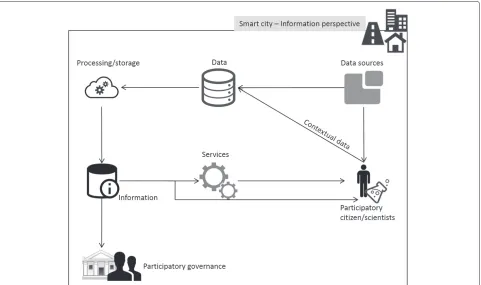
[image:2.595.59.540.417.702.2]Figure 1 illustrates an information perspective within smart cities. It highlights the dependencies between cit-izens, data, ICT tools, utilisation and provisioning of
Khanet al. Journal of Cloud Computing: Advances, Systems and Applications2014,3:14 Page 3 of 17 http://www.journalofcloudcomputing.com/content/3/1/14
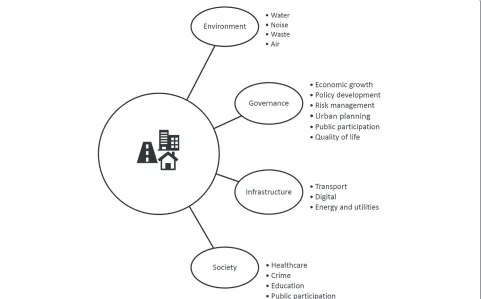
municipal services, and effectively supporting participa-tory governance. Figure 2 illustrates a number of pertinent smart cities issues that affect sustainable development of the city. With respect to public participation, citizens can perform two roles: i) act as information recipients for bet-ter awareness of their surroundings, and ii) data collectors. As information recipients, context-aware information availability can help citizens to make informed decisions in their daily life. For example, knowing the air quality at a specific location can be useful for taking necessary precautions for citizens with respiratory issues. As data collectors, participatory sensing can help in collecting environmental or other data (e.g. quality of surroundings such as offices and parks) that otherwise is either difficult or expensive to collect and manage. Citizens may not need to collect the data all the time and at different locations (e.g. when travelling) and only need to receive informa-tion that is more related to their profile and situainforma-tional needs. Such a requirement, on the one hand, reduces the amount of data to be captured and processed. On the other hand, new filtering and computational services need to be developed in order to fulfil this requirement. In this regard, smart city based context-aware services [12] for citizens can help them to better use their environ-ment by getting awareness about their surroundings and
available services. However, using Clouds and developing context-aware user services for participatory monitoring to support better decision making is not straightforward and raises several research, development, deployment and adoption related challenges such as user profiling and security, data and information segregation, processing and storage.
[image:3.595.59.540.413.712.2]In this paper, we discuss related issues of data and computation infrastructure and context-awareness and present related work in the ‘Context-awareness, data and computational infrastructure requirements’ section. Thereafter in the section ‘Conceptual framework for cloud-based context-aware services’, we propose a con-ceptual framework that provides a roadmap establishing the basis for the development of an integrated Cloud-based architecture for context-aware user services, which is then elaborated further in the section titled ‘Proposed architecture’. Furthermore, we showcase a hypothetical example using Bristol Open Data [13] in order to walk-through the proposed Cloud based architecture for smart cities in the section ‘Use case and discussion’. In ‘Proof of the concept’, we present a proof of concept implemen-tation of the proposed architecture along with evaluation and discussion. Finally, we conclude in the ‘Conclusion and future work’ section.
Khanet al. Journal of Cloud Computing: Advances, Systems and Applications2014,3:14 Page 4 of 17 http://www.journalofcloudcomputing.com/content/3/1/14
Context-awareness, data and computational infrastructure requirements
As discussed earlier, communication and information ser-vices provided by ICT bring smart aspect to the manage-ment of cities by transforming data into useful knowledge and actionable information. The challenge in realisation of smart cities through ICT lies in the integration of data from disparate sources and processing into useful infor-mation delivered through services, consumed by citizens and public administrations. This challenge has different dimensions including the collection of huge amounts of data, the aggregation of data in various formats, rele-vance of such data to practical problems and scenarios, analysis of the data to deduce useful information and visualisation, and management of the historic and ever-increasing sets of such data. Addressing these challenges require a multipronged approach involving standardis-ation of data formats, data harmonisstandardis-ation mechanisms, computational processing and storage infrastructure and mechanisms to ascertain contextual relevance of the data with its consumers.
The sources of data related to urban environments con-tinue to increase, ranging from data gathering services and sensing platforms deployed by administrative authorities to data gathered by/from the citizens through partici-patory and opportunistic sensing mechanisms. However, the absence of a common and standardised platform for collection, storage and utilisation of such data for col-lection, analysis and dissemination of such data severely curtails the prospects of information and services that can be developed and benefit the smart city themed infras-tructures. Hence the foremost requirement for realising holistic smart city related information services by and for wide-spectrum entities (citizens, governments, private enterprises) is to agree and utilise common, standard and inter-operable data formats.
An important qualitative provisioning of ICT for smart cities is the inclusive governance by informed citizens through participation i.e. an aspect of citizen science that allows their participation in information collection as well as information utilisation. Citizens are likely to be better informed and engaged if the services they con-sume relate to their social and environmental context. Context-awareness, which is an established discipline in the computer science and human-computer interaction domains, is thus pertinent to the employment of ICT in smart cities. However, integration of such contextual information is not straightforward due to a number of fac-tors. These include the availability of relevant contextual information, heterogeneity of information that is avail-able, inter-linking different types of context from possibly different sources, aggregating independently sourced con-textual information to infer higher-order context about citizens and environments.
The provisioning of context-aware services also depends on the seamless integration of data collection, processing and dissemination systems whose challenges we have dis-cussed in the earlier sections. Such technology integration to develop comprehensive smart city platforms is one of the primary objectives of the European Innovation Part-nership that is endeavouring to catalyse progress in this area [14]. Situation and contextual association of data to their pertinent environmental and human artefacts exists and not only in the raw state of the data (e.g. when it is collected by a sensor node), but also continues to asso-ciate as data are aggregated and synthesised into higher level information sets (e.g. by combining multiple data val-ues and inferring higher complex informational concepts about the environment). Therefore, any data formats, data collection mechanisms and information processing steps should continue to retain and extend contextual charac-teristics of aggregated data as it moves vertically from raw state towards its manifestation as complex, serviceable information.
The requirements of data collection, aggregation, repre-sentation formats and contextual annotation hint towards another requirement of a resourceful and scalable com-putational infrastructure. Cloud computing – based on the concepts of converged infrastructure and shared ser-vices – can be utilised to address some of the challenges in this domain, primarily those related to the collec-tion, storage and processing of the urban domain data. Cloud computing is ideally placed to provide infrastruc-tural support for meeting the smart city domain challenge through its key characteristics of reliability, scalability, performance and cost effectiveness. Most importantly, utilising a cloud computing infrastructure for smart city related data collection, processing and service delivery can remove the burden of computational infrastructure management and administration from a single entity (e.g. a city government). It also reduces the risk of increas-ing heterogeneity, which is likely to set in when different stakeholders utilise their own computation infrastruc-ture for data collection and processing related activities. There is an industry-wide push towards providing Cloud-based smart city solutions [15] and we are beginning to see prototype implementations at various early adopter cities [16].
Khanet al. Journal of Cloud Computing: Advances, Systems and Applications2014,3:14 Page 5 of 17 http://www.journalofcloudcomputing.com/content/3/1/14
[19]. In a cloud-based setting data is vulnerable to cyber attacks. As more and more users are storing sensitive data online, privacy becomes a legitimate concern in these set-tings. Hamza et al. investigate privacy concerns in cloud-based user data by utilising their sharing context [20]. Paelke et al. have proposed a solution that gathers geo-referenced contextual information from public sources such as Wikipedia [21]. This information is rendered as a tag-cloud and presented to users to increase their aware-ness about their spatial context. In short, utilising context in cloud-based systems is an active research area with many interested parties.
The issues and requirements discussed above are spread across a range of areas and addressing these holisti-cally requires a bottom up approach that considers the individual artefacts affected by these issues. These arte-facts, e.g. data/process models, context models, services, infrastructure, and their subcomponents may have dif-ferent objectives, roles, stakeholder association and util-ity. In order to develop a computational architecture for enabling citizen participation in smart cities and delivering contextual information services, we need to categorise and understand these artefacts, their charac-teristics and inter-relationships. We describe a conceptual framework in the following section to elaborate this point further.
Conceptual framework for cloud-based context-aware services
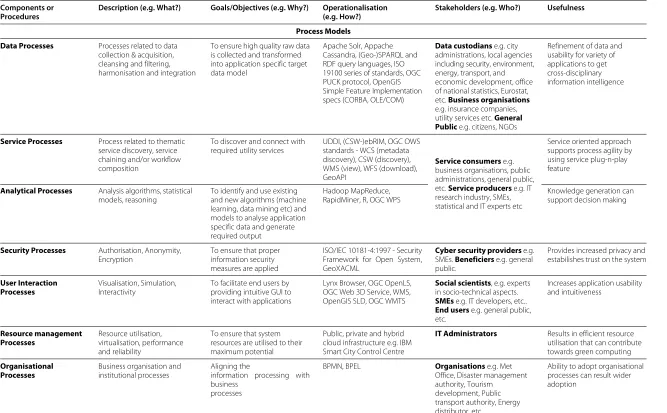
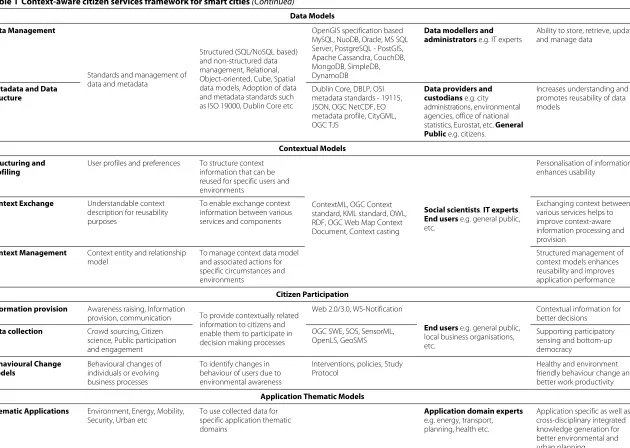
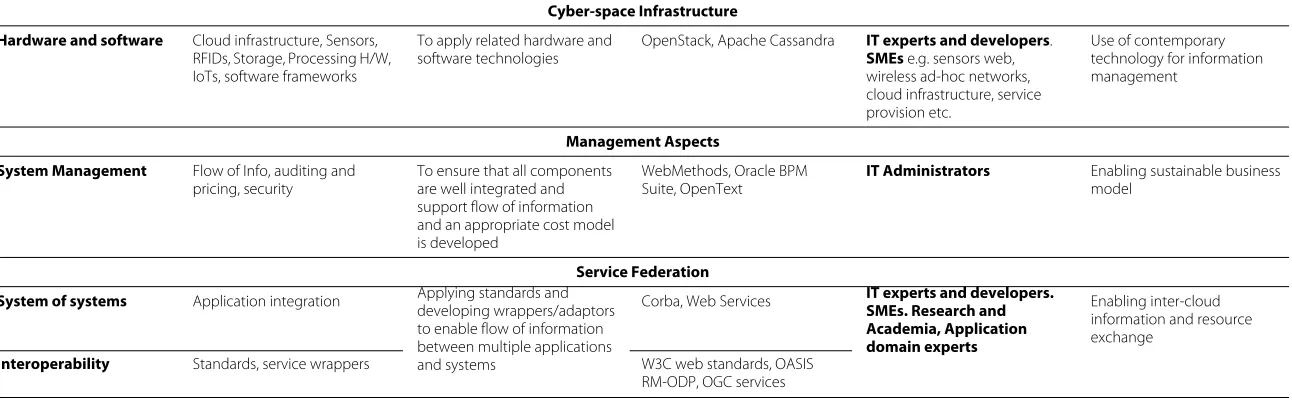
The motivation behind introducing the framework is to develop a roadmap for the development of cloud-based context aware services for citizens of smart cities. The framework attempts to establish the what, why, how and who characteristics of the relevant artefacts and associ-ated components or procedures. The artefacts are the main building blocks for the development of cloud-based context aware services architecture (discussed later). The artefacts include process models, data models, contextual models, citizen participation, application thematic mod-els, cyberspace infrastructure, management aspects and service federation. The description (i.e. what), goals and objectives (i.e. why) of these artefacts briefly explain their purpose. In addition, various standards and technologies are identified to exemplify how these artefacts can be operationalised and who can be the potential stakehold-ers. The framework, explained in Table 1, also briefly describes the usefulness of the artefacts.
The framework is generic in a sense that various arte-facts, components, standards and technologies can be applied (as platform-as-a-service or software-as-a-service model) depending on the need of different applications. Also, it is flexible to accommodate new artefacts and procedures and include new technologies and standards for various stakeholders. For example, the contextual
models artefact consists of three components structur-ing and profilstructur-ing, context exchange and context manage-ment. These components contribute in developing user preference profiles, structuring and managing contextual information and associated actions to provide neces-sary information to end users. In the next section, we attempt to operationalise the above framework by devel-oping a layered architecture using different framework artefacts.
Proposed architecture
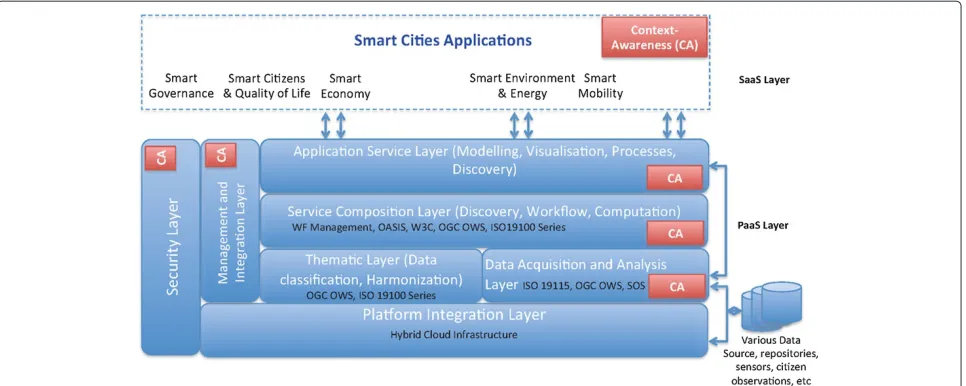
Khan et al. [10] presented the capabilities required in a Cloud environment to acquire integrated intelligence for urban management systems. These capabilities provide a sound foundation to respond to smart cities requirements by developing a context-aware component in a Cloud environment. Here we apply the proposed framework and adopt the Cloud-based layered architecture proposed in [10]. The layered architecture is extended by introduc-ing context-aware capabilities to respond to requirements of access to contextual information by citizens as well as data provision on demand basis, as depicted in Figure 3. The proposed architecture can be used to build either a platform-as-a-service or a software-as-a-service solution. For example, when it is used to build modelling service, then it becomes a platform-as-a-service solution on top of which other services can be built. When it is used to build a service that interacts directly with users, for example through visualisation, then it becomes a software-as-a-service solution. In ‘Proof of the concept’ section we present it as a software-as-a-service model.
The architecture depicted in Figure 3 consists primarily of five horizontal and two vertical layers. In our bottom up approach, the Platform Integration, Thematic and Data Acquisition and Analysis layers output generic data, which can be tailored to specific smart cities related application needs in the top three layers. One of the design prin-ciples here is to introduce context-aware components at different layers of the architecture in order to continually coordinate the vertical flow of data and retain or associate contextual information. Below we walkthrough the above architecture with the objective that how each layer con-tributes towards providing contextual information to end users for various purposes.
Khan et al. Journal o fC loud Computing: Advances, Systems and A pplications 2014, 3 :14 Page 6 o f 1 7 http://www.journalofcloudcomputing.com/content/3/1/14
Table 1 Context-aware citizen services framework for smart cities
Components or Procedures
Description (e.g. What?) Goals/Objectives (e.g. Why?) Operationalisation (e.g. How?)
Stakeholders (e.g. Who?) Usefulness
Process Models
Data Processes Processes related to data collection & acquisition, cleansing and filtering, harmonisation and integration
To ensure high quality raw data is collected and transformed into application specific target data model
Apache Solr, Appache Cassandra, (Geo-)SPARQL and RDF query languages, ISO 19100 series of standards, OGC PUCK protocol, OpenGIS Simple Feature Implementation specs (CORBA, OLE/COM)
Data custodianse.g. city administrations, local agencies including security, environment, energy, transport, and economic development, office of national statistics, Eurostat, etc.Business organisations
e.g. insurance companies, utility services etc.General Publice.g. citizens, NGOs
Refinement of data and usability for variety of applications to get cross-disciplinary information intelligence
Service Processes Process related to thematic service discovery, service chaining and/or workflow composition
To discover and connect with required utility services
UDDI, (CSW-)ebRIM, OGC OWS standards - WCS (metadata discovery), CSW (discovery), WMS (view), WFS (download), GeoAPI
Service consumerse.g. business organisations, public administrations, general public, etc.Service producerse.g. IT research industry, SMEs, statistical and IT experts etc
Service oriented approach supports process agility by using service plug-n-play feature
Analytical Processes Analysis algorithms, statistical models, reasoning
To identify and use existing and new algorithms (machine learning, data mining etc) and models to analyse application specific data and generate required output
Hadoop MapReduce, RapidMiner, R, OGC WPS
Knowledge generation can support decision making
Security Processes Authorisation, Anonymity, Encryption
To ensure that proper information security measures are applied
ISO/IEC 10181-4:1997 - Security Framework for Open System, GeoXACML
Cyber security providerse.g. SMEs.Beneficierse.g. general public.
Provides increased privacy and estabilishes trust on the system
User Interaction Processes
Visualisation, Simulation, Interactivity
To facilitate end users by providing intuitive GUI to interact with applications
Lynx Browser, OGC OpenLS, OGC Web 3D Service, WMS, OpenGIS SLD, OGC WMTS
Social scientists, e.g. experts in socio-technical aspects.
SMEse.g. IT developers, etc..
End userse.g. general public, etc.
Increases application usability and intuitiveness Resource management Processes Resource utilisation, virtualisation, performance and reliability
To ensure that system resources are utilised to their maximum potential
Public, private and hybrid cloud infrastructure e.g. IBM Smart City Control Centre
IT Administrators Results in efficient resource utilisation that can contribute towards green computing
Organisational Processes
Business organisation and institutional processes
Aligning the
information processing with business
processes
BPMN, BPEL Organisationse.g. Met
Office, Disaster management authority, Tourism
development, Public transport authority, Energy distributor, etc.
Khan et al. Journal o fC loud Computing: Advances, Systems and A pplications 2014, 3 :14 Page 7 o f 1 7 http://www.journalofcloudcomputing.com/content/3/1/14
Table 1 Context-aware citizen services framework for smart cities(Continued)
Data Models
Data Management
Standards and management of data and metadata
Structured (SQL/NoSQL based) and non-structured data management, Relational, Object-oriented, Cube, Spatial data models, Adoption of data and metadata standards such as ISO 19000, Dublin Core etc
OpenGIS specification based MySQL, NuoDB, Oracle, MS SQL Server, PostgreSQL - PostGIS, Apache Cassandra, CouchDB, MongoDB, SimpleDB, DynamoDB
Data modellers and administratorse.g. IT experts
Ability to store, retrieve, update and manage data
Metadata and Data structure
Dublin Core, DBLP, OSI metadata standards - 19115, JSON, OGC NetCDF, EO metadata profile, CityGML, OGC TJS
Data providers and custodianse.g. city administrations, environmental agencies, office of national statistics, Eurostat, etc.General Publice.g. citizens.
Increases understanding and promotes reusability of data models
Contextual Models
Structuring and Profiling
User profiles and preferences To structure context information that can be reused for specific users and environments
ContextML, OGC Context standard, KML standard, OWL, RDF, OGC Web Map Context Document, Context casting
Social scientists.IT experts.
End userse.g. general public, etc.
Personalisation of information enhances usability
Context Exchange Understandable context description for reusability purposes
To enable exchange context information between various services and components
Exchanging context between various services helps to improve context-aware information processing and provision
Context Management Context entity and relationship model
To manage context data model and associated actions for specific circumstances and environments
Structured management of context models enhances reusability and improves application performance
Citizen Participation
Information provision Awareness raising, Information
provision, communication To provide contextually related information to citizens and enable them to participate in decision making processes
Web 2.0/3.0, WS-Notification
End userse.g. general public, local business organisations, etc.
Contextual information for better decisions
Data collection Crowd sourcing, Citizen science, Public participation and engagement
OGC SWE, SOS, SensorML, OpenLS, GeoSMS
Supporting participatory sensing and bottom-up democracy
Behavioural Change models
Behavioural changes of individuals or evolving business processes
To identify changes in behaviour of users due to environmental awareness
Interventions, policies, Study Protocol
Healthy and environment friendly behaviour change and better work productivity
Application Thematic Models
Thematic Applications Environment, Energy, Mobility, Security, Urban etc
To use collected data for specific application thematic domains
Application domain experts
e.g. energy, transport, planning, health etc.
Khan
et
al.
Journal
o
fC
loud
Computing:
Advances,
Systems
and
A
pplications
2014,
3
:14
Page
8
o
f
1
7
[image:8.794.62.708.72.274.2]http://www.journalofcloudcomputing.com/content/3/1/14
Table 1 Context-aware citizen services framework for smart cities(Continued)
Cyber-space Infrastructure
Hardware and software Cloud infrastructure, Sensors, RFIDs, Storage, Processing H/W, IoTs, software frameworks
To apply related hardware and software technologies
OpenStack, Apache Cassandra IT experts and developers.
SMEse.g. sensors web, wireless ad-hoc networks, cloud infrastructure, service provision etc.
Use of contemporary technology for information management
Management Aspects
System Management Flow of Info, auditing and pricing, security
To ensure that all components are well integrated and support flow of information and an appropriate cost model is developed
WebMethods, Oracle BPM Suite, OpenText
IT Administrators Enabling sustainable business model
Service Federation
System of systems Application integration Applying standards and developing wrappers/adaptors to enable flow of information between multiple applications and systems
Corba, Web Services IT experts and developers.
SMEs. Research and Academia, Application domain experts
Enabling inter-cloud information and resource exchange
Interoperability Standards, service wrappers W3C web standards, OASIS
Khanet al. Journal of Cloud Computing: Advances, Systems and Applications2014,3:14 Page 9 of 17 http://www.journalofcloudcomputing.com/content/3/1/14
Figure 3Proposed architecture.Computation architecture for context-aware citizen services smart cities.
Sensor Observation Service [22], which provides the standardised APIs for managing deployed sensors and retrieving observation data is a suitable candidate for this role. The standard also includes provisions for specifying sensor metadata, both for existing and new sensors and can thus provide the necessary building blocks for acquiring contextual information about the sensors.
2. TheData Acquisition and Analysis layer allows collection of environmental data from various sources including remote database repositories, sensor nets, and citizens’ observations, e.g. using smart phones, in the Cloud environment. This layer also ensures the quality of data acquired and identifies the need for necessary data cleansing. A context-aware component is introduced here to filter out unrelated data and to perform quality check and harmonisation only to contextually related data. With respect to the sensed data format, Open GIS Sensor Modelling Language [22] is an established standard that caters for simple, aggregated and derived data concepts and supports multiple encodings (text, XML) as well. Other features that enable harvesting of contextual data from sensed observations include ability to encompass measurements about composite physical and non-physical processes, phenomena, temporal concepts and metadata information.
3. TheThematic layer classifies the acquired data into application specific thematic categories and performs data harmonisation and updates the data/service catalogues for further use of the data. The thematic categorisation of data, that is already contextually annotated, can help in its efficient and appropriate
utilisation by services and applications in the higher layers of the proposed architecture.
4. TheService Composition layer is required to design and specify service workflows, identify data sources, and link necessary processing components to enact the workflows that can constitute context-aware, citizen-specific services. Furthermore, necessary analytical analysis of the workflow outputs can be performed in this layer. This layer also ensures that the provenance of data and specific processes is maintained that can be utilised for analysis by different expert systems in the application layer. The context-aware component in this layer helps to utilise contextually related services for workflow composition and information generation.
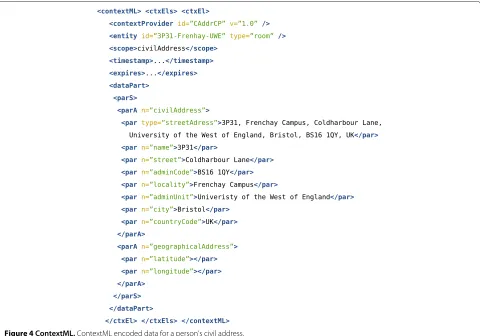
5. TheApplication Service layer uses the outcomes from the service composition layer in application domain specific tools such as simulations, smart phone apps and visual maps to perform contextual analysis for decision-making. Further, this layer enables stakeholders to use existing tools and develop new application domain specific components and services (at SaaS level) to satisfy contextual information needs of end users. User context can be modelled in a simple, extensible and machine readable context representation formats e.g. a civil address context snippet related to a person is shown in ContextML [23] format in Figure 4. This layer also supports participatory sensing applications for collection of new data from end users. For example, reporting of micro-criminalities in a neighbourhood using smart phone application. 6. TheManagement and Integration layer is used to
Khanet al. Journal of Cloud Computing: Advances, Systems and Applications2014,3:14 Page 10 of 17 http://www.journalofcloudcomputing.com/content/3/1/14
Figure 4ContextML.ContextML encoded data for a person’s civil address.
between the horizontal layers. It ensures that processed outputs from one layer to another are contextually related and syntactically correct. It also aims to handle change management that occurs at different layers and to reduce the extent to which the layered architecture requires management overhead. 7. TheSecurity layer ensures the necessary
authentication, authorisation and auditing for the use of data and services by legitimate users. Further, it ensures secure personalisation of end users services based on pre-defined preferences for processing and retrieval of contextual information from a Cloud environment.
Use case and discussion
The following discussion showcases a smart city scenario that can benefit from the architecture we have presented in the preceding section. Our premise rests on the impor-tance of smart city solutions for urban governance that involves citizens’ participation for their general wellbeing, city planning and decision-making. We consider citizens not as mere consumers of services offered in smart cities but highlight their inclusive role by acting as collectors
of data that informs the development and utilisation of such services. The issue in any such scenario is that the amount of data resulting from the efforts of public agen-cies that collect such data and contributions from citizens will overwhelm a conventional computing system due to initial and continually increasing storage and process-ing requirements and compromise quality of service. A Cloud computing based infrastructure that is designed with smart city themed services is well placed to address such issues.
Khanet al. Journal of Cloud Computing: Advances, Systems and Applications2014,3:14 Page 11 of 17 http://www.journalofcloudcomputing.com/content/3/1/14
[26], and hence are not reflected in the regional qual-ity of life records. We can present the use case where citizens, through our proposed architecture, can supple-ment the authoritative data by collection/submission of regional micro-crime statistics. This data then can be used to deliver informative services to the citizen for various purposes e.g. prototype scenario in next section.
1. Data sources and Platform Integration Layer
(a) One of the major sources of data is through Open Data Initiative e.g. UK Open Data [27]. Many city councils and public agencies have started to publish data in both raw and processed, visual format. For example, crime and safety data profile of a local authority e.g. Bristol city council (Bristol Open Data initiative [13]) is a collection of related statistical indicators and can be downloaded as well as viewed in an online visual atlas. Such data is useful for various stakeholders in making decisions such as buying a house in a specific area. However, the aggregated data here is covered at ward scale and hence makes it difficult to associate individual aspects of crimes and safety to a specific spatial coordinates such as smaller streets. The following option (b) complements data collection by associating different events and citizens’ perception to specific locations. The data storage and processing in performed in a cloud-based infrastructure to dynamically scale resource provisioning for citizens queries.
(b) User reported micro (and/or macro) security events or crimes e.g. through a desktop based visual interactive map or smartphone based application using GPS coordinates.
2. Data Acquisition and Analysis Layer
(a) The local authority collected data is imported into data repositories. The import process can be automated if data is in a standardised format e.g. compliant to Open Geospatial Consortium (OGC) OWS [28] and ISO 19000 Series on geospatial data standards [29]. Otherwise manual extraction, transformation and loading (ETL) process and conversion to standardised formats needs to be carried out. (b) Citizen submitted data, through smartphone
or desktop-based applications is also imported at this layer. A significant difference from local authority data is that this submission can benefit from collection of
user context at the time of submission e.g. location, time of submission, proximity to reported crime, relevance to supported crime (observer, witness) etc. This context
awareness augmentation can be built into the data submission tools used by the citizens. However, this approach may require additional data quality checks to improve accuracy and precision of the spatial data captured by citizens. Also, privacy concerns must be dealt by security layer.
3. Thematic Layer: The available data is harmonised and classified into specific thematic areas e.g. Crime & Safety class, ‘Bristol’ locality, temporal validity of 2001–2012 are examples of expected classification parameters. The INSPIRE data specificationsaplay a major role in harmonising spatial data and reusing at various spatial scales.
4. Service Composition Layer
(a) The collection, classification and
harmonisation of the aggregated data at the lower layers provide a platform for utilising the data into workflow definitions for service composition. For example, administrators can specify the data fields which can serve as querying parameters for analysis or trigger points that can be used for generating notifications. For the use case being
discussed here, these fields can be correlated with user context (through a user profile maintained in the ‘Management’ layer) such that applications can compare user
preferences and specified parameters e.g. crimes and offensives related to dog attacks, during the evenings, within the past year. (b) Similarly, further data aggregation and
analysis that can be carried out by using other data sources stored in the lower layers to generate datasets of higher complexity and granularity e.g. aggregating a crime profile with a ‘Child wellbeing’ profile [2] to link crimes or offences that can affect children including road accidents, dog attacks, fights, etc.
5. Application Service Layer: The services and applications at this layer build upon the data collected and aggregated with user context
Khanet al. Journal of Cloud Computing: Advances, Systems and Applications2014,3:14 Page 12 of 17 http://www.journalofcloudcomputing.com/content/3/1/14
triggers/notifications based on user context e.g. a user who frequents evening walks on a particular track may receive notifications of past and/or recent crimes in the vicinity of the track.
Proof of the concept
As a proof of concept we simulate a cloud-based imple-mentation of selected components of the proposed frame-work. The purpose is to demonstrate the effectiveness of cloud-based infrastructures to meet Quality-of-Service (QoS) requirements in an urban environment. Based on the above use case, consider the scenario where a user is passing through an area in Bristol. The user would like to buy a flat in this area or start a small business. Such a user would be interested in information about the qual-ity of life situation in that area (e.g. crime and safety, dog attacks, anti-social behaviour etc.). For this purpose, he opens up UrbanAwareness, a smart phone app pro-vided by the City Council for just such purposes. The user selects Crime and Safety from the list of choices available and the app sends a query to the Council’s servers along with contextual information; more specifically the coor-dinates of the user along with the data type preference. Moreover, the user also chooses to restrict the geograph-ical radius about which information is presented to him. This radial preference is also sent by the app as part of the contextual information. For this simulation, we have chosen to focus on the Broadmead area of Bristol City Centre.
The contextual query
The query is encoded in ContextML [23] and sent to the contextual service where it is processed and the results returned to the user. A sample contextual query is shown in Listing 1.
In addition to the location and the radius preference of the user, it also contains a timestamp and an expiry limit for the information. This ensures that the location infor-mation is considered invalid after a reasonable amount of time as the user may be moving around.
Processing the queries
Processing the query involves retrieving all data pertain-ing to the city centre from the database. The data con-sists of reported incidents along with their description, location and date of occurrence. The incidents are fil-tered according to the user’s preferences. In this case the Vincenty distance [30] from the user’s location to the loca-tion of each reported incident is calculated. All incidents that occurred outside of the user’s preferred radius are fil-tered. The remaining incidents are sent back to the mobile app, where they are visualised on a map and presented to the user.
Calculating the Vincenty distance between two points is a compute-intensive task. From the contextual service provider’s point-of-view, there may be many users issu-ing similar queries at the same time. For example, in a medium-sized city of 400,000 to 1 million inhabitants, it is not unreasonable to expect that 20,000 or more peo-ple may be using the UrbanAwareness app at any given time. Such a high volume of concurrent queries can eas-ily overload any desktop system, degrading the QoS. This is evidenced by the results shown in Figure 5. This figure depicts high execution times of such queries on a sin-gle compute node. In order to maintain an acceptable QoS, it may be desirable for the local council to process the queries concurrently on a cloud infrastructure. This prototype explores the efficacy of using such an infras-tructure. The methodology adopted involves measuring the net execution time when multiple concurrent queries
Listing 1Sample ContextML query
<contextML > < c t x E l s >
< c t x E l >
< e n t i t y i d = " j o h n " t y p e = " username " / > < s c o p e > l o c a t i o n < / s c o p e >
< timestamp >2014−02−08 T 1 6 : 2 1 : 2 0 +01 : 0 0 < / timestamp > < e x p i r e s >2014−02−08 T 1 6 : 2 6 : 2 0 +01 : 0 0 < / e x p i r e s > < d a t a P a r t >
< p a r n= " l a t i t u d e " > 5 2 . 2 8 1 5 7 1 < / p a r > < p a r n= " l o n g i t u d e " > 8 . 0 2 4 9 1 8 < / p a r > < p a r n= " r a d i u s " > 0 . 5 < / p a r >
Khanet al. Journal of Cloud Computing: Advances, Systems and Applications2014,3:14 Page 13 of 17 http://www.journalofcloudcomputing.com/content/3/1/14
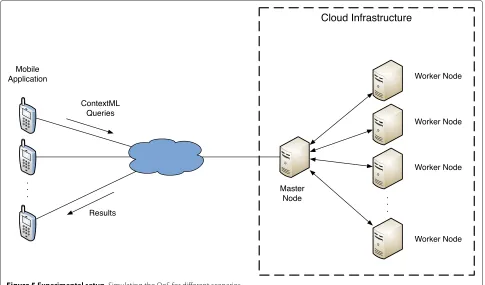
Figure 5Experimental setup.Simulating the QoS for different scenarios.
are issued and processed for an urban environment. A mapping between various stages in the prototype appli-cation to specific layers in the proposed architecture is shown in Table 2. The prototype, therefore, comprises a cloud-based software-as-a-service.
Experimental setup
The experimental setup is shown Figure 6. The mobile application sends a query to the cloud infrastructure via the internet. The infrastructure consists of a sin-gle master node that also acts as the scheduler. This node is responsible for receiving queries from the mobile applications and dispatching them to the worker nodes. It is also responsible for receiving the results and communicating them back to the mobile applica-tions. For these experiments actual crime data from the UK Police websiteb (http://www.police.uk/avon-and-somerset/BC192/crime/+osm1Dh/stats/) was used; in
Table 2 Mapping the prototype to the proposed architecture
Prototype stage Architecture layer
User interface Application service layer
Crime statistics retrieval Data acquisition and analysis layer
Data filtering Service composition layer
Simulated cloud infrastructure Platform integration later
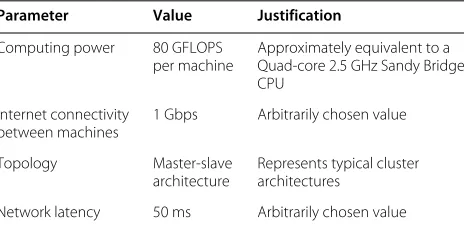
particular, data about all reported incidents within 1 mile of the Broadmead area. To simulate the cloud infrastruc-ture, the SimGrid toolkit was used [31]. It allows users to simulate execution of various kinds of jobs on dis-tributed cloud infrastructures. The infrastructure itself is described in terms of its topology, network connectivity
andcomputing power. To accurately simulate execution, a job is described using itscomputinganddata require-ments. The unit for computing power in SimGrid is Floating-Point Operations (FLOPS) and for data size is bytes. The parameters shown in Table 3 were used for the cloud infrastructure configuration.
To estimate the FLOPS required by a typical query of the previously-discussed nature, a sample query was implemented. This query took the user context, queried a database for reported criminal incidents and filtered the results based on the radial distance preference specified by the user. The FLOPS required by the application were then calculated using the following formula:
F=R×F×C×φ
whereF=FLOPS required by query
R=Runtime of query
F=CPU frequency in GHz
C=No of CPU cores
[image:13.595.56.291.653.730.2]Khanet al. Journal of Cloud Computing: Advances, Systems and Applications2014,3:14 Page 14 of 17 http://www.journalofcloudcomputing.com/content/3/1/14
0 500 1000 1500 2000 2500 3000
0 2000 4000 6000 8000 10000 12000 14000 16000 18000 20000
Execution time in seconds
No. of queries No. of nodes in cluster = 2
Radius = 0.5 miles
138.80 277.61
416.41 555.21
694.02 832.82
971.62 1110.43
1249.23 1388.03
1526.84 1665.64
1804.44 1943.25
2082.05 2220.85
2359.66 2498.46
[image:14.595.58.539.86.269.2]2637.26 2776.07
Figure 6Increasing number of queries and execution time in a two node cluster.
The prototype query was executed on a quad-core 2.2 GHz processor using the Sandy Bridge architecture [32]. To simplify the calculation, the query process was bound to a single CPU core. To the best of our knowledge, a CPU with the Sandy Bridge technology can perform 8 FLOPS per cycle per core. Based on this and the observed runtime of the query, it was calculated that each query requires approximately 11 GFLOPS to be executed when the user radius preference was set to 0.5 miles and approximately 13 GFLOPS for a radius preference of 1 mile. The numbers of required GFLOPS will significantly increase with larger sample area.
Results
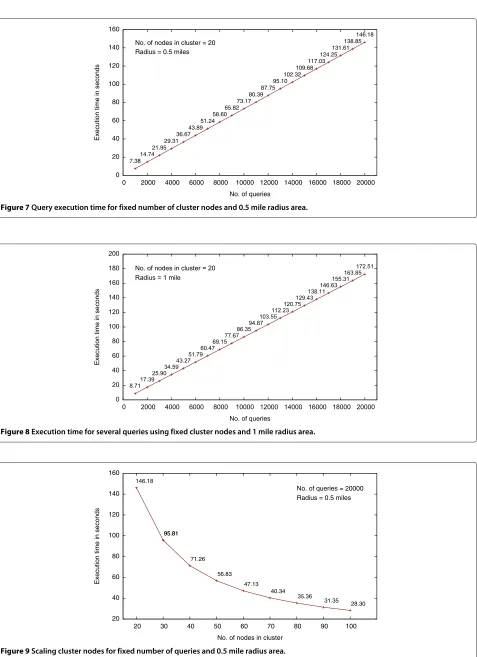
Using the aforementioned experimental setup, two sets of experiments were conducted. For both sets a sim-ple Round-Robin scheduler was imsim-plemented [33]. In one set, the number of queries being executed on the cloud infrastructure were varied and the results are shown in Figures 7 and 8. For this set of experiments, a virtual cluster of 20 nodes was used. As can be seen, there is a significant increase in execution time as the
Table 3 Configuration parameters for simulated cloud infrastructure
Parameter Value Justification
Computing power 80 GFLOPS Approximately equivalent to a per machine Quad-core 2.5 GHz Sandy Bridge
CPU
Internet connectivity 1 Gbps Arbitrarily chosen value between machines
Topology Master-slave Represents typical cluster
architecture architectures
Network latency 50 ms Arbitrarily chosen value
number of queries increases. Such a delay in getting results significantly deteriorates the QoS for users who may consider it unacceptable. In the other set the number of queries remained constant (20000) while the number of nodes in the infrastructure were varied. The results for this are shown in Figures 9 and 10. In this case a sharp decline in execution time is observable at first as the number of nodes is doubled. However, the rate of decline decreases as computing power increases. This is due to the fact that as the number of nodes increases in the cluster, the cost of scheduling the queries for exe-cution also increases. At a critical point (approximately at about 150 nodes), the time taken by the scheduler to schedule the first round of queries becomes greater than the time taken to execute a query. Therefore, at this point increasing worker nodes becomes meaningless since most of them sit idle for most of the time. Compared to these results, the relationship between total execution time and number of queries in the first set of experi-ments is linear because the number of nodes does not change. Thus, the scheduling time for the cluster remains constant, eliminating its influence.
[image:14.595.58.291.615.730.2]Khanet al. Journal of Cloud Computing: Advances, Systems and Applications2014,3:14 Page 15 of 17 http://www.journalofcloudcomputing.com/content/3/1/14
0 20 40 60 80 100 120 140 160
0 2000 4000 6000 8000 10000 12000 14000 16000 18000 20000
Execution time in seconds
No. of queries No. of nodes in cluster = 20
Radius = 0.5 miles
7.38 14.74
21.95 29.31
36.67 43.89
51.24 58.60
65.82 73.17
80.39 87.75
95.10 102.32
109.68 117.03
124.25 131.61
[image:15.595.63.540.69.726.2]138.85 146.18
Figure 7Query execution time for fixed number of cluster nodes and 0.5 mile radius area.
0 20 40 60 80 100 120 140 160 180 200
0 2000 4000 6000 8000 10000 12000 14000 16000 18000 20000
Execution time in seconds
No. of queries No. of nodes in cluster = 20
Radius = 1 mile
8.71 17.3925.90
34.5943.27 51.79
60.4769.15 77.6786.35
94.87103.55 112.23120.75
129.43 138.11146.63
[image:15.595.59.541.88.270.2]155.31163.85 172.51
Figure 8Execution time for several queries using fixed cluster nodes and 1 mile radius area.
20 40 60 80 100 120 140 160
20 30 40 50 60 70 80 90 100
Execution time in seconds
No. of nodes in cluster
No. of queries = 20000 Radius = 0.5 miles 146.18
95.81 95.81
71.26
56.83 47.13
40.34 35.36
31.35 28.30
[image:15.595.63.539.387.707.2]Khanet al. Journal of Cloud Computing: Advances, Systems and Applications2014,3:14 Page 16 of 17 http://www.journalofcloudcomputing.com/content/3/1/14
20 40 60 80 100 120 140 160 180
20 30 40 50 60 70 80 90 100
Execution time in seconds
No. of nodes in cluster
No. of queries = 20000 Radius = 1 mile 172.51
113.06 113.06
84.08
67.06
55.60 47.59
41.71 36.97
[image:16.595.58.539.87.267.2]33.38
Figure 10Query execution time in scaling cluster nodes for fixed number of queries.
Conclusion and future work
In this paper we have briefly presented a smart cities per-spective and argued that it necessitates myriad of complex interactions between its different applications to gener-ate intelligent information for smart urban governance. Further, we have proposed that Cloud computing can provide a suitable computing infrastructure for data stor-age and processing needs of smart cities applications. We also emphasise that, on one hand, end users e.g. citi-zens can collect data from their environment and, on the other hand, should be able to access contextual infor-mation from a smart cities based integrated inforinfor-mation system with reasonable quality of service. The contex-tual information presents necessary information to end users based on their predefined preferences but it requires additional processing for contextual data preparation and information visualisation. In this regard, we have pro-posed a cloud based context-aware service framework and architecture. The context-aware components enable data processing in a specific application context and facilitate application layer to correlate information based on end users preferences.
The use case indicates that citizens’ participation for quality of life and in particular crimes and safety related data collection can provide precise location informa-tion but is subject to data quality checks for accu-racy tolerance. This capability of the proposed system can be utilised to raise awareness about crime and safety situation of specific places but can also help in col-lecting data from citizens using smart phones and/or web-based interfaces. However, much concentration would be required to ensure data security and digital citizens’ privacy issues and QoS. Our proof-of-concept implementation of the proposed architecture indicates the effectiveness of cloud-based infrastructure for context-aware citizen services in smart cities. The prototype
results show that in order to meet increasing number of user queries cloud-based dynamic resource provi-sioning can satisfy required QoS requirement. This is true especially when more citizens participate and/or area of interest for querying is enlarged (e.g. 1 to 10 miles). Our future work aims to develop a participa-tory application for data collection using sensors and smart phones and information provisioning using an open cloud-based infrastructure.
Endnotes
aINSPIRE Themes - Annexes: http://inspire.jrc.ec.
europa.eu/index.cfm/pageid/2/list/7.
bContains public sector information licensed under
the Open Government Licence v2.0. (http://www. nationalarchives.gov.uk/doc/open-government-licence/ version/2/).
Competing interests
The authors declare that they have no competing interests.
Authors’ contributions
ZK and SLK carried out the research in identifying the scope of this research. ZK developed the case for smart cities and citizen participation and SLK integrated context-based information development. ZK introduced the generic contextual framework and SLK applied it to the proposed architecture. Both applied the proposed architecture on a smart city use case. KS and ZK derived a scenario for prototype application. KS designed, described, implemented and evaluated the proof-of-concept implementation. He also presented and analysed the results of the evaluation. All authors read and approved the final manuscript.
Author details
1Centre for Complex Cooperative Systems, Faculty of Environment And
Technology, University of the West of England, Coldharbour Lane, BS16 1QY Bristol, UK.2Department of Computer Science and Creative Technologies, Faculty of Environment And Technology, University of the West of England, Coldharbour Lane, BS16 1QY Bristol, UK.
Khanet al. Journal of Cloud Computing: Advances, Systems and Applications2014,3:14 Page 17 of 17 http://www.journalofcloudcomputing.com/content/3/1/14
References
1. Khan Z, Kiani SL (2012) A cloud-based architecture for citizen services in smart cities. In: Proceedings of the 2012 IEEE/ACM fifth international conference on utility and cloud computing. IEEE Computer Society, Washington, DC. pp 315–320
2. Ludlow D, Khan Z (2012) Participatory democracy and the governance of smart cities. In: Proceedings of the 26th annual AESOP congress, Ankara, Turkey
3. Suciu G, Vulpe A, Halunga S, Fratu O, Todoran G, Suciu V (2013) Smart cities built on resilient cloud computing and secure internet of things. In: Control Systems and Computer Science (CSCS), 2013 19th international conference on. IEEE. pp 513–518. http://ieeexplore.ieee.org/xpl/ articleDetails.jsp?arnumber=6569312
4. Naphade M, Banavar G, Harrison C, Paraszczak J, Morris R (2011) Smarter cities and their innovation challenges. Computer 44(6):32–39 5. Mitton N, Papavassiliou S, Puliafito A, Trivedi KS (2012) Combining cloud
and sensors in a smart city environment. EURASIP J Wireless Commun Netw 1:1–10
6. Gubbi J, Buyya R, Marusic S, Palaniswami M (2013) Internet of things (iot): a vision, architectural elements, and future directions. Future Generat Comput Syst 29(7):1645–1660. Elsevier Science Publishers B. V. Amsterdam, The Netherlands
7. Bandyopadhyay D, Sen J (2011) Internet of things: applications and challenges in technology and standardization. Wireless Pers Comm 58(1):49–69
8. European Environment Agency (2006) Urban sprawl in Europe, the ignored challenge. Technical report, ISBN: 92-9167-887-2, EEA and OPOCE. European Commission. http://www.eea.europa.eu/publications/ eea_report_2006_10
9. Furht B, Escalante A (2010) Handbook of cloud computing. Springer, New York
10. Khan Z, Ludlow D, McClatchey R, Anjum A (2012) An architecture for integrated intelligence in urban management using cloud computing. J Cloud Comput 1(1):1–14
11. Komninos N, Schaffers H, Pallot M (2011) Developing a policy roadmap for smart cities and the future internet. In: eChallenges E-2011 conference proceedings, Paul Cunningham and Miriam Cunningham (Eds). IIMC International Information Management Corporation Ltd 2011. http://www.urenio.org/wp-content/uploads/2008/11/2011-eChallenges_ref_196-Roadmap-for-Smart-Cities-Publised.pdf 12. Meier R, Lee D (2011) Context-aware pervasive services for smart cities.
Ubiquitous developments in ambient computing and intelligence: human-centered applications. IGI Global, pp 1–6. http://www.igi-global. com/book/ubiquitous-developments-ambient-computing-intelligence/ 45968
13. Bristol City Council GIS Support team (2014) Bristol data profiles. http://profiles.bristol.gov.uk. Accessed 06 Sept 2014
14. European Innovation Partnership (2012) Communication from the commission - smart cities and communities. Technical Report C (2012). 4701 final, European Commission. http://ec.europa.eu/energy/ technology/initiatives/doc/2012_4701_smart_cities_en.pdf 15. Naccarati F, Hobson S (2011) IBM Smarter City Solutions on Cloud.
http://public.dhe.ibm.com/common/ssi/ecm/en/giw03021usen/ GIW03021USEN.PDF. Accessed 06 Sept 2014
16. IBM (2012) IBM Intelligent Operations Center for Smarter Cities. http://public.dhe.ibm.com/common/ssi/ecm/en/gvs03044usen/ GVS03044USEN.PDF. Accessed 06 Sept 2014
17. La HJ, Kim SD (2010) A conceptual framework for provisioning context-aware mobile cloud services. In: Cloud Computing (CLOUD), 2010 IEEE 3rd international conference on. IEEE. pp 466–473. http:// ieeexplore.ieee.org/xpl/articleDetails.jsp?arnumber=5557960
18. Kiani S, Anjum A, Antonopoulos N, Munir K, McClatchey R (2012) Context caches in the clouds. J Cloud Comput Adv Syst Appl 1(1):7
19. Kiani S, Anjum A, Antonopoulos N, Knappmeyer M (2014) Context-aware service utilisation in the clouds and energy conservation. J Ambient Intell Humanized Comput 5(1):111–131
20. Harkous H, Rahman R, Aberer K (2014) C3P: Context-Aware Crowdsourced Cloud Privacy. In: 14th Privacy Enhancing Technologies Symposium (PETS 2014). Springer International Publishing, Switzerland
21. Paelke V, Dahinden T, Eggert D, Mondzech J (2012) Location based context awareness through tag-cloud visualizations. Adv Geo-Spatial Inf Sci 10:265
22. Botts M, Percivall G, Reed C, Davidson J (2008) OGC® sensor web enablement: overview and high level architecture. In: GeoSensor Networks. Springer, New York. pp 175–190
23. Knappmeyer M, Kiani SL, Frà C, Moltchanov B, Baker N (2010) ContextML: a light-weight context representation and context management schema. In: Wireless Pervasive Computing (ISWPC), 2010 5th IEEE International Symposium On. IEEE, Modena, Italy. pp 367–372. http://ieeexplore.ieee. org/xpl/articleDetails.jsp?arnumber=5483753
24. Van Dijk J, Manchin R, van Kesteren J, Nevala S, Hideg G (2005) The burden of crime in the EU, A Comparative Analysis of the European Survey of Crime and Safety, EUICS Report. Gallup Europe:126. http:// vorige.nrc.nl/redactie/binnenland/Misdaad.pdf
25. Keller W, Weinrich M (2004) Insecurities in European cities: crime-related fears within the context of new anxieties and community-based crime prevention. Final report HPSE-CT-2001-00052. DG Research, European Commission. Office for Official Publications of the European
Communities, Luxembourg. p 152. http://cordis.europa.eu/documents/ documentlibrary/100124091EN6.pdf
26. Nyiri Z (2005) Crime and security in European capitals. European Union International Crime Survey (EU ICS) Consortium. Research papers, Gallup Europe. pages 7
27. Shadbolt N, O’Hara K, Berners-Lee T, Gibbins N, Glasser H, Hall W, Schraefel MC (2012) Linked open government data: lessons from data. gov. uk. IEEE Intell Syst 27(3):16–24
28. Open Geospatial Consortium Inc. (2014) OGC Web Services Common Standard. http://www.opengeospatial.org/. Accessed 06 Sept 2014 29. Zarazaga-Soria FJ, Muro-Medrano PR (2005) Geographic information
metadata for spatial data infrastructures: resources, interoperability and information retrieval. Springer, New York
30. Vincenty T (1975) Direct and inverse solutions of geodesics on the ellipsoid with application of nested equations. Surv Rev 23(176):88–93
31. Casanova H (2001) SimGrid: a toolkit for the simulation of application scheduling. In: cluster computing and the grid, 2001. Proceedings. First IEEE/ACM international symposium on. IEEE. pp 430–437. http:// ieeexplore.ieee.org/xpl/articleDetails.jsp?arnumber=923223 32. Yuffe M, Knoll E, Mehalel M, Shor J, Kurts T (2011) A fully integrated
multi-cpu, gpu and memory controller 32nm processor. In: Solid-State Circuits Conference digest of technical papers (ISSCC) 2011. IEEE. pp 264–266. http://ieeexplore.ieee.org/xpl/articleDetails.jsp?arnumber= 5746311
33. Rasmussen RV, Trick MA (2008) Round robin scheduling – a survey. Eur J Oper Res 188(3):617–636
doi:10.1186/s13677-014-0014-4
Cite this article as:Khanet al.:A framework for cloud-based context-aware information services for citizens in smart cities.Journal of Cloud Computing:
Advances, Systems and Applications20143:14.
Submit your manuscript to a
journal and benefi t from:
7Convenient online submission
7Rigorous peer review
7Immediate publication on acceptance
7Open access: articles freely available online
7High visibility within the fi eld
7Retaining the copyright to your article