MODELS OF GEOMETRIC AND LOGICAL COMPUTATION
ANDREW ADAMATZKY1, STEPHEN KITSON2, BEN DE LACY COSTELLO1, MARIO ARIOSTO MATRANGA2AND DANIEL YOUNGER2
1 University of the West of England, Bristol, BS16 1QY UK 2 HP Labs, Bristol, BS34 8QZ UK
Abstract. When a voltage is applied across a thin layer of cholesteric liquid crystal,
fin-gers of cholesteric alignment can form and propagate in the layer. In computer simulation, based on experimental laboratory results, we demonstrate that these cholesteric fingers can solve selected problems of computational geometry, logic and arithmetics. We show that branching fingers approximate a planar Voronoi diagram, and non-branching fingers produce a convex subdivision of concave polygons. We also provide a detailed blue-print and simulation of a one-bit half-adder functioning on the principles of collision-based com-puting, where the implementation is via collision of liquid crystal fingers with obstacles and other fingers.
1. Introduction
Liquid crystals (LCs) are fluids composed of anisotropic (usually rod-shaped) molecules that exhibit long range order. In the simplest phase, known as the nematic, the molecules tend to align in a common direction, called the directorn. In this paper we use a cholesteric phase, in which the LC contains at least one component which is chiral so that the director adopts a helical structure through the LC. In a display, a thin layer of LC is enclosed between transparent substrates which contain electrodes to enable the application of a voltage.
LCs behave as elastic media and will adopt the director configuration that minimises the elastic energy of the system. In addition the molecules have anisotropic dielectric proper-ties so that applying an electric field will tend to cause them to rotate. The configuration adopted by the LC director will therefore be determined by the combination of the bound-ary conditions imposed by the inside surfaces of the substrates, as well as the interaction between the electric field and the LC molecules. In the devices considered in this paper the inside surfaces of the substrates are designed to induce homeotropic alignment, that is with the director orthogonal to the substrates. The thickness of the LC layer is chosen to be close to the natural pitch of the cholesteric LC, which is the distance over which the di-rector undergoes a full rotation. Under these conditions the natural tendency of the LC to twist is suppressed and the LC adopts a uniform untwisted configuration with the director orthogonal to the substrates. However, small perturbations to the system can upset this equilibrium and can cause the director to collapse into complex localised structures known
1
as cholesteric fingers. These fingers consist of extended domains of twisted LC and a rich variety of structures and phases has been reported [27, 26, 28, 8].
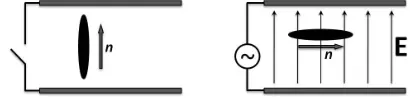
In our system we perturb the equilibrium by applying a voltage. The LC that we use has a negative dielectric anisotropy, that is the dielectric constant is greatest for electric fields directed orthogonal to the long axes of the rod shaped molecules. The field, which is applied across the layer, tends to rotate the director away from the initial vertical state (Fig. 1), and as the director becomes more planar the natural chirality of the LC dominates resulting in the formation of cholesteric fingers. The anisotropic optical properties of the LC means that these fingers are clearly visible under an optical microscope. In this paper we enhance the contrast by adding dichroic dyes [29]. The fingers nucleate at defects or particles [27] in the LC and grow as the applied voltage exceeds a threshold and retract as it reduces below the threshold. For larger voltages the fingers start to branch, and as they fill the space the fingers start to repel each other.
Fingers have also been reported in other LC phases [19, 25] and there have also been studies of isolated fingers which can propagate as a result of electroconvection in nematic LCs [15, 22]. These propagating localisations in liquid crystal first attracted the attention of the unconventional computation community in early 2000s in the frame of collision-based computing. It was demonstrated in cellular automata models that worms in liquid crystals can implement basic logical gates when they collide with each other and either annihilate or deflect as a result of the collision [2] however no extended results were obtained at that time. Recent work in HP Labs has focussed on the interaction between LC materials and engineered microstructures [30, 31] and some of these systems have shown the potential for engineering the nucleation and propagation of cholesteric fingers. These results inspired us to reconsider the concept of collision-based computing in liquid crystals and to expand a range of problems solved by the propagating and interacting fingers.
[image:2.612.216.421.96.146.2]of fingers, in Sect. 6. Final thoughts of future LC finger computing devices are outlined in Sect. 7.
2. Fabrications and measurement of devices
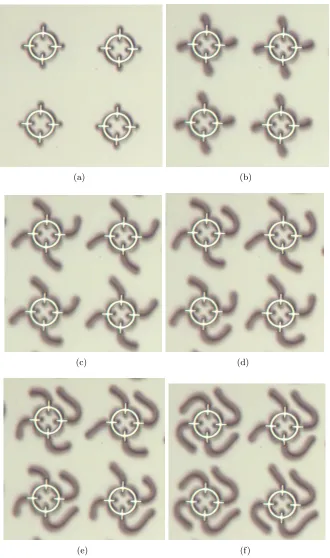
Devices were constructed using glass substrates coated with a transparent conductor layer made from ITO. In order to control the nucleation of the cholesteric fingers we patterned polymer structures onto one surface. Fingers tend to nucleate at the sharpest points on any structures. Fig. 2 shows a typical set of features: 40µm diameter rings with 4 protrusions to seed the nucleation of fingers. The structures are 5µm high and cover the ITO on one substrate. They are made from SU8 (Microchem Corp.) using photolithography. The surfaces of the two substrates are then coated with a thin polymer layer to align the LC homeotropically. To assemble the cell, the substrates are gently placed in contact so that the SU8 structures set the cell spacing, and the substrates are sealed on two edges with UV curing glue (NOA73 from Norland Products Inc.). The cell is then capillary filled with the LC mixture, with the cell heated to above the isotropic/nematic phase transition temperature to avoid the flow artifacts that can occur when filling with the LC in the nematic phase. The LC used was MLC2037 (Merck KGaA) which was chosen as it has a negative dielectric anisotropy, and the filling was carried out at 95◦C. It was doped with an additive (1.29% by weight of zli811, Merck) to impart a chiral pitch to the mixture. The concentration of the chiral dopant was chosen so that the pitch was very close to the cell spacing, so that the homeotropic state was just stable. The mixture was then doped with a blend of dichroic dyes (1% by weight G232, G241 and G472 from Hayashibara Biochemical Laboratories, Inc.). These enhance the contrast and make the fingers visible, without the need to use polarisers [29]. Dichroic dyes are rod-shaped molecules that only absorb light polarised along their long axis. They align with the LC, so that in the quiescent state the LC and dyes are both aligned vertically. Thus the dyes absorb very little light. When the fingers form, the LC and dyes at least partially align at a more planar angle, so that the dyes absorb more light and the fingers appear black. Applying a voltage across the LC layer causes the fingers to nucleate from the sharp points of the structures. These then slowly extend while the voltage is maintained (Fig. 2), and then retract when the voltage is removed. We use a 1kHz sinusoidal voltage with an amplitude of around 1.5V. In the next section we describe a model that captures some of the behaviour of the cholesteric fingers.
3. Mobile automata model of liquid crystal fingers
A mobile automaton is a tuple A = hc, s, f, α, d,i, where c ∈ R2 is an Euclidean co-ordinate of the automaton, c = (x, y); function f : R2 → R2 transforms coordinates as
xt+1 =xt+dsinαand yt+1=yt+dcosα; in models presented hered= 0.5. The automa-ton moves on a lattice L. All nodes of L are in state ’empty’ (0) initially. At each step
(a) (b)
(c) (d)
[image:4.612.160.490.96.654.2](e) (f)
(a) (b)
(c) (d)
[image:5.612.122.458.96.601.2](e) (f)
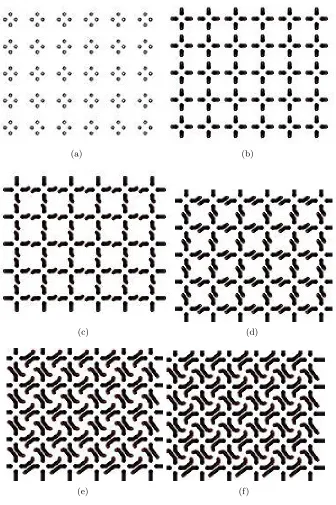
Figure 4. Simulated interaction between fingers when distance be-tween initial seeds is large enough to allow for prolonged movement. (a) Solid/impassable boundaries. (b) Boundary-less space.
Fig. 2 shows a sequence of microscope photos of fingers propagating away from a dense array of nucleation sites. As fingers approach each other they deviate from a straight path to avoid contact. We find that the fingers always tend to turn in the same direction, left in the case of figure 1. We believe this is due to the natural chirality of the LC mixture. The model is based on these observations. An automaton A chooses where to move as follows. If node (xt+dsinα, yt+dcosα) empty (0) thenAmoves into this node; otherwise it rotates left: α =α+π/360 and its statesis incremented. The exact angle of scattering is not known and may depend on many factors beyond our present knowledge. Thus we adopted increment π/360 whichα is increased with until a ’free’ site for the next position is found. The automaton stops when sexceeds a certain threshold of attempts.
The mobile automata model is phenomenological. A mobile automaton moving in a two-dimensional discrete space very roughly imitates the tip of a LC finger propagating in a quasi-two-dimensional space being squashed between two electrodes. Our model in no way competes with existing numerical models of LC fingers, see e.g. [20], but must rather be considered as a fast-prototyping tool in the design of LC finger computing algorithms.
them turns left (Fig. 2c–f). To imitate this experimental finding we regularly and uniformly distributed clusters of mobile automata in a two-dimensional space (Fig. 3). Initially the four automata of each cluster have their velocity vectors angles α oriented north, south, west and east (Fig. 3a). When fingerf0 moving North collides with fingerf00moving south the finger f0 turns south-east, and finger f00 north-west (Fig. 3b-d). Similarly, the finger initially travelling west deviates south-west and the finger travelling east turns north-east. Further changes of the fingers’ trajectories are attributed to subsequent collisions (Fig. 3ef). If the distance between the initiation sites of the fingers is large enough to allow for prolonged movement of the fingers the four neighbouring fingers form spirals (Fig. 4).
4. Approximation of Voronoi diagram
LetPbe a non-empty finite set of planar points. A planar Voronoi diagram of the setPis a partition of the plane into such regions that, for any element ofP, a region corresponding to a unique pointp contains all those points of the plane which are closer topthan to any other node of P. A unique region vor(p) ={z∈R2 :d(p, z)< d(p, m)∀m ∈R2, m6=z}
assigned to the pointpis called a Voronoi cell of the pointp. The boundary of the Voronoi cell of the point p is built up of segments of bisectors separating pairs of geographically closest points of the given planar set P. A union of all boundaries of the Voronoi cells determines the planar Voronoi diagram: V D(P) =∪p∈P∂vor(p) [23]. Voronoi diagrams are
applied in many fields of science and engineering. A few books and conference proceedings are available on the theory and applications of the Voronoi diagram [21, 7].
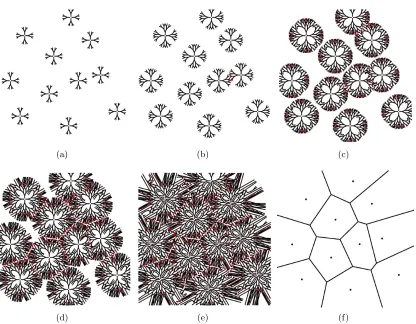
Construction of a Voronoi diagram is a classical problem of unconventional computing devices. This was the first ever problem solved in a reaction–diffusion chemical com-puter [24]. The basic concept of constructing Voronoi diagrams with reaction–diffusion systems is based on an intuitive technique for detecting the bisector points separating two given points of the set P. If we drop reagents at the two data points the diffusive waves, or phase waves if the computing substrate is active, travel outwards from the drops. The waves travel the same distance from the sites of origin before they meet one another. The points where the waves meet are the bisector points; see the extensive bibliography in [1, 4] and mechanisms of bisector formation in chemical media in [10, 11, 12, 13, 14]. The Voronoi diagram is also approximated in crystallisation-based processors [5] and colonies of acellu-lar slime mouldPhysarum polycephalum [6]. Thus it is intuitive to ascertain how Voronoi diagrams could be approximated with LC fingers.
(a)
[image:8.612.195.456.94.594.2](b)
(a) (b) (c)
[image:9.612.83.499.93.417.2](d) (e) (f)
Figure 6. Simulated approximation of Voronoi diagram. (a–e) Snapshots of the simulated dynamics of branching LC fingers. Edges of the Voronoi diagram calculated using a classical sweepline algorithm [18] are drawn by solid red/gray lines in (a–e) and shown explicitly in (f).
construction is improved where fingers are highly branched (approximate a continuous expanding front emanating from a defined site). This can be achieved by controlling the voltage or maximising the density of fingers initiated by altering the geometry and positioning of the seeding structures (for example compare construction in Figs. 5a and 5b). The approximation of the Voronoi diagram of eleven planar sites in mobile automata model of LC fingers is shown in Fig. 6.
5. Convex subdivision of concave polygons
(d) (e)
Figure 7. Convex subdivision of concave polygons in mobile automata model of LC fingers. Snapshots of the space after the propagation of all fingers has stopped. (a–d) Snapshots of LC finger model subdividing a concave polygon with three indentations. (e) Convex subdivision of star-shaped polygon.
singular points of indentations and the fingers’ propagation vectors are co-aligned with medians of the corresponding inward angles. Given a concave polygon every indentation initiates one propagating finger. A finger turns left, relative to its vector of propagation, when it collides with another finger or a segment of the polygon. Given a polygon with n
indentations, nfingers will be generated. By following their “turn-left-if-there-is-no-place-to-go” routine and also competing for the available space with each other the fingers fill
n−1 convex domains. At least one convex domain will remain unfilled.
finger c. When fingers collide to the ’walls’ of the polygon they turn left and more or less accurately follow the wall till next collision (Fig. 7c). Each finger forms a spiral and gets stuck inside the spiral at some point of its growth.
The computation of the convex subdivision of a concave polygon is completed when all fingers cease moving. The result of the computation is a set of convex polygons, each polygon is filled by a unique finger and at least one non-filled convex domain. In the example provided, a concave polygon is subdivided into four domains. The north-eastern domain is constructed by finger a, the south-eastern domain by finger c and the south-western domain by finger b. The north-western domain remains empty (Fig. 7d). In the case of regular polygons, e.g. star-shaped in Fig. 7e, boundaries between finger-filled convex domains correspond to the skeleton of this planar polygonal shape.
6. One-bit half-adder
The half-adder presented is based on the paradigm of collision-based computing, which originates from conservative logic and billiard ball model by Fredkin and Toffoli [17] and logical computation by colliding gliders in Conway’s Game of Life [9]. A collision-based computer employs mobile compact finite patterns and travelling localisations to represent quanta of information in non-linear media. Information values, e.g. truth values of logical variables, are given by either absence or presence of the localizations or other parameters of the localizations. The localizations travel in space and when collisions occur the result can be interpreted as computation. There are no predetermined stationary signal channels (wires) — however stationary localisations, or reflectors, are allowed — a trajectory of the travelling pattern is considered a transient wire. Almost any part of the mediums’ space can be used as a wire. Localizations can collide anywhere within the sample space, there are no fixed positions at which specific operations occur, nor location specified gates with fixed operations. The localizations undergo transformations, form bound states, annihilate or fuse when they interact with other mobile patterns. Information values of localizations are transformed as a result of collision [3].
In the design discussed we use reflectors. The reflectors are stationary structures or defects. They are ’artificial’ in a sense that they do not belong to the liquid crystal medium but are externally and intentionally introduced to deflect propagating fingers. We assume the obstacles are rectangular. In real-world implementations corners of the rectangular reflectors would generate additional propagating fingers, thus obstacles must be smooth e.g. circular or oval. However, our model is coarse-grained and therefore any oval reflector would be composed of small rectangles and ’perceived’ as a group of rectangles by the fingers.
Basic gatexy is illustrated in Fig. 8. The gate consists of three obstacles o1,o2 and o3 and two input fingers (Fig. 8a). The fingers represent values of Boolean variables x and
y: presence of a fingerx ory corresponds to x = 1 or y = 1 (True), absence of a finger corresponds to 0 (False). Obstacleso1 and o2 are used to deflect finger x while obstacle
x xy
xy o1
o3
[image:12.612.165.486.113.338.2](a) (b) (c) (d)
Figure 8. LC finger gate hx, yi → hxy, xyi. (a) Scheme: trajectories of fingersx andyentering gate are shown by solid lines, trajectories of fingers after collision are shown by dotted lines, obstacles are shown by grey rect-angles and tagged o1, o2 and o3. (b–d) Configurations of two-dimensional mobile automata model. Fingers and obstacles are represented by states of cells. (b) Input x = 0, y = 1. (c) Input x = 1, y = 0. (d) Input x = 1,
y= 1.
Let us consider inputx= 0 andy= 1 (Fig. 8b). Fingerxis not present. Fingerytravels south undisturbed. There are no obstacles in its way, thus it continues along its original trajectory which represents output xy. For input x = 1 and y = 0 only finger x enters the gate (Fig. 8c). The fingerx turns east after colliding with obstacle o1. It then collides with obstacleso3 and turns north. Both outputs are nil. When both inputs areTrueboth fingersxandy enter the gate (Fig. 8d). Fingerxenters the gate early than fingery. Thus by the time finger y passes southward along obstacle o2 finger x moves northward. The fingersxandy collide with each other. In the result of this collision fingery turns east and fingerxturns west. The deflected trajectory of fingerypropagating east represents output
xy. Deflected finger x collides with obstacle o2 deflected south, and eventually becomes trapped and propagation ceases (Fig. 8d).
x y 1 y x 1 1
x⊕y
[image:13.612.141.435.97.479.2]xy xy xy xy xy (a) a b c d e f g o1 o2 o4 o3 o5 o6 o7 o8 o9 o10 o11 o12 o13 o14 (b)
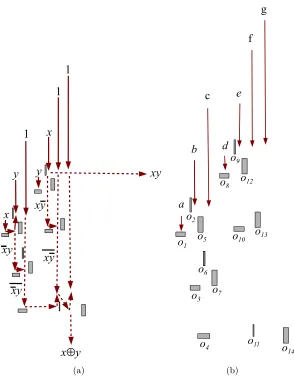
Figure 9. A scheme of one-bit half-adder implementable with LC fin-gers (a) and labels of key elements of the adder (b).
Truth, two fingers representing values ofxand two fingers representing values ofy. In the present model we do not tackle multiplication or splitting of signals therefore we assume copies of variables x and y are presented a priori. All input fingers travel south, output
x⊕y travels south and output xy travels east. Note that all input fingers enter the half-adder at different moments of time (Fig. 9a). In total we have seven fingers labelled ato
g and fourteen obstacles labelled o1 too14 (Fig. 9b).
(a) (b)
[image:14.612.179.465.103.705.2](c) (d)
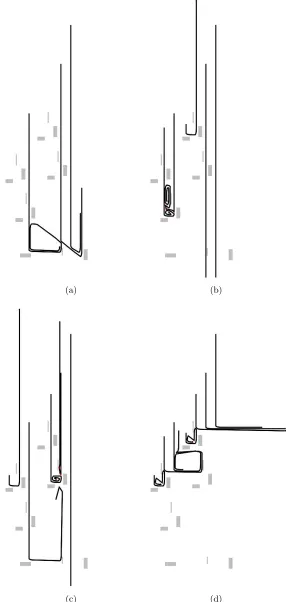
east, is deflected by obstacleo11 and turns north. It collides with fingerf. In the result of this collision fingercturns north-west and is ”self-trapped” while fingerf turns south-east. The body of fingerf prevents further propagation of fingerg. Fingerf andgare deflected by obstacle o14 and propagate north. Thus for input x = 0 and y = 0 no output fingers appear along dedicated trajectories (Fig. 10a): h0,0i → h0,0i.
For the input combination x= 0 andy= 1 the situation develops as follows (Fig. 10b). Fingersc,f andg, representing constantTrueenter the the adder as usual. Fingersaand
e, representing x, are absent. Fingers b and d, representing y= 1 enter the adder. Finger
b collides with obstacle o3 and turns east, then collides with obstacle o7 and heads north. Thus fingersbandccome into a head-on collision. Fingerbturns west and is ”self-trapped”. Fingercturns east, collides with obstacleo7 and theno6and gets trapped. Fingerdcollides with obstacleo8, heads east, collides with obstacle o12 and travels north. Fingersf andg continue their travel undisturbed. Thus operationh0,1i → h1,0i is imlpemented.
When x = 1 and y = 1 (Fig. 10c) finger a (representing first copy of x) is turned north by obstacles o1 and o5. Finger c(representing second copy of x) is turned north by obstacleso10 and o13, collides with fingerf. Fingers c andf stop propagating in result of the collision. Fingercis turned east by obstacleo4 and then north by obstacleo11. Finger
g continues its propagation undisturbed and thus operationh1,0i → h1,0i.
Most interactions between fingers take place in situation x = 1 and y = 1 (Fig. 10d). Finger a collides with finger b. Finger b turns east as a result of the collision. Body of finger b prevent fingerc propagating north. Finger dcollides with finger e and gets ”self-trapped”. Fingereturns east in result of the collision and exits the adder. Final trajectory of fingererepresentsxy= 1 (Figs. 9a and 10d). Propagation fingergis blocked by body of fingerseand f, it does not exit the adder along its original trajectory, and thusx⊕y= 0.
7. Discussion
Press; 1982.
[10] De Lacy Costello B. P. J. Constructive chemical processors — experimental evidence that shows that this class of programmable pattern forming reactions exist at the edge of a highly non-linear region. Int. J. Bifurcat. Chaos 13 (2003) 1561–1564.
[11] De Lacy Costello B. and Adamatzky A. On multitasking in parallel chemical processors: experimental findings. Int. J. Bifurcat. Chaos 13 (2003) 521–533.
[12] De Lacy Costello B. P. J., Hantz P., and Ratcliffe N. M. Voronoi diagrams generated by regressing edges of precipitation fronts. J. Chem. Phys. 120 (2004) 2413–2416.
[13] De Lacy Costello B. P. J., Adamatzky A., Ratcliffe N. M., Zanin A., Purwins H. G., and Liehr A. The formation of Voronoi diagrams in chemical and physical systems: experimental findings and theoretical models. Int. J. Bifurcat. Chaos 14(7) (2004) 2187–2210.
[14] De Lacy Costello B. P. J., Jahan I., Adamatzky A., and Ratcliffe N. M. Chemical tesselations. Int. J. Bifurcat. Chaos 19 (2009) 619–622.
[15] Dennin M., Cannell D. S. and Ahlers G. Patterns of electroconvection in a nematic liquid crystal. Physical Review E 57 (1998) 638-649.
[16] Dequidt A. and Oswald P. Does the electric Lehmann effect exist in cholesteric liquid crystals? Eur Phys J E 24 (2007) 157-166.
[17] Fredkin E. and Toffoli T. Conservative logic. Int J Theor Physics 21 (1982) 219-253.
[18] Fortune S. A sweepline algorithm for Voronoi diagrams. In Proc. 2nd Annu. Symp. Computational Geometry, Yorktown Heights, New York, 1986, pp. 313-322.
[19] Li J.-F., Wang X.-Y., Kangas E., Taylor P. L, and Rosenblatt C., Suzuki Y., Cladis P. E. Reversible propagating fingers in an antiferroelectric liquid crystal. Phys. Rev. B 52, R13075R13078 (1995) [20] Nagaya T., Hikita Y., Orihara H. and Ishibashi Y. Numerical study of the growth of the cholesteric
finger pattern J. Phys. Soc. Jpn. 65 (1996) 2713–2716.
[21] Okabe A., Boots B., Sugihara K., and Chiu S. N. Spatial Tesselations (Wiley, Chichester, New York, 2000).
[22] Riecke H. and Granzow G. D. Localization of waves without bistability: Worms in nematic electrocon-vection. (1998) arXiv:patt-sol/9802003v1.
[23] Preparata F. P. and Shamos M. I. Computational Geometry: An Introduction (Springer, New York, 1985).
[24] Tolmachiev D. and Adamatzky A. Chemical processor for computation of Voronoi diagram. Adv. Mater. Opt. Electron. 6 (1996) 191–196.
[26] Pirkl S. and Oswald P. Travelling fingers in two-frequency cholesteric liquid crystals: fragments, loops and spirals Liquid Crystals 28 (2001) 299
[27] Smalyukh I.I., Senyuk, B.I., Palffy-Muhoray, P., Lavrentovich, O.D., Huang, H., Gartland, E.C., Bodnar, V.H., Kosa, T. and Taheri, B. Electric-field-induced nematic-cholesteric transition and three-dimensional director structures in homeotropic cells Phys. Rev. E 72 (2005) 061707
[28] Ribiere, P., Oswald, P. and Pirkl, S. Crawling and spiraling of cholesteric fingers in electric field J. Phys. II France 4 (1994) 127
[29] White, D.L. and Taylor, G.N. New absorptive mode reflective liquid-crystal display device J. Appl. Phys. 45 (1974) 4718
[30] Kitson, S. and Geisow, A. Controllable alignment of nematic liquid crystals around microscopic posts: Stabilization of multiple states Appl. Phys. Lett. 80 (2002) 3635