(
E
)-4-(4-Fluorostyryl)benzoic acid
Saba Nazir,aKhushi Muhammad,aM. Khawar Rauf,b Masahiro Ebiharaband Shahid Hameeda*
a
Department of Chemistry, Quaid-i-Azam University, Islamabad 45320, Pakistan, andbDepartment of Chemistry, Faculty of Engineering, Gifu University, Yanagido, Gifu 501-1193, Japan
Correspondence e-mail: [email protected]
Received 30 April 2008; accepted 1 May 2008
Key indicators: single-crystal X-ray study;T= 123 K; mean(C–C) = 0.003 A˚; Rfactor = 0.065;wRfactor = 0.155; data-to-parameter ratio = 15.5.
The title compound, C15H11FO2, is an important intermediate in the synthesis of side-chain ligands for polymeric liquid crystals. The vinyl group is almost coplanar with both the aromatic rings. The crystal structure is stabilized by inter-molecular O—H O hydrogen bonding.
Related literature
For related literature, see: Ahmad et al. (2003); Collings & Hird (1997); Frazee & Foraker (2008); Hameed & Rama (2004); Hussainet al.(2005); Naziret al.(2008); Ribeiroet al.
(2008); Wanget al.(2008); Higashi (1999); Yasudaet al.(2000).
Experimental
Crystal data
C15H11FO2 Mr= 242.24
Monoclinic,P21=c a= 6.261 (4) A˚ b= 23.096 (15) A˚ c= 8.269 (5) A˚
= 107.072 (8)
V= 1143.1 (13) A˚3 Z= 4
MoKradiation
= 0.10 mm1 T= 123 (2) K 0.450.300.18 mm
Data collection
Rigaku/MSC Mercury CCD diffractometer
Absorption correction: none 9111 measured reflections
2589 independent reflections 2399 reflections withI> 2(I) Rint= 0.036
R[F2> 2(F2)] = 0.065 wR(F2) = 0.155 S= 1.16 2589 reflections 167 parameters
H atoms treated by a mixture of independent and constrained refinement
max= 0.55 e A˚
3 min=0.28 e A˚
3
Table 1
Hydrogen-bond geometry (A˚ ,).
D—H A D—H H A D A D—H A
O2—H2 O1i
1.04 (4) 1.57 (4) 2.610 (2) 174 (3)
Symmetry code: (i)xþ2;y;zþ2.
Data collection:CrystalClear(MSC/Rigaku, 2001); cell refinement:
CrystalClear; data reduction: TEXSAN (MSC/Rigaku, 2004); program(s) used to solve structure:SIR97 (Altomare et al., 1999); program(s) used to refine structure:SHELXL97(Sheldrick, 2008); molecular graphics: ORTEPII (Johnson, 1976); software used to prepare material for publication:SHELXL97andTEXSAN.
MKR is grateful to the Higher Education Commission of Pakistan for financial support under the International Support Initiative for Doctoral Fellowships at Gifu University, Japan.
Supplementary data and figures for this paper are available from the IUCr electronic archives (Reference: HG2398).
References
Ahmad, H. B., Rama, N. H., Hussain, M., Hussain, M. T., Qasim, M. M., Hameed, S., Malana, M. A. & Malik, A. (2003).Indian J. Chem.B42, 611– 615.
Altomare, A., Burla, M. C., Camalli, M., Cascarano, G. L., Giacovazzo, C., Guagliardi, A., Moliterni, A. G. G., Polidori, G. & Spagna, R. (1999).J. Appl. Cryst.32, 115–119.
Collings, P. J. & Hird, M. (1997).Introduction to Liquid Crystals, Chemistry and Physics, edited by G. W. Gray, J. W. Goodby & A. Fukuda, pp. 43–78. Bristol: Taylor and Francis.
Frazee, L. A. & Foraker, K. C. (2008).Annals Pharmacother.42, 403–407. Hameed, S. & Rama, N. H. (2004).J. Chem. Soc. Pak.26, 157–162. Higashi, T. (1999).NUMABS. Rigaku Corporation, 3-9-12 Akishima, Tokyo
196-8666, Japan.
Hussain, M. T., Rama, N. H., Hameed, S., Malik, A. & Khan, K. M. (2005).Nat. Prod. Res.19, 41–51.
Johnson, C. K. (1976).ORTEPII. Report ORNL-5138. Oak Ridge National Laboratory, Tennessee, USA.
MSC/Rigaku (2001).CrystalClear. MSC/Rigaku, The Woodlands, Texas, USA. MSC/Rigaku (2004).TEXSAN. MSC/Rigaku, The Woodlands, Texas, USA. Nazir, S., Khawar Rauf, M., Ebihara, M. & Hameed, S. (2008).Acta Cryst.E64,
o423.
Ribeiro, G., Benadiba, M., Colquhoun, A. & Silva, D. D. (2008).Polyhedron, 27, 1131–1137.
Sheldrick, G. M. (2008).Acta Cryst.A64, 112–122.
Wang, M. L., Liu, B. L. & Lin, S. J. (2008).Chem. Eng. Commun.195, 770–786. Yasuda, N., Uekusa, H. & Ohashi, Y. (2000).Acta Cryst.C56, 1364–1366.
Structure Reports
Online
supporting information
Acta Cryst. (2008). E64, o1013 [doi:10.1107/S1600536808012920]
(
E
)-4-(4-Fluorostyryl)benzoic acid
Saba Nazir, Khushi Muhammad, M. Khawar Rauf, Masahiro Ebihara and Shahid Hameed
S1. Comment
Carboxylic acids constitute an important class of organic compounds and have been used by the medicinal industry as
important drugs (Ribeiro et al., 2008; Frazee & Foraker 2008; Hameed & Rama 2004). The carboxylic acids have also
found applications as intermediates in the synthesis of an enormous number of organic compounds, in general (Hussain et
al., 2005; Ahmad et al., 2003), and in the synthesis of side chain ligands for polymeric liquid crystals, in particular (Wang
et al., 2008; Nazir et al., 2008). The liquid crystalline molecules containing substituents at 4-position behave as well
ordered calamitic ligands as a side chain group (Collings & Hird, 1997) in side chain polymeric liquid crysrtals
(SCPLCs). The derivatives of 4-(4-substituted styryl)benzoic acids have found applications as side chain groups in
SCPLCs (Wang et al., 2008). As a part of a project to synthesize ligands for SCPLCs, the title compound, (E
)-4-(4-fluoro-styryl)benzoic acid (I), was synthesized by reacting 4-fluorobenzaldehyde with methyl
[4-(methoxycarbonyl)benzyl]tri-phenylphosphonium bromide (Nazir et al., 2008) followed by hydrolysis. In the present article, the crystal structure of (I)
is being reported. Bond lengths and angles are within the normal ranges as given for vinylbenzoic acid (Yasuda et al.,
2000). The C(1)—O(1) and C(1)—O(2) bond lengths are 1.252 (2) and 1.291 (2) respectively,clearly indicating the
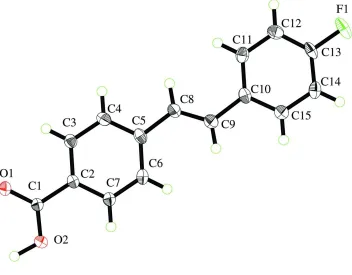
partial double bond character of the carboxylate group. The carboxylic acid group subtends a dihedral angle[13.72 (16)°]
with the phenyl ring C(2)/C(3)/C(4)/C(5)/C(6)/C(7).The vinyl group is almost coplanar with both the phenyl rings. The
torsion angles between the phenyl rings and vinyl group fulfill the condition of coplanarity[near to 0° or 180 °]. Two
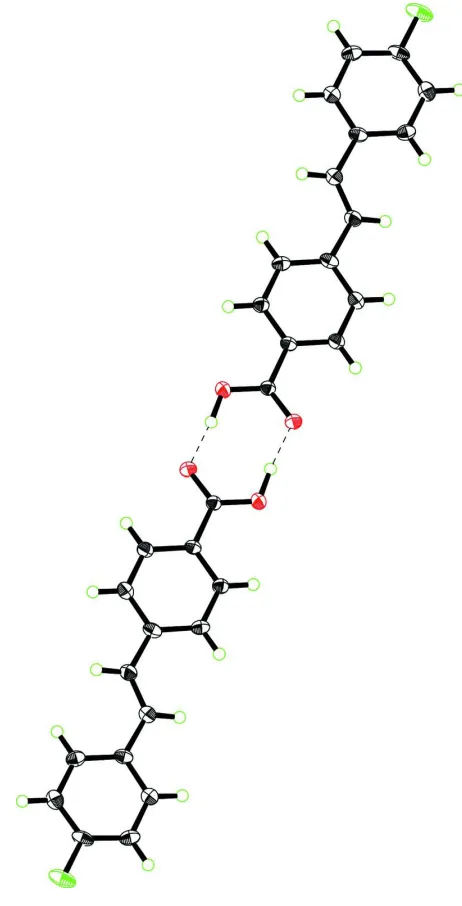
molecules related by an inversion center form a dimer via two hydrogen bonds composed of two carboxyl groups as
shown in Fig. 2.
S2. Experimental
Methyl 4-(4-fluorostyryl)benzoate 0.8g (0.0031moles) and sodium hydroxide 0.126g (0.0031 moles) were dissolved in a
mixture of 10 ml of methanol and 30 ml of water, and the mixture refluxed for 3 hours. The reaction mixture was cooled
to room temperature and acidified with 6M HCl. The precipitated solid was filtered and recrystallized from hot ethanol.
Yield: 76%, m.p: 240-252°C, Rf = 0.22 (n-hexane : ethyl acetate 7 : 3). IR (νmax, KBr, cm-1): 3300-2500, 1715, 1620,
1600, 1580, 1188, 1119, 965,834. 1H-NMR (300 MHz,DMSO-d
6): δ 7.25 (2H, d, J = 9.0 Hz),7.28 (1H, d, J= 16.2 Hz),
7.42 (1H, d, J = 16.2 Hz), 7.71-7.67 (4H, m),7.95 (2H, d, J = 8.1 Hz), 12.93 (1H, s). 13C-NMR (75 MHz, DMSO-d
6): δ
116.16 (d, J= 23 Hz), 126.90, 127.77, 129.23, 130.08 (d, J = 8 Hz), 131.95, 132.49, 133.71 (d, J = 3 Hz), 141.83, 162.42
(d, J = 246 Hz), 167.54.
S3. Refinement
The O-bound H atom was refined isotropically. All the other H atoms were placed in idealized positions and treated as
Figure 1
Figure 2
Showing hydrogen bonded molecules through N—H···O.
(E)-4-(4-Fluorostyryl)benzoic acid
Crystal data
C15H11FO2
Mr = 242.24 Monoclinic, P21/c Hall symbol: -P 2ybc
a = 6.261 (4) Å
b = 23.096 (15) Å
c = 8.269 (5) Å
β = 107.072 (8)°
V = 1143.1 (13) Å3
F(000) = 504
Dx = 1.408 Mg m−3
Mo Kα radiation, λ = 0.71070 Å Cell parameters from 3252 reflections
θ = 3.1–27.5°
µ = 0.10 mm−1
Rigaku/MSC Mercury CCD diffractometer
Radiation source: Rotating anode Graphite monochromator
ω scans
9111 measured reflections 2589 independent reflections
2399 reflections with I > 2σ(I)
Rint = 0.036
θmax = 27.5°, θmin = 3.1°
h = −8→6
k = −25→29
l = −10→9
Refinement
Refinement on F2 Least-squares matrix: full
R[F2 > 2σ(F2)] = 0.065
wR(F2) = 0.155
S = 1.16 2589 reflections 167 parameters 0 restraints
Primary atom site location: structure-invariant direct methods
Secondary atom site location: difference Fourier map
Hydrogen site location: inferred from neighbouring sites
H atoms treated by a mixture of independent and constrained refinement
w = 1/[σ2(F
o2) + (0.0616P)2 + 0.7669P] where P = (Fo2 + 2Fc2)/3
(Δ/σ)max < 0.001 Δρmax = 0.55 e Å−3 Δρmin = −0.28 e Å−3
Special details
Geometry. All e.s.d.'s (except the e.s.d. in the dihedral angle between two l.s. planes) are estimated using the full covariance matrix. The cell e.s.d.'s are taken into account individually in the estimation of e.s.d.'s in distances, angles and torsion angles; correlations between e.s.d.'s in cell parameters are only used when they are defined by crystal symmetry. An approximate (isotropic) treatment of cell e.s.d.'s is used for estimating e.s.d.'s involving l.s. planes.
Refinement. Refinement of F2 against ALL reflections. The weighted R-factor wR and goodness of fit S are based on F2, conventional R-factors R are based on F, with F set to zero for negative F2. The threshold expression of F2 > σ(F2) is used only for calculating R-factors(gt) etc. and is not relevant to the choice of reflections for refinement. R-factors based on F2 are statistically about twice as large as those based on F, and R- factors based on ALL data will be even larger.
Fractional atomic coordinates and isotropic or equivalent isotropic displacement parameters (Å2)
x y z Uiso*/Ueq
C1 0.7742 (3) 0.03235 (7) 0.8139 (2) 0.0188 (4)
O1 0.9748 (2) 0.04569 (6) 0.83715 (16) 0.0268 (3)
O2 0.7095 (2) −0.00358 (6) 0.90952 (16) 0.0258 (3)
H2 0.843 (6) −0.0202 (16) 1.006 (5) 0.089 (12)*
C2 0.5982 (3) 0.05820 (7) 0.6720 (2) 0.0188 (4)
C3 0.6547 (3) 0.10173 (8) 0.5755 (2) 0.0221 (4)
H3 0.8054 0.1143 0.6002 0.027*
C4 0.4916 (3) 0.12671 (8) 0.4437 (2) 0.0246 (4)
H4 0.5313 0.1568 0.3796 0.030*
C5 0.2699 (3) 0.10851 (8) 0.4031 (2) 0.0231 (4)
C6 0.2149 (3) 0.06476 (8) 0.5012 (2) 0.0232 (4)
H6 0.0645 0.0519 0.4756 0.028*
C7 0.3771 (3) 0.03999 (8) 0.6354 (2) 0.0213 (4)
H7 0.3374 0.0107 0.7020 0.026*
C8 0.1067 (3) 0.13727 (8) 0.2605 (2) 0.0250 (4)
C9 −0.1064 (3) 0.12250 (8) 0.1943 (2) 0.0246 (4)
H9 −0.1587 0.0904 0.2436 0.030*
C10 −0.2687 (3) 0.15134 (8) 0.0517 (2) 0.0224 (4)
C11 −0.2127 (3) 0.19609 (8) −0.0431 (2) 0.0250 (4)
H11 −0.0628 0.2094 −0.0148 0.030*
C12 −0.3734 (3) 0.22120 (8) −0.1778 (2) 0.0273 (4)
H12 −0.3353 0.2514 −0.2424 0.033*
C13 −0.5900 (3) 0.20104 (8) −0.2150 (2) 0.0262 (4)
C14 −0.6531 (3) 0.15774 (8) −0.1256 (2) 0.0257 (4)
H14 −0.8040 0.1451 −0.1539 0.031*
C15 −0.4898 (3) 0.13277 (8) 0.0075 (2) 0.0241 (4)
H15 −0.5300 0.1023 0.0700 0.029*
F1 −0.7470 (2) 0.22525 (6) −0.34838 (15) 0.0419 (4)
Atomic displacement parameters (Å2)
U11 U22 U33 U12 U13 U23
C1 0.0185 (8) 0.0204 (8) 0.0175 (8) 0.0011 (6) 0.0052 (6) −0.0007 (6)
O1 0.0173 (6) 0.0346 (8) 0.0269 (7) 0.0001 (5) 0.0040 (5) 0.0061 (5)
O2 0.0227 (6) 0.0285 (7) 0.0251 (6) 0.0005 (5) 0.0053 (5) 0.0084 (5)
C2 0.0190 (8) 0.0200 (8) 0.0165 (8) 0.0030 (6) 0.0038 (6) −0.0018 (6)
C3 0.0213 (8) 0.0251 (9) 0.0195 (8) 0.0016 (7) 0.0054 (6) −0.0001 (6)
C4 0.0267 (9) 0.0253 (9) 0.0219 (8) 0.0031 (7) 0.0073 (7) 0.0034 (7)
C5 0.0246 (9) 0.0249 (9) 0.0175 (8) 0.0057 (7) 0.0029 (7) −0.0022 (6)
C6 0.0175 (8) 0.0265 (9) 0.0237 (8) 0.0019 (7) 0.0032 (7) −0.0034 (7)
C7 0.0196 (8) 0.0226 (9) 0.0211 (8) 0.0012 (7) 0.0052 (6) −0.0003 (6)
C8 0.0238 (9) 0.0262 (9) 0.0234 (8) 0.0025 (7) 0.0045 (7) 0.0031 (7)
C9 0.0264 (9) 0.0248 (9) 0.0221 (8) 0.0011 (7) 0.0062 (7) 0.0004 (7)
C10 0.0220 (9) 0.0243 (9) 0.0187 (8) 0.0044 (7) 0.0028 (6) −0.0041 (6)
C11 0.0216 (9) 0.0259 (10) 0.0265 (9) −0.0002 (7) 0.0055 (7) −0.0057 (7)
C12 0.0347 (10) 0.0217 (9) 0.0265 (9) 0.0025 (8) 0.0104 (8) 0.0006 (7)
C13 0.0280 (9) 0.0233 (9) 0.0215 (8) 0.0116 (7) −0.0018 (7) −0.0012 (7)
C14 0.0188 (8) 0.0273 (9) 0.0290 (9) 0.0019 (7) 0.0038 (7) −0.0072 (7)
C15 0.0260 (9) 0.0229 (9) 0.0232 (8) 0.0013 (7) 0.0067 (7) −0.0006 (7)
F1 0.0413 (7) 0.0402 (8) 0.0330 (7) 0.0202 (6) −0.0063 (5) 0.0036 (5)
Geometric parameters (Å, º)
C1—O1 1.252 (2) C8—C9 1.330 (3)
C1—O2 1.291 (2) C8—H8 0.9500
C1—C2 1.479 (2) C9—C10 1.471 (2)
O2—H2 1.04 (4) C9—H9 0.9500
C2—C3 1.392 (3) C10—C15 1.392 (3)
C2—C7 1.393 (3) C10—C11 1.402 (3)
C3—C4 1.382 (2) C11—C12 1.390 (3)
C3—H3 0.9500 C11—H11 0.9500
C4—C5 1.394 (3) C12—C13 1.380 (3)
C5—C8 1.473 (2) C13—C14 1.369 (3)
C6—C7 1.389 (2) C14—C15 1.389 (3)
C6—H6 0.9500 C14—H14 0.9500
C7—H7 0.9500 C15—H15 0.9500
O1—C1—O2 123.07 (15) C9—C8—H8 116.9
O1—C1—C2 120.16 (15) C5—C8—H8 116.9
O2—C1—C2 116.78 (15) C8—C9—C10 125.99 (18)
C1—O2—H2 112 (2) C8—C9—H9 117.0
C3—C2—C7 119.79 (15) C10—C9—H9 117.0
C3—C2—C1 119.41 (16) C15—C10—C11 118.25 (16)
C7—C2—C1 120.80 (16) C15—C10—C9 118.07 (17)
C4—C3—C2 120.05 (17) C11—C10—C9 123.68 (17)
C4—C3—H3 120.0 C12—C11—C10 120.96 (18)
C2—C3—H3 120.0 C12—C11—H11 119.5
C3—C4—C5 121.11 (18) C10—C11—H11 119.5
C3—C4—H4 119.4 C13—C12—C11 118.08 (18)
C5—C4—H4 119.4 C13—C12—H12 121.0
C4—C5—C6 118.38 (16) C11—C12—H12 121.0
C4—C5—C8 117.69 (17) F1—C13—C14 118.85 (18)
C6—C5—C8 123.92 (17) F1—C13—C12 118.02 (18)
C7—C6—C5 120.88 (17) C14—C13—C12 123.12 (17)
C7—C6—H6 119.6 C13—C14—C15 118.00 (17)
C5—C6—H6 119.6 C13—C14—H14 121.0
C6—C7—C2 119.77 (17) C15—C14—H14 121.0
C6—C7—H7 120.1 C14—C15—C10 121.58 (18)
C2—C7—H7 120.1 C14—C15—H15 119.2
C9—C8—C5 126.22 (18) C10—C15—H15 119.2
O1—C1—C2—C3 −6.5 (2) C6—C5—C8—C9 −7.2 (3)
O2—C1—C2—C3 173.26 (15) C5—C8—C9—C10 −179.93 (17)
O1—C1—C2—C7 174.23 (16) C8—C9—C10—C15 −175.06 (18)
O2—C1—C2—C7 −6.0 (2) C8—C9—C10—C11 5.5 (3)
C7—C2—C3—C4 −0.1 (3) C15—C10—C11—C12 −0.1 (3)
C1—C2—C3—C4 −179.31 (16) C9—C10—C11—C12 179.26 (17)
C2—C3—C4—C5 −1.0 (3) C10—C11—C12—C13 0.4 (3)
C3—C4—C5—C6 1.1 (3) C11—C12—C13—F1 −179.25 (16)
C3—C4—C5—C8 −179.83 (16) C11—C12—C13—C14 0.1 (3)
C4—C5—C6—C7 −0.2 (3) F1—C13—C14—C15 178.64 (16)
C8—C5—C6—C7 −179.19 (17) C12—C13—C14—C15 −0.7 (3)
C5—C6—C7—C2 −0.9 (3) C13—C14—C15—C10 0.9 (3)
C3—C2—C7—C6 1.0 (3) C11—C10—C15—C14 −0.5 (3)
C1—C2—C7—C6 −179.80 (15) C9—C10—C15—C14 −179.93 (16)
Hydrogen-bond geometry (Å, º)
D—H···A D—H H···A D···A D—H···A
O2—H2···O1i 1.04 (4) 1.57 (4) 2.610 (2) 174 (3)