870
AUTOHOME-ORCA at SemEval-2019 Task 8: Application of BERT for
Fact-Checking in Community Forums
Zhengwei Lv1 Duoxing Liu1 Haifeng Sun2 Xiao Liang1
Tao Lei1 Zhizhong Shi1 Feng Zhu1 Lei Yang1
1Autohome Inc., Beijing, China
2Beijing University of Posts and Telecommunications, Beijing, China
{lvzhengwei,liuduoxing,liangxiao12030,leitao,shizhizhong,zhufeng,yanglei}@autohome.com.cn
Abstract
Fact checking is an important task for main-taining high quality posts and improving user experience in Community Question Answer-ing forums. Therefore, the SemEval-2019 task 8 is aimed to identify factual question (subtask A) and detect true factual information from corresponding answers (subtask B). In order to address this task, we propose a system based on the BERT model with meta information of questions. For the subtask A, the outputs of fine-tuned BERT classification model are combined with the feature of length of ques-tions to boost the performance. For the subtask B, the predictions of several variants of BERT model encoding the meta information are com-bined to create an ensemble model. Our sys-tem achieved competitive results with an ac-curacy of 0.82 in the subtask A and 0.83 in the subtask B. The experimental results vali-date the effectiveness of our system.
1 Introduction
The Community Question Answering (CQA) fo-rums are gaining more and more popularity be-cause they can offer great opportunity for users to get appropriate answers to their questions from other users. Meanwhile, the accumulated mas-sive questions and answers in CQA forums present a new challenge to provide valuable information for users more effectively. Therefore, researchers have shown an increased interest in CQA systems (Srba and Bielikova, 2016; Wang et al., 2018), aiming to facilitate efficient knowledge acquisi-tion and circulaacquisi-tion. Specifically, a large por-tion of researches mainly focus on the two tasks: find relevant questions to a new question to reuse corresponding answers (Question Retrieval), and search for relevant answers among existing an-swers to other questions (Answer Selection).
Despite a great deal of research on CQA, there are relatively few studies focusing on the quality
of questions and answers. Actually, the credibility of answers is an important aspect, which can di-rectly affect the user experience for CQA forums. In order to check the veracity of answers automat-ically, some recent works (Karadzhov et al.,2017;
Mihaylova et al.,2018) attempt to utilize external sources and extract appropriate features for classi-fication. Considering the importance of informa-tion veracity in CQA forums, the fact checking of answers is still an issue that is worth investigating further.
Therefore, the SemEval-2019 task 8 aims to conduct fact checking in CQA forums. In order to detect the veracity of answers, it is necessary to identify whether the questions are factual firstly. The task is comprised of two subtasks: the subtask A is targeted to identify whether a question is ask-ing for factual information, an opinion/advice or socializing. Given factual questions, the subtask B is aimed to determine whether the correspond-ing answers are true, false or not factual.
effectiveness of our system.
The rest of our paper is organized in the follow-ing way. The related work about CQA is summa-rized in Section 2. Section 3 gives a more detailed description of our system. The results and analy-sis of experiments are demonstrated in Section 4. Finally, Section 5 presents the main conclusions.
2 Related Work
So far, most studies about CQA mainly pay at-tention to two tasks: Question Retrieval and An-swer Selection. In previous works, some tradi-tional methods treat questions or answers as bag of words and measure their similarities based on weighted matching between the words ( Robert-son et al., 1994) or translation probability learn-ing from language model (Xue et al., 2008). In fact, similar questions often are not phrased with exactly same words, but related words, while there is very little token overlap between questions and answers. These methods essentially consider the question or answer as a bag of words, neglect-ing semantic information. So it is not surprisneglect-ing that the performance of traditional methods is not very well on aforementioned tasks. Recently, the neural-based models (He et al.,2015;Feng et al.,
2015;Tan et al.,2016;Bachrach et al.,2017;Tay et al.,2018), which can capture some semantic re-lations, are proposed and become mainstream in the research about CQA gradually. The basic idea behind them is to learn the representation of ques-tions and answers based on CNN or LSTM mod-els, then conduct text matching by regarding both tasks as classification or learning to rank.
Furthermore, there are also public CQA datasets and competitions available, which pro-mote relevant researches substantially. The pub-lic datasets are collected from various CQA web-sites, including Quora1, Yahoo! Answers2, Qatar Living3, etc. As for competitions, there is a kag-gle competition4 to identify the duplicated ques-tion pairs collecting from the Quora website. In SemEval-2015 Task 3 ”Answer Selection in Com-munity Question Answering” (Nakov et al.,2015), it is mainly targeted on the answer selection task. And there is a more comprehensive competition in SemEval-2016 Task 3 (Nakov et al., 2016)
1https://www.quora.com 2
https://answers.yahoo.com
3
https://www.qatarliving.com
4https://www.kaggle.com/c/quora-question-pairs
designed for both Question Retrieval and An-swer Selection, which is consisted of four sub-tasks: Comment Similarity, Question-Question Similarity, Question-Question-External Comment Similarity and Reranking the correct answers for a new question. In contrast, in SemEval-2017 task 3 (Nakov et al.,2017), a new duplicate question de-tection subtask is incorporated on the basis of the SemEval-2016 Task 3.
Although much work has been done in CQA researches, few attentions have been paid on im-proving the quality of questions and answers. In order to detect true factual answers automatically, Karadzhov et al. (Karadzhov et al., 2017) pro-pose a general framework using external sources, which adopts the LSTM model (Hochreiter and Schmidhuber, 1997) to learn text representation of answers and external sources. Mihaylova et al. (Mihaylova et al.,2018) extract features from mul-tiple aspects (the answer content, the author pro-file, the rest of the community forum and external authoritative sources) and demonstrate the effec-tiveness of fact checking of answers. At the same time, the lack of large-scale dataset also restricts the progress on fact checking in CQA forums fur-ther.
Recently, there are some of key milestones in the NLP field, such as ELMo (Peters et al.,
2018), ULMFiT (Howard and Ruder,2018), Ope-nAI GPT (Radford, 2018) and BERT (Devlin et al.,2018). These large-scale models have pro-vided great performance on various NLP tasks, which can be pre-trained on a massive corpus of unlabeled data, and then fine-tuned to down-stream tasks. Especially, the BERT model has achieved state-of-the-art results on a variety of language tasks, which allows us to obtain signif-icantly higher performance than models that are only able to leverage a small task-specific dataset. Therefore, we build a system based on the BERT model for the SemEval2019 task 8 and achieve sat-isfactory results.
3 System Description
3.1 System Overview
CQA corpus Questions
xml file
Preprocessing
Feature extraction
Answers xml file
BERT pretrained model
Fine-tuned BERT classifer
Ensemble Variant BERT
classifiers
Length of questions
Adaboost model
Prediction for Subtask A
Prediction for Subtask B
[image:3.595.304.525.61.303.2]Meta information of questions
Figure 1: Pipeline of our system.
meta information. Secondly, some important fea-tures are obtained from structured information, such as the length and category of questions. Thirdly, based on the pre-trained BERT model released by Google5, we conduct unsupervised training on specific CQA corpus further to make the model more suitable for the following classifi-cation tasks. Finally, the pre-trained BERT model and extracted features are fed into two subsystems to obtain predictions for the subtask A and the subtask B respectively. In the subsystem for sub-task A (detailed in Subsection3.2), the AdaBoost model is adopted to predict the classification of questions by combining the outputs of fine-tuned BERT classifier and the feature of length of ques-tions. In the subsystem for subtask B (described in Subsection 3.3), some variant BERT models which encode meta information of questions are combined to generate an ensemble model for pred-ication of labels of answers.
3.2 Subsystem for Subtask A
In this Subsection, the subsystem for subtask A is described in detail below.
Firstly, the subject and body of questions are en-coded into two BERT models separately for fine-tuning on the question classification. The different inputs for both BERT models are represented as
[CLS] +text1 + [SEP]
[CLS] +text2 + [SEP]
5https://github.com/google-research/bert
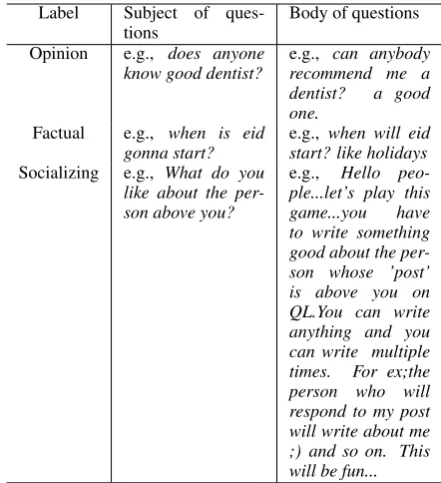
Label Subject of ques-tions
Body of questions
Opinion e.g., does anyone know good dentist?
e.g., can anybody recommend me a dentist? a good one.
Factual e.g., when is eid gonna start?
e.g., when will eid start? like holidays Socializing e.g., What do you
like about the per-son above you?
e.g., Hello peo-ple...let’s play this game...you have to write something good about the per-son whose ’post’ is above you on QL.You can write anything and you can write multiple times. For ex;the person who will respond to my post will write about me ;) and so on. This will be fun...
Table 1: Samples of questions with different labels.
wheretext1andtext2are the subject and body of question respectively.
Secondly, the outputs of two fine-tuned BERT models are concatenated with the length of ques-tions’ body as features for classification. As illus-trated in Table1, it is rather intuitive that the body length of questions for socializing is inclined to be longer than ones for factual or opinion. There-fore, it is reasonable to consider the body length of questions as a suitable feature for classification. In addition, the results of each BERT model are probabilities of questions belonging to different classes (Factual, Opinion and Socializing). Then the feature vector xvector for question
classifica-tion is represented as follows
xvector = [Ps1, Ps2, Ps3, Pb1, Pb2, Pb3, Lb] (1)
where Ps1, Ps2, Ps3 are the output of a BERT
model encoding the question subject. Similarly, Pb1, Pb2, Pb3 are the output of another BERT
model encoding the question body, andLb is the
body length of a question.
Finally, based on the generated feature vector
xvector, the AdaBoost algorithm is adopted to
[image:3.595.76.300.62.260.2]have achieved.
3.3 Subsystem for Subtask B
The Subsection describes the details of the subsys-tem for subtask B as follows.
Firstly, the subject and body of question, corre-sponding reply (i.e., answer) and meta information of question are combined to generate sequences for BERT encoders. In order to identify the true factual reply, the content of corresponding ques-tions and auxiliary information (e.g., the category of question, username of a questioner or replier) should be necessary for classifiers. So in the sub-system, we investigate the influence of different information for the classification performance (see Table4for details), including the subject of ques-tion (F-subject), the usernames of quesques-tioner and replier (F-username) and the category of question (F-category). Ultimately, the text of answer and the information of F-subject and F-category are employed for our BERT based models. The gener-ated sequence for inputs of models are represented as following:
[CLS] +text1 + [SEP] +text2 + [SEP]
We use [SEP] to separate between the information of question and answer. text1is composed of F-subject, F-category and the body of question sepa-rated by the special symbol (∼), whiletext2is the text of corresponding reply.
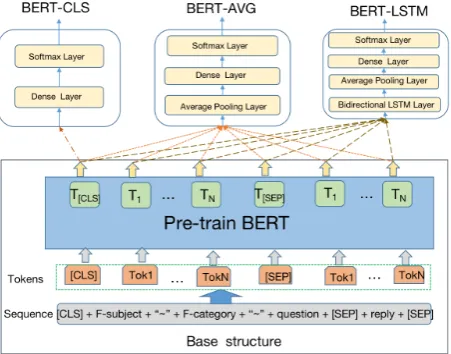
[image:4.595.73.299.519.696.2]Secondly, based on the generated sequences as inputs, we design three different categories of BERT based models for ensemble. As shown in
Figure 2: Architecture of BERT based models.
Figure2, the specific structures of the three kinds of models are described as follows:
• BERT-CLS. The final hidden state for the first token [CLS] in the input is employed for fine-tuning the pre-trained BERT model by adding a classification layer and a standard softmax.
• BERT-AVG. Different from BERT-CLS, the final hidden states for all tokens are utilized for classification by conducting an average pooling, and then adding a full connected layer and a standard softmax.
• BERT-LSTM. Compared with BERT-AVG, a Bi-LSTM network is added between the pooling layer and the pre-trained BERT en-coder. It must be noted that we only obtain the outputs of BERT encoder and the param-eters of BERT encoder are not updated when training.
Thirdly, we select a set of competitive classi-fiers in the training process by the three kinds of BERT based models respectively. The method of five-fold cross-validation is employed. To be spe-cific, the original samples are randomly divided into five sub-samples with equal size. And one of the five sub-samples is retained for validating the performance of classifier, and the rest of four sub-samples are used as training data. For each kind of BERT based model, the cross-validation process is repeated five times and each time no more than five optimal classifiers are obtained. Therefore, we get a total of sixty-five competitive classifiers fil-tered by certain threshold value on accuracy met-ric from three kinds of BERT based models for ensemble.
Finally, an effective integration strategy is ap-plied to produce a strong classifier for the subtask. There are two candidate integration strategies:
• Strategy 1 (Vote-ensemble): Each classifier casts a vote, the label of a sample is decided according to the majority of votes.
label with the largest proportion of data dis-tribution.
At last, the strategy 2 is employed in our subsys-tem because it seems that Distribution-ensemble strategy is more robust for variance error, espe-cially for small dataset, which will be discussed in Subsection4.2further.
4 Experiment
4.1 Dataset
The dataset is organized in question-answer threads from the Qatar Living forum. Each ques-tion, which is annotated by labels: Opinion, Fac-tual and Socializing, has a subject, a body and meta information including question ID, category, posting time, user’s ID and name. And each an-swer, which is classified as True, Factual-False and Non-Factual, has a body and meta in-formation (answer ID, posting time, user’s ID and name). The detailed statistics of the dataset in this task are illustrated in the task description paper (Mihaylova et al.,2019).
4.2 Experimental Results and Analysis
As for pre-training the BERT model, it is trained based on the BERT-Base-Cased model by the fo-rum corpus provided by organizer6. The training batch size is 32, the number of train steps is 1e+5 and the learning rate is 2e-5. The detailed exper-imental results for both subtasks are described as following.
4.2.1 Results for Subtask A
In the subsystem for subtask A, the AdaBoost al-gorithm is employed to boost the performance on question classification. The number of estimators for the AdaBoost method is 10. To evaluate the performance of question classification, we com-pare our proposed method against the following models:
• Text-CNN (Kim,2014): a simple CNN with one layer of convolution on top of word vec-tors. The subject and body of each question are concatenated as the input of Text-CNN model. When training, the number of epoch is 80, the initial learning rate is 0.001 and the dropout rate is set to 0.4.
6
http://alt.qcri.org/semeval2016/task3/data/uploads/QL-unannotated-data-subtaskA.xml.zip
• BERT without pre-training: the BERT-Base cased model release by Google. The input of the model is the concatenation of the subject and the body of each question with the sym-bol [SEP], which is represented as follows:
[CLS] +text1 + [SEP] +text2 + [SEP]
text1 and text2 are the subject and body of a question separately. When training the model, the batch size of training is 32, the initial learning rate is 2e-5 and the number of epoch is 9.
• BERT with pre-training: the BERT model pre-trained by CQA corpus. The settings of hyper-parameters is the same as the BERT model without pre-training.
Models Acc. (Dev) Acc. (Test)
Text-CNN 0.6569 0.6502
BERT without pre-training
0.6862 0.7370
BERT with pre-training
0.7197 0.7922
Our method 0.7283 0.8181
Table 2: Performance of different models in the subtask A.
4.2.2 Results for Subtask B
In the experiments for subtask B, the three kinds of BERT based models are implemented with Ten-sorFlow and trained with Adam optimizer. The maximum length of sequence is set to 150 and the batch size is 4. The initial learning rates are 3e-5 for parameters of BERT encoder and 1e-3 for oth-ers.
Models Acc.(Dev) Acc.(Test)
BERT-AVG 0.6732 –
BERT-CLS 0.6667 –
BERT-LSTM 0.656 –
Vote-ensemble 0.6693 0.7935
Distr.-ensemble 0.6845 0.8322
Table 3: Performance of different models in the subtask B.
The experimental results of different kinds of models are shown in Table3. From the table, it can be observed that the BERT-AVG model achieves the best performance in the three single models. By conducting average pooling operation on final hidden states of all tokens, the BERT-AVG model can capture more semantic information than the BERT-CLS model which can only pay attention to the hidden state of the [CLS] token. As for the BERT-LSTM model, it performs the worst, which may be caused by the highest model com-plexity and the lack of adequate training dataset, resulting in somewhat overfitting. In addition, it is indicated that ensemble models can obtain higher accuracy than single models and the strat-egy of Distribution-ensemble is more robust than the strategy of Vote-ensemble. This is because that when the numbers of votes for different labels are close to each other, it is difficult to identify the correct class only by the majority. By considering actual classification distribution in training dataset additionally, the Distribution-ensemble can show its potential advantage.
Feature Acc.(Dev)
Baseline 0.6559
+F-category 0.6606(+0.47)
+F-username 0.6547(-0.12)
+F-subject 0.6642(+0.83)
+F-category, +F-subject 0.6667(+1.08)
Table 4: Performance of different features on de-velopment dataset in the subtask B. “+” means to add current features to the main feature.
In order to explore the effectiveness of
differ-ent information for classification, a series of ex-periments based on the BERT-CLS model are con-ducted. The baseline model (BERT-CLS) is es-tablished only by encoding the information of the body of question and the corresponding answer. Therefore, the influence of other information can be discussed individually. By considering differ-ent information, the performance of the model val-idated on development dataset is shown in Table
4. It is observed that the F-username can not con-tribute to the increase of accuracy, which may be caused by existing many anonymous users in the forum. By encoding the information F-subject and F-category into the model, it can achieve the best performance.
5 Conclusion
Detecting the veracity of answers is vital to main-tain high quality information in CQA forums. In order to address this problem, a system based on BERT model is developed for participating in the SemEval-2019 Task 8. In the system, the meta in-formation of questions is encoded into the BERT model and an ensemble with multiple variants of BERT model are produced to accomplish better performance. In subtask A, we utilize the Ad-aBoost algorithm to the features that is consisted of fine-tuned results of BERT models and length of questions. In subtask B, after encoding the aux-iliary information of questions and answers into the BERT model, fine-tuned BERT model and two variant models by adding average-pooling or LSTM layers are combined to reduce the variance error. Finally, our system achieved great perfor-mance with an accuracy of 0.82 and 0.83 in the two subtasks respectively.
To our surprise, the system has impressive re-sults in the subtask B without using external sources. It may be explained by the potential ad-vantage of BERT model over other models only trained on a small task-specific dataset. In the fu-ture, we will explore to retrieve relevant informa-tion from the Web efficiently and then integrate the external information into our BERT based model.
References
International Conference on Tools with Artificial In-telligence (ICTAI), pages 425–432.
Jacob Devlin, Ming-Wei Chang, Kenton Lee, and Kristina Toutanova. 2018. BERT: pre-training of deep bidirectional transformers for language
under-standing.CoRR, abs/1810.04805.
Minwei Feng, Bing Xiang, Michael R. Glass, Li-dan Wang, and Bowen Zhou. 2015. Applying deep learning to answer selection: A study and an open task. 2015 IEEE Workshop on Automatic Speech Recognition and Understanding (ASRU), pages 813–820.
Hua He, Kevin Gimpel, and Jimmy Lin. 2015. Multi-perspective sentence similarity modeling with
con-volutional neural networks. InProceedings of the
2015 Conference on Empirical Methods in Natural Language Processing, pages 1576–1586. Associa-tion for ComputaAssocia-tional Linguistics.
Sepp Hochreiter and J¨urgen Schmidhuber. 1997. Long
short-term memory. Neural Comput., 9(8):1735–
1780.
Jeremy Howard and Sebastian Ruder. 2018. Universal
language model fine-tuning for text classification. In
Proceedings of the 56th Annual Meeting of the As-sociation for Computational Linguistics (Volume 1: Long Papers), pages 328–339. Association for Com-putational Linguistics.
Georgi Karadzhov, Preslav Nakov, Llu´ıs M`arquez, Alberto Barr´on-Cede˜no, and Ivan Koychev. 2017.
Fully Automated Fact Checking Using External
Sources. InProceedings of the International
Con-ference Recent Advances in Natural Language Pro-cessing, RANLP 2017, pages 344–353. INCOMA Ltd.
Yoon Kim. 2014. Convolutional neural networks for
sentence classification. In Proceedings of the 2014
Conference on Empirical Methods in Natural Lan-guage Processing (EMNLP), pages 1746–1751. As-sociation for Computational Linguistics.
Tsvetomila Mihaylova, Georgi Karadzhov, Atanasova Pepa, Ramy Baly, Mitra Mohtarami, and Preslav Nakov. 2019. SemEval-2019 task 8: Fact checking in community question answering forums. In Pro-ceedings of the International Workshop on Semantic Evaluation, SemEval ’19, Minneapolis, MN, USA.
Tsvetomila Mihaylova, Preslav Nakov, Llu´ıs M`arquez, Alberto Barr´on-Cede˜no, Mitra Mohtarami, Georgi Karadzhov, and James Glass. 2018. Fact Checking
in Community Forums. InAAAI Conference on
Ar-tificial Intelligence.
Preslav Nakov, Llu´ıs Arquez, Alessandro Moschitti, Walid Magdy, Hamdy Mubarak Abed, Alhakim Freihat, James Glass, Bilal Randeree, and Qatar Living. 2016. SemEval-2016 Task 3: Community
Question Answering. In Proceedings of
SemEval-2016, pages 525–545.
Preslav Nakov, Doris Hoogeveen, Llu´ıs M`arquez, Alessandro Moschitti, Hamdy Mubarak, Timothy Baldwin, and Karin Verspoor. 2017. SemEval-2017
Task 3: Community Question Answering. In
Pro-ceedings of the 11th International Workshop on Se-mantic Evaluation (SemEval-2017), pages 27–48.
Preslav Nakov, Llu´ıs M`arquez, Walid Magdy, Alessan-dro Moschitti, Jim Glass, and Bilal Randeree. 2015.
Semeval-2015 task 3: Answer selection in
com-munity question answering. In Proceedings of the
9th International Workshop on Semantic Evaluation (SemEval 2015), pages 269–281. Association for Computational Linguistics.
Matthew E. Peters, Mark Neumann, Mohit Iyyer, Matt Gardner, Christopher Clark, Kenton Lee, and Luke Zettlemoyer. 2018. Deep contextualized word rep-resentations. InProc. of NAACL.
Alec Radford. 2018. Improving language
understand-ing by generative pre-trainunderstand-ing.
Stephen E. Robertson, Steve Walker, Susan Jones, Micheline Hancock-Beaulieu, and Mike Gatford. 1994. Okapi at TREC-3. In Proceedings of The Third Text REtrieval Conference, TREC 1994, Gaithersburg, Maryland, USA, November 2-4, 1994, pages 109–126.
Robert E. Schapire. 1999. A brief introduction to
boosting. InProceedings of the 16th International
Joint Conference on Artificial Intelligence - Volume 2, IJCAI’99, pages 1401–1406, San Francisco, CA, USA. Morgan Kaufmann Publishers Inc.
Ivan Srba and Maria Bielikova. 2016. A Comprehen-sive Survey and Classification of Approaches for
Community Question Answering. ACM
Transac-tions on the Web, 10(3):1–63.
Ming Tan, Cicero dos Santos, Bing Xiang, and Bowen Zhou. 2016. Improved representation learning for
question answer matching. InProceedings of the
54th Annual Meeting of the Association for Compu-tational Linguistics (Volume 1: Long Papers), pages 464–473. Association for Computational Linguis-tics.
Yi Tay, Luu Anh Tuan, and Siu Cheung Hui. 2018.
Multi-cast attention networks. In Proceedings of
the 24th ACM SIGKDD International Conference on Knowledge Discovery & Data Mining, KDD ’18, pages 2299–2308, New York, NY, USA. ACM.
Xianzhi Wang, Chaoran Huang, Lina Yao, Boualem Benatallah, and Manqing Dong. 2018. A survey on expert recommendation in community question
an-swering.Journal of Computer Science and
Technol-ogy, 33(4):625–653.
Xiaobing Xue, Jiwoon Jeon, and W. Bruce Croft. 2008.
Retrieval models for question and answer archives.