MacSaar at SemEval-2016 Task 11: Zipfian and Character Features
for Complex Word Identification
Marcos Zampieri1,2, Liling Tan1, Josef van Genabith1,2 1Saarland University, Germany
2German Research Center for Artificial Intelligence, Germany
{first.last}@uni-saarland.de
Abstract
This paper presents theMacSaarsystem de-veloped to identify complex words in English texts. MacSaar participated in the SemEval 2016 task 11: Complex Word Identification submitting two runs. The system is based on the assumption that complex words are likely to be less frequent and on average longer than words considered to be simple. We report re-sults of 82.5% accuracy and 27% F-Score us-ing a Random Forest Classifier. The best Mac-Saarsubmission was ranked 8thin terms of F-Measure among 45 entries.
1 Introduction
Complex Word Identification (CWI) is the task of automatically identifying complex words in texts. It is considered a sub-task carried out in most lexical simplification pipelines (Paetzold and Specia, 2015). In this step, complex words, which are likely to be difficult words for readers and language learners, are identified so they can be substituted for simpler ones (Specia et al., 2012; Shardlow, 2013). Lexical sim-plification methods are usually integrated into text simplification systems developed for a particular tar-get population (e.g. people with reading impairment or dyslexia, language learners, etc.) (Siddharthan, 2014).
Given a sentence, a CWI system is trained to iden-tify words which are considered by readers to be complex. To give an example, let us consider the fol-lowing sentence extracted from the SemEval CWI task training set:
(1) Leo took an oath of purgation concerning the charges brought against him , and his oppo-nents were exiled.
Taking Example 1 into account, the task of the CWI system is to assign as complex the four under-lined words, namely: oath, purgation, charges, and
exiled. But what makes these words complex and not, for example,opponentsortook?
In the lexical simplification literature, the term
complex is a synonym for difficult or complicated. For practical purposes, we consider as complex words those that were assigned by a pool of human annotators, provided by the organizers of the CWI task, as difficult to be understood due to several fac-tors that we will discuss in this paper. This is a read-ability notion that is not necessarily related to intrin-sic linguistic phenomena (e.g. word formation).1
1.1 Motivation
MacSaarparticipated in the CWI SemEval task in-terested in two aspects of complex words. The first one is related to communication principles, or in other words, what makes words complex or simple to readers. One of our assumptions is that complex words tend to be less frequent in general language corpora than simple words. The second aspect is language learning. Lexical and text simplification methods are very important to produce simpler texts
1It is important to note that the definition ofcomplexused
targeted at language learners which facilitate reading comprehension.
In communication theory, thecooperative princi-plestates that interlocutors cooperate and mutually accept one another to be understood in a particular way to optimize each interaction (Grice, 1975). In-teractions should take what Grice describes as the four maxims into account: quality, quantity, rele-vance, andmanner.
We relate the maxim of manner to the usage of simple words that a learner will hear more frequently than complex words. Therefore, it should be pos-sible to determine whether a word is complex or simple by observing Zipfian frequency distributions computed from suitable text corpora (Zipf, 1949). Another aspect to consider is the length of the words. Words that are more frequent tend to be shorter as noted by Zipf: ‘the magnitude of words tends, on the whole, to stand in an inverse (not necessarily proportionate) relationship to the number of occur-rences’ (Zipf, 1935). That said, our approach takes both frequency and word length into account to de-termine whether a word is complex or not.
Finally, another aspect that we take into account is the difficulty in vocabulary acquisition that is re-lated to the spelling of complex words (Xu et al., 2011; Dahlmeier et al., 2013). Educational appli-cations that are tailored towards non-native speak-ers use character-leveln-grams to identify possible spelling errors that language learner make. Thus making character combinations another interesting aspect to be consider in this task.
2 Related Work
CWI is a sub-task included in many lexical and text simplification systems. Lexical simplification, as the name suggests, focuses only on the substi-tution of complex words for simpler words in texts whereas text simplification comprises also the mod-ification of syntactic structures to improve readabil-ity. Most text simplification systems also contain a lexical simplification module or component which often relies on the accurate identification of complex words for subsequent substitution. The three tasks are therefore inseparable.
Both lexical and text simplification approaches have been widely investigated. They have been
applied to different languages, examples include: Basque (Aranzabe et al., 2012), Italian (Barlacchi and Tonelli, 2013), Portuguese (Alu´ısio et al., 2008), Spanish (Bott et al., 2012), and the SemEval lexical simplification task for English (Specia et al., 2012).
To the best of our knowledge, very few methods have focused solely on complex word identification prior to the CWI shared task. An exception is the work by Shardlow (2013) which compared different techniques to identify complex words.
3 Methods 3.1 Task and Data
The SemEval 2016 Task 11, Complex Word Identi-fication (CWI) is a binary text classiIdenti-fication task at the word level. Systems are trained to attribute a la-bel of either 1 (for complex words) or 0 (for simple words) to each word in a given sentence. There are no borderline cases or gradation, all words are either complex of simple.
A tokenized data set containing English sentences annotated with the complex or simple label for each word was provided. The training set contained 2,237 sentences, and the test set contained 88,221 sen-tences. The shared task website2 states that: ‘the data was collected through a survey, in which 400 annotators were presented with several sentences and asked to select which words they did not un-derstand their meaning’. There was no information of whether annotators were English native speakers. The proportion of training vs. test instances makes the task more challenging than other simi-lar shared tasks which provide much more training than test instances (Tetreault et al., 2013; Zampieri et al., 2015), a common practice in text classification tasks.3
3.2 Approach
Given the motivation described in Section 1.1, we approach the CWI task using word frequency and character-leveln-gram features.4 To emulate a lan-guage learner exposure to English, we use
newspa-2http://alt.qcri.org/semeval2016/task11/
3The Chinese grammatical error diagnosis (CGED) shared
task (Yu et al., 2014) is an exception. See the discussion in Zampieri and Tan (2014).
4Our implementation is open source and it can be found on:
pers text from the English subsection of the DSL Corpus Collection (Tan et al., 2014) to compute the word frequencies and n-gram probability used to train our classifier.
The features used are explained in detail in the following sections and summarized in Table 1.
Type Feature
Zipfian Zipfian Frequncy (ZipfFreq) True Frequncy (TrueFreq) Orthographic Word Length (no. of chars) Difficulty Word-level Trigrams Density
Sentence Length (no. of words) Sentence-level Trigram Density
Table 1:Features used inMacSaar 3.2.1 Zipfian Features
We model the language learners perspicuity by using insights from Zipfian properties of human lan-guage. Zipf (1949) predicts that the frequency of an element from a population ofnelements,ZipfFreq, is defined as follows:
Zipf F req(word) = 1 ksH
n,s
= 1
kword (1)
wherekis the rank of the word sorted by most fre-quent first,sis the exponent characterizing the dis-tribution, n is the vocabulary and size Hn,s is the generalized harmonic number i.e. the sum of the re-ciprocals of the size of vocabulary. In the simplest case, where we assume that the harmonic number and exponent to be 1, we computeZipfFreqby tak-ing the inverse of the the rank of a word.5
The Zipfian frequency is a hypothetical estimate of the nature of word frequency in natural lan-guage. To account for the true frequency of the word, we calculate the non-smoothed probabilities of the count of a word divided by the number of to-kens in the corpus. Formally:
T rueF req(word) = count(word)
N (2)
whereNis the number of (non-unique) words in the corpus.
5In the actual implementation of our submission, we have
taken the percentile of the word rank, i.e. the product of the rank of the word and the inverse of number of words in the vo-cabulary,|n|. Empirically, they have the same effect in a classi-fication since|n|is a constant.
3.2.2 Character-based Features
To measure orthographic difficulty, we model word complexity by computing its (i) word length and (ii) sum probability of the character trigrams (normalized by the sum of all possible trigrams within the word). Intuitively, we could skip the normalization of then-grams since we can assume that longer words are more complex. But we have the word length feature to account for the length of words, so the normalization of then-grams probabil-ities would account for density of then-gram prob-abilities independent of the length of the word.
Additionally, we computed (iii) sentence length and (iv) sum probability of the character trigrams of the sentence to account for contextual orthographic complexity with respect to the word-level spelling complexity. These sentence-level features are sim-ilar to those used in Native Language Identification (Gebre et al., 2013; Malmasi and Dras, 2015; Mal-masi et al., 2015b).
As a meta-feature that captures both word and sentential level spelling complexity, we use the pro-portion of word to sentence orthographic difficulty by taking the ratio of the aforementioned features (ii) and (iv).
3.2.3 Classifiers
We trained 3 different classifiers using the fea-tures described in Table 1: a (i) Random Forest Classifier (RFC), (ii) Nearest Neighbor Classifier6 (NNC) and (iii) Support Vector Machine7(SVM).
Nearest neighbor classifiers usually work well when the distribution between the training set data points are dense and similar to (or representative) of test set. Since there is a limitation of two offi-cial submissions, we only submitted the output gen-erated by RFC and SVM.8
4 Results
The shared task organizers reported 45 submissions to the CWI task (including baseline systems). An overview of the task containing the complete scores 6RFC and NNC trained using Graphlab Create
https://dato.com/products/create/ with default parameters (without tuning)
7SVM trained using Scikit-Learn (Pedregosa et al., 2011) 8SVM has been shown to perform well for large text
Rank Team System Accuracy Precision Recall F-score G-score
1 PLUJAGH SEWDFF 0.922 0.289 0.453 0.353 0.608
2 LTG System2 0.889 0.220 0.541 0.312 0.672
3 LTG System1 0.933 0.300 0.321 0.310 0.478
4 MAZA B 0.912 0.243 0.420 0.308 0.575
5 HMC DecisionTree25 0.846 0.189 0.698 0.298 0.765
6 TALN RandomForest SIM 0.847 0.186 0.673 0.292 0.750
7 HMC RegressionTree05 0.838 0.182 0.705 0.290 0.766
8 MACSAAR RFC 0.825 0.168 0.694 0.270 0.754
9 TALN RandomForest WEI 0.812 0.164 0.736 0.268 0.772
10 UWB All 0.803 0.157 0.734 0.258 0.767
11 PLUJAGH SEWDF 0.795 0.152 0.741 0.252 0.767
12 JUNLP RandomForest 0.795 0.151 0.730 0.250 0.761
13 SV000gg Soft 0.779 0.147 0.769 0.246 0.774
14 MACSAAR SVM 0.804 0.146 0.660 0.240 0.725
[image:4.612.97.516.56.259.2]15 JUNLP NaiveBayes 0.767 0.139 0.767 0.236 0.767
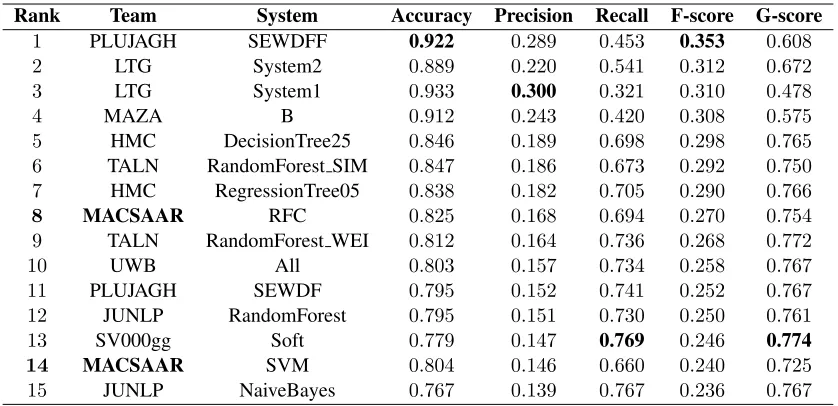
Table 2:The top 15 out of 45 systems in the shared task, ranked by their F-score.
obtained by all participants is available in the shared task report (Paetzold and Specia, 2016).
In Table 2 we include the top 15 submissions ranked by F-Score. We report results in terms of Accuracy, Precision, Recall, F-score, and G-score. The best scores for each metric are presented in bold.9 Our best performing system (RFC) achieved 82.5% accuracy and 27% F-Score. Our second sys-tem (SVM), scored 2.1 percentage points accuracy and 3.0 percentage points less than the one using RFC.10 Our best submission was ranked 8th in the CWI task in terms of both F-Score and G-Score.
We observed that some systems were trained to obtain good Recall and G-Score, for example the system ranked 13th by team SV000gg, while oth-ers obtained high Accuracy, for example the systems by teams LTG (System1), PLUJAGH, and MAZA which obtained accuracy scores higher than 90%. No system delivered a balanced combination of both scores which confirms the difficulty of this task.
Finally, as to the performance of the NNC system, we tested the NNC model on the gold data and this system achieved 75.9% accuracy and 11% F-score. As expected, it did not perform well because of the split between training and test set.
9G-score is the harmonic mean between Accuracy & Recall. 10In the official CWI task scores (Paetzold and Specia, 2016),
our second system is referred to as NNC even though it used an SVM. This occurred because we substituted the output of the NNC for the SVM but were unable to change the entry’s name.
5 Conclusion and Future Work
The twoMacSaar submissions were ranked on the top half of the table, among the top 15 out of 45 en-tries, in the SemEval-2016 Task 11: Complex Word Identification (CWI). Our best system using a Ran-dom Forest Classifier was ranked 8thin terms of both F-score and G-Score. This indicates that the per-formance we obtained can be comparable to other state-of-the-art systems for this task.
More than a good performance, we showed that the use of Zipfian features are a good source of in-formation for this task. The frequency of occurrence and word length in complex and simple words are two interesting variables to be investigated in fu-ture work. By looking at the relationship between word frequencies and word length Piantadosi et al. (2011) states that word lengths are optimized for ef-ficient communication and that ‘information content is a considerably more important predictor of word length than frequency’. In our approach we did not take information content into account and we would like to investigate this in the future.
Acknowledgments
We would like to thank Gustavo Paetzold and Lucia Specia for organizing the CWI shared task. We also thank the anonymous reviewers and Shervin Mal-masi for their feedback.
Liling Tan is supported by the People Programme (Marie Curie Actions) of the European Union’s Sev-enth Framework Programme FP7/2007-2013/ under REA grant agreement n◦317471.
References
Valerie Adams. 2001. Complex words in English. Rout-ledge.
Sandra M Alu´ısio, Lucia Specia, Thiago AS Pardo, Er-ick G Maziero, and Renata PM Fortes. 2008. Towards brazilian portuguese automatic text simplification sys-tems. InProceedings of DocEng.
Marıa Jes´us Aranzabe, Arantza Dıaz de Ilarraza, and Itziar Gonzalez-Dios. 2012. First approach to auto-matic text simplification in basque. InProceedings of the NLP4ITA Workshop.
Gianni Barlacchi and Sara Tonelli. 2013. Ernesta: A sen-tence simplification tool for childrens stories in Italian. InProceedings of CICLing.
Stefan Bott, Luz Rello, Biljana Drndarevic, and Hora-cio Saggion. 2012. Can spanish be simpler? lexsis: Lexical simplification for spanish. InProceedings of Coling.
Daniel Dahlmeier, Hwee Tou Ng, and Siew Mei Wu. 2013. Building a large annotated corpus of learner english: The nus corpus of learner english. In Pro-ceedings of the BEA Workshop.
Binyam Gebrekidan Gebre, Marcos Zampieri, Peter Wit-tenburg, and Tom Heskes. 2013. Improving native language identification with tf-idf weighting. In Pro-ceedings of the BEA Workshop.
Paul Grice. 1975. Logic and conversation. InSyntax and Semantics, pages 41–58. Academic Press, New York. Shervin Malmasi and Mark Dras. 2014. Language
Transfer Hypotheses with Linear SVM Weights. In Proceedings of EMNLP.
Shervin Malmasi and Mark Dras. 2015. Multilingual Native Language Identification. InNatural Language Engineering.
Shervin Malmasi, Eshrag Refaee, and Mark Dras. 2015a. Arabic Dialect Identification using a Parallel Multidi-alectal Corpus. InPACLING.
Shervin Malmasi, Joel Tetreault, and Mark Dras. 2015b. Oracle and Human Baselines for Native Language Identification. InProceedings of the BEA Workshop.
Gustavo Henrique Paetzold and Lucia Specia. 2015. LEXenstein: A framework for lexical simplification. InProceedings of ACL.
Gustavo Henrique Paetzold and Lucia Specia. 2016. Se-meval 2016 task 11: Complex word identification. In Proceedings of SemEval.
F. Pedregosa, G. Varoquaux, A. Gramfort, V. Michel, B. Thirion, O. Grisel, M. Blondel, P. Prettenhofer, R. Weiss, V. Dubourg, J. Vanderplas, A. Passos, D. Cournapeau, M. Brucher, M. Perrot, and E. Duches-nay. 2011. Scikit-learn: Machine learning in Python. Journal of Machine Learning Research, 12:2825– 2830.
Steven T Piantadosi, Harry Tily, and Edward Gibson. 2011. Word lengths are optimized for efficient com-munication. Proceedings of the National Academy of Sciences, 108(9):3526–3529.
Matthew Shardlow. 2013. A comparison of techniques to automatically identify complex words. InProceedings of the ACL Student Research Workshop.
Advaith Siddharthan. 2014. A survey of research on text simplification. ITL-International Journal of Applied Linguistics, 165(2):259–298.
Lucia Specia, Sujay Kumar Jauhar, and Rada Mihalcea. 2012. Semeval-2012 task 1: English lexical simplifi-cation. InProceedings of SemEval.
Liling Tan, Marcos Zampieri, Nikola Ljubeˇsic, and J¨org Tiedemann. 2014. Merging comparable data sources for the discrimination of similar languages: The dsl corpus collection. InProceedings of BUCC.
Joel Tetreault, Daniel Blanchard, and Aoife Cahill. 2013. A report on the first native language identification shared task. InProceedings of the BEA Workshop. Wei Xu, Joel Tetreault, Martin Chodorow, Ralph
Grish-man, and Le Zhao. 2011. Exploiting syntactic and distributional information for spelling correction with web-scale n-gram models. InProceedings of EMNLP. Liang-Chih Yu, Lung-Hao Lee, and Li-Ping Chang. 2014. Overview of grammatical error diagnosis for learning chinese as a foreign language. In Proceed-ings of ICCE.
Marcos Zampieri and Liling Tan. 2014. Grammatical error detection with limited training data: The case of chinese. InProceedings of ICCE.
Marcos Zampieri, Liling Tan, Nikola Ljubeˇsic, J¨org Tiedemann, and Preslav Nakov. 2015. Overview of the DSL shared task 2015. In Proceedings of the LT4VarDial Workshop.
George Kingsley Zipf. 1935.The Psychobiology of Lan-guage. Houghton Mifflin.