MUTUALLY TESTING PROCESSES
GIOVANNI BERNARDIa AND MATTHEW HENNESSYb
a IMDEA Software Institute, Madrid, Spain
e-mail address: [email protected]
b
School of Statistics and Computer Science, Trinity College, Dublin, Ireland e-mail address: [email protected]
Abstract. In the standard testing theory of DeNicola-Hennessy one process is considered to be a refinement of another if every test guaranteed by the former is also guaranteed by the latter. In the domain of web services this has been recast, with processes viewed as serversand tests asclients. In this way the standard refinement preorder between servers is determined by their ability to satisfy clients.
But in this setting there is also a natural refinement preorder betweenclients, determined by their ability to be satisfied by servers. In more general settings where there is no distinction between clients and servers, but all processes are peers, there is a further refinement preorder based on the mutual satisfaction ofpeers.
We give a uniform account of these three preorders. In particular we give two character-isations. The first is behavioural, in terms of traces and ready sets. The second, for finite processes, is equational.
1. Introduction
The DeNicola-Hennessy theory of testing [NH84, DH87, Hen88] considers a process pto be a refinement of processq if every test passed byp is also passed byq. Recently, in papers such as [LP07, Bd10, CGP09, Pad10], this refinement preorder has been recast with a view to providing theoretical foundations for web services. Here processes are viewed asservers and tests viewed asclients. In this terminology the standard (must) testing preorder is a refinement preorder between servers, which we denote by p @∼svr q; this is determined by the ability of the servers p, qto satisfy clients. However in this framework there are many other natural behavioural preorders between processes. In this paper we investigate two; the first, p@∼clt q, is determined by the ability of the clientsp, qto be satisfied by servers. For the second we drop the distinction between clients and servers. Instead all processes are viewed as peers of each other and the purpose of interaction between two peers is the
2012 ACM CCS: [Theory of computation]: Semantics and reasoning—Program semantics; Models of computation—Concurrency—Process calculi.
Key words and phrases: process equivalences, testing theory of processes, servers clients and peers, algebraic characterizations.
a,b
Research supported by SFI project SFI 06 IN.1 1898.
LOGICAL METHODS
l
IN COMPUTER SCIENCE DOI:10.2168/LMCS-11(2:1)2015c
G. Bernardi and M. Hennessy CC
mutual satisfaction of both. The resulting refinement preorder is denoted byp@∼p2pq. We give a uniform behavioural characterisation of all three refinement preorders in terms of traces andacceptances sets [NH84, Hen88]. We also give equational characterisations for a finite process calculus for servers/clients/peers.
We use an infinitary version of CCS [Mil89] augmented by a success constant 1, to describe processes, be they servers, clients or peers. Thus p=τ.a.(b.0+c.0) +τ.a.c.0is a server which offers the action afollowed by either b and c depending on how choices are made, and then terminates, denoted by0. On the other hand r=a.c.1 is a test or a client which seeks a synchronisation on afollowed by one on c; as usual [Mil89] communication or cooperation consists of the simultaneous occurrence of an action aand its complement a. Thus when the server pis executed in parallel with the client r, the latter will always be satisfied, in that it is guaranteed to reach the successful state1regardless of how the various choices are made. But if the client is executed with the alternative serverq=τ.a.b.0+τ.a.c.0
there is a possibility of the client remaining unhappy; for this reasonp6@∼svr q. However it turns out thatq @∼svrp because every client satisfied byq will also be satisfied byp.
The client preorderp@∼clt q compares the processes as clients, and their ability to be satisfied by servers. This refinement preorder turns out to be incomparable with the server preorder. For example a.1+b.06@∼svr a.1 because of the client b.1. But a.1+b.0@∼clt a.1
because every server satisfying the former also satisfiesa.1; intuitively the extra component of the client b.0 puts no further demands on servers, because the execution ofb will never lead to satisfaction. Converselya.1@∼svr a.0because 1plays no role for processes acting as servers, while a.16@∼clt a.0;a.1 as a client is satisfied by the servera.0 whilea.0 can never be satisfied as a client by any server. Behaviour relative to the client preorder@∼clt is very sensitive to the presence of1and0; for example0 is a least element, that is0@∼clt r for any processr.1 However in general the precise role these constants play is difficult to discern; for example, rather surprisingly we have a.(b.0+c.1) +a.(b.1+c.0)@∼clt 0.
If we ignore the distinction between servers and clients then every process plays an independent role as apeer to all other processes in its environment. This point of view leads to another behavioural preorder. Intuitively, we say that the processp satisfies its peerq if whenever they are executed in parallel both are guaranteed to be satisfied; in some sense both peers test their partner. Thenp1@∼p2p p2 means that every peer satisfied byp1 is also
satisfied by p2.
The peer preorder is different from the server and client preorders. In fact we will show that p1 @∼p2p p2 implies p1 @∼clt p2; but the converse is not true in general. For example
1+b.0@∼clt 1but1+b.0∼@6 p2p1because of the peerb.1. In our formulation1+b.0andb.1
mutually satisfy each other, whereas the peers 1and b.1do not.
The aim of the paper is to show that the theory of the standard (must) testing preorder [NH84, Hen88], here formulated as the server refinement preorder@∼svr, can be extended to both the client and the peer refinement preorders.
It is well-known that the behaviour of processes relative to@∼svr can be characterised in terms of the traces they can perform followed byready oracceptance sets; intuitively each ready setAafter a tracescaptures a possibility for the process to deadlock when interacting with a client. For example the processq =τ.a.b.0+τ.a.c.0has the ready set {b}after the (weak) sequence of actionsa; this represents the possibility of q deadlocking if servicing a
client which requests an action abut then is not subsequently interested in the action b. The process p=a.(b.0+c.0) +a.c.0, also discussed above, has no comparable ready set and for this reason p6@∼svr q.
The first main result of the paper is a similar behavioural characterisation of both the client and the peer refinement preorders, in terms of certain kinds of traces and ready sets. However the details are intricate. It turns out that unsuccessful traces, those which can be performed without reaching a successful state, play an essential role. We also need to parametrise these concepts, relative to usable actions and usable processes; the exact meaning ofusable will depend on the particular refinement preorder being considered.
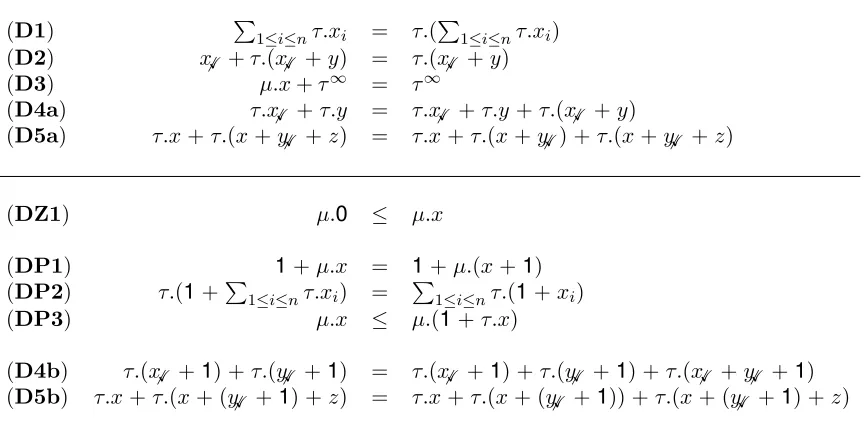
It is also well-known that the standard testing preorders over finite processes can be characterised by a collection of (in-)equations over the process operators, [NH84, Hen88]. The second main result of the paper is a similar characterisation of the new refinement preorders. In fact there is a complication here, as these preorders are not in general preserved by the external operator +. A similar complication occurred in Section 7.2 of [Mil89] in the axiomatisation of weak bisimulation equivalence, and in the axiomatisations of themust testing preorder in [NH84], and we adopt the same solution. We give sound and complete (in-)equational theories for the largest pre-congruences@∼cclt,@∼cp2p contained in the refinement preorders @∼clt,@∼p2p respectively, over a finite version of CCS. The presence of the success constant 1in this language complicates the axiomatisations considerably, as the behaviour of clients and peers is very dependent on their ability to immediately report success. For this reason we reformulate the axiomatisation of must testing preorder from [NH84], which in this paper coincides with the server preorder @∼c
svr, as a two-sorted equational theory.
The characterisation of the client and server preorders, @∼cclt,@∼csvr respectively, requires extra equations to capture the behaviour of the special processes 1 and 0. For example one of the inequations required by the client preorder isx≤1, while those for the peer preorder includeµ.(1+x)≤1+µ.x.
The remainder of the paper is organised as follows. Section 2 is devoted to definitions and notation. We introduce a language for describing processes, an infinitary version of theCCSused in [Mil89], and give the standard intensional interpretation of it as a labelled transition system, LTS. For the remainder of the paper, processes will then be considered to be states in the resulting LTS. We also formally define the three different refinement preorders discussed informally in the Introduction, by generalising the standard notion from [NH84] of applying tests to processes.
We begin Section 3 by recalling the well-known characterisation of the must preorder (Theorem 3.1) for finite branching LTSs from [NH84] in terms of traces and ready sets. To adapt this for the client preorder we need some extra technical notation. This is motivated by a series of examples, until we finally obtain a statement of the characterisation theorem (Theorem 3.13). The proof of this result is delegated to a separate subsequent section, Section 4. Meanwhile Section 3 continues by showing how the notation used in this characterisation of the client preorder can be modified in a uniform manner to give an analogous characterisation of the server preorder, (Theorem 3.15), which applies even in LTSs which are not finite-branching. Finally by combining these we get an analogous characterisation (Theorem 3.20) for the peer preorder.
is the topic of the next sub-section, Section 4.2, while the converse completeness is covered in the final sub-section.
Section 5 is similar in structure, but deals with the behavioural characterisation of the peer preorder.
In Section 6 we restrict our attention to a finite sub-language CCSf and address the question of equational characterisations. We first show why the client and peer refinement preorders are not preserved by the external choice operator +, and give a simple behavioural characterisation of the associated pre-congruences@∼c
svr, @∼
c
clt and @∼
c
p2p; this simply involves
taking into account the initial behaviour of processes. We then explain the equations which need to be added to the standard set in order to obtain an equational characterisation of the client and peer pre-congruences; These are stated in Theorem 6.7 and Theorem 6.9 respectively. The proof of the soundness of the equations is straightforward and is left to the reader. But the completeness is considerably more complex and the details are self-contained in a separate section, Section 7. This again is divided into three sub-sections. The first is devoted to the exposition of normal-forms which are crucial to the completeness proofs. This is followed by two sub-sections, dealing with the client preorder first, followed by the peer preorder.
The paper ends with Section 8, where we present a summary of our results, a comparison with the existing work, and a series of open questions. Most of the material described in the paper, in particular the results in Section 3 to Section 5, was originally reported in [Ber13].
2. Testing processes
LetAct be a set of actions, ranged over bya, b, c, . . .and letτ,Xbe two distinct actionsnot inAct; the first will denote internal unobservable activity while the second will be used to report the success of an experiment. To emphasise their distinctness we use Actτ to denote
the setAct∪ {τ}, and similarly forActτX; we useµto range over the former andλto range over the latter. We assumeAct has an idempotent complementation function, with abeing the complement toa. A labelled transition system, LTS, consists of a triplehP,ActτX,−→ i, whereP is a set of states and −→ ⊆ P×ActτX×P is a transition relation between states decorated with labels drawn from the setActτX. We use the infix notationp
λ
−→q in place of (p, λ, q)∈ −→. An LTS is finite-branching if for all p∈P and for allλ∈ActτX, the set {q | p−→λ q} is finite. Single transitionsp−→λ q are extended to sequences of transitions p −→t q, wheret ∈(ActτX)?, in the standard manner. For s∈ (ActX)? we also have the standard weak transitions, p=s⇒q, defined by ignoring the occurrences of τs. Somewhat nonstandard is the use of infinite weak transitions, p=u⇒, for u∈(Act)∞. Finally we lift in the obvious way the complementation function to both finite and infinite traces, so that, for example, sis the complement ofs.
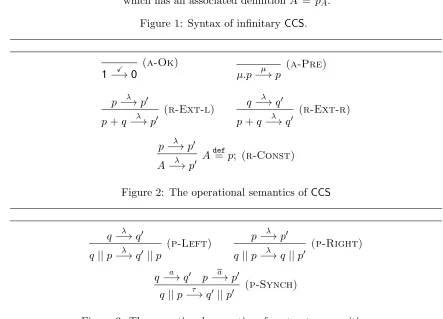
It will be convenient to have a notation for describing LTSs; we use an infinitary version of CCS, [Mil89], augmented with a success operator, 1. The syntax of the language is depicted in Figure 1. We use 0 to denote the empty external sum P
i∈∅pi and p1 + p2 for the binary sum P
i∈{1,2}pi. If I is a non-empty set, we use Li∈Ipi to denote the
sumP
i∈Iτ.pi. For the remainder of the paper we use the LTS whose states are the terms in
p, q, r ::= 1 | A | µ.p | X
i∈I
pi
where I is a countable index set, and Aranges over a set of definitional constants each of which has an associated definitionAdef= pA.
Figure 1: Syntax of infinitaryCCS.
1−→X 0
(a-Ok)
µ.p−→µ p (a-Pre)
p−→λ p0
p+q −→λ p0 (r-Ext-l)
q−→λ q0
p+q−→λ q0 (r-Ext-r)
p−→λ p0
A−→λ p0 A def
= p; (r-Const)
Figure 2: The operational semantics ofCCS
q −→λ q0
q||p−→λ q0 ||p (p-Left)
p−→λ p0
q||p−→λ q ||p0 (p-Right)
q−→a q0 p−→a p0
[image:5.612.80.523.171.490.2]q ||p−→τ q0 ||p0 (p-Synch)
Figure 3: The operational semantics of contract composition
CCSwhich generate finite branching structures. These are the ps inCCSsuch that the set {q | p−→λ q} is finite.
To model the interactions that take place between the server and the client contracts, we introduce a binary composition of contracts, p ||r, whose operational semantics is in Figure (3).
A computation consists of series ofτ actions of the form
p||r=p0||r0 −→τ p1 ||r1−→τ . . .−→τ pk||rk τ
−→. . . (2.1)
It is maximal if it is infinite, or whenever pn || rn is the last state then pn || rn τ
6−→. A computation may be viewed as two processes p, r, one a server and the other a client, co-operating to achieve individual goals, which may or may not be independent. We say that the computation in (2.1) is client-successful if there exists somek≥0 such thatrk−→X .
It is successful if it is client-successful and there exists an l ≥ 0 such that pl −→X . In a
both the client and the server can report success; note however that they are not required to do so at the same time.
Definition 2.1 ( Passing tests ). We write pmust r if every maximal computation from p||r isclient-successful. We write pmustp2p r if every such computation issuccessful.
Intuitively, p must r means that the client r is satisfied by the server p, as r always reaches a state where it can report success. On the other hand,pmustp2pr means thatp passesr andr also passesp; so p andr have to collaboratein order to pass each other. This is why when using the testing relation mustp2p we think ofp andr as two peers rather than a server and a client.
Definition 2.2 ( Testing preorders ). In an arbitrary LTS we write (1) p1@∼svr p2 if for every r,p1mustr impliesp2 mustr
(2) r1@∼clt r2 if for everyp,pmustr1 impliespmustr2
(3) p1@∼p2p p2 if for everyr,p1 mustp2p r implies p2 mustp2p r.
We use the obvious notation for the kernel of these preorders; for instancep1 hp2pp2 means
thatp1@∼p2p p2 andp2@∼p2p p1.
The preorder @∼svr is meant to compare servers, as p1 @∼svr p2 ensures that all the clients
passed (wrt must) by p1 are passed also by p2. The preorder@∼clt relates processes seen as
clients, becauser1 @∼cltr2 means that all the servers that satisfyr1 satisfy alsor2. The third
preorder, @∼p2p, relates processes seen as peers; this follows from the fact that pmustp2p r is true only if pand r mutually satisfy each other.
3. Semantic characterisations
The standard (must) testing preorder from [NH84, Hen88] has been characterised for finite-branching LTSs using two behavioural predicates. The first, p⇓s, says that p can never come across a divergent residual while executing the sequence of actions s∈Act?. We use the notation p⇓,pconverges, to mean that there is no infinite sequence
p−→τ p1 −→τ . . .−→τ pk τ
−→. . .
Then the general convergence predicate is defined inductively as follows: (a) p⇓εwheneverp⇓
(b) p⇓aswhenever (1) p⇓and
(2) if p=a⇒then L
(paftera)⇓s
where (pafters) denotes the set{p0 | p=⇒s p0}. Note thatp=a⇒ensures that (paftera) is
non-empty; thusL
(paftera) consists of the choice between the elements of the non-empty set (paftera), which may in general be infinite.
The second predicate codifies the possible deadlocks which may occur when a process p attempts to execute the (weak) trace of actions s∈Act?:
Acc(p, s) ={S(q) | p=⇒s q 6−→ }τ (3.1)
Acc(p, s) describe the interactions that can lead p out of a possible deadlock, reached by executing the tracesof external actions.
Theorem 3.1. [DH87, Hen88] In finite branching CCS, p @∼svr q if and only if, for every s∈Act?, if p⇓sthen
(i) q ⇓s,
(ii) for every B ∈Acc(q, s) there exists someA∈Acc(p, s) such that A⊆B.
As might be expected, the behavioural properties used in Theorem 3.1 do not characterise the preorder @∼clt:
Counterexample 3.2. We prove that r1@∼cltr2 does not imply that r1 and r2 satisfy the
requirements of Theorem 3.1.
One can prove thatr1@∼clt r2, wherer1, r2 denoteb.a.1andb.(c.0+1)respectively. Now
consider the singleton trace b; obviously ri ⇓b fori= 1,2. However calculations show that
{c} ∈Acc(r2, b) and that Acc(r1, b) ={ {a} }. So there is no setA in Acc(r1, b) satisfying A⊆ {c}.
Our intention is to provide a behavioural characterisation of the client preorder @∼clt, and later the peer preorder, along the lines of the characterisation of the server preorder@∼svr given in Theorem 3.1. This will require the elaboration of new behavioural predicates which capture behaviour relevant to clients. Or approach is incremental. To motivate the role of these new predicates we first define two tentative “bad” characterisations of @∼clt. In a series of examples we show the problems which arise with these characterisations, and which will motivate the necessity for our new client oriented behavioural predicates. These are then collated in Definition 3.10 to give the behavioural characterisation of @∼clt.
Some additional notation is in order. In Example 3.2 there is no need to require that the ready set{c} ∈Acc(q, b) be matched by one in Acc(b.a.1, b), becauseq can report success immediately after performingb. Intuitively ready sets need only be matched when success has not yet been reported. In order to capture this intuition we use the following predicate.
For everys∈Act? letp=s⇒6Xq be the least relation satisfying
(a) p 6−→X implies p=⇒ε 6Xp
(b) ifp0=⇒s
6Xq and p X 6−→then • p−→a p0 impliesp=as⇒6Xq • p−→τ p0 impliesp=s⇒
6Xq
Intuitively,p=s⇒6Xqmeans thatpcan perform the sequence of external actionssending up in stateqwithout passing through any state which can report success; in particular neitherpnor qcan report success. This notation is extended to infinite traces,u∈Act∞, by lettingp=u⇒6X whenever there exists at∈(Actτ)∞ such that t=µ1µ2. . ., (a) p=p0
µ1 −→p1
µ2 −→p2
µ3 −→. . .
implies that pi
X
6−→ for everypi, and (b) for every n∈ N there exists a k ∈ N such that, un=htki\τ; wherehti\τ is the string obtained removing theτs from t.
Definition 3.3. For every processp and trace s∈Act?, let
Acc6X(p, s) ={S(q) | p=⇒s 6Xq
τ
6−→ }
Our first attempt at adapting the characterisation for servers in Theorem 3.1 to clients is as follows:
Definition 3.4. Let r1 4bad r2 if for every s∈Act?, ifr1 ⇓s then (i) r2 ⇓s, and (ii) for everyB ∈Acc6X(r2, s), there exists someA∈Acc6X(r1, s) such thatA⊆B.
Counterexample 3.5. In this counterexample we show that the relation4badis not complete
wrt. @∼clt, that is @∼clt 6⊆4bad. One can show that r @∼clt c.a.1 where r denotes the client c.(a.1+b.0). However r and c.a.1 are not related by the proposed 4bad in Definition 3.4.
Obviouslyr⇓cand{a} ∈Acc6X(c.a.1, c). But there is noA∈Acc6X(r, c)such thatA⊆ {a}; this is because Acc6X(r, c) ={ {a, b} }; thus r64bad c.a.1.
The problem is the presence of b in the ready set of a.1+b.0.
Intuitively, in the previous example the actionbisunusable forr after having performed the unsuccessful tracec; this is because performing bleads to a client,0, which is unusable, in the sense that it can never be satisfied by any server. When comparing ready sets after unsuccessful traces in Definition 3.4 we should ignore occurrences ofunusable actions.
LetUclt={r | pmustr, for some server p}. The setUclt contains the usable clients, those satisfied by at least one server. We also need to consider the residuals of a clientr only after unsuccessful traces (see Counterexample 3.8): for any process r and s∈Act? let
(rafter6X s) ={q | r =s⇒6Xq} (3.2)
The usability of a client, then, is parametrised over traces: for every s∈Act?, the client usability along an unsuccessful traces, denoted usbl6Xs, is defined by induction ons: (a) r usbl6Xεwhenever r ∈ Uclt
(b) r usbl6Xas whenever (1) r∈ Uclt and
(2) if r=a⇒6X then L(r after6Xa)usbl6Xs
The predicateusbl6X is extended to infinite tracesu∈Act∞in the obvious manner. Intuitively r usbl6X s means that any state reachable from r by performing any subsequence of s is usable. Note that only unsuccessful traces have to be taken into the account, and also that the definitions of the predicates ⇓and usbl6X have the same structure.
Definition 3.6. The set of usable actions for a clientr after the trace sis defined as
uaclt(r, s) ={a∈Act | r
sa
=⇒6X impliesr usbl6Xsa}
Now we define a second tentative characterisation of@∼clt, denoted40bad, by replacing in
Definition 3.4 the set inclusion A⊆B with the more relaxed condition
A∩uaclt(r1, s)⊆B (3.3)
Example 3.7. We revisit Counterexample 3.5, and prove thatr 40bad c.a.1, thereby correctly
reflecting the fact that r @∼clt c.a.1 and improving on4bad.
Let us see why r 40bad c.a.1. Recall that Acc6X(r, ε) ={ {c, b} }, and observe that the
action b is not in uaclt(r, c) because r =cb⇒6X and r 6usbl6X cb. The last fact is true because (r after6Xcb)is the singleton set{0}, and0is not inUclt. Instead we haveuaclt(r, c) ={a},
and so the inclusion in Eq. (3.3) used to define 40bad is satisfied by the ready sets at hand,
because
Before critiquing the second attempted chaaracterisation, 40bad, let us point out that in
the definition of usbl6Xit is necessary to consider only unsuccesful traces.
Counterexample 3.8. In this counter example we prove that if in the definition of usbl6X
above we consider all the traces rather than only the unsuccessful ones, then the relation40bad
is not sound wrt @∼clt, that is 40bad 6⊆@∼clt.
Consider the client r = b.(τ.(1 + a.0) + τ.a.τ.1). First note that b.a.0 must r while b.a.06mustb.0 and thereforer 6@∼clt b.0.
Suppose that usbl6X was defined using =⇒ and after in place of =⇒6X and after6X. We prove that r 40bad b.0.
The set (r after ba) is {0,1}, so L
(r after ba) is the client τ.0 + τ.1, which is not in Uclt. This implies that uaclt(r, b) contains only actions not performed by r after b,
therefore any ready set B∈Acc6X(b.0, b) can be matched according to Eq. (3.3) by the ready set {a} ∈Acc6X(r, b), because A∩uaclt(r, b) =∅. From this r40bad b.0 follows.
However with the correct definition of usbl6X this reasoning no longer works because
uaclt(r, b) ={a}.
Unfortunately, as might be expected, the relation40bad is still not sufficient to obtain a
complete characterisation of the client preorder; one more adjustment is required.
Counterexample 3.9. Here we prove that the relation 40bad is not complete wrt @∼clt.
Consider the clients r1 = a.(b.d.0+b.1) and r2 = a.c.d.1. As r1 is not usable r1 @∼clt r2,
although r1 640badr2. To see this first note{d} ∈Acc6X(r2, ac), and r1 ⇓ac, althoughr1 can not actually perform the sequence of actions ac; r1⇓acmerely says that if r1 can perform any prefix of the sequence acto reach r0 thenr0 must converge. Sincer1 can not perform the sequence of actions ac, Acc6X(r1, ac) is empty; thus no ready set B can be found to match the ready set {d}.
To fix the problem highlighted in Example 3.9 we need to reconsider when ready sets are to be matched. In Definition 3.4 this matching is moderated by the predicate⇓s; for example a.(τ∞+b.1)4bada.c.d.1, where τ∞ denotes some process which does not converge. This is
because a.(τ∞+b.1) ⇓a is false and therefore the ready set {c} ∈ Acc6
X(a.c.d.1, a) does not have to be matched bya.(τ∞+b.1). However the client preorder is largely impervious to convergence/divergence. For example1hclt (1+τ∞).
It turns out that we have to moderate the matching of ready sets, not via the convergence predicate, but instead via usability. One can show that if r1 @∼clt r2 and r1 usbl6X s then r2 usbl6Xs. In fact this predicate describes precisely when we expect ready sets of clients to be compared.
Definition 3.10 ( Semantic client-preorder ). In any LTS, letr1-clt r2 if (1) for every s∈Act? such thatr1usbl6Xs,
(a) r2 usbl6Xs,
(b) for every B ∈Acc6X(r2, s) there exists some A∈Acc6X(r1, s) such that A∩uaclt(r1, s)⊆B
(2) for every w∈Act?∪Act∞ such that r1 usbl6Xw,r2=w⇒6X implies r1 =w⇒6X.
q
q2 q1
q0 q3 . . .
a
a aa
[image:10.612.95.526.112.229.2]a a
Figure 4: Infinite traces
Consequently r1 usbl6Xacdoes not hold, and therefore when checking whether r1 -clt r2 holds the ready set {d} ∈Acc6X(r2, ac) does not have to be matched byr1.
Indeed it is now straightforward to check that r1 -clt r2; the only s∈Act? for which
Acc6X(r2, s) is non-empty andr1usbl6X sis the empty sequence ε.
In passing let us note that in general, and in particular in LTSs which are not finite branching, the condition on the existence of infinite computations in (2) of Definition 3.10 does not follow from the condition on finite computations.
Example 3.12. Consider the process q from Figure 4, where qk denotes a process which
performs a sequence of k aactions followed by 1. Let p be a similar process, but without the self loop. Thenpusbl6Xsand q usbl6Xsfor every s, and the pair(p, q)satisfies condition (1) of -clt, and condition (2) on finite ws. However condition (2) on infinite ws is not satisfied:
if u denotes the infinite sequence of as then q=u⇒6X but p
u
6
=⇒6X.
In factp6@∼cltq. For consider the process Adef= a.A. When pis run as a test on A, or as a client using the server A, every computation is finite and successful;Amustp. However when q is run as a test, there is the possibility of an infinite computation, the indefinite synchronisation on a, which is not successful; A must6 q.
Theorem 3.13. In CCS, r1 @∼clt r2 if and only if r1-clt r2.
Proof. It follows from Theorem 4.6 and Theorem 4.10 of Section 4.
The server-preorder@∼svr can be characterised behaviourally in manner dual to that of Definition 3.10, using the set of usable serversUsvr={p | pmustr, for some clientr}, the usable actions
uasvr(p, s) ={a∈Act | p=s⇒ implies pusblsa}
and the server convergence predicate p ⇓svr s, defined as the conjunction of p ⇓s and a
server usability predicate pusbls. This latter predicate is defined inductively in a manner similar to usbl6Xs, but over all tracess, rather than simply the unsuccessful ones.
Definition 3.14 ( Semantic server-preorder ). In any LTS, let p-svr q if
(1) for every s∈Act? such thatp⇓svr s,
(a) q⇓svr s,
(b) for every B ∈Acc(q, s) there exists some A∈Acc(p, s) such that
A∩uasvr(p, s)⊆B
(2) for every w∈Act?∪Act∞ such that p⇓svr w,q=w⇒ implies p=u⇒.
Proof. The standard argument of [Hen88] suffices, but for the condition on infinite traces, which we prove here.
Let u = a1a2a3. . ., and Cn
def
= τ.1 + an.Cn+1 for every n ∈ N. No Cn is successful,
so the infinite computation of C0 || p2 due to the trace u proves that p2 6must C0. The
hypothesis p1 @∼svr p2 implies that p1 6must C0. For a contradiction, suppose that p1
u
6
=⇒. The assumption p1 ⇓svr u implies p1 ⇓u, which in turn lets us prove that all the maximal computations of C0 ||p1 are client-successful. But this is not possible, asp1 6must C0. It follows thatp1 =u⇒.
Theorem 3.15 is a generalisation of Theorem 3.1, as the server usability predicate Usvr is degenerate: it holds for every process, since any process used as a server trivially satisfies the degenerate client1.
Let us now consider the peer preorder. The following result is hopeful:
Proposition 3.16. InCCS, r1@∼p2p r2 implies r1 @∼cltr2.
Proof. First note that using Theorem (3.15) one can prove that 1 + p @∼svr p and that p@∼svr1+p.
Now suppose that p must r1; it follows that 1 + p must r1, and so 1 + p mustp2p r1 because 1 + p is trivially satisfied. The hypothesis imply that 1 + p mustp2p r2, thus
1+pmustr2. In turn this ensures thatpmustr2.
Unfortunately, the peer preorder isnot contained in the server preorder:
Example 3.17. It is easy to see that a.0@∼p2p b.0. This is true because a.0 can never be satisfied, for it offers no Xat all. However, a.06@∼svrb.0, as the client a.1 is satisfied bya.0, whereasb.06musta.1.
Intuitively, the reason why @∼p2p 6⊆ @∼svr is that the server preorder does not reflect the factthat servers should now act as peers; that is they should also be satisfied by their interactions with clients. To take this into account we introduce the usability of peers and amend the definition of -svr accordingly. In principle we should introduce the set of
usable peers,Up2p={p | pmustp2pr for some peerr}. However, since Up2pturns out to coincide withUclt, instead we define the peer convergence predicate by using the usability predicate ofclients. For everyw∈Act?∪Act∞, letp⇓p2p w wheneverp⇓wand pusbl6Xw.
Definition 3.18. Letp-usvr q whenever
(1) for every s∈Act?, ifp⇓p2p sthen (a) q⇓s,
(b) for every B ∈Acc(q, s) there exists some A∈Acc(p, s) such that A∩uaclt(p, s)⊆B
(2) for every w∈Act?∪Act∞, ifp⇓p2p w, and q
w
=⇒, thenp=w⇒.
Definition 3.19 ( Semantic peer-preorder ). Let p-p2p q ifp-cltq and p-usvrq.
Note that the definition ofp-p2pq isnot simply the conjunction of the client and server
preorders from Definition 3.10 and Definition 3.14. It is essential that the usable set of peers Up2pbe employed.
Theorem 3.20. In CCS, p@∼p2p q if and only if p-p2p q.
4. Characterising the client behaviour
This section is devoted to the proof of behavioural characterisation of the client preorder, Theorem 3.13. For convenience it is divided into three subsections. The first gathers some preliminary technical properties of the various predicates used in the characterisation; the second is devoted tosoundness and the final one to completeness.
4.1. Preliminaries. Here we collect some technical results on the interplay between the testing predicatepmustr and the client and action usability predicates. The two corollaries below are the main results of the section.
Lemma 4.1. Suppose pmustr where p=s⇒q. Then r =s⇒6Xr0 implies q mustr0.
Proof. Straightforward as any maximal computation from q || r0 can be prefixed by an
unsuccessful sequence of reduction steps to obtain a maximal computation fromp||r.
Corollary 4.2. Suppose pmustr where p=⇒s q. Then r usbl6Xs.
Proof. By induction ons. If s is the empty sequence ε then the result is immediate, as pmustr ensures thatr∈ Uclt. So assumeshas the formb.t and r=⇒b 6X. We have to show thatL
(rafter6X a)usbl6X t.
Letp=⇒b pb t
=⇒q. By Lemma 4.1 we knowpb mustr0 wheneverr b
=⇒6Xr0. This in turn means that pamust
L
(r after6Xa). Now apply induction.
Proposition 4.3. Suppose pmustr andp=sa⇒q. Then r=⇒s 6Xr0
a
−→r00 implies qmustr00.
Proof. Suppose thatp=sa⇒q and thatr =s⇒6X
a
−→r00. We proveq must6 r00 impliesp must6 r. Since q must6 r00 there must exist a maximal unsuccessful computation from
q ||r00 =q0 ||r000
τ
−→q1||r100
τ
−→q2 ||r002
τ
−→. . . (4.1)
such thatr00k 6−→X for everyk≥0. In particularr00 6−→X. The two derivationsp =sa⇒q andr =⇒s 6Xr0
a
−→r00 can be zipped together to obtain a
computation
p||r=p0 ||r0−→τ p1 ||r1 −→τ . . . pn||rn=q||r00 (4.2)
Moreover hereri
X
6−→for every 0≤i≤n.
Now the computation in (4.2) can be continued using the one in (4.1), leading to a maximal computation fromp||r which is unsuccessful. It follows thatp must6 r.
Corollary 4.4. Suppose pmustr where p=sa⇒q and r=s⇒r0 −→a r00. Then a∈uaclt(r, s). Proof. If r =6sa⇒6X, then by Definition 3.6 a∈ uaclt(r, s). If r
sa
=⇒6X, then we have to prove thatr usbl6Xsa; the argument relies on the previous proposition and induction ons.
Ifsis empty then L
(rafter6Xa)usbl6Xεbecause of the previous proposition.
If s=bt, then p=⇒b p0 =ta⇒ q. An application of the previous proposition to p=⇒b p0 ensures that p0 must r00 for every r00 ∈ (r after6X b), so p0 must L
(r after6X b). As p0 =ta⇒, induction implies that L
Usability ensures that even when a client diverges, it can report success.
Lemma 4.5. If r ∈ Uclt and r ⇑, then for every infinite reduction sequence r = r0 −→τ r1 −→τ r2 −→τ r3 −→τ . . ., there exists an n∈Nsuch that rn−→X .
Proof. Asr∈ Uclt there exists a server psuch that pmustr. Fix a divergent computation of r, and zip it with p,
p||r =p||r0−→τ p||r1 −→τ p||r2 −→τ . . .
The computation must be client-successful, sorn−→X for somen∈N.
4.2. Soundness. Here we prove that the behavioural preorder in Definition 3.10 provides a sufficient set of conditions to capture the client-preorder. It is difficult to break the proof into a series of manageable independent results; instead we have one long monolithic proof.
Theorem 4.6 (Soundness client preorder). r1 -clt r2 implies r1@∼cltr2.
Proof. Fix a pairr1-clt r2, and letpmustr1; we have to show that all the maximal compu-tations of the composition r2 ||p are client-successful. The argument is by contradiction, in that we show that if a maximal computation ofp||r2 is not client-successful, then alsop||r1 performs a non client-successful computation, sop must6 r1.
Fix a maximal computation from p||r2,
p||r2 =p0 ||r02
τ
−→p1 ||r12 −→τ p3 ||r32 −→τ p4 ||r42 −→τ . . . (4.3)
The computation in (4.3) is finite or infinite. We discuss the two cases separately.
Suppose that the computation is finite, and unzip it; the resulting contributions of p and r2 are
r2 =s⇒rk2, p
s
=⇒pk
for somes∈Act?, and stable pk ||rk
2. The hypothesispmustr1, p
s
=⇒, and Corollary 4.2 imply that r1 usbl6X s. Suppose that the computation in (4.3) is not client-successful, so
no state in the contribution of r2 reports success. It follows r2 =s⇒6Xr2k, and as rk2
τ
6−→, S(rk
2) ∈ Acc6X(r2, s); so part (1b) of Definition 3.10 implies that A ∈ Acc6X(r1, s), for some A such that A∩uaclt(r1, s) ⊆ S(r2k). Definition 3.3 implies that there exists a r01
such thatS(r10) =A and r1 =⇒s 6Xr10
τ
6−→. Zipping together the contributions along s of p and r1, the resulting computation reaches the state pk || r01; if this state is stable, then the computation is maximal andnot client-successful, sop6must r1. This contradicts our assumption thatpmustr1.
So it remains to show thatpk||r01 is stable. Suppose, for a contradiction, thatpk c
−→ and r0
1
c
−→, that is c ∈A, for some action c. This situation matches the assumptions in Corollary 4.4 exactly, which gives thatc∈uaclt(r1, s). SinceA∩uaclt(r1, s)⊆S(rk2) this in turn means thatrk
2
c
−→, which contradicts the assumption that p||rk
2 is stable.
We have discussed when the computation in (4.3) above is finite. Now let us suppose that it is infinite. As before unzip it.
If we are in the first case, then
r2 =u⇒, p=u⇒
The assumptionpmustr1, the fact thatp=u⇒, and Corollary 4.2 applied to every prefix ofu, imply thatr1usbl6Xu. The proof that there is a successful term inr2 =u⇒is by contradiction; for suppose that r2 =u⇒6X; then part (2) of Definition 3.10 implies that r1 =u⇒6X. By zipping r1 =u⇒6X with p
u
=⇒ we obtain a maximal computation of p || r1 which is not client-successful; this implies that p must6 r1, which contradicts our original assumption on p.
Suppose now thatp andr2 engage in a finite trace and then there is a divergence; by unzipping the computation in (4.3) we get the contributions
r2 =s⇒rk2, p
s
=⇒pk
The assumption p must r1, the fact that p =⇒s , and Corollary 4.2 imply that r1 usbl6X s. Eitherpk diverges or rk
2 diverges, or both diverge.
Suppose that pk diverges. To prove that the computation in (4.3) is client-successful
we reason by contradiction: suppose that there is no successful state amongr2, . . . , rk2; this implies thatr2 performs the traces unsuccessfully,
r2 =s⇒6X
Part (2) of Definition 3.10 ensures thatr1=⇒s 6Xr01. We zip the contribution ofp with the unsuccessful transition of r1; aspk diverges the resulting computation is maximal,
p||r1 =⇒pk||r10 =⇒pk||r10 =⇒. . . (4.4)
All the derivatives of r1 in the maximal computation above are inr1 =s⇒6Xr10, so they are not successful. It follows that the computation in (4.4) is not client-successful. However this contradicts the assumptionpmustr1.
Finally suppose that rk
2 diverges. If there is a successful state in r2 =⇒s rk2 then the maximal computation we unzipped is client-successful. Therefore suppose that there is no successful state in the contribution of r2, that is r2 =s⇒6Xr2k. As r1 usbl6X s, part (1a) of Definition 3.10 implies thatr2 usbl6X s. Now one can show that this implies that rk2 usbl6Xε. So an application of Lemma 4.5 ensures that the unzipped computation is client-successful.
4.3. Completeness. Here we show the converse of Theorem 4.6, which involves showing that the testing preorderr1 @∼cltr2 implies the collection of properties gathered together in
Definition 3.10. These in turn are quantified over all sequences s∈Act? and w∈Act∞; we handle this quantification using induction over the length of s. First a technical lemma.
Lemma 4.7. Suppose r ∈ Uclt. Then 0 must6 r if and only if r =ε⇒6Xr0
τ
6−→ for some client r0.
Proof. One direction is straightforward. For the converse suppose06mustr; we have to show
that there exists some r0 satisfying r=⇒ε 6Xr0
τ
Since 06mustr there must exist some unsuccessful maximal computation
0||r =0||r0−→τ . . .−→τ 0||rk−→τ . . . (4.5)
Suppose this is infinite. Then p must r can not be true for any server p, as 0 can be replaced in (4.5) by anyp, to obtain an unsuccessful maximal computation from p||r. This contradicts the assumption thatr ∈ Uclt.
So (4.5) has to be finite, with terminal element 0||rn. The required r0 isrn.
Proposition 4.8. Suppose r1 @∼cltr2 where r1 ∈ Uclt. (1) If r2
a
=⇒6X thenr1
a
=⇒6X
(2) for every B∈Acc6X(r2, ε) there exists some set A∈Acc6X(r1, ε) such that A∩uaclt(r1, ε)⊆B
(3) if r2 =a⇒6X then
L
(r1 after6Xa)@∼clt
L
(r2after6X a).
Proof. Throughout letp1 be a server such that p1 mustr1.
(1) Letp=p1+a.τ∞. As p diverges after the interaction ona, andr2 performs awithout reaching successful states, p 6must r2. The hypothesis implies p 6must r1. In turn this ensures that r1 =a⇒6X, for otherwise the assumption on p1 would imply thatpmustr1. (2) Let Acc6X(r1, ε) be denoted by {Ai | i∈I}, for some index set I. Note that I may
be empty, or indeed infinite. For convenience we use U to denote the set uaclt(r1, ε). Suppose, for a contradiction, that there exists someB ∈Acc6X(r2, ε) such that
for every i∈I there exists some actionai ∈(Ai∩U)\B (4.6)
We will eventually show that this assumption contradicts the hypothesis thatr1 @∼cltr2. But first we show that it implies that the index set I is non-empty. The existence of B ensures that Acc6X(r2, ε) is not empty; that is there exists a client r20 such that
r2 =ε⇒6Xr02
τ
6−→. Thus Lemma 4.7 implies that06mustr2. Asr1 ∼@clt r2, 06mustr1, and
another application of Lemma 4.7 ensures thatI is not empty. For each i∈I letDi denote the set {r0 | r1 =ε⇒6X
ai
−→ r0}; because ai ∈U each of
these sets are non-empty. We also know, again because ai ∈ U, that for every i∈ I
there is some server pi satisfying pi must r0 for every r0 ∈ Di. This is true because
either r0 −→X for everyr0 ∈Di, or Definition 3.6 ensures that there exists a pi such that
pimustL{r0 ∈Di | r0
X
6−→ }. Plainlypi mustr0 for everyr0 ∈Di such thatr0 −→X , so
the server pi indeed satisfies all the clients inDi.
Let J ={i∈I | r1
ai
6
=⇒6X}; this subset ofI contains the indices of all the actionsai
whichr1 can perform weakly while passing through a successful state. Now letp denote the server
X
i∈I\J
ai.pi + X
j∈J
aj.0
To establish the contradiction to r1 @∼clt r2, it remains to show that p6must r2 and
pmustr1.
(b) To prove thatpmustr1 is a little delicate. Consider a maximal computation
p||r1 =p0 ||r0 −→τ . . . pk||rk. . . (4.7) If the server p remains untouched then the same sequence of clients can be used to construct a maximal computation fromp1 ||r1; so somerk must report success. On the other hand supposep is touched. For examplepk isp while pk+1 is0 orp
i
for some i ∈ I. If no rj, for j ≤ k, reports success then rk+1 ∈ D
i, from which
pi mustrk+1 follows, andpk+1 indeed equalspi. This means again that (4.7) above
is successful.
(3) For convenience let ˆri denote L(ri after6X a), for i= 1,2. Suppose p must ˆr1. Then one can argue thatp1+a.pmustr1. Since r1 ∼@cltr2 this ensures thatp1 +a.pmustr2.
From this it is easy to see that pmustr0 for everyr0 in the non-empty set r2 after6Xa. Now the required result, pmustrˆ2, follows.
We note in passing that the first part of this proposition depends on the possibility of processses diverging. In the absence of divergence, that is if we confine our attention to both servers and clients which can never diverge, one can prove that a.1 @∼clt a.τ.1; see Example 4.2.26 in [Ber13]. This inequation would provide a counter example to part (1) of
Proposition 4.8, fora.τ.1=a⇒6X, whereas a.1
a
6
=⇒6X.
The property involving infinite sequences in Definition 3.10 does not follow from point (1) of Proposition 4.8, and requires an additional argument.
Lemma 4.9. Suppose r1 @∼clt r2. If r1 usbl6Xu and r2
u
=⇒6X, whereu∈Act∞, then r1
u
=⇒6X.
Proof. Letu=a1a2a3. . .. To show thatr1=u⇒6X we have to exhibit at∈Act∞τ such that
t=µ1µ2µ3. . . and • r1 =r10
µ1
−→r11 −→µ2 r12−→µ3 . . .
• for everyn∈N,un=htki\τ for somek∈N
• for everyn∈N,rn1 X 6−→
The hypothesis r1 usbl6X u ensures that for every uk there is a pk such that pk must L
(r1 after6Xuk). For every k∈N, let Ak
def
= pk+ak+1.Ak+1.
By zipping r2 =u⇒6X with A0 =u⇒ one sees that A0 6mustr2, for the client r2 does not report success. In turn A0 6mustr1, so there exists a maximal computation of r1 ||A0 which is not client-successful. Given the construction of the A’s and the Pk’s, this is possible only
if the computation is due to the infinite trace u. So r1 =u⇒ , which ensures the first two
properties above. As the computation is unsuccessful,ri
1 X
6−→for everyi∈N.
We have now gathered sufficient material to give the proof of completeness.
Theorem 4.10 (Completeness). r1 @∼cltr2 implies r1 -clt r2.
being in Uclt and (b) if r2 =b⇒6X then L(r2 after6X b) usbl6X t. So suppose r2
b
=⇒6X. But by part (3) of Proposition 4.8 we know thatL
(r1 after6Xb)@∼clt
L
(r2 after6Xb). Moreover unravelling the assumption r1 usbl6X s gives that L(r1 after6X b) usbl6X t. The required result,L
(r2 after6Xb)usbl6Xt, now follows by induction.
5. Characterising the peer behaviour
In this section we are concerned with the behavioural characterisation of the peer preorder, Theorem (3.20). The material is organised in three subsections, where we respectively gather ancillary results, we prove the soundnessof the characterisation, and then prove its completeness.
5.1. Preliminaries.
Lemma 5.1. If r∈ Uclt, then there exists a p such thatpmustr, p 6−→X andp 6−→τ . Proof. Supposer ∈ Uclt. This means that there is some pa such thatpamustr. As a first
step in the proof of the lemma we show that
pnmustr for somepn satisfying pn τ
6−→ (5.1)
The argument proceeds on whether or not pa diverges.
(a) pa diverges: Herepamustr implies that r −→X . It follows that 0mustr; as 0 τ
6−→, so we can take the required pn to be0.
(b) pa converges: Here let pn be any process satisfying pa=⇒pn and pn τ
6−→; there must exist at least one. All maximal computations of pn || r are extensions of the initial
computation pa||r, which ensures thatpnmustr.
Having established (5.1) above we now complete the proof of the lemma by examining
the structure ofpn. Ifpn
X
6−→we are done. Otherwise, because of the possible structure of processes, see Figure 1,pn must take the formp+
P
i∈I1 for some non-empty setI and p
such thatp 6−→X; moreoverpn τ
6−→ensures that p 6−→τ also.
It is easy to use Theorem 3.15 to prove that pnhsvrp, since adding 1to terms has no
impact on their traces and acceptance sets. It follows thatpmustr, and sop enjoys all the required properties.
The next lemma tells what it means for a process r to be usable along an unsuccessful trace s.
Lemma 5.2. For every process r and trace s, if r usbl6X s then for every s0 prefix of s if r=s⇒0 6X there exists a server p such thatpmustL(rafter6Xs0).
Proof. Asrusbl6X s,pmustr for somep.
We reason by induction ons. In the base case (s=ε) observe that pmustL
(rafterε). In the inductive case lets=aˆs. Fix a prefixs0 of ssuch that r=s⇒0 6X; we have to show a serverp which must passL
(r after6Xs0).
If s0 is empty we reason as in the base case. If s0 is not empty, then s0 = as00. Let ˆ
r = L
inductive hypothesis ensures that for every s000 prefix of ˆs, if ˆr =s⇒000
6X then there exists a serverp such that pmustL
(ˆrafters000). Since s00 is a prefix of ˆs, the equality
M
(ˆrafters00) =M(r after6Xs0)
implies that there exists a psuch that pmustL
(rafter6X s0).
The next result gives a proof method for the predicate⇓. This proof method is based on the convergence of the residuals of processes after traces.
Lemma 5.3. If for every s0 prefix of s, p=s⇒0 p0 implies p0 ⇓, then p⇓s.
Proof. Let us assume that for everys0 prefix of s, p=s⇒0 p0 implies p0 ⇓. The stringε is a prefix of every strings, so the assumption and p=⇒ε p imply thatp⇓.
We proceed by induction. Asp⇓ the base case is true. In the inductive cases=a.s0
and either p =6⇒a or p =a⇒. In the first case p ⇓a.s0 follows, while in the second case
L
(paftera)=s⇒0 . Induction ons0 implies thatL
(paftera)⇓s0, and so p⇓a.s0.
5.2. Soundness. Our aim in this section is to prove that the peer preorder contains the behavioural preorder of Definition 3.19. Roughly speaking, the proof is a combination of the standard arguments that show the soundness of the server preorder [Hen88], with the arguments on usability that we used to prove the soundness of the client preorder, Theorem 4.6. Much in the same style of Section 4.2, the proof is monolithic.
Theorem 5.4 (Soundness peer). p-p2p q implies p@∼p2p q.
Proof. Fix two processespand q such thatp-svrq. We are required to show that p@∼p2p q,
that is p mustp2p r implies q mustp2p r for every process r. Fix a process r such that pmustp2p r; we explain why all the maximal computations of q||r aresuccessful.
The definition of-p2p ensures thatp-clt q, so Theorem 4.6 implies thatp@∼clt q. The
assumption pmustp2p r ensures thatr mustp, thusrmustq. It follows that all the maximal computations of q||r are client-successful, that isq reach a successful state.
What is left to prove is that the maximal computations ofq ||r contain a state q0||r0 whereinr0 −→X .
Fix a maximal computation of q||r,
q||r=q0||r0−→τ q1 ||r1 −→τ q2 ||r2−→τ . . . (5.2) Unzip the computation above. We obtain the contributions
q =w⇒, r=w⇒ for some possibly infinitew.
The argument now depends on p. Eitherp6⇓w orp⇓w.
In the first case p performs a prefix ofw, says, and reaches a state p0 that diverges:
p=⇒s p0 −→τ p0 −→τ . . .. Zip this diverging trace ofp with a prefix of the trace r=⇒s , and let p0 diverge. The result is an infinite (i.e. maximal) computation ofp||r that contains a successful derivative of r, because pmustp2p r. The successful derivative ofr appears also
Suppose now that p⇓w.
The computation in (5.2) above is either finite or infinite. Suppose it is finite. Then the contributions are
q=⇒s qk, r s
=⇒rk
where qk || rk τ
6−→ and s = w. The last fact ensures that p ⇓s. Since r =s⇒ rk, and
pmustp2p r implies rmustp, Corollary 4.2 guarantees thatpusbl6Xs.
Note that q =s⇒ qk
X
6−→ ensures S(qk) ∈ Acc(q, s). As p usbl6X s and p ⇓s, we know p⇓p2p s, so part (1b) of Definition 3.18 implies that there exists a setA∈Acc(p, s) such that
A∩uaclt(p, s)⊆S(qk). In turn this means that there exists a stablep0 such that S(p0) =A
andp=s⇒p0. Consider the computation p||r =⇒p0 ||rk. If the statep0||rk is stable, then
the computation is maximal, thus p mustp2p r ensures that one of the derivatives of r is successful. This derivative appears also in (5.2) above.
We have to prove that p0 ||rk τ
6−→. The reasoning here is analogous to the one used in Theorem 4.6 to show that the state r01||pk is stable, and relies on Corollary 4.2.
Thus far we have proven that if (5.2) above is finite, then r reaches a successful state. This is the case also if the computation is infinite. Let us see why.
Eitherq andr engage in infinite traces, or (at least) one of them diverge.
Suppose that the contributions obtained by by unzipping the computation in (5.2) are infinite
q =u⇒, r=u⇒ (5.3)
with u=w. We have to show that one of the derivatives of r is successful.
Asr =u⇒andpmustp2p r, Corollary 4.2 applied to every finite prefix ofu implies that
pusbl6Xu. Asp⇓u it follows thatp⇓p2p u. Since q=u⇒, part (2) of Definition 3.18 implies thatp =u⇒. Zip this infinite trace of p with r =u⇒. The resulting computation ofp ||r is infinite as well, so the assumptionpmustp2p r ensures thatr reaches a successful state. This state appears in (5.2) above.
Now we discuss the case of (5.2) being due to finite traces and divergence of q or r. To unzip (5.2) gives the following contributions,
q=⇒s qk, r s
=⇒rk
with w=s. Note that p⇓s. The fact thatr=⇒s rk impliespusbl6X s, so p⇓p2p s. Part (1a)
of Definition 3.18 implies thatq ⇓s, so the divergent process must berk.
Part (2) of Definition 3.18, q =s⇒, and p⇓p2p s imply that p
s
=⇒. Zipping this trace of p with the trace r =s⇒ rk, and let rk diverge. The resulting computation of p || r is
infinite, so one of the derivatives ofr in it is successful; this is true because of the assumption pmustp2p r. This successful derivative ofr appears also in (5.2) above.
5.3. Completeness. This section contains the proof that the behavioural characterisation given in Definition 3.19 is complete with respect to the peer preorder. This result is the converse inclusion of Theorem 5.4.
In Section 4 we have proven a similar result for the client preorder and its characterisation, Theorem 3.13. Our reasoning there is inductive, and relies on the property proven in part (3) of Proposition 4.8. That property is not true for the peer preorder and traces, so here we will reason using techniques analogous to the standard ones of [Hen88].
Example 5.5. It is not true that if p@∼p2p q and q =a⇒ for some action a, then L
(pafter
a)@∼p2p L
(q aftera). An example are the peersp=a.1andq=1+a.0. First, the inequality p@∼p2pq is true, because the peers p andq engage exactly in the same interactions, and the
latter is trivially satisfied (i.e. q −→X ). Second,L
(paftera) =τ.1 and L
(qaftera) =τ.0. A peer that witnessesτ.16@∼p2p τ.0 is1, for τ.1mustp2p 1, while τ.06mustp2p1.
The remaining part of the section essentially shows what properties typical of server behaviours are enjoyed by peers. Duringunsuccessful execution of traces, peers behave at the same time as clients and servers, whereas after reporting success they behave only as servers. The tests that we will use in the oncoming proofs witness this intuition, for they are a combination of the tests used to reason on the client and on the server behaviours.
Lemma 5.6. if p@∼p2p q , p⇓p2p s, and q
s
=⇒q0, then q0⇓.
Proof. It is enough to show a peer C such that q mustp2p C and C =s⇒6XC, for some ˆˆ C. These facts imply that if q=s⇒q0 thenq0 ⇓. This is true for otherwise there exists a maximal computation ofq ||C which is not successful, namely
q ||C=⇒q0||Cˆ −→τ q1 ||Cˆ −→τ q2||Cˆ −→τ . . .
As q mustp2p C follows from p mustp2p C, we define C and prove the latter fact. Let s=a1a2. . . an and let s0 be the longest prefix of ssuch thatp
s0
=⇒6X. The precise definition of C depends on the existence ofs0, so we treat the two cases separately.
Supposes0 does not exist. In this case p−→X . For every 0≤k≤n, let
Ck
def =
(
(τ.1) +ak+1.Ck+1 if 0≤k < n
τ.1 ifk=n+ 1
The reason whypmustC0, is thatp⇓s. This follows fromp⇓p2ps, and ensures that all
the maximal computations ofC0 ||p contain a stable state C0 ||p0. AsC0 s
0
=⇒C0 for some s0 is a prefix of s, the definition of theCi’s ensures that C0 −→X .
Since p−→X we also know that Cmustp, and sopmustp2p C. The hypothesis p@∼p2p q implies thatqmustp2p C.
Suppose s0 exists. In this case p =s⇒0 6X for some s0; let s0 = a1a2. . . am, with m ≤n. For
every 0≤j≤m the assumptionp=s⇒0 6X ensures that p
sj
=⇒6X. Lemma 5.2 ensures that for every 0≤j≤m there exists a ˆrj such that
ˆ rj must
M
For every 0≤k≤n+ 1 let
Ck
def =
(τ.(ˆrk+1) ) +ak+1.Ck+1 if 0≤k≤m (τ.1) +ak+1.Ck+1 ifm < k≤n τ.(ˆrn+1) ifk=n+ 1, m=n
τ.1 ifk=n+ 1, m < n
We prove that pmustp2p C0. Fix a maximal computation ofp||C0,
p||C0=p0||C00 −→τ p1||C01 −→τ p2||C02−→τ . . . (5.5) Intuitively, if one of the ˆrk+1’s appears in the computation, then there is a statepk||C0k with Ck
0 = ˆri +1. The peerC0 reaches a successful state (namelyC0kitself). As forp, either pj −→X for some j≤k, or (5.4) above ensures that in the computation of pk ||Ck
0 the peer pk reaches a successful state.
If no ˆrk + 1 appears in the computation then the convergence of p, p ⇓s, ensures
thatC0 reaches 1. Moreover the construction of the Ck’s and the ˆrk’s imply thatp reaches
a successful state in the computation.
Corollary 5.7. if p@∼p2p q andp⇓p2p s, then q⇓s.
Proof. For every s0 prefix of s, the hypothesis imply that p ⇓p2p s0 and that q =s⇒0 q0, so Lemma 5.6 ensures that q0⇓. Lemma 5.3 implies thatq ⇓s.
Lemma 5.8. Let p@∼p2p q. For everys∈Act?, if p⇓p2ps and q=s⇒, then p=s⇒.
Proof. It suffices to define a peer C such that p 6must C, C =s⇒6XCˆ
τ
6−→, and for everys0
proper prefix of s, C=s⇒0 6XC0 implies C0
τ
−→−→X . These three conditions andp⇓sensure thatp=s⇒, for otherwise all the maximal computations of p||C would be client-successful, thereby contradicting p must6 C. To prove that p 6must C, it suffices to show that q6mustp2p C andC mustp. We show the first fact. The hypothesis imply that there exists a q0 such thatq=⇒s q0. If q0 diverges we infer the maximal computation
C0 ||q =⇒Cˆ||q0 −→τ Cˆ ||q1 −→τ Cˆ||q2−→τ . . .
Ifq0does not diverge, then there exists aq00such thatq0 =ε⇒q00 6−→τ , and we infer the maximal computation C0 || q =⇒ Cˆ || q00
τ
6−→. In both cases we have shown non client-successful computation ofC0||q, so we have proven that q6mustC0. This ensures thatq6mustp2p C0.
Now we define a suitable C, and prove that C must p. Let n be the length of s, s=a1a2. . . an, and let s0 be the longest prefix ofssuch thatp
s0
=⇒6X. The construction ofC depends on the existence ofs0, and so rest of the proof is divided in two parts.
Supposes0 does not exist. In this case p−→X . Let for every 0≤i≤n+ 1,
Ci
def =
(
(τ.1) +ai+1.Ci+1 if 0≤i < n
We prove thatq 6mustC0. The hypothesis imply that there exists aq0 such thatq =s⇒q0. Ifq0 diverges we infer the maximal computation
C0||q =⇒0||q0−→τ 0||q1 −→τ 0||q2 −→τ . . .
Ifq0does not diverge, then there exists aq00such thatq0 =ε⇒q00 6−→τ , and we infer the maximal computation C0 || q =⇒ 0 || q00
τ
6−→. In both cases we have shown non client-successful computation of C0 ||q, so we have proven that q6mustC0. This ensures that q6mustp2p C0.
Since p−→X , it is clear thatC mustp.
Supposes0 exists. Lets0 =a
0a1. . . am, with m≤n. For every 0≤k≤m, the assumption
p=s⇒6X ensures that p
sk
=⇒6X, and so Lemma 5.2 and Lemma 5.1 implies that there exists a
ˆ
rk such that ˆrk must L(pafter6Xsk), ˆrk τ
6−→ and ˆrk
X
6−→. For every 0≤i≤n+ 1, let
Ci
def =
(τ.(ˆri +1)) +ai.Ci+1 if 0≤i≤m (τ.1) +ai+1.Ci+1 ifm < i < n ˆ
rn ifi=n+ 1, m=n
0 ifi=n+ 1, m < n
We prove that C0 mustp. Fix a maximal computation
C0 ||p−→τ C01 ||p1−→τ C02 ||p2−→τ C03 ||p3−→τ . . .
Either one of the ˆri +1 (or ˆrn) appears in the computation, or none does. Suppose
Ck
0 = ˆri +1 or C0k = ˆrn for some state C0k || pk. If some pj with j ≤k is successful the computation is client-successful. If no pj is successful, then the part of the computation
starting at Ck
0 ||pk is client-successful, for ˆri must pk. If neither an ˆri +1 nor ˆrn appear
in the computation then there must a state Ck
0 || pk with C0k = Cn+1, and C0k ∈ {0,1}, because neither ˆrnnot ˆri +1appear. This and the construction ofCensure thatpreaches a
successful state in the computation above, for otherwiseCk
0 = ˆrn or C0k = ˆri +1 for somei.
Lemma 5.9. If p @∼p2p q and p ⇓p2p s, then for every B ∈ Acc(q, s) there exists a set A such that A∈Acc(p, s) and A∩uaclt(p, s) ⊆ B.
Proof. Let s = b1b2. . . bn. We reason by contradiction. Suppose that there exists a set
A ∈Acc(p, s) such that A∩uaclt(p, s) 6⊆ B. We use this assumption to define a peer C
such thatpmustp2p C and thatq 6mustp2p C, thereby proving that p6@
∼p2p q.
In particular, we build aC such thatC=⇒s 6XC0, whereC0 is similar to the external sum we used to prove part (2) of Proposition 4.8. This allows us to prove that q6mustp2p C.
Let I be the index set ofAcc(p, s), let J be the subset ofI which ranges over the ready sets of pafter successful executions of s, and let ai an action in Ai∩uaclt(p, s).
Supposes0 does not exist. In this case for every 0≤k≤n+ 1 we let
Ck
def =
(
(τ.1) +bk+1.Ck+1 if 0≤k≤n
P
j∈Jaj.1 ifk=n+ 1
All the maximal computations of p || C0 are successful. This is true because the assumption that s0 does not exist implies that p−→X , and because the hypothesisp⇓
p2ps
ensures thatp⇓s. In turn this let us prove thatC0 reaches a successful state in the maximal computations of p||C0. We have proven thatpmustp2pC0
To obtain an unsuccessful maximal computation ofq ||C0 zip together C0 =s⇒Cn with
the execution of sthat leadsq to the stateq0 with ready set B. The state q0||C0 is stable, so in the computation C0 does not report success. This shows that q 6mustp2p C0, in turn leading to the mentioned contradiction,p6@∼p2pq.
Suppose s0 exists. Let s0 = a0a1. . . am, with m ≤ n. The construction of C in this case
is more involved then the previous case. For every 0≤k≤m,p sk
=⇒6X so the hypothesis p ⇓p2p s implies that there exists a ˆrk such that ˆrk must L(p after6X sk). For every
0≤k≤n+ 1 we let
Ck
def =
(τ.(ˆrk+1) ) +bk.Ck+1 if 0≤i≤m (τ.1) +bk+1.Ck+1 ifm < k < n
P
i∈I\Jai.pi +Pj∈Jaj.0 ifk=n+ 1, m=n P
j∈Jaj.0 ifk=n+ 1, m < n
To prove thatp mustp2p C0 we show that C0 mustp and that p mustC0. The reason whyC0mustp is same we used in Lemma 5.8. The symmetric statement,pmustC0, follows from the convergence ofp, which is ensures by the hypothesisp⇓p2p s, and the fact that the
stable states reached byC0 are successful, except Cn. This state, though, can interact with
the derivative of p at hand, and reduce to a successful state.
To prove that q6mustp2pC0 we proceed as we did in the case thats0 does not exist.
Proposition 5.10. p@∼p2p q implies p-usvrq.
Proof. It is a consequence of Corollary 5.7, Lemma 5.9, Lemma 5.8 and of a fourth property of @∼p2p that we prove here.
We have to show that p @∼p2p q, p ⇓p2p u and q
u
=⇒, then p =u⇒. Fix a pair p @∼p2p q
that satisfies the first three conditions. p⇓u is true becausep ⇓p2p u. If p−→X , then the
argument is the same we used in Theorem 3.15. If p 6−→X, then either p=u⇒6X or p
u
6
=⇒6X. In
the first casep=u⇒ follows immediately. In the second case, thanks top 6−→X there exists the greatestm ∈Nsuch that p um
=⇒6X. The hypothesisp⇓p2p u ensures that pusbl6X u, so for every 0≤i≤mthere exists a process ri such thatrimustL(pafterui). For everyn∈N
let
Ck
def =
(
τ.(rk+1) +ak.Ck+1 ifi≤m τ.1+ak.Ck+1 otherwise
(S1a) µ.x6X+µ.y = µ.(τ.x6X+τ.y) (S1b) τ.x ≤ τ.τ.x
(S2) x6X+τ.y = τ.(x6X+y) +τ.y
(S3) µ.x+τ.(µ.y+z) = τ.(µ.x+µ.y+z) (S4) τ.x+τ.y ≤ x
[image:24.612.89.533.131.203.2](S5) τ∞ ≤ x
Figure 5: Standard inequations
Now the proof of completeness is straightforward.
Theorem 5.11 (Completeness: peers). p@∼p2p q implies p-p2p q.
Proof. Fix a pair p @∼p2p q. We have to show that p -clt q and p -usvr q. The first fact
follows from Proposition 3.16 and Theorem 3.13. The second fact is Proposition 5.10.
6. Equational characterisation
We use CCSf to denote the finite sub-language of CCS; this consists of all finite terms constructed from the operators 0,1,+, µ.− for each µ ∈ Actτ, together with the special
operator τ∞; its inclusion enables us to consider the algebraic properties of divergent processes. Our intention is to use equations, or more generally inequations, to characterise the three behavioural preorders p@∼?q over this finite algebra, where?ranges over svr,clt
andp2p. For a given set of inequationsE we will usepvE q to denote that the inequation p≤q can be derived from E using standard equational reasoning, whilet=E u means that
both tvE u and uvE tcan be derived.
There are two immediate obstacles. The first is that none of these preorders are pre-congruences for the language CCSf; specifically they are not preserved by the choice operator +.
Counterexample 6.1. Using the behavioural characterisation it is easy to check that 0@∼p2p b.0; in fact this is trivial because06∈ Up2p. However a.1+06@∼p2p a.1+b.0 because a.1+b.0 mustp2p a.1+0 while a.1+b.0 6mustp2p a.1+b.0; the latter follows because of
the possible communication on b.
The same counter-example also shows the other preorders are also not preserved by+.
So in order to discuss equational reasoning we focus on the largest CCSf pre-congruence contained in @∼? which we denote by@∼c
?; by definition this is preserved by all the operators.
But it is convenient to have an alternative more amenable characterisation. To this end we let p@∼+? q mean thatf.1+p@∼? f.1+q for some fresh actionf.
Proposition 6.2. In an arbitrary LTS, p@∼c
? q if and only if p@∼
+
? q.
Note that this is similar to the characterisation of observation-congruence in Section 7.2 of [Mil89]; the same technique is also used in [NH84].
Proposition 6.2 gives a convenient characterisation of the behavioural precongruences p@∼c?q which we will use in the sequel. One useful property of this characterisation is the following:
Lemma 6.3. Suppose p−→τ . Then p@∼? q implies p@∼+
? q.
Proof. Suppose p −→τ . Then for any client r, f.1 + p must r implies p must r. This is sufficient to prove thatp@∼svrq impliesf.1+p@∼svr f.1+q.
Minor variations on this argument will show that the result also holds for the client and peer preorders.
The second obstacle to the equational characterisation of the behavioural preorders is that they are very sensitive to the ability of processes to immediately report success, with the result that many of the expected equations are not in general valid. For example the innocuous
a.τ.x=a.x, (6.1)
valid in the theories of [Mil89, NH84], is not in general satisfied by two of our behavioural theories. For example a.16@∼+p2p a.τ.1 because of the peera.(1+τ∞).
Accordingly in order to have a more elegant presentation of the inequational theory we will use two sorts of variables, the standard x, y, . . . which may be instantiated with any process fromCCSf, andx6X, y6X, . . . which may only be instantiated by a processp satisfying p 6−→X ; in CCSf such processes p in fact have a simple syntactic characterisation. With this convention in mind consider the fivestandard inequations given in Figure 5,which are satisfied by all three behavioural orders @∼+?. We also assume the standard equations for (CCSf,+,0) being a commutative monoid. LetSVR denote the set of inequations obtained
by adding
1 = 0 (SVR1)
Intuitively 1 has no significance for server behaviour; this extra equation captures this intuition and is sufficient to characterise the server preorder:
Theorem 6.4 (Soundness and completeness for server-testing). In CCSf, p @∼csvr q if and only pvSVRq.
Outline. The equation (SVR1) means that every term can be reduced to one which does not contain any occurrence of the unit1. This means that all terms can now match the special variables x6X, y6X, . . . and therefore the equations (S1) - (S5) can be rewritten with them replaced with the standard variablesx, y, . . .. The resulting inequational theory coincides with that from [NH84] which characterises the must testing preorder over finite terms;2 this we know coincides with our server preorder @∼csvr.
2This is referred to asv