Implicit Semantic Roles in a Multilingual Setting
Jennifer Sikos Yannick Versley Anette Frank Department of Computational Linguistics
Heidelberg University, Germany
Leibniz Science Campus “Empirical Linguistics and Computational Language Modeling” {sikos, versley, frank}@cl.uni-heidelberg.de
Abstract
Extending semantic role labeling (SRL) to detect and recover non-local arguments continues to be a challenge. Our work is the first to address the detection of im-plicit roles from a multilingual perspec-tive. We map predicate-argument struc-tures across English and German sen-tences, and we develop a classifier that dis-tinguishes implicit arguments from other translation shifts. Using a combination of alignment statistics and linguistic fea-tures, we achieve a precision of 0.68 de-spite a limited training set, which is a sig-nificant gain over the majority baseline. Our approach does not rely on pre-existing knowledge bases and is extendible to any language pair with parallel data and de-pendency parses.
1 Introduction
Understanding events and their participants is a core NLP task, and SRL is the standard approach for identification and labeling of these events in text. SRL systems (T¨ackstr¨om et al., 2015; Roth and Woodsend, 2014) have benefited NLP appli-cations, and many approaches have been proposed to transfer semantic roles from English to other languages without further reliance on manual an-notation (Kozhevnikov and Titov, 2013; Pad´o and Lapata, 2009). However, event structures – both predicates and their arguments – are known to shift in the translation process, and this poor correspon-dence presents a bottleneck for the transference of semantic roles across languages. In some cases, the semantic content of an entire argument can be missing from the scope of its translated predicate. Arguments that are omitted are often treated as noise in state-of-the-art projection models; how-ever, our work views them as a valuable source of
data - such arguments serve as naturally occurring training data for implicit role detection. We tar-get arguments that have been dislocated from their predicates, or are dropped entirely, in translated sentences. These non-isomorphic event structures can not only be leveraged as new training data for implicit role detection, but analyzing the shifts that trigger these implicit roles can guide improve-ments to systems that perform cross-lingual se-mantic role projection.
Implicit Roles If a predicate is known to have multiple semantic arguments, only a subset might be expressed within the local boundary of its clause or sentence. SRL models typically restrict their search for semantic arguments to this local domain and are not designed to recover arguments situated in the broader discourse context. Non-local role linking extends the SRL task by recov-ering the semantic arguments not instantiated in the local scope of the predicate. One complicating factor is that these implicit arguments can either be found in the context, and thereby are recover-able, or they could be existentially interpreted and might not correspond to any referent in the text at all. In the examples below, the argument for the predicate withdrawn in (1) is resolvable while the implicit argument for reading in (2) is not: (1) El Salvador is now the only Latin
Ameri-can country which still has troops in [Iraq]1.
Nicaragua, Honduras, and the Dominican Re-public have withdrawn their troops ø.
Implicit role: Location
(2) I was sitting reading ø in the chair.
Implicit role: Theme
Implicit role labeling systems consistently re-port low performance due to lack of training data. Combining the few existing resources improves
1In this and other examples throughout the paper, the brackets [] indicate the antecedent of the implicit argument.
performance (Feizabadi and Pad´o, 2015) when they contribute diversity in predicate and argument types. Since much of the multilingual parallel pora vary in domain and genre, mining these cor-pora for implicit roles should provide new training data that is sufficiently diverse to benefit the im-plicit role labeling task.
Predicate-Argument Structures across Lan-guages Translational correspondences have been used in previous work to acquire resources for su-pervised monolingual tasks, such as word sense disambiguation (Diab and Resnik, 2002). Simi-larly, semantic role annotations can be transferred to new languages when predicate-argument struc-tures are stable across language pairs (Pad´o and Lapata, 2009). In this work, we target predicate-argument structures that do not express such sta-bility and have shifted in the translation process. In example (3), the role farmers is dropped en-tirely in the aligned German sentence:
(3) The only change is that [farmers] are not required to produce.
Die
Theeinzigeonly Neuerungchange ist,is, dassthat nichtnot gefordertrequired wird
are zuto produzieren.produce.
The challenge in detecting implicit roles across languages is that these omissions represent only a fraction of the kinds of poor alignments that can occur. In fact, different types of translational shifts may occur that do not constitute cases of implicit role omission. Such factors include: change in part-of-speech from a verbal predicate to a noun or adjective, light verb constructions, single predi-cates that are expressed as both a verb and comple-ment in the target language, and expressions with no direct translations (Samardˇzic et al., 2010).
Aims and Contributions To find implicit (non-local) semantic roles in translation, we distin-guish role omissions from other types of transla-tion shifts. We test linguistic features to automat-ically detect such role omissions in parallel cor-pora. We divide our work into alignment (Section 3.1) and classification (Section 3.2), with an anno-tation task for data construction (Section 4).
Our contributions are (i) a novel method for au-tomatically identifying implicit roles in discourse, (ii) a classifier that is able to distinguish general translational divergences from true cases of im-plicit roles, (iii) an annotated, multilingual dataset
of manually tagged implicit arguments, and (iv) a classifier that achieves precision of 0.68 despite a small training set size, which is a significant im-provement over a majority class baseline. Finally, we perform detailed analysis of our annotation and automatic classification results.
2 Related Work
2.1 Implicit Semantic Role Labeling
Previous resources for implicit SRL were devel-oped over diverging schemas, texts, and predi-cate types. An initial dataset was constructed in the SemEval-2010 Shared Task “Linking Events and Their Participants in Discourse”, under the FrameNet paradigm; authors annotated short sto-ries with implicit arguments and their antecedents, resulting in approx. 500 resolvable and 700 non-resolvable implicit roles out of roughly 3,000 frame instances (Ruppenhofer et al., 2010). Ger-ber and Chai (2010) focused on the implicit ar-guments of a constrained set of 10 nominal predi-cates in the NomBank scheme, annotating 966 im-plicit role instances for these specific predicates.
2.2 Cross-lingual Annotation Projection
Aside from English, resources for SRL only ex-ist for a select number of languages. For the lan-guages that have such resources, annotated data still tends to vastly underrepresent the variability and breadth of coverage that exists for English. To extend SRL to new languages without reliance on manual annotation, models for role transference have been developed under both the supervised (Pad´o and Lapata, 2009; Akbik et al., 2015) and unsupervised (Kozhevnikov and Titov, 2013) set-ting. Most relevant to our work are previous stud-ies that address the problem of projecting semantic role annotations across parallel corpora.
To transfer semantic annotations across lan-guages, Pad´o and Lapata (2009) score the con-stituents of word-aligned parallel sentences and project role labels for the arguments that achieve highest constituent alignment scores. Akbik et al (2015) use filtered projection by constraining alignments through lexical and syntactic filters to ensure accuracy in predicate and argument role projection. Complete predicate-argument map-pings are then used to bootstrap a classifier to re-cover further unaligned predicates and arguments. 3 Detecting Implicit Roles across
Languages
We hypothesize that implicit semantic roles can be found in translated sentences, even in corpora where sentences are typically close translations. Our goal is to distinguish implicit roles from other translation shifts that cause poor alignment in SRL projection. A model is constructed based on lex-ical, syntactic, and alignment properties of paral-lel predicate-argument structures, and this classi-fier is, to the best of our knowledge, the first to detect a wide range of omitted roles in multilin-gual, parallel corpora. Our implicit role detection applies to both core and non-core arguments and is not dependent on large-scale SRL resources.
3.1 Identifying Poorly Aligned Arguments
Our first goal is to find candidates for implicit arguments by aligning predicate-argument struc-tures across parallel English and German sen-tences.
Predicate and Argument IdentificationWe tar-get all non-auxiliary verbs as predicates, and de-tect their dependents through grammatical rela-tions in dependency parses. We extract subjects,
direct objects, indirect objects, prepositional ob-jects, adverbial or nominal modifiers as well as embedded clauses. These recover both the core and non-core arguments (adjuncts) of the pred-icate.2 Arguments are attached to their nearest
predicate and cannot be attached to more than one, as might occur in cases of embedded clauses.
Aligning Arguments for Detection of Unaligned Roles We use word alignments between paral-lel source (sl) and target (tl) language sentences as input. A predicate in the source language psl
is mapped to a predicate in the target language
ptl if there exists a word alignment link between
them, and their arguments are then aligned using the scoring function ArgALp (Eq 3). ArgALp
uses word alignment links between the source and target arguments asl, atl of the aligned predicate
pair to produce an optimal mapping between cor-responding predicate-argument structures.
For scoring, we adapt Pad´o and Lapata (2009)’s constituent alignment-based overlap measure (Eq 1) to dependencies, whereyield(a)denotes the set of words in the yield (headword and dependents) of an argumenta, andalign(a) the set of words in the target language that are aligned to the yield ofa. Because the automatic word alignment tool gives predictions for links in both directions, we apply this asymmetric measure from the English-German and English-German-English links and average their results (Eq 2). The ascoreis computed for the Cartesian product Asl × Atl over all source
and target arguments of the aligned predicatespsl
andptl. We select the argument alignmentsA0sl
×A0tl ⊆Asl×Atl that return the maximal sum
of scores for all arguments across the aligned ar-gument structure (Eq 3).
Anticipating noise in the word alignments, we set a threshold to enforce accurate mappings be-tween arguments. From the obtained mappings, we consider any argument whose alignment score does not exceed a threshold Θ asunaligned and thus as a candidate for an implicit role. The selec-tion of thresholdΘis discussed in Section 5.
ovlp(asl, atl) = ||alignalign((aaslsl))∩∪yieldyield((aatltl))|| (1)
ascore(asl, atl) = ovlp(asl, atl) +2 ovlp(atl, asl)
(2)
Alignment Aligned Alignment
Type Arguments Score
headword asl
1,– 0
asl
2,atl1 1
asl
3,– 0
ascore asl
1,–tl 0
asl
2,atl1 (1 + 1)/2 = 1.0
asl
[image:4.595.78.518.69.219.2]3,atl3 (2/3 + 2/3)/2 = 0.67
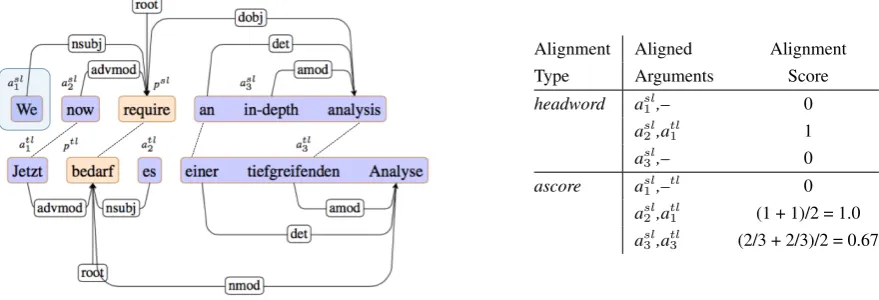
Figure 1: Predicate-argument structures with noisy word alignments (left), and alignment scores for the arguments (right). Headword scoring aligns only headwords of the source (asl) and target (atl)
arguments, whileascoreuses headwords and dependents of an entire argument span for alignment.
ArgALp= arg max A0sl×A0tl⊆Asl×Atl
P
Asl×Atlascore(asl, atl)
where Asl×Atl={hasl, atli |asl∈ hpsl, asli, atl∈ hptl, atli} (3) An example of the alignment scoring is given in Figure 1, where predicates and arguments are detected over parallel English-German sentences, and word alignments are automatically generated. The argument ‘an in-depth analysis’ consists of a headword and two dependents, with two noisy word alignments that link the arguments across languages. Given these word alignment links, the
ascore (Eq 2) is computed by taking the number of alignments and the yield of the arguments for both English and German, and these scores are then averaged for a final alignment score of 0.67. In this case, the scoring function still produces correct mappings across the predicate-argument structures despite imperfect word alignments, and an implicit role, We, is correctly unaligned to the German sentence.
3.2 Classification of Poor Alignments as Implicit Roles
Our objective is to build a classifier that automati-cally detects implicit roles across parallel corpora. To achieve this goal, we construct a classifier that takes as input an unaligned argument in English and, based on linguistic features in the aligned En-glish and German sentences, determines whether this unaligned argument is an implicit role in Ger-man. Our dataset, described in Section 4.2, con-sists of instances of poorly aligned roles that have been annotated as either implicit, not implicit,
or not a role of the predicate. In classification, we reduce the annotation classes (implicit/not im-plicit/not a role of the predicate) to a binary de-cision where the positive class represents the im-plicit roles, and the negative class is any unaligned argument that annotators determined as eithernot implicit or not a semantic role. We reduced the task to a binary decision to avoid sparsity in the classification.
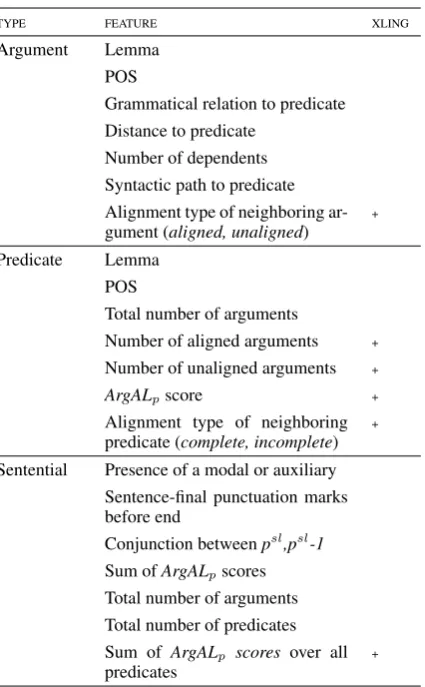
FeaturesWe hypothesize that we can predict the existence of an implicit role through features of the predicate-argument structures in the source and target languages. These features include mono-lingual predicate-argument structures, as well as cross-lingual features that represent the quality of the alignments across the parallel sentences. Monolingual features encode the syntactic prop-erties of the arguments and predicates for source and target sentences, as well as sentential-level features that include the presence of modal and auxiliary verbs and conjunctions. To incorporate cross-lingual information, the alignment scores described in Section 3.1 are kept as features to the classifier, based on our assumption that the over-all alignment between source and target predicate-argument structures should impact the classifica-tion of an implicit role. Both monolingual and cross-lingual features apply to surrounding pred-icate/arguments, where arguments can either be aligned or unaligned, and predicates that have fully aligned structures are considered complete. A complete list of features is shown in Table 1.
lin-TYPE FEATURE XLING Argument Lemma
POS
Grammatical relation to predicate Distance to predicate
Number of dependents Syntactic path to predicate Alignment type of neighboring ar-gument (aligned, unaligned) + Predicate Lemma
POS
Total number of arguments
Number of aligned arguments + Number of unaligned arguments +
ArgALpscore +
Alignment type of neighboring predicate (complete, incomplete) + Sentential Presence of a modal or auxiliary
Sentence-final punctuation marks before end
Conjunction betweenpsl,psl-1 Sum ofArgALpscores Total number of arguments Total number of predicates Sum of ArgALp scores over all
[image:5.595.74.287.59.403.2]predicates +
Table 1: Features investigated for classification, where Xling are cross-lingual features.
ear kernel, Decision Tree, and Gradient Boosting, under the framework of the Scikit-learn library (Pedregosa et al., 2011).
4 Constructing a Dataset for Classifying Implicit Arguments
This section presents the construction of our ex-perimental dataset for implicit role detection.
4.1 Corpora and Tools
We conduct our experiments over the Europarl corpus (Koehn, 2005), which contains over 1.9 million aligned sentences in our target lan-guages. Anticipating noise in the automatic word alignments, we first take sentences from manu-ally word-aligned German-English Europarl data (Pad´o and Lapata, 2005) to conduct our initial experiments. These sentences give us an upper bound for the number of implicit roles we should expect to obtain. Automatic word alignments are generated with GIZA++ (Och and Ney, 2003).
Predicates and their arguments are first detected
through dependency parses on English and Ger-man parallel corpora. Parses are generated for En-glish with ClearNLP (Choi and McCallum, 2013). German sentences are run through the MarMot morphological analyzer (Mueller et al., 2013), and dependency parses for German are then generated using the RBG Parser (Lei et al., 2014). The Universal Dependencies project facilitates cross-lingual consistency in parsing and provides bet-ter compatibility amongst multiple languages. We trained the RBG Parser with the Universal Depen-dencies tagset (Rosa et al., 2014), and thus our argument detection can be applied to other lan-guages in the Universal Dependencies project.
4.2 Annotation of Poorly Aligned Arguments Annotation InstancesOur goal is to find any ar-gument that is either missing or dislocated from its predicate in translation. With this objective in mind, we focused our annotation on incomplete predicate structures whose argument(s) remained unaligned. Any argument with scores below the alignment threshold (see Section 3.1) was a candi-date for annotation.
Annotation Task and Guidelines Three annota-tors worked on this task. Each annotator was a na-tive German speaker with high fluency in English, and had taken at least one undergraduate course in linguistics. Annotators were given guidelines that define predicates aseventsorscenarios, and semantic roles as an element that has a semantic dependence on the predicate, including the who, what, where, when,andwhytype of information. Implicit roles were defined as “any role that is missing from the scope, or clausal boundary, of the predicate”. Each annotator was trained on a test set of 10 example sentences.
Annotators were given pairs of sentences with aligned predicates in English and German, where the English predicate had a poorly aligned argu-ment. Annotation instances were presented as: two preceding English sentences, the English sen-tence with both the argument and predicate high-lighted, the German sentence with the aligned predicate highlighted, and two preceding German sentences. An example of the annotation task is shown in Figure 2.
sub-Context - 2 preceding English sentences ——
The only change is that [farmers] are not –required– to produce .
Die einzige Neuerung ist , dass nicht –gefordert– wird zu produzieren .
——
Context - 2 preceding German sentences
—————————————————————-[farmers]
Can ‘farmers’ be considered a role of the English predicate ‘required’?
If ‘no’: please choose: not a role of English predicate
Can ‘farmers’ be considered an implicit role for the German predicate ‘gefordert’?
If ‘no’: please choose:
not an implicit role of German predicate
If ‘yes’: please indicate the location of the German translation of ‘farmers’ by marking it in (**)
Figure 2: Example annotation task. Aligned pred-icates are marked in dashes (–) and implicit role candidates are surrounded by squared brackets [].
task asked annotators to judge whether a transla-tion for the argument was available in the scope of the highlighted German predicate. If it was not available in the scope, they were asked to annotate the example asimplicit.
Difficult Annotation CasesThe annotations were adjudicated by one of the authors, and the annota-tor with the highest agreement with the adjudicaannota-tor was asked to complete the entire dataset.
Cases that resulted in higher annotator disagree-ment included argudisagree-ments of nominal predicates that were themselves the argument of the aligned predicate. In Example 4 below, 30 August is a role for the nominal predicateparticipationbut not continue:
(4) The massive participation [from 30 August] must continue.
Other difficult annotation cases included roles that were partially, or entirely, encoded in the translated predicate. These included temporal ad-juncts that could either be interpreted as present tense or implicit in the translated sentence: (5) I will [now] give the floor to the President
Ich
I gebegive demthe Pr¨asidentenPresident dasthe Wortfloor
After a review of these difficult cases, annota-tion guidelines were modified and annotators were re-trained.
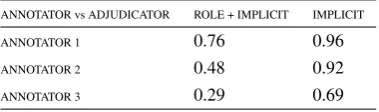
Annotation Quality Inter-annotator agreement was measured by Cohen’s Kappa scores over 114 instances, and the entire 700 candidates were then completed by Annotator 1. One of the authors ad-judicated for agreement. Results are given in Table 2 where “Role + Implicit” reports Kappa scores over all three categories -not a role, implicit, and not implicit, while “Implicit” reports agreement over binaryimplicitvsnon-implicitdecisions.
ANNOTATOR vs ADJUDICATOR ROLE + IMPLICIT IMPLICIT
ANNOTATOR 1 0.76 0.96
ANNOTATOR 2 0.48 0.92
[image:6.595.322.512.252.308.2]ANNOTATOR 3 0.29 0.69
Table 2: Kappa agreements
Annotation Results In total, we took 700 poorly aligned arguments whose scores were below the alignment threshold (Section 3.1), where 500 were selected from manual word alignments and 200 from GIZA++ alignments. The 500 candidate ar-guments were sampled from 987 gold-aligned Eu-roparl sentences, in which over 3,000 arguments fell below the threshold. The 200 candidates were sampled from 500 automatically aligned Europarl sentence pairs (excluding the sentences from the manually aligned dataset), with nearly 3,000 argu-ments below the threshold, to estimate the differ-ence in implicit roles between manual and auto-matic word alignments.
Over the completed dataset, results for the an-notation types are given in Table 3. Out of the manually aligned Europarl sentences, annotations produced 45 positive implicit role instances (9% of the annotated candidates). The automatic align-ments, with 200 examples, contained 6 instances (3% of the annotated candidates) of implicit roles. Over the total 700 instances, 24.5% were classified as ‘not a predicate role’, 68.3% as ‘not implicit’, and 7.2% as ‘implicit’.
INSTANCES NOT A ROLE NOT IMPLICIT IMPLICIT
Manual 500 154 301 45
GIZA++ 200 18 176 6
Classifier P R F1
Majority Baseline 0 0 0
SVM-ablated 0.6805 0.4444 0.5128
SVM-all 0.1555 0.2238 0.18333
[image:7.595.73.291.63.172.2]Decision Tree-ablated 0.6682 0.4155 0.4934 Decision Tree-all 0.4134 0.2222 0.2748 Gradient Boosting-ablated 0.6688 0.3777 0.4631 Gradient Boosting-all 0.6466 0.2222 0.3268 Table 4: Precision, Recall and F1 for the positive
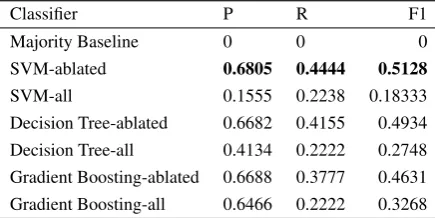
class (implicit role), with stratified 5-fold CV.
5 Classification Experiments and Results
5.1 Argument Alignment and Scoring
With the scoring function described in Section 3.1, perfectly aligned arguments should produce a score of 1.0. We experimentally set the threshold
Θfor the minimum alignment score at 0.2 for ar-guments such that arar-guments with imperfect word alignments will still be aligned.
5.2 Classification of Implicit Arguments
The data set constructed in Section 4 resulted in 51 manually validated implicit roles and 649 negative instances that were input for classification.
We measure precision, recall, and F1 scores,
and for the SVM and Gradient Boosting classi-fiers we experimented with parameters to optimize precision. The SVM classifier with a linear ker-nel produced the highest scores, but results were closely followed by Decision Tree and Gradient Boosting classifiers. For the SVM classifier, we experimented with different regularization {0.5, 1, 10, 20} and class weight increments {None, 1:2, 1:10}and found the highest precision scores were achieved with C=0.5 and class weight 1:2. In Gradient Boosting, we experimented with max depth {1, 2, 3} and found the highest precision scores were obtained with a max depth of 2. Since the data set is heavily biased towards the negative class, we divided training and test sets with a strat-ified 5-fold cross-validation (CV). We later exper-imented with upsampling for the positive class but found no significant improvement.
Feature AblationTo determine the optimal fea-ture set, we performed ablation tests by incre-mentally removing a feature and performing train-ing/testing over the reduced feature set. Ablation was performed individually for each classifier. Af-ter these tests, we eliminated features that caused
Type Feature
asl lemma, POS, path to predicate asl+1 POS, path to predicate
asl–1 alignment type, number of dependents
ptl POS
ptl–1 sum ofArgALp scores
ptl+1 POS, number of arguments, number of
unaligned arguments, sum of ArgALp
scores, alignment type
Table 5: Final feature set used in classification. Notation is defined in Section 3.1, where±1are the arguments/predicates preceding (–1) and fol-lowing(+1)the candidate.
a drop in performance and used only the best per-forming features in the final classification. The fi-nal feature set is shown in Table 5.
The SVM model obtains the best results of 0.68 precision and F1-score of 0.51 with the ablated
feature set, closely followed by the other classifier models and outperforming the majority baseline, which always predicts the negative class (see Ta-ble 4 for both ablated and full feature results).
Feature Analysis The final feature set used in the classification experiment included both cross-lingual features of the predicate and arguments on source/target sentences, as well as monolingual predicate and argument features. The ablation re-sults support our initial hypothesis that the sur-rounding predicate/argument structures and align-ment scores are relevant to the detection of an omitted role.
5.3 Analysis of Results
Translation Shifts that Trigger Implicit Roles
[image:7.595.305.528.65.197.2]Voice A change from active (source) to passive (target). Subjects are dropped in translation: (6) The more [we] refuse to democratize the
in-stitutions .... Je
ThemehrmoredietheDemokratisierungdemocratization derof the Institutionen
institution verweigertrefused wirdare ...
CoordinationAn argument might be the repeated subject of two conjoined clauses, but expressed as a shared argument in the parallel sentence: (7) I was faced with this systemand [I] do not
know any parliament Ich
I fandfaceddiesesthis Systemsystem vorbeforeundandkenneknow keinno Parlament
parliament
Extraposition Complex clausal embeddings can cause roles to be extraposed from their predicates in the target language text:
(8) ...but would also want to encourage both par-ties [to observe the spirit of this new agree-ment].
...er
...it kanncan diethatbeidenboth Parteienparties nuronlyveranlassenencourage wollen,
want, [denthe Geistspiritdiesesof-thisneuennew Abkommensagreement zu
to achten].observe
Coordination and extraposition are borderline cases with regard to the non-locality of roles. PropBank does annotate coordinated arguments, and in these cases the syntactic parse tree can be leveraged for recovery of the non-local role. How-ever, we still consider these implicit arguments since they are expressed outside of the local scope of the predicates.
NonfiniteSimilar to change in voice, the subject of a finite verb can be dropped when the translated verb is nonfinite:
(9) I would ask that [they] reconsider these deci-sions
Ich
I bitte,ask, diesetheseEntscheidungdecisions zu ¨uberdenkento reconsider Semantic/Pragmatic A role can be dropped in translation without a structural shift that licenses the omission. In these instances, the role could have been incorporated into the aligned sentence without a change to the syntactic environment.
(10) ... I am asking you to do this directly, [in this House].
...wende
...turn ichI michmyselfhiermithereby direktdirectlyanto Sieyou. Since the directionality of our implicit role search focused on English to German, we do not account for syntactic shifts that could cause omis-sions in the opposite direction, i.e. German to En-glish. There are imperative constructions in Ger-man that overtly encode the addressee of the com-mand (“go outside” in English can be translated as “goyououtside” in German) which can trigger im-plicit roles in translation from German to English.
Shift Type Count %
Voice 7 14%
Coordination 8 16%
Extraposition 8 16%
Nonfinite 6 11%
[image:8.595.343.491.260.342.2]Semantic/Pragmatic 22 43% Table 6: Shift types that trigger implicit roles.
Semantic Role Types of Omitted ArgumentsWe adopt the VerbNet roleset (Kipper et al., 2000) to manually label semantic role across all our im-plicit argument instances. A full analysis of the role types, shown in Table 7, found that a majority of implicit roles are Agent and Theme. This re-flects the general distributions for role frequency (Merlo and Van Der Plas, 2009), but could also be due to the syntactic shifts that produce a higher omission of the subject, such as passivization and coordination, which are commonly filled by the
AgentandThemeroles.
Core Role Count Non-Core Role Count
Agent 15 Time 6
Theme 14 Topic 5
Recipient 3 Location 3
Experiencer 2 Manner 1
Cause 2
Table 7: Thematic roles, both core and non-core, of the implicit cases.
able to recover the antecedent roles, either from the previous clause or sentences, were less than the majority (21 out of the 51 cases), while many in-stances were not instantiated in the non-local con-text. Table 8 gives the proportion of recovered an-tecedents according to shift types. The fact that extraposition and coordination cases yield higher number of resolvable roles can be exploited in fu-ture work for antecedent linking.
Shift Type Resolvable Not resolvable
Voice 1 6
Coordination 8 0
Extraposition 8 0
Nonfinite 1 5
Semantic/Pragmatic 3 19
Table 8: Availability of the antecedent in the sur-rounding context.
6 Conclusion and Future Work
In this work, we investigated the hypothesis that implicit semantic roles can be identified in transla-tion. Our method is knowledge-lean and achieves respectable performance despite a small training set. While the present work has focused on miss-ing arguments of verbal predicates, implicit role detection in this multilingual framework can be easily extended to nominal predicates. Combin-ing both predicate types is expected to improve the overall results, as some of the noise we are currently observing pertains to implicit roles oc-curring with nouns. Additional noise is produced by the automatic word alignments, which can be addressed by employing triangulation techniques using multiple language pairs. Further, with our current classifier we can predict role omissions across parallel sentences with better accuracy than reliance on noisy word alignments alone, and with these predictions we can generate better candi-dates for annotation and reduce the time and cost of future annotation effort.
A next step from the current work would be to automatically recover the antecedent of the im-plicit role in the target language when it is avail-able. By doing so, we can construct new training data for monolingual implicit role labeling, im-prove transference of semantic roles across paral-lel corpora, and generate novel training data for implicit role labeling for new languages.
7 Acknowledgments
This research has been conducted within the Leib-niz Science Campus “Empirical Linguistics and Computational Modeling”, funded by the Leibniz Association under grant no. SAS-2015-IDS-LWC and by the Ministry of Science, Research, and Art (MWK) of the state of Baden-W¨urttemberg. We thank our annotators Leo Born, Max M¨uller-Eberstein and Julius Steen for their contribution.
References
Alan Akbik, Laura Chiticariu, Marina Danilevsky, Yunyao Li, Shivakumar Vaithyanathan, and Huaiyu Zhu. 2015. Generating High Quality Proposi-tion Banks for Multilingual Semantic Role Labeling. In Proceedings of the 53rd Annual Meeting of the Association for Computational Linguistics and the 7th International Joint Conference on Natural Lan-guage Processing, pages 397–407, Beijing, China.
Jinho D. Choi and Andrew McCallum. 2013.
Transition-based Dependency Parsing with Selec-tional Branching. InProceedings of the 51st Annual Meeting of the Association for Computational Lin-guistics, pages 1052–1062, Sofia, Bulgaria.
Mona Diab and Philip Resnik. 2002. An unsuper-vised method for word sense tagging using parallel corpora. InProceedings of the 40th Annual Meet-ing on Association for Computational LMeet-inguistics, pages 255–262. Association for Computational Lin-guistics.
Parvin Sadat Feizabadi and Sebastian Pad´o. 2015. Combining Seemingly Incompatible Corpora for Implicit Semantic Role Labeling. InProceedings of the Fourth Joint Conference on Lexical and Compu-tational Semantics, pages 40–50, Denver, Colorado, June.
Matthew Gerber and Joyce Y Chai. 2010. Beyond NomBank: A study of implicit arguments for nom-inal predicates. InProceedings of the 48th Annual Meeting of the Association for Computational Lin-guistics, pages 1583–1592.
Philip Gorinski, Josef Ruppenhofer, and Caroline Sporleder. 2013. Towards weakly supervised res-olution of null instantiations. In Proceedings of the 10th International Conference on Computational Semantics (IWCS 2013), pages 119–130.
Karin Kipper, Hoa Trang Dang, Martha Palmer, et al. 2000. Class-based construction of a verb lexicon. In AAAI/IAAI, pages 691–696.
Mikhail Kozhevnikov and Ivan Titov. 2013. Cross-lingual Transfer of Semantic Role Labeling Mod-els. In Proceedings of the 51st Annual Meeting of the Association for Computational Linguistics, pages 1190–1200, Sofia, Bulgaria, August.
Egoitz Laparra and German Rigau. 2013. ImpAr: A Deterministic Algorithm for Implicit Semantic Role Labelling. InACL (1), pages 1180–1189.
Tao Lei, Yu Xin, Yuan Zhang, Regina Barzilay, and Tommi Jaakkola. 2014. Low-Rank Tensors for Scoring Dependency Structures. In Proceedings of the 52nd Annual Meeting of the Association for Computational Linguistics, pages 1381–1391, Bal-timore, Maryland.
Paola Merlo and Lonneke Van Der Plas. 2009. Ab-straction and generalisation in semantic role labels: PropBank, VerbNet or both? InProceedings of the Joint Conference of the 47th Annual Meeting of the ACL and the 4th International Joint Conference on Natural Language Processing of the AFNLP: Vol-ume 1-VolVol-ume 1, pages 288–296. Association for Computational Linguistics.
Thomas Mueller, Helmut Schmid, and Hinrich Sch¨utze. 2013. Efficient Higher-Order CRFs for Morphological Tagging. InProceedings of the 2013 Conference on Empirical Methods in Natural Lan-guage Processing, pages 322–332, Seattle, Wash-ington, USA.
Franz Josef Och and Hermann Ney. 2003. A System-atic Comparison of Various Statistical Alignment Models.Computational Linguistics, 29(1):19–51. Sebastian Pad´o and Mirella Lapata. 2005.
Cross-lingual projection of role-semantic information. In Proceedings of HLT/EMNLP 2005, Vancouver, BC. Sebastian Pad´o and Mirella Lapata. 2009. Cross-lingual Annotation Projection for Semantic Roles. Journal of Artificial Intelligence Research, 36(1):307–340.
F. Pedregosa, G. Varoquaux, A. Gramfort, V. Michel, B. Thirion, O. Grisel, M. Blondel, P. Pretten-hofer, R. Weiss, V. Dubourg, J. Vanderplas, A. Pas-sos, D. Cournapeau, M. Brucher, M. Perrot, and E. Duchesnay. 2011. Scikit-learn: Machine learn-ing in Python. Journal of Machine Learning Re-search, 12:2825–2830.
Rudolf Rosa, Jan Masek, David Marecek, Martin Popel, Daniel Zeman, and Zdenek Zabokrtsk`y. 2014. HamleDT 2.0: Thirty Dependency Treebanks Stanfordized. InLREC, pages 2334–2341.
Michael Roth and Anette Frank. 2015. Inducing Im-plicit Arguments from Comparable Texts: A Frame-work and its Applications. Computational Linguis-tics, 41(4):625–664.
Michael Roth and Kristian Woodsend. 2014. Compo-sition of Word Representations Improves Semantic Role Labelling. InEMNLP, pages 407–413.
Josef Ruppenhofer, Caroline Sporleder, Roser Morante, Collin Baker, and Martha Palmer. 2010. Semeval-2010 task 10: Linking events and their participants in discourse. InProceedings of the 5th International Workshop on Semantic Evaluation, pages 45–50.
Tanja Samardˇzic, Lonneke Van Der Plas, Goljihan Kashaeva, and Paola Merlo. 2010. The Scope and the Sources of Variation in Verbal Predicates in En-glish and French. InProceedings of the Ninth In-ternational Workshop on Treebanks and Linguistic Theories, pages 199–211.
Carina Silberer and Anette Frank. 2012. Casting Im-plicit Role Linking as an Anaphora Resolution Task. InProceedings of the First Joint Conference on Lex-ical and Computational Semantics-Volume 1: Pro-ceedings of the main conference and the shared task, and Volume 2: Proceedings of the Sixth Interna-tional Workshop on Semantic Evaluation, pages 1– 10.
Asher Stern and Ido Dagan. 2014. Recognizing im-plied predicate-argument relationships in textual in-ference. In Proceedings of the 52nd Annual Meet-ing of the Association for Computational LMeet-inguis- Linguis-tics (Volume 2: Short Papers), pages 739–744, Bal-timore, Maryland.