Original Article
Effects of
TERT
gene polymorphism
and environmental factor interactions on
lung cancer risk in the Xi’an Han population
Huijuan Wang1,2*, Hua Yang1,2*, Tian Feng2, Tingting Geng2,3, Chao Chen1,2, Tianbo Jin1,2
1School of Life Sciences, Northwest University, Xi’an 710069, Shaanxi, China; 2National Engineering Research
Center for Miniaturized Detection Systems, Xi’an 710069, China; 3Department of Endocrinology, First Affiliated
Hospital, Xi’an Jiaotong University, Xi’an 710061, China. *Equal contributors.
Received August 13, 2015; Accepted December 17, 2015; Epub February 15, 2016; Published February 29, 2016
Abstract: Background: Genetic polymorphisms of the telomerase reverse transcriptase (TERT) gene influence an in -dividual susceptibility to lung cancer. We examined the relationship between TERT single nucleotide polymorphisms (SNPs) and lung cancer occurrence and determined if smoking or alcohol consumption affects this relationship in lung cancer patients. Methods: Ten SNPs and inferred TERT haplotypes associated with increased risk of lung can-cer were evaluated in a Han Chinese population-based study including 228 lung cancan-cer patients and 310 healthy control individuals. Relationships between the patients’ genotypes and risk factors were investigated by estimating odds ratios (ORs) and 95% confidence intervals (CIs) using unconditional logistic regression analysis. Results: Minor allelesrs2853672 and rs2736098 conferred significantly increased lung cancer risk in both allelic and genotypic association analyses (codominant, recessive, and log-additive models), while rs4246742 showed a protective ef-fect against lung cancer in codominant and recessive models. Smoking increased the efef-fect of rs2736098 on lung cancer risk, but the interaction between rs2736098 and smoking was only significant in the overdominant model (P=0.03). No evidence was found that alcohol consumption influenced or interacted with TERT polymorphism on lung cancer risk. Conclusions: Our results confirmed that TERT genetic polymorphisms contribute to lung cancer susceptibility in Chinese populations and of ten interact with smoking as a lung cancer risk factor. However, these associations should be further explored in larger and varying populations.
Keywords: TERT, genetic polymorphism, lung cancer, case-control study, Han
Introduction
In many countries, including China, the inci-dence and mortality rates of lung cancer are greater than those from any other type of can-cer [1]. Despite considerable therapeutic prog-ress, the prognosis of non-small cell lung can-cer (NSCLC) patients remains poor, and their
five-year survival rates are less than 15% [2].
Finding markers associated with lung cancer risk is vital to early detection and discovery of novel chemo-preventive agents.
Lung cancer development appears to result from a complex interaction between environ-mental exposures and genetic factors. At pres-ent, cigarette smoking is the most important risk factor for lung cancer [3], and recent
epide-miological studies [4, 5] indicate alcohol con-sumption plays a potential role in lung carcino-genesis. In addition, genome-wide association (GWA) studies have determined common varia-tions at three separate chromosomal regions
(5p15, 6p21, and 15q25) influence the risk
of developing lung cancer [6-9]. Genes encod-ing telomerase reverse transcriptase (TERT) and cleft lip and palate transmembrane1-like protein, located in region 5p15.33, a crucial genomic region for telomere biology, showed associations with lung cancer risk [6, 7, 9, 10]. The TERT enzyme is the catalytic subunit of telomerase that elongates telomeres and is a key regulator of telomerase activity [11]. TERT is not expressed in most normal cells but is
85%-90% of human cancers, indicating telom-erase activation is necessary for healthy cells to transform into malignant ones [12, 13]. Telomerase activation, which depends on TERT expression, has been linked to tumor develop-ment in many types of cancer and is the rate-limiting step of regulating telomerase activity involved in tumorigenesis [14]. Many GWA stud-ies have shown that approximately 30 single-nucleotide polymorphisms (SNPs)in the TERT
gene affect an individual’s susceptibility of developing many tumor types [6, 7, 9, 10, 15,
16]. More specifically, two comprehensive
meta-analyses studying SNP rs2736100
con-firmed its significantly positive association with
lung cancer risk in whites and Asians, especial-ly with respect to adenocarcinoma, the most common type of lung cancer [16, 17]. Ad- ditionally, the association between rs2736100 and adenocarcinoma development was stron-ger in females and in individuals who had never smoked [9, 18]. Another TERT locus, rs273-
6098, may also lead to significantly increased
risk for lung cancer development in white and Asian populations [19-23].
Unlike rs2736100 and rs2736098, associa-tions between other TERT loci (rs2853676, rs2242652, rs2736122, and rs2075786) and lung cancer risk in previous studies are
incon-sistent and conflicting, likely due to the differ -ent ethnicities and pati-ent sample sizes inve- stigated in those studies. For example, rs20- 75786, an intronic TERT gene polymorphism, confers an increased risk of developing NSCLC on African-American females, but not white [24]. However, Hsiung et al. negated its associ-ation with lung cancer risk in non-smoking Asian females [9]. Another SNP, rs2853677,
exerted a significantly increased effect on lung
cancer development in white and African-American females, but this association was not observed in Asians [24, 25]. Moreover, though many studies have shown environmental risk factors may interact with susceptibility loci to
induce lung carcinogenesis, specific interac -tions between TERT genetic polymorphisms and environmental exposures remain unre- ported.
Therefore, to comprehensively assess the effect of TERT genetic polymorphisms on lung cancer risk, we conducted a Han Chinese pop-ulation-based study including 228 lung cancer
patients and 301 unrelated healthy individuals. We focused on the interactions between 10 common but relatively uncharacterized vari-ants of the TERT gene and cigarette smoking or alcohol consumption to explore the genetic and environmental risk factors of lung cancer development.
Materials and methods
Study populations
This study included 228 lung cancer patients and 301 healthy control patients. To exclude the possible effects of ethnicity, all subjects in this study were genetically unrelated ethnic Han Chinese individuals from Xi’an, the capital of Shaanxi province. The eligible patients were recruited at the Department of Respiration
from the First Affiliated Hospital of the
Medi-cal College of Xi’an Jiaotong University from October 2011 to September 2012.
All patients were recently diagnosed with lung
cancer identified by histological observation.
No patients had a previous history of other can-cers, chemotherapy, or radiotherapy, and the patients were chosen regardless of age, gen-der, or disease stage. In addition, 310 healthy unrelated individuals were selected during the same time period from the medical examina-tion center of Xi’an Jiaotong University based on standard recruitment and exclusion criteria to ensure they had no chronic or severe endo-crinological, metabolic, or nutritional diseases.
Demographic data collection
A standardized epidemiological questionnaire was completed for each patient and control individual by a trained interviewer to collect demographic data (age, sex, ethnicity, and edu-cation level) and clinical information (smoking habits, alcohol use, and family history of
can-cer). Smokers and drinkers were classified into
two categories ever and never. For smoking, those individuals who smoked < 2 cigarettes per week or < 100 cigarettes per year were
experimental procedures of the study, and writ-ten informed consent was obtained from each participant. This study was conducted under the approval of the Human Research Committee
of the First Affiliated Hospital of Xi’an Jiaotong
University and Northwest University.
SNP selection and genotyping
Based on previous GWA studies of lung cancer, 10 susceptibility loci in the TERT gene were selected as candidate SNPs. The SNPs include common variations with minor allele frequen-cies (MAF) greater than 0.05 in the HapMap Chinese Han Beijing population.
Blood samples were collected from all partici-pants at the time of recruitment. Genomic DNA was extracted from peripheral blood obtained from each participant using GoldMag-Mini
Whole Blood Genomic DNA Purification Kit
(GoldMag Co. Ltd., Xi’an City, China) according to the manufacturer’s protocol. DNA concentra-tion was measured by aNanoDrop 2000 (Gene
Company Ltd., Hong Kong, China). Polymerase
chain reaction and extension primers (Table S1) were designed using MassARRAY Assay Design 3.0 software (Sequenom, Inc., San Diego, CA, USA). SNP genotyping procedures were performed according to the manufactur-er’s iPLEX Application Guide (Sequenom, Inc.).
dence intervals (CIs) of the relationship be- tween TERT SNPs and lung cancer risk, and participants’ age was transformed into a binary covariate by using 50 years as the threshold age. Plink software performed the allele-based association test across the overall population.
We also performed a stratified analysis by age,
sex, smoking status, and alcohol use to further explore the association between SNPs and the risk of lung cancer in each stratum. Moreover, SNPstats were utilized to estimate ORs and CIs of the link between cancer risk and patient gen-otypes and haplgen-otypes. A genotypic association analysis was performed under the following genetic models: codominant, dominant, reces-sive, overdominant, and log-additive. Further, potential interactions between genotypes and either smoking or alcohol consumption with respect to lung cancer were analyzed by a crossover table method using SNPstats. All analyses were performed with adjustments made for potential confounding factors such as age, gender, smoking status, or alcohol use. All tests were two-sided, and P < 0.05 was
consid-ered significant.
Results
Population characteristics
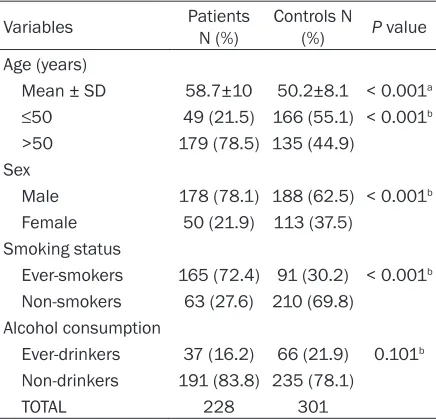
[image:3.612.91.309.96.306.2]The distribution of selected characteristics of study subjects (n=529; 228 patients and 301
Table 1. General characteristics of the study
popu-lation
Variables PatientsN (%) Controls N (%) P value Age (years)
Mean ± SD 58.7±10 50.2±8.1 < 0.001a ≤50 49 (21.5) 166 (55.1) < 0.001b >50 179 (78.5) 135 (44.9)
Sex
Male 178 (78.1) 188 (62.5) < 0.001b Female 50 (21.9) 113 (37.5)
Smoking status
Ever-smokers 165 (72.4) 91 (30.2) < 0.001b Non-smokers 63 (27.6) 210 (69.8)
Alcohol consumption
Ever-drinkers 37 (16.2) 66 (21.9) 0.101b Non-drinkers 191 (83.8) 235 (78.1)
TOTAL 228 301
aP values were calculated by Student’s t tests. bP values were
calculated from two-sided Chi-squared tests.
Statistical analysis
The MAF, pairwise linkage disequilibrium (LD) across all SNPs, and the Hardy-Weinberg equilibrium for each SNP in the control indi-viduals were measured by using HAPLOVIEW v4.2 (Daly Lab, Cambridge, MA, USA). The haplotypes and their frequencies were esti-mated based on a Bayesian algorithm using SNPstats [26] (http://bioinfo.iconcologia.net/ snpstats/start.htm).
The statistical analyses were performed using SPSS16.0 (SPSS Inc, USA), Plink v1.07 (http:// pngu.mgh.harvard.edu/~purcell/plink/) and SNPstats. A Chi-squared test was used to examine differences in the distributions of demographic characteristics among cancer patients and controls, and the Student’s t test
was performed to evaluate the any significant
differences in age. Unconditional logistic re- gression analysis was used to calculate the
-healthy control individuals) are summarized in
Table 1. Because control subjects were not
selected based on age and sex, we observed
significant differences in age (P < 0.001) and sex ratios (P < 0.001) between lung cancer
patients and controls. Specifically, the mean
age of the patients was greater than that of the control group (58.7±10 years vs. 50.2±8.1 years, respectively), and males were more prev-alent among patients than controls (78.1% vs. 62.5%, respectively). In addition, subjects older than 50 years were more common in the patient group than in the control group (78.5% vs. 44.9%; P < 0.001).
We also observed significant differences in
smoking status between patients and controls. More smokers were represented in the lung cancer patients compared with controls (72.4% vs. 30.2%, respectively; P < 0.001). By
con-trast, no significant difference was found
be-tween the patients and controls with regards to alcohol consumption (P=0.101).
Genetic polymorphisms and linkage disequi-librium
The MAFs of tested TERT polymorphisms and their allelic associations in patients and con-trols are presented in Table 2. The genotype distribution for the 10 SNPs was in Hardy-Weinberg equilibrium (P > 0.05) in the control group. In control individuals, only SNPs rs- 2736122 and rs2736114 exhibited a MAF slightly lower than 0.05. Pairwise LD values between SNPs were also calculated, which are
shown in Figure S1. In the controls, paired loci rs2736122 and rs2736114 (D’=1; r2=0.97),
rs2242652 and rs10069690 (D’=0.99; r2=
0.96) were almost completely linked; rs28- 53672 and rs2736098 (D’=0.98; r2=0.58),
rs2736122 and rs2075786 (D’=1; r2=0.22),
rs2736114 and rs2075786 (D’=1, r2=0.24),
andrs2853672 and rs2853676(D’=1, r2=0.23)
were also highly linked (Figure S1A). Similar LD pattern among the above loci were also observed in patients (Figure S1B). However, we also found different LD relationship among other SNPs between patients and controls. In the control group, only weak linkage was exist-ed between rs4246742 and rs2242652 or rs10069690 (D’ < 0.3), but in patient groups their linkage was increased (D’=0.7).
Association of SNPs with lung cancer
We investigated if the minor allele of each SNP was a cancer risk factor compared with the wild-type allele. Only rs2853672 (adjusted OR= 1.37, CI: 1.03-1.83; P=0.032) and rs2736098 (adjusted OR=1.47, CI: 1.07-2.02; P=0.017)
conferred significantly elevated risk in this
model (Table 2).
Subsequent stratified analysis data using
co-variates (sex, age, smoking status, and alcohol consumption) are shown in Table S2. Highly-linked SNPs rs2853672 and rs2853676 were
significantly associated with increased risk of
[image:4.612.94.521.97.255.2]lung cancer among males, subjects older than 50 years, ever-smokers, and non-drinkers (P < 0.05). Other highly-linked SNPs, rs2736122
Table 2. Genotypic information of selected TERT SNPs and their minor allelic associations with lung
cancer risk
SNP No. SNP ID Location Allele Aa/B MAF HWE p ORb 95% CI P value Case Control
1 rs2736122 Intron13 T/C 0.057 0.042 0.49 1.86 0.94-3.68 0.074 2 rs2736114 Intron10 A/G 0.057 0.042 0.43 1.92 0.97-3.83 0.063 3 rs2075786 Intron10 C/T 0.145 0.146 0.79 1.10 0.72-1.68 0.666 4 rs4246742 Intron9 T/A 0.307 0.36 0.22 0.75 0.55-1.02 0.069 5 rs10069690 Intron4 T/C 0.211 0.166 0.26 1.32 0.91-1.91 0.140 6 rs2242652 Intron4 T/C 0.206 0.161 0.33 1.35 0.93-1.96 0.112 7 rs34829399 Intron2 T/C 0.07 0.05 0.36 1.25 0.67-2.32 0.484 8 rs2853676 Intron2 A/G 0.185 0.166 0.11 1.12 0.77-1.63 0.549
9 rs2853672 Intron2 G/T 0.5 0.446 0.14 1.37 1.03-1.83 0.032
10 rs2736098 Exon2 A/G 0.377 0.323 0.27 1.47 1.07-2.02 0.017
aMinor allele; bAdjusted by sex, age, and smoking or drinking status. SNP: single nucleotide polymorphism; MAF: minor allele
and rs2736114 (similar to rs2736098), exhib-ited an approximately four-fold increased risk of lung cancer among ever-smokers (P < 0.05). In contrast, rs4246742 was inversely associ-ated with lung cancer risk in ever-smokers (adjusted OR=0.58, CI: 0.38-0.58; P=0.011) and alcohol drinkers (adjusted OR=0.51, CI: 0.26-1.0; P=0.049).
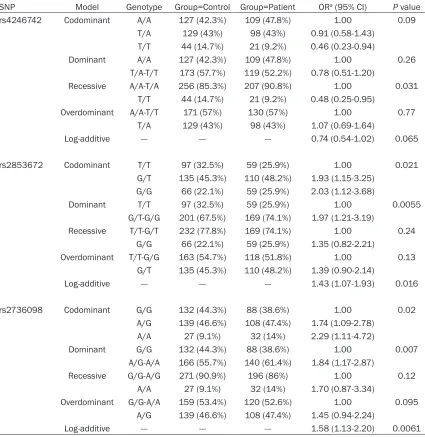
Genotypic model analysis showed that rs- 4246742, rs2853672, and rs2736098 were associated with lung cancer risk (Table 3). Using the AA and TA genotypes combined as a
reference, the TT genotype of rs4246742 was
significantly associated with a decreased risk
[image:5.612.94.519.97.534.2]of lung cancer (adjusted OR=0.48, CI: 0.25-0.95; P=0.031, recessive model). With the AA genotype as a reference, the OR for the TT gen-otype was 0.46 (CI: 0.23-0.94; P=0.09, codom-inant model). Conversely, rs2853672 and rs- 2736098 were associated with an increased risk of lung cancer in the codominant, domi-nant, and log-additive models. Compared to the homozygous major allele carriers of these two variants, risks of heterozygous and homozy-gous minor allele carriers of rs2853672 (GT:
Table 3. Logistic regression analysis of the association between TERT genetic polymorphisms and
lung cancer risk
SNP Model Genotype Group=Control Group=Patient ORa (95% CI) P value
rs4246742 Codominant A/A 127 (42.3%) 109 (47.8%) 1.00 0.09
T/A 129 (43%) 98 (43%) 0.91 (0.58-1.43) T/T 44 (14.7%) 21 (9.2%) 0.46 (0.23-0.94)
Dominant A/A 127 (42.3%) 109 (47.8%) 1.00 0.26
T/A-T/T 173 (57.7%) 119 (52.2%) 0.78 (0.51-1.20)
Recessive A/A-T/A 256 (85.3%) 207 (90.8%) 1.00 0.031 T/T 44 (14.7%) 21 (9.2%) 0.48 (0.25-0.95)
Overdominant A/A-T/T 171 (57%) 130 (57%) 1.00 0.77
T/A 129 (43%) 98 (43%) 1.07 (0.69-1.64)
Log-additive --- --- --- 0.74 (0.54-1.02) 0.065
rs2853672 Codominant T/T 97 (32.5%) 59 (25.9%) 1.00 0.021
G/T 135 (45.3%) 110 (48.2%) 1.93 (1.15-3.25) G/G 66 (22.1%) 59 (25.9%) 2.03 (1.12-3.68)
Dominant T/T 97 (32.5%) 59 (25.9%) 1.00 0.0055
G/T-G/G 201 (67.5%) 169 (74.1%) 1.97 (1.21-3.19)
Recessive T/T-G/T 232 (77.8%) 169 (74.1%) 1.00 0.24 G/G 66 (22.1%) 59 (25.9%) 1.35 (0.82-2.21)
Overdominant T/T-G/G 163 (54.7%) 118 (51.8%) 1.00 0.13 G/T 135 (45.3%) 110 (48.2%) 1.39 (0.90-2.14)
Log-additive --- --- --- 1.43 (1.07-1.93) 0.016
rs2736098 Codominant G/G 132 (44.3%) 88 (38.6%) 1.00 0.02
A/G 139 (46.6%) 108 (47.4%) 1.74 (1.09-2.78) A/A 27 (9.1%) 32 (14%) 2.29 (1.11-4.72)
Dominant G/G 132 (44.3%) 88 (38.6%) 1.00 0.007
A/G-A/A 166 (55.7%) 140 (61.4%) 1.84 (1.17-2.87)
Recessive G/G-A/G 271 (90.9%) 196 (86%) 1.00 0.12
A/A 27 (9.1%) 32 (14%) 1.70 (0.87-3.34)
Overdominant G/G-A/A 159 (53.4%) 120 (52.6%) 1.00 0.095 A/G 139 (46.6%) 108 (47.4%) 1.45 (0.94-2.24)
Log-additive --- --- --- 1.58 (1.13-2.20) 0.0061
adjusted OR=1.93, CI: 1.15-3.25; TT: adjusted OR=2.03, CI: 1.12-3.68; P=0.021) and rs- 2736098 (GA: adjusted OR=1.74, CI: 1.09-2.78; AA: adjusted OR=2.29, CI: 1.11-4.72;
P=0.02) were all significantly increased. When
heterozygous and homozygous carriers of the minor alleles of rs2853672 and rs2736098 were combined, their risks for lung cancer we-
re all significantly elevated (GT+TT: adjusted
OR=1.97, CI: 1.21-3.19, P=0.0055; GA+AA:
adjusted OR=1.84, CI: 1.17-2.87, P=0.007, respectively).
Association of haplotypes with lung cancer
Based on SNP genotypic information, we used the maximum expectation method to estimate
TERT gene haplotype distribution frequencies
in the population. We identified 74 haplotypes,
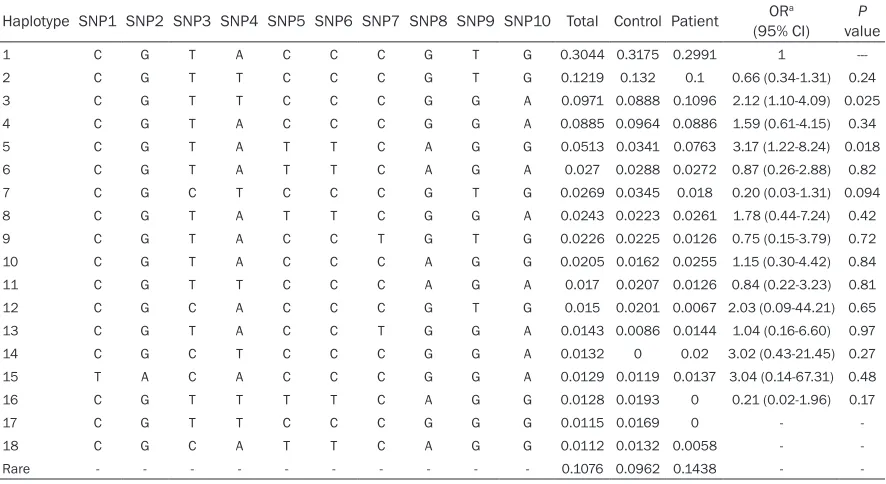
18 of which exhibited frequencies greater than 0.01 in the study group (Table 4) and account-ed for approximately 89% of all haplotypes observed. The most common haplotypes were 1, 2, 3, 4, and 5, with frequencies of 0.3044, 0.1219, 0.0971, 0.0885, and 0.0513, respec-tively, accounting for 66.3% of all haplotypes inferred. Of the 18 haplotypes, only the
[image:6.612.86.529.86.328.2]distri-butions of haplotypes 3 and 5 significantly dif -fered in cancer patients vs. controls (P=0.025 and 0.018, respectively). Using subjects carry-ing haplotype 1 as the reference group, carriers with haplotype 3 or haplotype 5 showed a two-fold (OR=2.12, CI: 1.10-4.09, P=0.025) or three-fold (OR=3.17, CI: 1.22-8.24, P=0.018)
Table 4. Haplotype distributions of TERT polymorphisms and their association with lung cancer risk
Haplotype SNP1 SNP2 SNP3 SNP4 SNP5 SNP6 SNP7 SNP8 SNP9 SNP10 Total Control Patient (95% CI)ORa valueP
1 C G T A C C C G T G 0.3044 0.3175 0.2991 1
---2 C G T T C C C G T G 0.1219 0.132 0.1 0.66 (0.34-1.31) 0.24
3 C G T T C C C G G A 0.0971 0.0888 0.1096 2.12 (1.10-4.09) 0.025
4 C G T A C C C G G A 0.0885 0.0964 0.0886 1.59 (0.61-4.15) 0.34
5 C G T A T T C A G G 0.0513 0.0341 0.0763 3.17 (1.22-8.24) 0.018
6 C G T A T T C A G A 0.027 0.0288 0.0272 0.87 (0.26-2.88) 0.82
7 C G C T C C C G T G 0.0269 0.0345 0.018 0.20 (0.03-1.31) 0.094
8 C G T A T T C G G A 0.0243 0.0223 0.0261 1.78 (0.44-7.24) 0.42
9 C G T A C C T G T G 0.0226 0.0225 0.0126 0.75 (0.15-3.79) 0.72
10 C G T A C C C A G G 0.0205 0.0162 0.0255 1.15 (0.30-4.42) 0.84
11 C G T T C C C A G A 0.017 0.0207 0.0126 0.84 (0.22-3.23) 0.81
12 C G C A C C C G T G 0.015 0.0201 0.0067 2.03 (0.09-44.21) 0.65
13 C G T A C C T G G A 0.0143 0.0086 0.0144 1.04 (0.16-6.60) 0.97
14 C G C T C C C G G A 0.0132 0 0.02 3.02 (0.43-21.45) 0.27
15 T A C A C C C G G A 0.0129 0.0119 0.0137 3.04 (0.14-67.31) 0.48
16 C G T T T T C A G G 0.0128 0.0193 0 0.21 (0.02-1.96) 0.17
17 C G T T C C C G G G 0.0115 0.0169 0 -
-18 C G C A T T C A G G 0.0112 0.0132 0.0058 -
-Rare - - - 0.1076 0.0962 0.1438 -
-aAdjusted by sex, age, and smoking or drinking status.
Table 5. Interaction between rs2736098 genotypes and smoking with respect to lung cancer
Genetic
model Genotype
Non-smoker Ever-smoker P value,
interaction Controls Patients OR (95% CI) Controls Patients OR (95% CI)
Codominant G/G 86 26 1 46 62 11.35 (4.97-25.93) 0.11 A/G 103 26 1.02 (0.51-2.03) 36 82 31.00 (12.87-74.65)
A/A 20 11 1.88 (0.72-4.90) 7 21 29.04 (8.51-99.06)
Dominant G/G 86 26 1 46 62 11.68 (5.11-26.70) 0.065 A/G-A/A 123 37 1.18 (0.62-2.24) 43 103 31.60 (13.42-74.39)
Recessive G/G-A/G 189 52 1 82 144 17.60 (8.97-34.53) 0.78 A/A 20 11 1.85 (0.77-4.48) 7 21 26.76 (8.50-84.18)
[image:6.612.94.523.373.513.2]significantly increased risk of lung cancer.
Haplotype 3 was composed of variant alleles of rs4246742, rs2853676, and rs2736098 and the reference allele of all other SNPs. Haplotype 5 consisted of the variant alleles of rs100696- 90, rs2242652, rs2853676, and rs2853672 and the reference allele of all other SNPs.
Effect of genetic-environmental interactions on lung cancer risk
Possible interaction effects of genetic poly- morphisms and either cigarette smoking or alcohol consumption on lung cancer risk were
analyzed. We found a significant interaction
between rs2736098 and smoking (Table 5). Risks of smokers with any genotype of rs- 2736098 were higher than non-smokers with corresponding genotypes. Among smokers, risks for subjects carrying the variant genotype of rs2736098 were all higher than those carry-ing the reference genotype in dominant (A/G or A/Avs. G/G), codominant (A/G-A/A vs. G/G), and recessive models (A/Avs. G/Gvs. A/G). In the overdominant model, using non-smokers with non-A/G genotypes as the reference group, ever-smokers with the G/G-A/A (adjusted OR=11.53, CI=5.35-24.85) or A/G (adjusted OR=26.35, CI=11.41-60.85) genotype were associated with an increased risk of lung can-cer. The multiplicative interaction between rs- 2736098 genotypes and smoking only reached
statistical significance in the over dominant
model (P=0.03). To date, we have not identified
any TERT gene SNP that significantly interacted
with alcohol consumption to affect lung cancer risk (data not shown).
Discussion
In this study, we explored the association between genetic variants of the TERT gene and lung cancer in a Chinese population and ana-lyzed interactions between TERT polymorph- isms and environmental risk factors, such as smoking and alcohol consumption. We found that TERT SNPs rs4246742, rs2853672, and
rs2736098 were significantly associated with
lung cancer risk. Among the 10 SNPs analyzed,
only rs2736098 significantly interacted with
smoking, as ever-smokers showed a stronger risk of lung cancer.
To date, more than 30 TERT variants associat-ed with cancer susceptibility have been
identi-fied by GWA studies [6, 7, 9, 10, 15, 16]. Based
on their allelic distributions in the HapMap Chinese population, we selected 10 common (frequencies greater than 0.05), but relatively less-studied SNPs to investigate their rela- tionship with lung cancer risk. Genotypic data showed the frequencies of the 10 SNPs in the control group were comparable to those in the HapMap Chinese population. All alleles were at Hardy-Weinberg equilibrium, indicating the con-trol genotypes in this study are representative of the general population. From the pairwise LD analysis, we determined some of the SNPs were highly linked, such as rs2736122/rs273- 6144 and rs2242652/rs10069690, suggest-ing one SNP of each pair can indicate the pres-ence of the other SNP in genetic association studies. We also analyzed TERT haplotype st-
ructure and identified 18 haplotypes with fre -quencies above 0.01. Association analysis between TERT genetic polymorphisms and lung cancer risk was then performed at both single variant and haplotype levels.
First, we investigated the effect of a single
TERT SNP on lung cancer risk in allelic and genotypic models. The results showed that three common variants, rs4246742, rs2853-
672, and rs2736098 were significantly associ -ated with lung cancer risk. Locus rs2736098, a very common synonymous SNP (A305A) locat-ed in exon 2 of the TERT gene, is associated with telomere extension but not TERT expres-sion [10]. Considerable studies have shown rs2736098 increased cancer susceptibility, including risk of lung cancer [6, 10, 19, 21, 22], bladder cancer [10, 27], prostate cancer [10], nasopharyngeal carcinoma [28], glioma [29], hepatocellular carcinoma [30], and cervical cancer [31]. However, the same SNP conferred a protective effect against breast cancer [32] and squamous cell carcinoma of the head and
neck [33]. Other meta-analyses confirmed its
ported rs4246742 did not significantly affect
lung cancer risk in white [6] or Asian non-smok-ing females [9]. However, our data showed the risk of homozygous minor allele (T) carriers was
significantly lower in the recessive model, com -pared to carriers of the major allele (A),
indicat-ing the TT genotype provided a beneficial
im-pact against lung carcinogenesis. Therefore, further large-scale studies are needed to verify the role of rs2853672 and rs4246742 in lung cancer development. Other SNPs tested in
our study did not significantly affect lung can -cer risk. These data support previous stud= ies, which determined rs2853676, rs2242652, and rs2736122 are not associated with in- creased lung cancer risk in white [6, 7] or nev-er-smoking females in Asia [9]. In contrast, SNPs rs2075786 and rs2853677 conferred an increased risk in Africa-American females, but not white females [24].
Secondly, we investigated possible associa-tions between TERT haplotypes and lung can-cer risk by focusing on any additive effects of carrying multiple variants of TERT. Haplotypes
3 and 5 were significantly associated with a
two-fold and three-fold increased risk of lung cancer, respectively. Haplotype 3 was com-posed of variant alleles of rs4246742, rs28- 53676, and rs2736098, and haplotype 5 con-sisted of the variant alleles of rs10069690, rs2242652, rs2853676, and rs2853672. The risks associated with either of these two haplo-types were stronger than that of any single SNP. Interestingly, the protective effect of rs4246742 in haplotype 3 was reduced when other covari-ants occurred, suggesting TERT haplotyping may provide a more precise and comprehen-sive evaluation of genetic susceptibility to can-cer than single variant analysis.
Finally, we assessed interactions between
TERT polymorphism and environmental factors for lung cancer. Only rs2736098 exhibited a
significant multiplicative interaction with smok
-ing in the over dominant model. Specifically, we
sometimes observed ever-smokers with a het-erozygous or homozygous mutant genotype had a higher risk for lung cancer than corre-sponding non-smokers or ever-smokers with the homozygous reference genotype, suggest-ing cigarette smoksuggest-ing could intensify the effect of rs2736098 on lung cancer development. Subgroup analysis consistently showed that
the impact of rs2736098 on lung cancer risk
was significantly higher in ever-smokers.
The role of alcohol consumption in lung cancer development was inconclusive in various stud-ies and may be confounded by cigarette smok-ing [4]. In our study, alcohol consumption was
not a risk factor for lung cancer, and no signifi -cant interactions were observed between TERT
genetic polymorphisms and alcohol consump-tion. However, due to relatively small
sub-groups, findings from these gene-environment
interaction analyses must be interpreted with caution.
Several limitations of this study should be men-tioned, such as the small study size. For exam-ple, the number of subjects with some SNP homozygous variant genotypes may have been too few for accurately testing associations with recessive or log-additive models. In addition,
the statistical power of our stratified and gene-environment interaction analysis could be influ -enced by the small samples size of some sub-groups. The second limitation involves the age and sex of patients vs. control individuals, which were not matched during subject
selec-tion. Therefore, we observed significant differ -ences in both age and sex distributions between patients and controls. However, these variables were adjusted in our subsequent regression analysis.
In conclusion, our data confirmed certain TERT
gene polymorphisms are associated with in- creased risk of lung cancer in Chinese individu-als, and lung carcinogenesis may be affected by interactions between cigarette smoking and
TERT genetic variants. Future population-based studies with larger sample sizes, and detailed environmental exposure information is need- ed to further explore these gene-environment interactions and their effects on lung cancer development.
Acknowledgements
This work was supported by the National High-Tech Research and Development Program of China (863 Program; Grant: 2012AA02A519).
Disclosure of conflict of interest
Address correspondence to: Dr. Tianbo Jin, School of Life Sciences, Northwest University; National Engineering Research Center for Miniaturized Detection Systems, 386, #229 North Taibai Road, Xi’an 710069, Shaanxi, China. Tel: +86-29-88303800; Fax: +86-29-+86-29-88303800; E-mail: tianbo [email protected]
References
[1] Jemal A, Bray F, Center MM, Ferlay J, Ward E and Forman D. Global cancer statistics. CA Cancer J Clin 2011; 61: 69-90.
[2] Ramalingam SS, Owonikoko TK and Khuri FR. Lung cancer: New biological insights and re-cent therapeutic advances. CA Cancer J Clin 2011; 61: 91-112.
[3] Cornfield J, Haenszel W, Hammond EC, Lilienfeld AM, Shimkin MB and Wynder EL. Smoking and lung cancer: recent evidence and a discussion of some questions. 1959. Int J Epidemiol 2009; 38: 1175-1191.
[4] Bandera EV, Freudenheim JL and Vena JE. Alcohol consumption and lung cancer: a re- view of the epidemiologic evidence. Cancer Epidemiol Biomarkers Prev 2001; 10: 813-821.
[5] Freudenheim JL, Ritz J, Smith-Warner SA, Albanes D, Bandera EV, van den Brandt PA, Colditz G, Feskanich D, Goldbohm RA, Harnack L, Miller AB, Rimm E, Rohan TE, Sellers TA, Virtamo J, Willett WC and Hunter DJ. Alcohol consumption and risk of lung cancer: a pooled analysis of cohort studies. Am J Clin Nutr 2005; 82: 657-667.
[6] McKay JD, Hung RJ, Gaborieau V, Boffetta P, Chabrier A, Byrnes G, Zaridze D, Mukeria A, Szeszenia-Dabrowska N, Lissowska J, Rudnai P, Fabianova E, Mates D, Bencko V, Foretova L, Janout V, McLaughlin J, Shepherd F, Montpetit A, Narod S, Krokan HE, Skorpen F, Elvestad MB, Vatten L, Njolstad I, Axelsson T, Chen C, Goodman G, Barnett M, Loomis MM, Lubinski J, Matyjasik J, Lener M, Oszutowska D, Field J, Liloglou T, Xinarianos G, Cassidy A, Vineis P, Clavel-Chapelon F, Palli D, Tumino R, Krogh V, Panico S, Gonzalez CA, Ramon Quiros J, Martinez C, Navarro C, Ardanaz E, Larranaga N, Kham KT, Key T, Bueno-de-Mesquita HB, Peeters PH, Trichopoulou A, Linseisen J, Boeing H, Hallmans G, Overvad K, Tjonneland A, Kumle M, Riboli E, Zelenika D, Boland A, Delepine M, Foglio M, Lechner D, Matsuda F, Blanche H, Gut I, Heath S, Lathrop M and Brennan P. Lung cancer susceptibility locus at 5p15.33. Nat Genet 2008; 40: 1404-1406. [7] Landi MT, Chatterjee N, Yu K, Goldin LR,
Goldstein AM, Rotunno M, Mirabello L, Jacobs
K, Wheeler W, Yeager M, Bergen AW, Li Q, Consonni D, Pesatori AC, Wacholder S, Thun M, Diver R, Oken M, Virtamo J, Albanes D, Wang Z, Burdette L, Doheny KF, Pugh EW, Laurie C, Brennan P, Hung R, Gaborieau V, McKay JD, Lathrop M, McLaughlin J, Wang Y, Tsao MS, Spitz MR, Krokan H, Vatten L, Skorpen F, Arnesen E, Benhamou S, Bouchard C, Metspalu A, Vooder T, Nelis M, Valk K, Field JK, Chen C, Goodman G, Sulem P, Thorleifsson G, Rafnar T, Eisen T, Sauter W, Rosenberger A, Bickeboller H, Risch A, Chang-Claude J, Wichmann HE, Stefansson K, Houlston R, Amos CI, Fraumeni JF Jr, Savage SA, Bertazzi PA, Tucker MA, Chanock S and Caporaso NE. A genome-wide association study of lung cancer identifies a region of chromosome 5p15 asso -ciated with risk for adenocarcinoma. Am J Hum Genet 2009; 85: 679-691.
[8] Wang Y, Broderick P, Webb E, Wu X, Vijayakrishnan J, Matakidou A, Qureshi M, Dong Q, Gu X, Chen WV, Spitz MR, Eisen T, Amos CI and Houlston RS. Common 5p15.33 and 6p21.33 variants influence lung cancer risk. Nat Genet 2008; 40: 1407-1409. [9] Hsiung CA, Lan Q, Hong YC, Chen CJ, Hosgood
HD, Chang IS, Chatterjee N, Brennan P, Wu C, Zheng W, Chang GC, Wu T, Park JY, Hsiao CF, Kim YH, Shen H, Seow A, Yeager M, Tsai YH, Kim YT, Chow WH, Guo H, Wang WC, Sung SW, Hu Z, Chen KY, Kim JH, Chen Y, Huang L, Lee KM, Lo YL, Gao YT, Liu L, Huang MS, Jung TH, Jin G, Caporaso N, Yu D, Kim CH, Su WC, Shu XO, Xu P, Kim IS, Chen YM, Ma H, Shen M, Cha SI, Tan W, Chang CH, Sung JS, Zhang M, Yang TY, Park KH, Yuenger J, Wang CL, Ryu JS, Xiang Y, Deng Q, Hutchinson A, Kim JS, Cai Q, Landi MT, Yu CJ, Tucker M, Hung JY, Lin CC, Perng RP, Boffetta P, Chen CY, Chen KC, Yang SY, Hu CY, Chang CK, Fraumeni JF Jr, Chanock S, Yang PC, Rothman N and Lin D. The 5p15.33 locus is associated with risk of lung adenocarcinoma in never-smoking females in Asia. PLoS Genet 2010; 6.
Schalken JA, van der Heijden HF, Smit HJ, Termeer RA, Oosterwijk E, van Hooij O, Nagore E, Porru S, Steineck G, Hansson J, Buntinx F, Catalona WJ, Matullo G, Vineis P, Kiltie AE, Mayordomo JI, Kumar R, Kiemeney LA, Frigge ML, Jonsson T, Saemundsson H, Barkardottir RB, Jonsson E, Jonsson S, Olafsson JH, Gulcher JR, Masson G, Gudbjartsson DF, Kong A, Thorsteinsdottir U and Stefansson K. Sequence variants at the TERT-CLPTM1L locus associate with many cancer types. Nat Genet 2009; 41: 221-227.
[11] Bianchi A and Shore D. How telomerase reach-es its end: mechanism of telomerase regula-tion by the telomeric complex. Mol Cell 2008; 31: 153-165.
[12] Shay JW and Bacchetti S. A survey of telomer-ase activity in human cancer. Eur J Cancer 1997; 33: 787-791.
[13] Wu TC, Lin P, Hsu CP, Huang YJ, Chen CY, Chung WC, Lee H and Ko JL. Loss of telomer -ase activity may be a potential favorable prog-nostic marker in lung carcinomas. Lung Cancer 2003; 41: 163-169.
[14] Blasco MA. Telomeres and human disease: ageing, cancer and beyond. Nat Rev Genet 2005; 6: 611-622.
[15] Baird DM. Variation at the TERT locus and pre-disposition for cancer. Expert Rev Mol Med 2010; 12: e16.
[16] Mocellin S, Verdi D, Pooley KA, Landi MT, Egan KM, Baird DM, Prescott J, De Vivo I and Nitti D. Telomerase reverse transcriptase locus poly-morphisms and cancer risk: a field synopsis and meta-analysis. J Natl Cancer Inst 2012; 104: 840-854.
[17] Timofeeva MN, Hung RJ, Rafnar T, Christiani DC, Field JK, Bickeboller H, Risch A, McKay JD, Wang Y, Dai J, Gaborieau V, McLaughlin J, Brenner D, Narod SA, Caporaso NE, Albanes D, Thun M, Eisen T, Wichmann HE, Rosenberger A, Han Y, Chen W, Zhu D, Spitz M, Wu X, Pande M, Zhao Y, Zaridze D, Szeszenia-Dabrowska N, Lissowska J, Rudnai P, Fabianova E, Mates D, Bencko V, Foretova L, Janout V, Krokan HE, Gabrielsen ME, Skorpen F, Vatten L, Njolstad I, Chen C, Goodman G, Lathrop M, Benhamou S, Vooder T, Valk K, Nelis M, Metspalu A, Raji O, Chen Y, Gosney J, Liloglou T, Muley T, Dienemann H, Thorleifsson G, Shen H, Stefansson K, Brennan P, Amos CI, Houlston R and Landi MT. Influence of common genetic variation on lung cancer risk: meta-analysis of 14 900 cases and 29 485 controls. Hum Mol Genet 2012; 21: 4980-4995.
[18] Wang Y, Broderick P, Matakidou A, Eisen T and Houlston RS. Role of 5p15.33 (TERT-CLPTM1L), 6p21.33 and 15q25.1 (CHRNA5-CHRNA3) variation and lung cancer risk in
never-smokers. Carcinogenesis 2010; 31: 234-238.
[19] Choi JE, Kang HG, Jang JS, Choi YY, Kim MJ, Kim JS, Jeon HS, Lee WK, Cha SI, Kim CH, Kam S, Jung TH and Park JY. Polymorphisms in telo-mere maintenance genes and risk of lung can-cer. Cancer Epidemiol Biomarkers Prev 2009; 18: 2773-2781.
[20] Li C, Yin Z, Wu W, Li X and Zhou B. Genetic vari-ants in TERT-CLPTM1L genetic region associ-ated with several types of cancer: a meta-anal-ysis. Gene 2013; 526: 390-399.
[21] Pande M, Spitz MR, Wu X, Gorlov IP, Chen WV and Amos CI. Novel genetic variants in the chromosome 5p15.33 region associate with lung cancer risk. Carcinogenesis 2011; 32: 1493-1499.
[22] Wu H, Qiao N, Wang Y, Jiang M, Wang S, Wang C and Hu L. Association between the Telomerase Reverse Transcriptase (TERT) rs2736098 Polymorphism and Cancer Risk: Evidence from a Case-Control Study of Non-Small-Cell Lung Cancer and a Meta-Analysis. PLoS One 2013; 8: e76372.
[23] Zhang XJ, Xu Z, Gong YL, Tang CJ and Chen JF. Association of TERT rs2736098 polymorphism with cancer risk: a meta-analysis. Asian Pac J Cancer Prev 2012; 13: 4943-4946.
[24] Van Dyke AL, Cote ML, Wenzlaff AS, Abrams J, Land S, Iyer P and Schwartz AG. Chromosome 5p Region SNPs Are Associated with Risk of NSCLC among Women. J Cancer Epidemiol 2009; 2009: 242151.
[25] Hosgood HD 3rd, Menashe I, Shen M, Yeager M, Yuenger J, Rajaraman P, He X, Chatterjee N, Caporaso NE, Zhu Y, Chanock SJ, Zheng T and Lan Q. Pathway-based evaluation of 380 can-didate genes and lung cancer susceptibility suggests the importance of the cell cycle path-way. Carcinogenesis 2008; 29: 1938-1943. [26] Sole X, Guino E, Valls J, Iniesta R and Moreno
V. SNPStats: a web tool for the analysis of as-sociation studies. Bioinformatics 2006; 22: 1928-1929.
[27] Gago-Dominguez M, Jiang X, Conti DV, Castelao JE, Stern MC, Cortessis VK, Pike MC, Xiang YB, Gao YT, Yuan JM and Van Den Berg DJ. Genetic variations on chromosomes 5p15 and 15q25 and bladder cancer risk: findings from the Los Angeles-Shanghai bladder case-control study. Carcinogenesis 2011; 32: 197-202.
[28] Fachiroh J, Sangrajrang S, Johansson M, Renard H, Gaborieau V, Chabrier A, Chindavijak S, Brennan P and McKay JD. Tobacco con -sumption and genetic susceptibility to naso-pharyngeal carcinoma (NPC) in Thailand. Cancer Causes Control 2012; 23: 1995-2002. [29] Chen H, Chen Y, Zhao Y, Fan W, Zhou K, Liu Y,
of sequence variants on chromosomes 20, 11, and 5 (20q13.33, 11q23.3, and 5p15.33) with glioma susceptibility in a Chinese popula-tion. Am J Epidemiol 2011; 173: 915-922. [30] Zhang C, Tian YP, Wang Y, Guo FH, Qin JF and
Ni H. hTERT rs2736098 genetic variants and susceptibility of hepatocellular carcinoma in the Chinese population: a case-control study. Hepatobiliary Pancreat Dis Int 2013; 12: 74-79.
[31] Wang S, Wu J, Hu L, Ding C, Kan Y, Shen Y, Chen X, Shen H, Guo X and Hu Z. Common ge-netic variants in TERT contribute to risk of cer-vical cancer in a Chinese population. Mol Carcinog 2012; 51 Suppl 1: E118-122.
[32] Savage SA, Chanock SJ, Lissowska J, Brinton LA, Richesson D, Peplonska B, Bardin-Mikolajczak A, Zatonski W, Szeszenia-Dabrowska N and Garcia-Closas M. Genetic variation in five genes important in telomere biology and risk for breast cancer. Br J Cancer 2007; 97: 832-836.
Table S1. Primers used to amplify TERT genetic polymorphisms analyzed in this study
SNPs Forward primer for PCR (5’-3’) Reverse Primer for PCR (5’-3’) Primer for extension reac-tions (5’-3’)
[image:12.612.92.523.169.427.2]rs4246742 ACGTTGGATGCCTTGATCCACTGTACATGC ACGTTGGATGAGGCCACACAGCCATTTCTC AGGAAAAACCCGGAG rs10069690 ACGTTGGATGACCCCGTCATCTGAGGAGA ACGTTGGATGATGTGTGTTGCACACGGGAT cGAGGTGGACAGAGGT rs2736098 ACGTTGGATGTTTGGAGGGTGCGCTCTCTG ACGTTGGATGTGGTGGCCGCGATGTGGAT gtCCGCCAGCACCACGC rs2853672 ACGTTGGATGGGGTGGGAGGTAAGGGTT ACGTTGGATGCTGGCCGTCAACACACAATT gaAGGTAAGGGTTTTGCAG rs2242652 ACGTTGGATGAGGCTCTGAGGACCACAAGA ACGTTGGATGACAGCAGGACACGGATCCAG cccctAGGACCACAAGAAGCAGC rs2736122 ACGTTGGATGAAAGGAGTCAAGCAGCTTGC ACGTTGGATGTCTCTCTCTGCCTCAAATC cccccCGTCAGGGAGATGCAAAC rs2853676 ACGTTGGATGACTAAGACCCAAGAGGGAAG ACGTTGGATGAGGTTGGAGTGTCTCTGTCT ggatAGGGAAGTCTGACGAAGGC rs2736114 ACGTTGGATGGCTGTGCTTTAGACAAAGGG ACGTTGGATGAAGCTGACGACTGGTGTTGC GTTCCTGCTCAGGCG rs2075786 ACGTTGGATGCAGGTTACACACGTGGTGAG ACGTTGGATGAGCCGCCACTCTTGACTTTC gtggGTGCAGGCGGTGACC
Table S2. Stratified analysis of allelic associations of selected TERT minor alleles with respect to lung
cancer risk
SNP Population MAF ORsa 95% CI P value HWE P
Cases Controls Lower Upper
rs2736122 Female 0.05 0.044 1.85 0.55 6.25 0.321 0.623
Male 0.059 0.04 1.96 0.84 4.59 0.121 0.184
Age ≤ 50 0.066 0.054 1.62 0.62 4.26 0.328 0.438
Age > 50 0.063 0.026 2.32 0.83 6.47 0.109 0.756
Ever-smokers 0.061 0.017 4.15 1.11 15.52 0.035 0.872
Non-smokers 0.048 0.052 1.23 0.48 3.18 0.664 0.556
Drinkers 0.054 0.023 2.71 0.45 16.42 0.278 0.849
Non-drinkers 0.058 0.047 1.91 0.89 4.08 0.096 0.478
rs2736114 Female 0.05 0.04 1.98 0.92 4.29 0.081 0.659
Male 0.059 0.04 1.96 0.84 4.59 0.121 0.182
Age ≤ 50 0.065 0.051 1.71 0.65 4.53 0.279 0.363
Age > 50 0.063 0.026 2.31 0.83 6.46 0.11 0.756
Ever-smokers 0.061 0.016 4.17 1.11 15.65 0.034 0.873
Non-smokers 0.048 0.05 1.3 0.5 3.36 0.595 0.49
Drinkers 0.054 0.023 2.76 0.45 16.79 0.27 0.85
Non-drinkers 0.058 0.045 1.98 0.92 4.29 0.081 0.417
rs2075786 Female 0.12 0.115 1.2 0.55 2.65 0.644 0.641
Male 0.152 0.165 1.07 0.65 1.77 0.8 0.953
Age ≤ 50 0.166 0.144 1.47 0.75 2.88 0.258 0.329
Age > 50 0.144 0.149 0.85 0.5 1.44 0.546 0.503
Ever-smokers 0.155 0.121 1.13 0.64 1.99 0.683 0.508
Non-smokers 0.119 0.157 0.97 0.51 1.83 0.925 0.923
Drinkers 0.108 0.144 0.53 0 1.45 0.216 0.714
Non-drinkers 0.152 0.147 1.26 0.79 2.03 0.337 0.626
rs4246742 Female 0.27 0.341 0.73 0.42 1.25 0.246 0.104
Male 0.317 0.372 0.73 0.49 1.07 0.105 0.77
Age ≤ 50 0.304 0.38 0.63 0.37 1.05 0.078 0.111
Age > 50 0.328 0.336 0.74 0.5 1.1 0.138 0.965
Ever-smokers 0.312 0.412 0.58 0.38 0.88 0.011 0.27
Non-smokers 0.294 0.338 0.89 0.57 1.41 0.625 0.538
Drinkers 0.257 0.371 0.51 0.26 1 0.049 0.125
Non-drinkers 0.317 0.357 0.77 0.54 1.09 0.135 0.575
rs10069690 Female 0.21 0.19 1.17 0.63 2.17 0.625 0.244
Male 0.212 0.152 1.5 0.92 2.43 0.103 0.7
Age ≤ 50 0.215 0.174 1.11 0.61 2.03 0.732 0.603
Age > 50 0.212 0.157 1.58 0.96 2.57 0.069 0.264
Ever-smokers 0.21 0.165 1.51 0.86 2.63 0.148 0.719
Non-smokers 0.214 0.167 1.25 0.75 2.09 0.388 0.116
Drinkers 0.189 0.174 1.51 0.64 3.55 0.346 0.997
Non-drinkers 0.216 0.164 1.36 0.9 2.06 0.147 0.2
rs2242652 Female 0.22 0.181 1.1 0.37 3.22 0.867 0.417
Male 0.202 0.149 1.29 0.6 2.79 0.51 0.596
Age ≤ 50 0.204 0.168 1 0.31 3.15 0.993 0.866
Age > 50 0.203 0.153 1.46 0.68 3.13 0.336 0.189
Non-smokers 0.222 0.163 0.87 0.35 2.2 0.772 0.21
Drinkers 0.189 0.164 3.84 0.87 16.9 0.076 0.8
Non-drinkers 0.209 0.16 0.99 0.49 2 0.977 0.334
rs34829399 Female 0.08 0.054 1.18 0.62 2.23 0.611 0.549
Male 0.067 0.048 1.12 0.7 1.79 0.645 0.491
Age ≤ 50 0.065 0.042 1.15 0.64 2.07 0.648 0.571
Age > 50 0.078 0.06 1.1 0.68 1.78 0.704 0.462
Ever-smokers 0.073 0.044 1 0.6 1.69 0.992 0.661
Non-smokers 0.063 0.053 1.32 0.79 2.23 0.292 0.422
Drinkers 0.095 0.03 0.74 0.34 1.59 0.439 0.8
Non-drinkers 0.065 0.056 1.3 0.84 2 0.241 0.368
rs2853676 Female 0.22 0.174 1.1 0.68 1.78 0.7 0.087
Male 0.175 0.16 1.56 1.08 2.26 0.018 0.519
Age ≤ 50 0.183 0.163 1.27 0.78 2.07 0.335 0.137
Age > 50 0.186 0.169 1.47 1.03 2.11 0.036 0.462
Ever-smokers 0.174 0.189 1.58 1.05 2.39 0.029 0.885
Non-smokers 0.214 0.156 1.22 0.81 1.84 0.335 0.038
Drinkers 0.176 0.223 1.01 0.53 1.91 0.981 0.584
Non-drinkers 0.187 0.15 1.51 1.09 2.09 0.014 0.155
rs2853672 Female 0.49 0.496 1.09 0.65 1.82 0.752 0.019
Male 0.503 0.417 1.72 1.14 2.6 0.01 0.93
Age ≤ 50 0.482 0.482 1.23 0.71 2.12 0.464 0.653
Age > 50 0.496 0.402 1.72 1.15 2.57 0.008 0.106
Ever-smokers 0.497 0.416 1.82 1.14 2.92 0.013 0.114
Non-smokers 0.508 0.46 1.27 0.82 1.98 0.284 0.461
Drinkers 0.473 0.445 1.48 0.72 3.04 0.288 0.243
Non-drinkers 0.505 0.447 1.52 1.06 2.17 0.022 0.281
rs2736098 Female 0.35 0.35 1.85 0.55 6.25 0.321 0.622
Male 0.385 0.306 1.96 0.84 4.59 0.121 0.059
Age ≤ 50 0.394 0.359 1.62 0.62 4.26 0.328 0.011
Age > 50 0.496 0.402 2.32 0.83 6.47 0.109 0.106
Ever-smokers 0.376 0.281 4.15 1.11 15.52 0.035 0.991
Non-smokers 0.381 0.34 1.23 0.48 3.18 0.664 0.182
Drinkers 0.365 0.269 2.71 0.45 16.42 0.278 0.856