Proceedings of the Eighth Joint Conference on Lexical and Computational Semantics (*SEM), pages 292–307
292
Generating Animations from Screenplays
Yeyao Zhang1,3, Eleftheria Tsipidi1 ,
Sasha Schriber1, Mubbasir Kapadia1,2, Markus Gross1,3,Ashutosh Modi1
1Disney Research, 2Rutgers University, 3ETH Zurich
{etsipidi,sasha.schriber}@disneyresearch.com
{gross,ashutosh.modi}@disneyresearch.com
Abstract
Automatically generating animation from na-tural language text finds application in a num-ber of areas e.g. movie script writing, ins-tructional videos, and public safety. However, translating natural language text into anima-tion is a challenging task. Existing text-to-animation systems can handle only very sim-ple sentences, which limits their applications. In this paper, we develop a text-to-animation system which is capable of handling complex sentences. We achieve this by introducing a text simplification step into the process. Buil-ding on an existing animation generation sys-tem for screenwriting, we create a robust NLP pipeline to extract information from screen-plays and map them to the system’s knowledge base. We develop a set of linguistic transfor-mation rules that simplify complex sentences. Information extracted from the simplified sen-tences is used to generate a rough storyboard and video depicting the text. Our sentence sim-plification module outperforms existing sys-tems in terms of BLEU and SARI metrics.We further evaluated our system via a user study: 68 % participants believe that our system gene-rates reasonable animation from input screen-plays.
1. Introduction
Generating animation from texts can be useful in many contexts e.g. movie script writing (Ma and Kevitt,2006;Liu and Leung,2006;Hanser et al.,
2010), instructional videos (Lu and Zhang,2002), and public safety (Johansson et al.,2004). Text-to-animation systems can be particularly valuable for screenwriting by enabling faster iteration, prototy-ping and proof of concept for content creators.
In this paper, we propose a text-to-animation generation system. Given an input text describing a certain activity, the system generates a rough ani-mation of the text. We are addressing a practical
setting, where we do not have any annotated data for training a supervised end-to-end system. The aim is not to generate a polished, final animation, but apre-visualization of the input text. The pur-pose of the system is not to replace writers and artists, but to make their work more efficient and less tedious. We are aiming for a system which is robust and could be deployed in a production en-vironment.
Existing text-to-animation systems for screenw-riting (§2) visualize stories by using a pipeline of Natural Language Processing (NLP) techniques for extracting information from texts and mapping them to appropriate action units in the animation engine. The NLP modules in these systems trans-late the input text into predefined intermediate ac-tion representaac-tions and the animaac-tion generaac-tion engine produces simple animation from these re-presentations.
Although these systems can generate anima-tion from carefully handcrafted simple sentences, translating real screenplays into coherent anima-tion still remains a challenge. This can be attri-buted to the limitations of the NLP modules used with regard to handling complex sentences. In this paper, we try to address the limitations of the current text-to-animation systems. Main contribu-tions of this paper are:
We propose a screenplay parsing architectu-re which generalizes well on diffearchitectu-rent scarchitectu-reen- screen-play formats (§3.1).
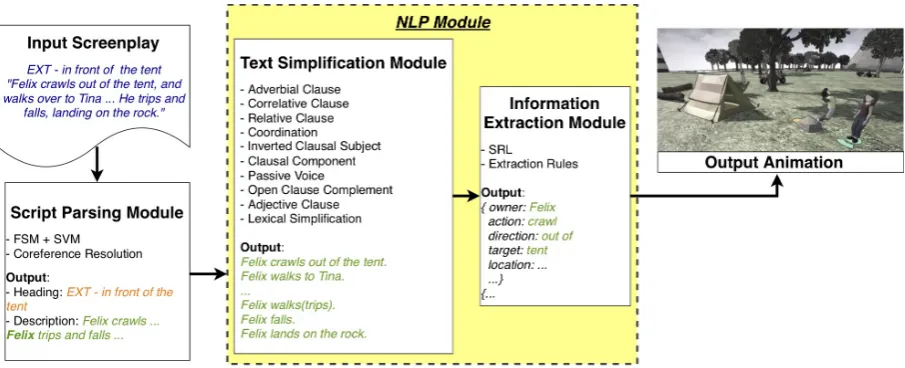
in-Figure 1: System Architecture: Screenplays are first segmented into different functional blocks. Then, the descrip-tive action sentences are simplified. Simplified sentences are used to generate animation.
formation extraction tasks.
2. Related Work
Translating texts into animation is not a trivial task, given that neither the input sentences nor the output animations have a fixed structure. Prior work addresses this problem from different pers-pectives (Hassani and Lee,2016).
CONFUCIUS (Ma and Kevitt, 2006) is a sys-tem that converts natural language to animation using the FDG parser (Tapanainen and J¨arvinen,
1997) and WordNet (Miller,1995). ScriptViz (Liu and Leung,2006) is another similar system, crea-ted for screenwriting. It uses the Apple Pie par-ser (Sekine,1998) to parse input text and then re-cognizes objects via an object-specific reasoner. It is limited to sentences having conjunction bet-ween two verbs. SceneMaker (Hanser et al.,2010) adopts the same NLP techniques as proposed in CONFUCIUS (Ma and Kevitt,2006) followed by a context reasoning module. Similar to previously proposed systems, we also use dependency par-sing followed by linguistic reduction (§3.2).
Recent advances in deep learning have pushed the state of the art results on different NLP tasks (Honnibal and Johnson, 2015;Wolf et al., 2018;
He et al., 2017). We use pre-trained models for dependency parsing, coreference resolution and SRL to build a complete NLP pipeline to crea-te increa-termediacrea-te action representations. For the ac-tion representaac-tion (§3.4), we use a key-value pair structure inspired by the PAR architecture (Badler et al.,2000), which is a knowledge base of repre-sentations for actions performed by virtual agents.
Our work comes close to the work done in the area of Open Information Extraction (IE) (Niklaus et al.,2018). In particular, to extract information, Clause-Based Open IE systems (Del Corro and Gemulla,2013;Angeli et al.,2015;Schmidek and Barbosa, 2014) reduce a complex sentence into simpler sentences using linguistic patterns. Howe-ver, the techniques developed for these systems do not generalize well to screenplay texts, as these systems have been developed using well-formed and factual texts like Wikipedia, Penn TreeBank, etc. An initial investigation with the popular Open IE system OLLIE (Open Language Learning for Information Extraction) (Mausam et al.,2012) did not yield good results on our corpus.
Previous work related to information extraction for narrative technologies includes the CARDI-NAL system (Marti et al.,2018;Sanghrajka et al.,
2018), as well as the conversational agent PICA (Falk et al.,2018). They focus on querying know-ledge from stories. The CARDINAL system also generates animations from input texts. However, neither of the tools can handle complex sentences. We build on the CARDINAL system. We deve-lop a new NLP module to support complex sen-tences and leverage the animation engine of CAR-DINAL.
[image:2.595.73.526.61.245.2]da-ta (e.g. (text,video) pairs) for training end-to-end text-to-animation systems.
3. Text-to-Animation System
We adopt a modular approach for generating animations from screenplays. The general over-view of our approach is presented in Figure1. The system is divided into three modules:
Script Parsing Module: Given an input screenplay text, this module automatically extracts the relevant text for generating the animation (§3.1).
NLP Module:It processes the extracted text to get relevant information. This has two sub-modules:
• Text Simplification Module:It simpli-fies complex sentences using a set of lin-guistic rules (§3.2).
• Information Extraction Module:It ex-tracts information from the simplified sentences into pre-defined action repre-sentations (§3.4).
Animation Generation Module: It genera-tes animation based on action representations (§3.5).
3.1. Script Parsing Module
Typically, screenplays or movie scripts or scripts (we use the terms interchangeably), are made of several scenes, each of which corresponds to a series of consecutive motion shots. Each sce-ne contains several functional composce-nents1: Hea-dings(time and location),Descriptions(scene des-cription, character actions),Character Cues (cha-racter name before dialog),Dialogs(conversation content), Slug Lines (actions inserted into con-tinuous dialog) and Transitions (camera move-ment). In many scripts, these components are ea-sily identifiable by indentation, capitalization and keywords. We call these scripts well-formatted, and the remaining onesill-formatted. We want to segment the screenplays into components and are mainly interested in the Descriptions component for animation generation.
Well-formatted Scripts: We initially tried ScreenPy (Winer and Young, 2017) to annotate the well-formatted scripts with the component labels. However, ScreenPy did not perform well on our data. We developed our own model, based on Finite State Machines (FSM), for parsing
1https://www.storysense.com/format.htm
Algorithm 1Syntactic Simplification Procedure 1: procedureSYNTACTICSIMPLIFICATION(sent, temp)
2: Q←empty queue
3: HS←empty integer hash set
4: RES←empty list
5: Q.push(sent) .push input sentence to queue
6: whileQ6=Emptydo
7: str←Q.pop()
8: ifhash(str)∈HSthen
9: RES.append(str) .have seen this sentence
10: continue
11: HS.add(str) .mark current sentence asalready seen 12: transform←False
13: fora in analyzersdo
14: if!transform&a.identify(str)then
15: transform←True
16: simplified= a.transform(str)
17: correct verb tense(simplified)
18: Q.push(simplified)
19: iftransform6=Truethen
20: RES.append(str)
21: returnRES
scripts (for details refer to Appendix A). Due to space limitations, we do not describe the FSM model; the key idea is that the model uses hand-crafted transition rules to segment the input screenplay and generates (paragraph, component name) pairs.
Ill-formatted Scripts:Taking all the (paragraph, component name) pairs generated by the FSM as ground truth, an SVM model is trained to segment ill-formatted screenplays with inconsistent inden-tations. For extracting features, each paragraph is encoded into a fix-sized vector using a pre-trained Universal Sentence Encoder. The SVM is trained and tested on a 9:1 train-test data split. The re-sult shows an accuracy of 92.72 % on the test set, which is good for our purposes, as we are interes-ted mainly in the Descriptions component.
Coreference Resolution: Screenplays contain a number of ambiguous entity mentions (e.g. pro-nouns). In order to link mentions of an entity, an accurate coreference resolution system is requi-red. The extracted Descriptions components are processed with the NeuralCoref2 system. Given the text, it resolves mentions (typically pronouns) to the entity they refer to in the text. To facili-tate entity resolution, we prepend each Descrip-tion component with the Character Cues compo-nent which appears before it in the screenplay (e.g. [character]MARTHA: [dialog]“I knew it!” [des-cription]She then jumps triumphantly→ MART-HA. She then jumps triumphantly).
3.2. Text Simplification Module
In a typical text-to-animation system, one of the main tasks is to process the input text to extract
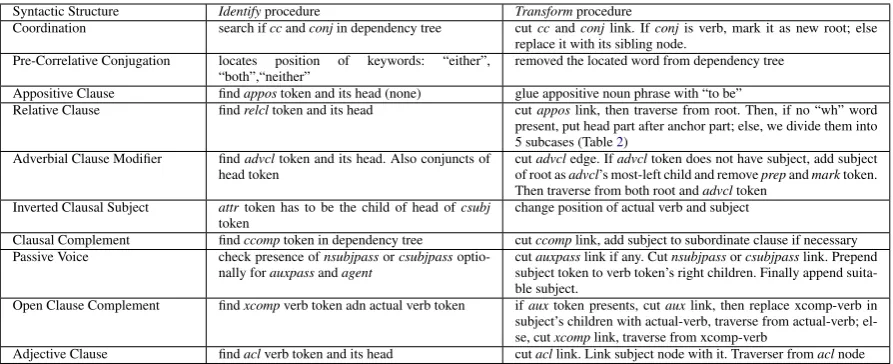
Syntactic Structure Identifyprocedure Transformprocedure
Coordination search ifccandconjin dependency tree cutccandconjlink. Ifconjis verb, mark it as new root; else replace it with its sibling node.
Pre-Correlative Conjugation locates position of keywords: “either”, “both”,“neither”
removed the located word from dependency tree
Appositive Clause findappostoken and its head (none) glue appositive noun phrase with “to be”
Relative Clause findrelcltoken and its head cutapposlink, then traverse from root. Then, if no “wh” word present, put head part after anchor part; else, we divide them into 5 subcases (Table2)
Adverbial Clause Modifier findadvcltoken and its head. Also conjuncts of head token
cutadvcledge. Ifadvcltoken does not have subject, add subject of root asadvcl’s most-left child and removeprepandmarktoken. Then traverse from both root andadvcltoken
Inverted Clausal Subject attrtoken has to be the child of head ofcsubj
token
change position of actual verb and subject
Clausal Complement findccomptoken in dependency tree cutccomplink, add subject to subordinate clause if necessary Passive Voice check presence ofnsubjpassorcsubjpass
optio-nally forauxpassandagent
cutauxpasslink if any. Cutnsubjpassorcsubjpasslink. Prepend subject token to verb token’s right children. Finally append suita-ble subject.
Open Clause Complement findxcompverb token adn actual verb token ifauxtoken presents, cutauxlink, then replace xcomp-verb in subject’s children with actual-verb, traverse from actual-verb; el-se, cutxcomplink, traverse from xcomp-verb
[image:4.595.76.523.61.243.2]Adjective Clause findaclverb token and its head cutacllink. Link subject node with it. Traverser fromaclnode
Table 1: Linguistic rules for text simplification module
the relevant information about actions (typically verbs) and participants (typically subject/object of the verb), which is subsequently used for genera-ting animation. This works well for simple sen-tences having a single verb with one subject and one (optional) object. However, the sentences in a screenplay are complicated and sometimes infor-mal. In this work, a sentence is said to be compli-cated if it deviates from easily extractable and sim-ple subject-verb-object (and its permutations) syn-tactic structures and possibly has multiple actions mentioned within the same sentence with syntactic interactions between them. By syntactic structure we refer to the dependency graph of the sentence. In the case of screenplays, the challenge is to process such complicated texts. We take the text simplification approach, i.e. the system first sim-plifies a complicated sentence and then extracts the relevant information. Simplification reduces a complicated sentence into multiple simpler sen-tences, each having a single action along with its participants, making it straightforward to extract necessary information.
Recently, end-to-end Neural Text Simplifica-tion (NTS) systems (Nisioi et al.,2017;Saggion,
2017) have shown reasonable accuracy. However, these systems have been trained on factual data such as Wikipedia and do not generalize well to screenplay texts. Our experiments with such a pre-trained neural text simplification system did not yield good results (§5.1). Moreover, in the context of text-to-animation, there is no standard labeled corpus to train an end-to-end system.
There has been work on text simplification using linguistic rules-based approaches. For
exam-ple, (Siddharthan, 2011) propose a set of rules to manipulate sentence structure to output simpli-fied sentences using syntactic dependency parsing. Similarly, the YATS system (Ferr´es et al., 2016) implements a set of rules in the JAPE language (Cunningham et al., 2000) to address six syntac-tic structures:Passive Constructions, Appositive Phrases, Relative Clauses, Coordinated Clau-ses, Correlated ClausesandAdverbial Clauses. Most of the rules focus on case and tense correc-tion, with only 1-2 rules for sentence splitting. We take inspiration from the YATS system, and our system incorporates modules to identify and trans-form sentence structures into simpler ones using a broader set of rules.
In our system, each syntactic structure is hand-led by an Analyzer, which contains two proces-ses:IdentifyandTransform. The Identifyprocess takes in a sentence and determines if it contains a particular syntactic structure. Subsequently, the Transformprocess focuses on the first occurrence of the identified syntactic structure and then splits and assembles the sentence into simpler sentences. Both Identify and Transform use Part-of-Speech (POS) tagging and dependency parsing ( Honni-bal and Montani,2017) modules implemented in spaCy 2.03
The simplification algorithm (Algorithm 1) starts with an input sentence and recursively pro-cesses it until no further simplification is possi-ble. It uses a queue to manage intermediate simpli-fied sentences, and runs in a loop until the queue is empty. For each sentence, the system applies each syntactic analyzer toIdentifythe
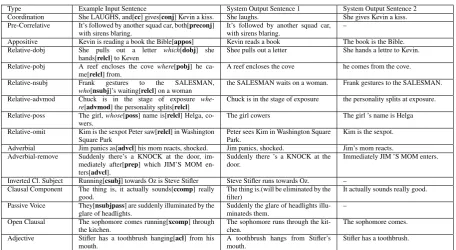
Type Example Input Sentence System Output Sentence 1 System Output Sentence 2 Coordination She LAUGHS, and[cc] gives[conj] Kevin a kiss. She laughs. She gives Kevin a kiss. Pre-Correlative It’s followed by another squad car, both[preconj]
with sirens blaring.
It’s followed by another squad car, with sirens blaring.
–
Appositive Kevin is reading a book the Bible[appos] Kevin reads a book The book is the Bible. Relative-dobj She pulls out a letter which[dobj] she
hands[relcl] to Keven
Shee pulls out a letter She hands a lettre to Kevin.
Relative-pobj A reef encloses the covewhere[pobj] he ca-me[relcl] from.
A reef encloses the cove he comes from the cove.
Relative-nsubj Frank gestures to the SALESMAN,
who[nsubj]’s waiting[relcl] on a woman
the SALESMAN waits on a woman. Frank gestures to the SALESMAN.
Relative-advmod Chuck is in the stage of exposure whe-re[advmod] the personality splits[relcl]
Chuck is in the stage of exposure the personality splits at exposure.
Relative-poss The girl,whose[poss] name is[relcl] Helga, co-wers.
The girl cowers The girl ’s name is Helga
Relative-omit Kim is the sexpot Peter saw[relcl] in Washington Square Park
Peter sees Kim in Washington Square Park.
Kim is the sexpot.
Adverbial Jim panics as[advcl] his mom reacts, shocked. Jim panics, shocked. Jim’s mom reacts. Adverbial-remove Suddenly there’s a KNOCK at the door,
im-mediately after[prep] which JIM’S MOM en-ters[advcl].
Suddenly there ’s a KNOCK at the door.
Immediately JIM ’S MOM enters.
Inverted Cl. Subject Running[csubj] towards Oz is Steve Stifler Steve Stifler runs towards Oz. – Clausal Component The thing is, it actually sounds[ccomp] really
good.
The thing is.(will be eliminated by the filter)
It actually sounds really good.
Passive Voice They[nsubjpass] are suddenly illuminated by the glare of headlights.
Suddenly the glare of headlights illu-minateds them.
–
Open Clausal The sophomore comes running[xcomp] through the kitchen.
The sophomore runs through the kit-chen.
The sophomore comes.
Adjective Stifler has a toothbrush hanging[acl] from his mouth.
A toothbrush hangs from Stifler’s mouth.
[image:5.595.71.528.58.308.2]Stifler has a toothbrush.
Table 2: Syntactic simplification rules applied on example sentences.
ding syntactic structure in the sentence (line 14). If the result is positive, the sentence is processed by theTransformfunction to convert it to simple sentences (line 16). Each of the output sentences is pushed by the controller into the queue (line 19). The process is repeated with each of theIdentify analyzers (line 13). If none of the analyzers can be applied, the sentence is assumed to be simple and it is pushed into the result list (line 21). We summarize linguistic rules in Table 1 and exam-ples are given in Table 2. Next, we describe the coordination linguistic rules. For details regarding other rules, please refer to Appendix B.
Coordination: Coordination is used for entities having the same syntactic relation with the head and serving the same functional role (e.g. subj, obj, etc.). It is the most important component in our simplification system. The parser tags word units such as “and” and “as well as” with the de-pendency label cc, and the conjugated words as conj. Our system deals with coordination based on the dependency tag of the conjugated word.
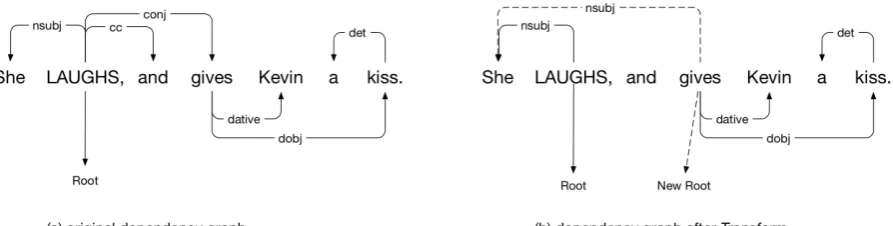
In the case of coordination, theIdentifyfunction simply returns whetherccorconjis in the depen-dency graph of the input sentence. TheTransform function manipulates the graph structure based on the dependency tags of the conjugated words as shown in Figure 2. If the conjugated word is a verb, then we mark it as another root of the sen-tence. Cuttingccandconjedges in the graph and
traversing from this new root results in a new sen-tence parallel to the original one. In other cases, such as the conjugation between nouns, we simply replace the noun phrases with their siblings and traverse from root again.
3.3. Lexical Simplification
In order to generate animation, actions and par-ticipants extracted from simplified sentences are mapped to existing actions and objects in the ani-mation engine. Due to practical reasons, it is not possible to create a library of animations for all possible actions in the world. We limit our library to a predefined list of 52 actions/animations, ex-panded to 92 by a dictionary of synonyms (§3.5). We also have a small library of pre-uploaded ob-jects (such as “campfire”, “truck” and others).
Figure 2:Transformin an example coordination sentence. Firstly the dependency links ofccandconjare cut. Then we look for a noun in the left direct children of the original rootLAUGHSand link the new rootgiveswith it. In-order traverse from the original root and the new root will result in simplified sentences as shown in Table2.
Our list of actions and objects is not exhausti-ve. Currently, we do not cover actions which may not be visual. For out of list actions, we give the user a warning that the action cannot be animated. Nevertheless, this is a work in progress and we are working on including more animations for actions and objects in our knowledge base.
3.4. Action Representation Field (ARF): Information Extraction
For each of the simplified sentences, informa-tion is extracted and populated into a predefined key-value pair structure. We will refer to the keys of this structure as Action Representation Fields (ARFs). These are similar to entities and rela-tions in Knowledge Bases. ARFs include:owner, target, prop, action, origin action, manner, mo-difier location, modifier direction,start-time, du-ration,speed, translation,rotation, emotion, par-tial start time(for more details see Appendix C). This structure is inspired by the PAR (Badler et al.,
2000) architecture, but adapted to our needs. To extract the ARFs from the simplified sen-tences, we use a Semantic Role Labelling (SRL) model in combination with some heuristics, for example creating word lists for duration, speed, translation, rotation, emotion. We use a pre-trained Semantic Role Labelling model4based on a Bi-directional LSTM network (He et al.,2017) with pre-trained ELMo embeddings (Peters et al.,
2018). We map information from each sentence to the knowledge base of animations and objects.
3.5. Animation Generation
We use the animation pipeline of the CAR-DINAL system. We plug in our NLP module in
4AllenNLP SRL model: https://github.com/
allenai/allennlp
CARDINAL to generate animation. CARDINAL creates pre-visualizations of the text, both in story-board form and animation. A storystory-board is a se-ries of pictures that demonstrates the sequence of scenes from a script. The animation is a 3-D ani-mated video that approximately depicts the script. CARDINAL uses the Unreal game engine ( Ga-mes, 2007) for generating pre-visualizations. It has a knowledge base of pre-baked animations (52 animations, plus a dictionary of synonyms, resul-ting in 92) and pre-uploaded objects (e.g. “camp-fire”, “tent”). It also has 3-D models which can be used to create characters.
4. Text-to-Animation Corpus
We initially used a corpus of Descriptions com-ponents from ScreenPy (Winer and Young,2017), in order to study linguistic patterns in the mo-vie script domain. Specifically, we used the “hea-ding” and “transition” fields from ScreenPy’s pu-blished JSON output on 1068 movie scripts scra-ped from IMSDb. We also scrascra-ped screenplays from SimplyScripts and ScriptORama5. After se-parating screenplays into well-formatted and ill-formatted, Descriptions components were extrac-ted using our model (§3.1). This gave a corpus of Descriptions blocks from 996 screenplays.
The corpus contains a total of 525,708 Descrip-tions components. The DescripDescrip-tions components contain a total of 1,402,864 sentences. Out of all the Descriptions components, 49.45 % (259,973) contain at least one verb which is in the anima-tion list (henceforth called “acanima-tion verbs”). Des-criptions components having at least one action verb have in total 920,817 sentences. Out of
the-5http://www.simplyscripts.com and http:
Carl touches Ellie’s shoulder as the doctor explains. Ellie drops her head in her hands.
System output Annotator I Annotator II BLEU2( %)
Carl touches Ellie ’s shoulder carl touches ellie’s shoulder carl touches ellie’s shoulder. 38.73
the doctor explains the doctor explains the doctor is talking. 100
Ellie drops Ellie head in Ellie hands
ellie drops her head in her hands ellie drops her head in her hands.
[image:7.595.112.248.164.210.2]48.79
Table 3: Differences between system output and annotator responses
BLEU SARI NTS-w2v 61.45 36.04
YATS 58.83 48.75
Our System 67.68 50.65
Table 4: Results on syntactic simplification
se, 42.2 % (388,597) of the sentences contain ac-tion verbs. In the corpus, the average length of a sentence is 12 words.
5. Evaluation and Analysis
There are no standard corpora for text-to-animation generation. It is also not clear how should such systems be evaluated and what should be the most appropriate evaluation metric. Nevert-heless, it is important to assess how our system is performing. We evaluate our system using two ty-pes of evaluation: Intrinsic and Extrinsic. Intrinsic evaluation is for evaluating the NLP pipeline of our system using the BLEU metric. Extrinsic eva-luation is an end-to-end qualitative evaeva-luation of our text-to-animation generation system, done via a user study.
5.1. Intrinsic Evaluation
To evaluate the performance of our proposed NLP pipeline, 500 Descriptions components from the test set were randomly selected. Three anno-tators manually translated these 500 Descriptions components into simplified sentences and extrac-ted all the necessary ARFs from the simplified sentences. This is a time intensive process and took around two months. 30 % of the Descriptions blocks contain verbs not in the list of 92 animation verbs. There are approximately 1000 sentences in the test set, with average length of 12 words. Each Descriptions component is also annotated by the three annotators for the ARFs.
Taking inspiration from the text simplification community (Nisioi et al., 2017; Saggion, 2017), we use the BLEU score (Papineni et al.,2002) for evaluating our simplification and information ex-traction modules. For each simplified sentencesi
we have 3 corresponding referencesr1i, r2i andr3i. We also evaluate using the SARI (Xu et al.,2016) score to evaluate our text simplification module.
5.1.1. Sentence Simplification
Each action block a is reduced to a set of simple sentences Sa = {s1, s2, ....sna}. And
for the same action block a, each annotator t,
t ∈ {1,2,3} produces a set of simplified sen-tences Rta = {rt1, r2t, ...rtmt
a}. Since the
simpli-fication rules in our system may not maintain the original ordering of verbs, we do not ha-ve sentence leha-vel alignment between elements in
Sa and Rat. For example, action block a = He
laughs after he jumps into the water is reduced by our system into two simplified sentencesSa = {s1 = He jumps into the water, s2 = He laughs}
by the temporal heuristics, while annotator3
gives us R3a = {r13 = He laughs, r32 =
He jumps into the water}. In such cases, sequen-tially matchingsitorj will result in a wrong
(hy-pothesis, reference) alignment which is (s1, r13)
and (s2,r23).
To address this problem, for each hypothesis
si ∈ Sa, we take the corresponding reference
rit∈Rtaas the one with the least Levenshtein Dis-tance (Navarro,2001) tosi, i.e,
rit= arg min rt
j
lev dist(si, rtj),∀j∈ {1, ..., mta}
As per this alignment, in the above example, we will have correct alignments (s1,r32) and (s2,r13).
Thus, for each simplified sentencesiwe have 3
co-rresponding referencesr1i,ri2andr3i. The aligned sentences are used to calculate corpus level BLEU score6and SARI score7.
The evaluation results for text simplification are summarized in Table 4. We compare against YATS (Ferr´es et al.,2016) and neural end-to-end text simplification system NTS-w2v (Nisioi et al.,
6We used NLTK’s API with default parameters:http:
//www.nltk.org/api/nltk.translate.html# nltk.translate.bleu_score.corpus_bleu
7Implementation available at https://github.
Field BLEU1 Field BLEU1
owner 56.16 org action 80.92
target 41.85 manner 84.84
prop 28.98 location 71.89
action 70.46 direction 70.83
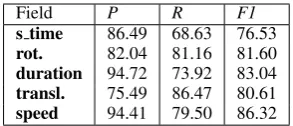
[image:8.595.350.497.61.124.2]emotion 57.89
Table 5: Results on textual ARFs ( %)
Field P R F1
s time 86.49 68.63 76.53
rot. 82.04 81.16 81.60
duration 94.72 73.92 83.04
transl. 75.49 86.47 80.61
[image:8.595.94.279.62.125.2]speed 94.41 79.50 86.32
Table 6: Result on Non-textual ARFs( %)
2017). YATS is also a rule-based text simplifica-tion system. As shown in Table4, our system per-forms better than YATS on both the metrics, in-dicative of the limitations of the YATS system. A manual examination of the results also showed the same trend. However, the key point to note is that we are not aiming for text simplification in the conventional sense. Existing text simplifica-tion systems tend to summarize text and discard some of the information. Our aim is to break a complex sentence into simpler ones while preser-ving the information.
An example of a Descriptions component with
BLEU2scores is given in Table3. In the first
sim-plified sentence, the space between Ellie and ’s causes the drop in the score. But it gives exactly the same answer as both annotators. In the second sentence, the system output is the same as the an-notator I’s answer, so the BLEU2 score is 1. In
the last case, the score is low, as annotators pos-sibly failed to replaceherwith the actual Charac-ter Cue Ellie. Qualitative examination reveals, in general, that our system gives a reasonable result for the syntactic simplification module. As exem-plified, BLEU is not the perfect metric to evaluate our system, and therefore in the future we plan to explore other metrics.
5.1.2. ARF Evaluation
We also evaluate the system’s output for action representation fields against gold annotations. In our case, some of the fields can have multiple (2 or 3) words such as owner, target, prop, action, origin action, manner, locationanddirection. We use BLEU1 as the evaluation metric to measure
the BOW similarity between system output and ground truth references. The results are shown in Table5.
In identifying owner, target andprop, the sys-tem tends to use a fixed long mention, while an-notators prefer short mentions for the same cha-racter/object. The score ofpropis relatively lower than all other fields, which is caused by a systema-tic SRL mapping error. The relatively high
accu-racy on the actionfield indicates the consistency between system output and annotator answers.
Annotation on the emotionARF is rather sub-jective. Responses on the this field are biased and noisy. TheBLEU1score on this is relatively low.
For the other non-textual ARFs, we use precision and recall to measure the system’s behavior. Re-sults are shown in Table6. These fields are sub-jective: annotators tend to give different responses for the same input sentence.
rotation and translation have Boolean values. Annotators agree on these two fields in most of the sentences. The system, on the other hand, fails to identify actions involving rotation. For exam-ple, in the sentence “Carl closes CARL ’s door sharply” all four annotators think that this sen-tence involves rotation, which is not found by the system. This is due to the specificity of rules on identifying these two fields.
speed,durationandstart timehave high preci-sion and low recall. This indicates the inconsis-tency in annotators’ answers. For example, in the sentence “Woody runs around to the back of the pizza truck”, two annotators give 2 seconds and another gives 1 second in duration. These fields are subjective and need the opinion of the script author or the director. In the future, we plan to in-volve script editors in the evaluation process.
5.2. Extrinsic Evaluation
We conducted a user study to evaluate the per-formance of the system qualitatively. The focus of the study was to evaluate (from the end user’s pers-pective) the performance of the NLP component w.r.t. generating reasonable animations.
We developed a questionnaire consisting of 20 sentence-animation video pairs. The animations were generated by our system. The questionnai-re was filled by 22 participants. On an average it took around 25 minutes for a user to complete the study.
Strongly Di-sagree
Disagree Neutral Agree Strongly Agree The animation shown in the video is a
reasona-ble visualization of the text.
13.64 % 18.18 % 22.95 % 28.64 % 16.59 %
All the actions mentioned in the text are shown in the video.
15.68 % 20 % 22.96 % 20.68 % 20.68 %
All the actions shown in the video are mentio-ned in the text.
[image:9.595.86.512.63.148.2]12.96 % 11.14 % 16.36 % 23.18 % 36.36 %
Table 7: User Study Results
the text information was depicted in the video and how much of the information in the video was pre-sent in the text (Table7). The 68.18 % of the parti-cipants rated the overall pre-visualization as neu-tral or above. The rating was 64.32 % (neuneu-tral or above) for the conservation of textual information in the video, which is reasonable, given limitations of the system that are not related to the NLP com-ponent. For the last question, 75.90 % (neutral or above) agreed that the video did not have extra in-formation. In general, there seemed to be reasona-ble consensus in the responses. Besides the limita-tions of our system, disagreement can be attributed to the ambiguity and subjectivity of the task.
We also asked the participants to describe quali-tatively what textual information, if any, was mis-sing from the videos. Most of the mismis-sing infor-mation was due to limitations of the overall system rather than the NLP component: facial expression information was not depicted because the charac-ter 3-D models are deliberately designed without faces, so that animators can draw on them. Infor-mation was also missing in the videos if it refe-rred to objects or actions that do not have a close enough match in the object list or animations list. Furthermore, the animation component only sup-ports animations referring to a character or object as a whole, not parts, (e.g. “Ben raises his head” is not supported).
However, there were some cases where the NLP component can be improved. For example, lexical simplification failed to map the verb “watches” to the similar animation “look”. In one case, syntac-tic simplification created only two simplified sen-tences for a verb which had three subjects in the original sentence. In a few cases, lexical simpli-fication successfully mapped to the most similar animation (e.g.“argue” to “talk”) but the partici-pants were not satisfied - they were expecting a more exact animation. We plan to address these shortcomings in future work.
6. Conclusion and Future Work
In this paper, we proposed a new text-to-animation system. The system uses linguistic text simplification techniques to map screenplay text to animation. Evaluating such systems is a cha-llenge. Nevertheless, intrinsic and extrinsic eva-luations show reasonable performance of the sys-tem. The proposed system is not perfect, for exam-ple, the current system does not take into account the discourse information that links the actions im-plied in the text, as currently the system only pro-cesses sentences independently. In the future, we would like to leverage discourse information by considering the sequence of actions which are des-cribed in the text (Modi and Titov, 2014; Modi,
2016). This would also help to resolve ambiguity in text with regard to actions (Modi et al., 2017;
Modi, 2017). Moreover, our system can be used for generating training data which could be used for training an end-to-end neural system.
Acknowledgments
We would like to thank anonymous reviewers for their insightful comments. We would also li-ke to thank Daniel Inversini, Isabel Sim´o Ayn´es, Carolina Ferrari, Roberto Comella and Max Gros-se for their help and support in developing the Cardinal system. Mubbasir Kapadia has been fun-ded in part by NSF IIS-1703883 and NSF S&AS-1723869.
References
Gabor Angeli, Melvin Jose Johnson Premkumar, and Christopher D Manning. 2015. Leveraging linguis-tic structure for open domain information extraction. In Proceedings of the 53rd Annual Meeting of the Association for Computational Linguistics and the 7th International Joint Conference on Natural Lan-guage Processing (Volume 1: Long Papers), volu-me 1, pages 344–354.
2000. Embodied conversational agents. chapter Pa-rameterized Action Representation for Virtual Hu-man Agents, pages 256–284. MIT Press, Cambrid-ge, MA, USA.
Hamish Cunningham, Diana Maynard, and Valentin Tablan. 2000. Jape: a java annotation patterns en-gine.
Luciano Del Corro and Rainer Gemulla. 2013. Clau-sie: clause-based open information extraction. In Proceedings of the 22nd international conference on World Wide Web, pages 355–366. ACM.
Jessica Falk, Steven Poulakos, Mubbasir Kapadia, and Robert W Sumner. 2018. Pica: Proactive intelligent conversational agent for interactive narratives. In Proceedings of the 18th International Conference on Intelligent Virtual Agents, pages 141–146. ACM.
Daniel Ferr´es, Montserrat Marimon, Horacio Saggion, and Ahmed AbuRa’ed. 2016. Yats: Yet another text simplifier. InNatural Language Processing and In-formation Systems, pages 335–342, Cham. Springer International Publishing.
Epic Games. 2007. Unreal engine. Online: https://www. unrealengine. com.
Eva Hanser, Paul Mc Kevitt, Tom Lunney, and Joan Condell. 2010. Scenemaker: Intelligent multimodal visualization of natural language scripts. In Pro-ceedings of the 20th Irish Conference on Artificial Intelligence and Cognitive Science, AICS’09, pages 144–153, Berlin, Heidelberg. Springer-Verlag.
Kaveh Hassani and Won-Sook Lee. 2016. Visualizing natural language descriptions: A survey.ACM Com-put. Surv., 49(1):17:1–17:34.
Luheng He, Kenton Lee, Mike Lewis, and Luke Zettle-moyer. 2017. Deep semantic role labeling: What works and what’s next. InProceedings of the 55th Annual Meeting of the Association for Computatio-nal Linguistics (Volume 1: Long Papers), volume 1, pages 473–483.
Matthew Honnibal and Mark Johnson. 2015. An im-proved non-monotonic transition system for depen-dency parsing. InProceedings of the 2015 Confe-rence on Empirical Methods in Natural Language Processing, pages 1373–1378, Lisbon, Portugal. As-sociation for Computational Linguistics.
Matthew Honnibal and Ines Montani. 2017. spacy 2: Natural language understanding with bloom embed-dings, convolutional neural networks and incremen-tal parsing. To appear.
Richard Johansson, David Williams, Anders Berglund, and Pierre Nugues. 2004. Carsim: a system to vi-sualize written road accident reports as animated 3d scenes. InProceedings of the 2nd Workshop on Text Meaning and Interpretation, pages 57–64. Associa-tion for ComputaAssocia-tional Linguistics.
R. Likert. 1932. A technique for the measurement of attitudes. Archives of Psychology, 22(140):1–55.
Zhi-Qiang Liu and Ka-Ming Leung. 2006. Script vi-sualization (scriptviz): a smart system that makes writing fun.Soft Computing, 10(1):34–40.
Ruqian Lu and Songmao Zhang. 2002. Automatic ge-neration of computeranimation: using AI for movie animation. Springer-Verlag.
Minhua Ma and Paul Kevitt. 2006. Virtual human ani-mation in natural language visualisation. Artif. In-tell. Rev., 25(1-2):37–53.
Elman Mansimov, Emilio Parisotto, Jimmy Lei Ba, and Ruslan Salakhutdinov. 2015. Generating ima-ges from captions with attention. arXiv preprint ar-Xiv:1511.02793.
Marcel Marti, Jodok Vieli, Wojciech Wito´n, Rushit Sanghrajka, Daniel Inversini, Diana Wotruba, Isabel Simo, Sasha Schriber, Mubbasir Kapadia, and Mar-kus Gross. 2018. Cardinal: Computer assisted aut-horing of movie scripts. In23rd International Con-ference on Intelligent User Interfaces, pages 509– 519. ACM.
Mausam, Michael Schmitz, Robert Bart, Stephen So-derland, and Oren Etzioni. 2012. Open language learning for information extraction. InProceedings of the 2012 Joint Conference on Empirical Methods in Natural Language Processing and Computational Natural Language Learning, pages 523–534. Asso-ciation for Computational Linguistics.
George A. Miller. 1995. Wordnet: A lexical database for english. COMMUNICATIONS OF THE ACM, 38:39–41.
Ashutosh Modi. 2016. Event embeddings for se-mantic script modeling. In Proceedings of The 20th SIGNLL Conference on Computational Natu-ral Language Learning.
Ashutosh Modi. 2017.Modeling common sense know-ledge via scripts. Ph.D. thesis, Universit¨at des Saar-landes.
Ashutosh Modi and Ivan Titov. 2014. Inducing neu-ral models of script knowledge. In Conferen-ce on Computational Natural Language Learning (CoNLL).
Ashutosh Modi, Ivan Titov, Vera Demberg, Asad Sa-yeed, and Manfred Pinkal. 2017. Modelling se-mantic expectation: Using script knowledge for re-ferent prediction. Transactions of the Association for Computational Linguistics, 5:31–44.
Thomas Wolf, James Ravenscroft, Julien Chau-mond, and Maxwell Rebo. 2018. Neu-ralcoref: Coreference resolution in spacy with neural networks. Available online at https://github.com/huggingface/neuralcoref.
Wei Xu, Courtney Napoles, Ellie Pavlick, Quanze Chen, and Chris Callison-Burch. 2016. Optimizing statistical machine translation for text simplification. Transactions of the Association for Computational Linguistics, 4:401–415.
[image:11.595.185.414.224.364.2]Appendix A
Figure 3:FSM of Well-formatted Screenplay Parser. Numbers of link are Rules and∼means logical NOT
ID Rule Summary
1 If input is uppercase and contains heading words such as ‘INT’, ‘EXT’. etc, return True, otherwise False
2 If input is uppercase and contains character words such as ‘CONT.’, ‘(O.S)’, or if #indentation>
most frequent #indentation, return True. Otherwise False 3 If input starts with‘(0, return True, otherwise False 4 If input ends with‘)0, return True, otherwise False
5 If|#lastindents−#currentindents|<3, return True, otherwise False
6 If the input is uppercase and contains transition words such as ‘DISSOLVE’, ‘CUT TO’. etc, return True, otherwise False
7 If the input equals to ‘THE END’, return True. Otherwise False.
[image:11.595.72.542.438.589.2]COMPLEX: Another parent , Mike Munson , sits on the bench with a tablet and uses an app to track and analyze the team ’s shots.
NSELSTM-B: Another parent, Mike Munson, sits on the bench with a tablet and uses an app to track. YATS: Another parent sits on the bench with a tablet and uses an app to track and examines the team’ s shots. This parent is Mike Munson.
OURS: Another parent is Mike Munson. Another parent sits on the bench with a tablet. Another parent uses an app.
COMPLEX: Stowell believes that even documents about Lincoln’s death will give people a better un-derstanding of the man who was assassinated 150 years ago this April.
NSELSTM-B: Stowell believes that the discovery about Lincoln’s death will give people a better unders-tanding of the man.
YATS: Stowell believes that even documents about Lincoln’ s death will give people a better reason of the man. This man was assassinated 150 years ago this April.
OURS: Stowell believes. Even documents about Lincoln ’s death give people a better understanding of the man. Somebody assassinates the man 150 years ago this April.
Appendix B: Algorithms
Algorithm 2Identify Adverbial Clause
1: procedureADVERBIALCLAUSE IDENTIFYPROCEDURE(sent) .The input sentence
2: find tokens in sents with dependency tag ROOT and ADVCL (we call it advcl)
3: ifno ADVCL token in sentsthen
4: returnFalse
5: find father token ofadvclasfather 6: iffatheris not a VERBthen
7: we make it as a VERB .We correct POS error here
8: find conjunction tokens offatherasconjuncts 9: ifNOUN inadvcl’s left subtreethen
10: subject←this NOUN
11: else
12: subject←NOUN infather’s left subtree
13: returnTrue
Algorithm 3Transform Adverbial Clause
1: procedureADVERBIALCLAUSE TRANSFORMPROCEDURE(sent) .The input sentence
2: cut edge between root and advcl token .remove advcl token from root’s children
3: ifadvcl verb does not have its own subjectthen
4: add subject as advcl’s most left direct child
5: remove PREP and MARK token in advcl’s children, modify temporal id accordingly
6: str1←traverse a string(root)
7: str2←correct tense(traverse a string(advcl))
8: return[str1, str2]
Algorithm 4Identify() in Relative Clause Analyzer
1: procedureRELATIVECLAUSE IDENTIFYPROCEDURE(sent) .The input sentence.
2: ifno RELCL token in sentthen
3: returnFalse
4: anchor←RELCL token
5: head←anchor’s head token
6: wg←NULL
7: fortoken t in anchor’s childrendo
8: ift.tag∈[WDT, WP, WP$, WRB]then
9: wh←t
10: returnTrue
Algorithm 5Transform() in Relative Clause Analyzer
1: procedureRELATIVECLAUSE TRANSFORMPROCEDURE(root, anchor, head, wh) .Root of dependency tree, the recl anchor token, its head, and wh-word
2: cut relcl edge between head and anchor
3: str1←traverse a string(root)
4: ifwh=NULLthen .No Wh-word in the sentence, concatenate
5: str2←traverse a string(anchor) + traverse a string(head)
6: else
7: wh-dep←dependency tag of wh
8: wh-head←head of wh
9: remove wh in anchor’s children
10: ifwh-dep=DOBJthen .wh is verb
11: str2←traverse a string(wh-head) + traverse a string(anchor)
12: else ifwh-dep=POBJthen .wh-head is preposition
13: put head after wh-head in anchor’s children
14: str2←traverse a string(anchor)
15: else ifwh-dep∈[NSUBJ, NSUBJPASS]then .wh is subject
16: str2←traverse a string(wh-head) + traverse a string(anchor)
17: else ifwh-dep=ADVMODthen .wh is time or location
18: prep←‘at’
19: str2←traverse a string(anchor) + prep+ traverse a string(wh-head)
20: else ifwh-dep=POSSthen .wh=whose
21: str2←traverse a string(wh-head) + be verb+ traverse a string(anchor)
22: correct verb tense in str1 and str2
Algorithm 6Transform() in Coordination Analyzer
1: procedureCOORDINATION TRANSFORMPROCEDURE(sents) .Input sentence
2: results←empty list
3: findrootof dependency tree ofsents
4: find firstcc(if any) andconjtoken in denpendency tree and their head tokenmain 5: embed all conjugate words ofmainin a listconjus
6: cut conj edge betweenmainandccandconj 7: ifno object formainthen
8: try find object inconj’s right children
9: str1←traverse a string(root)
10: results.append(str1)
11: forconjinconjsdo
12: type←get conj type(main,conj)
13: iftype=VERB&VERBthen
14: correct part-of-speech tag if necessary .spaCy tends to tag verb as noun
15: ifconjhas its own subjectthen
16: new-root←conj
17: else
18: ifmain=rootthen
19: new-root←conj
20: else
21: replacemainwithconjinroot’s children
22: new-root←root
23: else .Other cases such as NOUN&NOUN, AD*&AD*, apply same rule
24: main-head←head ofmain
25: replacemainwithconjinmain-head’s children
26: new-root←root
27: str2←traverse a string(new-root)
28: results.append(str2)
29: returnresults
Algorithm 7Identify() in Passive Analyzer
1: procedurePASSIVEVOICE IDENTIFYPROCEDURE(sents) .Input sentence
2: is-passive←False
3: fortokentin sentsdo
4: ift.dep∈[CSUBJPASS, NSUBJPASS]then
5: subj-token←t
6: verb-token←t.head
7: is-passive←True
8: ift.dep∈[AUXPASS] and t.head=verb-tokenthen
9: auxpass-token←t
10: ift.dep∈[AGENT] and t.text=‘by’then
11: by-token←t
12: returnis-passive
Algorithm 8Transform() in Passive Analyzer
1: procedurePASSIVEVOICE TRANSFORMPROCEDURE(sents) .Input sentence
2: ifauxpass-token6=NULLthen
3: cut auxpass edge
4: cut nsubjpass or csubj edge
5: prepend subject-token to verb-token’s right children
6: ifby-token6=NULLthen
7: cut by-agent edge
8: add by-token’s right children to verb-token’s left children
9: else
10: add ‘Somebody’ to verb-token’s left children
11: correct verb tense for verb-token
12: returntraverse a string(root-token)
Algorithm 9Transform() in Appositive Clause Analyzer
1: procedureAPPOSITIVECLAUSE TRANSFORMPROCEDURE(anchor, head) .The APPOS token and its head token.
2: cut edge betweenanchorandheadtoken .removeanchorfromhead’s right children
3: str1←traverse a string(root token of input sentence)
4: str2←traverse a string(head)+be verb+traverse a string(anchor)
5: correct verb tense in str1 and str2
6: return[str1, str2]
Algorithm 10Identify() in Inverted Clausal Subject Analyzer
1: procedureINVERTEDCLAUSALSUBJECT IDENTIFYPROCEDURE(sents) .Input sentence
2: forToken t insentsdo
3: ift.dep=CSUBJ and t.tag∈[VBN, VBG] and t.head.lemma=‘be’then
4: attr←token with dependency labelattrin t.head’s right children
5: ifattr=NULLthen .attris the actual subject of the sentence
6: returnFalse .Make sure this is an inverted sentence
7: actual-verb←t
8: be-verb←t.head
9: returnTrue
Algorithm 11Transform() in Inverted Clausal Subject Analyzer
1: procedureINVERTEDCLAUSALSUBJECT TRANSFORMPROCEDURE(sents) .Input sentence
2: get access to actual-verb, be-verb and attr in identify procedure10
3: change position of actual-verb and attr in be-verb’s children
4: return[traverse a string(be-verb)]
Algorithm 12Transform() in CCOMP Analyzer
1: procedureCLAUSECOMPONENT TRANSFORMPROCEDURE(sents) .Input sentence
2: cut CCOMP link in dependency tree
3: subject←find ccomp verb’s subject
4: ifsubject6=NULL and subject6=DET(e.g. ‘that’)then
5: iforiginal verb do not have objectthen
6: make subject as original verb’s object
7: else ifsubject=DET (e.g. ‘that’)then
8: find root verb’s object, substitute ‘that’
9: str1←traverse a string(ccomp verb)
10: str2←traverse a string(original verb)
11: return[str1, str2]
Algorithm 13Transform() in XCOMP Analyzer
1: procedureOPENCLAUSALCOMPONENT TRANSFORMPROCEDURE(sents) .Input sentence
2: subject-token←find subject(xcomp-verb-token) .find subject of the actual verb
3: results←empty list
4: ifAUX6∈sentsthen .for some cases two verbs needs to be output
5: cut xcomp link
6: results.add(traverse a string(xcomp-verb-token))
7: remove AUX token in the dependency tree
8: replace xcomp-verb-token in subject’s children with actual-verb-token
9: results.add(traverse a string(actual-verb-token))
10: returnresults
Algorithm 14Transform() in ACL Analyzer
1: procedureADJECTIVECLAUSE TRANSFORMPROCEDURE(sents) .Input Sentence
2: cut acl edge in dependency tree
3: str1←traverse a string(root-token)
4: mid-fix←empty string
5: ifacl-token.tag=VBN and by-token in acl-token’s right childrenthen
6: mid-fix←‘be’
7: update acl-verb-token’s left children with [acl-noun, mid-fix, [t∈acl-verb-token.lefts where t.dep6∈[AUX]]
8: correct acl-verb-tense
9: str2←traverse a string(acl-verb-token)
10: return[str1, str2]
Algorithm 15Get-Temporal Function at Line 5 in Algorithm3
1: procedureADVERBIALCLAUSETEMPORALINFOEXTRACTIONPROCEDURE(prep−or−mark, cur−temp).The PREP or MARK token in input sentence
2: flag←False .whether we change the temp
3: ifprep-or-mark.type=PREPthen
4: sign←-1
5: else
6: sign←1
7: text←prep-or-mark.text.lower()
8: iftext=asthen
9: flag←True
10: else iftext∈[until,till] then
11: flag←True
12: cur-temp←cur-temp + sign
13: else iftext=afterthen
14: flag←True
15: cur-temp←cur-temp - sign
16: else iftext=beforethen
17: flag←True
18: cur-temp←cur-temp + sign
Appendix C: Action Representation Fields
Action Representation Fields (ARFs) in the demo sentenceJames gently throws a red ball to Alice in the restaurant from back, extracted with SRL:
owner: James
target: a red ball
prop: to Alice
action: throw
origin action: throws
manner: gently
modifier location: in the restaurant
modifier direction: from back
In this case, our output for the prop and target is not correct; they should be swapped. This is one example where this module can introduce errors.
Additional ARFs, extracted heuristically:
startTime: Calculated by current scene time
duration: We have a pre-defined list of words that when appearing in the sentence, they will indicate a short duration (e.g “run” or “fast”) and therefore thedurationwill be set to 1 second; in contrast, for words like “slowly” we assign a duration of 4 seconds; otherwise, the duration is 2 seconds.
speed: Similarly toduration, we have pre-defined lists of words that would affect the speed of the pre-baked animation: “angrily” would result in faster movement, but “carefully” in slower movement. We have 3 scales: 0.5, 1, 2 which corresponds toslow, normalandfast.
translation: We have a list ofactionswhich would entail a movement in from one place to another, e.g. “go”. If the value of theactionexists in this list, it is set to True, otherwise False.
rotation: If theactionexists in our list of verbs that entail rotation, this field is True, otherwise False. Rotation refers to movement in place e.g. “turn” or “sit”.
emotion: We find the closet neighbor of each word in the sentence in list of words that indicate emotion, using word vector similarity. If the similarity exceeds an empirically tested threshold, then we take the corresponding emotion word as theemotionfield of this action.
partial start time: an important field, since it controls the sequence order of each action. It determines which actions happen in parallel and which happen sequentially. This is still an open question. We solve this problem when doing sentence simplification. Together with the input sentence, current time is also fed into eachAnalyzer. There are several rules in some of theAnalyzersto obtain temporal information. For example, in Line 5 of theAdverbial Clause Analyzer
(c.f.3), we assign different temporal sequences for simplified actions. The algorithm is shown in Algorithm15. Thesign