CoMeT: Integrating different levels of linguistic modeling for
meaning assessment
Niels Ott Ramon Ziai Michael Hahn Detmar Meurers
Sonderforschungsbereich 833 Eberhard Karls Universit¨at T¨ubingen
{nott,rziai,mhahn,dm}@sfs.uni-tuebingen.de
Abstract
This paper describes the CoMeT system, our contribution to the SemEval 2013 Task 7 chal-lenge, focusing on the task of automatically assessing student answers to factual questions. CoMeT is based on a meta-classifier that uses the outputs of the sub-systems we developed: CoMiC, CoSeC, and three shallower bag ap-proaches. We sketch the functionality of all sub-systems and evaluate their performance against the official test set of the challenge. CoMeT obtained the best result (73.1% accu-racy) for the 3-way unseen answers in Beetle among all challenge participants. We also dis-cuss possible improvements and directions for future research.
1 Introduction
Our contribution to the SemEval 2013 Task 7 chal-lenge (Dzikovska et al., 2013) presented here is based on our research in the A4 project1 of the SFB 833, which is dedicated to the question how meaning can be computationally compared in realistic situations. In realistic situations, utterances are not necessarily well-formed or complete, there may be individual differences in situative and world knowledge among the speakers. This can complicate or even preclude a complete linguistic analysis, leading us to the fol-lowing research question: Which linguistic repre-sentations can be used effectively and robustly for comparing the meaning of sentences and text frag-ments computationally?
1
http://purl.org/dm/projects/sfb833-a4
In order to work on effective and robust processing, we base our work on reading comprehension exer-cises for foreign language learners, of which we are also collecting a large corpus (Ott et al., 2012). Our first system, CoMiC, is an alignment-based approach which exists in English and German variants (Meur-ers et al., 2011a; Meur(Meur-ers et al., 2011b). CoMiC uses various levels of linguistic abstraction from sur-face tokens to dependency parses. Further work that we are starting to tackle includes the utilization of Information Structure (Krifka, 2007) in the system.
The second approach emerging from the research project is CoSeC (Hahn and Meurers, 2011; Hahn and Meurers, 2012), a semantics-based system for meaning comparison that was developed for German from the start and was ported to operate on English for this shared task. As a novel contribution in this paper, we present CoMeT (Comparing Meaning in T¨ubingen), a system that employs a meta-classifier for combining the output of CoMiC and CoSeC and three shallower bag approaches.
In terms of the general context of our work, short answer assessment essentially comes in the two fla-vors of meaning comparison and grading, the first trying to determine whether or not two utterances convey the same meaning, the latter aimed at grading the abilities of students (cf. Ziai et al., 2012). Short answer assessment is also closely related to the field of Recognizing Textual Entailment (RTE, Dagan et al., 2009), which this year is directly reflected by the fact that SemEval 2013 Task 7 is the Joint Stu-dent Response Analysis and 8th Recognizing Textual Entailment Challenge.
Turning to the organization of this paper, section 2 introduces the three types of sub-systems and the meta-classifier. In section 3, we report on the evalu-ation results of each sub-system both for our devel-opment set as well as for the official test set of the shared task. We then discuss possible causes and implications of the findings we made by participating in the shared task.
2 Systems
The CoMeT system that we describe in this paper is a combination of three types of sub-systems in one meta-classifier. CoSeC and CoMiC are sys-tems that align linguistic units in the student answer to those in the reference answer. In contrast, the bag-based approaches employ a vocabulary of words, lemmas, and Soundex hashes constructed from all of the student answers in the training data. In the meta-classifier, we tried to combine the benefits of the named sub-systems into one large system that eventu-ally computed our submission to the SemEval 2013 Task 7 challenge.
2.1 CoMiC
CoMiC (Comparing Meaning in Context) is an alignment-based system, i.e., it operates on a map-ping of linguistic units found in a student answer to those given in a reference answer. CoMiC started off as a re-implementation of the Content Assessment Module (CAM) of Bailey and Meurers (2008). It exists in two flavors: CoMiC-DE for German, de-scribed in Meurers et al. (2011b), and CoMiC-EN for English, described in Meurers et al. (2011a). Both systems are positioned in the landscape of the short answer assessment field in Ziai et al. (2012). In this paper, we refer to CoMiC-EN simply as CoMiC.
Sketched briefly, CoMiC operates in three stages:
1. Annotationuses various NLP modules to equip
student answers and reference answers with lin-guistic abstractions of several types.
2. Alignmentcreates links between these linguistic
abstractions from the reference answer to the student answer.
3. Classificationuses summary statistics of these
alignment links in machine learning in order to assign labels to each student answer.
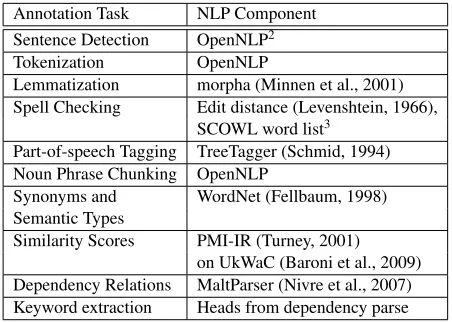
Automatic annotation and alignment are imple-mented in the Unstructured Information Management Architecture (UIMA, Ferrucci and Lally, 2004). Our UIMA modules mainly wrap around standard NLP tools of which we provide an overview in Table 1. We used the standard statistical models which are provided with the NLP tools.
Annotation Task NLP Component Sentence Detection OpenNLP2 Tokenization OpenNLP
Lemmatization morpha (Minnen et al., 2001) Spell Checking Edit distance (Levenshtein, 1966),
SCOWL word list3 Part-of-speech Tagging TreeTagger (Schmid, 1994) Noun Phrase Chunking OpenNLP
Synonyms and WordNet (Fellbaum, 1998) Semantic Types
[image:2.612.314.540.165.326.2]Similarity Scores PMI-IR (Turney, 2001) on UkWaC (Baroni et al., 2009) Dependency Relations MaltParser (Nivre et al., 2007) Keyword extraction Heads from dependency parse
Table 1: NLP tools used for CoMiC and Bag Approaches
Annotation ranges from very basic linguistic units such as sentences and tokens with POS and lemmas, over NP chunks, up to full dependency parses of the input. For distributional semantic similarity via PMI-IR (Turney, 2001), a local search engine based on Lucene (Gospodneti´c and Hatcher, 2005) querying the UkWaC corpus (Baroni et al., 2009) was used, since all major search engines meanwhile have shut down their APIs.
After the annotation of linguistic units has taken place,candidate alignment linksare created within UIMA. In a simple example case, a candidate align-ment link is a pair of tokens that is token identical in the student answer and in the reference answer. The same token in the student answer may also be part of a candidate alignment link that maps to an-other token in the reference answer that, e.g., has the same lemma, or is a possible synonym, or again is token identical. Other possible links are based on spelling-corrected tokens, semantic types, or high values of the PMI-IR similarity measure.
Words that are present in the reading comprehen-sion question and that are also found in the student an-swer are excluded from alignment, resulting in a very
2
http://incubator.apache.org/opennlp
3
basic implementation of an approach togivenness
(cf. Halliday, 1967, p. 204 and many others since). Subsequently, aglobally optimal alignmentof lin-guistic units in the reference answer and student an-swer is determined using the Traditional Marriage Algorithm (Gale and Shapley, 1962).
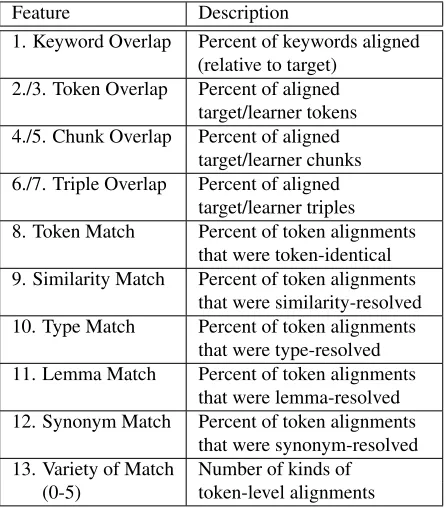
At this point, processing within UIMA comes to an end with an output module that generates the files containing the features for machine learning. These features basically are summary statistics of the types of alignment links. An overview of these numeric features used is given in Table 2.
Feature Description
1. Keyword Overlap Percent of keywords aligned (relative to target)
2./3. Token Overlap Percent of aligned target/learner tokens 4./5. Chunk Overlap Percent of aligned
target/learner chunks 6./7. Triple Overlap Percent of aligned
target/learner triples 8. Token Match Percent of token alignments
that were token-identical 9. Similarity Match Percent of token alignments
that were similarity-resolved 10. Type Match Percent of token alignments
that were type-resolved 11. Lemma Match Percent of token alignments
that were lemma-resolved 12. Synonym Match Percent of token alignments
that were synonym-resolved 13. Variety of Match Number of kinds of
[image:3.612.75.298.238.494.2](0-5) token-level alignments
Table 2: Features used in CoMiC’s classification phase
Current versions of CoMiC use the WEKA toolkit (Hall et al., 2009), allowing us to experiment with different machine learning strategies. In general, any type of classification can be trained in this machine learning phase, a binary correct vs. incorrect de-cision as in the 2-way task being the simplest case. The best results with CoMiC on our held-out develop-ment set were achieved using WEKA’s J48 classifier, which is an implementation of decision tree based on Quinlan (1993).
In terms of linguistic abstractions, CoMiC leaves the choice of representations used to its alignment step. However, in the final machine learning step, no concrete information about linguistic units is present
any more. The machine learning component only sees alignment configurations which are indepen-dent of concrete words, phrases, or any other lin-guistic information. This high level of abstraction suggests that CoMiC should perform better than other approaches on unseen topics and unseen questions, since it does not rely on concrete units as, e.g., a bag-of-words approach does.
2.2 CoSeC
CoSeC (Comparing Semantics in Context) performs meaning comparison on the basis of an underspec-ified semantic representation robustly derived from the learner and the reference answers. The sys-tem was developed for German (Hahn and Meurers, 2012), on the basis of which we created the English CoSeC-EN for the SemEval 2013 Task 7 challenge. Using an explicit semantic formalism in principle makes it possible to precisely represent meaning dif-ferences. It also supports a direct representation of Information Structure as a structuring of semantics representations (Krifka, 2007).
CoSeC is based on Lexical Resource Semantics (LRS, Richter and Sailer, 2004). Being an under-specified semantic formalism, LRS avoids the costly computation of all readings and provides access to the building blocks of the semantic representation, while additional constraints provide the information about their composition.
As described in Hahn and Meurers (2011), LRS representations can be derived automatically using a two-step approach based on part-of-speech tags assigned by TreeTagger (Schmid, 1994) and depen-dency parses by MaltParser (Nivre et al., 2007). First, the dependency structure is transformed into a com-pletely lexicalized syntax-semantics interface rep-resentation, which abstracts away from some form variation at the surface. These representations are then mapped to LRS representations. The approach is robust in that it always results in an LRS structure, even for ill-formed sentences.
preserves structure at the levels of variables and the subterm structure of the semantic formulas.
Local similarity of semantic expressions is esti-mated using WordNet (Fellbaum, 1998), FrameNet (Baker et al., 1998), PMI-IR (Turney, 2001) on the UkWaC (Baroni et al., 2009) as used in CoMiC, the Minimum Edit Distance (Levenshtein, 1966), and special parameters for comparing functional elements such as quantifiers and grammatical function labels. Based on the alignments, the system marks ele-ments which are not linked to eleele-ments in the ques-tion or which are linked to the semantic contribuques-tion of an alternative in an alternative question as “fo-cused”. This is intended as a first approximation of the concept offocusin the sense of Information Struc-ture (von Heusinger, 1999; Kruijff-Korbayov´a and Steedman, 2003; Krifka, 2007), an active field of re-search in linguistics addressing the question how the information in sentences is packaged and integrated into discourse. Focus elements are expected to be particularly relevant for determining the correctness of an answer (Meurers et al., 2011b).
Overall meaning comparison is then done based on a set of numerical scores computed from the align-ments and their quality. For each of these scores, a threshold is empirically determined, over which the student answer is considered to be correct. Among the scores discussed by Hahn and Meurers (2011),
weighted-targetfocus, consistently scored best in the development set. This score measures the percent-age of terms in the semantic representation of the reference answer which are linked to elements of the student answer in relation to the number of all elements in the representation of the reference an-swer. Only terms that were marked as focused in the preceding step are counted. Functional elements, i.e., quantifiers, predicates representing grammatical function labels, or the lambda operator, are weighted differently from other elements.
This threshold method can only be used to perform 2-way classification. Unlike the machine learning step in CoMiC, it does not generalize to 3-way or 5-way classification.
The alignment algorithm uses several numerical parameters, such as weights for the different compo-nents measuring semantic similarities, weights for the different overall local and global criteria, and the weight of theweighted-targetfocusscore. These
parameters are optimized using Powells algorithm combined with grid-based line optimization (Press et al., 2002). To avoid overfitting, the parameters and the threshold are determined on disjoint partitions of the training set.
In terms of linguistic abstractions, meaning assess-ment in CoSeC is based entirely on underspecified semantic representations. Surface forms are indi-rectly encoded by the structure of the representation and the predicate names, which are usually derived from the lemmas. As with CoMiC, parameter opti-mization and the determination of the thresholds for the numerical scores do not involve concrete infor-mation about linguistic objects. Again, the high level of abstraction suggests that CoSeC should perform better than other approaches on unseen topics and unseen questions.
2.3 The Bag Approaches
Inspired by the bag-of-words concept that emerged from information retrieval (Salton and McGill, 1983), we designed a system that uses bag representations of student answers. For each student answer, there are three bags, each containing one of the following representations: words, lemmas and Soundex hashes of that answer. The question ID corresponding to the answer is added to each bag as a pseudo-word, allowing the machine learner to adjust to question-specific properties. Based on the bag representations, the approach compares a given student answer to a model trained on all other known student answers. On the one hand, this method ignores the presence of reference answers (although they could be added to the training set as additional correct answers), on the other hand it makes use of information not taken into account by alignment-based systems such as CoMiC or CoSeC.
for each class. The optimal gamma parameter and complexity constant were estimated via 10-fold grid search.
In terms of abstractions, all bag-based approaches simply disregard word order and in case of binary bags even word frequency. Still, a bit of the relation between words is essentially encoded in their mor-phology. This piece of information is discarded in the bags of lemmas, eventually, e.g., putting words like “bulb” and “bulbs” in the same vector slot. Fur-ther away from the surface are the Soundex hashes, a phonetic representation of English words patented by Russell (1918). The well-known algorithm trans-forms similar-sounding English words into the same representation of characters and numbers, thereby ironing out many spelling mistakes and common confusion cases of homophones such as “there” vs. “their”. The MorphAdorner4implementation we used
returns empty Soundex hashes for input tokens that do not start with a letter of the alphabet. However, we found in our experiments, that the presence of these empty hashes in the bags has a positive impact on performance. This is most likely due to the fact that it discriminates answers containing punctuation (not a letter of the alphabet) from those which do not.
Since the bag approaches use Soundex as pho-netic equivalence classes, but no semantic equiva-lence classes, they should perform best on the unseen answers data in which most lexical material from the test set is likely to already be present in the training set.
2.4 CoMeT: A Meta-Classifier
As described in the previous sections, our sub-systems perform short answer evaluation on differ-ent represdiffer-entations and at differdiffer-ent levels of abstrac-tion. The bag approaches are very surface-oriented, whereas CoSeC uses a semantic formalism to com-pare answers to each other. We expected each system to show its strengths in different test scenarios, so a way was needed to combine the predictions of differ-ent systems into the final result.
CoMeT (Comparing Meaning in T¨ubingen) is a meta-classifier which builds on the predictions of our individual systems (feature stacking, see Wolpert, 1992). The rationale is that if systems are
comple-4
http://morphadorner.northwestern.edu
mentary, their combination will perform better (or at least as good) than any individual system on its own. The design is as follows:
Each system produces predictions on the training set, using 10-fold cross-validation, and on the test set. In addition to the predicted class, each system was also made to output probabilities for each possible class (cf., e.g., Tetreault et al., 2012a). The class probabilities were then used as features in the meta classifier to train a model for the test data. In addition to the probabilities, we also used the question ID and module ID in the meta-classifier, in the hope that they would allow differentiation between scenarios. For example, an unseen question ID means that we are not testing on unseen answers and thus predictions from systems with more abstraction from the surface may be preferred.
The class probabilities come from different sources, depending on the system. In the case of CoMiC, they are extracted directly from the decision trees. For the bag approaches, we used WEKA’s op-tion to fit logistic models to the SVM output after classification in order to estimate probabilities. Fi-nally, the CoSeC probabilities are derived directly from its final score. As mentioned in section 2.2, CoSeC only does binary classification, so those prob-abilities are used in the meta-classifier for all tasks.
Based on the results on our internal development set (see section 3.1), we chose different system com-binations for different scenarios. For unseen topics and unseen questions, we used only CoMiC in com-bination with CoSeC, since the inclusion of the bag approaches had a negative impact on results. For un-seen answers, we additionally included the bag mod-els. All meta-classification was done using WEKA’s Logistic Regression implementation. The results are discussed in section 3.
3 Evaluation
3.1 Development Set
In order to be as close as possible to the final test setting, we replicated the official test scenarios on the training set, resulting in atrain/dev/testsplit for each of the corpora. For Beetle, we held out all an-swers to two random questions for each module to form the unseen questions scenario, and five random answers from each remaining question to form the unseen answers scenario. For SciEntsBank, we held out module LF for dev and moduleVB for test to form the unseen topics scenario, because they have an average number of questions (11). TheLFmodule turned out to be far more skewed towards incorrect answers (76.8%) than the training set on average (57.5%). While this skewedness needs to be taken into account for the interpretation of the development results, it did not have a negative effect on our fi-nal test results. Furthermore, afi-nalogous to Beetle, we held out all answers to one random question for each remaining module for unseen-questions, and two random answers from each remaining question for unseen answers.
Thedevset was used for tuning and design deci-sions concerning which individual systems to com-bine in the stacked classifier, while we envisaged the testset to be used as a final checkpoint before submission.
The accuracy results for all sub-systems on the development set are reported in detail in Table 3. The majority baseline reflects the accuracy a system would achieve by always labelling any student answer as “incorrect”, hence it is equivalent to the percentage of incorrect answers in the data. The lexical baseline is the performance of the system provided by the challenge organizers.
Beetle SciEntsBank
System d-uA d-uQ d-uA d-uQ d-uT
Maj. Baseline 57.14% 59.28% 54.30% 60.70% 76.84% Lex. Baseline 75.43% 71.10% 63.44% 66.05% 59.54% CoMiC 76.57% 71.52% 67.20% 70.23% 64.63% Bag of Words 85.14% 62.03% 80.65% 54.65% 73.79%
∼of Lemmas 85.71% 58.02% 80.11% 52.33% 74.55%
[image:6.612.316.541.373.497.2]∼of Soundex 86.86% 60.76% 81.18% 53.95% 72.77% CoSeC 76.00% 74.89% 64.52% 73.49% 68.96% CoMeT 88.00% 75.95% 81.18% 66.74% 68.45%
Table 3: Development set: accuracy for 2-way task (uA: unseen answers, uQ: unseen questions, uT: unseen topics)
The systems presented in section 2 performed as expected: The Bag-of-Soundex system achieved its best scores on the unseen answers where overlap of vocabulary was most likely, outperforming CoMiC and CoSeC with accuracy values as high as 86.86%. For Beetle unseen answers, the meta-classifier op-erated as expected and improved the overall results to 88.86%. For SciEntsBank unseen answers, it re-mained stable at 81.18%.
As expected, CoMiC and CoSeC with their align-ment not depending on vocabulary outperformed the bag approaches in the other scenarios, in which the question or even the domain were not known during training. However, both alignment-based systems failed on SciEntsBank’s unseen topics in comparison to the rather high majority baseline.
3.2 Official Test Set
For our submission to the SemEval 2013 Task 7 chal-lenge, we trained our sub-systems on the entire of-ficial training set. The overall performance of the CoMeT system on all sub-tasks is shown in Table 4.
Beetle SciEntsBank
uA uQ uA uQ uT
Lexical 2-way 79.7% 74.0% 66.1% 67.4% 67.6% Overlap 3-way 59.5% 51.2% 55.6% 54.0% 57.7% Baseline 5-way 51.9% 48.0% 43.7% 41.3% 41.5% Best 2-way 84.5% 74.1% 77.6% 74.5% 71.1% System 3-way 73.1% 59.6% 72.0% 66.3% 63.7% 5-way 71.5% 62.1% 64.3% 53.2% 51.2% CoMeT 2-way 83.8% 70.2% 77.4% 60.3% 67.6% 3-way 73.1% 51.8% 71.3% 54.6% 57.9% 5-way 68.8% 48.8% 60.0% 43.7% 42.1%
Table 4: Official test set: overall accuracy of CoMeT (uA: unseen answers, uQ: unseen questions, uT: unseen topics)
While CoMeT won the Beetle 3-way task in unseen answers, our main focus is on the 2-way task. The results for the 2-way task of our sub-systems on the official test set are shown in Table 5.
[image:6.612.72.300.578.683.2]Beetle SciEntsBank
System uA uQ uA uQ uT
Best 84.50% 74.10% 77.60% 74.50% 71.10% Maj. Baseline 59.91% 58.00% 56.85% 58.94% 57.98% Lex. Baseline 79.70% 74.00% 66.10% 67.40% 67.60% CoMiC 76.08% 70.57% 67.96% 66.30% 67.97% Bag of Words 83.14% 67.52% 75.93% 57.84% 59.84%
∼of Lemmas 83.60% 67.16% 76.67% 58.25% 58.81%
∼of Soundex 84.05% 68.38% 75.93% 57.57% 58.02% CoSeC 62.19% 63.61% 67.22% 58.94% 62.36% CoMeT 83.83% 70.21% 77.41% 60.30% 67.62% CoSeC* 75.40% 70.82% 72.04% 64.94% 70.60% CoMeT* 84.51% 71.43% 79.26% 65.35% 69.53%
Table 5: Official test set: accuracy for 2-way task (uA: unseen answers, uQ: unseen questions, uT: unseen topics)
Even though it does not live up to the standards of the bag approaches in their area of expertise (unseen answers), the CoMiC systems outperforms the bags on the unseen question and unseen topic sub-sets as expected. Note that on unseen topics, CoMiC still scores 10% above the majority baseline on the official test set, in contrast to the drop of more than 10% below the baseline for the corresponding (skewed) development set.
However, the results for CoSeC are around 10% lower on the unseen questions, and almost 7% lower on the unseen topics of the test data than on the de-velopment set, a drop that the overall meta-classifier (CoMeT) was unable to catch. Investigating this drop in comparison to our development set, we checked the correctness of the training script and discovered a bug in the CoSeC setup that led to the parameters and the thresholds being computed on the same partition of the training set, i.e., the system overfitted to this partition, while the remainder of the training set was not used for training. Correcting the bug resulted in CoSeC accuracy values broadly comparable to those of CoMiC, as was the case on the development set. This confirms that the reason for the drop in the sub-mission was not a flaw in the CoSeC system as such, but a programming bug in a peripheral component.
With this bug fixed, CoSeC performs 5%–13% better on the test set, and the meta-classifier would have been able to benefit from the regularly perform-ing CoSeC, improvperform-ing in performance up to 5%. These two amended systems are listed as CoSeC* and CoMeT* in Table 5. For the two unseen an-swers scenarios, CoMeT* would outperform the best scoring systems of the challenge in the 2-way task.
3.3 Discussion
In this section, we try to identify some general ten-dencies from studying the results. Firstly, we can observe that due to the strong performance of the bag models, unseen answers scores are generally higher than their counterparts. It seems that if questions have been seen before, surface-oriented methods out-perform more abstract approaches. However, the picture is different for unseen domains and unseen questions. We are generally puzzled by the fact that many systems in the shared task scored worse on unseen questions, where in-domain training data is available, than on unseen domains, where this is not the case. The CoMeT classifier suffered especially in unseen questions of SciEntsBank, scoring lower than our best system would have on its own (see Table 5); even after the CoSeC bug was fixed, CoMeT* still scored worse there than CoMiC on its own.
In general, we likely would have benefited from domain adaptation, as described in, e.g., Daume III (2007). Consider that the input for the meta-classifier always consists of the same set of features produced via standard cross-validation, regardless of the test scenario. Instead, the trained model should have dif-ferent feature weights depending on what the model will be tested on.
4 Conclusion and Outlook
We presented our approach to Task 7 of SemEval 2013, consisting of a combination of surface-oriented bag models and the increasingly abstract alignment-based systems CoMiC and CoSeC. Predictions of all systems were combined using a meta classifier in order to produce the final result for CoMeT.
[image:7.612.75.300.60.196.2]fea-tures, which turned out not to be an effective domain adaptation approach.
In our future research, work on CoMiC will con-centrate on integrating two aspects of the context: First, we are planning to develop an automatic ap-proach to focus identification in order to pinpoint the essential parts of the student answers. Second, for data sets where a reading text is available, we will try to automatically determine the location of the rel-evant source information given the question, which can then be used as alternative or additional reference material for answer evaluation.
The CoMiC system currently also relies on the Traditional Marriage Algorithm to select the optimal global alignment between student answer and refer-ence answer. We plan to replace this algorithm by a machine learning component that can handle this selection in a data-driven way.
For CoSeC, we plan to develop an extension that allows for n-to-m mappings, hence improving the alignment performance for multi-word units such as, e.g., phrasal verb constructions.
The bag approaches could be augmented by explor-ing additional levels of abstractions, e.g., semantic equivalence classes constructed via WordNet lookup.
In sum, while we will also plan to explore opti-mizations to the training setup of the meta-classifier (e.g., domain adaptation along the lines of Daume III, 2007), the main focus of our further research lies in improving the individual sub-systems, which then again are expected to push the overall performance of the CoMeT meta-classifier system.
Acknowledgements
We are thankful to Sowmya Vajjala and Serhiy Bykh for their valuable advice on meta-classifiers and other machine learning techniques. We also thank the re-viewers for their comments; in consultation with the SemEval organizers we kept the length at 8 pages plus references, the page limit for papers describing multiple systems.
References
Stacey Bailey and Detmar Meurers. 2008. Diagnosing meaning errors in short answers to reading compre-hension questions. In Joel Tetreault, Jill Burstein, and Rachele De Felice, editors, Proceedings of the
3rd Workshop on Innovative Use of NLP for Building Educational Applications (BEA-3) at ACL’08, pages 107–115, Columbus, Ohio.http://aclweb.org/ anthology/W08-0913.pdf.
Collin F. Baker, Charles J. Fillmore, and John B. Lowe. 1998. The berkeley framenet project. InProceedings of the 36th Annual Meeting of the Association for Compu-tational Linguistics and 17th International Conference on Computational Linguistics, volume 1, pages 86–90, Montreal, Quebec, Canada.
Marco Baroni, Silvia Bernardini, Adriano Ferraresi, and Eros Zanchetta. 2009. The wacky wide web: A collec-tion of very large linguistically processed web-crawled corpora. Journal of Language Resources and Evalua-tion, 3(43):209–226.
Walter Daelemans, Jakub Zavrel, Ko van der Sloot, and Antal van den Bosch, 2007. TiMBL: Tilburg Memory-Based Learner Reference Guide, ILK Techni-cal Report ILK 07-03. Induction of Linguistic Knowl-edge Research Group Department of Communication and Information Sciences, Tilburg University, Tilburg, The Netherlands, July 11. Version 6.0.
Ido Dagan, Bill Dolan, Bernardo Magnini, and Dan Roth. 2009. Recognizing textual entailment: Rational, evalu-ation and approaches.Natural Language Engineering, 15(4):i–xvii, 10.
Hal Daume III. 2007. Frustratingly easy domain adap-tation. InProceedings of the 45th Annual Meeting of the Association of Computational Linguistics, pages 256–263, Prague, Czech Republic, June. Association for Computational Linguistics.
Myroslava O. Dzikovska, Rodney Nielsen, Chris Brew, Claudia Leacock, Danilo Giampiccolo, Luisa Ben-tivogli, Peter Clark, Ido Dagan, and Hoa Trang Dang. 2013. Semeval-2013 task 7: The joint student response analysis and 8th recognizing textual entailment chal-lenge. In*SEM 2013: The First Joint Conference on Lexical and Computational Semantics, Atlanta, Geor-gia, USA, 13-14 June.
Christiane Fellbaum, editor. 1998. WordNet: An Elec-tronic Lexical Database. MIT Press, Cambridge, Mas-sachusetts.
David Ferrucci and Adam Lally. 2004. UIMA: An ar-chitectural approach to unstructured information pro-cessing in the corporate research environment. Natural Language Engineering, 10(3–4):327–348.
David Gale and Lloyd S. Shapley. 1962. College admis-sions and the stability of marriage. American Mathe-matical Monthly, 69:9–15.
Otis Gospodneti´c and Erik Hatcher. 2005. Lucene in Action. Manning, Greenwich, CT.
practical approach for evaluating meaning in learner corpora. In Proceedings of the Intern. Confer-ence on Dependency Linguistics (DEPLING 2011), pages 94–103, Barcelona. http://purl.org/ dm/papers/hahn-meurers-11.html.
Michael Hahn and Detmar Meurers. 2012. Evaluat-ing the meanEvaluat-ing of answers to readEvaluat-ing comprehen-sion questions: A semantics-based approach. In Pro-ceedings of the 7th Workshop on Innovative Use of NLP for Building Educational Applications (BEA-7) at NAACL-HLT 2012, pages 94–103, Montreal. http: //aclweb.org/anthology/W12-2039.pdf. Mark Hall, Eibe Frank, Geoffrey Holmes, Bernhard
Pfahringer, Peter Reutemann, and Ian H. Witten. 2009. The WEKA data mining software: An update. InThe SIGKDD Explorations, volume 11, pages 10–18. Michael Halliday. 1967. Notes on Transitivity and Theme
in English. Part 1 and 2. Journal of Linguistics, 3:37– 81, 199–244.
Manfred Krifka. 2007. Basic notions of information struc-ture. In Caroline Fery, Gisbert Fanselow, and Manfred Krifka, editors,The notions of information structure, volume 6 ofInterdisciplinary Studies on Information Structure (ISIS). Universit¨atsverlag Potsdam, Potsdam. Ivana Kruijff-Korbayov´a and Mark Steedman. 2003. Dis-course and information structure. Journal of Logic, Language and Information (Introduction to the Special Issue), 12(3):249–259.
Vladimir I. Levenshtein. 1966. Binary codes capable of correcting deletions, insertions, and reversals. Soviet Physics Doklady, 10(8):707–710.
Detmar Meurers, Ramon Ziai, Niels Ott, and Stacey Bai-ley. 2011a. Integrating parallel analysis modules to evaluate the meaning of answers to reading comprehen-sion questions. IJCEELL. Special Issue on Automatic Free-text Evaluation, 21(4):355–369. http://purl. org/dm/papers/meurers-ea-11.html. Detmar Meurers, Ramon Ziai, Niels Ott, and Janina Kopp.
2011b. Evaluating answers to reading comprehen-sion questions in context: Results for German and the role of information structure. In Proceedings of the TextInfer 2011 Workshop on Textual Entailment, pages 1–9, Edinburgh, Scotland, UK, July. http: //aclweb.org/anthology/W11-2401.pdf. Guido Minnen, John Carroll, and Darren Pearce. 2001.
Applied morphological processing of English.Natural Language Engineering, 7(3):207–233.
Joakim Nivre, Jens Nilsson, Johan Hall, Atanas Chanev, G¨ulsen Eryigit, Sandra K¨ubler, Svetoslav Marinov, and Erwin Marsi. 2007. MaltParser: A language-independent system for data-driven dependency pars-ing. Natural Language Engineering, 13(1):1–41. Niels Ott, Ramon Ziai, and Detmar Meurers. 2012.
Cre-ation and analysis of a reading comprehension exercise
corpus: Towards evaluating meaning in context. In Thomas Schmidt and Kai W¨orner, editors, Multilin-gual Corpora and MultilinMultilin-gual Corpus Analysis, Ham-burg Studies in Multilingualism (HSM), pages 47–69. Benjamins, Amsterdam. http://purl.org/dm/ papers/ott-ziai-meurers-12.html. John C. Platt. 1998. Sequential minimal optimization:
A fast algorithm for training support vector machines. Technical Report MSR-TR-98-14, Microsoft Research. William H. Press, Saul A. Teukolsky, William T. Vetter-ling, and Brian P. Flannery. 2002. Numerical Recipes in C++. Cambridge University Press, Cambridge, UK. J.R. Quinlan. 1993.C4.5: Programs for Machine
Learn-ing. Morgan Kaufmann Publishers.
Frank Richter and Manfred Sailer. 2004. Basic concepts of lexical resource semantics. In Arnold Beckmann and Norbert Preining, editors,European Summer School in Logic, Language and Information 2003. Course Mate-rial I, volume 5 ofCollegium Logicum, pages 87–143. Publication Series of the Kurt G¨odel Society, Wien. Robert C. Russell. 1918. US patent number 1.261.167, 4. Gerard Salton and Michael J. McGill. 1983.Introduction
to modern information retrieval. McGraw-Hill, New York.
Helmut Schmid. 1994. Probabilistic part-of-speech tag-ging using decision trees. InProceedings of the In-ternational Conference on New Methods in Language Processing, pages 44–49, Manchester, UK.
Joel Tetreault, Daniel Blanchard, Aoife Cahill, and Mar-tin Chodorow. 2012. Native tongues, lost and found: Resources and empirical evaluations in native language identification. InProceedings of the 24th International Conference on Computational Linguistics (COLING), pages 2585–2602, Mumbai, India.
Peter Turney. 2001. Mining the web for synonyms: PMI-IR versus LSA on TOEFL. InProceedings of the Twelfth European Conference on Machine Learn-ing (ECML-2001), pages 491–502, Freiburg, Germany. Klaus von Heusinger. 1999.Intonation and Information
Structure. The Representation of Focus in Phonology and Semantics. Habilitationssschrift, Universit¨at Kon-stanz, KonKon-stanz, Germany.
David H. Wolpert. 1992. Stacked generalization. Neural Networks, 5(2):241–259.