Annotating Preferences in Negotiation Dialogues
Ana¨ıs Cadilhac, Nicholas Asher and Farah Benamara IRIT, CNRS and University of Toulouse
118, route de Narbonne 31062 Toulouse, France
{cadilhac, asher, benamara}@irit.fr
Abstract
Modeling user preferences is crucial in many real-life problems, ranging from individual and collective decision-making to strategic in-teractions between agents and game theory. Since agents do not come with their prefer-ences transparently given in advance, we have only two means to determine what they are if we wish to exploit them in reasoning: we can infer them from what an agent says or from his nonlinguistic actions. In this paper, we an-alyze how to infer preferences from dialogue moves in actual conversations that involve bar-gaining or negotiation. To this end, we pro-pose a new annotation scheme to study how preferences are linguistically expressed in two different corpus genres. This paper describes the annotation methodology and details the inter-annotator agreement study on each cor-pus genre. Our results show that preferences can be easily annotated by humans.
1 Introduction
Modeling user preferences is crucial in many real-life problems, ranging from individual and collec-tive decision-making (Arora and Allenby, 1999) to strategic interactions between agents (Brainov, 2000) and game theory (Hausman, 2000). A web-based recommender system can, for example, help a user to identify (among an optimal ranking) the product item that best fits his preferences (Burke, 2000). Modeling preferences can also help to find some compromise or consensus between two or more agents having different goals during a nego-tiation (Meyer and Foo, 2004).
Working with preferences involves three subtasks (Brafman and Domshlak, 2009):preference acquisi-tion, which extracts preferences from users, prefer-ence modelingwhere a model of users’ preferences is built using a preference representation language andpreference reasoningwhich aims at computing the set of optimal outcomes. We focus in this paper on the first task.
Handling preferences is not easy. First, specifying an ordering over acceptable outcomes is not trivial especially when multiple aspects of an outcome mat-ter. For instance, choosing a new camera to buy may depend on several criteria (e.g. battery life, weight, etc.), hence, ordering even two outcomes (cameras) can be cognitively difficult because of the need to consider trade-offs and dependencies between the criteria. Second, users often lack complete infor-mation about preferences initially. They build a partial description of agents’ preferences that typi-cally changes over time. Indeed, users often learn about the domain, each others’ preferences and even their own preferences during a decision-making pro-cess. Since agents don’t come with their preferences transparently given in advance, we have only two means to determine what they are if we wish to ex-ploit them in reasoning: we can infer them from what an agent says or from his nonlinguistic actions. In this paper, we analyze how to infer preferences from dialogue moves in actual conversations that in-volve bargaining or negotiation.
Within the Artificial Intelligence community, preference acquisition from nonlinguistic actions has been performed using a variety of specific tasks, including preference learning (F¨urnkranz and
H¨ullermeier, 2011) and preference elicitation meth-ods (Chen and Pu, 2004) (such as query learning (Blum et al., 2004), collaborative filtering (Su and Khoshgoftaar, 2009) and qualitative graphical rep-resentation of preferences (Boutilier et al., 1997)). However, these tasks don’t occur in actual conver-sations about negotiation. We are interested in how agents learn about preferences from actual conver-sational turns in real dialogue (Edwards and Barron, 1994), using NLP techniques.
To this end, we propose a new annotation scheme to study how preferences are linguistically expressed in dialogues. The annotation study is performed on two different corpus genres: the Verbmobil cor-pus (Wahlster, 2000) and a booking corcor-pus, built by ourselves. This paper describes the annotation methodology and details the inter-annotator agree-ment study on each corpus genre. Our results show that preferences can be easily annotated by humans.
2 Background
2.1 What are preferences?
A preference is commonly understood as an order-ing by an agent over outcomes, which are under-stood as actions that the agent can perform or goal states that are the direct result of an action of the agent. For instance, an agent’s preferences may be defined over actions likebuy a new caror by its end result likehave a new car. The outcomes over which a preference is defined will depend on the domain or task.
Among these outcomes, some are acceptable for the agent, i.e. the agent is ready to act in such a way as to realize them, and some outcomes are not. Among the acceptable outcomes, the agent will typ-ically prefer some to others. Our aim is not to de-termine the most preferred outcome of an agent but follows rather the evolution of their commitments to certain preferences as the dialogue proceeds. To give an example, if an agent proposes to meet on a certain day X and at a certain time Y, we learn that among the agent’s acceptable outcomes is a meeting on X at Y, even if this is not his most preferred outcome. We are interested in an ordinal definition of prefer-ences, which consists in imposing a ranking over all (relevant) possible outcomes and not a cardinal defi-nition which is based on numerical values that allow
comparisons.
More formally, let Ω be a set of possible outcomes. A preference relation, written , is a reflexive and transitive binary relation over elements ofΩ. The preference orderings are not necessarily complete, since some candidates may not be com-parable by a given agent. Given the two outcomes o1ando2,o1o2means that outcomeo1is equally
or more preferred to the decision maker than o2.
Strict preferenceo1 o2 holds iffo1 o2 and not o2 o1. The associated indifference relation is o1∼o2 ifo1o2 ando2 o1.
2.2 Preferences vs. opinions
It is important to distinguish preferences from opin-ions. While opinions are defined as a point of view, a belief, a sentiment or a judgment thatan agent may have about an object or a person, preferences, as we have defined them, involve an ordering on be-half of an agent and thus are relational and com-parative. Hence, opinions concern absolute judg-ments towards objects or persons (positive, negative or neutral), while preferences concern relative judg-ments towards actions (preferring them or not over others). The following examples illustrate this:
(a) The movie is not bad.
(b) The scenario of the first season is better than the second one.
(c) I would like to go to the cinema. Let’s go and see
Madagascar 2.
(a) expresses a direct positive opinion towards the movie but we do not know if this movie is the most preferred. (b) expresses a comparative opinion be-tween two movies with respect to their shared fea-tures (scenarios) (Ganapathibhotla and Liu, 2008). If actions involving these movies (e.g. seeing them) are clear in the context, such a comparative opin-ion will imply a preference, ordering the first season scenario over the second. Finally, (c) expresses two preferences, one depending on the other. The first is that the speaker prefers to go to the cinema over other alternative actions; the second is, given that preference, that he wants to see Madagascar 2 over other possible movies.
determine an order over outcomes that predicts how the agent, if he is rational, will act. This is not true for opinions. Opinions have at best an indirect link to action: I may hate what I’m doing, but do it any-way because I prefer that outcome to any of the al-ternatives.
3 Data
Our data come from two corpora: one already-existing, Verbmobil (CV), and one that we cre-ated,Booking(CB).
The first corpus is composed of 35 dialogues ran-domly chosen from the existing corpus Verbmobil (Wahlster, 2000), where two agents discuss on when and where to set up a meeting. Here is a typical frag-ment:
π1A: Shall we meet sometime in the next week? π2A: What days are good for you?
π3 B: I have some free time on almost every day
except Fridays. π4B: Fridays are bad.
π5B: In fact, I’m busy on Thursday too.
π6A: Next week I am out of town Tuesday,
Wednes-day and ThursWednes-day.
π7A: So perhaps Monday?
The second corpus was built from various En-glish language learning resources, available on the Web (e.g., www.bbc.co.uk/worldservice/ learningenglish). It contains 21 randomly se-lected dialogues, in which one agent (the customer) calls a service to book a room, a flight, a taxi, etc. Here is a typical fragment:
π1 A: Northwind Airways, good morning. May I
help you?
π2 B: Yes, do you have any flights to Sydney next
Tuesday?
π3A: Yes, there’s a flight at 16:45 and one at 18:00. π4A: Economy, business class or first class ticket? π5B: Economy, please.
Our approach to preference acquisition exploits discourse structure and aims to study the impact of discourse for extracting and reasoning on prefer-ences. Cadilhac et al. (2011) show how to compute automatically preference representations for a whole stretch of dialogue from the preference representa-tions for elementary discourse units. Our annota-tion here concentrates on the commitments to
pref-erences expressed in elementary discourse units or
EDUs. We analyze how the outcomes and the depen-dencies between them are linguistically expressed by performing, on each corpus, a two-level anno-tation. First, we perform a segmentation of the di-alogue intoEDUs. Second, we annotate preferences
expressed by theEDUs.
The examples above show the effects of segmen-tation. Each EDU is associated with a label πi. For Verbmobil, we rely on the already avail-able discourse annotation of Baldridge and Las-carides (2005). For Booking, the segmentation was made by consensus.
We detail, in the next section, our preference an-notation scheme.
4 Preference annotation scheme
To analyze how preferences are linguistically ex-pressed in eachEDU, we must: (1) identify the set
Ω of outcomes, on which the agent’s preferences are expressed, and (2) identify the dependencies be-tween the elements ofΩ by using a set of specific operators, i.e. identifying the agent’s preferences on the stated outcomes. Consider the segment “Let’s meet Thursday or Friday”. We have Ω = {meet Thursday,meet Friday}where outcomes are linked by a disjunction that means the agent is ready to act for one of these outcomes, preferring them equally.
Within an EDU, preferences can be expressed in different ways. They can be atomic preference state-ments or complex preference statestate-ments.
4.1 Atomic preferences
Atomic preference statements are of the form “I pre-fer X”, “Let’s X”, or “We need X”, where X de-scribes an outcome. X may be a definite noun phrase (“Monday”, “next week”, “almost every day”), a prepositional phrase (“at my office”) or a verb phrase (“to meet”). They can be expressed within comparatives and/or superlatives (“a cheaper room” or “the cheapest flight”).
is even stronger. Expressions of sentiment or polite-ness can also be used to indirectly introduce prefer-ences. InBooking, the segment “economy please” indicates the agent’s preference to be in an economy class.
EDUs can also express preferences via free-choice
modalities; “I am free on Thursday” or “I can meet on Thursday” tells us that Thursday is a possible day to meet, it is an acceptable outcome.
A negative preference expresses an unacceptable outcome, i.e. what the agent does not prefer. Neg-ative preference can be expressed explicitly with negation words (“I don’t want to meet on Friday”) or inferred from the context (“I am busy on Mon-day”).
While the logical form of an atomic preference statement is something of the form P ref(X), we abbreviate this in the annotation language, using just the outcome expression X to denote that the agent prefers X to the alternatives, i.e. X X. If X is an unacceptable outcome, we use the non-boolean operatornotto denote that the agent prefersnot Xto other alternatives, i.e.X X. In ourVerbmobil
annotation,Xis typically an NP denoting a time or place; X as an outcome is thus shorthand formeet on X ormeet atX. For Booking, X is short for
reserveorbookX.
4.2 Complex preferences
Preference statements can also be complex, express-ing dependencies between outcomes. Borrowing from the language of conditional preference net-works or CP-nets (Boutilier et al., 2004), we rec-ognize that some preferences may depend on an-other action. For instance, given that I have cho-sen to eat fish, I will prefer to have white wine over red wine—something which we express as
eat fish: drink white wine drink red wine. Among the possible combinations, we find con-junctions, disjunctions and conditionals. We exam-ine these conjunctive, disjunctive and conditional operations over outcomes and suppose a language with non-boolean operators&,5and7→taking out-come expressions as arguments.
With conjunctions of preferences, as in “Could I have a breakfast and a vegetarian meal?” or in “Mondays and Fridays are not good?”, the agent ex-presses two preferences (respectively over the
ac-ceptable outcomes breakfast and vegetarian meal and the non acceptable outcomes not Mondays and not Fridays) that he wants to satisfy and he prefers to have one of them if he can not have both. Hence o1&o2 meanso1 o1 ando2 o2.
The semantics of a disjunctive preference is a free choice one. For example in “either Monday or Tues-day is fine for me” or in “I am free MonTues-day and Tuesday”, the agent states that either Monday or Tuesday is an acceptable outcome and he is indif-ferent between the choice of the outcomes. Hence o1 5 o2 means o2 : o1 ∼ o1, o2 : o1 o1 and o1:o2 ∼o2,o1 :o2 o2.
Finally, some EDUs express conditional among preferences. For example, in the sentence “What about Monday, in the afternoon?”, there are two preferences: one for the day Monday, and, given the Monday preference, one for the time afternoon (of Monday), at least for one syntactic reading of the utterance. Henceo1 7→ o2 means o1 o1 and o1:o2 o2.
For eachEDU, annotators identify how outcomes
are expressed and then indicate if the outcomes are acceptable, or not, using the operatornot and how the preferences on these outcomes are linked using the operators &,5and7→.
4.3 Example
We give below an example of how someEDUs are annotated. <o> i indicates that o is the outcome numberiin theEDU, the symbol // is used to sepa-rate the two annotation levels and brackets indicate how outcomes are attached.
π1 :<Tuesday the sixteenth>1 I got class<from nine to twelve>2? // 17→not 2
π2 : What about <Friday afternoon>1, <at two thirty>2 or<three>3, // 17→(253)
π3 : <The room with balcony>1 should be equipped
<with a queen size bed>2, <the other one>3
<with twin beds>4, please. // (1 7→2) & (3 7→ 4)
Inπ1, the annotation tells us that we have two
out-comes and that the agent prefers outcome 1 over any other alternatives and given that, he does not pre-fer outcome 2. In π2, the annotation tells us that
outcome 3 is lexicalized by the coordinating con-junction “or”. On the contrary,π3is a more complex
example where there is no discursive marker to find that the preference operator between the couples of outcomes 1 and 2 on one hand, and 3 and 4 on the other hand, is the conjunctive operator &.
5 Inter-annotator agreements
Our two corpora (Verbmobil and Booking) were annotated by two annotators using the pre-viously described annotation scheme. We per-formed an intermediate analysis of agreement and disagreement between the two annotators on two
[image:5.612.318.537.53.140.2]Verbmobil dialogues. Annotators were thus trained only forVerbmobil. The aim is to study to what extent our annotation scheme is genre depen-dent. The training allowed each annotator to under-stand the reason of some annotation choices. After this step, the dialogues of our corpora have been an-notated separately, discarding those two dialogues. Table 1 presents some statistics about the annotated data in the gold standard.
CV CB
No. of dialogues 35 21
No. of outcomes 1081 275
No. ofEDUs with outcomes 776 182 % with 1 outcome 71% 70% % with 2 outcomes 22% 19% % with 3 or more outcomes 8% 11%
No. of unacceptable outcomes (not) 266 9 No. of conjunctions (&) 56 31 No. of disjunctions (5) 75 29 No. of conditionals (7→) 184 37
Table 1: Statistics for the two corpora.
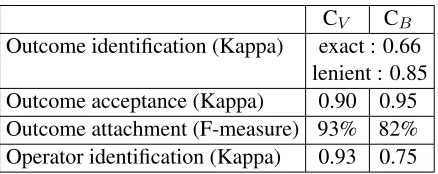
We compute four inter-annotator agreements: on outcome identification, on outcome acceptance, on outcome attachment and finally on operator identifi-cation. Table 2 summarizes our results.
5.1 Agreements on outcome identification
Two inter-annotator agreements were computed us-ing Cohen’s Kappa. One based on anexactmatching between two outcome annotations (i.e. their corre-sponding text spans), and the other based on a
le-CV CB Outcome identification (Kappa) exact : 0.66
lenient : 0.85 Outcome acceptance (Kappa) 0.90 0.95 Outcome attachment (F-measure) 93% 82% Operator identification (Kappa) 0.93 0.75
Table 2: Inter-annotator agreements for the two corpora.
nient match between annotations (i.e. there is an overlap between their text spans as in “2p.m” and “around 2p.m”). This approach is similar to the one used by Wiebe, Wilson and Cardie (2005) to com-pute agreement when annotating opinions in news corpora. We obtained an exact agreement of 0.66 and a lenient agreement of 0.85 for both corpus gen-res.
We made the gold standard after discussing cases of disagreement. We observed four cases. The first one concerns redundant preferences which we de-cided not to keep in the gold standard. In such cases, the secondEDUπ2 does not introduce a new
prefer-ence, neither does it correct the preferences stated in π1; rather, the agent just wants to insist by
repeat-ing already stated preferences, as in the followrepeat-ing example:
π1 A: Thursday, Friday, and Saturday I am out.
π2 A: So those days are all out for me,
The second case of disagreement comes from anaphora which are often used to introduce new, to make more precise or to accept preferences. Hence, we decided to annotate them in the gold standard. Here is an example:
π1 A: One p.m. on the seventeenth?
π2 B: That sounds fantastic.
The third case of disagreement concerns prefer-ence explanation. We chose not to annotate these expressions in the gold standard because they are used to explain already stated preferences. In the following example, one judge annotated “from nine to twelve” to be expressions of preferences while the other did not :
π1 A: Monday is really not good,
[image:5.612.73.299.369.536.2]Finally, the last case of disagreement comes from preferences that are not directly related to the action of fixing a date to meet but to other actions, such as having lunch, choosing a place to meet, etc. Even though those preferences were often missed by an-notators, we decided to keep them, when relevant.
5.2 Agreements on outcome acceptance
The aim here is to compute the agreement on thenot
operator, that is if an outcome is acceptable, as in “<Mondays>1 are good // 1”, or unacceptable, as in “<Mondays> 1 are not good // not 1”. We get a Cohen’s Kappa of 0.9 forVerbmobiland 0.95 for
Booking. The main case of disagreement concerns anaphoric negations that are inferred from the con-text, as inπ2below where annotators sometimes fail
to consider “in the morning” as unacceptable out-comes:
π1 A: Tuesday is kind of out,
π2 A: Same reason in the morning
Same case of disagreement in this example where “Monday” is an unacceptable outcome:
π1 well, I am, busy<in the afternoon of the twenty sixth>1, // not 1
π2 that is<Monday>1 // not 1
5.3 Agreements on outcome attachment
Since this task involves structure building, we com-pute the agreement using the F-score measure. The agreement was computed on the previously built gold standard once annotators discussed cases of outcome identification disagreements. We compare how each outcome is attached to the others within the same EDU. This agreement concerns EDUs that contain at least three outcomes, that is 8% of
EDUs from Verbmobil and 11% of EDUs from
Booking. When comparing annotations for the ex-ample π1 below, there is three errors, one for
out-come 2, one for 3 and one for 4.
π1 <for the next week>1 the only days I have open are<Monday>2 or<Tuesday>3 <in the morning>4.
• Annotation 1 : 17→(25(37→4)) • Annotation 2 : 17→((253)7→4)
We obtain an agreement of 93% forVerbmobil
and 82% forBooking.
5.4 Agreements on outcome dependencies
Finally, we compute the agreements for each couple of outcomes on which annotators agreed about how they are attached.
InVerbmobil, the most frequently used binary operator is 7→. Because the main purpose of the agents in this corpus is to schedule an appointment, the preferences expressed by the agents are mainly focused on concepts of time and there are many con-ditional preferences since it is common that prefer-ences on specific concepts depend on more broad temporal concepts. For example, preferences on hours are generally conditional on preferences on days. InBooking, there are almost as many & as 7→because independent and dependent preferences are more balanced in this corpus. The agents dis-cuss preferences about various criteria that are in-dependent. For example, to book a hotel, the agent express his preferences towards the size of the bed (single or double), the quality of the room (smoker or nonsmoker), the presence of certain conveniences (TV, bathtub), the possibility to have breakfast in his room, etc. Within anEDU, such preferences are often expressed in different sentences (compared to
Verbmobilwhere segments’ lengths are smaller) which lead annotators to link those preferences with the operator &. Conditionals between preferences hold when decision criteria are dependent. For ex-ample, the preference for having a vegetarian meal is conditional on the preference for having lunch. There also are conditionals between temporal con-cepts, for example, to choose the time of a flight.
Table 3 shows the Kappa for each operator on each corpus genre. The Cohen’s Kappa, averaged over all the operators, is 0.93 forVerbmobiland 0.75 forBooking. We observe two main cases of disagreement: between 5 and &, and between & and7→. These cases are more frequent forBooking
mainly because annotators were not trained on this corpus. This is why the Kappa was lower than for
Verbmobil. We discuss below the main two cases of disagreement.
CV CB & 0.90 0.66
5 0.97 0.89
7→ 0.92 0.71
Table 3: Agreements on binary operators.
good” or in “I would like a <single room>1 and a <taxi>2” we have respectively not 1 & not 2
and1 & 2.
The coordinating conjunction “or” is a strong pre-dictor for recognizing a disjunction of preferences, at least when the “or” is clearly outside of the scope of a negation1, as in the examples below (inπ1, the
negation is part of the wh-question, and not boolean over the preference):
π1 Why don’t we<meet, either Thursday the first>1, or<Thursday the eighth>2 // 152
π2 Would you like<a single>1 or<a double>2? // 152
The coordinating conjunction “and” is also a strong indication, especially when it is used to link two acceptable outcomes that are both of a single type (e.g., day of the week, time of day, place, type of room, etc.) between which an agent wants to choose a single realization. For example, in
Verbmobil, agents want to fix a single appoint-ment so if there is a conjunction “and” between two temporal concepts of the same level, it is a disjunc-tion of preference (seeπ3below). It is also the case
inBookingwhen an agent wants to book a single plane flight (seeπ4).
π3 <Monday>1 and<Tuesday>2 are good for me // 152
π4 You could <travel at 10am.>1, <noon>2 and
<2pm>3 // 15(253)
The acceptability modality distributes across the conjoined NPs to deliver something like
3(meet Monday) ∧ 3(meet Tuesday) in modal logic (clearly acceptability is an existential rather than universal modality), and as is known from studies of free choice modality
1
When there is a propositional negation over the disjunction as in “I don’t want sheep or wheat”, which occurs frequently in a corpus in preparation, we no longer have a disjunction of preferences.
(Schulz, 2007), such a conjunction translates to
3(meet Monday ∨ meet Tuesday), which ex-presses our free choice disjunction of preferences, o1 5 o2.
On the other hand, when the conjunction “and” links two outcomes referring to a single concept that are not acceptable, it gives a conjunction of preferences, as in π5. Once again thinking in
terms of modality is helpful. The “not accept-able” modality distributes across the conjunction, this gives something like2¬o1 ∧ 2¬o2 (where ¬
is truth conditional negation) which is equivalent to
2(¬o1 ∧ ¬o2), i.e.not o1 ¬ o2and not
equiv-alent to2(¬o1 ∨ ¬o2), i.e.not o1 5 not o2.
The connector “and” also involves a conjunction of preferences when it links two independent out-comes that the agent wants to satisfy simultaneously. For example, inπ6, the agent wants to book two
ho-tel rooms, and so the outcomes are independent. In π7, the agent expresses his preferences on two
differ-ent features he wants for the hotel room he is book-ing.
π5 <Thursday the thirtieth>1, and<Wednesday the twenty ninth>2 are, booked up // not 1 & not 2
π6 Can I have one room<with balcony>1 and<one without balcony>2? // 1 & 2
π7 <Queen>1 and<nonsmoking>2 // 1 & 2
Confusion between & and 7→. In this case, dis-agreements are mainly due to the difficulty for an-notators to decide if preferences are dependent, or not. For example, in “I have a meeting <starting at three>1, but I could meet<at one o’clock>2”, one annotator put not 1 7→ 2 meaning that the agent is ready to meet at one o’clock because he can not meet at three, while the other annotated not1 & 2meaning that the agent is ready to meet at one o’clock independently of what it will do at three.
Some connectors introduce contrast between the preferences expressed in a segment as “but”, “although” and “unless”. In the annotation, we can model it thanks to the operator7→. When it is used between two conflicting values, it represents a cor-rection. Thus, the annotationo17→not o1means we
need to replace in our model of preferenceso1o1
byo1 o1. And vice versa fornot o1 7→o1.
π9 <Friday>1 is a little full, although there is some possibility,<before lunch>2 // not 17→(17→2)
π10 we’re full<on the 22nd>1, unless you want <a smoking room>2 // not 17→(17→2)
However, it is important to note that the coordi-nating conjunction “but” does not always introduce contrast, as in the example below, where it intro-duces a conjunction of preferences.
π11 I am busy <on Monday>1, but <Tuesday afternoon>2, sounds good // not 1 & 2
The subordinating conjunctions “if”, “because” and “so” are indications for detecting conditional preferences. The preferences in the main clause de-pend on the preferences in the subordinate clause (if-clause, because-clause, so-clause), as in the ex-amples below.
π12 so if we are going to be able to meet<that, last week in January>1, it is going have to be<the, twenty fifth>2 // 17→2
π13 <the twenty eighth>1 I am free, <all day>2, if you want to go for<a Sunday meeting>3 // 37→ (27→1)
π14 it is going to have to be<Wednesday the third>1 because, I am busy<Tuesday>2 // not 27→1
π15 I have a meeting <from eleven to one>1, so we could, meet <in the morning from nine to eleven>2, or,<in the afternoon after one>3 // not 17→(253)
Whether or not there are some discursive markers between two outcomes, to find the appropriate oper-ator, we need to answer some questions : does the agent want to satisfy the two outcomes at the same time ? Are the preferences on the outcomes depen-dent or independepen-dent ?
We have shown in this section that it is difficult to answer the second question and there is quite some ambiguity between the operators & et7→. This am-biguity can be explained by the fact that both opera-tors model the same optimal preference. Indeed, we saw in section 4.2 that for two outcomeso1 ando2
linked by a conjunction of preferences (o1&o2), we
haveo1o1ando2 o2. For two outcomeso1and o2 whereo2 is linked too1 by a conditional
prefer-ence (o17→o2), we haveo1 o1 ando1 :o2 o2.
In both cases, the best possible world for the agent is the one whereo1 ando2 are both satisfied at the
same time.
6 Conclusion and Future Work
In this paper, we proposed a linguistic approach to preference aquisition that aims to infer prefer-ences from dialogue moves in actual conversations that involve bargaining or negotiation. We stud-ied how preferences are linguistically expressed in elementary discourse units on two different cor-pus genres: one already available, theVerbmobil
corpus and the Booking corpus purposely built for this project. Annotators were trained only for
Verbmobil. The aim is to study to what extent our annotation scheme is genre dependent.
Our preference annotation scheme requires two steps: identify the set of acceptable and non accept-able outcomes on which the agents preferences are expressed, and then identify the dependencies be-tween these outcomes by using a set of specific non-boolean operators expressing conjunctions, disjunc-tions and conditionals. The inter-annotator agree-ment study shows good results on each corpus genre for outcome identification, outcome acceptance and outcome attachment. The results for outcome de-pendencies are also good but they are better for
Verbmobil. The difficulties concern the confu-sion between disjunctions and conjunctions mainly because the same linguistic realizations do not al-ways lead to the same operator. In addition, anno-tators often fail to decide if the preferences on the outcomes are dependent or independent.
This work shows that preference acquisition from linguistic actions is feasible for humans. The next step is to automate the process of preference extrac-tion using NLP methods. We plan to do it using an hybrid approach combining both machine learning techniques (for outcome extraction and outcome ac-ceptance) and rule-based approaches (for outcome attachment and outcome dependencies).
References
Neeraj Arora and Greg M. Allenby. 1999. Measur-ing the influence of individual preference structures in group decision making. Journal of Marketing Re-search, 36:476–487.
Jason Baldridge and Alex Lascarides. 2005. Annotating discourse structures for robust semantic interpretation. InProceedings of the 6th IWCS.
Martin Zinkevich. 2004. Preference elicitation and query learning. Journal of Machine Learning Re-search, 5:649–667.
Craig Boutilier, Ronen Brafman, Chris Geib, and David Poole. 1997. A constraint-based approach to prefer-ence elicitation and decision making. InAAAI Spring Symposium on Qualitative Decision Theory, pages 19– 28.
Craig Boutilier, Craig Brafman, Carmel Domshlak, Hol-ger H. Hoos, and David Poole. 2004. Cp-nets: A tool for representing and reasoning with conditionalceteris paribuspreference statements. Journal of Artificial In-telligence Research, 21:135–191.
Ronen I. Brafman and Carmel Domshlak. 2009. Prefer-ence handling - an introductory tutorial. AI Magazine, 30(1):58–86.
Sviatoslav Brainov. 2000. The role and the impact of preferences on multiagent interaction. InProceedings of ATAL, pages 349–363. Springer-Verlag.
Robin Burke. 2000. Knowledge-based recommender systems. InEncyclopedia of Library and Information Science, volume 69, pages 180–200. Marcel Dekker. Ana¨ıs Cadilhac, Nicholas Asher, Farah Benamara, and
Alex Lascarides. 2011. Commitments to preferences in dialogue. InProceedings of SIGDIAL, pages 204– 215. ACL.
Li Chen and Pearl Pu. 2004. Survey of preference elici-tation methods. Technical report.
Ward Edwards and F. Hutton Barron. 1994. Smarts and smarter: Improved simple methods for multiat-tribute utility measurement. Organizational Behavior and Human Decision Processes, 60(3):306–325. Johannes F¨urnkranz and Eyke H¨ullermeier, editors.
2011.Preference Learning. Springer.
Murthy Ganapathibhotla and Bing Liu. 2008. Mining opinions in comparative sentences. InProceedings of the 22nd International Conference on Computational Linguistics - Volume 1, COLING ’08, pages 241–248, Stroudsburg, PA, USA. Association for Computational Linguistics.
Daniel M. Hausman. 2000. Revealed preference, be-lief, and game theory. Economics and Philosophy, 16(01):99–115.
Thomas Meyer and Norman Foo. 2004. Logical founda-tions of negotiation: Strategies and preferences. InIn Proceedings of the Ninth International Conference on Principles of Knowledge Representation and Reason-ing (KR04, pages 311–318.
Katrin Schulz. 2007. Minimal Models in Semantics and Pragmatics: Free Choice, Exhaustivity, and Condi-tionals. PhD thesis, ILLC.
Xiaoyuan Su and Taghi M. Khoshgoftaar. 2009. A sur-vey of collaborative filtering techniques. Advances in Artificial Intelligence, 2009:1–20.
Wolfgang Wahlster, editor. 2000. Verbmobil: Founda-tions of Speech-to-Speech Translation. Springer. Janyce Wiebe, Theresa Wilson, and Claire Cardie. 2005.