Proceedings of NAACL-HLT 2018, pages 1314–1324
Fast Lexically Constrained Decoding with Dynamic Beam Allocation for
Neural Machine Translation
Matt Post and David Vilar
Amazon Research Berlin, Germany
Abstract
The end-to-end nature of neural machine translation (NMT) removes many ways of manually guiding the translation process that were available in older paradigms. Recent work, however, has introduced a new capa-bility: lexically constrained or guided de-coding, a modification to beam search that forces the inclusion of pre-specified words and phrases in the output. However, while theoret-ically sound, existing approaches have com-putational complexities that are either linear (Hokamp and Liu,2017) or exponential ( An-derson et al., 2017) in the number of con-straints. We present an algorithm for lexi-cally constrained decoding with a complex-ity ofO(1)in the number of constraints. We
demonstrate the algorithm’s remarkable abil-ity to properly place these constraints, and use it to explore the shaky relationship between model and BLEU scores. Our implementation is available as part of SOCKEYE.
1 Introduction
One appeal of the phrase-based statistical ap-proach to machine translation (Koehn et al.,2003) was that it provided control over system output. For example, it was relatively easy to incorporate domain-specific dictionaries, or to force a transla-tion choice for certain words. These kinds of terventions were useful in a range of settings, in-cluding interactive machine translation or domain adaptation. In the new paradigm of neural ma-chine translation (NMT), these kinds of manual interventions are much more difficult, and a lot of time has been spent investigating how to restore them (cf.Arthur et al.(2016)).
At the same time, NMT has also provided new capabilities. One interesting recent innovation is lexically constrained decoding, a modification to beam search that allows the user to specify words
No one has the intention of building a wall.
“errichten”
Niemand hat die Absicht, eine Mauer zu bauen. “No one has the intention, a wall to build.”
Niemand hat die Absicht, eine Mauer zu errichten. “No one has the intention, a wall to construct.”
“Keiner” “Keiner”
"errichten”
Keiner hat die Absicht, eine Mauer zu bauen.
“No one has the intention, a wall to build.”
Keiner hat die Absicht, eine Mauer zu errichten.
“No one has the intention, a wall to construct.”
Figure 1: An example translating from English to Ger-man. The first translation is unconstrained, whereas the remaining ones have one or two constraints im-posed. A word-for-word translation of the German output has been provided for the convenience of non-German speaking readers.
and phrases that must appear in the system output (Figure 1). Two algorithms have been proposed for this: grid beam search (Hokamp and Liu,
2017, GBS) andconstrained beam search( Ander-son et al.,2017, CBS). These papers showed that these algorithms do a good job automatically plac-ing constraints and improvplac-ing results in tasks such as simulated post-editing, domain adaptation, and caption generation.
A downside to these algorithms is their runtime complexity: linear (GBS) or exponential (CBS) in the number of constraints. Neither paper reported decoding speeds, but the complexities alone sug-gest a large penalty in runtime. Beyond this, other factors of these approaches (a variable sized beam, finite-state machinery) change the decoding pro-cedure such that it is difficult to integrate with other operations known to increase throughput, like batch decoding.
We propose and evaluate a new algorithm, dy-namic beam allocation(DBA), that isconstantin the number of provided constraints (Table1). Our algorithm works by grouping together hypotheses that have met the same number of constraints into
work complexity
Anderson et al.(2017) O(N k2C)
Hokamp and Liu(2017) O(N kC)
[image:2.595.310.521.106.234.2]This work O(N k)
Table 1: Complexity of decoding (sentence lengthN, beam sizek, and constraint countC) with target-side constraints under various approaches.
banks(similar in spirit to the grouping of hypothe-ses into stacks for phrase-based decoding (Koehn et al.,2003)) and dynamically dividing a fixed-size beam across these banks at each time step. As a re-sult, the algorithm scales easily to large constraint sets that can be created when words and phrases are expanded, for example, by sub-word process-ing such as BPE (Sennrich et al.,2016). We com-pare it to GBS and demonstrate empirically that it is significantly faster, making constrained decod-ing with an arbitrary number of constraints feasi-ble with GPU-based inference. We also use the al-gorithm to study beam search interactions between model and metric scores, beam size, and pruning.
2 Beam Search and Grid Beam Search
Inference in statistical machine translation seeks to find the output sequence, yˆ, that maximizes
the probability of a function parameterized by a model,θ, and an input sequence,x:
ˆ
y= argmaxy∈Ypθ(y |x)
The space of possible translations,Y, is the set of
all sequences of words in the target language vo-cabulary, VT. It is impossible to explore this
en-tire space. Models decompose this problem into a sequence of time steps, t. At each time step, the
model produces a distribution overVT. The
sim-plest approach to translation is therefore to run the steps of the decoder, choosing the most-probable token at each step, until either the end-of-sentence token, h/si, is generated, or some maximum
out-put length is reached. An alternative, which ex-plores a slightly larger portion of the search space, is beam search.
In beam search (Lowerre,1976;Sutskever et al.,
2014), the decoder maintains abeamof sizek
con-taining a set of active hypotheses (Algorithm 1). At each time stept, the decoder model is used to
produce a distribution over the target-language vo-cabulary, VT, for each of these hypotheses. This
produces a large matrix of dimensionsk× |VT|,
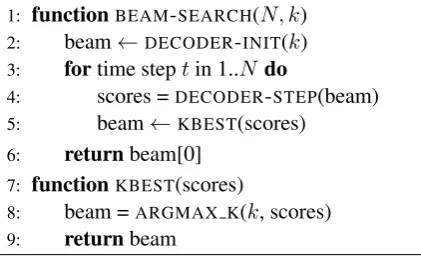
Algorithm 1 Beam search. Inputs: max output length N, beam size k. Output: highest-scoring
hypothesis.
1: functionBEAM-SEARCH(N, k)
2: beam←DECODER-INIT(k)
3: fortime steptin 1..N do
4: scores =DECODER-STEP(beam) 5: beam←KBEST(scores)
6: returnbeam[0]
7: functionKBEST(scores)
8: beam =ARGMAX K(k, scores)
9: returnbeam
that can be computed quickly with modern GPU hardware. Conceptually, a (row, column) entry
(i, j) in this matrix contains the state obtained
from starting from the ith state in the beam and
generating the target word corresponding to the
jth word ofVT. The beam for the next time step
is filled by taking the states corresponding to the
k-best items from this entire matrix and sorting them.
A principal difference between beam search for phrase-based and neural MT is that in NMT, there is no recombination: each hypothesis represents a complete history, back to the first word gener-ated. This makes it easy to record properties of the history of each hypothesis that were not possi-ble with dynamic programming.Hokamp and Liu
(2017) introduced an algorithm for forcing certain words to appear in the output called grid beam search(GBS). This algorithm takes a set of con-straints, which are words that must appear in the output, and ensures that hypotheses have met all these constraints before they can be considered to be completed. For C constraints, this is
accom-plished by maintainingC + 1separate beams or
banks,B0, B1, . . . , BC, whereBigroups together
hypotheses that have generated (or met) i of the
constraints. Decoding proceeds as with standard beam decoding, but with the addition of bookkeep-ing that tracks the number of constraints met by each hypothesis, and ensures that new candidates are generated, such that each bank is filled at each time step. When beam search is complete, the hypothesis returned is the highest-scoring one in bankBC. Conceptually, this can be thought of as
adding an additional dimension to the beam, since we multiply out some base beam size b by (one
We note two problems with GBS:
• Decoding complexity is linear in the
num-ber of constraints: The effective beam size,
k·(C+ 1), varies with the number of
con-straints.
• It is impractical. The beam size changes for every sentence, whereas most decoders specify the beam size at model load time in order to optimize computation graphs, spe-cially when running on GPUs. It also compli-cates beam search optimizations that increase throughput, such as batching.
Our extension, fast lexically-constrained decoding via dynamic beam allocation (DBA), addresses both of these issues. Instead of maintainingC+ 1
beams, we maintain a single beam of size k, as
with unconstrained decoding. We then dynami-cally allocate the slots of this beam across the con-straint banks at each time step. There is still book-keeping overhead, but this cost is constant in the number of constraints, instead of linear. The result is a practical algorithm for incorporating arbitrary target-side constraints that fits within the standard beam-decoding paradigm.
3 Dynamic Beam Allocation (DBA)
Our algorithm (Algorithm2) is based on a small but important alteration to GBS. Instead of multi-plyingthe beam by the number of constraints, we divide. A fixed beam size is therefore provided to the decoder, just as in standard beam search. As different sentences are processed with differing numbers of constraints, the beam is dynamically allocated to these different banks. In fact, the allo-cation varies not just by sentence, but across time steps in processing each individual sentence.
We need to introduce some terminology. A word constraintprovided to the decoder is a sin-gle token in the target language vocabulary. A phrasal constraint is a sequence of two or more contiguous tokens. Phrasal constraints come into play when the user specifies a multi-word phrase directly (e.g., high-ranking member), or when a word gets broken up by subword splitting (e.g., thou@@ ghtful). The total number of constraints is the sum of the number of tokens across all word and phrasal constraints. It is easier for the decoder to place multiple sequential tokens in a phrasal constraint (where the permutation is fixed) com-pared to placing separate, independent constraints
(see discussion at the end of§5), but the algorithm does not distinguish them when counting.
DBA fits nicely within standard beam decod-ing; we simply replace thekbestimplementation from Algorithm1with one that involves a bit more bookkeeping. Instead of selecting the top-kitems
from thek×VT scores matrix, the new algorithm
must consider two important matters.
1. Generating a list of candidates (§3.1).
Whereas the baseline beam search simply takes the top-kitems from the scores matrix
(a fast operation on a GPU), we now need to ensure that candidates progress through the set of provided constraints.
2. Allocating the beam across the constraint banks (§3.2). With a fixed-sized beam and an arbitrary number of constraints, we need to find an allocation strategy for dividing the beam across the constraint banks.
3.1 Generating the candidate set
We refer to Figure 2 for discussion of the algo-rithm. The set of candidates for the beam at time stept+ 1is generated from the hypotheses in the
current beam at step t, which are sorted in de-creasing order, with the highest-scoring hypoth-esis at position 1. The DECODER-STEP function of beam search generates a matrix,scores, where each rowr corresponds to a probability
distribu-tion over all target words, expanding the hypoth-esis in positionr in the beam. We build a set of candidates from the following items:
1. The best k tokens across all rows ofscores
(i.e., normal top-k);
2. for each hypothesis in the beam, all unmet constraints (to ensure progress through the constraints); and
3. for each hypothesis in the beam, the single-best token (to ensure consideration of partially-completed hypotheses).
Each of these candidates is denoted by its coordi-nates inscores. The result is a set of candidates which can be grouped into banks according to how many constraints they have met, and then sorted within those banks. The new beam for timestep
t+ 1 is then built from this list according to an
t V
0.93 0.96 1.09 0.91 1.06 0.95→ 1.03
→
1.02 1.04 →
1.00
0.89 1.08
⟲
1.07 1.03 0.97
→
0.98 0.93
→
0.99 1.02 0.98
1.01 0.91 0.94 1.00 0.94 0.93 0.90 0.96 ⬦ 1.03
→
0.88
0.97
→
0.88 0.93 ⬦⟲
1.03 0.92 0.90 0.81 0.98 0.87 0.81
0.91 0.93 0.91 0.84 ⬦
0.95 0.90 0.83 0.94 0.83 0.87
ge
ne
ra
te
, a
ll
oc
at
e, a
dj
us
t
t+1
(1, 3)
(1, 10)
(2, 2)
(3, 10)
(5, 5)
for b in [0.9, 0.88, 0.85, 0.81, 0.79]:
t = [random.random() for x in range(10)];
t = [b + x / sum(t) for x in t];
[image:4.595.77.522.64.234.2]print('\t'.join(['{:.2f}'.format(x) for x in t]))
Figure 2: A single step of the constrained decoder. Along the left is the beam (k= 5) at time stept. The shapes
in this beam represent constraints, both met (filled) and unmet (outlined). The blue square represents a phrasal constraint of length 2, which must be completed in order (left half, then right half). A step of the decoder produces ak×VT matrix of scores. Each constraint corresponds to a single token in the vocabulary, and is marked along the bottom. Gray squares denote the set of candidates that are produced (§3.1) from thekbest items (F), from
extending each hypothesis with all unfilled constraints (→), and from its single-best next token (3). Items that
violate a phrasal constraint ( ) require the phrasal constraint from that hypotheses to be unwound (set to unmet). From these fifteen candidates, the beam at time stept+ 1is filled, according to the bank allocation strategy, which here assigns one slot in the beam to each bank. The final beam includes coordinates indicating the provenance of chosen items (which are also indicated in bold in the grid).
For hypotheses partially through a phrasal con-straint, special care must be taken. If a phrasal constraint has been begun, but not finished, and a token is chosen that does not match the next word of the constraint, we must reset or “unwind” those tokens in this constraint that are marked as having been met. This permits the decoder to abort the generation of a phrasal constraint, which is impor-tant in situations where a partial prefix of a phrasal constraint appears in the decoded sentence earlier than the entire phrase.
3.2 Allocating the beam
The task is to allocate a size-kbeam acrossC+ 1
constraint banks, whereCmay be greater thank.
We use the termbankto denote the portion of the beam reserved for items having met the same num-ber of constraints (including one bank for hypothe-ses with zero constraints met). We use a simple allocation strategy, setting each bin size tobk/Cc, irrespective of the timestep. Any remaining slots are assigned to the “topmost” or maximally con-strained bank,C.
This may at first appear wasteful. For exam-ple, space allocated at timestep 1 to a bank rep-resenting candidates having met more than one constraint cannot be used, and similarly, for later
timesteps, it seems wasteful to allocate space to bank 1. Additionally, if the number of candidates in a bank is smaller than the allocation for that bank, the beam is in danger of being underfilled. These problems are mitigated by bank adjustment (Figure3). We provide here only a sketch of this procedure. An overfilled bank is one that has been allocated more slots than it has candidates to fill. Each such overfilled bank, in turn, gives its extra allotments to banks that have more candidates than slots, looking first to its immediate neighbors, and moving outward until it has distributed all of its extra slots. In this way, the beam is filled, up to the minimum of the beam size or the number of candidates.
3.3 Finishing
Hypotheses are not allowed to generate the end-of-sentence token, h/si, unless they have met all
of their constraints. When beam search is finished, the highest-scoring completed item is returned.
4 Experimental Setup
pre-Algorithm 2k-best extraction with DBA.Inputs: Ak× |VT|matrix of model states.
1: functionKBEST-DBA(beam, scores)
2: constraints←[hyp.constraint for hyp in beam]
3: candidates←[(i, j,constraints[i].add(j)] fori, jinARGMAX K(k, scores) .Top overallk
4: for1≤h≤kdo .Go over current beam
5: for allw∈VT that are unmet constraints for beam[h]do .Expand new constraints
6: candidates.append((h, w,constraints[h].add(w) ) )
7: w=ARGMAX(scores[h,:])
8: candidates.append( (h, w, constraints[h].add(w)) ) .Best single word
9: selected←ALLOCATE(candidates,k)
10: newBeam←[candidates[i] foriin selected]
11: returnnewBeam
0
1
2
3
4
0
0
1
1
1
[image:5.595.79.349.84.437.2]candidates allocation reallocation
Figure 3: Beam reallocation for k = 5 with 4
con-straints at timestept. There are eight candidates, each
having met only 0 or 1 constraint. The allocation pol-icy gives one slot of the beam to each bank. However, there are no candidates for banks 2–4 (greyed), so their slots are redistributed to banks 0 and 1.
processed with the Moses tokenizer (preserving case) and with a joint byte-pair-encoded vocabu-lary with 32k merge operations (Sennrich et al.,
2016). The model was a 4 layer RNN with atten-tion. We trained using the Adam optimizer with a batch size of 80 until cross-entropy on the de-velopment data (newstest2016) stopped increasing for 10 consecutive iterations.
For decoding, we normalize completed hy-potheses (those that have generated h/si),
divid-ing the cumulative sentence score by the num-ber of words. Unless otherwise noted, we apply threshold pruning to the beam, removing hypothe-ses whose log probability is not within 20 com-pared to the best completed hypothesis. This prun-ing is applied to all hypotheses, whether they are
complete or not. (We explore the importance of this pruning in§6.3). Decoding stops when either
all hypotheses still on the beam are completed or the maximum length, N, is reached. All
experi-ments were run on a single a Volta P100 GPU. No ensembling or batching were used.
For experiments, we used the newstest2014 English–German test set (the developer version, with 2,737 sentences). All BLEU scores are com-puted on detokenized output using SACREBLEU (Post,2018),1and are thus directly comparable to
scores reported in the WMT evaluations.
5 Validation Experiment
We center our exploration of DBA by experiment-ing with constraints randomly selected from the references. We extract five sets of constraints: from one to four randomly selected words from the reference (rand1torand4), and a randomly selected four-word phrase (phr4). We then apply BPE to these sets, which often yields a much larger number of token constraints. Statistics about these extracted phrases can be found in Table2.
We simulate the GBS baseline within our framework. After applying BPE, We group to-gether translations with the same number of con-straints, C, and then translate them as a group, with the beam set for that group set tob(C + 1),
where b is the “base beam” parameter. We use b = 10as reported in Hokamp et al., but also try smaller values ofb= 5and 1. Finally, we disable
beam adjustment (§3.2), so that the space allocated
to each constraint bank does not change.
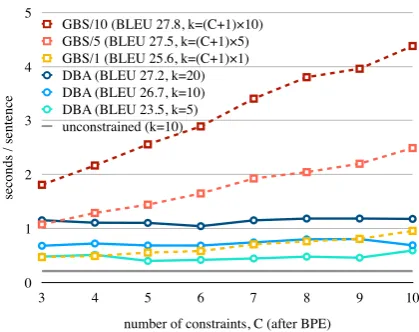
Table4compares speeds and BLEU scores (in the legend) as a function of the number of
post-1The signature is
num rand1 rand2 rand3 rand4 phr4
1 2,182 0 0 0 0
2 548 3,430 0 0 0
3 516 1,488 4,074 0 0
4 272 1,128 2,316 4,492 4,388
5 150 765 1,860 3,275 2,890
6 30 306 1,218 2,520 2,646
7 42 133 805 1,736 1,967
8 0 112 488 1,096 1,280
9 0 36 171 702 720
10 0 10 140 400 430
11+ 0 22 189 417 575
total 3,726 7,477 11,205 14,885 14,926
[image:6.595.311.521.61.227.2]mean 1.36 2.73 4.09 5.43 5.45
Table 2: Histogram of the number of token constraints for some constraint sets after applying BPE (model trained with 32k merge operations). meandenotes the mean number of constraints per sentence in the 2,737-sentence test set.
BPE constraints for the rand3dataset. We plot all points for which there were at least 10 sen-tences. The times are decoding only, and exclude model loading and other setup. The linear trend in C is clear for GBS, as is the constant trend
for DBA. In terms of absolute runtimes, DBA im-proves considerably over GBS, whose beam sizes quickly become quite large with a non-unit base beam size. On the Tesla V100 GPU, DBA (k = 10) takes about 0.6 seconds/sentence, regardless
of the number of constraints.2 This is about 3x
slower than unconstrained decoding.
It is difficult to compare these algorithms ex-actly because of GBS’s variable beam size. An important comparison is that between DBA (k = 10) and GBS/1 (base beam of 1). A beam of k = 10is a common setting for decoding in
gen-eral, and GBS/1 has a beam size of k ≥ 10 for
C ≥ 9. At this setting, DBA finds better
transla-tions (BLEU 26.7 vs. 25.6) with the same runtime and with a fixed, instead of variable-sized, beam.
We note that the bank adjustment correction of the DBA algorithm allows it to work when
C >= k. The DBA (k = 5) plot demonstrates
this, while still finding a way to increase the BLEU score over GBS (23.5 vs. 22.3). However, while possible, lowkrelative toCreduces the observed
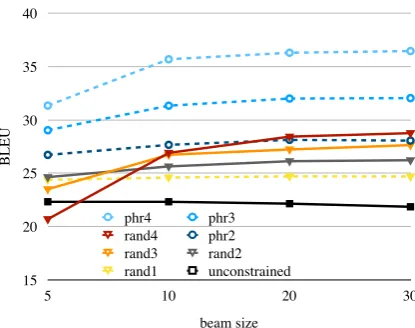
improvement considerably. Looking at Figure 5
across different constraint sets, we can get a better feel for this relationship. DBA is still always able to meet the constraints even with a beam size of 5,
2On a K80, it is about 1.4 seconds / sentence
Volta decoding rand3
beam size = 10 (DBA), 5(C+1) (GBS)
GBS/10 (BLEU 27.8, k=(C+1)×10)
GBS/5 (BLEU 27.5, k=(C+1)×5)
GBS/1 (BLEU 25.6, k=(C+1)×1)
DBA (BLEU 27.2, k=20)
DBA (BLEU 26.7, k=10)
DBA (BLEU 23.5, k=5)
unconstrained (k=10)
counts
3 1.8101 1.0757 0.4725 1.1538 0.6817 0.4805 0.2133 1358
4 2.1669 1.2887 0.4923 1.1083 0.7240 0.5139 0.2133 579
5 2.5580 1.4420 0.5556 1.1052 0.6874 0.4012 0.2133 372
6 2.8908 1.6499 0.5844 1.0443 0.6858 0.4204 0.2133 203
7 3.4037 1.9266 0.7074 1.1524 0.7445 0.4466 0.2133 115
8 3.8006 2.0444 0.7642 1.1847 0.8012 0.4802 0.2133 61
9 3.9575 2.1997 0.8096 1.1856 0.8057 0.4603 0.2133 19
10 4.3779 2.4897 0.9564 1.1785 0.6904 0.5947 0.2133 14
11 4.7845 2.6689 1.1181 1.3284 0.8735 0.7886 0.2133 8
12 4.8664 2.9615 1.2622 1.5562 1.0878 0.8452 0.2133 5
13 3.0738 1.9880 1.0199 1.0908 0.8781 0.7931 0.2133 2
15 4.4652 2.7549 1.3539 1.4413 1.0156 0.9548 0.2133 1
se conds / s ent enc e 0 1 2 3 4 5
number of constraints, C (after BPE)
3 4 5 6 7 8 9 10 GBS/10 (BLEU 27.8, k=(C+1)×10)
GBS/5 (BLEU 27.5, k=(C+1)×5) GBS/1 (BLEU 25.6, k=(C+1)×1) DBA (BLEU 27.2, k=20) DBA (BLEU 26.7, k=10) DBA (BLEU 23.5, k=5) unconstrained (k=10)
Volta decoding
beam size = 10 (DBA), 5(C+1) (GBS)-1
# constraints
phr2 phr3 phr4 rand1 rand2 rand3
0
1
0.6303 2
0.6407 0.6862 0.6560
3
0.6534 0.6404 0.6865 0.6584 0.6817
4
0.6493 0.6799 0.6439 0.7503 0.7267 0.7240
5
0.6441 0.6165 0.6141 0.7177 0.6706 0.6874
6
0.7285 0.7219 0.6195 0.7096 0.6858
7
0.7426 0.6765 0.6883 0.7445
8
0.7091 0.6819 0.8012
9 0.8327 10 0.5532 11 12 13 14 15 16 17 threshold 30 times 0 1 0.6303 2
0.6407 0.6862 0.6560
3
0.6534 0.6404 0.6865 0.6584 0.6817
4
0.6493 0.6799 0.6439 0.7503 0.7267 0.7240
5
0.6441 0.6165 0.6141 0.7177 0.6706 0.6874
6
0.7285 0.7219 0.6195 0.8798 0.7096 0.6858
7
0.7426 0.6765 0.6883 0.8994 0.7814 0.7445
8
1.1061 0.7091 0.6819 1.2610 0.8012
9
1.4579 0.8107 0.8327 0.8215 0.8057
10
0.7694 0.5532 1.0103 0.6904
11
0.7960 0.8048 0.6271 1.4163 0.8735
12
0.6904 1.0627 1.0878
13
0.7613 1.2263 0.8781
14
0.9635 0.7614 1.0156
15 0.7341 16 17 counts 0 0
1 0 2149
2 1679 317 1765
3 517 1355 171 453 1398
4 301 572 1100 53 284 554
5 135 400 600 33 136 356
6 57 208 467 9 62 209
7 36 104 254 5 20 113
8 7 57 152 6 61
9 2 25 78 5 25
10 5 42 5 14
11 3 2 19 1 4
12 4 8 1
13 2 2 1
14 1 4 1
15 2 16 17 # constraints 25.6 27.5 27.8 23.5 26.7 27.2
1
Figure 4: Running time (seconds / sentence, lower isbetter) as a function of the number of constraints, C
(after applying BPE) on therand3dataset. The un-constrained baselines have BLEU scores of 22.3, 22.3, and 22.1 fork= 5,10, and 20, respectively.
but the quality suffers. This should not be too sur-prising; correctly placing independent constraints is at least as hard as finding their correct permuta-tion, which is exponential in the number of inde-pendent constraints. But it is remarkable that the only failure to beat the baseline in terms of BLEU is when the algorithm is tasked with placing four random constraints (before BPE) with a beam size of 5. In contrast, DBA never has any trouble plac-ing phrasal constraints (dashed lines).
6 Analysis
6.1 Placement
It’s possible that the BLEU gains result from a boost in n-gram counts due to the mere presence of the reference constraints in the output, as opposed to their correct placement. This appears not to be the case. Experience examining the outputs shows its uncanny ability to sensibly place constrained words and phrases. Figure6contains some exam-ples from translating a German sentence into En-glish, manually identifying interesting phrases in the target, choosing paraphrases of those words, and then decoding with them as constraints. Note that the word weak, which doesn’t fit in the seman-tics of the reference, is placed haphazardly.
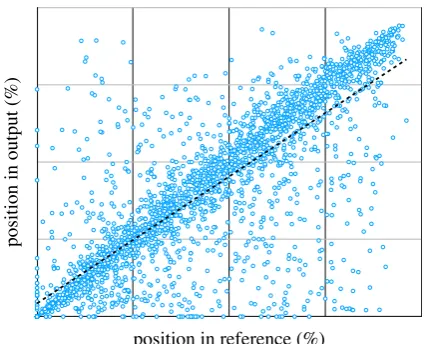
We also confirm this correct placement quanti-tatively by comparing the location of the first word of each constraint in (a) the reference and (b) the output of the constrained decoder, represented as a percentage of the respective sentence lengths (Fig-ure 7). We would not expect these numbers to
[image:6.595.75.289.62.235.2]Volta decoding rand3
beam size = 10 (DBA), 5(C+1) (GBS)
5 10 20 30 phr4 31.34 35.68 36.29 36.45
phr3 29.03 31.33 32.00 32.04
rand4 20.70 26.91 28.43 28.76
phr2 26.72 27.66 28.13 28.06
rand3 23.51 26.73 27.23 27.64
rand2 24.64 25.64 26.13 26.22
rand1 24.38 24.60 24.71 24.70
unconstrained 22.33 22.33 22.15 21.86
BL
E
U
15 20 25 30 35 40
beam size
5 10 20 30
phr4 phr3
rand4 phr2
rand3 rand2
rand1 unconstrained
BL
E
U
15 20 25 30 35 40
beam size
5 10 20 30
phr4 phr3
rand4 phr2
rand3 rand2
rand1 unconstrained
[image:7.595.77.285.60.224.2]1
Figure 5: BLEU score as a function of beam size un-der DBA. All constraint sets improve as the beam gets larger (recall that the actual number of constraints in-creases after BPE and varies by sentence).rand4 per-forms under the unconstrained baseline if the beam is too low.
be perfectly matched, but the strong correlation is pretty apparent (Pearson’sr = 0.82). Together, Figures 6 and7 provide confidence that DBA is intelligently placing the constraints.
6.2 Reference Aversion
The inference procedure in SOCKEYE maximizes the length-normalized version of the sentence’s log probability. While there is no explicit training towards the metric, BLEU, modeling in machine translation assumes that better model scores cor-relate with better BLEU scores. However, a gen-eral repeated observation from the NMT literature is the disconnect between model score and BLEU score. For example, work has shown that open-ing up the beam to let the decoder find better hy-potheses results in lower BLEU score (Koehn and Knowles, 2017), even as the model score rises. The phenomenon is not well understood, but it seems that NMT models have learned to travel a path straight towards their goal; as soon as they get off this path, they get lost, and can no longer function (Ott et al.,2018).
Another way to look at this problem is to ask what the neural model thinks of the references. Scoring against complete references is easy with NMT (Sennrich, 2017), but lexically-constrained decoding allows us to investigate this in finer-grained detail by including just portions of the references. We observe that forcing the decoder to include even a single word from the reference imposes a cost in model score that is inversely
0 3 5 10 20 30
none 24.4 24.5 24.5 24.4 24.5 24.4 rand1 25.2 25.1 25.2 25.6 25.5 25.3 rand2 26.0 25.3 25.6 26.1 26.7 26.4 rand3 26.5 24.7 24.9 25.7 26.9 27.2 rand4 26.2 23.7 23.9 24.6 26.0 26.9 phr4 35.1 33.5 33.5 34.0 35.0 35.9
Table 3: BLEU scores decoding with a beam size of 10. Runtimes for unpruned systems (column 0) are nearly twice those of the other columns. But it is only at large thresholds that BLEU scores are higher than the un-pruned setting.
correlated with BLEU score, and that this grows with the number of constraints that are added (Fig-ure8). The NMT system seems quite averse to the references, even in small pieces, and even while it improves the BLEU score. At the same time, the hypotheses it finds in this reduced space are still good, and become better as the beam is en-largened (Figure5). This provides a complemen-tary finding to that ofKoehn and Knowles(2017): in that setting, higher model scores found by a larger beam produce lower BLEU scores; here, lower model scores are associated with signifi-cantly higher BLEU scores.
6.3 Effects of Pruning
In the results reported above, we used a prun-ing threshold of 20, meanprun-ing that any hypothe-sis whose log probability is not within 20 of the best completed hypothesis is removed from the beam. This pruning threshold is far greater than those explored in other papers; for example, Wu et al. (2016) use 3. However, we observed two things: first, without pruning, running time for constrained decoding is nearly doubled. This in-creased runtime applies to both DBA and GBS in Figure 4. Second, low pruning thresholds are harmful to BLEU scores (Table3). It is only once the thresholds reach 20 that the algorithm is able to find better BLEU scores compared to the un-pruned baseline (column 0).
6.4 Garbage Generation
Why is the algorithm so slow without pruning? One might suspect that the outputs are longer, but mean output length with all constraint sets is roughly the same. The reason turns out to be that the the decoder never quits before the maximum
[image:7.595.305.529.62.161.2]constraint score output
source Einer soll ein hochrangiges Mitglied aus Berlin gewesen sein .
no constraints -0.217 One should have been a high-ranking member from Berlin .
is said to -0.551 One is said to have been a high-ranking member from Berlin .
of them -0.577 One of them was to be a high-ranking member from Berlin .
participant -0.766 One should have been a high-ranking participant from Berlin .
is thought to -0.792 One is thought to have been a high-ranking member from Berlin .
considered -0.967 One is considered to have been a high-ranking member from Berlin .
Hamburg -1.165 One should have been a high-ranking member from Hamburg .
powerful -1.360 One is to have been a powerful member from Berlin .
powerful,is said to -1.496 One is said to have been a powerful member from Berlin .
powerful,is said to,participant -1.988 One is said to have been a powerful participant from Berlin .
weak -1.431 One weak point was to have been a high-ranking member from Berlin .
[image:8.595.76.523.70.234.2]reference One is said to have been a high-ranking member from Berlin.
Figure 6: Example demonstrating the correct placement of manually chosen constraints (beam size 10). The unnatural placement of the constraintweakdemonstrates what the model does when forced to include a word that is not a semantic fit.
pos
it
ion i
n out
put
(%)
position in reference (%)
Figure 7: Location of the first word of each constraint fromphr3in the reference versus the constrained out-put (Pearson’s r = 0.82). DBA correctly places its
constraints, even though no source word or alignment information is provided.
timestep, N. SOCKEYE’s stopping criterium is to wait until all hypotheses on the beam are fin-ished. Without pruning, the decoder generates a finished hypotheses, but continues on until the maximum timestep N, populating the rest of the
beam with low-cost garbage. An example can be found in Figure 9. This may be an example of the well-attested phenomenon where NMT sys-tems become unhinged from the source sentence, switching into “language model” mode and gen-erating high-probable output with no end. But strangely, this doesn’t seem to affect the best hy-potheses, but only the rest of the beam. This seems to be more evidence of reference aversion, where
beam=10
run model BLEU
none -1039.86 22.33
rand1 -1337.54 24.60
rand2 -1724.98 25.64 test
rand3 -2236.24 26.73
rand4 -3082.17 26.91
phr2 -1766.27 27.66
phr3 -2156.17 31.33
phr4 -2681.62 35.68
ref 95.86 4396.46
0 10 20 30 40
-4,000 -3,000 -2,000 -1,000 0
none rand1 rand4
phr4 phr3
rand3 rand2 phr2
[image:8.595.76.290.301.473.2]1
Figure 8: BLEU score as a function of model score (summed over the corpus). The reference model score is -4,396.
the decoder, having been forced into a place it doesn’t like, does not know how to generate good competing hypotheses.
An alternative to pruning is early stopping, which is to stop when the first complete hypothe-sis is generated. In our experiments, while this did fix the problem of increasing runtimes, the BLEU scores were lower.
6.5 Conclusions
[image:8.595.309.521.303.448.2]1 2 3 4 5 6 7 8 9 10 11 12 13 14 . . . 41
-0.51 hsi Er und Kerr lieben einander noch immer , betonte die 36-J¨ahrige . h/si
-0.52 hsi Er und Kerr lieben einander noch immer , betonte der 36-J¨ahrige . h/si
-0.56 hsi Er und Kerr lieben einander noch immer , betonte die 36-j¨ahrige . h/si
-0.57 hsi Er und Kerr lieben einander noch immer , betonte den 36-j¨ahrigen . h/si
-25.11 hsi Er und Kerr lieben sich weiterhin einander , betonte die 36-J¨ahrige .   . . .  
[image:9.595.71.525.62.131.2]-27.92 hsi Er und Kerr lieben sich weiterhin einander , betonte die 36-J¨ahrige .   . . .  
Figure 9: The sentenceHe and Kerr still love each other , emphasised the 36-year-old . translated with the constraintnoch immer , betonte(BPE removed for readability). The first column is the log probability, which is normalized only for finished hypotheses. The decoder completes a few hypotheses well before the maximum timestep, but then fills the lower beam with garbage until forced to stop.
7 Related Work
Hokamp and Liu (2017) was novel in that it
allowed the specification of arbitrary target-side words as hard constraints, implemented entirely as a restructuring of beam search, and without refer-ence to the source. A related approach was that of
Anderson et al.(2017), who extended beam search with a finite state machine whose states marked completed subsets of the set of constraints, at an exponential cost in the number of constraints.
Lexically-constrained decoding also general-izes prefix decoding (Knowles and Koehn,2016;
Wuebker et al., 2016), since the hsi symbol can easily be included as the first word of a constraint. Our work here has not explored where to get lexical constraints, but considering that question naturally brings to mind attempts to improve NMT by using lexicons and phrase tables (Arthur et al.,
2016;Tang et al.,2016).
Finally, another approach which shares the hard-decision made by lexically constrained de-coding is theplaceholder approach(Crego et al.,
2016), wherein identifiable elements in the in-put are transformed to masks during preprocess-ing, and then replaced with their original source-language strings during postprocessing.
8 Summary
Neural machine translation removes many of the knobs from phrase-based MT that provided fine-grained control over system output. Lexically-constrained decoding restores one of these tools, providing a powerful and interesting way to in-fluence NMT output. It requires only the speci-fication of the target-side constraints; without any source word or alignment information, it correctly places the constraints. Although we have only tested it here with RNNs, the code works with-out modification with other architectures generate target-side words one-by-one, such as the
Trans-former (Vaswani et al.,2017).
This paper has introduced a fast and practical solution. Building on previous approaches, con-strained decoding with DBA does away with lin-ear and exponential complexity (in the number of constraints), imposing only a constant overhead. On a Volta GPU, lexically-constrained decoding with DBA is practical, requiring about 0.6 sec-onds per sentence on average even with 10+ con-straints, well within the realm of feasibility even for applications with strict lattency requirements, like post-editing tasks. We imagine that there are further optimizations in reach that could improve this even further.
Acknowledgments We thank Felix Hieber for valuable discussions.
References
Peter Anderson, Basura Fernando, Mark Johnson, and Stephen Gould. 2017. Guided open vocabulary im-age captioning with constrained beam search. In
Proceedings of the 2017 Conference on Empirical
Methods in Natural Language Processing, pages
936–945. Association for Computational Linguis-tics.
Philip Arthur, Graham Neubig, and Satoshi Nakamura. 2016. Incorporating discrete translation lexicons into neural machine translation. InProceedings of the 2016 Conference on Empirical Methods in
Nat-ural Language Processing, pages 1557–1567.
Asso-ciation for Computational Linguistics.
Ondˇrej Bojar, Rajen Chatterjee, Christian Federmann, Yvette Graham, Barry Haddow, Shujian Huang, Matthias Huck, Philipp Koehn, Qun Liu, Varvara Logacheva, Christof Monz, Matteo Negri, Matt Post, Raphael Rubino, Lucia Specia, and Marco Turchi. 2017. Findings of the 2017 conference on machine translation (wmt17). InProceedings of the
Second Conference on Machine Translation, pages
Josep Crego, Jungi Kim, Guillaume Klein, Anabel Re-bollo, Kathy Yang, Jean Senellart, Egor Akhanov, Patrice Brunelle, Aurelien Coquard, Yongchao Deng, Satoshi Enoue, Chiyo Geiss, Joshua Johan-son, Ardas Khalsa, Raoum Khiari, Byeongil Ko, Catherine Kobus, Jean Lorieux, Leidiana Martins, Dang-Chuan Nguyen, Alexandra Priori, Thomas Riccardi, Natalia Segal, Christophe Servan, Cyril Ti-quet, Bo Wang, Jin Yang, Dakun Zhang, Jing Zhou, and Peter Zoldan. 2016. Systran’s pure neural ma-chine translation systems.CoRR.
Felix Hieber, Tobias Domhan, Michael Denkowski, David Vilar, Artem Sokolov, Ann Clifton, and Matt Post. 2017. Sockeye: A toolkit for neural ma-chine translation. Computing Research Repository, abs/1712.05690.
Chris Hokamp and Qun Liu. 2017. Lexically con-strained decoding for sequence generation using grid beam search. In Proceedings of the 55th Annual Meeting of the Association for Computational
Lin-guistics (Volume 1: Long Papers), pages 1535–
1546. Association for Computational Linguistics.
Howard Johnson, Joel Martin, George Foster, and Roland Kuhn. 2007. Improving translation qual-ity by discarding most of the phrasetable. In Pro-ceedings of the 2007 Joint Conference on Empirical Methods in Natural Language Processing and Com-putational Natural Language Learning
(EMNLP-CoNLL).
Rebecca Knowles and Philipp Koehn. 2016. Neural interactive translation prediction. In Proceedings of the Association for Machine Translation in the
Americas, pages 107–120.
Philipp Koehn and Rebecca Knowles. 2017. Six chal-lenges for neural machine translation. In Pro-ceedings of the First Workshop on Neural Machine
Translation, pages 28–39. Association for
Compu-tational Linguistics.
Philipp Koehn, Franz J. Och, and Daniel Marcu. 2003. Statistical phrase-based translation. InProceedings of the 2003 Human Language Technology Confer-ence of the North American Chapter of the
Associa-tion for ComputaAssocia-tional Linguistics.
Pierre Lison and J¨org Tiedemann. 2016. Opensub-titles2016: Extracting large parallel corpora from movie and tv subtitles. InProceedings of the Tenth International Conference on Language Resources
and Evaluation (LREC 2016), Paris, France.
Euro-pean Language Resources Association (ELRA).
Bruce T. Lowerre. 1976. The HARPY speech
recogni-tion system. Ph.D. thesis, Carnegie-Mellon
Univer-sity.
Christopher Manning, Mihai Surdeanu, John Bauer, Jenny Finkel, Steven Bethard, and David McClosky. 2014. The stanford corenlp natural language pro-cessing toolkit. In Proceedings of 52nd Annual
Meeting of the Association for Computational
Lin-guistics: System Demonstrations, pages 55–60.
As-sociation for Computational Linguistics.
Myle Ott, Michael Auli, David Grangier, and Marc’Aurelio Ranzato. 2018. Analyzing uncer-tainty in neural machine translation. CoRR, abs/1803.00047.
Matt Post. 2018. A call for clarity in report-ing bleu scores. Computing Research Repository, abs/1804.08771.
Rico Sennrich. 2017. How grammatical is character-level neural machine translation? assessing mt qual-ity with contrastive translation pairs. InProceedings of the 15th Conference of the European Chapter of the Association for Computational Linguistics:
Vol-ume 2, Short Papers, pages 376–382. Association
for Computational Linguistics.
Rico Sennrich, Barry Haddow, and Alexandra Birch. 2016. Neural machine translation of rare words with subword units. InProceedings of the 54th An-nual Meeting of the Association for Computational
Linguistics (Volume 1: Long Papers), pages 1715–
1725. Association for Computational Linguistics.
Ilya Sutskever, Oriol Vinyals, and Quoc V Le. 2014. Sequence to sequence learning with neural net-works. In Z. Ghahramani, M. Welling, C. Cortes, N. D. Lawrence, and K. Q. Weinberger, editors, Ad-vances in Neural Information Processing Systems 27, pages 3104–3112. Curran Associates, Inc.
Yaohua Tang, Fandong Meng, Zhengdong Lu, Hang Li, and Philip L. H. Yu. 2016. Neural machine transla-tion with external phrase memory.CoRR.
Ashish Vaswani, Noam Shazeer, Niki Parmar, Jakob Uszkoreit, Llion Jones, Aidan N. Gomez, Lukasz Kaiser, and Illia Polosukhin. 2017. Attention is all you need.CoRR.
Yonghui Wu, Mike Schuster, Zhifeng Chen, Quoc V. Le, Mohammad Norouzi, Wolfgang Macherey, Maxim Krikun, Yuan Cao, Qin Gao, Klaus Macherey, Jeff Klingner, Apurva Shah, Melvin Johnson, Xiaobing Liu, Łukasz Kaiser, Stephan Gouws, Yoshikiyo Kato, Taku Kudo, Hideto Kazawa, Keith Stevens, George Kurian, Nishant Patil, Wei Wang, Cliff Young, Jason Smith, Jason Riesa, Alex Rudnick, Oriol Vinyals, Greg Corrado, Macduff Hughes, and Jeffrey Dean. 2016. Google’s neural machine translation system: Bridging the gap between human and machine translation. CoRR, abs/1609.08144.
Joern Wuebker, Spence Green, John DeNero, Sasa Hasan, and Minh-Thang Luong. 2016. Models and inference for prefix-constrained machine translation.
InProceedings of the 54th Annual Meeting of the
As-sociation for Computational Linguistics (Volume 1:
Long Papers), pages 66–75. Association for
A Appendix: Failed Experiments
The main contribution of this paper is a fast, practical algorithmic improvement to lexically-constrained decoding. While we did not attempt to corroborate the experiments in interactive transla-tion and domain adaptatransla-tion experiments reported in (Hokamp and Liu,2017), the gains discovered there only become more salient with this faster al-gorithm. We did try to apply lexical constraints in a few other settings, but without success. In the spirit of open scientific inquiry and reporting, we provide here a brief report on these experiments.
A.1 Automatic Constraint Selection
Our validation experiments (§5) demonstrate the large potential gains in BLEU score when includ-ing random phrases from the reference. Even in-cluding just a single random word from the ref-erence increased BLEU score by a point; an-other point was gained from including two ran-dom words, and a four-word phrase yielded 10+ point gains. Only about 18% of these random un-igrams were present in the unconstrained output (less for longer n-grams). This raises the question of whether we can automatically identify words that are likely to be in the reference and include them as constraints, in order to improve transla-tion quality.
In order to do that, we first extracted a phrase table using Moses and filtered it with the signifi-cance testing approach proposed byJohnson et al.
(2007) in order to keep only high quality phrases. We then selected the best phrase for each input sentence according to different criteria (longest phrase, higher significance, highest probability, combination of those). Unfortunately, adding such phrases as constraints when translating WMT or IWSLT data did not help.
A.2 Name Entity Translation
One topic that has received attention in the litera-ture is the tendency of NMT systems to do poorly with rare words, and in particular, named entities (e.g.,Arthur et al.(2016)). BPE helps address this by breaking down words into pieces and allowing all words to be represented in the decoder’s vocab-ulary. But even with BPE, many times the correct translation does not follow any pattern, even at the subword level. This is specially true for named entities; e.g. “Aachen” in German is translated as “Aquisgr´an” in Spanish or “Aix-la-Chapelle” in
French, which bear little resemblance to the origi-nal form except for the starting letter. Named en-tities (NEs) also have the advantage that in several languages they are not inflected; therefore a simple lookup in a dictionary, if available, should produce the correct translation.
To the best of our knowledge, there is no pub-licly available parallel corpus of named entities. In order to create one, we downloaded the OpenSub-titles database (Lison and Tiedemann, 2016) for German and English and applied a simple method for extracting named entity correspondences. We first tagged the source and target sides with the Stanford NER system (Manning et al., 2014). We then selected a subset of the tags that were produced by both systems (“Person”, “Location” and “Organization”) and selected those sentences where they appeared only once for each language. From those we extracted the corresponding NEs, selecting the most frequent target side at the cor-pus level as the translation of a given source NE.
![Figure 2: A single step of the constrained decoder. Along the left is the beam (for b in [0.9, 0.88, 0.85, 0.81, 0.79]:
k = 5) at time step t](https://thumb-us.123doks.com/thumbv2/123dok_us/1394998.674187/4.595.77.522.64.234/figure-single-step-constrained-decoder-left-beam-time.webp)