LEABHARLANN CHOLAISTE NA TRIONOIDE, BAILE ATHA CLIATH TRINITY COLLEGE LIBRARY DUBLIN OUscoil Atha Cliath The University of Dublin
Terms and Conditions of Use of Digitised Theses from Trinity College Library Dublin Copyright statement
All material supplied by Trinity College Library is protected by copyright (under the Copyright and Related Rights Act, 2000 as amended) and other relevant Intellectual Property Rights. By accessing and using a Digitised Thesis from Trinity College Library you acknowledge that all Intellectual Property Rights in any Works supplied are the sole and exclusive property of the copyright and/or other I PR holder. Specific copyright holders may not be explicitly identified. Use of materials from other sources within a thesis should not be construed as a claim over them.
A non-exclusive, non-transferable licence is hereby granted to those using or reproducing, in whole or in part, the material for valid purposes, providing the copyright owners are acknowledged using the normal conventions. Where specific permission to use material is required, this is identified and such permission must be sought from the copyright holder or agency cited.
Liability statement
By using a Digitised Thesis, I accept that Trinity College Dublin bears no legal responsibility for the accuracy, legality or comprehensiveness of materials contained within the thesis, and that Trinity College Dublin accepts no liability for indirect, consequential, or incidental, damages or losses arising from use of the thesis for whatever reason. Information located in a thesis may be subject to specific use constraints, details of which may not be explicitly described. It is the responsibility of potential and actual users to be aware of such constraints and to abide by them. By making use of material from a digitised thesis, you accept these copyright and disclaimer provisions. Where it is brought to the attention of Trinity College Library that there may be a breach of copyright or other restraint, it is the policy to withdraw or take down access to a thesis while the issue is being resolved.
Access Agreement
By using a Digitised Thesis from Trinity College Library you are bound by the following Terms & Conditions. Please read them carefully.
M ech an oregu lation A lg o rith m s P r ed ictin g
P e r i-P r o sth e tic B o n e A d a p ta tio n s
Paul Timothy Scannell,
b.a., b.a.i.A thesis su b m itted to th e U niversity of D ubhn in p a rtia l fulfilment of th e requirem ents for th e degree of
D o c to r in P h ilo so p h y
T rinity College D ubhn
Supervisor Prof. P.J. P ren d erg ast
E x ternal exam iner Prof. M. Taylor
D eclaration
I declare th a t I am the sole author of this thesis and th a t all the work presented in
it, unless otherwise referenced, is my own. I also declare th a t this work has not been
subm itted, in whole or in part, to any other university or college for any degree or
other qualification.
I authorise the library of Trinity College Dublin to lend and copy this thesis.
Paul Scannell
A ckn ow led gem ents
F irst I would like to thank my supervisor Prof. Patrick Prendergast not only for
providing me with the opportunity to carry out this research degree, but also for
affording me the opportunity to take tim e out to travel, w ithout w'hich my work up
to th a t point might have been subm itted for a Masters. Thank you Paddy for your
support and guidance throughout the last four years.
Before I thank everyone there are a few individuals who need to be singled out
for special thanks. First I’d like to thank my “babysitters” in the office, Dr. Alex
Lennon and Dr. John Britton. If it w asn’t for Alex and his unnatural knowledge
of the finite element m ethod I would probably still be messing about with a two-
dimensional “brick” model. Thank you Alex. Thanks to John B ritton for all the
help provided when using the Borelli cluster and subsequently the A ristotle high
perform ance computer. W ith regard to the tissue differentiation aspect of this thesis
I would like to extend a special thanks to Dr. Danny Kelly on the com putational
side and Louise McMahon on the biological side. I would like to thank all postgrads
and postdocs past and present, and so to mention a few': Adriele, Brian, Brfanne,
Conor, Damien, Emma, Eric, Geraldine, James, Jennifer, John G, Karen, Kevin,
Louise, Melanie, Michael, Niamh, Oran, Paula, Pavel, R uth, and Tadhg.
Many thanks to Sheena Browm for everything from arranging meetings with
Paddy to organising flights and accommodation for conferences. Thanks to Joan
Gillen and Nicole Byrne for their assistance throughout the last four years. Thanks
to John Gaynor for all the I.T. help provided. I would like to acknowledge M aterials
Ireland for the use of their 3D laser scanner.
euro from time to time. I would like to thank my sister Maria, who w^as there when
I needed to take my frustration out on someone when simulations didn’t run.
Finalty, I would like to thank Maire for her support and for being there for me
over the past four years. I would like to say I couldn’t have done it w ithout her, but
her knowledge of FE is limited.
T h is w^ork was su p p o rted by th e P ro g ra m m e for R esea rch
in T h ird L evel In stitu tio n s (P R T L I) C y cle 2 p rogram m e
P u b lica tio n s and p resen ta tio n s
resu ltin g from th is stu d y
P. T. Scannell and P. J. P ren d erg ast, 2003. D evelopm ent of a bone rem odelling algorithm based on strain and dam age stim uli. P resented a t th e 7^^ Conference of th e E urop ean Society of Engineering and M edicine, Septem ber 2003, Halle (Salle), G erm any.
P. T. Scannell and P. J. P ren d erg ast, 2004. Bone a d a p ta tio n based on a com bined strain -d am age m echanoregulation rule. P resented at B ioengineering in Ireland 10, 3Qt/i_3ist Jan u ary 2004, C astle O aks House Hotel, C astleconnell, Co. Limerick.
P. T. Scannell and P. J. P ren d erg ast, 2004. T he com bination of b o th strain and dam age as a stim ulus for bone ad ap tatio n . P resen ted a t th e 14*^ E uro pean Society of Biom echanics Conference, July 2004 ’s-H ertogenbosch, T he N etherlands.
P. T. Scannell and P. J. P ren d erg ast, 2005. Bone rem odelling (including rem od elling a t th e b o n e/im p lan t interface) w ith a non-cernented hip prosthesis. P resented a t B ioengineering in Ireland 11, 28^^-29*^ Jan u ary 2005, F itz p atrick C astle Hotel, Killiney, Co. D ublin.
P. T. Scannell and P. J. P ren d erg ast, 2005. Sim ulation of changes in bone around hip replacem ent im plants, E ngineers Journal 59; 372-377.
p. J. Prendergast, P. T. Scannell, J. R. B ritton, and A. B. Lennon, 2006. The role
of com putation in identifying failure of biom aterials in implant fixation. Proceedings
of the 16th European Congress on Fracture. Alexandroupolis, Greece. [CD-Rom].
P. T. Scannell and P. J. Prendergast, 2006. Simulations predicting bone remod
elling and interfacial tissue formation in uncemented hip replacements. Presented at
the 5*^ World Congress of Biomechanics, 29*^ July -
August, Munich, Germany.
C ontents
D e cla r a tio n
1
A ck n o w led g em en ts
ii
P u b lic a tio n s and p re se n ta tio n s resu ltin g from th is stu d y
iv
C o n ten ts
vi
A b str a ct
viii
L ist o f F igu res
ix
List o f T ables
x v i
N o m e n c la tu re
x v ii
C hapter 1
In trod u ction
1
A brief introd uctio n to th e fixation of to tal hip replacem ents and possible m odes of failure is presented. T h e physiological process and some meclianobiological theories of bo th bone rem odelling and tissue differentiation is outlined. It is argued th a t im provem ents in pre-clinical te stin g of uncernented femoral hip prostheses can be im proved by com bining rem odelling and tissue differentiation algorithm s.
C hapter 2
L iterature review
7
C hapter 3
M eth od s
42
The process of reverse engineering of a hip prosthesis and the generation of a finite
element model of an implanted femur is described. The development of mechanoreg-
ulation rules of both bone remodelling and tissue differentiation is outlined. The
application of the developed theories to the finite element models, w ith prostheses
of varying stiffness, is described.
C hapter 4
R esu lts
70
The results of the bone remodelling and combined remodelling-tissue differentiation
simulations are presented. The influence of stem stiffness on load transfer and both
bulk and interfacial adaptations is reported.
C hapter 5
D iscu ssion
97
Lim itations of the study are listed and the results are discussed. A validation of
the algorithms is attem pted through the comparison of results between each stem
material, against other numerical simulations, and with clinical observations. The
potential use as a pre-clinical testing tool is proposed.
C hapter 6
C onclusions
115
The main conclusions drawn from this study are listed and recommendations for
future work are given.
B ibliography
118
A p p en d ix A
P aram etric variation stu d y 1
135
A p p en d ix B
P aram etric variation stu d y 2
140
A b stra ct
Numerous mechanobiological algorithms have been developed in recent years to
simulate biological processes such as bone remodelling and tissue differentiation.
However, the im plem entation of such algorithms for th e design and testing of or
thopaedic devices has yet to be fully realised. In this thesis a mechanoregulation
algorithm based on a combined strain-dam age remodelling rule together with the
integration of a tissue differentiation algorithm is proposed. Such a mechanoregula
tion approach was tested using a finite element model of a uncemented femoral hip
prosthesis under idealized bonding characteristics. Three stem materials (iso-elastic,
titanium , and CoCrlvIo) were investigated and compared to previous numerical and
clinical observations to corroborate the predictive power of the algorithms.
Results of the bone remodelling algorithm predicted similar remodelling trends
to those observed clinically. Namely, th a t while the use of an iso-elastic stem re
duces proximal bone loss because stress shielding is prevented; proximal interface
resorption is increased due to damage stim ulated resorption. On the other hand, a
stiff cobalt chrome stem increases both proximal strain-stim ulated resorption and
damage stim ulated interfacial resorption at the distal tip. Simulations for the tita
nium stem were predicted to minimise both strain and damage related remodelling.
The inclusion of th e tissue differentiation simulation predicted bone regeneration for
all resorbed interfacial bone through either intram em branous or endochondral ossi
fication, which can be corroborated by clinical observations of implant stabilisation
through osseointegration. However, it was predicted th a t some soft-tissue forma
tion persisted at the proximal medial interface of the iso-elastic stem, following the
trend of what is observed clinically; early failure of iso-elastic stems due to excessive
proximal soft tissue formation.
List o f Figures
1.1 Aseptic loosening, osteolysis, and stress shielding surrounding femoral
stems, (a) Aseptic loosening at the cement bone interface
{arrow).
A dapted from Sinha et al. (2004). (b) Osteolysis in the calcar region
(arrow).
A dapted from Learmonth et al. (1995). (c) postoperative
titanium alloy hydroxyapatite coated cementless stem, and (d) two
years after operation showing proximal bone loss due to stress shield
ing. A dapted from Karrholm et al. (1994)...
2
1.2 Schematic of Bone Multicellular Unit (BMU). A dapted from McNa
m ara (2004)...
3
2.1 Basic multicellular unit in (a) cortical bone and (b) cancellous bone.
A dapted from Jee (2001)...
9
2.2 Cross-section of m etacarpal at forty weeks for (a) control and (b)
experim ental sides. Taken from Uhthoff and Jaworski (1978)... 10
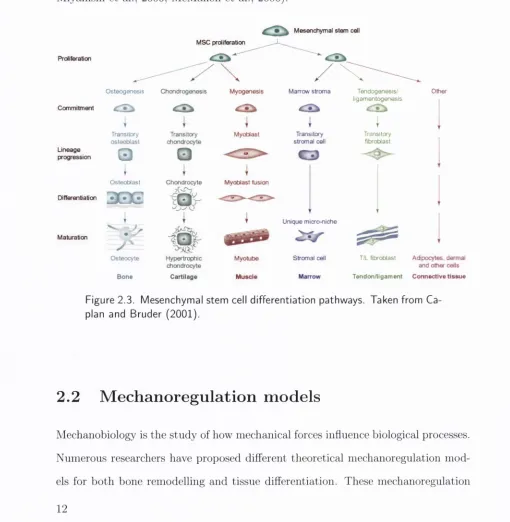
2.3 Mesenchymal stem cell differentiation pathways. Taken from Caplan
and Bruder (2001)... 12
2.4 Predicted density distribution using multiple loads.
Adapted
from C arter et al. (1989)... 15
2.5 Density (p) versus free surface area per unit volume (a(p))... 17
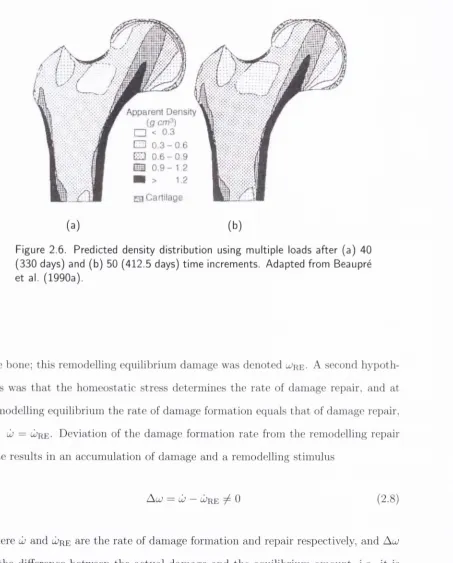
2.6 Predicted density distribution using multiple loads after (a)
40
(330 days) and (b) 50 (412.5 days) tim e increments.
A dapted
from Beaupre et al. (1990a)... 18
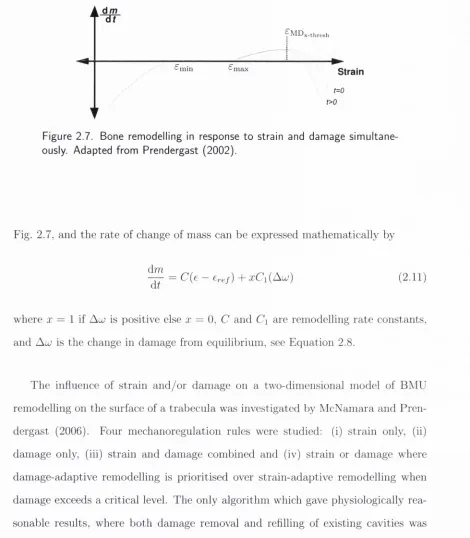
2.7 Bone remodelling in response to strain and damage simultaneously.
2.8 Schematics of hydrostatic (dilatational) stresses and shear (devia-
toric) stresses. From C arter et al. (1988)... 21
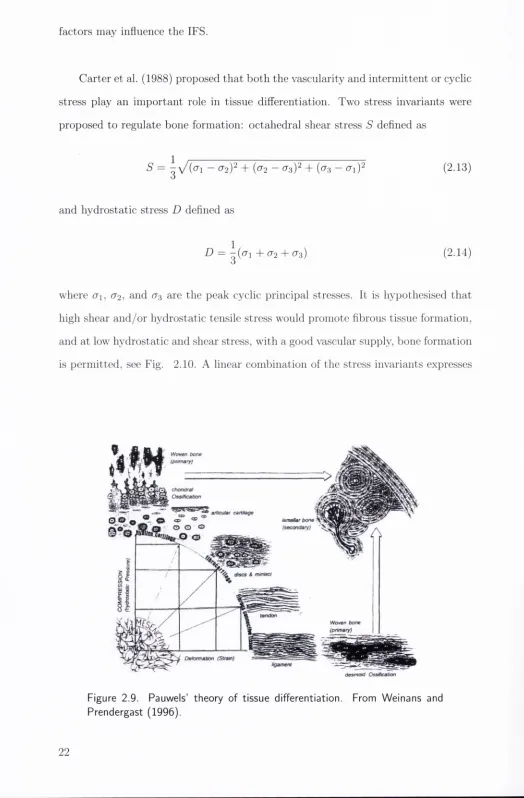
2.9
Pauwels’ theory of tissue differentiation. From Weinans and
Prender-gast (1996)... 22
2.10 Schematic of influence of hydrostatic stress, octahedral shear stress,
and vascularity on differentiation. Adapted from C arter et al. (1988).
23
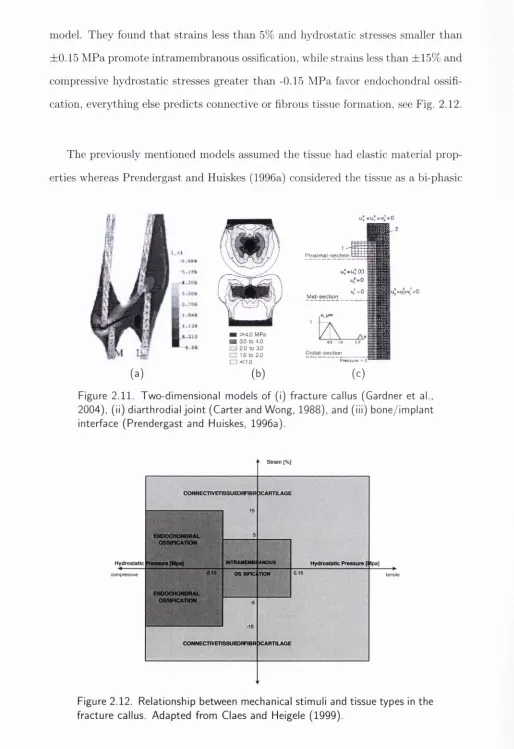
2.11 Two-dimensional models of (i) fracture callus (Gardner et al.,
2004), (ii) diarthrodial joint (Carter and Wbng, 1988), and (iii)
bone/im plant interface (Prendergast and Huiskes, 1996a)... 24
2.12 Relationship between mechanical stinuili and tissue types in the frac
ture callus. A dapted from Claes and Heigele (1999)... 24
2.13 M echanoregulation diagram of tissue differentiation based on shear
strain and fluid flow. A dapted from Prendergast et al. (1997)... 25
2.14 Possible states th a t a daughter cells can occupy after mitosis using
the random walk model. Taken from Perez and Prendergast (2006). . 26
2.15 Predicted osteoblast cell distribution at im plant/bone interface with
(a) diffusion and (b) random walk analysis. A dapted from Perez and
Prendergast (2006)... 27
2.16 Methods of fixation (a) radiograph of prosthesis fixed by bone ce
ment (Charnely, 1960) (b) prosthesis fixation by bone ingrow'th (El-
dridge and Learmonth, 1999)... 28
2.17 (a)Tifit (Smith and Nephew Richards) titanium alloy hydroxyapatite
coated cementless stem (b) postoperatively and (c) two years after op
eration showing proximal bone loss due to stress shielding. Adapted
from Karrholm et al. (1994)... 30
2.19 Remodelled density distribution in proximal for (a) cemented
CoCrMo stem (b) cemented titanium stem (c) uncemented CoCrMo
stem (d) uncemented titanium stem (e) uncemented iso-elastic stem.
A dapted from Weinans et al. (1992)... 35
2.20 The relationship between stress shielding (relative to the titanium
stem) and and proximal interface stress (relative to the iso-elastic
stem) with stem stiffness. Adapted from Huiskes et al. (1992)... 37
2.21 Influence peri-prosthetic tissue adaptations on (a) piston displace
ment over time, and resulting phase diagrams for (b) the 1^^ iteration,
and (c) 15‘*^ iteration. A dapted from Huiskes et al. (1997)... 40
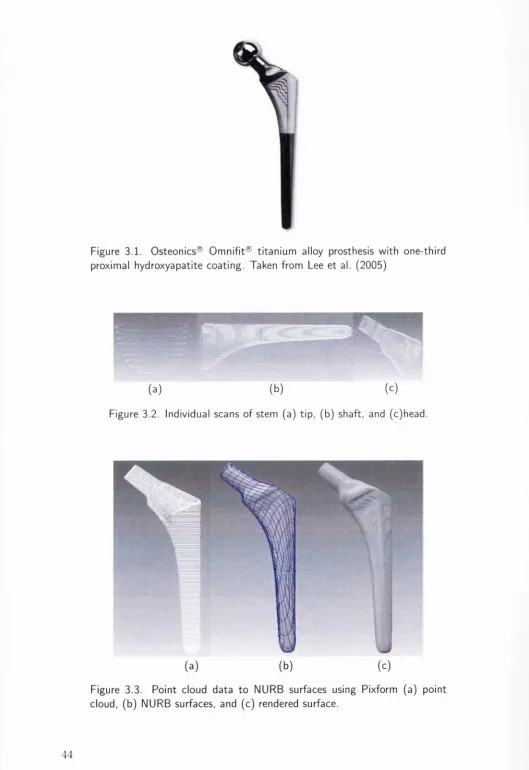
3.1 Osteonics® Omnifit® titanium alloy prosthesis with one-third proxi
mal hydroxyapatite coating. Taken from Lee et al. (2 0 0 5 )... 44
3.2 Individual scans of stem (a) tip, (b) shaft, and (c) head... 44
3.3 Point cloud d ata to NURB surfaces using Pixform (a) point cloud,
(b) NURB surfaces, and (c) rendered surface...44
3.4 Stem solid model generation (a) NURB surfaces, (b) point extraction,
(c) spline generation, and (d) solid model...46
3.5 Femur solid model generation (a) standardized femur, (b) spline gen
eration, and (c) solid model... 46
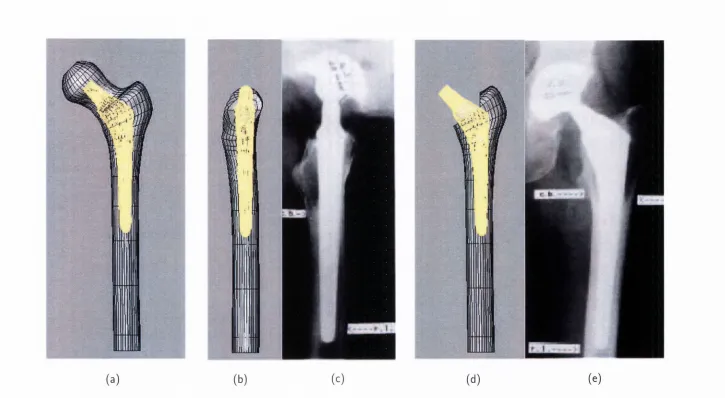
3.6 Stem resection and positioning (a) positioning of stem in the intact
femur, (b) medial view of stem position with head resected, (c) medial
radiograph (taken from D’Antonio et al. (1992)), (d) anterior view of
stem position with head resected, and (d) anterior radiograph (taken
from D ’Antonio et al. (1992))... 47
3.7 Finite element meslies of (a) stem HA coating high-lighted in blue,
(b) cancellous bone, (c) cortical bone, (d) implanted femur, and (e)
assumed intact femur... 49
3.8 Division of model into anterior, posterior, bulk, and interfacial (blue
3.9 A pplication of loads to finite elem ent m odel (a) muscle stand ardized fem ur showing muscle insertion areas P I and P2 (ad apted from Vice- conti et al. (2003)), (b) finite elem ent m odel showing equivalent m us cle insertion areas P I and P 2, and th e hip contact point PO, (c) finite elem ent model showing loads applied to muscle insertion areas and
prosthesis h e a d ... 52
3.10 Zero pore pressure applied to the free surfaces of th e interface elem ents. 53 3.11 Schem atic of strain stim u lated rem odelling... 55
3.12 Schem atic of dam age stim ulated rem odelhng... 57
3.13 D ensity [p] versus free surface area p er unit volume (a(/)))... 58
3.14 Schem atic of com bined strain -d am ag e stim u lated rem odelling...59
3.15 Schem atic of com bined strain -d am ag e bone rem odelling algorithm . . . 61
3.16 M echanoregulation reg ulatin g cell differentiation based on two bio physical stim uli: o ctah ed ral shear stra in and fluid velocity. A dap ted from P ren d erg ast et al. (1997)... 64
3.17 D evelopm ent of tissue Y oung’s m odulus over 75 days...66
3.18 D evelopm ent of tissue p erm eab ility over 75 d ays...66
3.19 Schem atic of com bined strain -d am ag e bone rem odelling and tissue differentiation alg o rith m ... 68
4.1 M id-plane cross section showing d istrib u tio n of th e strain energy den sity per u n it m ass in th e (a) iso-elastic, (b) titan iu m , and (c) CoCrM o stem s... 72
4.2 P ercentage volum e of bone experiencing stress shielding im m ediately post-op, and after 10 years in all th ree stem m odels... 73
4.3 Percentage change in bulk density per G ruen zone over tim e...75
4.4 A nterior, posterior, and cross-sectional bulk density distribution (a) pre-rem odelling, and 10 years post-op for th e (b) iso-elastic, (c) tita nium , and (d) CoCrM o stem s. (W hite lines outline G ruen zones). . . 76
4.6 Percentage volume of bone within the lazy-zone immediately post-op,
and after 10 years in all three stem models... 78
4.7 Posterior and anterior interface strain energy density per unit mass
distribution for the (a) reference model, (b) iso-elastic, (c) titanium ,
and (d) CoCrMo stems. (Black line outlines stem position and Gruen
zones)... 80
4.8 Percentage volume of interfacial bone experiencing damage stim u
lated remodelling in all three stem models... 81
4.9 Percentage change in interfacial density per Gruen zone over time. . . 83
4.10 Posterior and anterior interface density distribution (a) pre
remodelling, and 10 years post-op for the (b) iso-elastic, (c) titanium ,
and (d) CoCrMo stems. (Black line outlines stem position and Gruen
zones)... 84
4.11 Change in tissue differentiation stim ulus over at three points at the
medial interface of the iso-elastic stem ...86
4.12 Change in tissue phenotype over time at the medial interface of the
iso-elastic stem. Fibrous tissue (yellow) disappears by year 1 but
small amounts of cartilage and im m ature bone is predicted to persist. 87
4.13 Change in tissue differentiation stim ulus at two points at the (a)
posterior and three points at the (b) anterior interface over time of
the titanium stem ... 89
4.14 Change in tissue phenotype over tim e at the posterior interface of the
titanium stem. Fibrous tissue appears at the distal tip and disappears
completely (bone ingrowth) by the th ird m onth...90
4.16 Change in tissue differentiation stimulus at two points at the (a)
posterior and three points at the (b) anterior interface over time of
the CoCrMo stem ...93
4.17 Change in tissue phenotype over time at the posterior interface of the
CoCrMo stem. Fibrous tissue appears at the distal tip and disappears
completely (bone ingrowth) by the third m onth... 94
4.18 Change in tissue phenotype over time at the anterior interface of the
CoCrMo stem. Fibrous tissue and cartilage formation predicted at
the distal tip almost completely converted to m ature bone by one and
a half years... 95
5.1 Comparison of differentiation stimulus between the titanium and
CoCrMo stems for points 1-5 (see Figs. 4.13 and 4.16 for location of
points). Note stimulus,
S = ^
^
... 105
5.2 Comparison of predicted interfacial density changes for the 8 node
linear elastic model against the 20 node biphasic model for the (a)
iso-elastic, (b) titanium , and (c) CoCrMo stem s... 107
5.3
Comparison of sim ulated density loss for a titanium stem, flexible
stem, and a small lazy zone (i.e.
s =
0.35) as predicted in (a) Huiskes
et al. (1992) and (b) this thesis. It is predicted, in both models, th a t
reducing the stem stiffness reduces the amount of bone resorption,
while reducing the w idth of th e lazy zone increases the amount of
bone resorption... 110
5.4 Radiographs of (a) the percentage difference in bone mineral content
between the femur implanted with the stiffer stem (right) and more
flexible stem (left), and (b) proximal cross sections of the femur im
planted with the stiffer stem (right) and more flexible stem showing
radiolucent gaps(left). Taken from Engh et al. (1999)... 112
A.2 Relationship between size and BMD. A dapted from C arter et al. (1992). 138
B .l Comparison of predicted percentage change in BMD surrounding the
anterior and posterior distal stem -bone interface (Gruen zones 3 and
5) over two years, with the damage tim e constant, r^, set at: 1E7,
1E6, 1E5, 1E4, and 1E3... 141
B.2 Comparison of experimental percentage change in BMD (with stan
dard deviations) in zones 3 and 5, over two years (Sluimer et a l, 2006)
against predicted interfacial change for
= 1E7, and 1E6... 141
List o f Tables
3.1
Hip joint and muscle load magnitudes applied to the finite element
model... 51
3.2
M aterial properties of the finite element models... 54
3.3
Stem material properties... 62
3.4
Tissue material properties... 63
A .l
Predicted percentage change in apparent BMD (g/cm^) in zones 1-7
over tim e... 138
N o m en cla tu re
R o m a n le tte rs
k P e rm e a b ility [m'^/Ns]
Cd D a m a g e rem o d e llin g r a te c o n s ta n t
Cs S tra in rem o d e llin g r a te c o n s ta n t
Sref R eference rem o d ellin g S tim u lu s [Jg"^]
A{p) Free su rface a re a [mrn^]
a{p) Free su rface a re a p e r u n it volum e [m m ^/m m ^
d D a m ag e lazy zone
E Y o u n g ’s m o d u lu s [MPa]
N N u m b e r of cycles p e r m o n th
N f N u m b e r o f cycles to failure
S S tra in rem o d e llin g stim u lu s [Jg‘^]
Sd T issu e d iffe re n tia tio n stim u lu s
tdifS D iffe ren tia tio n tim e
u
S tra in en erg y d e n sity [MPa]V V olum e [mm^]
Greek le tte rs
Auj D am age stim ulus
A td D am age tim e step
Atg S train tim e step
A t T im e step
uj D am age form ation ra te
Wre D am age repair rate
7 O ctah ed ral shear strain
u F luid velocity
u! D am age
<^CRiT C ritical am ount of dam age
LL-'RE H om eostatic dam age
p A p p aren t density [g/cm^]
(7 Stress [MPa]
Td D am age tim e constant
C hapter 1
Introduction
C o n ten ts
1.1 G en era l i n t r o d u c t i o n ... 1 1.2 B o n e r e m o d e llin g a n d tis s u e d if f e r e n t ia t io n ... 3
1.2.1
Bone remodelling...
3
1.2.2 Tissue differentiation...
4
1.3 O b je c tiv e s o f th is th e s is ... 5
1.1
G en eral in tr o d u c tio n
a biological fixation, where the implant is secured by the process of osseointegra-
tion. Osseointegration occurs by bony ingrowth onto the surface of the prosthesis,
which can either have a porous coating (Engh et al., 1987) or a hydroxyapatite
coating (D ’Antonio et al., 1996).
The prim ary function of a joint replacement is to provide stable pain-free artic
ulation; however it is the stress patterns generated by the load transfer th a t often
determines the success or failure of the prosthesis. Regardless of the m ethod of
fixation the leading causes of implant failure are aseptic loosening (see Fig. 1.1a),
exacerbated by peri-prosthetic bone changes e.g. osteolysis (see Fig. 1.1b), and
stress shielding (see Fig. l.lc ,d ).
Figure 1.1. Aseptic loosening, osteolysis, and stress shielding surrounding femoral stems, (a) Aseptic loosening at the cem ent bone interface (arrow). Adapted from Sinha et al. (2 004). (b) Osteolysis in the calcar region (arrow). Adapted from Learmonth et al. (1995). (c) postoperative titanium alloy hydroxyapatite coated cementless stem, and (d) two years after operation showing proximal bone loss due to stress shielding. Adapted from Karrholm et al. (1994).
in the case of uncemented fixation) leading to bone death and loosening. Atrophy
in the form of proximal bone resorption, induced by stress shielding, is more com
monly seen in uncemented stems as they are generally larger and more rigid. Stress
shielding is caused by the altered load transfer from prosthesis to bone leading to
adaptive bone remodelling. Therefore it can be appreciated th a t peri-prosthetic
bone adaptations are complex and contribute in a variety of ways to THA failure.
By combining the finite element method with mechano-biological algorithms,
such as bone remodelling and tissue differentiation algorithms, the peri-prosthetic
bone response, and hence, the likely long-term success of the arthroplasty may be
predicted.
1.2
B o n e r em o d ellin g and tis s u e d ifferen tia tio n
1.2.1
B o n e rem o d ellin g
Bone is a dynamic living material which is continually being renewed, resorbed, or
formed by the processes of bone modelling and remodelling. Bone
modelling
is char
acterised by the formation of new bone by osteoblasts or the resorption of existing
bone by osteoclasts. Bone
rem.odelling
is the process of bone renewal with both the
osteoclasts and osteoblasts working together, resorbing and forming bone respec
tively, with osteocytes mediating the resorption/form ation signal to the relevant
cells in units called Bone Multicellular Units (BMU), see Fig. 1.2.
(
Uld
bo7ieO steoclasts
Osteoblasts
Fi gure 1. 2. S c h e m a t i c o f B o n e Mul t i cel l ul ar Uni t ( B M U ) . A d a p t e d f r o m M c N a m a r a ( 2 0 0 4 ) .
In the 19^^ century Julius Wolff first proposed the concept th a t the architecture
of bone adapts to the mechanical stresses and strains acting upon it. In recent
times m athem atical models have been developed to model bone adaptation. These
models assume th a t bone contains sensors, or mechanoreceptors, which can detect
changes in the mechanical stim ulus and relate this signal to a biological response
in order to meet the new functional demand. During normal loading conditions
bone resorption by osteoclasts is balanced by bone formation by osteoblasts and a
dynamic equilibrium exists such th a t there is no net increases or decrease in bone
mass. However, if the mechanical stimulus were to deviate from normal levels the
bone responds with either a net increase or decrease in mass. Despite many years of
investigation the governing mechanical stimulus is still not agreed among researchers,
with different researchers proposing different stimuli; some have proposed a strain
related stimulus (Cowin and Hegedus, 1976; Fyhrie and C arter, 1986; Huiskes et al.,
1987), others propose a dam age-based stimulus (C arter et al., 1987; M artin, 1992;
Prendergast and Taylor, 1992, 1994). Recently M cNamara and Prendergast (2005,
2006) have proposed a combined strain and microdamage remodelling algorithm
based on the earlier work of Prendergast and Huiskes (1995, 1996b).
Numerous studies have been carried out on the influence of femoral hip prostheses
on adaptive bone remodelling using both strain-adaptive (Huiskes et al., 1987, 1989;
Weinans et al., 1992, 1993; van Rietbergen et al., 1993) and damage-adaptive (Pren
dergast and Taylor, 1992; M cNamara et al., 1997) remodelling theories. These mod
els have realistically predicted proximal bone resorption as of a result of stress shield
ing around the prosthesis. However, no simulation of interfacial bone adaptations
has yet been performed; it has only been assumed from these models th a t high inter
face stresses promote a failed ingrowth scenario (Weinans et al., 1992; Huiskes et al.,
1992). Being able to model simultaneously both the influence of stress shielding and
interfacial damage on bone remodelling patterns would allow' for a better prediction
of implant performance.
1.2.2
T issu e d iffe r e n tia tio n
to a poor fit between the prosthesis and the underlying bone, or may be caused
by in interfacial bone adaptations. The differentiation of the granulation tissue in
these gaps determines whether fibrous tissue, cartilage or bone is formed. Several
mechanical stimuli have been proposed as regulators of tissue differentiation: octahe
dral shear stress and hydrostatic stress (C arter et al., 1988), hydrostatic pressure and
strain (Claes and Heigele, 1999), tissue shear strain and fluid velocity (Prendergast
et a l , 1997). The approach of Prendergast et al. (1997) has been successfully applied
to several types of models: tissue differentiation at im plant interfaces (Prendergast
et al., 1997; Huiskes et al., 1997; Geris et al., 2003), fracture healing (Lacroix and
Prendergast, 2002a,b; Lacroix et al., 2002; Isaksson et al., 2006), and osteochondral
defect repair (Kelly and Prendergast, 2005, 20Q6).
Surgical im plantation of an endoprosthesis gives rise to tissue reactions th a t are
analogous to fracture healing (Willert and Buchhorn, 1999). The repair of resorbed
bone tissue surrounding a femoral prosthesis can determ ine the success or failure of
the prosthesis. Following a study by S0balle et al. (1992a) which showed th a t micro-
rnovements between bone and implant inhibit bone ingrow'th and promote a fibrous
tissue membrane formation around implants, Soballe et al. (1993) showed th a t a
HA coating on an initially unstable im plant helps prom ote eventual im plant stabil
ity. Combining algorithms for mechanoregulation of tissue differentiation with bone
remodelling algorithms could provide a significant step forward in com putational
modelling of the performance of uncemented hip replacem ents.
1.3
O b jectives o f th is th esis
From the foregoing, it is clear th a t the long term success of a femoral hip prosthesis is
dependant on numerous factors, and predom inant am ong them is the peri-prosthetic
bone reactions. Numerous investigations have been successful at predicting these
adaptations; however, the limitations of these investigations is th a t they are based
on either a strain or damage stimulus whereas bone tissue seems to react to both.
be overcome by integrating and further developing existing algorithms.
C hapter 2
Literature R eview
C ontents
2.1 P h y s io lo g y o f b o n e r e m o d e llin g an d t is s u e d iffe r e n tia tio n . . . 7 2.1.1 Bone re m o d e llin g ... 8
2.1.2 Tissue d iffe re n tia tio n ... 11 2.2 M e c h a n o r e g u la tio n m o d e l s ... 12 2.2.1 Strain stim ulated rem o d e llin g ... 13 2.2.2 Damage stim ulated rem o d e llin g ... 17 2.2.3 Strain and damage stim ulated rem o d e llin g ... 19
2.2.4 Tissue d iffe ren tiatio n ... 21 2.3 T o tal h ip a r t h r o p l a s t i e s ... 27 2.4 P e r i-p r o s th e tic b o n e a d a p t a t i o n s ... 29 2.4.1 Clinical o b s e rv a tio n s ... 29
2.4.2 C om putational a n a ly s e s ... 32 2 .5 C o n c lu sio n ... 40
2.1
P h y sio lo g y o f bone rem od ellin g and tissu e dif
ferentiation
mod-ulate their production of extracellular m atrix, causing both bone remodelling and
tissue differentiation. Numerous investigations have been carried out into possible
candidates for both the stimulus and mechanosensory cells for both remodelling and
differentiation.
2.1.1
B on e rem odelling
Bone consists of an extracellular m atrix with four prim ary cell types: (i) osteoclasts,
(ii) osteoblasts, (iii) bone lining cells, and (iv) osteocytes. Osteoclasts are giant cells
w ith can have more than 50 nuclei. Their role is to dissolve the bony m atrix by
secreting acids. Osteoblasts form bone by expressing collagen and other proteins
w'hich later mineralize. Bone lining cells are flattened and elongated in-active or
resting osteoblasts covering quiescent bone surfaces (Jee, 2001). They are capable
of becoming active osteoblasts in order to form bone. Osteocytes are the most abun
dant cell in m ature bone. They are formed w'hen some osteoblasts become encased
in the newly formed bone matrix. These remaining osteoblasts differentiate into
osteocytes forming a long cell processes called canaliculi, to allow for contact with
other bone cells (Jee, 2001). Osteocytes have been proposed as the likely candidates
for mechariosensor cells (Cowin, 1991; Lanyon, 1993; Burger and Klein-Neulend,
1999; Noble and Reeve, 2000; Burger, 2001) because of their favorable distribu
tion throughout the bone and interconnections with bone the bone effector cells
(bone lining cells, osteoblasts, and osteoclasts). Structures resembling trabecular
architectures have been generated in com puter simulations by using osteocytes as
mechansensors to sense mechanical signals and mediate local bone remodelling (Mul-
lender et al., 1994; Mullender and Huiskes, 1995, 1997).
osteo-clast precursor cells are recruited (iii)
resorption, newly formed osteoclasts begin
to resorb bone forming cutting cones in cortical bone, see Fig. 2.1a and Howship’s
lacunae in cancellous bone see Fig. 2.1b (iv)
reversal, is the transition between bone
resorption and bone formation, cutting cones and Howship’s lacunae lack osteoclasts
but contain osteoblast proprogenitors (v)
formation, first osteoblasts deposit bone
m atrix (osteoid) in discrete layers known as lamallae, secondly mineralization of the
organic m atrix occurs with full mineralization taking 3 to 6 months. A net loss
in bone, and hence a decrease in bone mass is observed w'hen the am ount of bone
resorbed exceeds th a t which is subsequently formed.
So if osteocytes are the mechanosensors which transduce a mechanical stimulus
into a biological signal, what exactly is the driving stimulus? There have been a
number of experimental investigations proposing different stimuli.
First it is considered th at strain is a stimulus for remodelling. It is w'idely
accepted th a t bone is able to alter its bone mass and shape in response to me
chanical loading, namely th a t under conditions of reduced loading bone atrophy is
observed, while over loading promotes hypertrophy. Numerous animal experiments
have shown the adaptive response of bone to a altered mechanical loading. Uhthoff
and Jaworski (1978) immobilised the right forelimb in beagle dogs and observed a
reduction in bone mass of between 30% and 50%, see Fig. 2.2. O ’Connor et al. (1982)
dem onstrated th a t the ratio between the maximum artificial strain state during ex
perimental loading and the maximum strain state during normal loading, in the radii
and ulnae of sheep, correlates to the degree of bone hypertrophy. The experim ents of
Lanyon et al. (1982), showed the removal of the ulna in m ature sheep increased the
Culltng R ev ersal
C o n e Z o o e C losing C o o e
II IV
70 60
100 200
Y
(a) (b)
* I ' ? *
-✓ ■ 1
.^
L
1(a) (b)
Figure 2 .2 . Cross-section o f metacarpal a t forty w eeks for (a ) control and (b) experim ental sides. Taken from U h th o ff and Jaworski (1 9 7 8 ) .
loading of the radius thus inducing new bone deposition, equilibrating the strains
in the osteotoniised and non-osteomised limbs. Similar results on the influence of
strain on remodelling and bone formation were found in the four point bending of
rat tibiae (Turner et al., 1991), and dynamic axial loading of rat ulnae (Mosley and
Lanyon, 1998). It is thought th a t stresses and strains placed upon the bone cause
fluid flow within the the lacunar-canalicular network stim ulating osteocytes, which
in tu rn emit signals to cells on the bone surface to regulate bone formation and
resorption (Klein-Nulend et al., 1995; Turner et al., 1994).
[image:31.545.14.522.38.653.2]rather than initiating it. They applied three-point bending load at 10,000 cycles
with 2500 microstrain to the left limb of 13 dogs. Eight days later the right limb
w’BS loaded in the same manner and the dogs sacrificed immediately after. The
results showed an increase in new remodelling events subsequent to microdamage
formation, dem onstrating th a t bone remodelling occurs in response to microdamage
and not th at microdamage accumulates at preexisting resorption spaces. A similar
finding was found by Bentolila et al. (1998) in the ulnae of rats using an end-load
bending system. Lee et al. (2002) observed th a t the location of and tim ing of mi
crocracks, resorption cavities, and secondary osteons in overloaded sheep’s radaii
w'ere consistent with the activation-resorption-formation of the remodelling cycle.
Possible causes of the observed bone remodelling found in locations of damage ac
cumulation include: osteocyte apoptosis induced by microdamage (Verborgt et al.,
2000; Noble, 2003), unloading of osteocyte lacuna by microdamage (Prendergast
and Huiskes, 1996a), and fracture of the osteocyte processes spanning the crack due
to the shearing motion between crack faces (Taylor et al., 2003).
2.1.2
T issu e d iffer en tia tio n
Mesenchymal stem cells (MSCs) are cells th a t exist as unspecialised cells which
lack tissue-specific characteristics until they are exposed to some appropriate sig
nal (Barry, 2003). Tissue differentiation is a process by which MSCs can be directed
to change into specific cell phenotypes which then produce extracellular matrices,
forming specific tissue types of the skeletal system. W hen MSCs are exposed to
specific growth factors they have the capacity to differentiate into several tissue
types, including bone, cartilage, muscle, marrow, tendon and ligament, and other
connective tissues, see Fig. 2.3.
fibrous connective tissue and cartilaginous tissues respectively, while bone m atrix is
laid down by osteoblasts.
It is well documented th a t mechanical stim ulation is required to maintain the in
tegrity of skeletal tissues. Although mechanoregulation theories have postulated for
many years th a t mechanical stim ulation can influence tissue differentiation (Pauwels,
1980; Perren, 1979; C arter et al., 1988; Claes and Heigele, 1999; Prendergast et al.,
1997), it has only been in recent years th a t in vitro experiments have been carried
out to dem onstrate th a t mechanical loading can direct MSC differentiation (Mat-
suda et al., 1998; A ltm an et al., 2002; Angele et al., 2003; Knippenberg et al., 2005;
Miyanishi et al.,*2006; McMahon et al., 2006).
P rdiferation
Com m itm ent
L ineage progression
OifTerentiation
M aturation
MSC proliferation
O steo g en esis
Transitory o steo b last
Q
i
O steo b last3Q
g
:
i
y
O steo cy teB o n e
C h o n d ro g en esis
Transitory chondrocyte
Q
i
C hondrocyteW r
I
Hypertrophic chondrocyte C artila g eM esenchym al stem cell
M yogenests M arrcw strom a
M yobisst Transitory stromal cell
M y o a a st fusion
U nique micro-niche
Tendogenesis/ ligam entogenesis
Other
M yotube Strom al cell T/L fibroblast Adipocytes, derm al and ott>er cells M u sc le M arrow T e n d o n /lig a m e n t C o n n e c tiv e tis s u « Figure 2 .3. M esenchym al st e m cell differentiation pathways. Taken from Ca-plan and Bruder (2 0 0 1 ) .
2.2
M e c h a n o r e g u la tio n m o d els
Mechanobiology is the study of how mechanical forces influence biological processes.
Numerous researchers have proposed different theoretical mechanoregulation mod
[image:33.545.7.517.273.795.2]models have been combined with finite element m ethods to simulate the density
distribution in the proximal femur (C arter et al., 1989; Fyhrie and C arter, 1990;
Beaupre et al., 1990a), the morphological changes around prostheses (Huiskes et al.,
1987; Weinans et al., 1992), tissue differentiation at im plant interfaces (Prendergast
et al., 1997; Huiskes et al., 1997; Geris et al., 2003), fracture healing (Lacroix and
Prendergast, 2002a,b; Lacroix et al., 2002; Isaksson et al., 2006), and osteochondral
defect repair (Kelly and Prendergast, 2005, 2006).
2.2 .1
S tra in stim u la te d re m o d ellin g
The theory of adaptive elasticity developed by Cowin and Hegedus (1976) proposes
th a t bone has the capacity to adapt both its density and shape to attain a re
modelling equilibrium strain state. Remodelling equilibrium is characterised by the
homeostatic equilibrium strain state, which is based on physiological loading, ma
terial properties and boundary conditions. This m ethod can be considered ‘site
specific’, as the remodelling equilibrium strain state,is site dependent, i.e. different
from one position to another in the bone. Any deviation from the equilibrium strain
state, caused by a change in load, produces a local strain difference. Consequently,
the bone strives to re-establish the remodelling equilibrium strain state by adapting
the density and shape of the bone. Equation 2.1 was proposed by Cowin and Buskirk
(1979) to predict surface remodelling based on the theory of adaptive elasticity
S W ) = |B ]{ £ -£ » }
(2,1)
w'here
S
represents the rate of change in position of point
Q
on the external bone
surface,
e
and
are the strain and remodelling equilibrium strain vector a t th at
point, and [B] is the row m atrix of remodelling rate constants.
Huiskes et al. (1987) proposed a development of Cowin’s adaptive elasticity the
equ ation expressed as
dt
Ce{U - { l + s)Un),
0,
U > {l + s)Un
(1 — s)Un < t/ ^ (1 + s)Un U < { 1 - s)Un
(2.2)
C e { U - { l - s ) U n ) ,
w here s is half th e w idth of th e lazy zone, E is th e elastic m odulus, Cg is th e rem odelling ra te coefficient, Un and U is th e hom eostatic and m easured strain- energy density respectively. T his m ethod was applied to investigate th e influence of intram ed u llary prosthesis design characteristics on bone rem odelling p a tte rn s, w ith th e stiffer stem s exhibiting an increased am ount of proxim al bone loss due to stress shielding.
T he two theories explained above are ‘site-specific’, or ‘site-d ep en d en t’, as th e hom eostatic strain levels vary depending on th e location in th e bone. F y hrie and C arter (1986) proposed an altern ativ e ‘site-in d ep en d en t’ theory to predict th e ad ap ta tio n of b o th th e ap p are n t bone density and trab e cu lar orientation to a change in applied stress. It w’as assum ed th a t cancellous bone is a self-optim izing m aterial w’hich sim ultaneously m inimizes th e am ount of bone while m axim izing its stru c tu ra l integrity for a given stress. An objective function, Q{ p , 9 , a ) , w here p is th e ap p are n t density, 6 is th e orientation, and a is th e stress tensor, is used to find th e m inim um acceptable ap p aren t density and o ptim al trab e cu lar orientation. Two ap proaches were investigated: one on optim izing th e strain energy density (stiffness), and an o th er on optim izing th e stren gth. B oth of th e m ethods predict th a t, a t re m odelling equilibrium , th e relationship betw een th e applied stress and th e ap p are n t density of cancellous bone is given by
w here Ce// is an effective stress and th e value of C depends on w hether stiffness or stre n g th optim izatio n is assum ed. T his m ethod was investigated by F y hrie and C arter (1990) using a finite elem ent m odel to predict th e bone density d istrib u tio n
(2.3)
ap p are n t density was predicted using: (i) th e von Mises, (ii) th e energy stress and
(iii) a spherical stress. They showed th a t th e von Mises stress was not accurate
in predicting th e ap p aren t density of th e femoral head, while b o th th e energy and
effective stress predicted a dense column of trab e cu la bone thro ug h the head as seen
physiologically. This difference was a ttrib u te d to th e exclusion of th e influence of
d ilatatio n al, or hydrostatic, stress on bone rem odelling in th e von Mises model, and
areas experiencing purely d ilatatio n al stress would experience zero von Mises stress
and hence resorbtion is experienced. T h e theory proposed by F yhrie and C arter
(1986) was fu rth er expanded by C arter et al. (1987) to include th e m ultiple loading
conditions experienced by th e bone and subsequently applied to a two-dim ensional
finite elem ent model of th e proxim al femur to predict th e d istribu tion of trab ecu lar
bone density (see Fig. 2.4) using E quation 2.4 (C arter e t al., 1989)
w here c is th e num ber of discrete loading conditions, K and M are constants, n
is th e bone ap parent density. T h e results showed m ultiple loading conditions are
required to predict a realistic trab e cu lar density d istrib ution , and th e orientation of
th e trab e cu lae are not necessarily perpendicular, as proposed by Wolff. However,
th e m odel did not converge to an equilibrium w ith excessive density predicted for
( 1 / 2 M )
(2.4)
is th e num ber of loading cycles, a is th e ‘energy stre ss’ cr.en ergy \ / 2 E U , and p
A P P A R E N T D E N S I T Y g/ cm^
r~i 0 4-06 □ o f i - 0 8 I I 0 8 - 1.0 I 1 1 0 - 1.2 I I > 1 - 2
<0.2
1 s t I T E R A T I O N 3 r d I T E R A T I O N 7 t h I T E R A T I O N
F ig u re 2 . 4 . P r e d i c t e d d e n s it y d ist r ib u t io n u s in g m u lt ip le lo a d s. A d a p t e d
th e seventh iteratio n . T he progressive increase in bone density after th e seventh
iteratio n was a ttrib u te d to four causative factors: (1) th e co n stitu tiv e relation in
E quatio n 2.4 w hereby th e advantage of increasing th e bone density is dim inished
as th e th e effective stress is related to th e square of th e ap p are n t density while
th e m odulus increases as a cube of th e density th u s increasing th e m agnitude of
th e stress in th e following iteration, (2) more su btle density changes w hen a greater
variation in loading conditions is used, (3) th e use of a continuum m odel to represent
cancellous bone w hereby no lim it was im posed on rem odelling resulting in densities
incom patible w ith practical lim its of the continuum m odel, and (4) th e assum ption
th a t rem odelling proceeds to a unique equilibrium solution i.e. no ‘lazy zone’ was
used.
B eaupre et al. (1990b) developed this concept fu rth er by m aking th e theory into
a tim e-dependent one. T he daily tissue level stress stim ulus 'ipb is defined as
where n* is th e num ber of loading cycles of load ty pe i, is th e tissue level effective stress, and th e stress exponent m is an em pirical con stan t. T he relation ship between
th e stress stim ulus and ra te of bone reso rp tio n /fo rm atio n , denoted r, was expressed
as
w'here ipbAs ^he a ttra c to r, rem odelling, equilibrium stress stim ulus, 'iph is th e daily
tissue stress stim ulus, Ci, C2, C3, and C4 are em pirical ra te constants, and w \ and W2 is
th e w idth of th e central, norm al activity region (B eaupre et al., 1990b). E qu atio n 2.6
can be used to p red ict th e ra te of bone deposition or resorption on external bone
surfaces. However, to model th e rate of internal rem odelling th e relatio nsh ip betw een
bone surface area and ap p aren t density, developed by M artin (1984), was included (2.5)
r =
Cl (^ 6 - ^ ’bAs) + ( f l “ C2)U’1, C2{'ipb - '06.45)>
Csilpb - ^fc.4s)>
Cii-lpb - i ’b A s ) + (C3 - C4)w2,
H ’b ^ A S < - ^ "1)
{ - U h < t p b - ' I p b A S < 0)
( 0 < ^6 - rpbAs < - ^ ’2)
to derive an equ ation for th e rate of change of ap p aren t density
p = rS „ p i (2.7)
w here p is th e tim e ra te of change in ap p aren t density, r is th e ra te of bone apposition
or resorption, is th e bone surface area density (see Fig. 2.5), and pt is th e tru e
density of bone tissue. This m ethod was used to determ ine th e d istrib u tio n of bone
density in a tw o-dim ensional model of th e proxim al femur (see Fig. 2.6) using a
simplified version of E quation 2.6 w here no bone rem odelling occurs w ithin th e lazy
zone i.e. C2 = C3 = 0. As w ith C arter et al. (1989) satisfactory d istrib u tio n of bone
density was predicted. How'ever, convergence w'as achieved this tim e, even after a
p eriod of reduced loading and subsequent rein statem ent of th e original load.
fT3 c (D “ D 0 3 o; a; u fD M— 3 LO E E N E E 4 3 2 1 0
0 0.5 1 1.5 2
Figure
Density, p [g/cm^]
2.5. Density (p) versus free surface area per unit volume (a(p)).
2 .2 .2
D a m a g e stim u la te d re m o d ellin g
An a ltern ativ e approach to th e sim ulation of bone rem odelling is based on m icro
dam age. C a rte r et al. (1987) proposed fatigue dam age accum ulation as a bone m ain
ten an ce stim ulus w hereby th e local ap p aren t density is altered to ensure an efficient
factor of safety. P ren d erg ast and Taylor (1994) expanded this concept by account
ing for dam age accum ulation w ith a continuous dam age rate. It was hypothesised
Figure 2.6. Predicted density distribution using m ultiple loads after (a) 40
(330 days) and (b) 50 (412.5 days) tim e increments. Adapted from Beaupre et al. (1990a).
the bone; th is rem odelhng e q u ih b riin ii damage was denoted u;re- A second h y p o th
esis was th a t the hom eostatic stress determ ines th e ra te o f damage re])air, and at
rem odelhng e q u ih b riu m the ra te o f damage fo rm a tio n equals th a t o f damage repair,
i.e. c i ’ = d > R E - D e v ia tio n o f the damage fo rm a tio n ra te fro m the rem o d ellin g repair
ra te results in an accum ula tio n o f damage and a re m o d ellin g stim ulus
where cj and cOre are th e ra te o f damage fo rm a tio n and re p a ir respectively, and A u
is the difference between th e a ctu a l damage and the e q u ilib riu m am ount, i.e. it is
the change in accum ulated damage and can be calculated as
(2.8)
( u > - U J R E ) d t (2.9)
[image:39.547.77.530.40.603.2]where
C
is a rate constant and
X
represents the periosteal bone diameter. This
approach was apphed to a bone diaphysis under a reduced torsional load giving
physically reasonable results. However, convergence to a homeostatic strain w'as not
achieved. Instead an overshoot was predicted. This is attributed to the accumula
tive nature of the model whereby even when
Co — C
oheand the rate of increase of
Ati.’ is zero, Ait/' itself will not be zero. Hence, a backlog of accumulated damage
remains to be repaired and bone adaptation will continue until the damage is fully
repaired. A similar approach was applied to a simplified axi-symmetric finite ele
ment model of an intramedullary prosthesis (Prendergast and Taylor, 1992). This
theory was further developed by (McNamara et al., 1997) who modeled damage as a
function of crack length, and was applied to a finite element model of a noncemented
femoral prosthesis. The results of the damage stimulated remodelling were shown
to be equivalent to those based on strain energy density and successfully predicted
the adaptive remodelling of bone in response to an altered load once damage was
assumed as nonlinear.
2.2 .3
S train and d am age stim u la te d re m o d ellin g
i I d m
S train t=o t>o
Figure 2.7 . B o n e remodelling in r espo nse t o strain and d a m a g e sim u lt a n e
ously. A dapted from Prendergast ( 2 0 0 2 ) .
Fig. 2.7, and the rate of change of mass can be expressed m athem atically by
where x = 1 if Acj is positive else
x = 0, C
and
C\
are remodelling rate constants,
and
Au!
is the change in damage from equilibrium, see Equation 2.8.
The influence of strain an d /o r damage on a two-dimensional model of BIMU
remodelling on the surface of a trabecula was investigated by M cNamara and Pren
dergast (2006). Four mechanoregulation rules were studied: (i) strain only, (ii)
damage only, (iii) strain and damage combined and (iv) strain or damage where
damage-adaptive remodelling is prioritised over strain-adaptive remodelling when
damage exceeds a critical level. The only algorithm which gave physiologically rea
sonable results, where both damage removal and refilling of existing cavities was
predicted, was the algorithm which prioritised damage remodelling once a critical
level was reached i.e. (iv), this can be described by
— C{e
—
Cref)
+
xC\{Au))
(2.11)^ < ^ C R I T ^ stra in
^ > ^ C R I T ‘^ dam age
dp
(2.12)
where Ci and
C
2are strain and damage rate constants respectively,
lJ c r i t
is the
[image:41.545.50.520.55.593.2]2 .2 .4
T issu e d ifferen tia tio n
Pauwels (1980) proposed th a t the differentiation of the mesenchymal cells is a func
tion of both the change in shape, due to shear (deviatoric) stresses, and volume,
due to hydrostatic (dilatational) stresses, of the cells, see Fig. 2.8. A schematic of
enchymal cells differentiate into fibroblaists and fibrous connective tissue is formed,
and under hydrostatic compression chondrocytes proliferate and cartilage is formed.
For a combination of both stimuli diiTerentiation into fibrocartilage is assumed. The
arrows on Fig. 2.9 show' th at, once the soft tissue is formed a stabilised mechanical
environment can lead to ossification.
Perren (1979) introduced the theory of interfragmentary strain (IFS) w'hich pro
poses th a t the tissue which fills the fracture gap must be able to sustain the IFS
w ithout failure. High IFS promotes formation of granulation tissue, which in turn
reduces the IFS. Due to the reduced IFS chondrocytes can proliferate allowing for
endochondral ossification. How^ever, this may only be regarded as a theoretical rela
tionship between tissue formation and IFS as many other mechanical and structural
Pauwels’ theory is shown in Fig. 2.9. It proposes th a t under a shear stimulus
mes-H Y D R O S T A T I C S T R E S S
C O M PR ESSIO N T E N SIO N
S H E A R S T R E S S
equals
Figure 2.8. S c h e m a t ic s o f hydrostatic (dilatational) st re sses and shear (d e
[image:42.545.52.515.457.747.2]factors may influence the IFS.
Carter et al. (1988) proposed that both the vascula,rity and intermittent or cychc
stress play an important role in tissue differentiation. Two stress invariants were
proposed to regulate bone formation: octahedral shear stress
S
defined as
-S' = ^ \/(c ri -
0 -2 )2+
( c t2-
0 - 3 )2+ (
0 - 3-
( T i)2
(2.13)
and hydrostatic stress
D
defined as
-D = ^ (
0 -1+
0 - 2+
0-
3)
(2.14)
where ct],
0-
2, and
0 - 3are the peak cyclic principal stresses. It is hypothesised that
high shear and/or hydrostatic tensile stress would promote fibrous tissue formation,
and at low hydrostatic and shear stress, with a good vascular supply, bone formation
is permitted, see Fig. 2.10. A linear combination of the stress invariants expresses
kVoven bone
(pttmmry)
chondral Ossfficat/on
BrttctMf cartilage
iametar bone
/secondary)
o,® ©
*
^
^ discs S mtnisci%
W O kV n bone (pnmaryj
D 9/0fTnatt0n f S t W i j
desmoid OssAcaltof)
Figure 2.9. Pauwels' theory o f tissue differentiation. From Weinans and
[image:43.545.4.528.35.833.2]