Multimodal Frame Identification with Multilingual Evaluation
Teresa Botschen§†, Iryna Gurevych∗§†, Jan-Christoph Klie∗†,Hatem Mousselly-Sergieh∗†, Stefan Roth∗§‡
§Research Training Group AIPHES †Ubiquitous Knowledge Processing (UKP) Lab
‡Visual Inference Lab
Department of Computer Science, Technische Universit¨at Darmstadt
www.{aiphes, ukp, visinf}.tu-darmstadt.de
Abstract
An essential step in FrameNet Semantic Role Labeling is the Frame Identification (FrameId) task, which aims at disambiguating a situation around a predicate. Whilst current FrameId methods rely on textual representations only, we hypothesize that FrameId can profit from a richer understanding of the situational con-text. Such contextual information can be ob-tained from common sense knowledge, which is more present in images than in text. In this paper, we extend a state-of-the-art FrameId system in order to effectively leverage multi-modal representations. We conduct a compre-hensive evaluation on the English FrameNet and its German counterpart SALSA. Our anal-ysis shows that for the German data, tex-tual representations are still competitive with multimodal ones. However on the English data, our multimodal FrameId approach out-performs its unimodal counterpart, setting a new state of the art. Its benefits are particularly apparent in dealing with ambiguous and rare instances, the main source of errors of current systems. For research purposes, we release(a)
the implementation of our system,(b)our eval-uation splits for SALSA 2.0, and(c)the em-beddings for synsets and IMAGINEDwords.1
1 Introduction
FrameNet Semantic Role Labeling analyzes sen-tences with respect to frame-semantic structures based on FrameNet (Fillmore et al.,2003). Typ-ically, this involves two steps: First, Frame Iden-tification (FrameId), capturing the context around a predicate (frame evoking element) and assigning a frame, basically a word sense label for a pro-totypical situation, to it. Second, Role Labeling, i.e. identifying the participants (fillers) of the pred-icate and connecting them with predefined
frame-∗named alphabetically
1https://github.com/UKPLab/
naacl18-multimodal-frame-identification
specific role labels. FrameId is crucial to the suc-cess of Semantic Role Labeling as FrameId errors account for most wrong predictions in current sys-tems (Hartmann et al., 2017). Consequently, im-proving FrameId is of major interest.
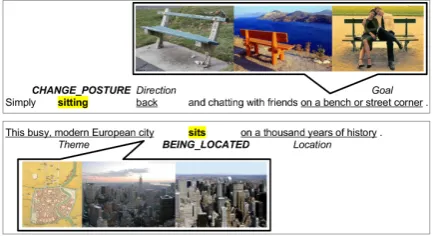
The main challenge and source of prediction er-rors of FrameId systems are ambiguous predicates, which can evoke several frames, e.g., the verb
sit evokes the frameChange posturein a context like ‘a person is sitting back on a bench’, while it evokesBeing located when ‘a company is sit-ting in a city’. Understanding the predicate con-text, and thereby the context of the situation (here,
‘Who / what is sitting where?’), is crucial to iden-tifying the correct frame for ambiguous cases.
[image:1.595.308.525.609.727.2]State-of-the-art FrameId systems model the sit-uational context using pretrained distributed word embeddings (see Hermann et al., 2014). Hence, it is assumed that the context of the situation is explicitly expressed in words. However, lan-guage understanding involves implicit knowledge, which is not mentioned but still seems obvious to humans, e.g.,‘people can sit back on a bench, but companies cannot’, ‘companies are in cities’. Such implicit common sense knowledge is obvi-ous enough to be rarely expressed in sentences, but is more likely to be present in images. Fig-ure1takes the ambiguous predicatesitto illustrate
Figure 1: Example sentences demonstrating the poten-tial benefit of images for ambiguous predicates.
how images can provide access to implicit com-mon sense knowledge crucial to FrameId.
When looking at the semantics of events, FrameId has commonalities with event prediction tasks. These aim at linking events and their partic-ipants to script knowledge and at predicting events in narrative chains. Ahrendt and Demberg(2016) argue that knowing about the participants helps to identify the event, which suggests the need for im-plicit context knowledge also for FrameId. This specifically applies to images, which can reflect properties of the participants of a situation in a in-herently different way, see Fig.1.
We analyze whether multimodal representa-tions grounded in images can encode common sense knowledge to improve FrameId. To that end, we extend SimpleFrameId (Hartmann et al.,
2017), a recent FrameId model based on dis-tributed word embeddings, to the multimodal case and evaluate for English and German. Note that there is a general lack of evaluation of FrameId systems for languages other than English. This is problematic as they yield different challenges; German, for example, due to long distance depen-dencies. Also, word embeddings trained on differ-ent languages have differdiffer-ent strengths in ambigu-ous words. We elaborate on insights from using different datasets by language.
Contributions. (1) We propose a pipeline and architecture of a FrameId system, extending state-of-the-art methods with the option of using im-plicit multimodal knowledge. It is flexible toward modality and language, reaches state-of-the-art ac-curacy on English FrameId data, clearly outper-forming several baselines, and sets a new state of the art on German FrameId data. (2)We discuss properties of language and meaning with respect to implicit knowledge, as well as the potential of multimodal representations for FrameId. (3) We perform a detailed analysis of FrameId systems. First, we develop a new strong baseline. Second, we suggest novel evaluation metrics that are es-sential for assessing ambiguous and rare frame in-stances. We show our system’s advantage over the strong baseline in this regard and by this improve upon the main source of errors. Third, we analyze gold annotated datasets for English and German showing their different strengths. Finally, we re-lease the implementation of our system, our eval-uation splits for SALSA 2.0, and the embeddings for synsets and IMAGINEDwords.
2 Related Work 2.1 Frame identification
State-of-the-art FrameId systems rely on pre-trained word embeddings as input (Hermann et al.,
2014). This proved to be helpful: those sys-tems consistently outperform the previously lead-ing FrameId system SEMAFOR (Das et al.,2014), which is based on a handcrafted set of features. The open source neural network-based FrameId system SimpleFrameId (Hartmann et al.,2017) is conceptually simple, yet yields competitive accu-racy. Its input representation is a concatenation of the predicate’s pretrained embedding and an em-bedding of the predicate context. The dimension-wise mean of the pretrained embeddings of all words in the sentence is taken as the context. In this work, we first aim at improving the represen-tation of the predicate context using multimodal embeddings, and second at assessing the applica-bility to another language, namely German.
Common sense knowledge for language under-standing. Situational background knowledge can be described in terms of frames (Fillmore,
1985) and scripts (Schank and Abelson, 2013).
Ahrendt and Demberg (2016) report that know-ing about a script’s participants aids in predict-ing events linked to script knowledge. Transfer-ring this insight to FrameId, we assume that a rich context representation helps to identify the sense of ambiguous predicates. Addressing ambiguous predicates where participants have different prop-erties depending on the context, Feizabadi and Pad´o(2012) give some examples where the loca-tion plays a discriminating role as participant: mo-tion verbs that have both a concrete momo-tion sense and a more abstract sense in the cognitive domain, e.g.,struggle,lean,follow.
requires software dependencies that are not avail-able anymore, hindering application to new data. To the best of our knowledge, there is no FrameId system evaluated on SALSA 2.0.
Johannsen et al. (2015) present a simple, but weak translation baseline for cross-lingual FrameId. A SEMAFOR-based system is trained on English FrameNet and tested on German Wikipedia sentences, translated word-by-word to English. This translation baseline reaches an F1 score of 8.5 % on the German sentences when translated to English. The performance of this weak translation baseline is worse than that of another simple baseline: a ‘most frequent sense baseline’ – computing majority votes for German (and many other languages) – reaches an F1 score of 53.0 % on the German sentences. This shows that pure translation does not help with FrameId and, furthermore, indicates a large room for im-provement for FrameId in languages other than English.
2.2 Multimodal representation learning
There is a growing interest in Natural Language Processing for enriching traditional approaches with knowledge from the visual domain, as images capture qualitatively different information com-pared to text. Regarding FrameId, to the best of our knowledge, multimodal approaches have not yet been investigated. For other tasks, mul-timodal approaches based on pretrained embed-dings are reported to be superior to unimodal approaches. Textual embeddings have been en-riched with information from the visual domain, e.g., for Metaphor Identification (Shutova et al.,
2016), Question Answering (Wu et al.,2017), and Word Pair Similarity (Collell et al., 2017). The latter presents a simple, but effective way of ex-tending textual embeddings with so-called multi-modal IMAGINED embeddings by a learned map-ping from language to vision. We apply the IMAG -INEDmethod to our problem.
In this work, we aim to uncover whether rep-resentations that are grounded in images can help to improve the accuracy of FrameId. Our appli-cation case of FrameId is more complex than a comparison on the word-pair level as it considers a whole sentence in order to identify the predicate’s frame. However, we see a potential for multimodal IMAGINED embeddings to help: their mapping from text to multimodal representations is learned
from images for nouns. Such nouns, in turn, are candidates for role fillers of predicates. In order to identify the correct sense of an ambiguous predi-cate, it could help to enrich the representation of the context situation with multimodal embeddings for the entities that are linked by the predicate.
3 Our Multimodal FrameId Model
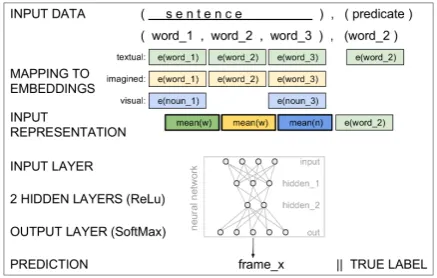
Our system builds upon the SimpleFrameId ( Hart-mann et al., 2017) system for English FrameId based on textual word embeddings. We extend it to multimodal and multilingual use cases; see Fig.2for a sketch of the system pipeline. Same as SimpleFrameId, our system is based on pretrained embeddings to build the input representation out of the predicate context and the predicate itself.
However, different to SimpleFrameId, our rep-resentation of the predicate context is multimodal: beyond textual embeddings we also use IMAG -INEDand visual embeddings. More precisely, we concatenate all unimodal representations of the predicate context, which in turn are the unimodal mean embeddings of all words in the sentence. We use concatenation for fusing the different embed-dings as it is the simplest yet successful fusion approach (Bruni et al., 2014; Kiela and Bottou,
2014). The input representation is processed by a two-layer Multilayer Perceptron (MLP, Rosen-blatt, 1958), where we adapt the number of hid-den nodes to the increased input size and apply dropout to all hidden layers to prevent overfitting (Srivastava et al.,2014). Each node in the output layer corresponds to one frame-label class. We use rectified linear units (Nair and Hinton,2010) as ac-tivation function for the hidden layers, and a
soft-Figure 2: Sketch of the pipeline. (1) Data: sentence with predicate. (2) Mapping: words to embeddings.
[image:3.595.307.526.565.704.2]max for the output layer yielding a multinomial distribution over frames. We take itsarg max as the final prediction at test time. Optionally, filter-ing based on the lexicon can be performed on the predicted probabilities for each frame label. The development set was used to determine the archi-tecture and hyperparameters, see Sec.6.
Majority baselines. We propose a new strong baseline based on a combination of two existing ones. These are: first, the most-frequent-sense baseline using the data majority (Data Baseline) to determine the most frequent frame for a predi-cate; second, the baseline introduced byHartmann et al. (2017) using a lexicon (Lexicon Baseline) to consider the data counts of the Data Baseline only for those frames available for a predicate. We propose to combine them into a Data-Lexicon Baseline, which uses the lexicon for unambiguous predicates and for ambiguous ones it uses the data majority. This way, we trust the lexicon for un-ambiguous predicates but not for un-ambiguous ones, there we rather consider the data majority. Com-paring a system to these baselines helps to see whether it just memorizes the data majority or the lexicon, or actually captures more.
All majority baselines strongly outperform the weak translation baseline of Johannsen et al.
(2015) when training the system on English data and evaluating it on German data.
4 Preparation of Input Embeddings Textual embeddings for words. We use the 300-dimensional GloVe embeddings (Pennington et al.,2014) for English, and the 100-dimensional embeddings of Reimers et al. (2014) for Ger-man. GloVe and Reimers have been trained on the Wikipedia of their targeted language and on addi-tional newswire text to cover more domains, re-sulting in similarly low out-of-vocabulary scores.
Visual embeddings for synsets. We obtain vi-sual embeddings for WordNet synsets (Fellbaum,
1998; , Ed.): we apply the pretrained VGG-m-128 Convolutional Neural Network model ( Chat-field et al., 2014) to images for synsets from Im-ageNet (Deng et al., 2009), we extract the 128-dimensional activation of the last layer (before the softmax) and then we L2-normalize it. We use the images of the WN9-IMG dataset (Xie et al.,
2017), which links WordNet synsets to a collec-tion of ten ImageNet images. We average the
em-beddings of all images corresponding to a synset, leading to a vocabulary size of 6555 synsets. All synsets in WN9-IMG are part of triples of the form entity-relation-entity, i.e. synset-relation-synset. Such synset entities that are participants of rela-tions with other synset entities are candidates for incorporating the role fillers for predicates and, therefore, may help to find the correct frame for a predicate (see Sec. 5 for details about sense-disambiguation.)
Linguistic embeddings for synsets. We obtain 300-dimensional linguistic synset embeddings: we apply the AutoExtend approach (Rothe and Sch¨utze, 2015) to GloVe embeddings and pro-duce synset embeddings for all synsets having at least one synset lemma in the GloVe embeddings. This leads to a synset vocabulary size of 79 141. Linguistic synset embeddings are based on tex-tual word embeddings and the synset information known by the knowledge base WordNet, thus they complement the visual synset embeddings.
5 Data and Preparation of Splits
English FrameId: Berkeley FrameNet. The Berkeley FrameNet (Baker et al.,1998; Ruppen-hofer et al.,2016) is an ongoing project for build-ing a large lexical resource for English with ex-pert annotations based on frame semantics ( Fill-more,1976). It consists of two parts, a manually created lexicon that maps predicates to the frames they can evoke, and fully annotated texts (fulltext). The mapping can be used to facilitate the frame identification for a predicate in a sentence, e.g., a sentence in the fulltext corpus. Table 1 contains the lexicon statistics, Table2(top left) the dataset statistics. In this work, we use FrameNet 1.5 to ensure comparability with the previous state of the art, with the common evaluation split for FrameId systems introduced byDas and Smith(2011) (with the development split of Hermann et al., 2014). Due to having a single annotation as consent of experts, it is hard to estimate a performance bound of a single human for the fulltext annotation.
German FrameId: SALSA. The SALSA
project (Burchardt et al., 2006; Rehbein et al.,
2012) is a completed annotation project, which serves as the German counterpart to FrameNet. Its annotations are based on FrameNet up to ver-sion 1.2. SALSA adds proto-frames to properly annotate senses that are not covered by the En-glish FrameNet. For a more detailed description of differences between FrameNet and SALSA, see
Ellsworth et al. (2004); Burchardt et al. (2009). SALSA also provides a lexicon (see Table 1 for statistics) and fully annotated texts. There are two releases of SALSA: 1.0 (Burchardt et al.,
2006) used for Shalmaneser (Erk and Pado,2006) (cf. Sec. 2.1), and the final release 2.0 (Rehbein et al.,2012), which contains more annotations and adds nouns as predicates. We use the final release. SALSA has no standard evaluation split; Erk and Pado (2006) used an undocumented random
lexicon frames LUs avg(fr/pred) %amb.pred.
FrameNet 1020 11 942 1.26 17.32
SALSA 1023 1827 2.82 57.56
Table 1: Lexicon statistics for FrameNet 1.5 and for SALSA 2.0: the total number of distinct framesand lexical units LUs (distinct predicate-frame combina-tions), the number of frames a predicate can evoke on averageavg, and the % ofambiguouspredicates.
split. Also, it is not possible to follow the split-ting method ofDas and Smith(2011), as SALSA project distributions do not map to documents. We suggest splitting based on sentences, i.e. all anno-tations of a sentence are in the same set to avoid mixing training and test sets. We assign sentences to 100 buckets based on their IDs and create a 70/15/15 split for training, development, and test sets based on the bucket order. This procedure al-lows future work to be evaluated on the same data. Table2(bottom left) shows the dataset statistics.
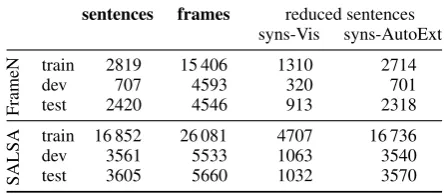
Synsets in FrameNet and SALSA. To prepare the datasets for working with the synset embed-dings, we sense-disambiguate all sentences using the API of BabelNet (Navigli and Ponzetto,2010), which returns multilingual synsets. We thus de-pend on the state-of-the-art accuracy of BabelNet (Navigli and Ponzetto, 2012) when using synset embeddings on sense-disambiguated sentences. However, this dependence does not hold when ap-plying IMAGINEDembeddings to sentences, as the mapping from words to IMAGINED embeddings does not need any synsets labeled in the sentences. After sense-disambiguation some sentences do not contain any synset available in our synset embed-dings. The statistics of those sentences that have at least one synset embedding (visual or linguistic AutoExtend) is given in Table2(right).
6 Experimental Setup
We contrast our system’s performance for context representations based on unimodal (textual) ver-sus multimodal (textual and visual) embeddings. Also, we compare English against German data. We run the prediction ten times to reduce noise in
sentences frames reduced sentences syns-Vis syns-AutoExt
FrameN
train 2819 15 406 1310 2714
dev 707 4593 320 701
test 2420 4546 913 2318
SALSA
train 16 852 26 081 4707 16 736
dev 3561 5533 1063 3540
[image:5.595.304.527.575.672.2]test 3605 5660 1032 3570
the evaluation (cf.Reimers and Gurevych,2017) and report the mean for each metric.
Use of lexicon. We evaluate our system in two settings: with and without lexicon, as suggested byHartmann et al.(2017). In the with-lexicon set-ting, the lexicon is used to reduce the choice of frames for a predicate to only those listed in the lexicon. If the predicate is not in the lexicon, it corresponds to the without-lexicon setting, where the choice has to be done amongst all frames.
Evaluation metrics. FrameId systems are usu-ally compared in terms of accuracy, which we adopt for comparability. As a multiclass clas-sification problem, FrameId has to cope with a strong variation in the annotation frequency of frame classes. Minority classes are frames that oc-cur only rarely; majority classes ococ-cur frequently. Note that the accuracy is biased toward majority classes, explaining the success of majority base-lines on imbalanced datasets such as FrameNet.
Alternatively, the F1 score is sometimes re-ported as it takes a complementary perspective. The F-measure is the harmonic mean of precision and recall, measuring exactness and completeness of a model, respectively. In previous work, micro-averaging is used to compute F1 scores. Yet, sim-ilar to the accuracy, micro-averaging introduces a bias toward majority classes. We compute F1-macroinstead, for which precision and recall are computed for each class and averaged afterwards, giving equal weight to all classes.
Taken together, this yields scores that underesti-mate (F1-macro) and overestiunderesti-mate (average accu-racy) on imbalanced datasets. Previous work just used the overestimate such that a comparison is possible in terms of accuracy in the with-lexicon setting. We suggest to use F1-macro additionally to analyze rare, but interesting classes. Thus, a comparison within our work is possible for both aspects, giving a more detailed picture. Note that previous work reports one score whilst we report the mean score of ten runs.
Hyperparameters. We identified the best hy-perparameters for the English and German data based on the respective development sets.2 The Multilayer Perceptron architecture performed
con-2Differences in hyperparameters to SimpleFrameId: ‘nadam’ as optimizer instead of ‘adagrad’, dropout on hid-den layers and early stopping to regularize training. Different number of hidden units, optimized by grid search.
sistently better than a more complex Gated Re-current Unit model (Cho et al.,2014). We found that more than two hidden layers did not bring any improvement over two layers; using dropout on the hidden layers helped to increase the accu-racy. Among the various input representations, a concatenation of the representations of context and predicate was the best amongst others, includ-ing dependencies, lexicon indicators, and part-of-speech tags. Training is done using Nesterov-accelerated Adam (Nadam,Dozat,2016) with de-fault parameters. A batch size of 128 is used. Learning stops if the development accuracy has not improved for four epochs, and the learning rate is reduced by factor of two if there has not been any improvement for two epochs.
7 Results
First, we report our results on English data (see Ta-ble3, top) and then, we compare against German data (see Table3, bottom).
7.1 English FrameNet data
Baseline. Our new strong Data-Lexicon Base-line reaches a considerable accuracy of 86.32 %, which is hard to beat by trained models. Even the most recent state of the art only beats it by about two points: 88.41 % (Hermann et al.,2014). However, the accuracy of the baseline drops for ambiguous predicates (69.73 %) and the F1-macro score reveals its weakness toward minority classes (drop from 64.54 % to 37.42 %).
Unimodal. Our unimodal system trained and evaluated on English data slightly exceeds the ac-curacy of the previous state of the art (88.66 % on average versus 88.41 % forHermann et al.,2014); our best run’s accuracy is 89.35 %. Especially on ambiguous predicates, i.e. the difficult and there-fore interesting cases, our average accuracy sur-passes that of previous work by more than one point (the best run by almost three points). Con-sidering the proposed F1-macro score for an as-sessment of the performance on minority classes and ambiguous predicates reveals our main im-provement: Our system substantially outperforms the strong Data-Lexicon Baseline, demonstrating that our system differs from memorizing majori-ties and actually improves minority cases.
with lexicon without lexicon
model acc acc amb F1-m F1-m amb acc acc amb F1-m F1-m amb
FrameNet
Data Baseline 79.06 69.73 33.00 37.42 79.06 69.73 33.00 37.42
Lexicon Baseline 79.89 55.52 65.61 30.95 – – – –
Data-Lexicon Baseline 86.32 69.73 64.54 37.42 – – – –
Hermann et al.(2014) 88.41 73.10 – – – – – –
Hartmann et al.(2017) 87.63 73.80 – – 77.49 – – –
ouruni 88.66 74.92 76.65 53.86 79.96 71.70 57.07 47.40
ourmm (im, synsV) 88.82 75.28 76.77 54.80 81.21 72.51 57.81 49.38
SALSA
Data Baseline 77.00 70.51 37.40 28.87 77.00 70.51 37.40 28.87
Lexicon Baseline 61.57 52.5 19.36 15.68 – – – –
Data-Lexicon Baseline 77.16 70.51 38.48 28.87 – – – –
ouruni 80.76 75.59 48.42 41.38 80.59 75.52 47.64 41.17
[image:7.595.73.526.64.240.2]ourmm (im) 80.71 75.58 48.29 41.19 80.51 75.51 47.36 40.93
Table 3: FrameId results (in %) on English (upper) and German (lower) with and without using the lexicon. Reported areaccuracy andF1-macro, both also forambiguous predicates (mean scores over ten runs). Models:
(a)Data, Lexicon, and Data-Lexicon Baselines. (b)Previous models for English. (c)Ours: unimodalour-uni, multimodal on top of our-uni –our-mm – with IMAGINEDembeddings (and synset visual embeddings for English). Best results highlighted in bold. The best run’s results for English were:
our uni: acc: 89.35 ;acc amb: 76.45 ;F1-m: 76.95 ;F1-m amb: 54.02 (with lexicon)
our mm (im, synsV): acc: 89.09 ;acc amb: 75.86 ;F1-m: 78.17 ;F1-m amb: 57.48 (with lexicon)
the most helpful one is the concatenation of IMAG -INED embeddings and visual synset embeddings: it outperforms the unimodal approach slightly in all measurements. We observe that the improve-ments are more pronounced for difficult cases, such as for rare and ambiguous cases (one point improvement in F1-macro), as well as in the ab-sence of a lexicon (up to two points improvement).
Significance tests. We conduct a single sample t-test to judge the difference between previous state-of-the-art accuracy (Hermann et al., 2014) and our unimodal approach. The null hypothe-sis (expected value of our sample of ten accuracy scores equals previous state-of-the-art accuracy) is rejected at a significance level of α = 0.05 (p = 0.0318). In conclusion, even our unimodal approach outperforms prior state of the art in terms of accuracy.
To judge the difference between our unimodal and our multimodal approach, we conduct a t-test for the means of the two independent samples. The null hypothesis states identical expected val-ues for our two samples of ten accuracy scores. Regarding the setting with lexicon, the null hy-pothesis cannot be rejected at a significance level ofα = 0.05 (p = 0.2181). However, concern-ing accuracy scores without usconcern-ing the lexicon, the null hypothesis is rejected at a significance level
of α = 0.05 (p < 0.0001). In conclusion, the
multimodal approach has a slight overall
tage and, interestingly, has a considerable advan-tage over the unimodal one when confronted with a more difficult setting of not using the lexicon.
7.2 German SALSA versus English data German results. Our system evaluated on Ger-man data sets a new state of the art on this corpus with 80.76 % accuracy, outperforming the base-lines (77.16 %; no other system evaluated on this dataset). The difference in F1-macro between the majority baselines and our system is smaller than for the English FrameNet. This indicates that the majorities learned from data are more powerful in the German case with SALSA than in the English case, when comparing against our system. Multi-modal context representations cannot show an im-provement for SALSA with this general dataset.
8 Discussion 8.1 English data
Insights from the baseline. Many indicators point to our approach not just learning the data majority: our trained models have better F1-macro and especially much higher ambiguous F1-macro scores with lexicon. This clearly suggests that our system is capable of acquiring more expressive-ness than the baselines do by counting majorities.
Impact of multimodal representations. Mul-timodal context representations improve results compared to unimodal ones. It helps to incorpo-rate visual common sense knowledge about the sit-uation’s participants. Referring back to our exam-ple of the ambiguous predicatesit, the multimodal approach is able to transfer the knowledge to the test sentence‘Al-Anbar in general, and Ramadi in particular, are sat with the Americans in Jordan.’
by correctly identifying the frame Being located
whilst the unimodal approach fails with predict-ingChange posture. The increase in performance when adding information from visual synset em-beddings is not simply due to higher dimensional-ity of the embedding space. To verify, we further investigate extending the unimodal system with random word embeddings. This leads to a drop in performance compared to using just the uni-modal representations or using these in combina-tion with the proposed multimodal embeddings, especially in the setting without lexicon. Interest-ingly, replacing visual synset embeddings with lin-guistic synset embeddings (AutoExtend byRothe and Sch¨utze(2015), see Sec.4) in further investi-gations also showed that visual embeddings yield better performance. This points out the potential for incorporating even more image evidence to ex-tend our approach.
8.2 German versus English data
Difficulties for German data. The impact of multimodal context representations is more
dif-ficult to interpret for the German dataset. The fact that they have not helped here may be due to mismatches when translating the English nouns of a synset to German in order to train the IMAG -INED embeddings. Here, we see room for future work to improve on simple translation by sense-based translations. In SALSA, a smaller portion of sentences has at least one synset embedding, see Table 2. For further investigations, we re-duced the dataset to only sentences actually con-taining a synset embedding. Then, minor improve-ments of the multimodal approach were visible for SALSA. This points out that a dataset containing more words linking to implicit knowledge in im-ages (visual synset embeddings) can profit more from visual and IMAGINEDembeddings.
Impact of lexicon: English versus German.
Even if both lexica approximately define the same number of frames (see Table1), the number of de-fined lexical units (distinct predicate-frame combi-nations) in SALSA is smaller. This leads to a lexi-con that is a magnitude smaller than the FrameNet lexicon. Thus, the initial situation for the Ger-man case is more difficult. The impact of the lexi-con for SALSA is smaller than for FrameNet (best visible in the increase of F1-macro with using the lexicon compared to without), which can be explained by the larger percentage of ambiguous predicates (especially evoking proto-frames) and the smaller size of the lexicon. The evaluation on two different languages highlights the impact of an elaborate, manually created lexicon: it boosts the performance on frame classes that are less present in the training data. English FrameId benefits from the large high-quality lexicon, whereas German FrameId currently lacks a high-quality lexicon that is large enough to benefit the FrameId task.
Dataset properties: English versus German.
To better understand the influence of the dataset on the prediction errors, we further analyze the errors of our approach (see Table 4) following Palmer
with lexicon without lexicon
model correct euns eunsLab en correct euns eunsLab en
FrameN
ouruni 89.35 0.40 3.04 7.22 80.36 1.32 7.68 10.65
ourmm (im, synsV) 89.79 0.58 3.55 6.08 80.63 1.91 8.50 8.96
SALSA
ouruni 80.99 0.49 0.97 17.54 80.80 0.49 1.10 17.61
[image:8.595.78.515.660.745.2]ourmm (im) 81.24 1.94 1.88 14.94 80.96 1.94 2.05 15.05
and Sporleder(2010). A wrong prediction can ei-ther be a normal classification error, or it can be the result of an instance that was unseen at train-ing time, which means that the error is due to the training set. The instance can either be completely unseen or unseen with the target label. We observe that FrameNet has larger issues with unseen data compared to SALSA, especially data that was un-seen with one specific label but un-seen with another label. This is due to the uneven split of the docu-ments in FrameNet, leading to data from different source documents and domains in the training and test split. SALSA does not suffer from this prob-lem as much since the split was performed dif-ferently. It would be worth considering the same splitting method for FrameNet.
8.3 Future work
As stated previously, FrameId has commonalities with event prediction. Since identifying frames is only one way of capturing events, our approach is transferable to other schemes of event prediction and visual knowledge about participants of situ-ations should be beneficial there, too. It would be interesting to evaluate the multimodal archi-tecture on other predicate-argument frameworks, e.g., script knowledge or VerbNet style Semantic Role Labeling. In particular the exploration our findings on visual contributions to FrameId in the context of further event prediction tasks forms an interesting next step.
More precisely, future work should consider us-ing implicit knowledge not only from images of the participants of the situation, but also from the entire scene in order to directly capture rela-tions between the participants. This could pro-vide access to a more holistic understanding of the scene. The following visual tasks with accompa-nying datasets could serve as a starting point: (a) visual Verb Sense Disambiguation with the VerSe dataset (Gella et al.,2016) and (b) visual SRL with several datasets, e.g., imSitu (Yatskar et al.,2016) (linked to FrameNet), V-COCO (Gupta and Ma-lik,2015) (verbs linked to COCO), VVN (Ronchi and Perona, 2015) (visual VerbNet) or even SRL grounded in video clips for the cooking-domain (Yang et al., 2016) and visual Situation Recogni-tion (Mallya and Lazebnik,2017). Such datasets could be used for extracting visual embeddings for verbs or even complex situations in order to improve the visual component in the embeddings
for our FrameId system. Vice versa: visual tasks could profit from multimodal approaches ( Bal-truˇsaitis et al., 2017) in a similar sense as our textual task, FrameId, profits from additional in-formation encoded in further modalities. More-over, visual SRL might profit from our multi-modal FrameId system to a similar extend as any FrameNet SRL task profits from correctly identi-fied frames (Hartmann et al.,2017).
Regarding the combination of embeddings from different modalities, we suggest to experiment with different fusion strategies complementing the middle fusion (concatenation) and the mapping (IMAGINED method). This could be a late fusion at decision level operating like an ensemble.
9 Conclusion
In this work, we investigated multimodal repre-sentations for Frame Identification (FrameId) by incorporating implicit knowledge, which is bet-ter reflected in the visual domain. We presented a flexible FrameId system that is independent of modality and language in its architecture. With this flexibility it is possible to include textual and visual knowledge and to evaluate on gold data in different languages. We created multimodal rep-resentations from textual and visual domains and showed that for English FrameNet data, enriching the textual representations with multimodal ones improves the accuracy toward a new state of the art. For German SALSA data, we set a new state of the art with textual representations only and dis-cuss why incorporating multimodal information is more difficult. For both datasets, our system is particularly strong with respect to ambiguous and rare classes, considerably outperforming our new Data-Lexicon Baseline and thus addressing a key challenge in FrameId.
Acknowledgments
This work has been supported by the DFG-funded research training group “Adaptive Prepara-tion of InformaPrepara-tion form Heterogeneous Sources” (AIPHES, GRK 1994/1). We also acknowledge the useful comments of the anonymous reviewers.
References
Collin F. Baker, Charles J. Fillmore, and John B. Lowe. 1998. The Berkeley FrameNet project. In Pro-ceedings of the 36th Annual Meeting of the Associ-ation for ComputAssoci-ational Linguistics and 17th International Conference on Computational Linguistics -Volume 1, pages 86–90, Stroudsburg, PA, USA.
Tadas Baltruˇsaitis, Chaitanya Ahuja, and Louis-Philippe Morency. 2017. Multimodal machine learning: A survey and taxonomy. arXiv preprint arXiv:1705.09406.
Elia Bruni, Nam-Khanh Tran, and Marco Baroni. 2014.
Multimodal distributional semantics.Journal of Ar-tificial Intelligence Research, 49(2014):1–47.
Aljoscha Burchardt, Katrin Erk, Anette Frank, An-drea Kowalski, Sebastian Pad´o, and Manfred Pinkal. 2006. The SALSA corpus: A German corpus re-source for lexical semantics. In Proceedings of LREC, Genoa, Italy.
Aljoscha Burchardt, Katrin Erk, Anette Frank, An-drea Kowalski, Sebastian Pad´o, and Manfred Pinkal. 2009. Using FrameNet for the semantic analysis of German: Annotation, representation, and automa-tion. InMultilingual FrameNets in Computational Lexicography, pages 209–244. Mouton de Gruyter, New York City, USA.
Ken Chatfield, Karen Simonyan, Andrea Vedaldi, and Andrew Zisserman. 2014. Return of the devil in the details: Delving deep into convolutional nets. In
Proceedings of the British Machine Vision Confer-ence (BMVC 2015), Nottingham, Great Britain.
Kyunghyun Cho, Bart van Merri¨enboer, G¨ulc¸ehre C¸a˘glar, Dzmitry Bahdanau, Fethi Bougares, Hol-ger Schwenk, and Yoshua Bengio. 2014. Learning phrase representations using RNN encoder–decoder for statistical machine translation. InProceedings of the Conference on Empirical Methods in Natural Language Processing (EMNLP), pages 1724–1734, Doha, Qatar.
Guillem Collell, Ted Zhang, and Marie-Francine Moens. 2017. Imagined visual representations as multimodal embeddings. InThirty-First AAAI Con-ference on Artificial Intelligence, pages 4378–4384, San Francisco, USA.
Dipanjan Das, Desai Chen, Andr´e F. T. Martins, Nathan Schneider, and Noah A. Smith. 2014.
Frame-semantic parsing. Computational Linguis-tics, 40:1:9–56.
Dipanjan Das and Noah A. Smith. 2011. Semi-supervised frame-semantic parsing for unknown predicates. InProceedings of the 49th Annual Meet-ing of the Association for Computational LMeet-inguis- Linguis-tics: Human Language Technologies - Volume 1, pages 1435–1444, Stroudsburg, PA, USA.
J. Deng, W. Dong, R. Socher, L.-J. Li, K. Li, and L. Fei-Fei. 2009. ImageNet: A large-scale hierarchical im-age database. InProceedings of the IEEE Confer-ence on Computer Vision and Pattern Recognition, pages 248–255, Miami, USA.
Timothy Dozat. 2016. Incorporating Nesterov momen-tum into Adam. In International Conference on Representation Learning (ICLR): Posters, pages 1– 7, San Juan, Puerto Rico.
Christiane Fellbaum (Ed.). 1998. WordNet: An Elec-tronic Lexical Database. The MIT Press, Cam-bridge, MA ; London.
Michael Ellsworth, Katrin Erk, Paul Kingsbury, and Sebastian Pad´o. 2004. PropBank, SALSA, and FrameNet: How design determines product. In Pro-ceedings of the LREC 2004 Workshop on Build-ing Lexical Resources from Semantically Annotated Corpora, Lisbon, Portugal.
Katrin Erk and Sebastian Pado. 2006. Shalmaneser -A flexible toolbox for semantic role assignment. In
Proceedings of LREC, Genoa, Italy.
Parvin Sadat Feizabadi and Sebastian Pad´o. 2012. Au-tomatic identification of motion verbs in WordNet and FrameNet. InKONVENS, pages 70–79, Vienna, Austria.
Christiane Fellbaum, editor. 1998. WordNet: An elec-tronic lexical database. MIT Press, Cambridge, USA.
Charles J. Fillmore. 1976. Frame semantics and the na-ture of language. Annals of the New York Academy of Sciences, 280:20–32.
Charles J Fillmore. 1985. Frames and the semantics of understanding. Quaderni di semantica, 6(2):222– 254.
Charles J. Fillmore, Christopher R. Johnson, and Miriam R.L. Petruck. 2003. Background to FrameNet. International Journal of Lexicography, 16(3):235–250.
Spandana Gella, Mirella Lapata, and Frank Keller. 2016.Unsupervised visual sense disambiguation for verbs using multimodal embeddings. In Proceed-ings of NAACL-HLT, pages 182–192, San Diego, USA.
Saurabh Gupta and Jitendra Malik. 2015. Vi-sual semantic role labeling. arXiv preprint arXiv:1505.04474.
Karl Moritz Hermann, Dipanjan Das, Jason Weston, and Kuzman Ganchev. 2014. Semantic frame iden-tification with distributed word representations. In
Proceedings of the ACL, pages 1448–1458, Balti-more, USA.
Anders Johannsen, H´ector Mart´ınez Alonso, and An-ders Søgaard. 2015. Any-language frame-semantic parsing. In Proceedings of the Conference on Em-pirical Methods in Natural Language Processing, page 20622066, Lisbon, Portugal.
Douwe Kiela and L´eon Bottou. 2014. Learning image embeddings using convolutional neural networks for improved multi-modal semantics. In Proceedings of the Conference on Empirical Methods in Natural Language Processing, pages 36–45, Doha, Qatar.
Arun Mallya and Svetlana Lazebnik. 2017. Recurrent models for situation recognition. InProceedings of the IEEE International Conference on Computer Vi-sion (ICCV), pages 455–463, Venice, Italy.
Vinod Nair and Geoffrey E. Hinton. 2010. Rectified linear units improve restricted Boltzmann machines. InProceedings of the 27th International Conference on Machine Learning, pages 807–814, Haifa, Israel.
Roberto Navigli and Simone Paolo Ponzetto. 2010.
BabelNet: Building a very large multilingual se-mantic network. InProceedings of the 48th Annual Meeting of the Association for Computational Lin-guistics, pages 216–225, Uppsala, Sweden.
Roberto Navigli and Simone Paolo Ponzetto. 2012.
BabelNet: The automatic construction, evaluation and application of a wide-coverage multilingual se-mantic network. Artificial Intelligence, 193:217– 250.
Alexis Palmer and Caroline Sporleder. 2010. Eval-uating FrameNet-style semantic parsing: The role of coverage gaps in FrameNet. In Proceedings of the 23rd International Conference on Computa-tional Linguistics: Posters, pages 928–936, Beijing, China.
Jeffrey Pennington, Richard Socher, and Christo-pher D. Manning. 2014. GloVe: Global vectors for word representation. InEmpirical Methods in Natu-ral Language, pages 1532–1543, Doha, Qatar.
Ines Rehbein, Josef Ruppenhofer, Caroline Sporleder, and Manfred Pinkal. 2012. Adding nominal spice to SALSA - Frame-semantic annotation of German nouns and verbs. In Proceedings of KONVENS 2012, pages 89–97, Vienna, Austria.
Nils Reimers, Judith Eckle-Kohler, Carsten Schnober, Jungi Kim, and Iryna Gurevych. 2014. GermEval-2014: Nested named entity recognition with neural networks. InWorkshop Proceedings of the 12th Edi-tion of the KONVENS Conference, pages 117–120, Hildesheim, Germany.
Nils Reimers and Iryna Gurevych. 2017. Report-ing score distributions makes a difference: Perfor-mance study of LSTM-networks for sequence tag-ging. In Proceedings of the Conference on Em-pirical Methods in Natural Language Processing (EMNLP), pages 338–348, Copenhagen, Denmark. Matteo Ruggero Ronchi and Pietro Perona. 2015.
De-scribing common human visual actions in images. In Proceedings of the British Machine Vision Con-ference (BMVC 2015), Swansea, Wales.
Frank Rosenblatt. 1958. The perceptron: A probabilis-tic model for information storage and organization in the brain.Psychological Review, pages 65–386. Sascha Rothe and Hinrich Sch¨utze. 2015.
AutoEx-tend: Extending word embeddings to embeddings for synsets and lexemes. InProceedings of the ACL, Beijing, China.
Josef Ruppenhofer, Michael Ellsworth, Miriam R.L. Petruck, Christopher R. Johnson, and Jan Schef-fczyk. 2016. FrameNet II: Extended Theory and Practice, revised november 1, 2016 edition. Interna-tional Computer Science Institute, Berkeley, USA. Roger C Schank and Robert P Abelson. 2013. Scripts,
plans, goals, and understanding: An inquiry into hu-man knowledge structures. Psychology Press. Ekaterina Shutova, Douwe Kiela, and Jean Maillard.
2016. Black holes and white rabbits: Metaphor identification with visual features. InProceedings of NAACL-HLT, pages 160–170, San Diego, USA. Nitish Srivastava, Geoffrey E. Hinton, Alex
Krizhevsky, Ilya Sutskever, and Ruslan Salakhutdi-nov. 2014. Dropout: A simple way to prevent neural networks from overfitting. Journal of Machine Learning Research, 15:1929–1958.
Qi Wu, Damien Teney, Peng Wang, Chunhua Shen, Anthony Dick, and Anton van den Hengel. 2017.
Visual question answering: A survey of methods and datasets. Computer Vision and Image Understand-ing, 163:21–40.
Ruobing Xie, Zhiyuan Liu, Huanbo Luan, and Maosong Sun. 2017. Image-embodied knowledge representation learning. In Proceedings of the Twenty-Sixth International Joint Conference on Ar-tificial Intelligence, pages 3140–3146, Melbourne, Australia.
Shaohua Yang, Qiaozi Gao, Changsong Liu, Caiming Xiong, Song-Chun Zhu, and Joyce Y Chai. 2016.
Grounded semantic role labeling. InProceedings of NAACL-HLT, pages 149–159, San Diego, USA. Mark Yatskar, Luke Zettlemoyer, and Ali Farhadi.