Proceedings of NAACL-HLT 2018, pages 685–696
Semantic Structural Evaluation for Text Simplification
Elior Sulem, Omri Abend, Ari Rappoport
Department of Computer Science, The Hebrew University of Jerusalem
{eliors|oabend|arir}@cs.huji.ac.il
Abstract
Current measures for evaluating text simplifi-cation systems focus on evaluating lexical text aspects, neglecting its structural aspects. In this paper we propose the first measure to ad-dress structural aspects of text simplification, calledSAMSA. It leverages recent advances in semantic parsing to assess simplification qual-ity by decomposing the input based on its se-mantic structure and comparing it to the out-put. SAMSA provides a reference-less auto-matic evaluation procedure, avoiding the prob-lems that reference-based methods face due to the vast space of valid simplifications for a given sentence. Our human evaluation experi-ments show bothSAMSA’s substantial corre-lation with human judgments, as well as the deficiency of existing reference-based mea-sures in evaluating structural simplification.1
1 Introduction
Text simplification (TS) addresses the translation of an input sentence into one or more simpler sen-tences. It is a useful preprocessing step for several NLP tasks, such as machine translation ( Chan-drasekar et al.,1996;Mishra et al.,2014) and rela-tion extracrela-tion (Niklaus et al.,2016), and has also been shown useful in the development of reading aids, e.g., for people with dyslexia (Rello et al., 2013) or non-native speakers (Siddharthan,2002). The task has attracted much attention in the past decade (Zhu et al.,2010;Woodsend and La-pata,2011;Wubben et al.,2012;Siddharthan and Angrosh, 2014;Narayan and Gardent,2014), but has yet to converge on an evaluation protocol that yields comparable results across different methods and strongly correlates with human judgments. This is in part due to the difficulty to combine the effects of different simplification operations 1All data and code are available inhttps://github. com/eliorsulem/SAMSA.
(e.g., deletion, splitting and substitution).Xu et al. (2016) has recently made considerable progress towards that goal, and proposed to tackle it both by using an improved reference-based measure, named SARI, and by increasing the number of ref-erences. However, their research focused on lex-ical, rather than structural simplification, which provides a complementary view of TS quality as this paper will show.
This paper focuses on the evaluation of the structural aspects of the task. We introduce the semantic measureSAMSA (Simplification Auto-matic evaluation Measure through Semantic An-notation), the first structure-aware measure for TS in general, and the first to use semantic structure in this context in particular. SAMSA stipulates that an optimal split of the input is one where each predicate-argument structure is assigned its own sentence, and measures to what extent this asser-tion holds for the input-output pair in quesasser-tion, by using semantic structure. SAMSAfocuses on the core semantic components of the sentence, and is tolerant towards the deletion of other units.2
For example,SAMSAwill assign a high score to the output split “John got home. John gave Mary a call.” for the input sentence “John got home and gave Mary a call.”, as it splits each of its predicate-argument structures to a different sentence. Splits that alter predicate-argument re-lations such as “John got home and gave. Mary called.” are penalized bySAMSA.
SAMSA’s use of semantic structures for TS evaluation has several motivations. First, it pro-vides means to measure the extent to which the meaning of the source is preserved in the output. Second, it provides means for measuring whether the input sentence was split to semantic units of
2We do not consider other structural operations, such as passive to active transformations (Canning, 2002), that are currently not treated by corpus-based simplification systems.
the right granularity. Third, defining a semantic measure that does not require references avoids the difficulties incurred by their non-uniqueness, and the difficulty in collecting high quality ref-erences, as reported by Xu et al. (2015) and by Narayan and Gardent (2014) with respect to the Parallel Wikipedia Corpus (PWKP; Zhu et al., 2010). SAMSA is further motivated by its use of semantic annotation only on the source side, which allows to evaluate multiple systems using same source-side annotation, and avoids the need to parse system outputs, which can be garbled.
In this paper we use the UCCA scheme for defining semantic structure (Abend and Rap-poport,2013). UCCA has been shown to be pre-served remarkably well across translations (Sulem et al., 2015) and has also been successfully used for machine translation evaluation (Birch et al., 2016) (Section 2). We note, however, that
SAMSA can be adapted to work with any se-mantic scheme that captures predicate-argument relations, such as AMR (Banarescu et al., 2013) or Discourse Representation Structures (Kamp, 1981), as used byNarayan and Gardent(2014).
We experiment with SAMSA both where se-mantic annotation is carried out manually, and where it is carried out by a parser. See Section4. We conduct human rating experiments and com-pare the resulting system rankings with those pre-dicted by SAMSA. We find thatSAMSA’s ings obtain high correlations with human rank-ings, and compare favorably to existing reference-based measures for TS. Moreover, our results show that existing measures, which mainly target lexical simplification, are ill-suited to predict hu-man judgments where structural simplification is involved. Finally, we applySAMSAto the dataset of the QATS shared task on simplification evalu-ation (ˇStajner et al.,2016). We find thatSAMSA
obtains comparative correlation with human judg-ments on the task, despite operating in a more restricted setting, as it does not use human rat-ings as training data and focuses only on struc-tural aspects of simplicity. Section2presents pre-vious work. Section 3 discusses UCCA. Section 4 presentsSAMSA. Section 5 details the collec-tion of human judgments. Our experimental setup for comparing our human and automatic rankings is given in Section6, and results are given in Sec-tion 7, showing superior results for SAMSA. A discussion on the results is presented in Section8.
Section 9 presents experiments withSAMSA on the QATS evaluation benchmark.
2 Related Work
Evaluation Metrics for Text Simplification.
As pointed out byXu et al. (2016), many of the existing measures for TS evaluation do not gener-alize across systems, because they fail to capture the combined effects of the different simplification operations. The two main directions pursued are direct human judgments and automatic measures borrowed from machine translation (MT) evalua-tion. Human judgments generally include gram-maticality (or fluency), meaning preservation (or adequacy) and simplicity. Human evaluation is usually carried out with a small number of sen-tences (18 to 20), randomly selected from the test set (Wubben et al., 2012; Narayan and Gardent, 2014,2016).
The most commonly used automatic measure for TS is BLEU (Papineni et al.,2002). Using 20 source sentences from the PWKP test corpus with 5 simplified sentences for each of them, Wubben et al.(2012) investigated the correlation of BLEU with human evaluation, reporting positive correla-tion for simplicity, but no correlacorrela-tion for adequacy. ˇStajner et al.(2014) explored the correlation with human judgments of six automatic metrics: co-sine similarity with a bag-of-words representation, METEOR (Denkowski and Lavie, 2011), TERp (Snover et al.,2009), TINE (Rios et al.,2011) and two sub-components of TINE: T-BLEU (a variant of BLEU which uses lower n-grams when no 4-grams are found) and SRL (based on semantic role labeling). Using 280 pairs of a source sentence and a simplified output with only structural mod-ifications, they found positive correlations for all the metrics except TERp with respect to meaning preservation and positive albeit lower correlations for METEOR, T-BLEU and TINE with respect to grammaticality. Human simplicity judgments were not considered in this experiment. In this pa-per we collect human judgments for grammatical-ity, meaning preservation and structural simplic-ity. To our knowledge, this is the first work to tar-get structural simplicity evaluation, and it does so both through elicitation of human judgments and through the definition ofSAMSA.
and Zhou,2012), originally proposed for evaluat-ing paraphrase generation by comparevaluat-ing the out-put both to the reference and to the inout-put, and of the Flesch-Kincaid Index (FK), a measure of the readability of the text (Kincaid et al.,1975). The second one is SARI (System output Against Refer-ences and against the Input sentence) which com-pares the n-grams of the system output with those of the input and the human references, separately evaluating the quality of words that are added, deleted and kept by the systems. They found that FKBLEU and even more so SARI correlate better with human simplicity judgments than BLEU. On the other hand, BLEU (with multiple references) outperforms the other metrics on the dimensions of grammaticality and meaning preservation.
As the Parallel Wikipedia Corpus (PWKP), usually used in simplification research, has been shown to contain a large portion of problematic simplifications (Xu et al., 2015; Hwang et al., 2015), Xu et al. (2016) further proposed to use multiple references (instead of a single reference) in the evaluation measures. SAMSA addresses this issue by directly comparing the input and the output of the simplification system, without re-quiring manually curated references.
Structural Measures for Text-to-text Genera-tion. Other than measuring the number of splits (Narayan and Gardent, 2014, 2016), which only assesses the frequency of this operation and not its quality, no structural measures were previously proposed for the evaluation of structural simplifi-cation. The need for such a measure is pressing, given recent interest in structural simplification, e.g., in the Split and Rephrase task (Narayan et al., 2017), which focuses on sentence splitting.
In the task of sentence compression, which is similar to simplification in that they both in-volve deletion and paraphrasing,Clarke and Lap-ata(2006) showed that a metric that uses syntactic dependencies better correlates with human evalu-ation than a metric based on surface sub-strings. Toutanova et al.(2016) found that structure-aware metrics obtain higher correlation with human eval-uation over bigram-based metrics, in particular with grammaticality judgments, but that they do not significantly outperform bigram-based metrics on any parameter. BothClarke and Lapata(2006) and Toutanova et al. (2016) use reference-based metrics that use syntactic structure on both the out-put and the references.SAMSAon the other hand
uses linguistic annotation only on the source side, with semantic structures instead of syntactic ones. Semantic structures were used in MT evalua-tion, for example in the MEANT metric (Lo et al., 2012), which compares the output and the refer-ence sentrefer-ences, both annotated using SRL (Se-mantic Role Labeling). Lo et al.(2014) proposes the XMEANT variant, which compares the SRL structures of the source and output (without us-ing references). As some frequent constructions like nominal argument structures are not addressed by the SRL annotation, Birch et al. (2016) pro-posed HUME, a human evaluation metric based on UCCA, using the semantic annotation only on the source side when comparing it to the output. We differ from HUME in proposing an automatic metric, tackling monolingual text simplification, rather than MT.
The UCCA annotation has also been recently used for the evaluation of Grammatical Error Cor-rection (GEC). The USIM metric (Choshen and Abend,2018) measures the semantic faithfulness of the output to the source by comparing their re-spective UCCA graphs.
Semantic Structures in Text Simplification. In most of the work investigating the structural oper-ations involved in text simplification, both in rule-based systems (Siddharthan and Angrosh, 2014) and in statistical systems (Zhu et al.,2010; Wood-send and Lapata, 2011), the structures that were considered were syntactic. Narayan and Gardent (2014,2016) proposed to use semantic structures in the simplification model, in particular in order to avoid splits and deletions which are inconsis-tent with the semantic structures. SAMSA identi-fies such incoherent splits, e.g., a split of a phrase describing a single event, and penalizes them.
un-expected kick towards the gate saved the game” which has two events, one evoked by “kick” (a noun) and another by “saving” (a verb) can be con-verted to “John kicked the ball towards the gate. It saved the game.”
3 UCCA’s Semantic Structures
In this section we will briefly describe the UCCA scheme, focusing on the concepts of Scenes and Centers which are key in the definition of
SAMSA. UCCA (Universal Cognitive Conceptual Annotation;Abend and Rappoport,2013) is a se-mantic annotation scheme based on typological (Dixon,2010b,a,2012) and cognitive (Langacker, 2008) theories which aims to represent the main semantic phenomena in the text, abstracting away from syntactic detail. UCCA structures are di-rected acyclic graphs whose nodes (or units) cor-respond either to the leaves of the graph (including the words of the text) or to several elements jointly viewed as a single entity according to some se-mantic or cognitive consideration. Unlike AMR, UCCA semantic units are directly anchored in the text (Abend and Rappoport, 2017; Birch et al., 2016), which allows easy inclusion of a word-to-word alignment in the metric model (Section 4).
UCCA Scenes. A Scene, which is the most ba-sic notion of the foundational layer of UCCA con-sidered here, describes a movement, an action or a state which persists in time. Every Scene contains one main relation, which can be either a Process or a State. The Scene may contain one or more Par-ticipants, which are interpreted in a broad sense, including locations and destinations. For example, the sentence “He ran into the park” has a single Scene whose Process is “ran”. The two Partici-pants are “He” and “into the park”.
Scenes can have several roles in the text. First, they can provide additional information about an established entity (Elaborator Scenes) as for ex-ample the Scene “who entered the house” in the sentence “The man who entered the house is John”. They can also be one of the Participants of another Scene, for example, “he will be late” in the sentence: “He said he will be late”. In the other cases, the Scenes are annotated as parallel Scenes (H) which can be linked by a Linker (L): “WhenL
[he will arrive at home]H, [he will call them]H”. Unit Centers. With regard to units which are not Scenes, the category Center denotes the semantic
head of the unit. For example, “dogs” is the center of the expression “big brown dogs” and “box” is the center of “in the box”. There could be more than one Center in a non-Scene unit, for example in the case of coordination, where all conjuncts are Centers.
4 TheSAMSAMetric
SAMSA’s main premise is that a structurally cor-rect simplification is one where: (1) each sentence contains a single event from the input (UCCA Scene), (2) the main relation of each of the events and their participants are retained in the output.
For example, consider “John wrote a book. I read that book.” as a simplification of “I read the book that John wrote.”. Each output sentence con-tains one Scene, which has the same Scene ele-ments as the source, and would thus be deemed correct by SAMSA. On the other hand, the out-put “John wrote. I read the book.” is an incor-rect split of that sentence, since a participant of the “writing” Scene, namely “the book” is absent in the split sentence. SAMSA would indeed pe-nalize such a case.
Similarly, Scenes which have elements across several sentences receive a zero score bySAMSA. As an example, consider the sentence “The com-bination of new weapons and tactics marks this battle as the end of chivalry”, and erroneous split “The combination of new weapons and tactics. It is the end of chivalry.” (adapted from the output of a recent system on the PWKP corpus), which does not preserve the original meaning.
4.1 Matching Scenes to Sentences
SAMSA is based on two external linguistic re-sources. One is a semantic annotation (UCCA in our experiments) of the source side, which can be carried out either manually or automatically, using the TUPA parser3(Transition-based UCCA
parser; Hershcovich et al., 2017) for UCCA. UCCA decomposes each sentencesinto a set of
Scenes {sc1, sc2, .., scn}, where each scene sci
contains a main relationmri(sub-span ofsci) and
a set of zero or more participantsAi.
The second resource is a word-to-word align-mentAbetween the words in the input and one or
zero words in the output. The monolingual align-ment thus permits SAMSA not to penalize out-puts that involve lexical substitutions (e.g.,
mence” might be aligned with “start”). We denote byninp the number of UCCA Scenes in the input
sentence and by nout the number of sentences in
the output.
Given an input sentence’s UCCA Scenes
sc1, . . . , scninp, a non-annotated output of
a simplification system split into sentences
s1, . . . , snout, and their word alignment A, we
distinguish between two cases:
1. ninp ≥ nout: in this case, we compute the
maximal Many-to-1 correspondence between Scenes and sentences. A Scene is matched to a sentence in the following way. We say that a leaf l in a Scenescis consistent in a
Scene-sentence mapping M which maps scto a
sen-tences, if there is a wordw∈ swhichlaligns
to (according to the word alignment A). The
score of matching a Scene sc to a sentence s
is then defined to be the total number of con-sistent leaves insc. We traverse the Scenes in
their order of occurrence in the text, selecting for each the sentence that maximizes the score. Ifninp = nout, once a sentence is matched to
a Scene, it cannot be matched to another one. Ties between sentences are broken towards the sentence that appeared first in the output.
M∗(sci) = argmaxsscore(sci, s)
s.t. s /∈ {M∗(sc1), . . . , M∗(sci−1)} ifninp=nout
2. ninp < nout: In this case, a Scene will
neces-sarily be split across several sentences. As this is an undesired result, we assign this instance a score of zero.
4.2 Score Computation
Minimal Centers. The minimal center of a UCCA unit u is UCCA’s notion of a semantic
head word, defined through recursive rules not un-like the head propagation rules used for converting constituency structures to dependency structures. More formally, we define the minimal center of a UCCA unit u (here a Participant or a Main
Re-lation) to be the UCCA graph’s leaf reached by starting fromu and iteratively selecting the child
tagged as Center. If a Participant (or a Center in-side a Participant) is a Scene, its center is the main relation (Process or State) of the Scene.
For example, the center of the unit “The previ-ous president of the commission” (u1) is
“presi-dent of the commission”. The center of the latter is “president”, which is a leaf in the graph. So the minimal center ofu1is “president”.
Given the input sentence Scenes
{sc1, ..., scninp}, the output sentences {s1, ..., snout}, and a mapping between them
M∗,SAMSAis defined as:
nout
ninp
1 2ninp
X
sci
1
M∗(sci)(M Ri) +
1 ki
ki
X
j=1 1M∗(
sci)(Par(ij))
where MRi is the minimal center of the main
relation (Process or State) ofsci, andPar(j)i (j =
1, . . . , ki) are the minimal centers of the
Partici-pants ofsci.
For an output sentence s, 1s(u) is a function
from the input units to{0,1}, which returns 1 iff
uis aligned (according toA) with a word ins.4
The role of the non-splitting penalty term
nout/ninp in theSAMSA formula is to penalize
cases where the number of sentences in the output is smaller than the number of Scenes. In order to isolate the effect of the non-splitting penalty, we experiment with an additional metricSAMSAabl
(reads “SAMSA ablated”), which is identical to
SAMSA but does not take this term into account. Corpus-levelSAMSA andSAMSAabl scores are
obtained by averaging their sentence scores. In the case of implicit units i.e. omitted units that do not appear explicitly in the text (Abend and Rappoport,2013), since the unit preservation can-not be directly captured, the scoret for the
rele-vant unit will be set to 0.5. For example, in the Scene “traveling is fun”, the people who are trav-eling correspond to an implicit Participant. As im-plicit units are not covered by TUPA, this will only be relevant for the semi-automatic implementation of the metric (see Section6).
5 Human Evaluation Benchmark
5.1 Evaluation Protocol
For testing the automatic metric, we first build a human evaluation benchmark, using 100 sentences from the complex part of the PWKP corpus and the outputs of six recent simplification systems for these sentences:5 (1) TSM (Zhu et al.,2010) using
Tree-Based SMT, (2) RevILP (Woodsend and La-pata,2011) using Quasi-Synchronous Grammars, (3) PBMT-R (Wubben et al.,2012) using Phrase-Based SMT, (4) Hybrid (Narayan and Gardent, 4In some cases, the unitucan be a sequence of centers (if there are several minimal centers). In these cases,1s(u)
returns 1 iff the condition holds for all centers.
2014), a supervised system using DRS, (5) UN-SUP (Narayan and Gardent, 2016), an unsuper-vised system using DRS, and (6) Split-Deletion (Narayan and Gardent, 2016), the unsupervised system with only structural operations.
All these systems explicitly address at least one type of structural simplification operation. The last system, Split-Deletion, performs only struc-tural (i.e., no lexical) operations. It is thus an interesting test case for SAMSA since here the aligner can be replaced by a simple match be-tween identical words. In total we obtain 600 sys-tem outputs from the six syssys-tems, as well as 100 sentences from the simple Wikipedia side of the corpus, which serve as references. Five in-house annotators with high proficiency in English eval-uated the resulting 700 input-output pairs by an-swering the questions in Table1.6
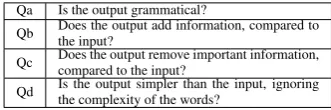
Qa addresses grammaticality, Qb and Qc cap-ture two complementary aspects of meaning preservation (the addition and the removal of in-formation) and Qd addresses structural simplicity. Possible answers are: 1 (“no”), 2 (“maybe”) and 3 (“yes”). Following Glavas and ˇStajner (2013), we used a 3 point Likert scale, which has recently been shown to be preferable over a 5 point scale through human studies on sentence compression (Toutanova et al.,2016).
Question Qd was accompanied by a negative example7showing a case of lexical simplification,
where a complex word is replaced by a simple one. A positive example was not included so as not to bias the annotators by revealing the nature of the operations our experiments focus on (i.e., splitting and deletion).
The PWKP test corpus (Zhu et al., 2010) was selected for our experiments over the development and test sets used in (Xu et al.,2016), as the lat-ter’s selection process was explicitly biased to-wards input-output pairs that mainly contain lex-ical simplifications.
Qa Is the output grammatical?
Qb Does the output add information, compared tothe input?
Qc Does the output remove important information,compared to the input?
Qd Is the output simpler than the input, ignoringthe complexity of the words?
Table 1: Questions for the human evaluation
6Each input-output pair was rated by all five annotators. 7Other questions appeared without any example.
5.2 Human Score Computation
Given the annotator’s answers, we consider the following scores. First, the grammaticality score
Gis the answer to Qa. By inverting (changing 1 to
3 and 3 to 1) the answer for Qb, we obtain a Non-Addition score indicating to which extent no addi-tional information has been added. Similarly, in-verting the answer to Qc yields the Non-Removal score. Averaging these two scores, we obtain the meaning preservation scoreP. Finally, the
struc-tural simplicity scoreSis the answer to Qd. Each of these scores is averaged over the five annotators. We further compute an average human score:
AvgHuman = 1
3(G+P+S)
5.3 Inter-annotator Agreement
Inter-annotator agreement rates are computed in two ways. Table 2 presents the absolute agree-ment and Cohen’s quadratic weighted κ (Cohen, 1968). Table 3 presents Spearman’s correlation (ρ) between the human ratings of the input-output
pairs (top row), and between the resulting system scores (bottom row). In both cases, the agreement between the five annotators is computed as the av-erage agreement over the 10 annotator pairs.
Qa Qb Qc Qd Total 0.58 (0.56) 0.74 (0.30) 0.53 (0.45) 0.57 (0.10)
TSM 0.59 (0.47) 0.75 (0.27) 0.50 (0.40) 0.43 (0.08)
RevILP 0.61 (0.59) 0.78 (0.27) 0.60 (0.43) 0.62 (0.11)
PBMT-R 0.47 (0.42) 0.70 (0.20) 0.58 (0.31) 0.76 (0.10)
Hybrid 0.59 (0.46) 0.77 (0.26) 0.52 (0.48) 0.72 (0.15)
UNSUP 0.51 (0.42) 0.59 (0.10) 0.45 (0.17) 0.52 (0.04)
Split-Deletion 0.59 (0.48) 0.93 (0.02) 0.45 (0.29) 0.55 (0.04)
Reference 0.70 (0.40) 0.66 (0.46) 0.52 (0.58) 0.41 (0.12)
Table 2: Inter-annotator absolute agreement (and quadratic weightedκ), averaged over the 10 annotator
pairs. Rows correspond to systems, columns to ques-tions. The top “Total” row refers to the concatenation of the outputs of all 6 systems together with the refer-ence sentrefer-ences.
Qa Qb Qc Qd AvgHuman
Sen. 0.63∗ 0.30∗ 0.48∗ 0.11∗∗ 0.49∗
[image:6.595.306.525.429.515.2]Sys. 0.92∗∗ 0.54 (0.1) 0.64 (0.06) 0.14 (0.4) 0.64 (0.06)
Table 3: Spearman’s correlation (andp-values) of the
system-level (top row) and sentence-level (bottom row) ratings of the five annotators.∗p <10−5,∗∗p= 0.002.
6 Experimental Setup
[image:6.595.97.263.645.700.2]UCCA annotation was carried out manually by a single expert UCCA annotator using the UC-CAApp annotation software (Abend et al.,2017), and according to the standard annotation guide-lines;8 (2) an automatic setting where the UCCA
annotation was carried out by the TUPA parser (Hershcovich et al., 2017). Sentence segmenta-tion of the outputs was carried out using the NLTK package (Loper and Bird,2002). For word align-ments, we used the aligner ofSultan et al.(2014).9
7 Correlation with Human Evaluation We compare the system rankings obtained by
SAMSA and by the four human parameters. We find that the two leading systems according to AvgHuman andSAMSAturn out to be the same: Split-Deletion and RevILP. This is the case both for the semi-automatic and the automatic imple-mentations of the metric. A Spearmanρ
correla-tion between the human andSAMSAscores (com-paring their rankings) is presented in Table4.
We compare SAMSA and SAMSAabl to the
reference-based measures SARI10 (Xu et al.,
2016) and BLEU, as well as to the negative Lev-enshtein distance to the reference (-LDSR). We
use the only available reference for this corpus, in accordance with the standard practice. SARI is a reference-based measure, based on n-gram overlap between the source, output and reference, and fo-cuses on lexical (rather than structural) simplifica-tion. For completeness, we include the other two measures reported inNarayan and Gardent(2016), which are measures of similarity to the input (i.e., they quantify the tendency of the systems to in-troduce changes to the input): the negative Lev-enshtein distances between the output and input compared to the original complex corpus (-LDSC),
and the number of sentences split by each of the systems.
The highest correlation with AvgHuman and grammaticality is obtained by semi-automatic
SAMSA(0.58 and 0.54), a high correlation espe-cially in comparison to the inter-annotator agree-ment on AvgHuman (0.64, Table 3). The auto-matic version obtains high correlation with hu-man judgments in these settings, where for
struc-8http://www.cs.huji.ac.il/˜oabend/ ucca.html
9https://github.com/ma-sultan/ monolingual-word-aligner
10Data and code for can be found inhttps://github. com/cocoxu/simplification.
tural simplicity, it scores somewhat higher than the semi-automaticSAMSA. The highest correlation with structural simplicity is obtained by the num-ber of sentences with splitting, where SAMSA
(automatic and semi-automatic) is second and third highest, although when restricted to multi-Scene sentences, the correlation for SAMSA
(semi-automatic) is higher (0.89, p = 0.009and 0.77,p= 0.04).
The highest correlation for meaning preserva-tion is obtained by SAMSAabl which provides
further evidence that the retainment of semantic structures is a strong predictor of meaning preser-vation (Sulem et al.,2015).SAMSAin itself does not correlate with meaning preservation, probably due to its penalization of under-splitting sentences. Note that the standard reference-based mea-sures for simplification, BLEU and SARI, obtain low and often negative correlation with human rat-ings. We believe that this is the case because SARI and BLEU admittedly focus on lexical simplifica-tion, and are difficult to use to rank systems which also perform structural simplification.
Our results thus suggest thatSAMSAprovides additional value in predicting the quality of a sim-plification system and should be reported in tan-dem with more lexically-oriented measures.
8 Discussion
Human evaluation parameters. The fact that the highest correlations for structural simplicity and meaning preservation are obtained by dif-ferent metrics (SAMSA and SAMSAabl
respec-tively) highlights the complementarity of these two parameters for evaluating TS quality but also the difficulty of capturing them together. Indeed, a given sentence-level operation could both change the original meaning by adding or removing infor-mation (affecting the P score) and increase
sim-plicity (S). On the other hand, the identity trans-formation perfectly preserves the meaning of the original sentence without making it simpler.
For examining this phenomenon, we compute Spearman’s correlation at the system-level be-tween the simplicity and meaning preservation hu-man scores. We obtain a correlation of -0.77 (p = 0.04) betweenSandP. The correlation be-tween S and the two sub-components of P, the
Reference-less Reference-based ∆from Source
SAMSA SAMSAabl BLEU SARI -LDSR -LDSC # Split Sents.
Semi-Auto. Auto. Semi-Auto. Auto.
G 0.54(0.1) 0.37 (0.2) 0.14 (0.4) 0.14 (0.4) 0.09 (0.4) -0.77 (0.04) -0.43 (0.2) -0.09 (0.4) 0.09 (0.4)
P -0.09 (0.4) -0.37 (0.2) 0.54(0.1) 0.54(0.1) 0.37 (0.2) -0.14 (0.4) 0.03 (0.5) 0.37 (0.2) -0.49 (0.2)
S 0.54 (0.1) 0.71 (0.06) -0.71 (0.06) -0.71 (0.06) -0.60 (0.1) -0.43 (0.2) -0.43 (0.2) -0.54 (0.1) 0.83(0.02)
[image:8.595.74.528.63.123.2]AvgHuman 0.58(0.1) 0.35 (0.1) 0.09 (0.2) 0.09 (0.2) 0.06 (0.5) -0.81 (0.02) -0.46 (0.2) -0.12 (0.4) 0.14 (0.4)
Table 4: Spearman’s correlation of system scores i.e. Pearson’s correlation of system rankings (andp-values),
between evaluation measures (columns) and human judgments (rows). The ranking is between the six simplifica-tion systems experimented with. The left block of columns corresponds to theSAMSAandSAMSAablmeasures, in their semi-automatic and automatic forms. The middle block of columns corresponds to the reference-based measures SARI and BLEU, as well as -LDSR, which is the negative Levenshtein distances of the system output from the reference. The right block corresponds to measures of conservatism, and reflect how well the tendency of the systems to introduce changes to the input correlates with the human rankings. The block includes -LDSC, the negative Levenshtein distance from the source sentence, and the number of input sentences split by each of the systems. Levenshtein distances are taken as negative in order to capture similarity between the output and source/reference. The measure with the highest correlation in each row is boldfaced.
of an average human score for assessing the over-all quality of the simplification.
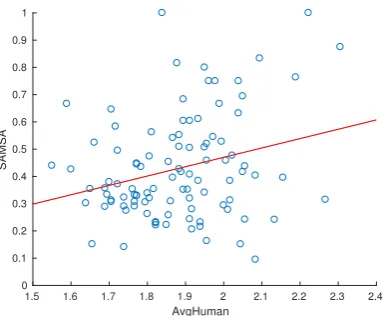
Distribution at the sentence level. In addition to the system-level analysis presented in Section 7, we also investigate the behavior ofSAMSA at the sentence level by examining its joint distribu-tion with the human evaluadistribu-tion scores. Focusing on the AvgHuman score and the automatic im-plementation ofSAMSAand using the same data as in Section7, we consider a single pair of scores (AvgHumani,SAMSAi), 1≤i≤100, for each
of the 100 source sentences, averaging over the
SAMSAand human scores obtained for the 6 sim-plification systems (See Figure1).
The joint distribution indicates a positive cor-relation betweenSAMSA andAvgHuman. The corresponding Pearson correlation is indeed 0.27 (p= 0.03).
9 Evaluation on the QATS Benchmark In order to provide further validation forSAMSA
predictive value for quality of simplification systems, we report SAMSA’s correlation with a recently proposed benchmark, used for the QATS (Quality Assessment for Text Simplifica-tion) shared task (ˇStajner et al.,2016).
Setup. The test corpus contains 126 sentences taken from 3 datasets described in ˇStajner et al. (2016)11: (1) EventS: original sentences from the
EMM News-Brief12 and their syntactically
sim-plified versions (with significant content reduc-tion) by the EventSimplify TS system (Glavas
11http://qats2016.github.io/shared.html 12emm.newsbrief.eu/NewsBrief/
clusteredition/en/latest.html
and ˇStajner,2013)13 (the test corpus contains 54
pairs from this dataset), (2) EncBrit: original sen-tences from the Encyclopedia Britannica (Barzilay and Elhadad,2003) and their automatic simplifica-tions obtained using ATS systems based on several phrase-based statistical MT systems (ˇStajner et al., 2015) trained on Wikipedia TS corpus (Coster and Kauchak, 2011) (24 pairs), and (3) LSLight: sentences from English Wikipedia and their auto-matic simplifications (Glavaˇs and ˇStajner, 2015) by three different lexical simplification systems (Biran et al.,2011;Horn et al., 2014;Glavaˇs and
ˇStajner,2015) (48 pairs).
Human evaluation is also provided by this re-source, with scores for overall quality, grammat-icality, meaning preservation and simplicity. Im-portantly, the simplicity score does not explicitly refer to the output’s structural simplicity, but rather to its readability. We focus on the overall human score, and compare it toSAMSA. Since different systems were used to simplify different portions of the input, correlation is taken at the sentence level. We use the same implementations ofSAMSA. Manual UCCA annotation is here performed by one of the authors of this paper.
Results. We follow ˇStajner et al. (2016) and report the Pearson correlations (at the sentence level) between the rankings of the metrics and the human evaluation scores. Results show that the semi-automatic/automatic SAMSA obtains a Pearson correlation of 0.32 and 0.28 with the hu-man scores. This places these measures in the 3rd and 4th places in the shared task, where the only two systems that surpassed it are marginally better, with scores of 0.33 and 0.34, and where the next
1.5 1.6 1.7 1.8 1.9 2 2.1 2.2 2.3 2.4
AvgHuman
0 0.1 0.2 0.3 0.4 0.5 0.6 0.7 0.8 0.9 1
[image:9.595.200.392.69.227.2]SAMSA
Figure 1: Joint distribution of the automaticSAMSAand theAvgHumanscores at the sentence level. Each point
in the graph corresponds to a single source sentence. In addition to the scatter plot, a least-squares regression line is presented.
system in QATS obtained a correlation of 0.23. This correlation by SAMSA was obtained in more restricted conditions, compared to the mea-sures that competed in QATS. First,SAMSA com-putes its score by only considering the UCCA structure of the source, and an automatic word-to-word alignment between the source and out-put. Most QATS systems, including OSVCML and OSVCML2 (Nisioi and Nauze, 2016) which scored highest on the shared task, use an ensem-ble of classifiers based on bag-of-words, POS tags, sentiment information, negation, readability mea-sures and other resources. Second, the systems participating in the shared task had training data available to them, annotated by the same anno-tators as the test data. This was used to train classifiers for predicting their score. This gives the QATS measures much predictive strength, but hampers their interpretability. SAMSA on the other hand is conceptually simple and inter-pretable. Third, the QATS shared task does not focus on structural simplification, but experiments on different types of systems. Indeed, some of the data was annotated by systems that exclusively perform lexical simplification, which is orthogo-nal toSAMSA’s structural focus.
Given these factors,SAMSA’s competitive cor-relation with the participating systems in QATS suggests that structural simplicity, as reflected by the correct splitting of UCCA Scenes, captures a major component in overall simplification qual-ity, underscoringSAMSA’s value. These promis-ing results also motivate a future combination of SAMSA with classifier-based metrics.
10 Conclusion
We presented the first structure-aware metric for text simplification,SAMSA, and the first evalua-tion experiments that directly target the structural simplification component, separately from the lex-ical component. We argue that the structural and lexical dimensions of simplification are loosely re-lated, and that TS evaluation protocols should as-sess both. We empirically demonstrate that strong measures that assess lexical simplification quality (notably SARI), fail to correlate with human judg-ments when structural simplification is performed by the evaluated systems. Our experiments show that SAMSA correlates well with human judg-ments in such settings, which demonstrates its use-fulness for evaluating and tuning statistical sim-plification systems, and shows that structural eval-uation provides a complementary perspective on simplification quality.
Acknowledgments
References
Omri Abend and Ari Rappoport. 2013.Universal Con-ceptual Cognitive Annotation (UCCA). In Proc. of ACL-13. pages 228–238. http://aclweb. org/anthology/P/P13/P13-1023.pdf.
Omri Abend and Ari Rappoport. 2017. The state of the art in semantic representation. In Proc. of ACL’17. pages 77–89. http://aclweb.org/ anthology/P/P17/P17-1008.pdf.
Omri Abend, Shai Yerushalmi, and Ari Rap-poport. 2017. UCCAApp: Web-application for syntactic and semantic phrase-based annota-tion. InProc. of ACL’17, System Demonstrations. pages 109–114. http://www.aclweb.org/ anthology/P17-4019.
Laura Banarescu, Claire Bonial, Shu Cai, Madalina Georgescu, Kira Griffitt, Ulf Hermjakob, Kevin Knight, Philipp Koehn, Martha Palmer, and Nathan Schneider. 2013. Abstract Meaning Rrepresen-tation for sembanking. Proc. of Linguistic An-notation Workshop and Interoperability with Dis-coursepages 178–186. http://aclweb.org/ anthology/W/W13/W13-2322.pdf.
Regina Barzilay and Noemie Elhadad. 2003. Sen-tence alignment for monolingual comparable cor-pora. In Proc. of EMNLP’03. pages 25– 32.http://www.aclweb.org/anthology/ W/W03/W03-1004.pdf.
Or Biran, Samuel Brody, and No´emie Elhadad. 2011. Putting it simply: a context-aware approach to lex-ical simplification. InProc. of ACL’11. pages 465– 501. http://aclweb.org/anthology/P/ P11/P11-2087.pdf.
Alexandra Birch, Omri Abend, Ondˇrej Bojar, and Barry Haddow. 2016. HUME: Human UCCA-based evaluation of machine transla-tion. In Proc. of EMNLP’16. pages 1264–1274. http://aclweb.org/anthology/D/D16/ D16-1134.pdf.
Yvonne Margaret Canning. 2002. Syntactic simplifica-tion of text. Ph.D. thesis, University of Sunderland, UK.
Raman Chandrasekar, Christine Doran, and Banga-lore Srinivas. 1996. Motivations and methods for sentence simplification. In Proc. of COL-ING’96. pages 1041–1044. http://aclweb. org/anthology/C/C96/C96-2183.pdf.
Leshem Choshen and Omri Abend. 2018. Reference-less measure of faithfulness for grammatical error correction. In Proc. of NAACL’18 (Short papers). To appear.
James Clarke and Mirella Lapata. 2006. Models for sentence compression: A comparison across do-mains, training requirements and evaluation mea-sures. In Proc. of ACL-COLING’06. pages 377–
384. http://aclweb.org/anthology/P/ P06/P06-1048.pdf.
Jacob Cohen. 1968. Weighted kappa: Nominal scale agreement provision for scaled disagreement or par-tial credit.Psychological bulletin70(4):213.
William Coster and David Kauchak. 2011. Sim-ple English Wikipedia: A new text simplifica-tion task. In Proc. of ACL’11. pages 665– 669. http://aclweb.org/anthology/P/ P11/P11-2117.pdf.
Michael Denkowski and Alon Lavie. 2011. Meteor 1.3: Automatic metric for reliable optimization and evaluation of machine translation systems. InProc. of WMT’11. pages 85–91. http://aclweb. org/anthology/W/W11/W11-2107.pdf.
Robert M.W. Dixon. 2010a. Basic Linguistic Theory: Grammatical Topics, volume 2. Oxford University Press.
Robert M.W. Dixon. 2010b. Basic Linguistic Theory: Methodology, volume 1. Oxford University Press.
Robert M.W. Dixon. 2012. Basic Linguistic Theory: Further Grammatical Topics, volume 3. Oxford University Press.
Goran Glavas and Sanja ˇStajner. 2013. Event-centered simplification of news stories. InProc. of the Stu-dent Research Workshop associated with RANLP 2013. pages 71–78. http://aclweb.org/ anthology/R13-2011.
Goran Glavaˇs and Sanja ˇStajner. 2015. Simplifying lexical simplification: Do we need simplified cor-pora? InProc. of ACL’15 (Short papers). pages 63– 68.http://www.aclweb.org/anthology/ P15-2011.
Daniel Hershcovich, Omri Abend, and Ari Rappoport. 2017. A transition-based directed acyclic graph parser for UCCA. InProc. of ACL’17. pages 1127– 1138. http://aclweb.org/anthology/P/ P17/P17-1104.pdf.
Colby Horn, Cathryn Manduca, and David Kauchak. 2014.Learning a lexical simplifier using Wikipedia. In Proc. of ACL’14 (Short papers). pages 458– 463. http://aclweb.org/anthology/P/ P14/P14-2075.pdf.
William Hwang, Hannaneh Hajishirzi, Mari Ostendorf, and Wei Wu. 2015. Aligning sentences from Stan-dard Wikipedia to Simple Wikipedia. In Proc. of NAACL’15. pages 211–217. http://aclweb. org/anthology/N/N15/N15-1022.pdf.
Hans Kamp. 1981. A theory of truth and seman-tic representation. In J.A.G. Groenendijk, T.M.V. Jassen, B.J. Stokhof, and M.J.B/ Stokhof, editors,
J. Peter Kincaid, Robert P. Fishburne Jr., Richard L. Rogers, and Brad S. Chissom. 1975. Derivation of new readability formulas (automated readability in-dex, fog count and Flesch reading ease formula) for Navy enlisted personnel. Technical report, DTIC Document.
Ronald W. Langacker. 2008. Cognitive Grammar: A Basic Introduction. Oxford University Press, USA.
Chi-kiu Lo, Meriem Beloucif, Markus Saers, and Dekai Wu. 2014. XMEANT: Better seman-tic mt evaluation without reference translations. In Proc. of ACL’14 (Short Papers). pages 765– 771. http://aclweb.org/anthology/P/ P14/P14-2124.pdf.
Chi-kiu Lo, Anand Karthik Tumuluru, and Dekai Wu. 2012. Fully automatic semantic MT eval-uation. In Proc. of WMT’12. pages 243– 252. http://aclweb.org/anthology/W/ W12/W12-3129.pdf.
Edward Loper and Steven Bird. 2002. NLTK: the natural language toolkit. In Proc. of EMNLP’02. pages 63–70. http://www.aclweb.org/ anthology/W/W02/W02-0109.pdf.
Kshitij Mishra, Ankush Soni, Rahul Sharma, and Dipti Misra Sharma. 2014. Exploring the effects of sentence simplification on Hindi to English Ma-chine Translation systems. In Proc. of the Work-shop on Automatic Text Simplification: Methods and Applications in the Multilingual Society. pages 21– 29.http://www.aclweb.org/anthology/ W14-5603.
Shashi Narayan and Claire Gardent. 2014. Hy-brid simplification using deep semantics and ma-chine translation. InProc. of ACL14. pages 435– 445. http://aclweb.org/anthology/P/ P14/P14-1041.pdf.
Shashi Narayan and Claire Gardent. 2016. Un-supervised sentence simplification using deep se-mantics. In Proc. of INLG’16. pages 111– 120. http://aclweb.org/anthology/W/ W16/W16-6620.pdf.
Shashi Narayan, Claire Gardent, Shay B. Cohen, and Anastasia Shimorina. 2017. Split and rephrase. In Proc. of EMNLP’17. pages 617– 627. http://aclweb.org/anthology/D/ D17/D17-1065.pdf.
Christina Niklaus, Bernahard Bermeitinger, Siegfried Handschuh, and Andr´e Freitas. 2016. A sentence simplification system for improving relation extrac-tion. InProc. of COLING’16. http://aclweb. org/anthology/C/C16/C16-2036.pdf.
Sergiu Nisioi and Fabrice Nauze. 2016. An ensemble method for quality assessment of text simplification. InWorkshop on Quality Assessment for Text Simpli-fication (QATS).
Kishore Papineni, Salim Roukos, Todd Ward, and Wei-Jing Zhu. 2002. BLEU: a method for auto-matic evaluation of machine translation. In Proc. of ACL’02. pages 311–318. http://aclweb. org/anthology/P/P02/P02-1040.pdf. Luz Rello, Ricardo Baeza-Yates, Stefan Bott, and
Ho-racio Saggion. 2013. Simplify or help?: text simpli-fication strategies for people with dyslexia. InProc. of the 10th International Cross-Disciplinary Confer-ence on Web Accesibility. pages 15:1 – 15:10. Miguel Rios, Wilker Aziz, and Lucia Specia. 2011.
TINE: A metric to assess MT adequacy. InProc. of WMT’11. pages 116–122. http://aclweb. org/anthology/W/W11/W11-2112.pdf. Advaith Siddharthan. 2002. An architecture for a text
simplification system. In Proc. of LEC. pages 64– 71.
Advaith Siddharthan and M. A. Angrosh. 2014.Hybrid text simplification using synchronous dependency grammars with hand-written and automatically har-vested rules. In Proc. of EACL’14. pages 722– 731. http://aclweb.org/anthology/E/ E14/E14-1076.pdf.
Matthew Snover, Nitin Madnani, Bonnie J. Dorr, and Richard Schwartz. 2009. Fluency, adequacy, or HTER? Exploring different human judgments with a tunable MT metric. InProc. of WMT’09. pages 85– 91.http://www.aclweb.org/anthology/ W09-0441.
Elior Sulem, Omri Abend, and Ari Rappoport. 2015. Conceptual annotations preserve structure across translations. In Proc. of 1st Workshop on Semantics-Driven Statistical Machine Translation (S2Mt 2015). pages 11–22. http://aclweb. org/anthology/W/W15/W15-3502.pdf. Md Arafat Sultan, Steven Bethard, and Tamara
Sum-ner. 2014. Back to basics for monolingual align-ment: Exploiting word similarity and contextual ev-idence. TACL 2:219–230. http://aclweb. org/anthology/Q/Q14/Q14-1018.pdf. Hong Sun and Ming Zhou. 2012. Joint
learn-ing of a dual SMT system for paraphrase gen-eration. In Proc. of ACL’12. pages 38– 42. http://aclweb.org/anthology/P/ P12/P12-2008.pdf.
Kristina Toutanova, Chris Brockett, Ke M. Tran, and Saleema Amershi. 2016. A dataset and evaluation metrics for abstractive compression of sentences and short paragraphs. In Proc. of EMNLP’16. pages 340–350. http://aclweb. org/anthology/D/D16/D16-1033.pdf. Sanja ˇStajner, Hannah Bechara, and Horacio Saggion.
Sanja ˇStajner, Ruslan Mitkov, and Horacio Saggion. 2014. One step closer to automatic evaluation of text simplification systems. Proc. of the 3rd Workshop on Predicting and Improving Text Readability for Target Reader Populationspages 1–10. http:// www.aclweb.org/anthology/W14-1201.
Sanja ˇStajner, Maja Popovi´c, Horacio Saggion, Lu-cia SpeLu-cia, and Mark Fishel. 2016. Shared task on quality assessment for text simplification. In Work-shop on Quality Assessment for Text Simplification (QATS).
Kristian Woodsend and Mirella Lapata. 2011. Learn-ing to simplify sentences with quasi-synchronous grammar and integer programming. In Proc. of EMNLP’11. pages 409–420. http://aclweb. org/anthology/D/D11/D11-1038.pdf.
Sander Wubben, Antal van den Bosch, and Emiel Krahmer. 2012. Sentence simplification by mono-lingual machine translation. In Proc. of ACL’12. pages 1015–1024. http://aclweb.org/ anthology/P/P12/P12-1107.pdf.
Wei Xu, Chris Callison-Burch, and Courtney Napoles. 2015. Problems in current text simplification research: new data can help. TACL 3:283– 297. http://aclweb.org/anthology/Q/ Q15/Q15-1021.pdf.
Wei Xu, Courtney Napoles, Ellie Pavlick, Quanze Chen, and Chris Callison-Burch. 2016. Optimiz-ing statistical machine translation for text simplifica-tion. TACL4:401–415. http://aclweb.org/ anthology/Q/Q16/Q16-1029.pdf.