Proceedings of NAACL-HLT 2018, pages 346–351
Improve Neural Entity Recognition via Multi-Task Data Selection and
Constrained Decoding
Huasha Zhao1, Yi Yang1,2∗
, Qiong Zhang1, and Luo Si1 1Alibaba Group, San Mateo, CA
{huasha.zhao, qz.zhang, luo.si}@alibaba-inc.com
2Nanjing University, Nanjing, Jiangsu, China
Abstract
Entity recognition is a widely benchmarked task in natural language processing due to its massive applications. The state-of-the-art solution applies a neural architecture named BiLSTM-CRF to model the language se-quences. In this paper, we propose an entity recognition system that improves this neural architecture with two novel techniques. The first technique is Multi-Task Data Selection, which ensures the consistency of data distri-bution and labeling guidelines between source and target datasets. The other one is con-strained decoding using knowledge base. The decoder of the model operates at the docu-ment level, and leverages global and external information sources to further improve perfor-mance. Extensive experiments have been con-ducted to show the advantages of each tech-nique. Our system achieves state-of-the-art re-sults on the English entity recognition task in KBP 2017 official evaluation, and it also yields very strong results in other languages.
1 Introduction
Entity Recognition (ER) is a fundamental task in Natural Language Processing (NLP). The task in-cludes named entity recognition and nominal en-tity recognition. ER is the building blocks for higher level applications such as natural language understanding, question answering, machine read-ing comprehension, etc. They are usually treated as sequence labeling problems. Although the topics have been studied extensively for the past several decades, development of neural network and deep learning based methods in recent years (Lample et al., 2016; Ma and Hovy, 2016; Yang et al., 2017; Kenton Lee and Zettlemoyer, 2017;
Xinchi Chen, 2017) significantly improves the previous state-of-the-art.
∗ Work was done while doing internship at Alibaba.
A popular neural architecture for ER is BiLSTM-CRF (Lample et al., 2016). The archi-tecture has been shown to achieve best perfor-mance on many sequence labeling tasks. In ad-dition, the architecture can be easily extended to model different sources of training data. In real world applications, it is important to include exter-nal data sources for model training, because using only domain-specific data for training is usually not enough to achieve best performance. For ex-ample, in the case of KBP 2016 tracks, both the 1stand the 2ndteams (ranking in theNERC evalu-ation) use external data source (Liu et al., 2016;
Xu et al., 2017) for model training. The chal-lenge here is to transfer knowledge from external data source to target data source. Multi-Task (MT) BiLSTM-CRF architecture (Yang et al.,2017) is designed for this knowledge transfer.
In this work, we develop an ER model based on the MT BiLSTM-CRF architecture, with ad-ditional entity embeddings and domain adaption. Two novel methods are proposed to further im-prove the model performance.
Multi-Task Data Selection
To ensure homogeneity between source and target training data, adaptive training data selection is ap-plied to source data during multi-task learning, to filter out instances with different distribution and misaligned annotation guideline. Data selection is interleaved with model training iteratively, and this training process terminates until convergence.
Constrained Decoding using Knowledge Base
Knowledge-based constraints are enforced at de-coding time. The goal is to capture document level contexts given those knowledge. For example, a phrase is likely to be an entity if it is detected in another sentence in the same document. It also helps detect related mentions, such as the mention
Embeddings BiLSTM
CRF
Embeddings BiLSTM FC Layer
CRF CRF
Domain Adaption
Source Target
(a) (b)
[image:2.595.80.288.71.155.2]FC Layer FC Layer
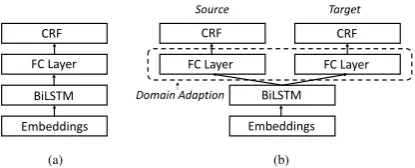
Figure 1: Neural architectures for mention detection and classification. a) Single-task model. b) Multi-task model with domain adaptions.
apple is more likely to be a ORG when it occurs in the same discussion forum withApple Inc.
2 Related Works
There are many works in literature applying neu-ral networks to ER problems (Lample et al.,2016;
Ma and Hovy,2016;Yang et al.,2017;Peng and Dredze, 2016). The baseline model of this work is mostly closed to (Yang et al.,2017). However, we introduce additional channel in the embedding layer(Peng and Dredze,2016).
The idea of multi-task data selection is derived from topics of data selection (Moore and Lewis,
2010) and instance weighting (Jiang and Zhai,
2007) from the transfer learning community. Dif-ferent from previous work, we propose an adaptive selection approach interleaved with MT BiLSTM-CRF model training. Decoding with global con-straints has been studied in (Yarowsky,1993; Kr-ishnan and Manning,2006). Here we share simi-lar ideas with previous work, but explore the use of external knowledge base (Radford et al.,2015) as constraints.
3 Approach
This section describes the baseline model used for the ER task. We first describe a slight variant of BiLSTM-CRF and its MT version for transfer learning. For the sake of brevity, discussions of the basis theory of MT learning are skipped and more details can be found in (Zhang and Yang,
2017). Then we present in details how data selec-tion and constrained decoding are applied to fur-ther improve the model performance.
3.1 BiLSTM-CRF
BiLSTM-CRF is a widely adopted neural archi-tecture for sequence labeling problems including ER. BiLSTM-CRF is a hierarchical model and the architecture is illustrated in Figure1(a).
The first layer of the model maps words to their embeddings. Let x = (x1,· · ·, xn)
de-note a sentence composed of n words in a se-quence, withx0isas their word/character embed-ding combinations. In the second layer, word em-beddings are encoded using a bidirectional-LSTM network, and the output is h = (h1,· · · , hn),
whereht = BiLST M(x, t). The encodings are
further passed to a fully connection network, to compute CRF featuresφ(x) = G·h, and finally objective to optimize is the CRF likelihood defined as the following,
p(y|x;θ) =
Qn
i=1exp(θ·f(yi−1, yi, φ(x)))
Z ,
where yare predicted labels andZ is the nor-malizing constant.
3.1.1 Entity Embeddings
We extend the BiLSTM-CRF model by adding en-tity embedding channel to the embedding layer. As a result, xi is the concatenation of word
bedding, character embedding and its entity em-bedding, xi = [ωi, ci, gi]. Entity embeddings
are derived from a noisy gazetteer created using Wikipedia articles. The gazetteer is derived from the word-entity statistics from (Pan et al., 2017). More specifically, each coordinate of the entity embedding is the probability distribution of a word occurring as the corresponding entity type.
3.1.2 Domain Adaption
To explore external datasets, we apply MT BiLSTM-CRF with domain adaptions, as illus-trated in Figure1(b). The fully connection layer are adapted to different datasets. The CRF features are computed separately, i.e. φT(x) = GT ·h, φS(x) = GS ·h for target and source dataset respectively. The loss function p(y|x;θT) and p(y|x;θS)are optimized in alternating order.
3.2 Multi-task Data Selection
Multi-task training can alleviate some of the prob-lem caused by data heterogeneity between target and source. This section presents an adaptive data selection algorithm during multi-task training that further removes noisy data from source dataset.
Algorithm 1Multi-task Data Selection
Input: Target training dataset(x,y) ∈ T, source training dataset(x0,y0)∈ S.
Initialize: Strain ← S; XS = {x0 : (x0,y0) ∈ S}.
Repeat:
1. Train the model for one iteration, by opti-mizing the following instance weighted object function,
J = X
(x,y)∈T
p(y|x;θT)+ X
(x0,y0)∈Strain
p(y0|x0;θS);
2. Compute consistency score for each training example inS,
s(x) = max
i X
j
p(xi =j) logp(xi =j)
q(xi =j)
,
wherep(xi)∼sof tmax(φT(xi))and
q(xi)∼sof tmax(φS(xi)));
3. ConstructSsame,Sdif f by the following, Ssame={x∈ XS :s(x)< α}and Sdif f ={x∈ XS :s(x)> β};
Thresholds α andβ are manually set that de-termine the selection/exclusion of a data point. 4. Update source training setStrain,
Strain ← Strain∪ Ssame\ Sdif f.
In the new training set, data with different dis-tributions are eliminated.
Until:|Sdif f|< k
Return: the final BiLSTM-CRF model.
based on aconsistency score, which measures the similarity between target and source data distri-bution. Specifically, the consistency score is de-rived from the KL divergence betweenφT(x)and φS(x)for every word in the sentence in the source training data. According to step 4, data that are notconsistentwith the target are eliminated from the training dataset. The iterations terminate un-til there is few additional data to filter out, up to a manually-tuned threshold.
3.3 Constrained Decoding using Knowledge Base
It has been well studied that non-local informa-tion can be used to help improve entity recogni-tion performance (Radford et al.,2015) (Krishnan
and Manning,2006). Here we describe a globally constrained decoding (Graves et al.,2012) method used in our model. In particular, we use external knowledge information to guide the decoding pro-cess at the document level.
3.3.1 Knowledge Base
An external knowledge base is built from Wikipedia articles (Radford et al., 2015) (Dalton et al., 2014). For each Wikipedia entity, we first extract all its aliases from the redirects, and then build a cluster of the mentions for the this entity which includes all its aliases. Our goal is that given a document mentionsMicrosoft, the knowl-edge base can help identify the other mentions such asMS Corp. The knowledge base can be nat-urally extended to include related entities (using anchor texts), instead of only aliases of the same entity, in the cluster; we leave this to the future works.
Then we apply global decoding with constraint C, such that all mentions that belong to the same cluster should be labeled as the same entity type within a single document,
y1:N = argmax
C
p(y1:N|x1:N;θ),
where subscripts 1 : N are indices of sentences within the same document. We use a greedy algo-rithm for decoding.
4 Experiments
This section presents experiments results of our methods on the KBP 2016 and 2017 evaluation datasets. We focus on Engilsh (ENG) and Man-darin Chinese (CMN) ER tasks, which include both named entity recognition (NAM) and nom-inal entity recognition (NOM). The neural models are implemented using Tensorflow (Abadi et al.,
2016). Dropout and gradient clipping are applied when necessary to avoid numerical issues during training. Performance numbers are reported using theNERCF1score as defined in (Ji et al.,2016).
4.1 Datasets
Method NAM NOM Overall
baseline (ENG) 0.809 0.587 0.748
+ EE (ENG) 0.842 0.587 0.770
baseline (CMN) 0.822 0.305 0.727
[image:4.595.78.285.62.134.2]+ EE (CMN) 0.851 0.305 0.752
Table 1: Effectiveness of additional entity embeddings (EE) in model embedding layer.
(Song et al., 2015) entity annotations as source datasets. It is worth noting that annotation guide-lines are different from one dataset to another, es-pecially for nominal entity annotations.
4.2 Baseline
The baseline is a BiLSTM-CRF model with word and character embeddings which simply combines source and target data as training data. GloVe vec-tors (Pennington et al.,2014) are used as word em-beddings. NAM and NOM models are trained sep-arately with individually tuned parameters.
4.3 Results
First, we examine the performance impact of en-tity embedding. As shown in Table1, entity em-bedding is very useful for both NAM and NOM prediction tasks, and for both languages. It pro-vides an overall performance improvement of 2.2 F1 points. Since the entity embeddings are
de-rived from soft gazetteer features, this experiment confirms again the usefulness of gazetteer even in neural network models. In theory, the entity em-beddings should have been already captured by the model itself; the additional predictability of the entity embeddings actually comes from the exter-nal dataset (Wikipedia) where the embeddings are derived from.
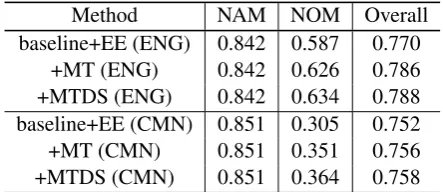
Next the effectiveness of Multi-Task Data Se-lection is evaluated. Results in Table2show that both MT and MTDS can significantly improve NOM detection over the baseline, and adaptive data selection in MTDS further improves over the MT model. However, there is no gain at all for NAM detection for both languages. We manually evaluate the source and target datasets, and find that the annotation guideline and data distribution of NAM data are quite the similar while there are some significant differences for NOM data. No-tably, many of the plural form nouns are marked as nominal entities in the ACE dataset while in our target KBP tasks plural nouns are not labeled as
Method NAM NOM Overall
baseline+EE (ENG) 0.842 0.587 0.770
+MT (ENG) 0.842 0.626 0.786
+MTDS (ENG) 0.842 0.634 0.788
baseline+EE (CMN) 0.851 0.305 0.752
+MT (CMN) 0.851 0.351 0.756
+MTDS (CMN) 0.851 0.364 0.758
Table 2: Effectiveness of Multi-Task Data Selection (MTDS).
entities in general.
Table 3 presents the performance impact of knowledge based constrained decoding. It is worth noting that the performance gain in the Chinese language is more limited in comparison with En-glish. The primary reason behind this is that the English Wikipedia site is more comprehen-sive than its Chinese counterpart. Constrained de-coding does not change the NOM performance because only name mentions are included in the knowledge base.
Method NAM NOM Overall
baseline+EE (ENG) 0.842 0.587 0.770
+CD (ENG) 0.851 0.587 0.778
baseline+EE (CMN) 0.851 0.305 0.752
+CD (CMN) 0.855 0.305 0.754
Table 3: Effectiveness of Constrained Decoding (CD) using Knowledge Base.
[image:4.595.305.527.63.159.2]Year/Language Our F1 Best F1
2016/ENG 0.804 0.772
2017/ENG
(Official evaluation) 0.811 0.811
[image:5.595.86.277.62.134.2]2017/CMN 0.769 0.780
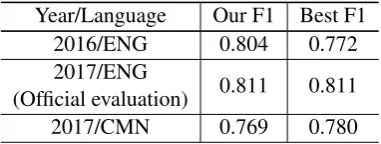
Table 4: Performance comparison between 2016 and 2017 datasets.
5 Conclusion and Future Works
This paper presents novel methods to improve neural entity recognition tasks. Multi-task data selection removes noise from training data, while constrained decoding further improves the model by exploiting global and external information sources. Extensive experiments show the effec-tiveness of the methods. Work needs to be done to justify in theoretic foundation the adaptive data selection algorithm. Furthermore, runtime and computational complexity of the system should be studied. We also plan to extend the knowledge base cluster to include related entities.
References
Mart´ın Abadi, Paul Barham, Jianmin Chen, Zhifeng Chen, Andy Davis, Jeffrey Dean, Matthieu Devin, Sanjay Ghemawat, Geoffrey Irving, Michael Isard, et al. 2016. Tensorflow: A system for large-scale machine learning. InOSDI. volume 16, pages 265– 283.
Jeffrey Dalton, Laura Dietz, and James Allan. 2014. Entity query feature expansion using knowledge base links. InProceedings of the 37th international ACM SIGIR conference on Research & development in information retrieval. ACM, pages 365–374. Alex Graves et al. 2012. Supervised sequence
la-belling with recurrent neural networks, volume 385. Springer.
Heng Ji, Joel Nothman, Hoa Trang Dang, and Syd-ney Informatics Hub. 2016. Overview of tac-kbp2016 tri-lingual edl and its impact on end-to-end cold-start kbp. Proceedings of TAC.
Heng Ji, Xiaoman Pan, Boliang Zhang, Joel Nothman, James Mayfield, Paul McNamee, and Cash Costello. 2017. Overview of tac-kbp2017 13 languages entity discovery and linking. Proceedings of TAC. Jing Jiang and ChengXiang Zhai. 2007. Instance
weighting for domain adaptation in nlp. In ACL. volume 7, pages 264–271.
Luheng He Mike Lewis Kenton Lee and Luke Zettle-moyer. 2017. End-to-end neural coreference resolu-tion. InEMNLP. pages 188–197.
Vijay Krishnan and Christopher D Manning. 2006. An effective two-stage model for exploiting non-local dependencies in named entity recognition. In
Proceedings of the 21st International Conference on Computational Linguistics and the 44th annual meeting of the Association for Computational Lin-guistics. Association for Computational Linguistics, pages 1121–1128.
Guillaume Lample, Miguel Ballesteros, Sandeep Sub-ramanian, Kazuya Kawakami, and Chris Dyer. 2016. Neural architectures for named entity recognition.
arXiv preprint arXiv:1603.01360.
Dan Liu, Wei Lin, Shiliang Zhang, Si Wei, and Hui Jiang. 2016. The ustc nelslip systems for trilingual entity detection and linking tasks at tac kbp 2016 .
Xuezhe Ma and Eduard Hovy. 2016. End-to-end sequence labeling via bi-directional lstm-cnns-crf.
arXiv preprint arXiv:1603.01354.
Robert C Moore and William Lewis. 2010. Intelligent selection of language model training data. In Pro-ceedings of the ACL 2010 conference short papers. Association for Computational Linguistics, pages 220–224.
Xiaoman Pan, Boliang Zhang, Jonathan May, Joel Nothman, Kevin Knight, and Heng Ji. 2017. Cross-lingual name tagging and linking for 282 languages. InACL.
Nanyun Peng and Mark Dredze. 2016. Multi-task multi-domain representation learning for sequence tagging.arXiv preprint arXiv:1608.02689.
Jeffrey Pennington, Richard Socher, and Christopher Manning. 2014. Glove: Global vectors for word representation. InProceedings of the 2014 confer-ence on empirical methods in natural language pro-cessing (EMNLP). pages 1532–1543.
Will Radford, Xavier Carreras, and James Henderson. 2015. Named entity recognition with document-specific kb tag gazetteers. In EMNLP. pages 512– 517.
Zhiyi Song, Ann Bies, Stephanie Strassel, Tom Riese, Justin Mott, Joe Ellis, Jonathan Wright, Seth Kulick, Neville Ryant, and Xiaoyi Ma. 2015. From light to rich ere: annotation of entities, relations, and events. InProceedings of the 3rd Workshop on EVENTS at the NAACL-HLT. pages 89–98.
Christopher Walker, Stephanie Strassel, Julie Medero, and Kazuaki Maeda. 2006. Ace 2005 multilin-gual training corpus. Linguistic Data Consortium, Philadelphia57.
Mingbin Xu, Hui Jiang, and Sedtawut Watcharawit-tayakul. 2017. A local detection approach for named entity recognition and mention detection. In Pro-ceedings of the 55th Annual Meeting of the Associa-tion for ComputaAssocia-tional Linguistics (Volume 1: Long Papers). volume 1, pages 1237–1247.
Zhilin Yang, Ruslan Salakhutdinov, and William W Cohen. 2017. Transfer learning for sequence tag-ging with hierarchical recurrent networks. ICLR.
David Yarowsky. 1993. One sense per colloca-tion. Technical report, PENNSYLVANIA UNIV PHILADELPHIA DEPT OF COMPUTER AND INFORMATION SCIENCE.