Proceedings of NAACL-HLT 2018, pages 252–262
Looking Beyond the Surface:
A Challenge Set for Reading Comprehension over Multiple Sentences
Daniel Khashabi1, Snigdha Chaturvedi2, Michael Roth3, Shyam Upadhyay1, Dan Roth1 1University of Pennsylvania, 2University of California, Santa Cruz, 3Saarland University
{danielkh,shyamupa,danroth}@cis.upenn.edu, [email protected], [email protected]
Abstract
We present a reading comprehension chal-lenge in which questions can only be answered by taking into account information from mul-tiple sentences. We solicit and verify ques-tions and answers for this challenge through a 4-step crowdsourcing experiment. Our chal-lenge dataset contains∼6kquestions for+800 paragraphs across 7 different domains (ele-mentary school science, news, travel guides, fiction stories, etc) bringing in linguistic diver-sity to the texts and to the questions wordings. On a subset of our dataset, we found human solvers to achieve an F1-score of86.4%. We analyze a range of baselines, including a re-cent state-of-art reading comprehension sys-tem, and demonstrate the difficulty of this challenge, despite a high human performance. The dataset is the first to study multi-sentence inference at scale, with an open-ended set of question types that requires reasoning skills.
1 Introduction
Machine Comprehension of natural language text is a fundamental challenge in AI and it has re-ceived significant attention throughout the his-tory of AI (Greene, 1959; McCarthy, 1976; Re-iter, 1976; Winograd, 1980). In particular, in natural language processing (NLP) it has been studied under various settings, such as multiple-choice Question-Answering (QA) (Green Jr. et al.,
1961), Reading Comprehension (RC) (Hirschman et al., 1999), Recognizing Textual Entailment (RTE) (Dagan et al., 2013) etc. The area has seen rapidly increasing interest, thanks to the existence of sizable datasets and standard benchmarks. CNN/Daily Mail (Hermann et al.,
2015), SQuAD (Rajpurkar et al., 2016) and NewsQA (Trischler et al., 2016) to name a few, are some of the datasets that were released re-cently with the goal of facilitating research in ma-chine comprehension. Despite all the excitement
fueled by that large data sets and the ability to directly train statistical learning models, current QA systems do not have capabilities comparable to elementary school or younger children (Clark and Etzioni, 2016). For many of these datasets, researchers point out that models neither need to ‘comprehend’ in order to correctly predict an answer, nor do they learn to ‘reason’ in a way that generalizes across datasets. For example,
Khashabi et al.(2016) showed that adversarial per-turbation in candidate answers results in a signifi-cant drop in performance of a few state-of-art sci-ence QA systems. Similarly,Jia and Liang(2017) show that adding an adversarially selected sen-tence to the instances in the SQuAD datasets dras-tically reduces the performance of many of the ex-isting baselines.Chen et al.(2016) show that in the CNN/Daily Mail datasets, “the required reasoning and inference level . . . is quite simple” and that a relatively simple algorithm can get almost close to the upper-bound. We believe that one key reason that simple algorithms can deal with the existing large datasets but, nevertheless, fail at generaliza-tion, is that the datasets do not actually require a deep understanding.
We propose to address this shortcoming by de-veloping a reading comprehension challenge in which answering each of the questions requires reasoning over multiple sentences.
There is evidence that answering ‘single-sentence questions’, i.e. questions that can be an-swered from a single sentence of the given para-graph, is easier than answering multi-sentence questions’, which require multiple sentences to answer a given question. For example, Richard-son et al.(2013) released a reading comprehension dataset that contained both single-sentence and multi-sentence questions; models proposed for this task yielded considerably better performance on the single-sentence questions than on the
sentence questions (according toNarasimhan and Barzilay (2015) accuracy of about83% and60% on these two types of questions, respectively).
There could be multiple reasons for this. First, multi-sentence reasoning seems to be inherently a difficult task. Research has shown that while complete-sentence construction emerges as early as first grade for many children, their ability to integrate sentences emerges only in fourth grade (Berninger et al.,2011). Answering multi-sentence questions might be more challenging for an automated system because it involves more than just processing individual sentences but rather combining linguistic, semantic and back-ground knowledge across sentences—a computa-tional challenges in itself. Despite these chal-lenges, multi-sentence questions can be answered by humans and hence present an interesting yet reasonable goal for AI systems (Davis,2014).
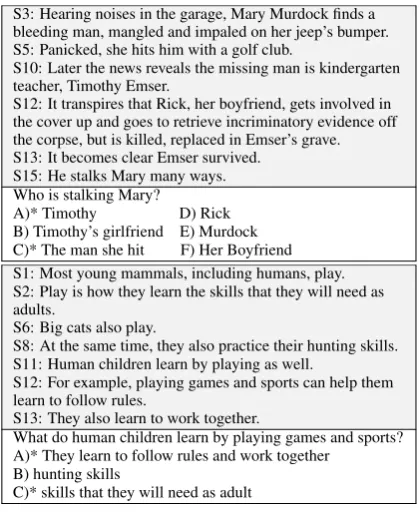
In this work, we propose a multi-sentence QA challenge in which questions can be answered only using information from multiple sentences. Specifically, we presentMultiRC(Multi-Sentence Reading Comprehension)1—a dataset of short paragraphs and multi-sentence questions that can be answered from the content of the paragraph. Each question is associated with several choices for answer-options, out of whichone or more cor-rectly answer the question. Figure 1 shows two examples from our dataset. Each instance consists of a multi-sentence paragraph, a question, and answer-options. All instances were constructed such that it is not possible to answer a question correctly without gathering information from mul-tiple sentences. Due to space constraints, the fig-ure shows only the relevant sentences from the original paragraph. The entire corpus consists of 871 paragraphs and about ∼ 6k multi-sentence questions.
The goal of this dataset is to encourage the re-search community to explore approaches that can do more than sophisticated lexical-level matching. To accomplish this, we designed the dataset with three key challenges in mind. (i) The number of correct answer-options for each question is not pre-specified. This removes the over-reliance of current approaches on answer-options and forces them to decide on the correctness of each can-didate answer independently of others. In other words, unlike previous work, the task here is not
1http://cogcomp.org/multirc/
S3: Hearing noises in the garage, Mary Murdock finds a bleeding man, mangled and impaled on her jeep’s bumper. S5: Panicked, she hits him with a golf club.
S10: Later the news reveals the missing man is kindergarten teacher, Timothy Emser.
S12: It transpires that Rick, her boyfriend, gets involved in the cover up and goes to retrieve incriminatory evidence off the corpse, but is killed, replaced in Emser’s grave. S13: It becomes clear Emser survived.
S15: He stalks Mary many ways. Who is stalking Mary?
A)* Timothy D) Rick B) Timothy’s girlfriend E) Murdock C)* The man she hit F) Her Boyfriend S1: Most young mammals, including humans, play. S2: Play is how they learn the skills that they will need as adults.
S6: Big cats also play.
S8: At the same time, they also practice their hunting skills. S11: Human children learn by playing as well.
S12: For example, playing games and sports can help them learn to follow rules.
S13: They also learn to work together.
What do human children learn by playing games and sports? A)* They learn to follow rules and work together
B) hunting skills
[image:2.595.311.521.60.317.2]C)* skills that they will need as adult
Figure 1: Examples from ourMultiRCcorpus. Each ex-ample shows relevant excerpts from a paragraph; multi-sentence question that can be answered by combin-ing information from multiple sentences of the para-graph; and corresponding answer-options. The correct answer(s) is indicated by a *. Note that there can be multiple correct answers per question.
to simply identify the best answer-option, but to evaluate the correctness of each answer-option in-dividually. For example, the first question in Fig-ure1can be answered by combining information from sentences 3, 5, 10, 13 and 15. It requires not only understanding that the stalker’s name is Timothy but also that he is the man who Mary had hit. (ii) The correct answer(s) is not required to be a span in the text. For example, the correct an-swer, A, of the second question in Figure1is not present in the paragraph verbatim. It is instead a combination of two spans from 2 sentences: 12 and 13. Such answer-options force models to pro-cess and understand not only the paragraph and the question but also the answer-options. (iii) The paragraphs in our dataset have diverse provenance by being extracted from 7 different domains such as news, fiction, historical text etc., and hence are expected to be more diverse in their contents as compared to single-domain datasets. We also ex-pect this to lead to diversity in the types of ques-tions that can be constructed from the passage.
• ∼6k high-quality multiple-choice RC ques-tions that are generated (and manually verified via crowdsourcing) to require inte-grating information from multiple sentences.
• The questions are not constrained to have a single correct answer, generalizing existing paradigms for representing answer-options.
• Our dataset is constructed using 7 different sources, allowing more diversity in content, style, and possible question types.
• We show a significant performance gap be-tween current solvers and human perfor-mance, indicating an opportunity for devel-oping sophistical reasoning systems.
2 Relevant Work
Automated reasoning is arguably one of the ma-jor problems in contemporary AI research. Brach-man et al. (2005) suggest challenges for devel-oping AI program that can pass the SAT ex-ams. In similar spirit Clark and Etzioni (2016) advocate elementary-school tests as a new test for AI. Davis (2014) proposes hand-construction of multiple-choice challenge sets that are easy for children but difficult for computers. Despite Davis’ claim on simplicity of his target questions, it is not clear how easy it is to generate such questions, as he doesn’t provide any reasonably-sized dataset matching his proposal. Weston et al. (2015) present a relatively small dataset of 10 reasoning categories, and propose to build a system that uses a world model and a linguistic model. The fundamental limitation of the dataset is that it is generated according to a restricted set of reasoning categories, which possibly limits the complexity and diversity of questions.
Some other recent datasets proposed for ma-chine comprehension also pay attention to type of questions and reasoning required. For exam-ple, RACE (Lai et al., 2017) attempts to incor-porate different types of reasoning phenomena, and MCTest (Richardson et al., 2013) attempted to contain at least 50% multi-sentence reason-ing questions. However, since the crowdsourced workers who created the dataset were only encour-aged, and not required, to write such questions, it is not clear how many of these questions actually require multi-sentence reasoning (see Sec. 3.5). Similarly, only about 25% of question in the RACE dataset require multi-sentence reasoning as reported in their paper. Remedia (Hirschman
et al.,1999) also contains5different types of ques-tions (based on question words) but is a much smaller dataset. Other datasets which do not delib-erately attempt to include multi-sentence reason-ing, like SQuAD (Rajpurkar et al.,2016) and the CNN/Daily Mail dataset (Hermann et al., 2015), suffer from even lower percentage of such ques-tions (12% and 2% respectively (Lai et al.,2017)). There are several other corpora which do not guarantee specific reasoning types, including MS MARCO (Nguyen et al., 2016), WikiQA (Yang et al.,2015), and TriviaQA (Joshi et al.,2017).
The complexity of reasoning required for a reading comprehension dataset would depend on several factors such as the source of questions or paragraphs; the way they are generated; and the order in which they are generated (i.e. questions from paragraphs, or the reverse). Specifically, paragraphs’ source could influence the complex-ity and diverscomplex-ity of the language of the paragraphs and questions, and hence the required level of rea-soning capabilities. Unlike most current datasets which rely on only one or two sources for their paragraphs (e.g. CNN/Daily Mail and SQuAD rely only on news and Wikipedia articles respec-tively) our dataset uses7different domains.
3 Construction ofMultiRC
In this section we describe our principles and methodology of dataset collection. This includes automatically collecting paragraphs, composing questions and answer-options through crowd-sourcing platform, and manually curating the col-lected data. We also summarize a pilot study that helped us design this process, and end with a sum-mary of statistics of the collected corpus.
3.1 Principles of design
Questions and answers in our dataset are designed based on the following key principles:
Multi-sentenceness. Questions in our challenge require models to use information from multiple sentences of a paragraph. This is ensured through explicit validation. We exclude any question that can be answered based on a single sentence from a paragraph.
Open-endedness. Our dataset is not restricted to questions whose answer can be found verbatim in a paragraph. Instead, we provide a set of hand-crafted answer-options for each question. Notably, they can represent information that is not explic-itly stated in the text but is only inferable from it (e.g. implied counts, sentiments, and relation-ships).
Answers to be judged independently. The total number of answer options per question is variable in our data and we explicitly allow multiple correct and incorrect answer options (e.g. 2 correct and 1 incorrect options). As a consequence, correct answers cannot be guessed solely by a process of elimination or by simply choosing the best candidates out of the given options.
Through these principles, we encourage users to explicitly model the semantics of text beyond indi-vidual words and sentences, to incorporate extra-linguistic reasoning mechanisms, and to handle answer options independently of one another.
Variability. We encourage variability on differ-ent levels. Our dataset is based on paragraphs from multiple domains, leading to linguistically diverse questions and answers. Also, we do not impose any restrictions on the questions, to encourage dif-ferent forms of reasoning.
3.2 Sources of documents
The paragraphs used in our dataset are extracted from various sources. Here is the complete list of the text types and sources used in our dataset, and the number of paragraphs extracted from each cat-egory (indicated in square brackets on the right):
1. News: [121]
• CNN (Hermann et al.,2015)
• WSJ (Ide et al.,2008) • NYT (Ide et al.,2008)
2. Wikipedia articles [92] 3. Articles on society, law and justice (Ide and Suderman,2006) [91] 4. Articles on history and anthropology (Ide et al.,2008) [65] 5. Elementary school science textbooks2 [153] 6. 9/11 reports (Ide and Suderman,2006) [72]
7. Fiction: [277]
• Stories from the Gutenberg project
• Children stories from MCTest ( Richard-son et al.,2013)
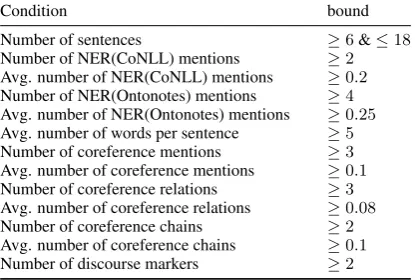
• Movie plots from CMU Movie Sum-mary corpus (Bamman et al.,2013) From each of the above-mentioned sources we extracted paragraphs that had enough content. To ensure this we followed a 3-step process. In the first step we selected top few sentences from para-graphs such that they contained 1k-1.5k charac-ters. To ensure coherence, all sentences were con-tiguous and extracted from the same paragraph. In this process we also discarded paragraphs that seemed to deviate too much from third person nar-rative style. For example, while processing Guten-berg corpus we considered files that had at least 5k lines because we found that most of them were short poetic texts. In the second step, we an-notated (Khashabi et al., 2018b) the paragraphs and automatically filtered texts using conditions such as the average number of words per sen-tence; number of named entities; number of dis-course connectives in the paragraph. These were designed by the authors of this paper after review-ing a small sample of paragraphs. A complete set of conditions is listed in Table 1. Finally in the last step, we manually verified each paragraph and filtered out the ones that had formatting issues or other concerns that seemed to compromise their usability.
Condition bound Number of sentences ≥6&≤18 Number of NER(CoNLL) mentions ≥2 Avg. number of NER(CoNLL) mentions ≥0.2 Number of NER(Ontonotes) mentions ≥4 Avg. number of NER(Ontonotes) mentions ≥0.25 Avg. number of words per sentence ≥5 Number of coreference mentions ≥3 Avg. number of coreference mentions ≥0.1 Number of coreference relations ≥3 Avg. number of coreference relations ≥0.08 Number of coreference chains ≥2 Avg. number of coreference chains ≥0.1 Number of discourse markers ≥2
Table 1: Bounds used to select paragraphs for dataset creation.
3.3 Pipeline of question extraction
In this section, we delineate details of the process for collecting questions and answers. Figure 2
gives a high-level idea of the process. The first two steps deal with creating multi-sentence questions, followed by two steps for construction of candi-date answers. Interested readers can find more de-tails on set-ups of each step in Appendix I.
Step 1: Generating questions. The goal of the first step of our pipeline is to collect multi-sentence questions. We show each paragraph to 5turkers and ask them to write3-5questions such that: (1) the question is answerable from the pas-sage, and (2) only those questions are allowed whose answer cannot be determined from a sin-gle sentence. We clarify this point by providing example paragraphs and questions. In order to en-courage turkers to write meaningful questions that fit our criteria, we additionally ask them for a cor-rect answer and for the sentence indices required to answer the question. To ensure the grammati-cal quality of the questions collected in this step, we limit the turkers to the countries with English as their major language. After the acquisition of questions in this step, we filter out questions which required less than 2 or more than 4 sentences to be answered; we also run them through an automatic spell-checker3 and manually correct questions re-garding typos and unusual wordings.
Step 2: Verifying multi-sentenceness of ques-tions. In a second step, we verify that each ques-tion can only be answered using more than one sentence. For each question collected in the pre-vious step, we create question-sentence pairs by pairing it with each of the sentences necessary for
3Grammarly: www.grammarly.com
answering it as indicated in the previous step. For a given question-sentence pair, we then ask turk-ers to annotate if they could answer the question from the sentence it is paired with (binary anno-tation). The underlying idea of this step is that a multi-sentence question would not be answer-able from a single sentence, hence turkers should not be able to give a correct answer for any of the question-sentence pair. Accordingly, we de-termine a question as requiring multiple sentences only if the correct answer cannot be guessed from any single question-sentence pair. We collected at least 3 annotations per pair, and to avoid sharing of information across sentences, no two pairs shown to a turker came from the same paragraph. We ag-gregate the above annotations for each question-answer pair and retain only those questions for which no pair was judged as answerable by a ma-jority of turkers.
Step 3: Generating answer-options. In this step, we collect answer-options that will be shown with each question. Specifically, for each verified question from the previous steps, we ask 3 turkers to write as many correct and incorrect answer op-tions as they can think of. In order to not curb cre-ativity, we do not place a restriction on the number of options they have to write. We explicitly ask turkers to design difficult and non-trivial incorrect answer-options (e.g. if the question is about a per-son, a non-trivial incorrect answer-option would be other people mentioned in the paragraph).
After this step, we perform a light clean up of the candidate answers by manually correct-ing minor errors (such as typos), completcorrect-ing in-complete sentences and rephrasing any ambiguous sentences. We further make sure there is not much repetition in the answer-options, to prevent poten-tial exploitation of correlation between some can-didate answers in order to find the correct answer. For example, we drop obviously duplicate answer-options (i.e. identical answer-options after lower-casing, lemmatization, and removing stop-words).
Step 1: generating
multi-sentence questions given paragraphs
Step 2: Verifying multi-sentenceness
Step 3: Generating candidate answers
[image:6.595.138.461.62.106.2]Step 4: Judging quality of questions & candidates
Figure 2: Pipeline of our dataset construction.
and correct if needed, all erroneous questions and answer-options. This ensures that we have mean-ingful questions and answer-options. In this step, we also want to verify that the correct (or incor-rect) options obtained from Step 3 were indeed correct (or incorrect). For this, we additionally ask the annotators to select all correct answer-options for the question. If their annotations did not agree with the ones we had after Step 3 (e.g. if they unanimously selected an ‘incorrect’ option as the answer), we manually reviewed and corrected (if needed) the annotation.
3.4 Pilot experiments
The4-step process described above was a result of detailed analysis and substantial refinement after two small pilot studies.
In the first pilot study, we ran a set of 10 para-graphs extracted from the CMU Movie Summary Corpus through our pipeline. Our then pipeline looked considerably different from the one de-scribed above. We found the steps that required turkers to write questions and answer-options to often have grammatical errors, possibly because a large majority of turkers were non-native speakers of English. This probslem was more prominent in questions than in answer-options. Because of this, we decided to limit the task to native speakers. Also, based on the results of this pilot, we over-hauled the instructions of these steps by including examples of grammatically correct—but undesir-able (not multi-sentence)—questions and answer-options, in addition to several minor changes.
Thereafter, we decided to perform a manual val-idation of the verification steps (current Steps 2 and 4). For this, we (the authors of this paper) performed additional annotations ourselves on the data shown to turkers, and compared our results with those provided by the turkers. We found that in the verification of answer-options, our annota-tions were in high agreement (98%) with those ob-tained from mechanical turk. However, that was not the case for the verification of multi-sentence questions. We made several further changes to the first two steps. Among other things, we clarified in the instructions that turkers should not use their
background knowledge when writing and verify-ing questions, and also included negative exam-ples of such questions. Additionally, when turkers judged a question to be answerable using a sin-gle sentence, we decided to encourage (but not re-quire) them to guess the answer to the question. This improved our results considerably, possibly because it forced annotators to think more care-fully about what the answer might be, and whether theyactuallyknew the answer or they justthought that they knew it (possibly because of background knowledge or because the sentence contained a lot of information relevant to the question). Guessed answers in this step were only used to verify the validity of multi-sentence questions. They were not used in the dataset or subsequent steps.
After revision, we ran a second pilot study in which we processed a set of50paragraphs through our updated pipeline. This second pilot confirmed that our revisions were helpful, but thanks to its larger size, also allowed us to identify a couple of borderline cases for which additional clarifications were required. Based on the results of the second pilot, we made some additional minor changes and then decided to apply the pipeline for creating the final dataset.
3.5 Verifying multi-sentenceness
While collecting our dataset, we found that, even though Step 1 instructed turkers to write multi-sentence questions, not all generated questions in-deed required multi-sentence reasoning. This hap-pened even after clarifications and revisions to the corresponding instructions, and we attribute it to honest mistakes. Therefore, we designed the sub-sequent verification step (Step 2).
which sentences contain information relevant to a question, we created question-sentence pairs us-ing all sentences from a paragraph. After aggre-gation of turker annotations, we found that about half of the questions annotated as multi-sentence could be answered from a single sentence of the paragraph. This study, though performed on a sub-set of the data, underscores the necessity of rigor-ous verification step for multi-sentence reasoning when studying this phenomenon.
3.6 Statistics on the dataset
We now provide a brief summary of MultiRC. Overall, it contains roughly ∼6k multi-sentence
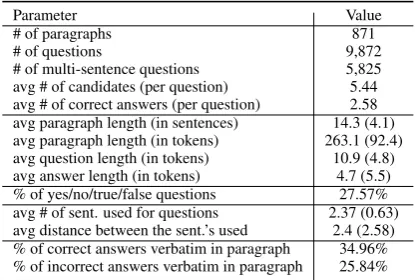
questions collected for about +800 paragraphs.4 The median number of correct and total answer options for each question is2and5, respectively. Additional statistics are given in Table2.
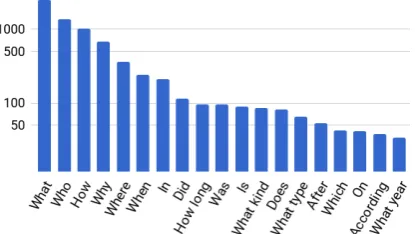
In Step 1, we also asked annotators to identify sentences required to answer a given question. We found that answering each question required 2.4 sentences on average. Also, required sentences are often not contiguous, and the average distance be-tween sentences is2.4. Next, we analyze the types of questions in our dataset. Figure 4 shows the count of first word(s) for our questions. We can see that while the popular question words (What, Who, etc.) are very common, there is a wide va-riety in the first word(s) indicating a diversity in question types. About 28% of our questions re-quire binary decisions (true/false or yes/no).
We randomly selected 60 multi-sentence ques-tions from our corpus and asked two indepen-dent annotators to label them with the type of reasoning phenomenon required to answer them.5 During this process, the annotators were shown a list of common reasoning phenomena (shown below), and they had to identify one or more of the phenomena relevant to a given question. The list of phenomena shown to the annotators included the following categories: mathematical and logical reasoning, spatio-temporal reasoning, list/enumeration, coreference resolution (includ-ing implicit references, abstract pronouns, event coreference, etc.), causal relations, paraphrases and contrasts (including lexical relations such as synonyms, antonyms), commonsense knowledge,
4We will also release the3.7kquestions that did not pass Step 2. Though not multi-sentence questions, they could be a valuable resource on their own.
5The annotations were adjudicated by two authors of this paper.
and ‘other’. The categories were selected after a manual inspection of a subset of questions by two of the authors. The annotation process revealed that answering questions in our corpus requires a broad variety of reasoning phenomena. The left plot in Figure3provides detailed results.
The figure shows that a large fraction of ques-tions require coreference resolution, and a more careful inspection revealed that there were dif-ferent types of coreference phenomena at play here. To investigate these further, we conducted a follow-up experiment in which manually anno-tated all questions that required coreference res-olution into finer categories. Specifically, each question was shown to two annotators who were asked to select one or more of the following cate-gories: entity coreference (between two entities), event coreference (between two events), set inclu-sion coreference (one item is part of or included in the other) and ‘other’. Figure3 (right) shows the results of this experiment. We can see that, as expected, entity coreference is the most com-mon type of coreference resolution needed in our corpus. However, a significant number of ques-tions also require other types of coreference res-olution. We provide some examples of questions along with the required reasoning phenomena in Appendix II.
Parameter Value
# of paragraphs 871
# of questions 9,872
[image:7.595.310.518.453.593.2]# of multi-sentence questions 5,825 avg # of candidates (per question) 5.44 avg # of correct answers (per question) 2.58 avg paragraph length (in sentences) 14.3 (4.1) avg paragraph length (in tokens) 263.1 (92.4) avg question length (in tokens) 10.9 (4.8) avg answer length (in tokens) 4.7 (5.5) % of yes/no/true/false questions 27.57% avg # of sent. used for questions 2.37 (0.63) avg distance between the sent.’s used 2.4 (2.58) % of correct answers verbatim in paragraph 34.96% % of incorrect answers verbatim in paragraph 25.84%
Table 2: Various statistics of our dataset. Figures in parentheses represent standard deviation.
4 Analysis
In this section, we provide a quantitative analysis of several baselines for our challenge.
Evaluation Metrics. We define precision and recall for a question q as: Pre(q) = |A(q)∩Aˆ(q)|
|Aˆ(q)|
Figure 3: Distribution of (left) general phenomena; (right) variations of the “coreference” phenomena.
Figure 4: Most frequent first chunks of the questions (counts in log scale).
We define (macro-average) F1m as the harmonic mean of average-precision avgq∈Q(Pre(q)) and average-recallavgq∈Q(Rec(q))withQ as the set of all questions.
Since by design, each answer-option can be judged independently, we consider another met-ric, F1a, evaluating binary decisions on all the answer-options in the dataset. We define F1ato be the harmonic mean of Pre(Q) and Rec(Q), with Pre(Q) = |A(Q)∩Aˆ(Q)|
|Aˆ(Q)| ;A(Q) = S
q∈QA(q); and similar definitions forAˆ(Q)and Rec(Q).
4.1 Baselines
Human. Human performance provides us with an estimate of the best achievable results on datasets. Using mechanical turk, we ask 4 peo-ple (limited to native speakers) to solve our data. We evaluate score of each label by averaging the decision of the individuals.
Random. To get an estimate on the lower-bound we consider a random baseline, where each an-swer option is selected as correct with a probabil-ity of 50% (an unbiased coin toss). The numbers
reported for this baseline represent the expected outcome (statistical expectation).
IR (information retrieval baseline). This base-line selects answer-options that best match sen-tences in a text corpus (Clark et al.,2016). Specifi-cally, for each questionqand answer optionai, the IR solver sendsq+ai as a query to a search en-gine (we use Lucene) on a corpus, and returns the search engine’s score for the top retrieved sentence
s, wheres must have at least one non-stopword
overlap withq, and at least one withai.
We create two versions of this system. In the first variation IR(paragraphs) we create a corpus of sentences extracted from all the paragraphs in the dataset. In the second variation, IR(web) in addition to the knowledge of the paragraphs, we use extensive external knowledge extracted from the web (Wikipedia, science textbooks and study guidelines, and other webpages), with 5× 10¹⁰ tokens (280GB of plain text).
SurfaceLR (logistic regression baseline). As a simple baseline that makes use of our small training set, we reimplemented and trained a lo-gistic regression model using word-based over-lap features. As described in (Merkhofer et al.,
2018), this baseline takes into account the lengths of a text, question and each answer candidate, as well as indicator features regarding the (co-)occurrences of any words in them.
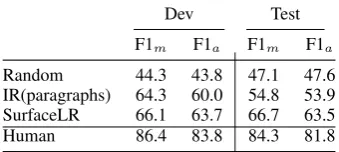
[image:8.595.71.279.267.384.2]abstrac-Dev Test F1m F1a F1m F1a
Random 44.3 43.8 47.1 47.6
IR(paragraphs) 64.3 60.0 54.8 53.9 SurfaceLR 66.1 63.7 66.7 63.5
[image:9.595.304.512.60.243.2]Human 86.4 83.8 84.3 81.8
Table 3: Performance comparison for different baselines tested on a subset of our dataset (in per-centage). There is a significant gap between the human performance and current statistical meth-ods.
tions (Khashabi et al., 2018a). Since the solver is designed for multiple-choice with single-correct answer, we adapt it to our setting by running it for each option. Specifically for each answer-option, we create a single-candidate question, and retrieve a real-valued score from the solver.
BiDAF (neural network baseline). As a neural baseline, we apply this solver bySeo et al.(2017), which was originally proposed for SQuAD but has been shown to generalize well to another do-main (Min et al., 2017). Since BiDAF was de-signed for cloze style questions, we apply it to our multiple-choice setting following the proce-dure byKembhavi et al.(2017): Specifically, we score each answer-option by computing the sim-ilarity value of it’s output span with each of the candidate answers, computed by phrasal similar-ity tool ofWieting et al.(2015).
4.2 Results
To get a sense of our dataset’s hardness, we eval-uate both human performance and multiple com-putational baselines. Each baseline scores an answer-option with a real-valued score, which we threshold to decide whether an answer option is selected or not, where the threshold is tuned on the development set. Table 3 shows perfor-mance results for different baselines. The signif-icantly high human performance shows that hu-mans do not have much difficulties in answering the questions. Similar observations can be made in Figure 5 where we plot avgq∈Q(Pre(q)) vs.
avgq∈Q(Rec(q)), for different threshold values.
5 Conclusion
In this paper we have presentedMultiRC, a read-ing comprehension dataset in which questions re-quire reasoning over multiple sentences to be
an-Figure 5: PR curve for each of the baselines. There is a considerable gap with the baselines and human.
swered. Our dataset contains∼ 6kquestions
ex-tracted from about +800 paragraphs. For each question, it contains multiple answer-options out of which one or more can be correct. The para-graphs (and questions) originate from different do-mains and hence are amenable to a wide variety and complexity of required reasoning phenomena. We found human performance on this corpus to be about88%while state-of-the-art machine compre-hension models do not exceed a F1-score of60%. We hope that this significant difference in perfor-mance will encourage the community to work to-wards more sophisticated reasoning systems.
6 Acknowledgement
[image:9.595.93.263.64.140.2]References
David Bamman, Brendan O’Connor, and Noah A. Smith. 2013. Learning latent personas of film characters. In
Proceedings of the 51st Annual Meeting of the Associa-tion for ComputaAssocia-tional Linguistics, ACL 2013, Volume 1: Long Papers. pages 352–361.http://aclweb.org/
anthology/P/P13/P13-1035.pdf.
Virginia W. Berninger, William Nagy, and Scott Beers. 2011. Child writers construction and reconstruction of single sentences and construction of multi-sentence texts: Con-tributions of syntax and transcription to translation. Read-ing and writRead-ing24(2):151–182.
Ronald Brachman, David Gunning, Selmer Bringsjord, Michael Genesereth, Lynette Hirschman, and Lisa Ferro. 2005. Selected grand challenges in cognitive science. Technical report, MITRE Technical Report 05-1218. Danqi Chen, Jason Bolton, and Christopher D. Manning.
2016. A thorough examination of the cnn/daily mail reading comprehension task. In Proceedings of the 54th Annual Meeting of the Association for Compu-tational Linguistics, ACL 2016, Volume 1: Long Pa-pers. http://aclweb.org/anthology/P/P16/ P16-1223.pdf.
Peter Clark and Oren Etzioni. 2016. My computer is an honor student - but how intelligent is it? standard-ized tests as a measure of AI. AI Magazine 37(1):5–
12. http://www.aaai.org/ojs/index.php/
aimagazine/article/view/2636.
Peter Clark, Oren Etzioni, Tushar Khot, Ashish Sabharwal, Oyvind Tafjord, Peter D. Turney, and Daniel Khashabi. 2016. Combining retrieval, statistics, and inference to answer elementary science questions. InProceedings of the Thirtieth AAAI Conference on Artificial Intelligence. pages 2580–2586. http://www.aaai.org/ocs/
index.php/AAAI/AAAI16/paper/view/11963.
Ido Dagan, Dan Roth, Mark Sammons, and Fabio Massimo Zanzoto. 2013. Recognizing Textual Entailment: Models and Applications. Morgan and Claypool.
Ernest Davis. 2014. The limitations of standardized science tests as benchmarks for artificial intelligence research: Po-sition paper. CoRRabs/1411.1629. http://arxiv. org/abs/1411.1629.
Bert F. Green Jr., Alice K. Wolf, Carol Chomsky, and Kenneth Laughery. 1961. Baseball: An auto-matic question-answerer. In Papers Presented at the May 9-11, 1961, Western Joint IRE-AIEE-ACM Com-puter Conference. ACM, IRE-AIEE-ACM ’61 (West-ern), pages 219–224. https://doi.org/10.1145/ 1460690.1460714.
Peter H. Greene. 1959. An approach to computers that perceive, learn, and reason. In Papers Pre-sented at the the March 3-5, 1959, Western Joint Com-puter Conference. ACM, IRE-AIEE-ACM ’59 (West-ern), pages 181–186. https://doi.org/10.1145/ 1457838.1457870.
Karl Moritz Hermann, Tom´as Kocisk´y, Edward Grefenstette, Lasse Espeholt, Will Kay, Mustafa Suleyman, and Phil Blunsom. 2015. Teaching machines to read and compre-hend. InAdvances in Neural Information Processing Sys-tems 28: Annual Conference on Neural Information Pro-cessing Systems 2015. pages 1693–1701.
Lynette Hirschman, Marc Light, Eric Breck, and John D. Burger. 1999. Deep read: A reading comprehension system. In27th Annual Meeting of the Association for Computational Linguistics, ACL 1999. http://www.
aclweb.org/anthology/P99-1042.
Nancy Ide, Collin F. Baker, Christiane Fellbaum, Charles J. Fillmore, and Rebecca J. Passonneau. 2008. MASC: the manually annotated sub-corpus of american en-glish. In Proceedings of the International Conference on Language Resources and Evaluation, LREC 2008.
http://www.lrec-conf.org/proceedings/
lrec2008/summaries/617.html.
Nancy Ide and Keith Suderman. 2006. Integrating lin-guistic resources: The american national corpus model. In Proceedings of the Fifth International Conference on Language Resources and Evaluation, LREC 2006. pages 621–624. http://www.lrec-conf.org/
proceedings/lrec2006/pdf/560_pdf.pdf.
Robin Jia and Percy Liang. 2017. Adversarial examples for evaluating reading comprehension systems. In Proceed-ings of the 2017 Conference on Empirical Methods in Nat-ural Language Processing, EMNLP 2017. pages 2021– 2031. https://aclanthology.info/papers/ D17-1215/d17-1215.
Mandar Joshi, Eunsol Choi, Daniel S. Weld, and Luke Zettle-moyer. 2017. Triviaqa: A large scale distantly supervised challenge dataset for reading comprehension. In Proceed-ings of the 55th Annual Meeting of the Association for Computational Linguistics, ACL 2017, Volume 1: Long Papers. pages 1601–1611. https://doi.org/10. 18653/v1/P17-1147.
Aniruddha Kembhavi, Min Joon Seo, Dustin Schwenk, Jonghyun Choi, Ali Farhadi, and Hannaneh Hajishirzi. 2017. Are you smarter than a sixth grader? textbook question answering for multimodal machine comprehen-sion. In 2017 IEEE Conference on Computer Vision and Pattern Recognition, CVPR 2017. pages 5376–5384.
https://doi.org/10.1109/CVPR.2017.571.
Daniel Khashabi, Tushar Khot, Ashish Sabharwal, Peter Clark, Oren Etzioni, and Dan Roth. 2016. Question answering via integer programming over semi-structured knowledge. InProceedings of the Twenty-Fifth Interna-tional Joint Conference on Artificial Intelligence, IJCAI 2016. pages 1145–1152. http://www.ijcai.org/ Abstract/16/166.
Daniel Khashabi, Tushar Khot, Ashish Sabharwal, and Dan Roth. 2018a. Question answering as global reasoning over semantic abstractions. InProceedings of The Thirty-Second AAAI Conference on Artificial Intelligence, AAAI 2018 (to appear). http://cogcomp.org/page/ publication_view/824.
Guokun Lai, Qizhe Xie, Hanxiao Liu, Yiming Yang, and Ed-uard H. Hovy. 2017. RACE: large-scale reading com-prehension dataset from examinations. In Proceedings of the 2017 Conference on Empirical Methods in Nat-ural Language Processing, EMNLP 2017. pages 785–
794. https://aclanthology.info/papers/
D17-1082/d17-1082.
J. McCarthy. 1976. An example for natural language understanding and the AI problems it raises. Avail-able at http://jmc.stanford.edu/articles/ mrhug/mrhug.pdf.
Elizabeth Merkhofer, John Henderson, David Bloom, Laura Strickhart, and Guido Zarrella. 2018. Mitre at semeval-2018 task 11: Commonsense reasoning without common-sense knowledge. In Proceedings of the International Workshop on Semantic Evaluation (SemEval-2018). New Orleans, LA, USA.
Sewon Min, Min Joon Seo, and Hannaneh Hajishirzi. 2017.
Question answering through transfer learning from large fine-grained supervision data. In Proceedings of the 55th Annual Meeting of the Association for Computa-tional Linguistics, ACL 2017, Volume 2: Short Papers. pages 510–517. https://doi.org/10.18653/ v1/P17-2081.
Karthik Narasimhan and Regina Barzilay. 2015. Ma-chine comprehension with discourse relations. In Pro-ceedings of the 53rd Annual Meeting of the Associa-tion for ComputaAssocia-tional Linguistics and the 7th Interna-tional Joint Conference on Natural Language Processing of the Asian Federation of Natural Language Process-ing, ACL 2015, Volume 1: Long Papers. pages 1253– 1262. http://aclweb.org/anthology/P/P15/ P15-1121.pdf.
Tri Nguyen, Mir Rosenberg, Xia Song, Jianfeng Gao, Saurabh Tiwary, Rangan Majumder, and Li Deng. 2016.
MS MARCO: A human generated machine reading com-prehension dataset. CoRR abs/1611.09268. http:// arxiv.org/abs/1611.09268.
Pranav Rajpurkar, Jian Zhang, Konstantin Lopyrev, and Percy Liang. 2016. Squad: 100, 000+ questions for machine comprehension of text. In Proceedings of the 2016 Conference on Empirical Methods in Natu-ral Language Processing, EMNLP 2016. pages 2383– 2392. http://aclweb.org/anthology/D/D16/ D16-1264.pdf.
Raymond Reiter. 1976.A semantically guided deductive sys-tem for automatic theorem proving. IEEE Transactions on Computers25:328–334. https://doi.org/10. 1109/TC.1976.1674613.
Matthew Richardson, Christopher J. C. Burges, and Erin Ren-shaw. 2013. Mctest: A challenge dataset for the open-domain machine comprehension of text. InProceedings of the 2013 Conference on Empirical Methods in Nat-ural Language Processing, EMNLP 2013. pages 193–
203. http://aclweb.org/anthology/D/D13/
D13-1020.pdf.
Minjoon Seo, Aniruddha Kembhavi, Ali Farhadi, and Han-naneh Hajishirzi. 2017. Bidirectional attention flow for machine comprehension. InInternational Conference on Learning Representations, ICLR 2017.
Adam Trischler, Tong Wang, Xingdi Yuan, Justin Harris, Alessandro Sordoni, Philip Bachman, and Kaheer Sule-man. 2016. Newsqa: A machine comprehension dataset.
CoRR abs/1611.09830. http://arxiv.org/abs/ 1611.09830.
Jason Weston, Antoine Bordes, Sumit Chopra, and Tomas Mikolov. 2015.Towards ai-complete question answering: A set of prerequisite toy tasks. CoRRabs/1502.05698.
http://arxiv.org/abs/1502.05698.
J. Wieting, M. Bansal, K. Gimpel, K. Livescu, and D. Roth. 2015. From paraphrase database to compositional para-phrase model and back.TACL3:345–358.
Terry Winograd. 1980. Extended inference modes in reason-ing by computer systems. Artificial Intelligence13:5–26. Yi Yang, Wen-tau Yih, and Christopher Meek. 2015.
Wik-iqa: A challenge dataset for open-domain question an-swering. In Proceedings of the 2015 Conference on Empirical Methods in Natural Language Processing, EMNLP 2015. pages 2013–2018. http://aclweb.